

Pair of Mimeographed Documents Contrasting Johnson's 1964 and Nixon's 1969 Vietnam War Policies with Viet Cong Peace Terms
- 1964
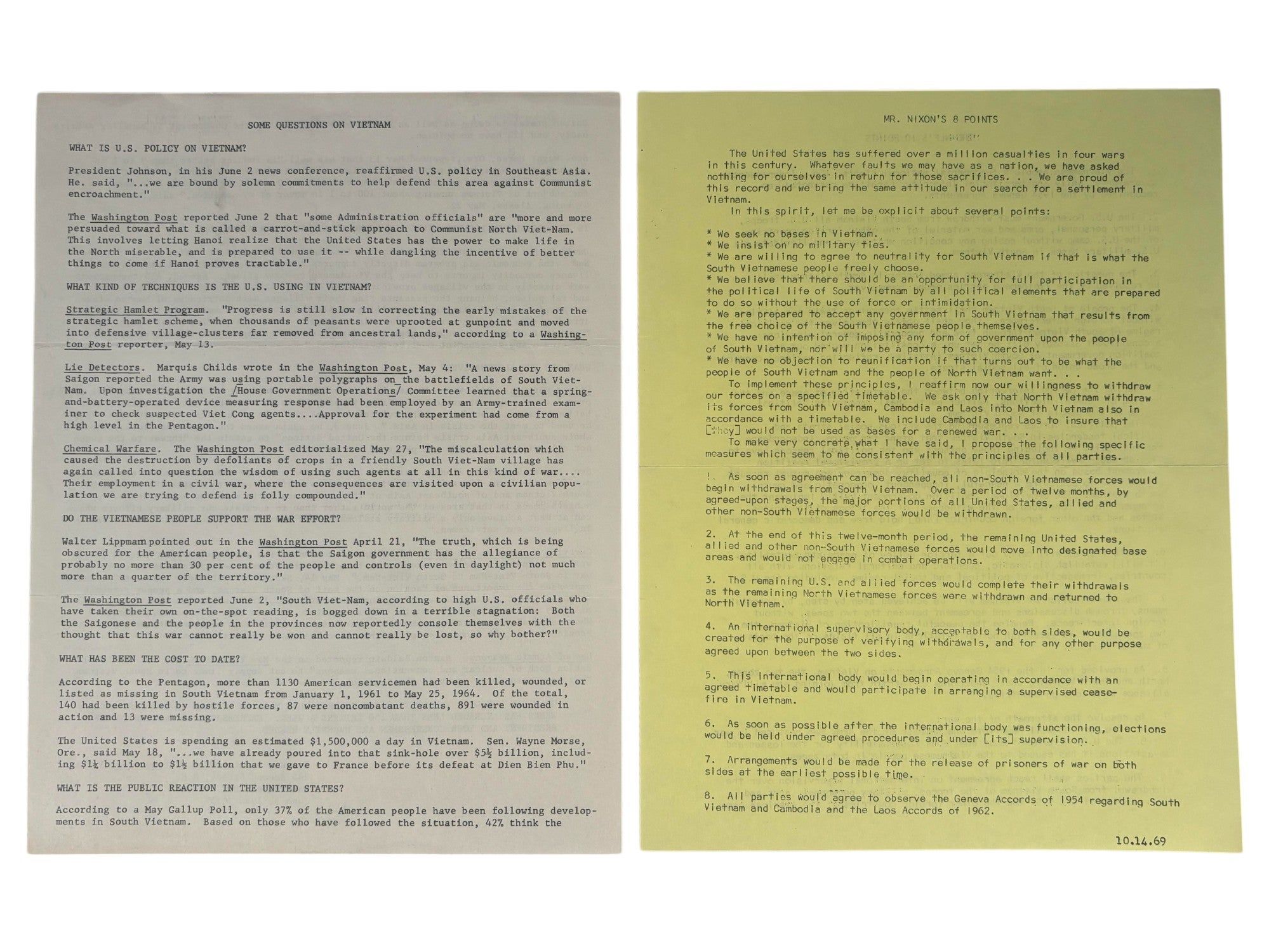
1964. [Counterculture] [Vietnam War] This pair of mimeographed documents, issued in 1964 and 1969 respectively, capture the shifting rhetorical and political frameworks of U.S. justification and policy aims in Vietnam, offering rare comparative insight into both the Lyndon B. Johnson and Richard Nixon administrations' public positions. [1] Some Questions on Vietnam. Washington: Friends Committee on National Legislation, June 3, 1964. [2] Mr. Nixon's Points. [N.p], October 14, 1969. Two double-sided mimeographed typescripts measuring 8.5" x 11" each. Together, they trace the continuity and contradictions in American official thinking from the earliest stages of direct military intervention to the early attempts at managed withdrawal. The 1969 document is particularly notable for its side-by-side presentation of Nixon's proposed peace terms with those of the National Liberation Front (NLF), the political wing of the Viet Cong.
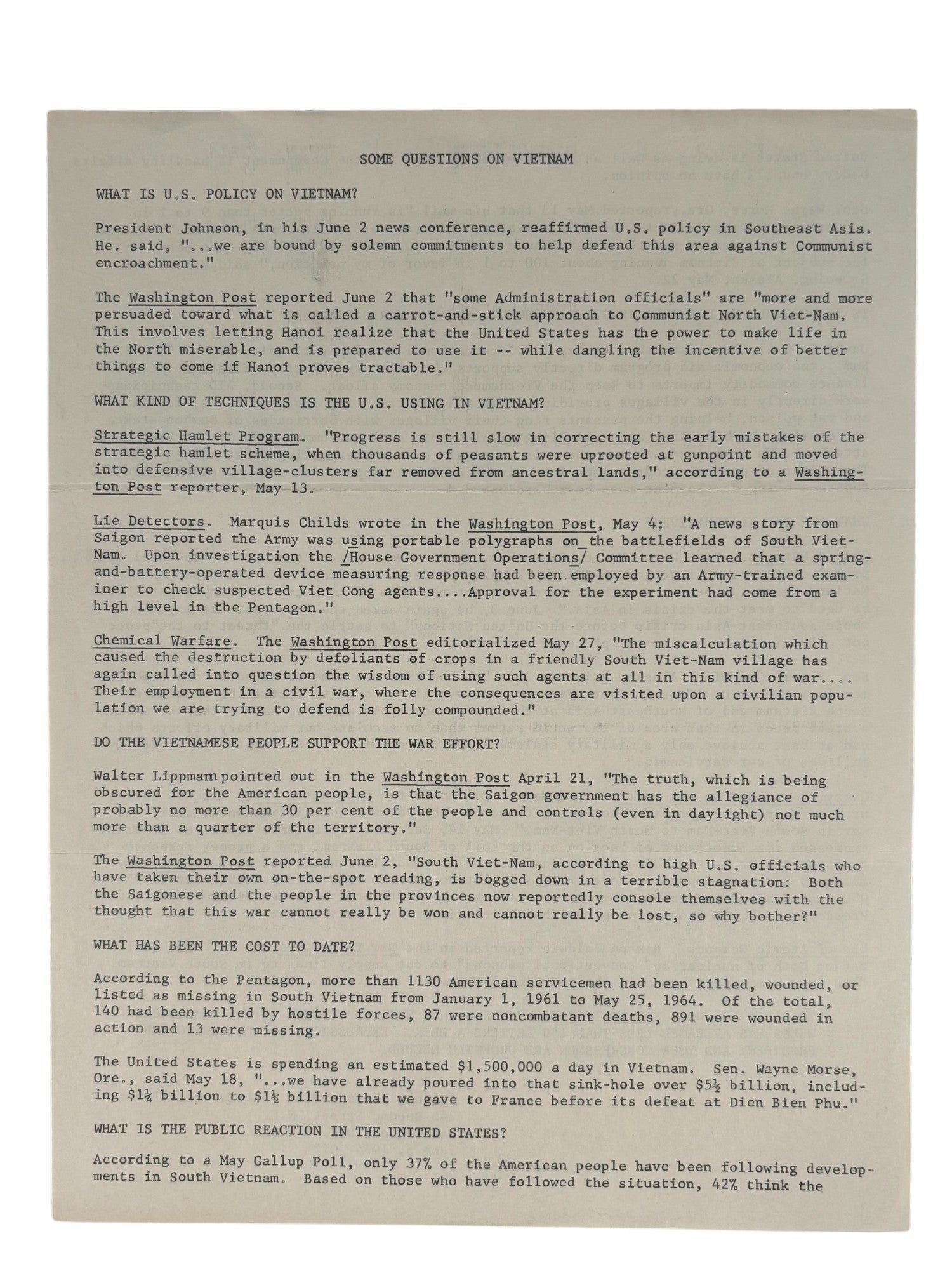
[1] The first document, dated June 3, 1964 and issued by the Friends Committee on National Legislation in Washington, D.C., is titled Some Questions on Vietnam. Framed as a briefing tool for concerned citizens, it outlines the U.S. position in the early escalation phase of the war and provides extensive excerpts from contemporary sources, including President Johnson's June 2 press conference and articles from The Washington Post and New York Times. Johnson is quoted stating that the U.S. is "bound by solemn commitments to help defend this area against Communist encroachment," reaffirming the domino theory logic underpinning American involvement.
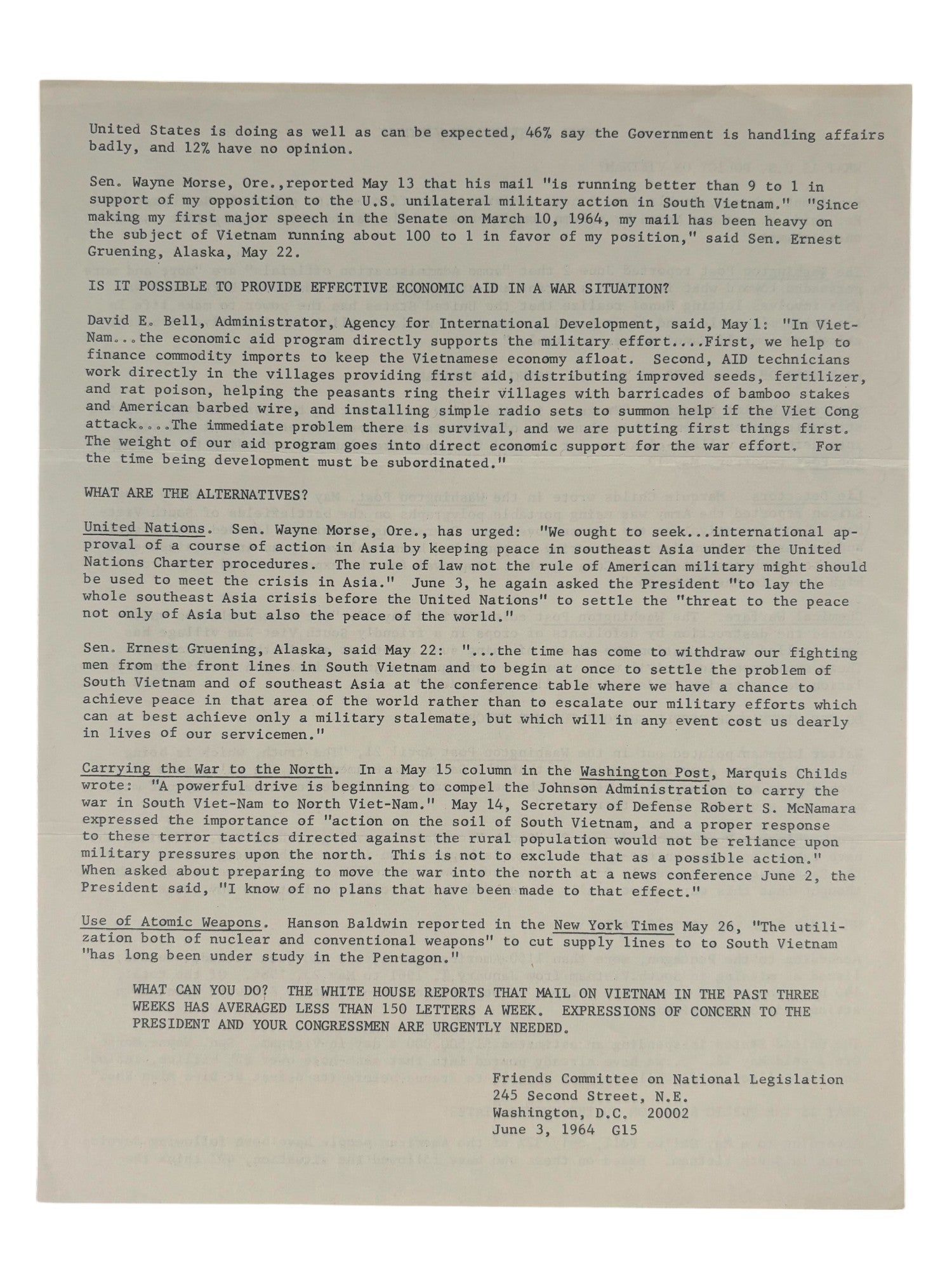
The handout catalogs U.S. military strategies then being deployed, including the "Strategic Hamlet Program," in which "thousands of peasants were uprooted at gunpoint and moved into defensive village-clusters far removed from ancestral lands." Other methods included the use of lie detectors on suspected Viet Cong, and defoliation tactics that the Washington Post acknowledged raised "questions of the wisdom of using such agents at all in this kind of war... where the consequences are visited upon a civilian population we are trying to defend." The leaflet also raises doubt about South Vietnamese support for the war: "the Saigon government has the allegiance of probably no more than 30 per cent of the people." Statistics from the Pentagon note that by May 25, 1964, 1,130 American servicemen had been killed, wounded, or listed as missing since 1961. Senator Wayne Morse is quoted: "We have already poured into that sink-hole over $5½ billion." The final sections argue that economic aid cannot be separated from military goals and propose alternatives such as United Nations mediation. Notably, the sheet warns that mail to the White House on Vietnam had been averaging fewer than 150 letters per week, urging citizens to "make their views known to the President and your Congressmen."
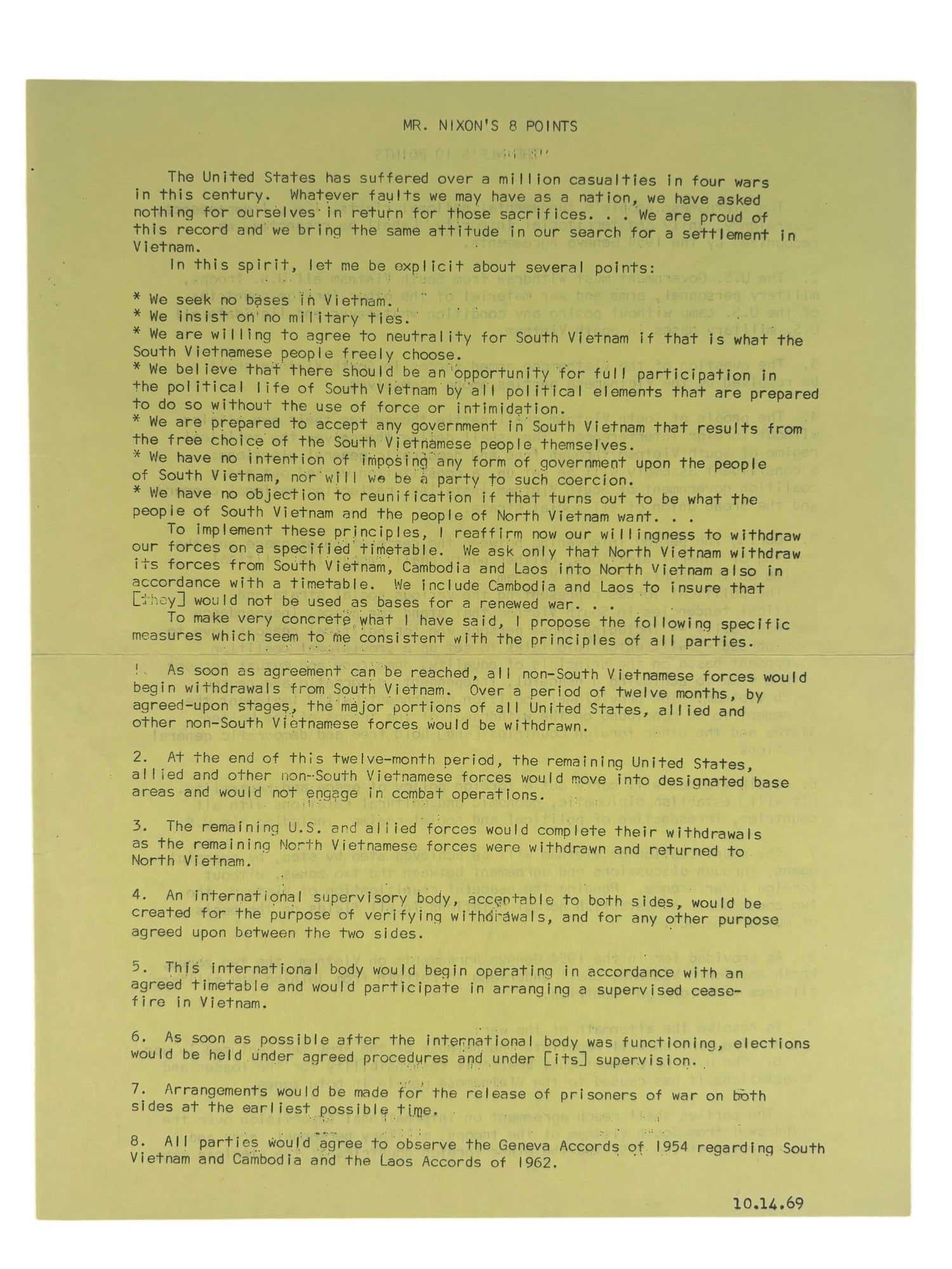
[2] The second document, dated October 14, 1969, presents President Nixon's public negotiating stance during the early phase of his "Vietnamization" strategy. Titled Mr. Nixon's 8 Points, the yellow sheet begins with a justification of U.S. sacrifices: "The United States has suffered over a million casualties in four wars in this century... We are proud of this record and we bring the same attitude in our search for a settlement in Vietnam." Nixon outlines eight specific principles, most notably: "We seek no bases in Vietnam. We insist on no military ties. We are willing to agree to neutrality for South Vietnam if that is what the South Vietnamese people freely choose." He continues, "We have no intention of imposing any form of government upon the people of South Vietnam, nor will we be a party to such coercion." The points include phased withdrawal over twelve months, the establishment of an international supervisory body, elections under international supervision, release of prisoners of war, and mutual agreement to observe the 1954 Geneva Accords. Nixon concludes with a reaffirmation that U.S. presence would end entirely once these measures were fulfilled.
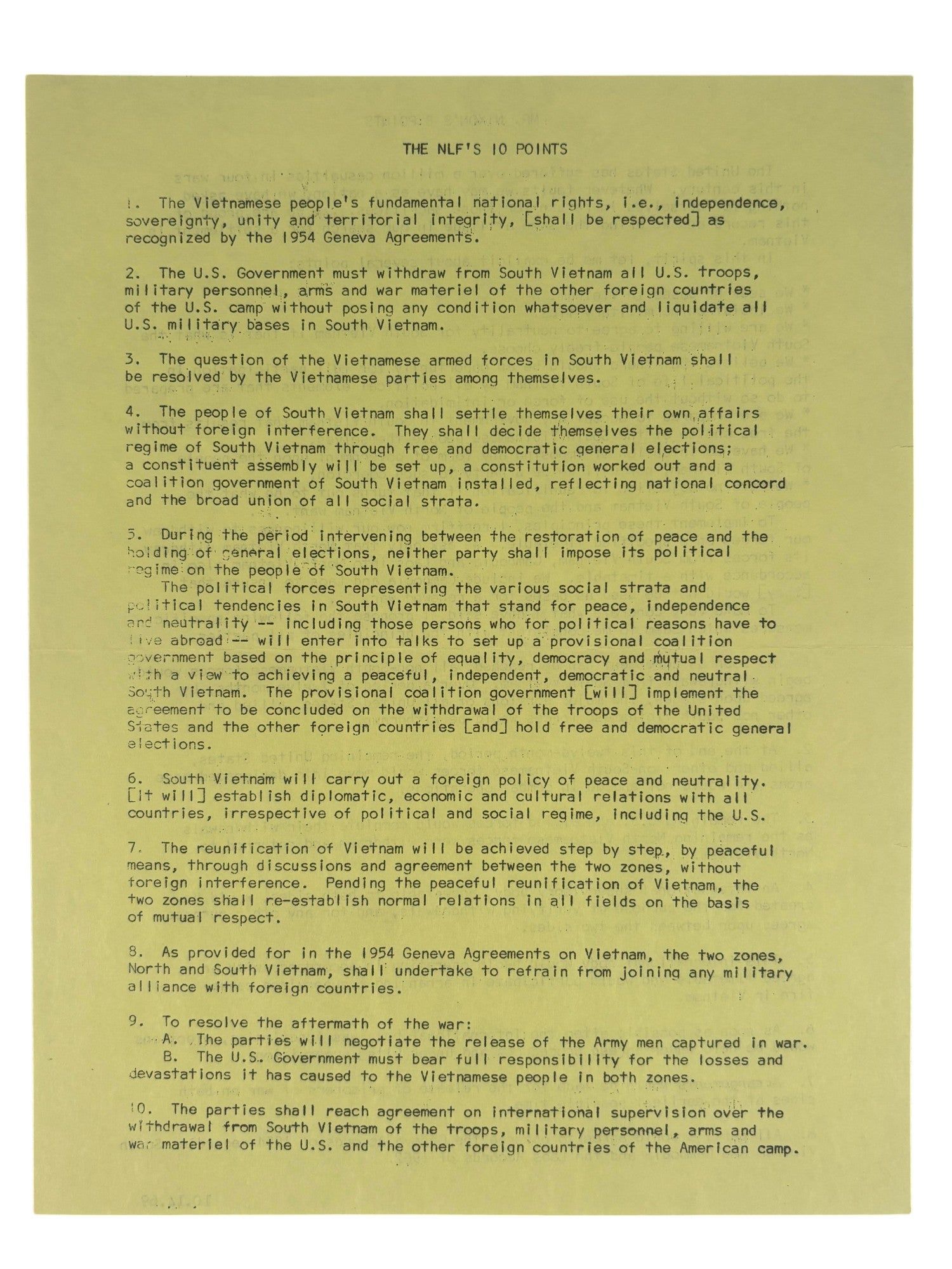
The reverse of the Nixon flyer contains The NLF's 10 Points, the Viet Cong's counter-position, which sharply contradicts Nixon's framing. Point 2 is categorical: "The U.S. Government must withdraw from South Vietnam all U.S. troops, military personnel, arms and war materiel... and liquidate all U.S. military bases in South Vietnam." Point 4 emphasizes sovereignty: "The people of South Vietnam shall settle themselves their own affairs without foreign interference." Throughout, the NLF stresses full political participation, neutral diplomatic relations, and reunification of Vietnam as "a peaceful process... without foreign interference." Notably, Point 9 demands that the U.S. government "must bear full responsibility for the losses and devastations it has caused to the Vietnamese people in both zones."
Juxtaposing these two documents reveals a significant divergence between U.S. public rhetoric and Vietnamese revolutionary demands. While Nixon framed U.S. intentions as altruistic and limited, the NLF viewed the war as colonial in nature and demanded unconditional withdrawal. This side-by-side format would have been a powerful tool for peace activists and educators in 1969, especially as public trust in government narratives about Vietnam eroded in the wake of the Tet Offensive and ongoing domestic protest. Very good condition overall.
[1] The first document, dated June 3, 1964 and issued by the Friends Committee on National Legislation in Washington, D.C., is titled Some Questions on Vietnam. Framed as a briefing tool for concerned citizens, it outlines the U.S. position in the early escalation phase of the war and provides extensive excerpts from contemporary sources, including President Johnson's June 2 press conference and articles from The Washington Post and New York Times. Johnson is quoted stating that the U.S. is "bound by solemn commitments to help defend this area against Communist encroachment," reaffirming the domino theory logic underpinning American involvement.
The handout catalogs U.S. military strategies then being deployed, including the "Strategic Hamlet Program," in which "thousands of peasants were uprooted at gunpoint and moved into defensive village-clusters far removed from ancestral lands." Other methods included the use of lie detectors on suspected Viet Cong, and defoliation tactics that the Washington Post acknowledged raised "questions of the wisdom of using such agents at all in this kind of war... where the consequences are visited upon a civilian population we are trying to defend." The leaflet also raises doubt about South Vietnamese support for the war: "the Saigon government has the allegiance of probably no more than 30 per cent of the people." Statistics from the Pentagon note that by May 25, 1964, 1,130 American servicemen had been killed, wounded, or listed as missing since 1961. Senator Wayne Morse is quoted: "We have already poured into that sink-hole over $5½ billion." The final sections argue that economic aid cannot be separated from military goals and propose alternatives such as United Nations mediation. Notably, the sheet warns that mail to the White House on Vietnam had been averaging fewer than 150 letters per week, urging citizens to "make their views known to the President and your Congressmen."
[2] The second document, dated October 14, 1969, presents President Nixon's public negotiating stance during the early phase of his "Vietnamization" strategy. Titled Mr. Nixon's 8 Points, the yellow sheet begins with a justification of U.S. sacrifices: "The United States has suffered over a million casualties in four wars in this century... We are proud of this record and we bring the same attitude in our search for a settlement in Vietnam." Nixon outlines eight specific principles, most notably: "We seek no bases in Vietnam. We insist on no military ties. We are willing to agree to neutrality for South Vietnam if that is what the South Vietnamese people freely choose." He continues, "We have no intention of imposing any form of government upon the people of South Vietnam, nor will we be a party to such coercion." The points include phased withdrawal over twelve months, the establishment of an international supervisory body, elections under international supervision, release of prisoners of war, and mutual agreement to observe the 1954 Geneva Accords. Nixon concludes with a reaffirmation that U.S. presence would end entirely once these measures were fulfilled.
The reverse of the Nixon flyer contains The NLF's 10 Points, the Viet Cong's counter-position, which sharply contradicts Nixon's framing. Point 2 is categorical: "The U.S. Government must withdraw from South Vietnam all U.S. troops, military personnel, arms and war materiel... and liquidate all U.S. military bases in South Vietnam." Point 4 emphasizes sovereignty: "The people of South Vietnam shall settle themselves their own affairs without foreign interference." Throughout, the NLF stresses full political participation, neutral diplomatic relations, and reunification of Vietnam as "a peaceful process... without foreign interference." Notably, Point 9 demands that the U.S. government "must bear full responsibility for the losses and devastations it has caused to the Vietnamese people in both zones."
Juxtaposing these two documents reveals a significant divergence between U.S. public rhetoric and Vietnamese revolutionary demands. While Nixon framed U.S. intentions as altruistic and limited, the NLF viewed the war as colonial in nature and demanded unconditional withdrawal. This side-by-side format would have been a powerful tool for peace activists and educators in 1969, especially as public trust in government narratives about Vietnam eroded in the wake of the Tet Offensive and ongoing domestic protest. Very good condition overall.
Details
Title
Pair of Mimeographed Documents Contrasting Johnson's 1964 and Nixon's 1969 Vietnam War Policies with Viet Cong Peace Terms
Author
Anti Vietnam War
Condition
Unknown
Date
1964