

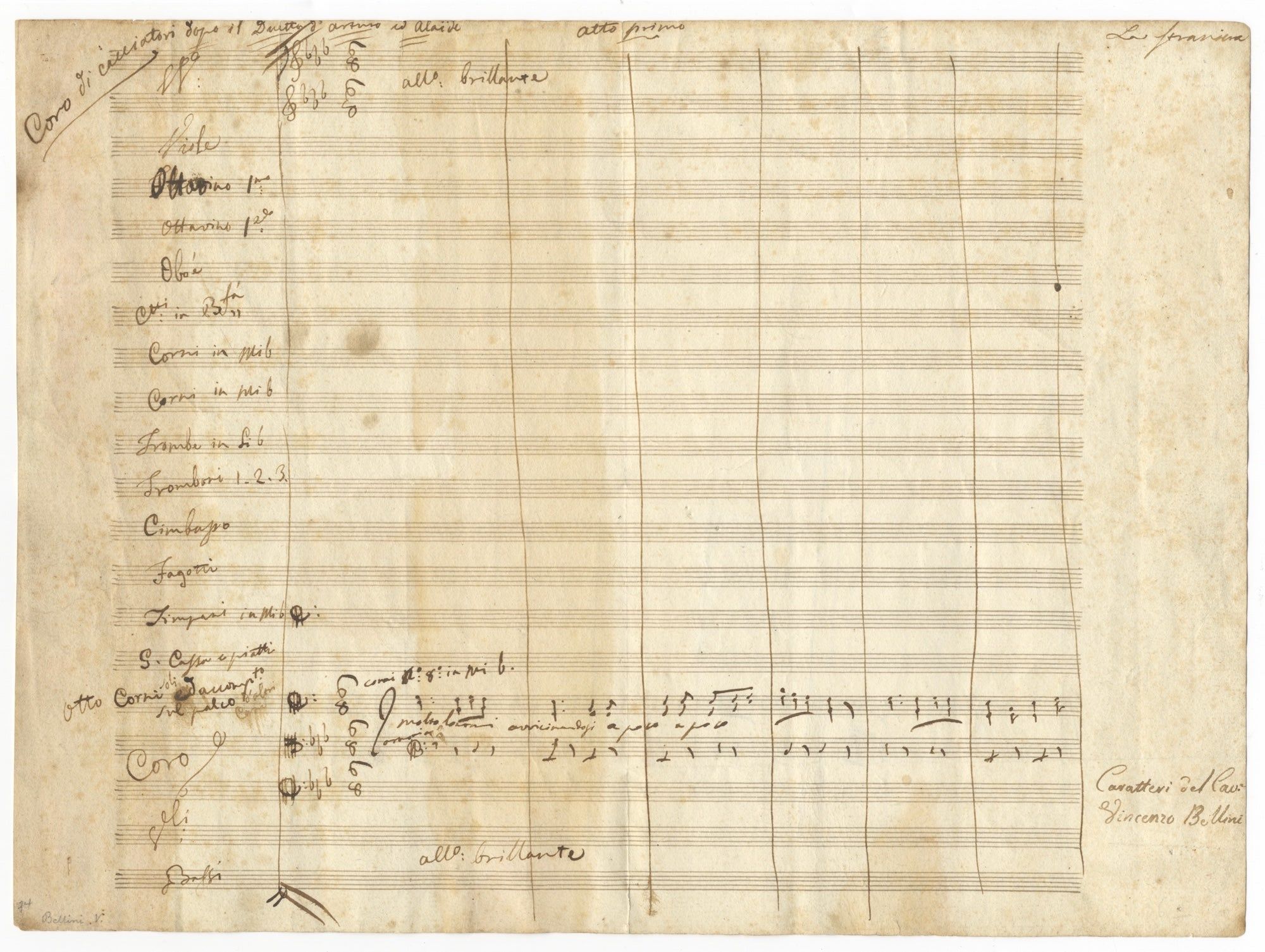
La straniera. Coro di Cacciatori from the opera. Autograph musical manuscript draft. Unsigned. Milan, ca. 1826-1827
- SIGNED
Oblong folio (231 x 313 mm). 2 pp. Notated on 20-stave rastrum-ruled paper.
15 measures of music for horns, starting from the 20th measure of the "Coro di cacciatori" from Act 1, scene VIII of the opera.
With "Coro di cacciatori dopo il Duetto d'Arturo ed Alaïde Atto primo La straniera" in Bellini's autograph to head of first page, and with annotation and signature to lower right corner in another hand "Caratteri del Cave. Vincenzo Bellini."
The horn parts are marked at the beginning of the stave "Otto corni soli d'accompagnamento sul palco d'altri corni;" the phrase "d'altri corni," in lighter ink, may have been added later.
The parts are also marked, within the music, "molto [?]lontano avvicinandosi a poco a poco."
Slightly worn, browned, foxed, and creased; two ca. 45 mm. vertical bands of light brown staining. La straniera, an opera seria in two acts with libretto by Felice Romani, was first performed in Milan at La Scala on 14 February 1829.
Bellini "was a leading figure in early 19th-century opera, noted for his expressive melodies and sensitive approach to text-setting. ... Il pirata had its première at La Scala in October 1827 with a cast headed by three singers who maintained close ties to Bellini throughout his career: soprano Henriette Méric-Lalande (the first Bianca and Alaide in La straniera), Giovanni Battista Rubini, who created the tenor leads in Bianca e Fernando, La sonnambula and I puritani, and baritone Antonio Tamburini, who would sing in premières of both La straniera and I puritani. The opera was an immediate success, and was quickly taken up in Naples and Vienna, establishing Bellini as a leading figure of his generation and assuring his financial and professional security. Although Bellini was paid only about 2000F for Pirata itself, the success put him in a position to demand twice as much for his next opera, La straniera. La sonnambula and Norma would earn just over 10,000F each, fulfilling Bellini's long-standing dream of outdoing the 5000F Rossini had been paid for Semiramide in 1823, previously the top fee for an Italian operatic commission. Bellini was unusual in being able to earn his living entirely from operatic commissions, but even at the peak of his earning power, he seems to have lived fairly frugally, sending money to his family in Catania and indulging only in his taste for silk gloves and other fine clothing." Mary Ann Smart, Friedrich Lippmann, and Simon Maguire in Grove Music Online.
15 measures of music for horns, starting from the 20th measure of the "Coro di cacciatori" from Act 1, scene VIII of the opera.
With "Coro di cacciatori dopo il Duetto d'Arturo ed Alaïde Atto primo La straniera" in Bellini's autograph to head of first page, and with annotation and signature to lower right corner in another hand "Caratteri del Cave. Vincenzo Bellini."
The horn parts are marked at the beginning of the stave "Otto corni soli d'accompagnamento sul palco d'altri corni;" the phrase "d'altri corni," in lighter ink, may have been added later.
The parts are also marked, within the music, "molto [?]lontano avvicinandosi a poco a poco."
Slightly worn, browned, foxed, and creased; two ca. 45 mm. vertical bands of light brown staining. La straniera, an opera seria in two acts with libretto by Felice Romani, was first performed in Milan at La Scala on 14 February 1829.
Bellini "was a leading figure in early 19th-century opera, noted for his expressive melodies and sensitive approach to text-setting. ... Il pirata had its première at La Scala in October 1827 with a cast headed by three singers who maintained close ties to Bellini throughout his career: soprano Henriette Méric-Lalande (the first Bianca and Alaide in La straniera), Giovanni Battista Rubini, who created the tenor leads in Bianca e Fernando, La sonnambula and I puritani, and baritone Antonio Tamburini, who would sing in premières of both La straniera and I puritani. The opera was an immediate success, and was quickly taken up in Naples and Vienna, establishing Bellini as a leading figure of his generation and assuring his financial and professional security. Although Bellini was paid only about 2000F for Pirata itself, the success put him in a position to demand twice as much for his next opera, La straniera. La sonnambula and Norma would earn just over 10,000F each, fulfilling Bellini's long-standing dream of outdoing the 5000F Rossini had been paid for Semiramide in 1823, previously the top fee for an Italian operatic commission. Bellini was unusual in being able to earn his living entirely from operatic commissions, but even at the peak of his earning power, he seems to have lived fairly frugally, sending money to his family in Catania and indulging only in his taste for silk gloves and other fine clothing." Mary Ann Smart, Friedrich Lippmann, and Simon Maguire in Grove Music Online.
Details
Title
La straniera. Coro di Cacciatori from the opera. Autograph musical manuscript draft. Unsigned. Milan, ca. 1826-1827
Author
BELLINI, Vincenzo 1801-1835
Condition
Unknown