

Mexican History and Indigenous Daily Life in Postrevolutionary Rural Mexico, 1922
- 1920
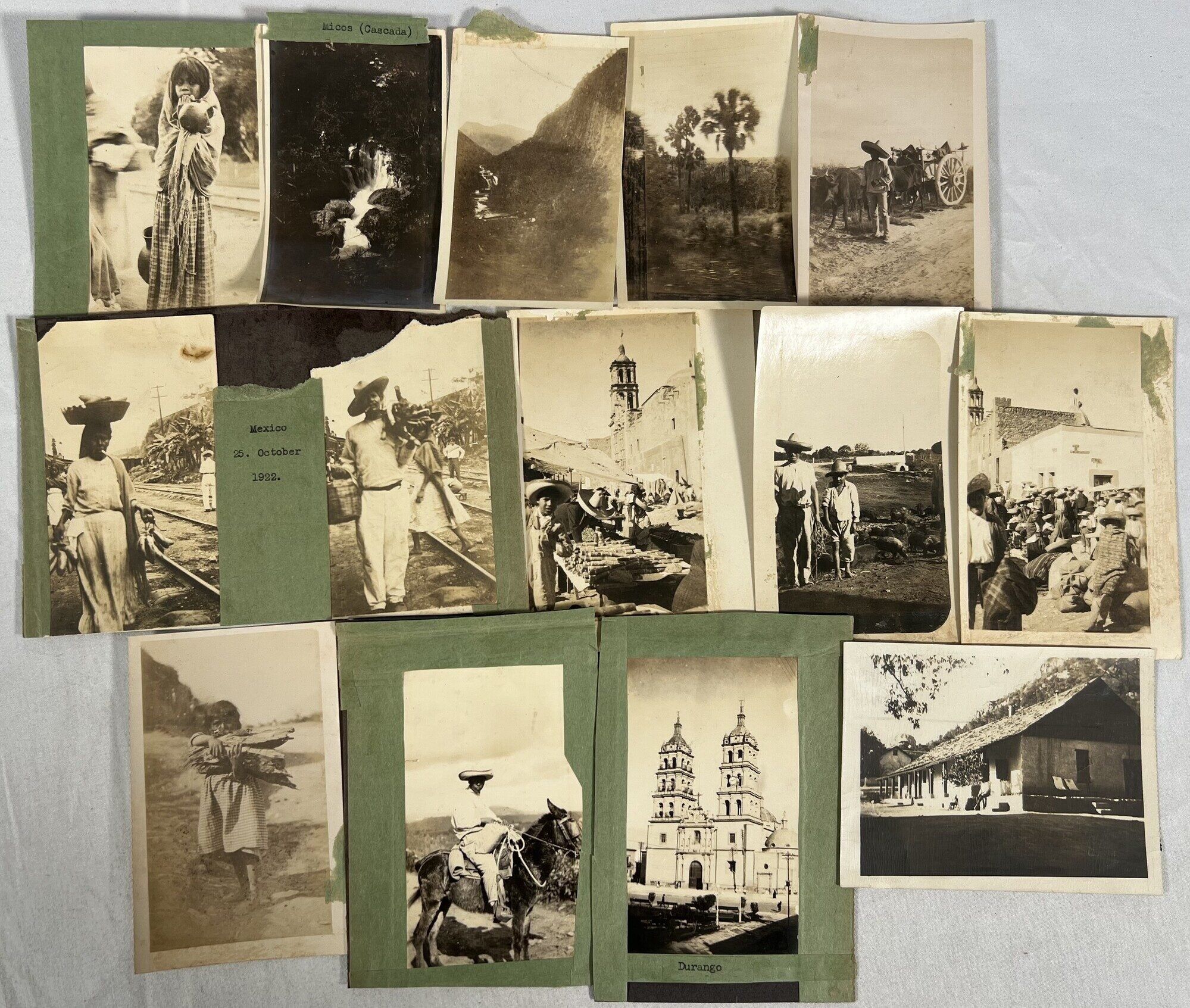
1920. Unknown photographer, postrevolutionary Mexico daily life photo archive, 1922, documents rural and regional scenes in Mexico shortly after the Revolution and supports research into Indigenous representation, campesino life, foreign travel photography, gendered domestic labor, and the visual culture of postrevolutionary nationhood. The Mexican Revolution, usually dated from 1910 to 1920, reshaped political authority, rural land claims, and national identity, while the 1920s saw continued struggles over agrarian reform and the place of peasants and Indigenous communities in the modern Mexican state. These photographs capture lived experience rather than official political change: women carry ceramic vessels, children appear in traditional dress, men stand beside carts and mules, and rural landscapes and town settings locate the viewer within a Mexico still marked by regional movement, village commerce, and postwar social reconstruction.
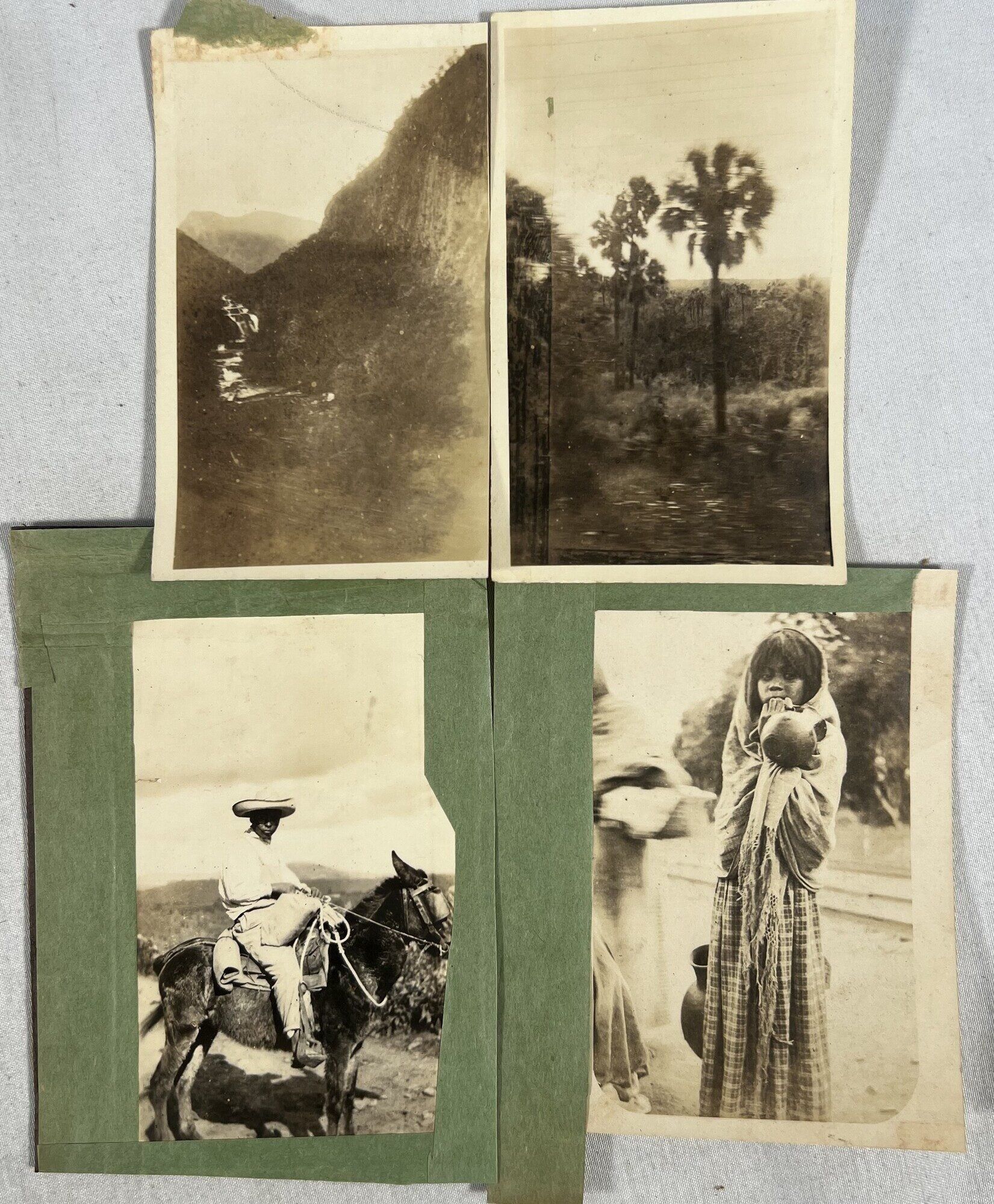
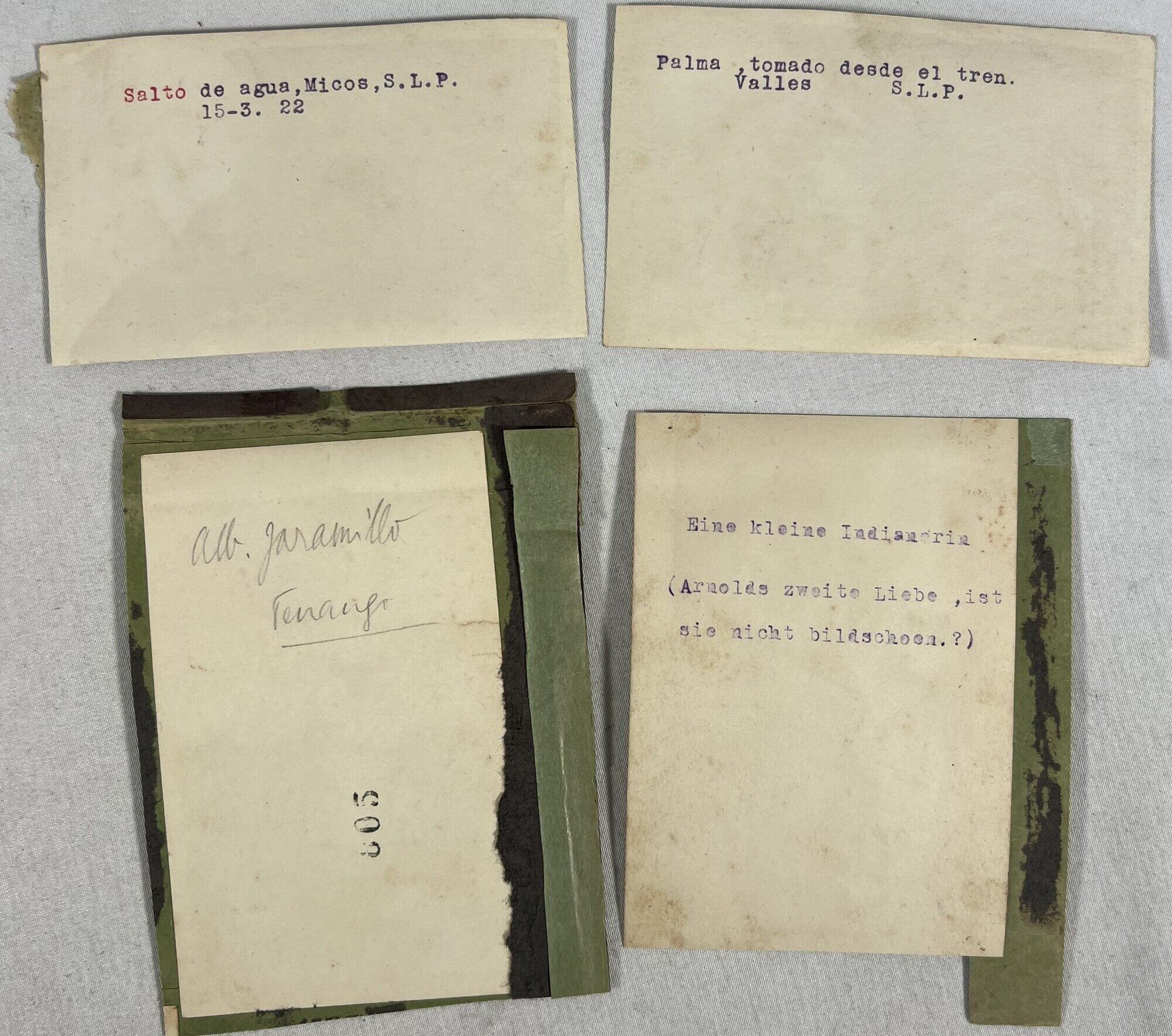
Fourteen vintage silver gelatin prints, dated October 25, 1922, with some typed captions on rectos or versos and one handwritten inscription; locations or references include San Luis Potosí, including Micos and Valles, Durango, and a handwritten notation reading "Alb. Jaramillo / Tenango." The images include a young girl in traditional dress carrying a baby while holding a clay vessel, an Indigenous woman posed with a large ceramic jar, male campesinos in wide-brimmed sombreros and charro-style clothing, men beside carts, figures riding mules, and vendors or local residents in village plazas. One view shows a church façade identified as "Durango," while a waterfall is captioned "Salto de agua, Micos, S.L.P. / 15-3-22." Another caption reads "Palma tomado desde el tren. Valles / S.L.P.," placing at least part of the travel itinerary along a rail route through San Luis Potosí. The German caption "Eine kleine Indianerin (Arnolds zweite Liebe, ist sie nicht bildschön?)," translated as "A little Indian girl (Arnold's second love, isn't she beautiful?)," indicates annotation by a German-speaking traveler or compiler and gives the archive additional value as evidence of foreign viewing practices and ethnographic language applied to Indigenous subjects in early twentieth-century Mexico.
Photographs measure approximately 2½ x 3 inches. The group includes rural portraits, transportation views, marketplace or village scenes, architectural documentation, and landscape images, with captions in Spanish and German providing unusually useful geographic and interpretive evidence. Light edge wear, small handling creases, and adhesive remnants from former album mounting, very good overall. Focused visual record of postrevolutionary Mexico through a foreign-language travel lens, especially notable for its dated images of Indigenous women and children, campesino dress, ceramic vessels, mule and cart transport, and regional travel across San Luis Potosí, Durango, and related locales.
Fourteen vintage silver gelatin prints, dated October 25, 1922, with some typed captions on rectos or versos and one handwritten inscription; locations or references include San Luis Potosí, including Micos and Valles, Durango, and a handwritten notation reading "Alb. Jaramillo / Tenango." The images include a young girl in traditional dress carrying a baby while holding a clay vessel, an Indigenous woman posed with a large ceramic jar, male campesinos in wide-brimmed sombreros and charro-style clothing, men beside carts, figures riding mules, and vendors or local residents in village plazas. One view shows a church façade identified as "Durango," while a waterfall is captioned "Salto de agua, Micos, S.L.P. / 15-3-22." Another caption reads "Palma tomado desde el tren. Valles / S.L.P.," placing at least part of the travel itinerary along a rail route through San Luis Potosí. The German caption "Eine kleine Indianerin (Arnolds zweite Liebe, ist sie nicht bildschön?)," translated as "A little Indian girl (Arnold's second love, isn't she beautiful?)," indicates annotation by a German-speaking traveler or compiler and gives the archive additional value as evidence of foreign viewing practices and ethnographic language applied to Indigenous subjects in early twentieth-century Mexico.
Photographs measure approximately 2½ x 3 inches. The group includes rural portraits, transportation views, marketplace or village scenes, architectural documentation, and landscape images, with captions in Spanish and German providing unusually useful geographic and interpretive evidence. Light edge wear, small handling creases, and adhesive remnants from former album mounting, very good overall. Focused visual record of postrevolutionary Mexico through a foreign-language travel lens, especially notable for its dated images of Indigenous women and children, campesino dress, ceramic vessels, mule and cart transport, and regional travel across San Luis Potosí, Durango, and related locales.
Details
Title
Mexican History and Indigenous Daily Life in Postrevolutionary Rural Mexico, 1922
Author
Vernacular Mexico 1920s
Condition
Unknown
Date
1920