

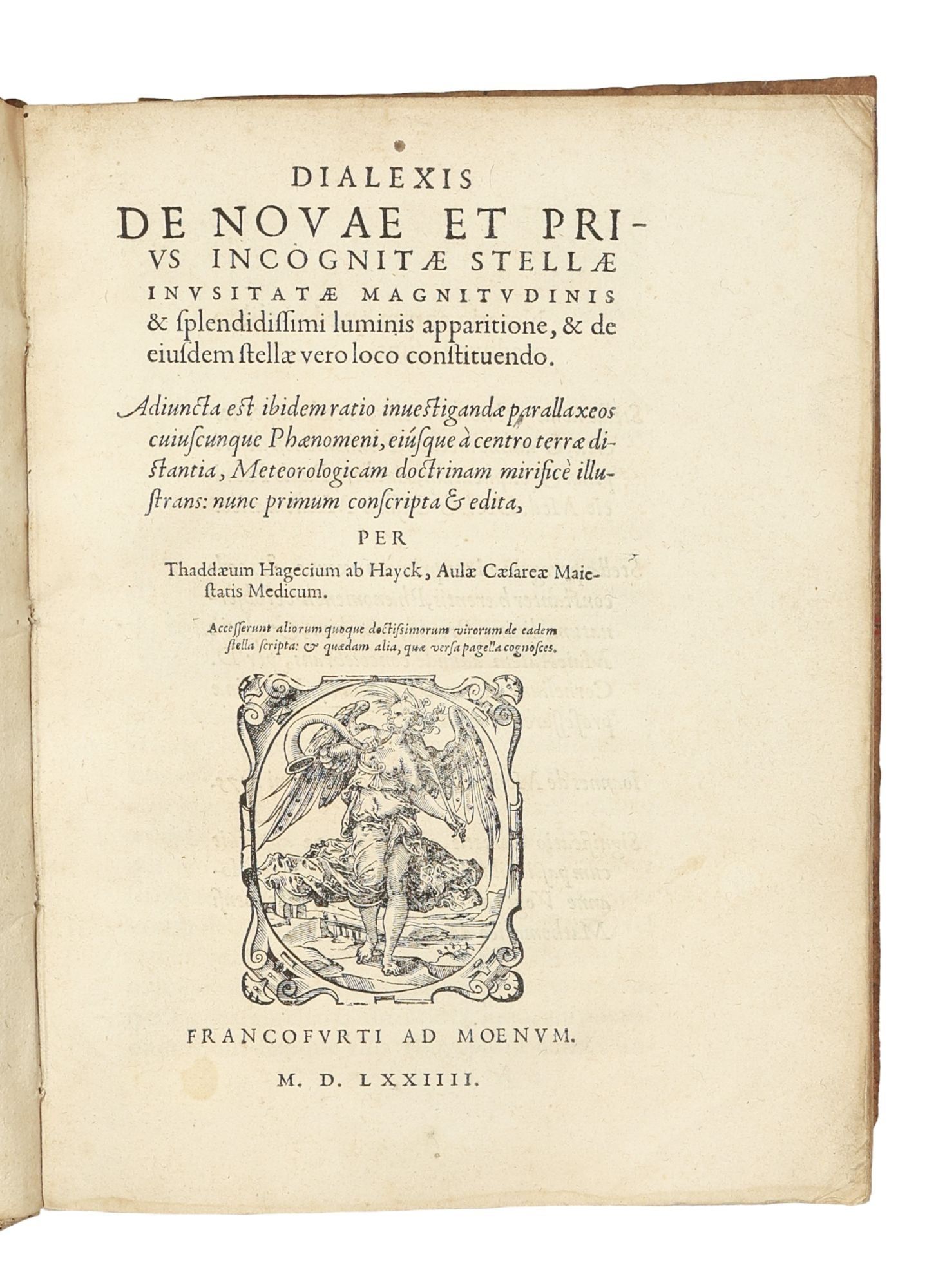
Dialexis de novae et prius incognitae stellae inusitatae magnitudinis et splendidissimi luminis apparitione, & de eiusdem stellae vero loco constituendo. Accesserunt aliorum quoque doctissimorum virorum de eadem stella scripta
- Hardcover
- Frankfurt: A. Wechel for S. Feyerabend, 1574
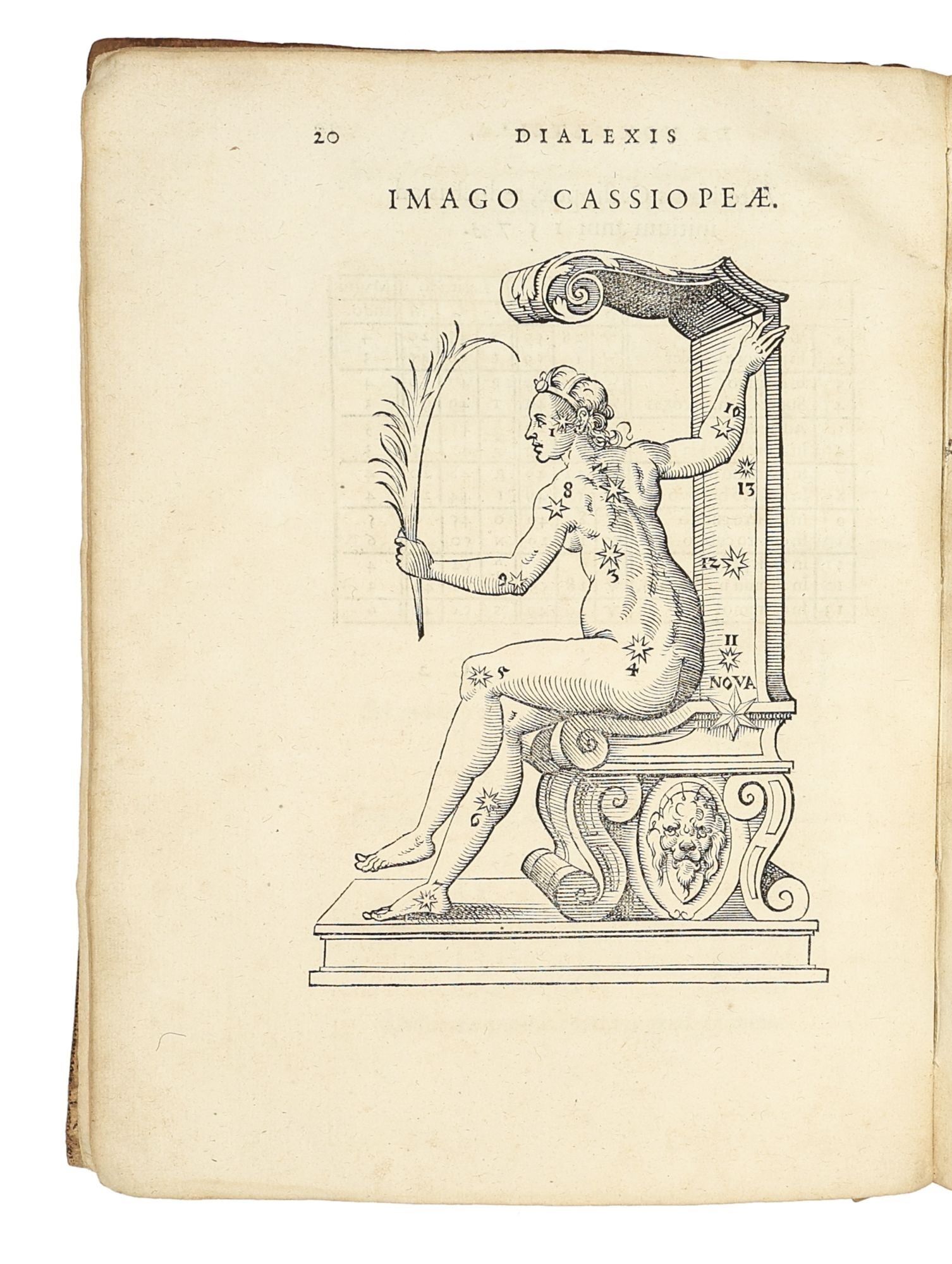
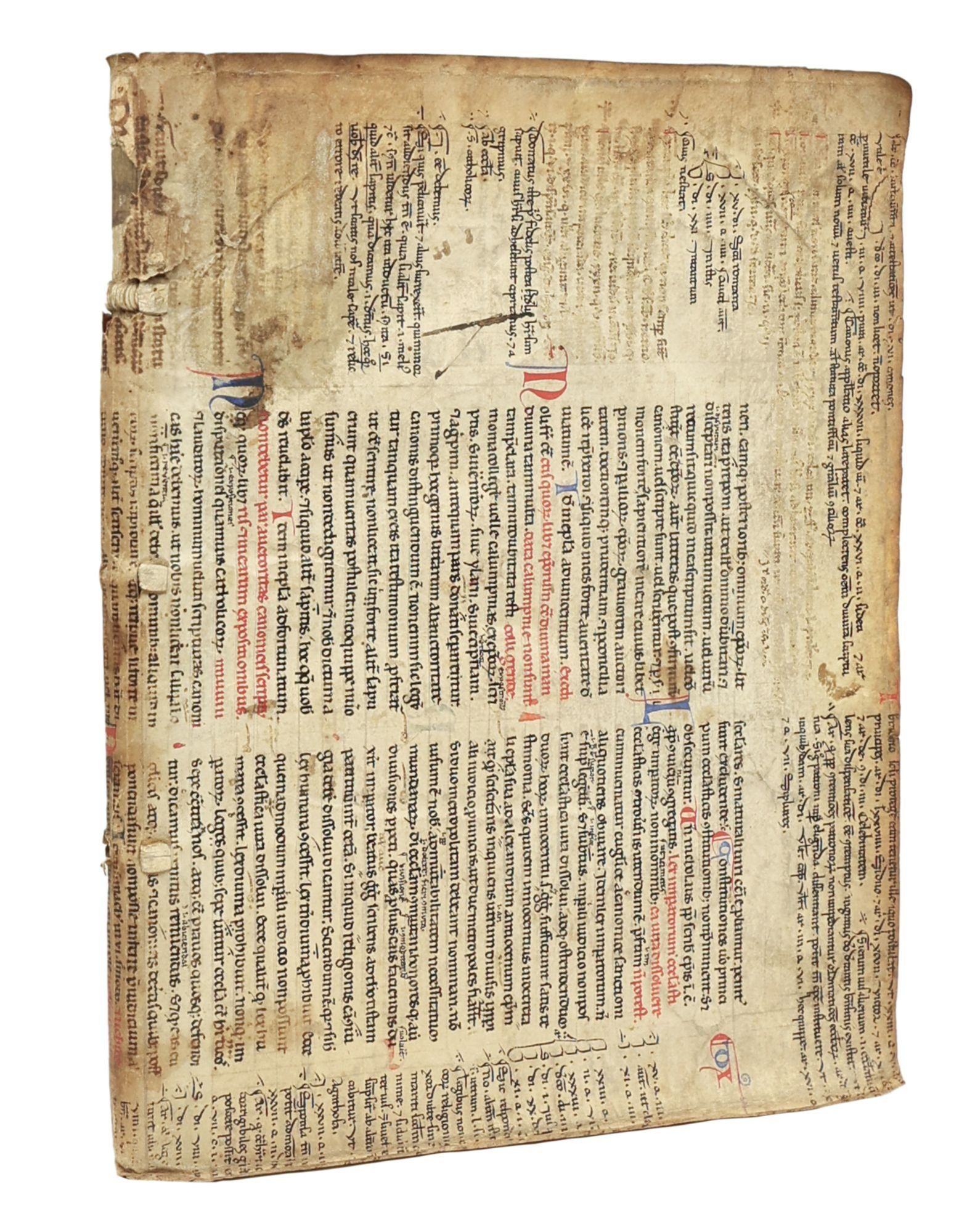
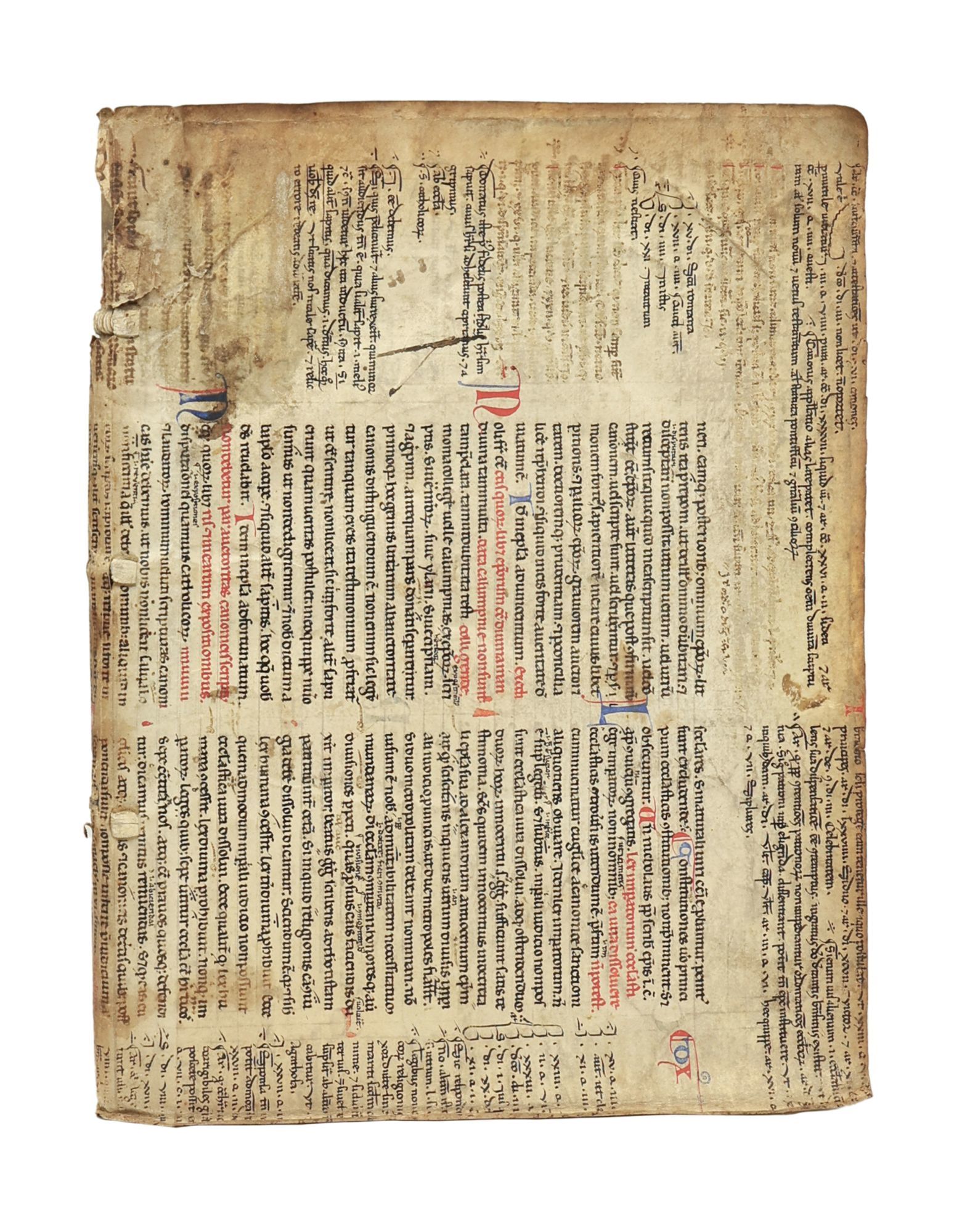
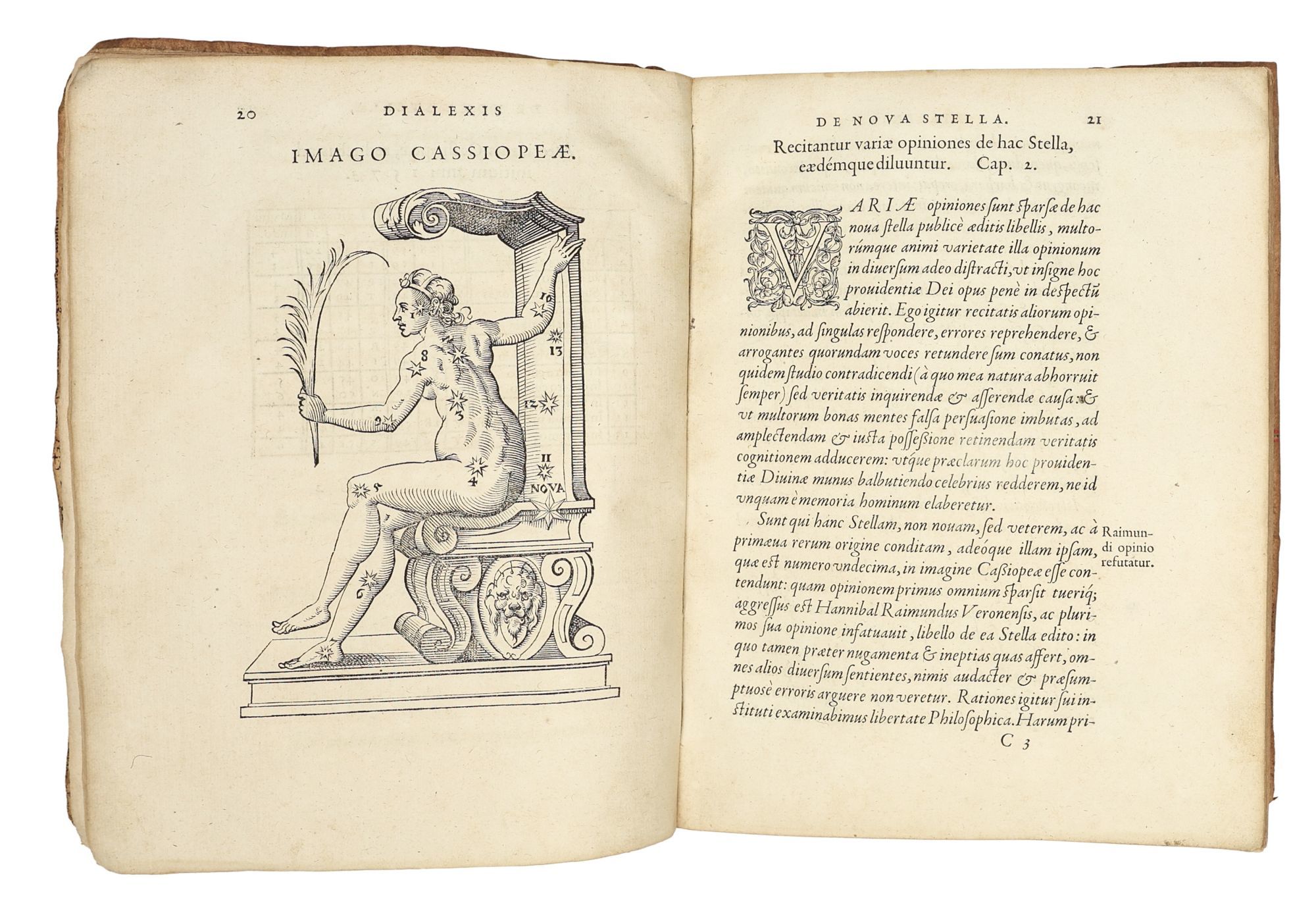
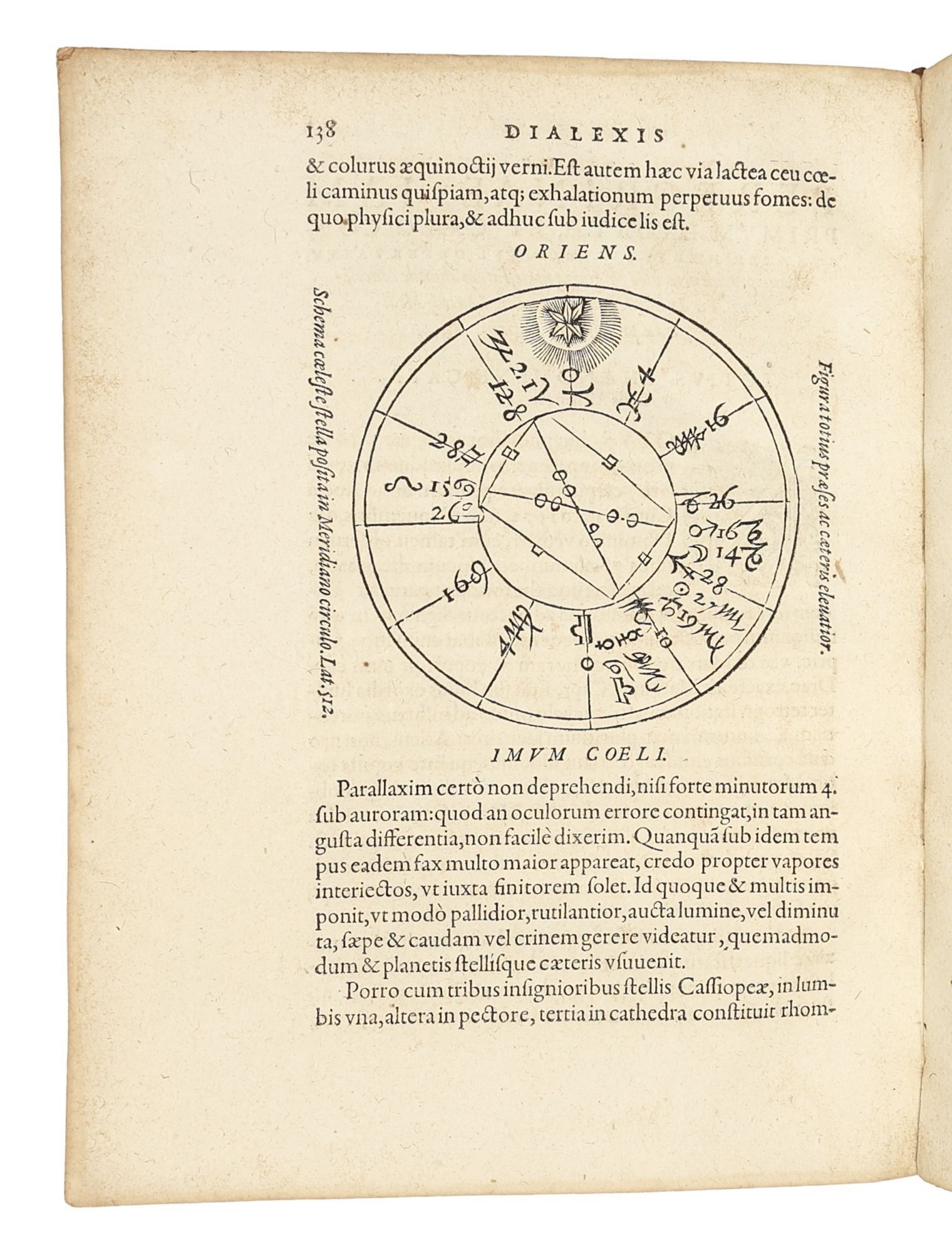
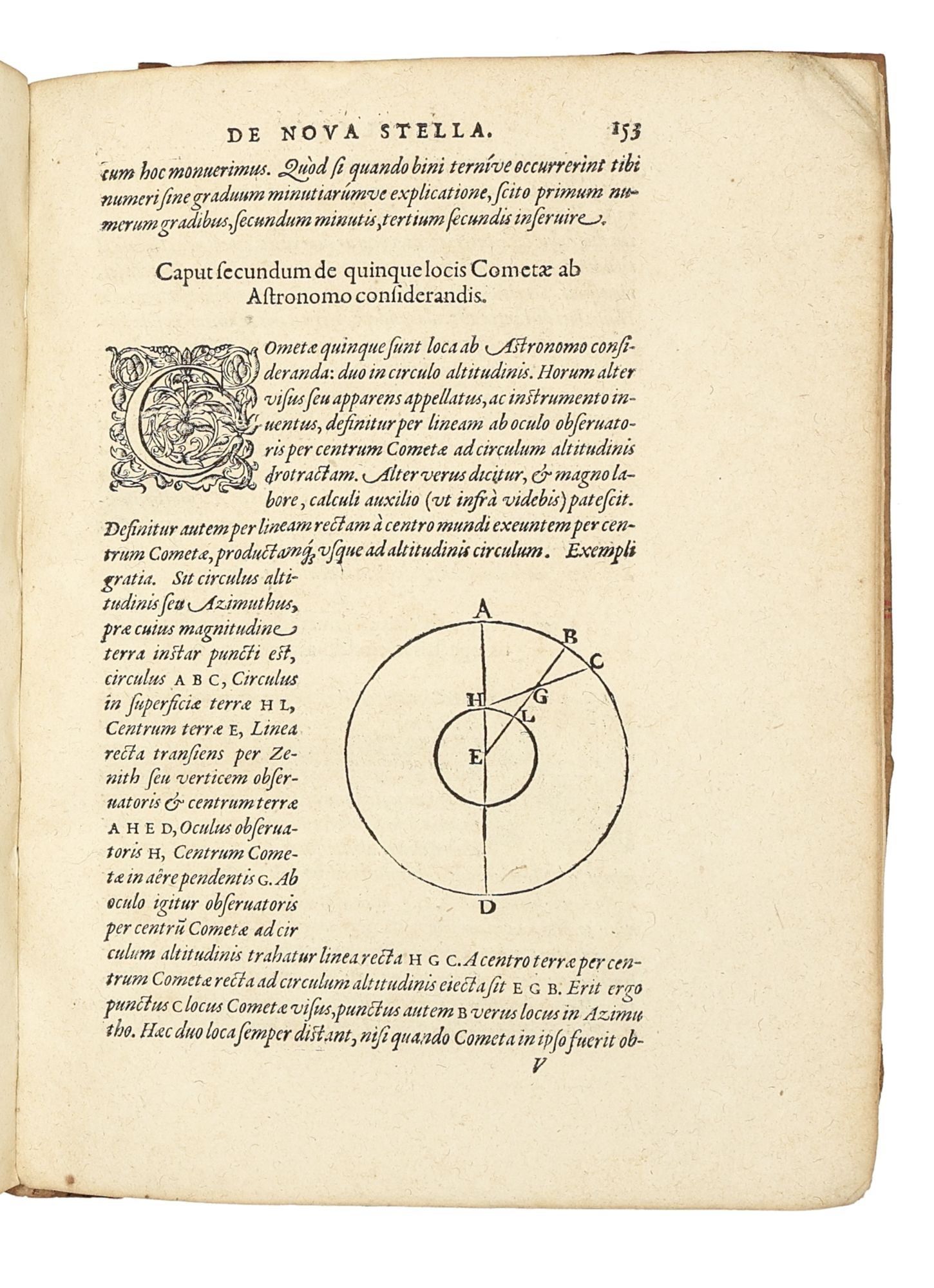
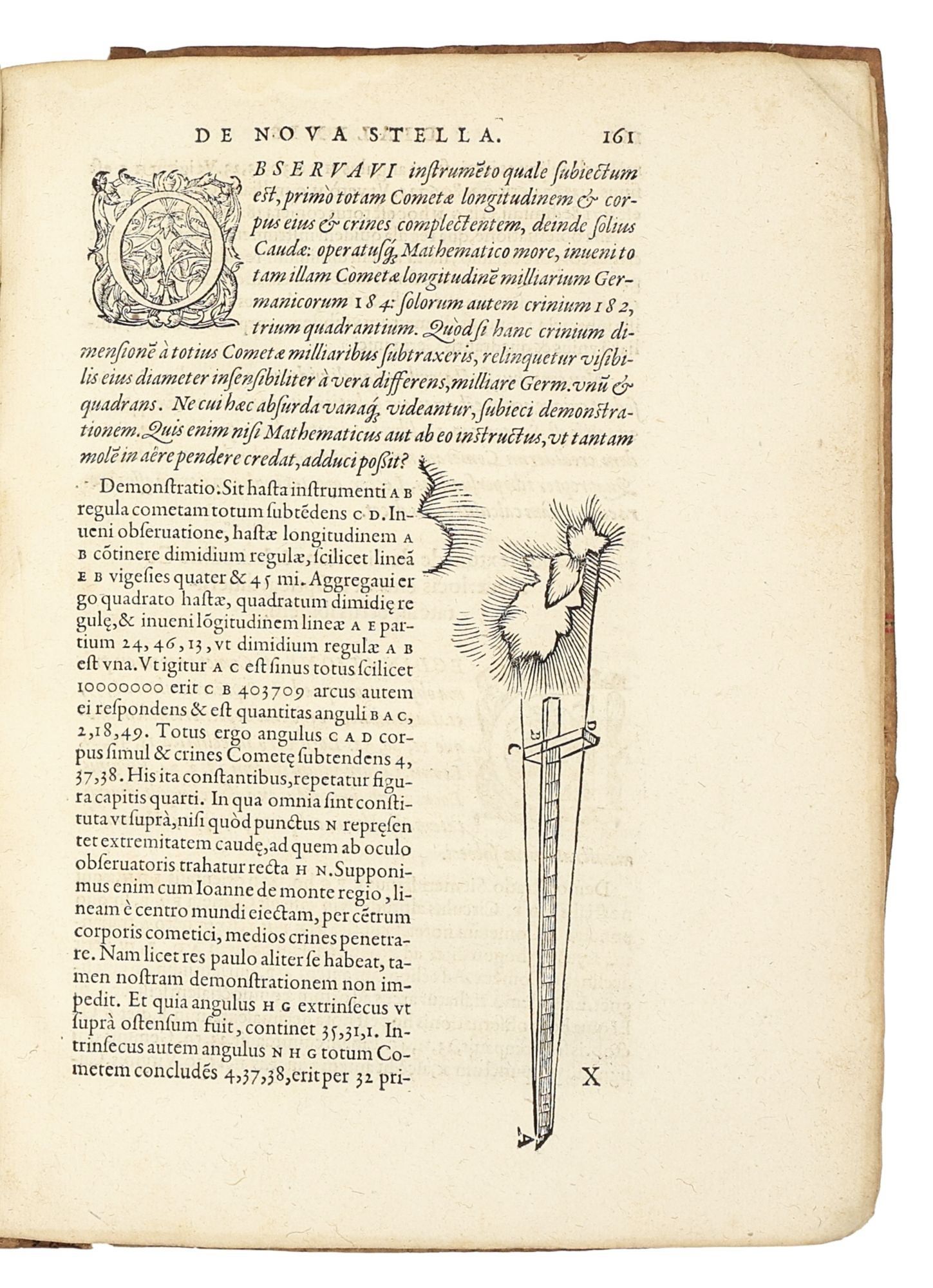
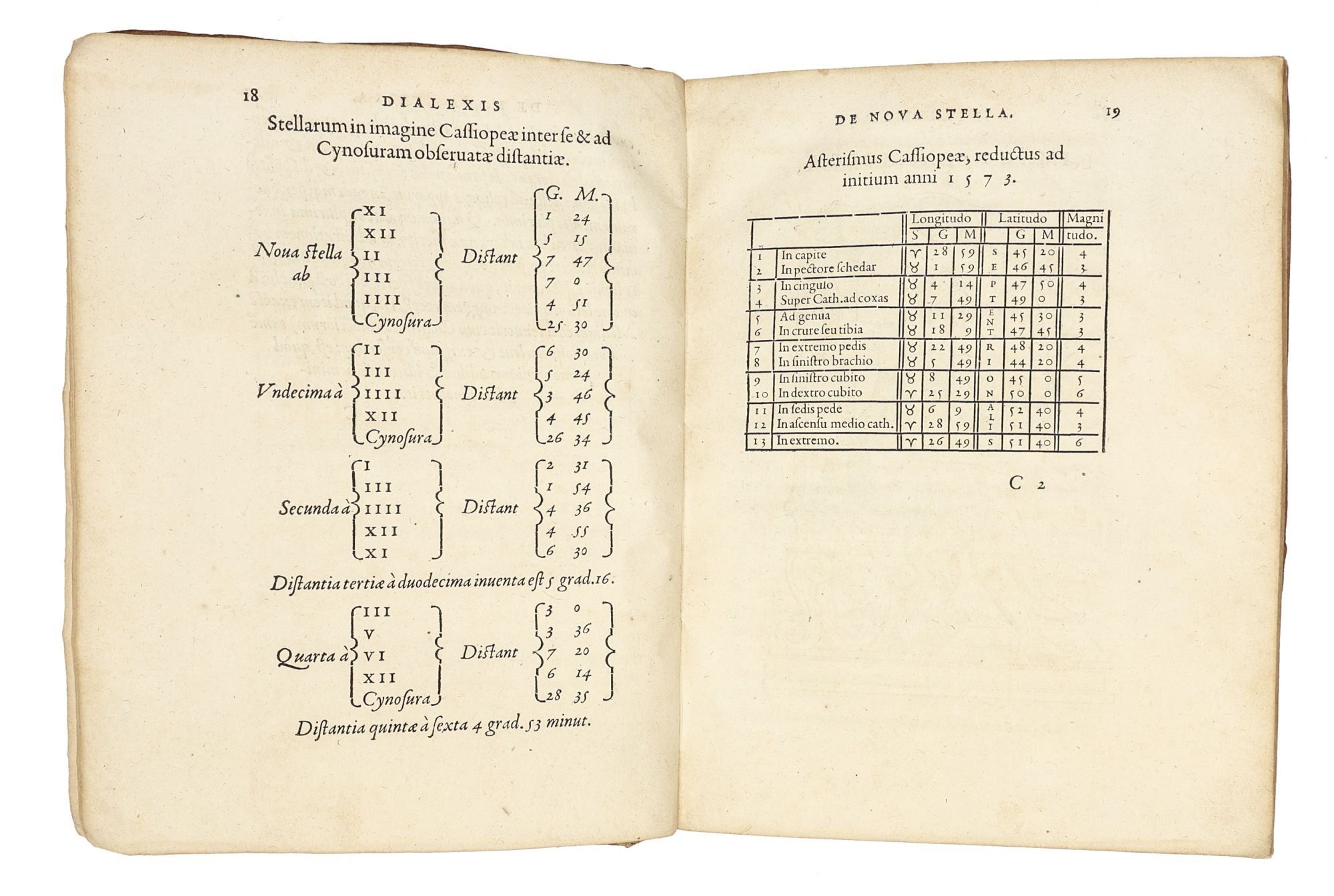
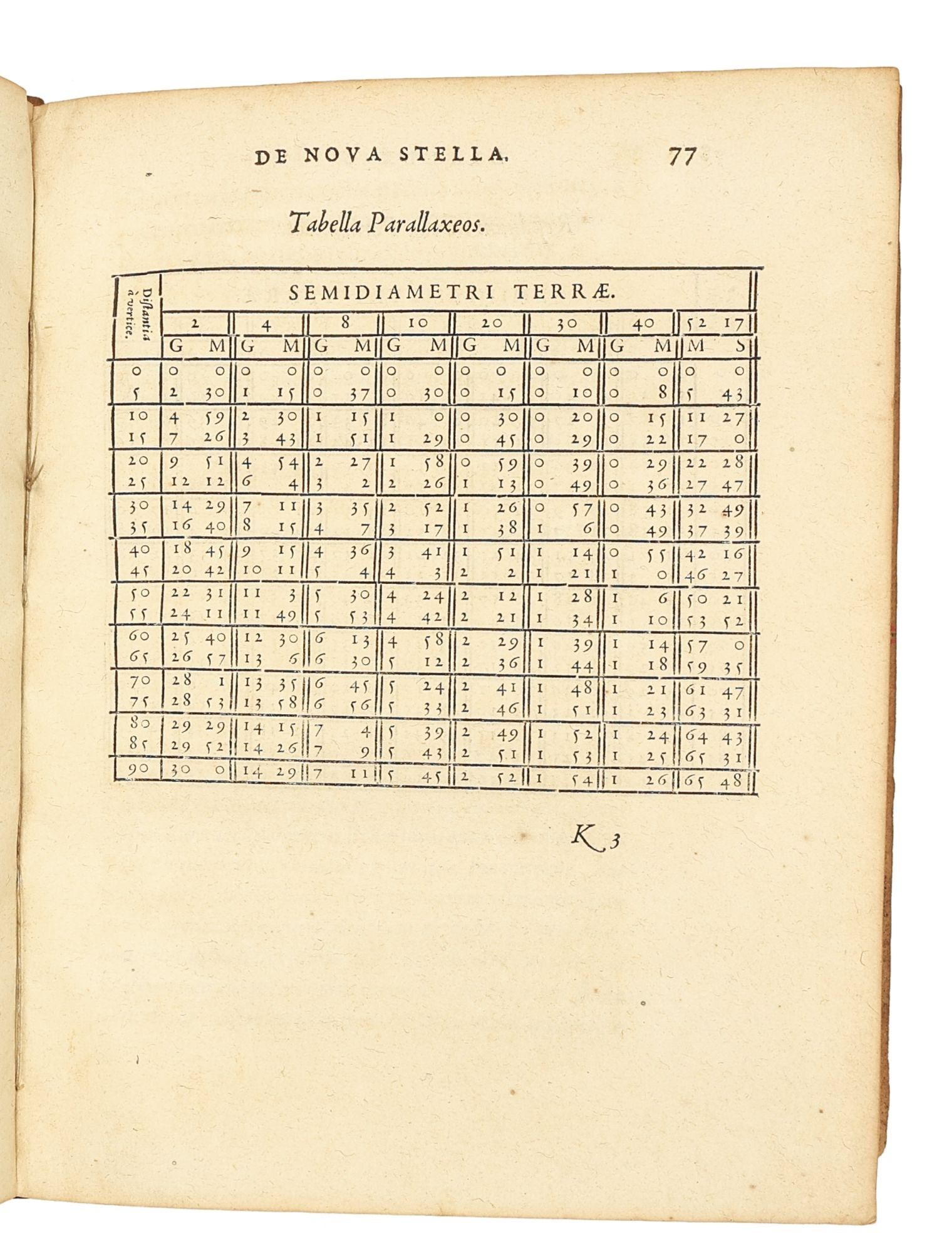
Frankfurt: A. Wechel for S. Feyerabend, 1574. SOLE EDITION. Hardcover. Fine. A very fine copy with a few small spots and a minor marginal stain to one leaf. With woodcut diagrams and a full-page woodcut map showing the nova within the constellation of Cassiopeia personified. "The style of this map was copied directly from Dürer" (Warner). Original limp vellum binding (defective at head of spine) from a medieval manuscript leaf. Extremely rare. Harvard and Stanford only in North America. The extremely rare first edition of this important work on the new star "stella nova" that appeared in 1572, now known as SN 1572 or Tycho's Supernova, written by the Czech astronomer and physician Tadeáš Hájek z Hájku. In his book, "Discussion of the appearance of a new and previously unknown star of unusual magnitude and brilliance", Hájek argued that the nova was a supralunary (i.e. celestial) phenomenon, located outside of the terrestrial sphere (beyond the Moon), challenging the Aristotelian belief that the heavens were immutable. His conclusions, based on meticulous observations and measurements and the employment of novel methods (see below), contributed significantly to the shift in the astronomical paradigms of the time. Hájek's -like Tycho Brahe's- measurements of the nova revealed no parallax shift, proving that the nova was not a comet (at the time considered "sublunary", and therefore mutable, phenomena). Nor, since the nova always followed the diurnal motion of the fixed stars, was it a planet. These factors could only mean that the nova must be counted among the fixed stars.
"The 'Dialexis' justly earned Hájek popularity among the most renowned astronomers of his time. Thanks to his contacts and his reputation, Hájek was able to establish a leading network of communication concerning the newly discovered phenomenon which attracted a number of illustrious observers, like Thomas Digges in Cambridge, Michael Maestlin in Heidelberg, Cornelius Gemma in Louvain, Elias Camerarius in Frankfurt, Annibale Raimondo in Verona, Jerónimo Muñoz in Spain, Ciprianus Leovitius (Leowitz or Lvovický) in Bohemia, and Tycho Brahe in Denmark. But, most importantly, Hájek's ideas inspired Tycho Brahe's own considerations on the new star in his 'Astronomiae instauratae progymnasmata '(1602), where he quoted Hájek extensively."(Žemla, Hagecius, a Renaissance Man, in Thaddaeus Hagecius, or Hájek, 1526-1600. Bohemian Polymath of the Rudolfine Period)
Hájek maintained a close scholarly relationship with Danish astronomer Tycho Brahe. They corresponded extensively, sharing observations and analyses of celestial events, including the 1572 supernova; he also shared a manuscript of Copernicus' "Commentariolus" with Tycho. Hájek's influence extended beyond correspondence. He played a role in persuading Emperor Rudolf II to invite Brahe to Prague, facilitating further collaboration and the eventual involvement of Johannes Kepler in Brahe's work.
The appearance of the supernova of 1572 was a pivotal event in astronomical history. Its sudden appearance and subsequent analysis by astronomers like Hájek and Brahe provided concrete evidence against the long-held belief in the immutability of the heavens. Their observations demonstrated that changes could occur in the celestial realm, prompting a reevaluation of existing cosmological models.
"In November 1572, a new star blazed in the constellation of Cassiopeia [and] entered the lives of both Hájek and Tycho, shaping their destiny… Hájek was one of the first to write an essay on the strange heavenly appearance, sending the brief 'De investigatione loci novae stellae' to Bartholomew Reisacher who published it in the appendix of his 'De Mirabili Novae ac splendidissimae Stellae' (Vienna 1573). Hájek later extended this originally brief report with additional details into the 'Dialexis.'
"The great importance of Hajek's works on Nova Cassiopeiae consists not only in the accuracy of his observations and analysis of this highly significant astronomical phenomenon, but in the method by which he determined the location of this nova. The new method introduced time as an astronomical measure for the difference in longitude. Although efforts to use this method were made by Wilhelm IV of Hessen at his observatory in Kassel, it appears that this method was first suggested by Hájek who, even before Tycho, tried to use it in his observations."(Hujer, Thaddeus Hájek and Early Attempts to Measure Stellar Parallax).
The book includes additional works on the nova by Hegecius' contemporaries: the imperial mathematician Paulus Farbricius' "Stellae novae vel nothae potius, in coelo nuper exortae" and Cornelius Gemma's "Stellae peregrinae iam primum exortae"; as well as a letter to Hagecius from Gemma and another from Fabricius (from whom Hagecius probably borrowed instruments.) Two other texts are included: Johannes Voegelin's "Significatio cometae, qui anno 1532 apparuit.", previously published in 1533; and "De cometa anni 1472" attributed to Regiomontanus but taken from a work by Eberhard Schleusinger. See Zinner.
"Hájek was a genuine Renaissance man with a broad range of interests. A physician wavering between the traditional Galenic and the new Paracelsian medicine, an astronomer and mathematician as well as an astrologer and alchemist. He embraced most of the arts, or proto-sciences, available in his time. Even though he earned his daily bread by his medical services, he never let mathematics and astronomy go. It is here, in astronomy, that he achieved the greatest reputation both among his scholarly peers and in the eyes of later historians of science. As it may have been a handy source of income, he published popular calendars, prognostics, and minutions in his youth, i.e., day-by-day instructions on ideal dates for bathing, bloodletting, purgation, hunting, fertilizing, cutting trees, picking fruits, castrating livestock, etc., calculated on an astronomical and astrological basis. He continued with this activity sporadically until to 1570. He was a supporter of calendar reform, declared by the pope in 1582, and was commissioned by Rudolf II to examine all calendars to be published in Prague."(Žemla, Hagecius, a Renaissance Man, in Thaddaeus Hagecius, or Hájek, 1526-1600. Bohemian Polymath of the Rudolfine Period).
Details
Title
Dialexis de novae et prius incognitae stellae inusitatae magnitudinis et splendidissimi luminis apparitione, & de eiusdem stellae vero loco constituendo. Accesserunt aliorum quoque doctissimorum virorum de eadem stella scripta
Author
Hájek z Hájku, Tadeáš (Hagecius, Thaddaeus) (1525-1600)
Binding
Hardcover
Condition
Fine
Publisher
A. Wechel for S. Feyerabend: Frankfurt
Date
1574
Edition
SOLE EDITION