

Moses. From the Tomb of Pope Julius II
- Hardcover
- Rome: ca, 1550
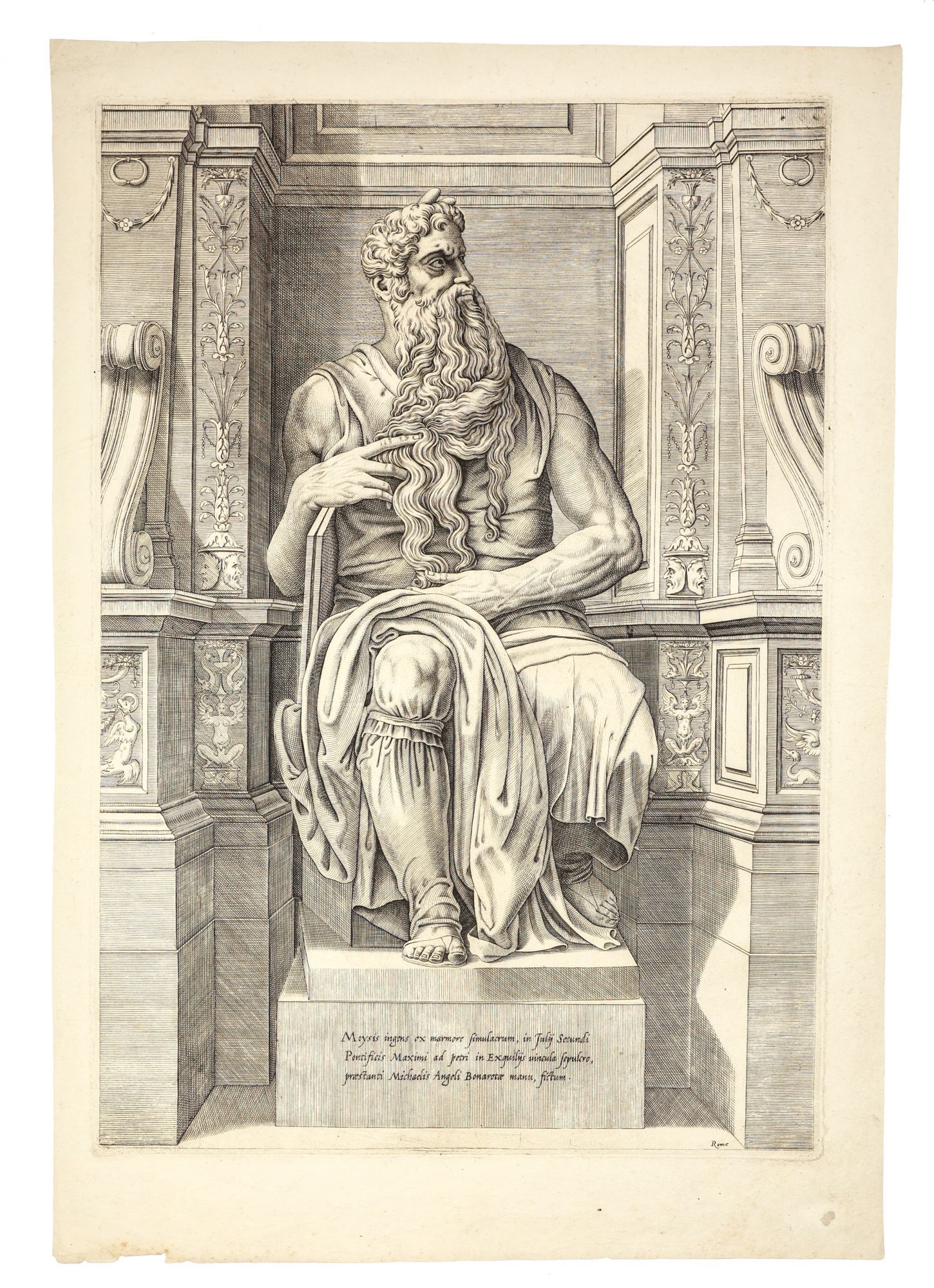
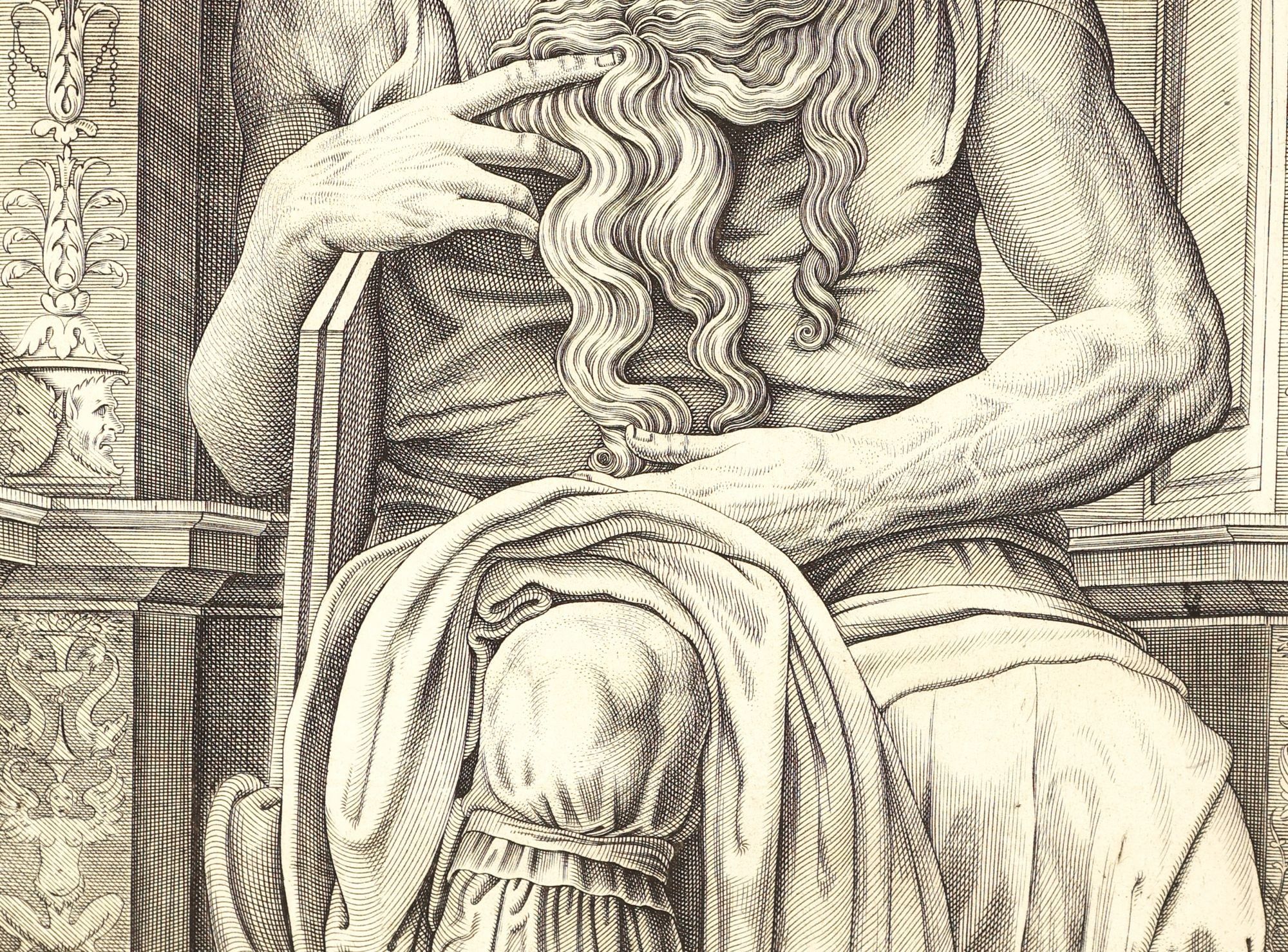
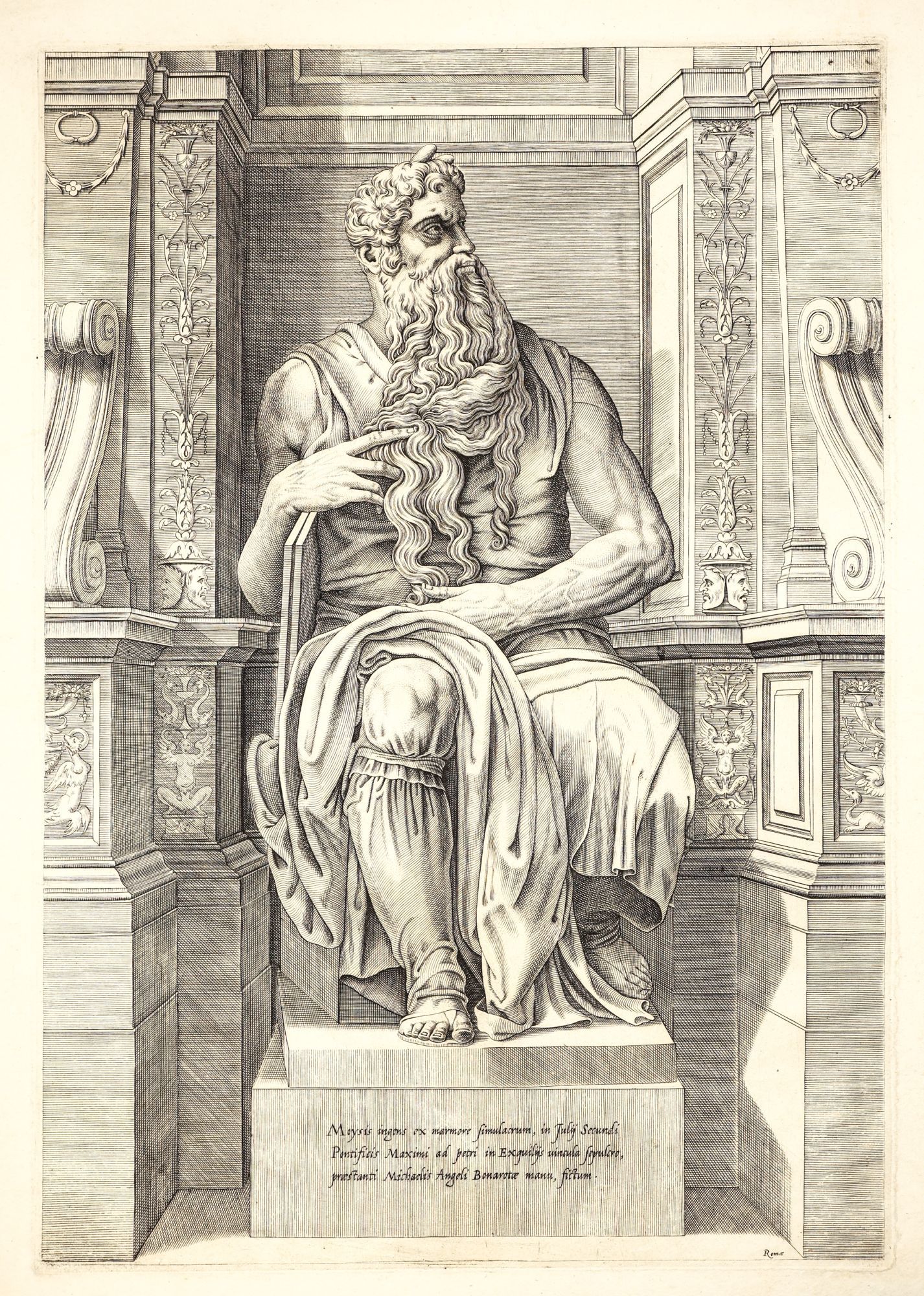
Rome: ca, 1550. SECOND STATE, of three, with the addition of “Romae” incised at lower right. Hardcover. Fine. A very fine example, with high contrast, of this rare print. This is the first published engraving dedicated to Michelangelo’s Moses, and one of only two made in the 16th century. The funerary monument of Julius II occupied Michelangelo, in various phases, from 1505 to the 1540s. Prints of the entire monument are few. In them, the figure of Moses is necessarily reduced in size and imperfectly executed. Later prints of the statue in isolation, such as that by the Netherlandish artist Jacob Matham (1571-1631), in which the figure is shown in reverse, fail to match the standard set by this early engraving.
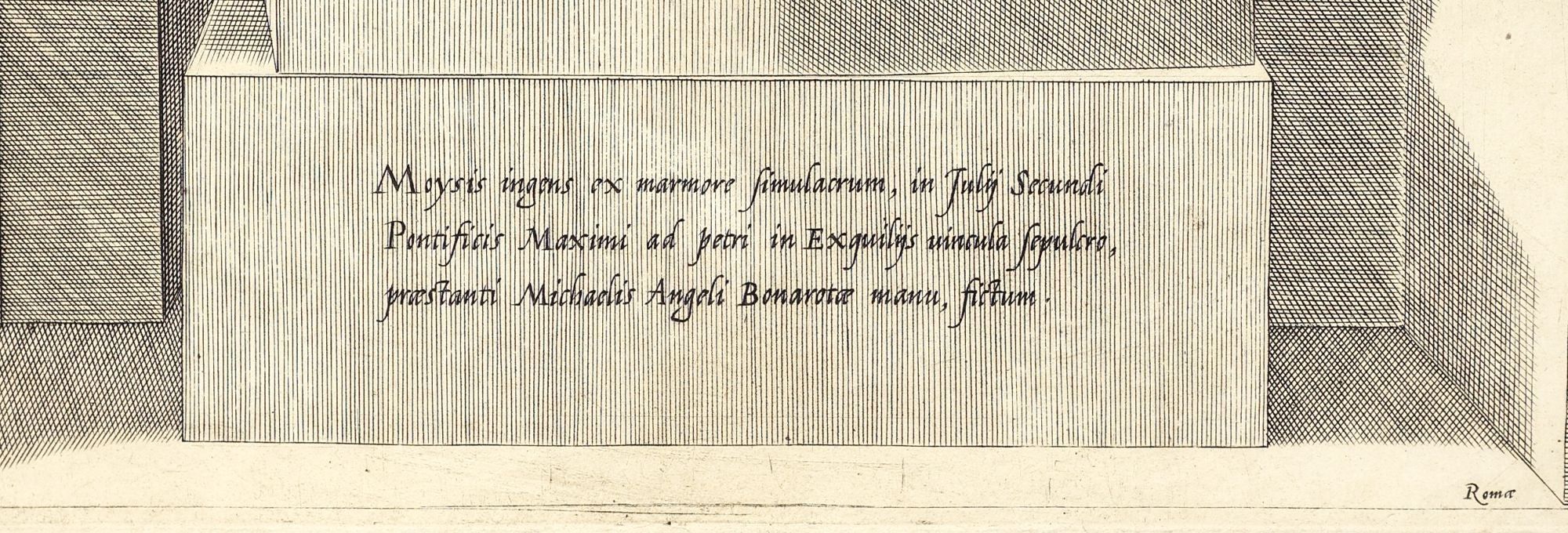
The inscription reads: Moysis ingens ex marmore simulacrum, in Julij Secundi/ Pontificis Maximi ad petri in Exquilijs uincula sepulcro / præstanti Michaelis Angeli Bonarotae manu, fictum. [The immense marble statue of Moses in the Church of San Pietro in Vincoli on the Esquiline Hill, sculpted by the hand of Michelangelo Buonarroti for the tomb of Pope Julius II.]
Michelangelo’s design for the tomb of Pope Julius II, with the master’s iconic figure of Moses, was originally intended for St. Peter’s but was, ultimately, installed in the church of San Pietro in Vincoli in Rome. The work was commissioned by Pope Julius in 1505, at which time Michelangelo received an initial payment of 100 gold ducats, but was not completed until March 1545. Michelangelo re-worked his initial design numerous times, first in 1513 (after Julius’ death), and again in 1516, 1525/1526, 1532 and 1542.
The final monument includes three figures carved by Michelangelo: the aforementioned Moses, and Leah and Rachel (symbols, respectively, of the active and contemplative life). Michelangelo’s sculptures of the dying and rebellious slaves (now in the Louvre) and the Genius of Victory (Palazzo Vecchio, Florence) were not used in the final design. On the second tier of the monument as it stands, is an effigy of the reclining Julius II attributed to Tommaso di Pietro Boscoli (1503-1574) but with the face possibly the work of Michelangelo, watched over by the Madonna and Child (carved by Alessandro Scherano di Settignano after a model by Michelangelo) and flanked by a sibyl and a prophet; these last two sculptures were carved by Michelangelo’s pupil Raffaello da Montelupo (ca. 1504-ca. 1567).
“The engraving reproduces, accurately, in the same direction and without substantial variations, the sculpture of the tomb of Julius II, identifying the light source at the top left. The work, attributed by Bottari to Beatrizet (Heinecken, 1768), was treated as anonymous by Heinecken in the Nachrichten of 1768, but later included by him in the list of Beatrizet's works (Dictionnaire, 1788). Nagler recorded it both under the monogram of Cornelis Bos and as the work of Beatrizet. Appearing in the Hollstein repertoire as Bos, it was subsequently treated among works of doubtful attribution both of Bos (Schéle, 1965) and of Beatrizet (Bianchi, 2004).
“Due to the fact that copies of this print are found in volumes of Roman composition on the model of the Speculum Romanae Magnificentiae (El Escorial; Madrid, Biblioteca Nacional; both datable between the mid-1580s and the 1590s) one would be led to believe that the plate was engraved in Rome, where in the last decade of the 16th century it was acquired by Van Aelst. This does not, however, exclude Cornelis Bos as a possible author (since more than one of his plates is known to bear a Roman address in late editions), even if it makes it more likely -in our opinion- the identification with a Flemish engraver active in Italy. In the sparse and luminous texture and in the clean geometries one could also perceive the burin of Niccolò della Casa.”(Alberti, Rovetta, and Salsi, “D'après Michelangelo”(2015), p. 219 ff.).
The inscription reads: Moysis ingens ex marmore simulacrum, in Julij Secundi/ Pontificis Maximi ad petri in Exquilijs uincula sepulcro / præstanti Michaelis Angeli Bonarotae manu, fictum. [The immense marble statue of Moses in the Church of San Pietro in Vincoli on the Esquiline Hill, sculpted by the hand of Michelangelo Buonarroti for the tomb of Pope Julius II.]
Michelangelo’s design for the tomb of Pope Julius II, with the master’s iconic figure of Moses, was originally intended for St. Peter’s but was, ultimately, installed in the church of San Pietro in Vincoli in Rome. The work was commissioned by Pope Julius in 1505, at which time Michelangelo received an initial payment of 100 gold ducats, but was not completed until March 1545. Michelangelo re-worked his initial design numerous times, first in 1513 (after Julius’ death), and again in 1516, 1525/1526, 1532 and 1542.
The final monument includes three figures carved by Michelangelo: the aforementioned Moses, and Leah and Rachel (symbols, respectively, of the active and contemplative life). Michelangelo’s sculptures of the dying and rebellious slaves (now in the Louvre) and the Genius of Victory (Palazzo Vecchio, Florence) were not used in the final design. On the second tier of the monument as it stands, is an effigy of the reclining Julius II attributed to Tommaso di Pietro Boscoli (1503-1574) but with the face possibly the work of Michelangelo, watched over by the Madonna and Child (carved by Alessandro Scherano di Settignano after a model by Michelangelo) and flanked by a sibyl and a prophet; these last two sculptures were carved by Michelangelo’s pupil Raffaello da Montelupo (ca. 1504-ca. 1567).
“The engraving reproduces, accurately, in the same direction and without substantial variations, the sculpture of the tomb of Julius II, identifying the light source at the top left. The work, attributed by Bottari to Beatrizet (Heinecken, 1768), was treated as anonymous by Heinecken in the Nachrichten of 1768, but later included by him in the list of Beatrizet's works (Dictionnaire, 1788). Nagler recorded it both under the monogram of Cornelis Bos and as the work of Beatrizet. Appearing in the Hollstein repertoire as Bos, it was subsequently treated among works of doubtful attribution both of Bos (Schéle, 1965) and of Beatrizet (Bianchi, 2004).
“Due to the fact that copies of this print are found in volumes of Roman composition on the model of the Speculum Romanae Magnificentiae (El Escorial; Madrid, Biblioteca Nacional; both datable between the mid-1580s and the 1590s) one would be led to believe that the plate was engraved in Rome, where in the last decade of the 16th century it was acquired by Van Aelst. This does not, however, exclude Cornelis Bos as a possible author (since more than one of his plates is known to bear a Roman address in late editions), even if it makes it more likely -in our opinion- the identification with a Flemish engraver active in Italy. In the sparse and luminous texture and in the clean geometries one could also perceive the burin of Niccolò della Casa.”(Alberti, Rovetta, and Salsi, “D'après Michelangelo”(2015), p. 219 ff.).
Details
Title
Moses. From the Tomb of Pope Julius II
Author
Michelangelo Buonarroti (1475-1564), artist. Béatrizet, Nicolas (ca. 1515-1565), or Cornelis Bos (c. 1506/10 – before 7 May 1555), attributed engravers
Binding
Hardcover
Condition
Fine
Publisher
ca: Rome
Date
1550
Edition
SECOND STATE, of three, with the addition of “Romae” incised