

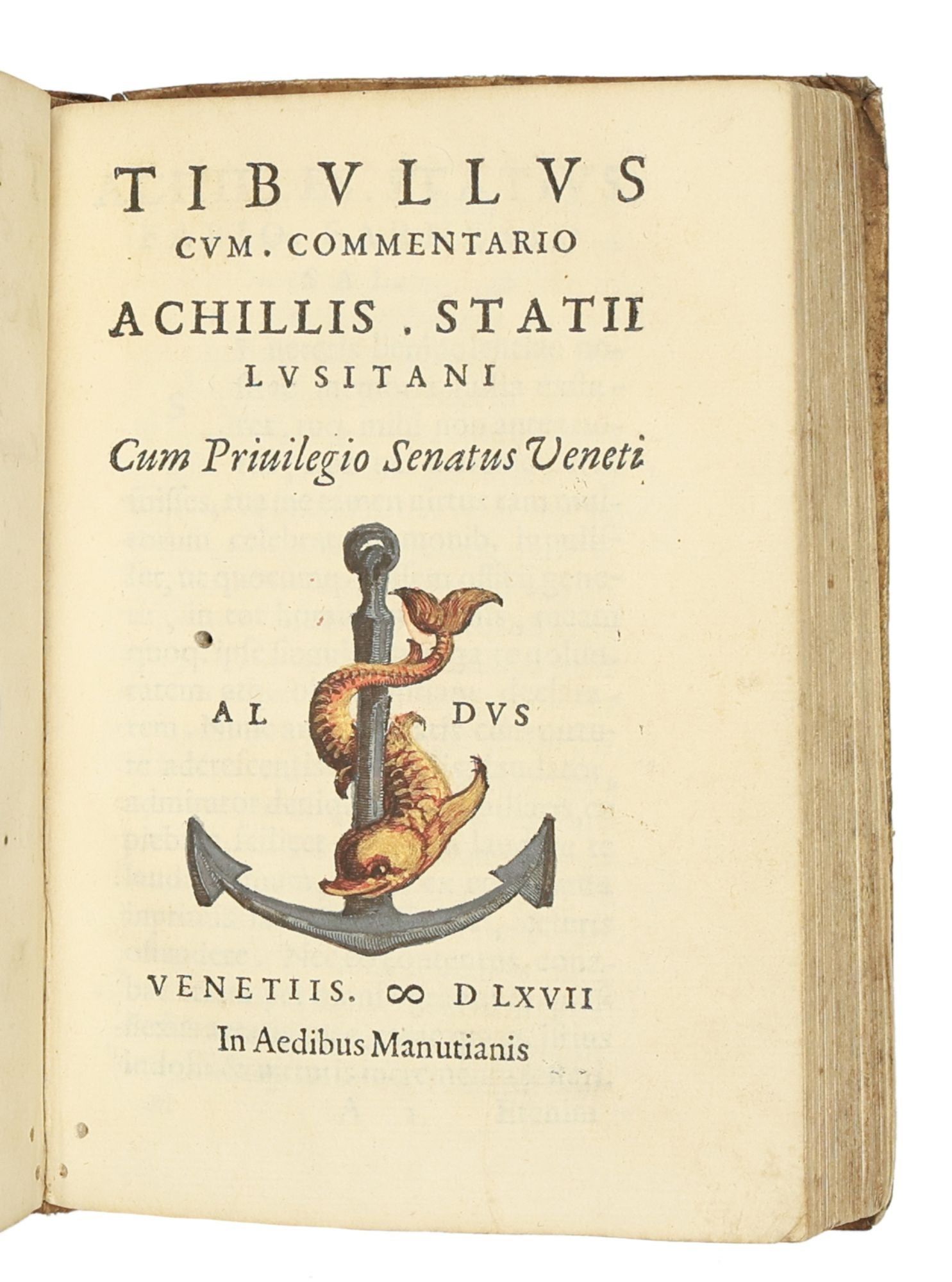
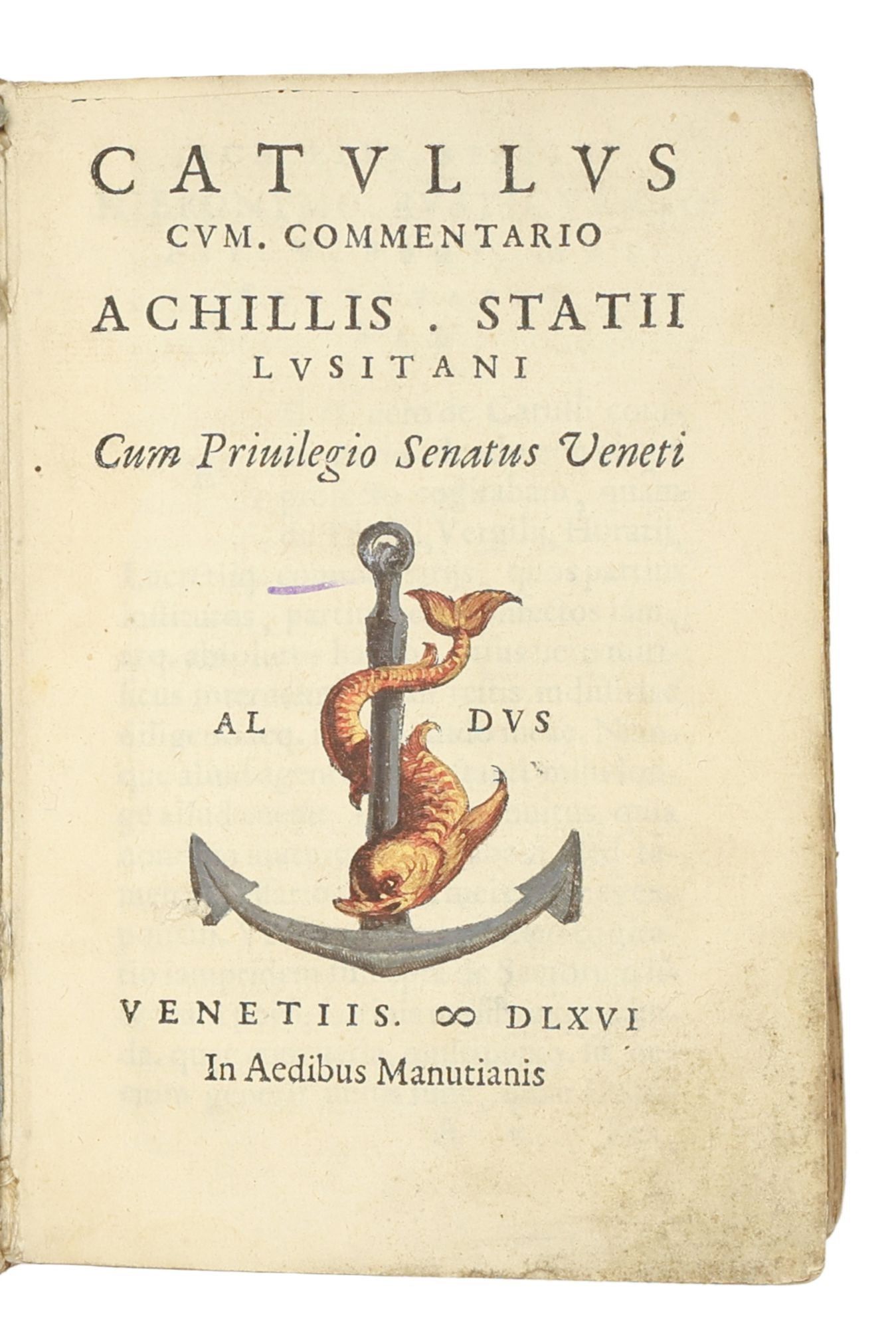
Catvllvs cvm commentario Achillis Statii Lvsitani [Bound with]: Tibvllvs cvm commentario Achillis Statii Lvsitani
- Hardcover
- Venice: In aedibus Manutianus, 1566 and, 1567
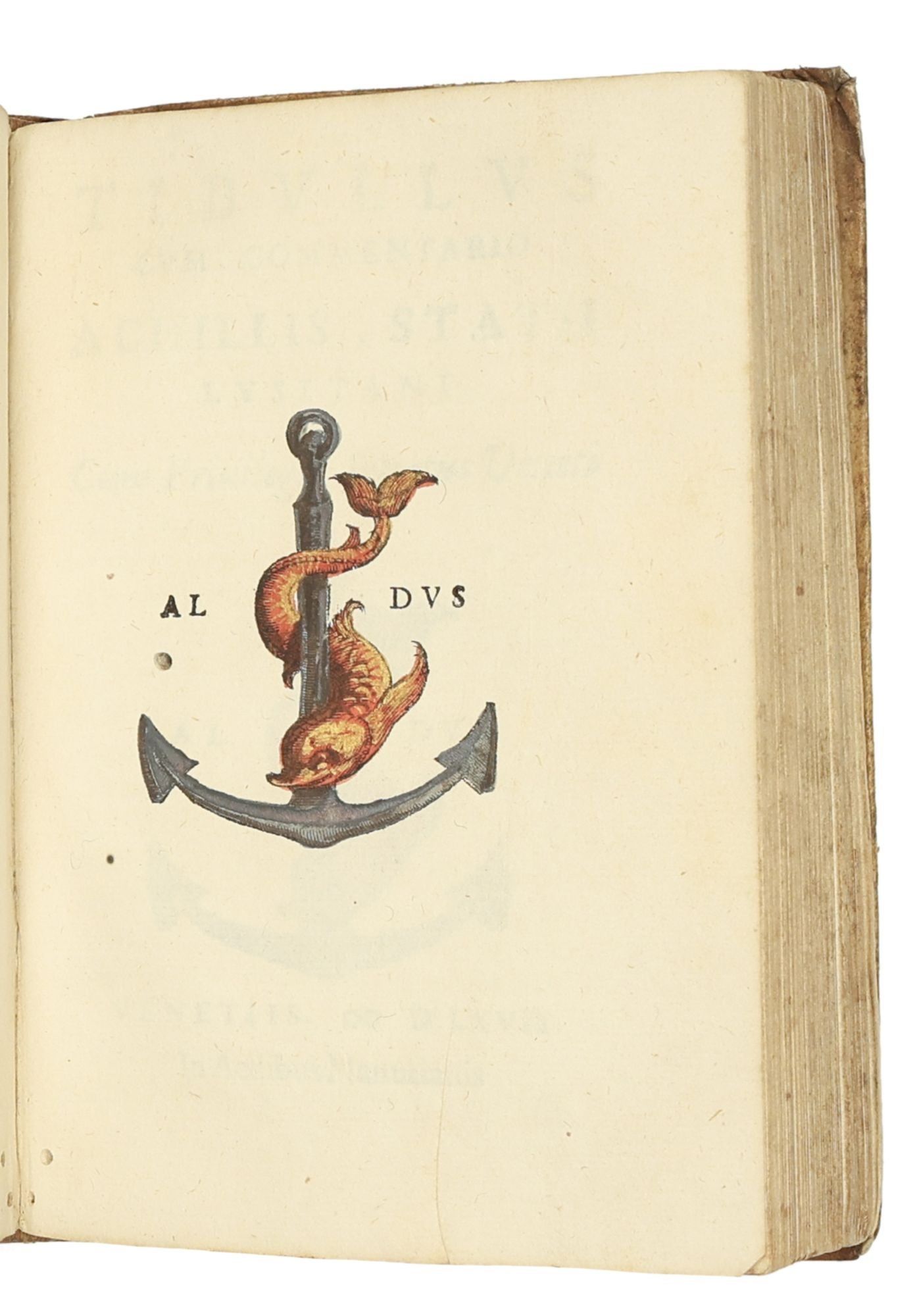
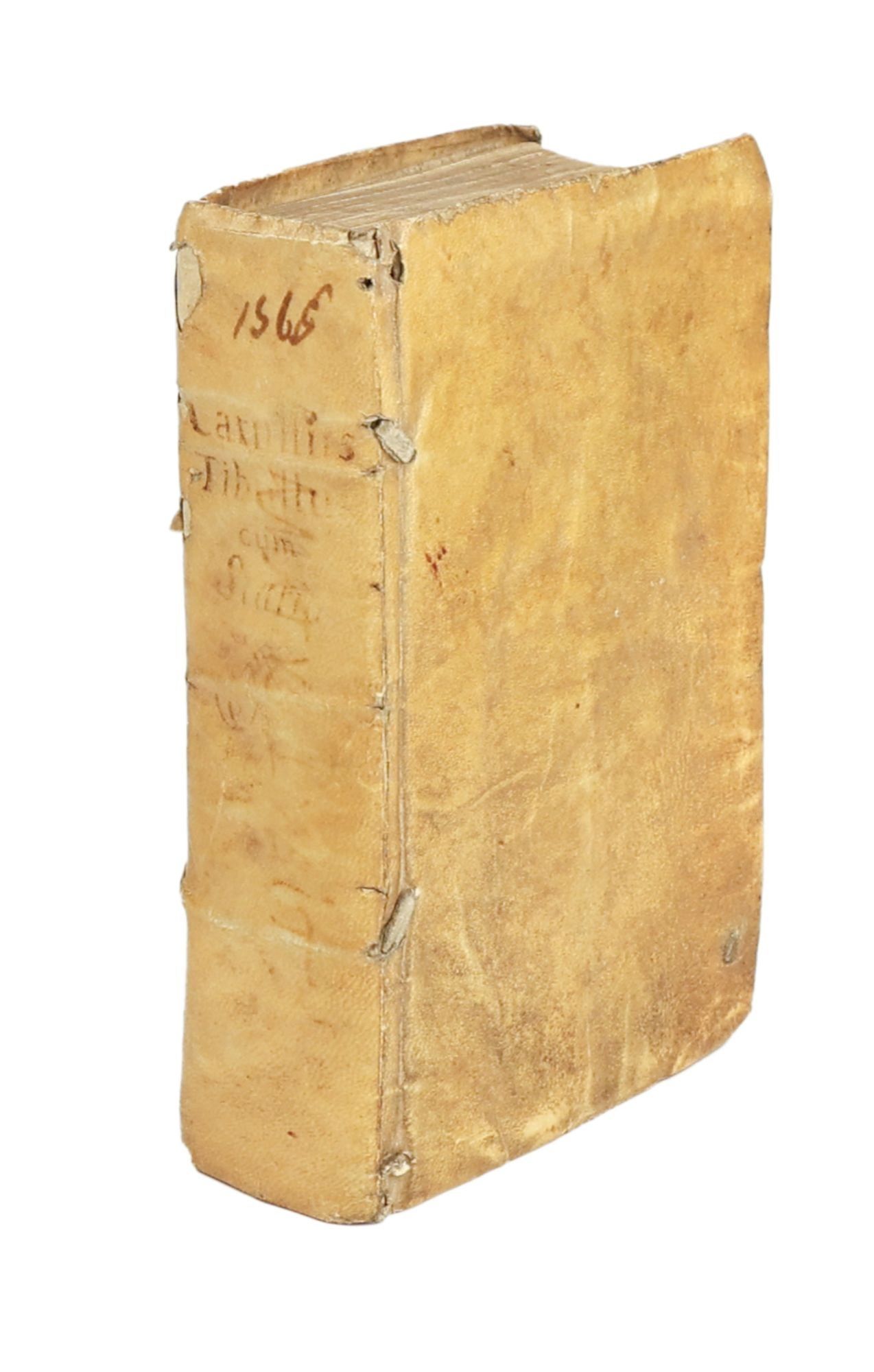
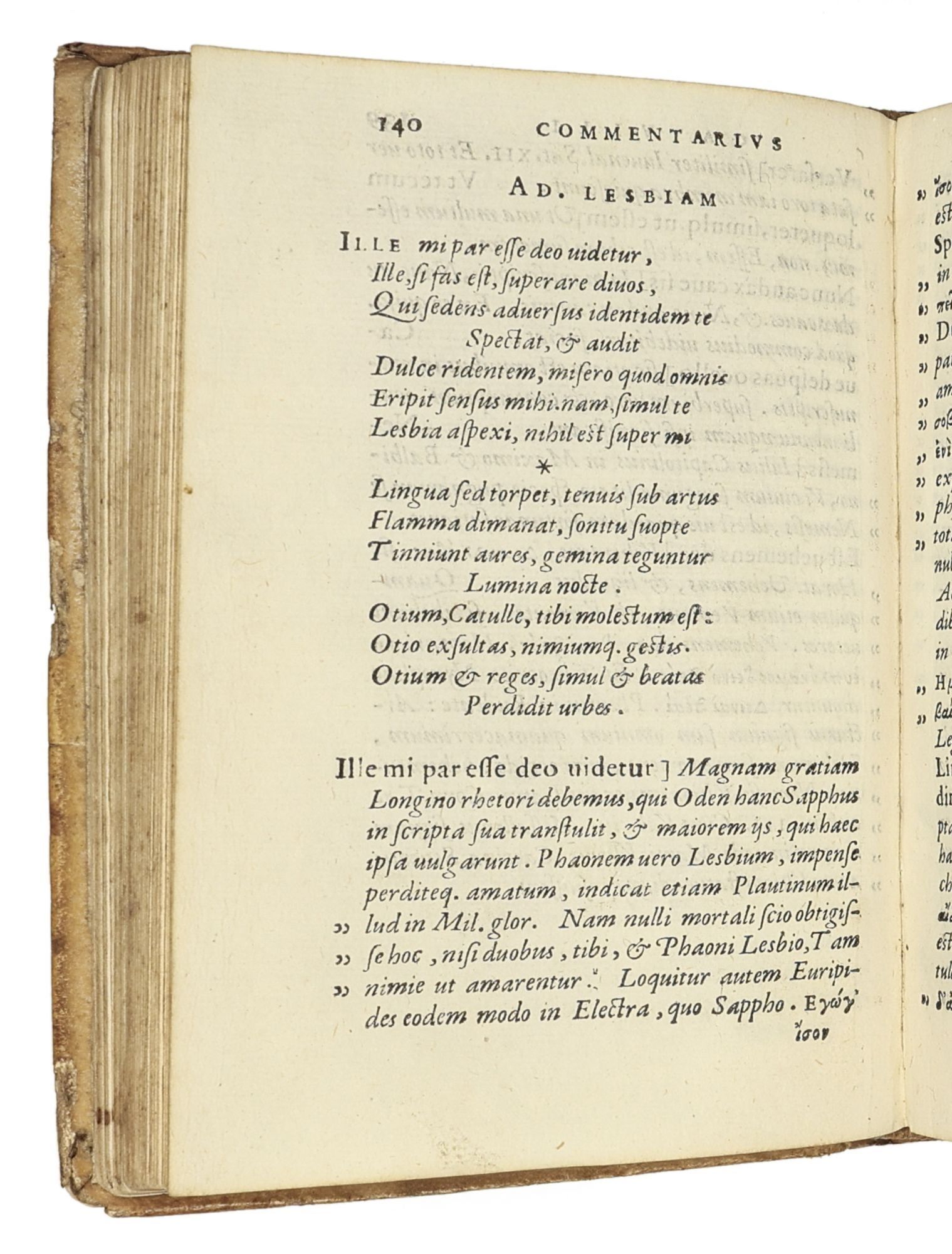
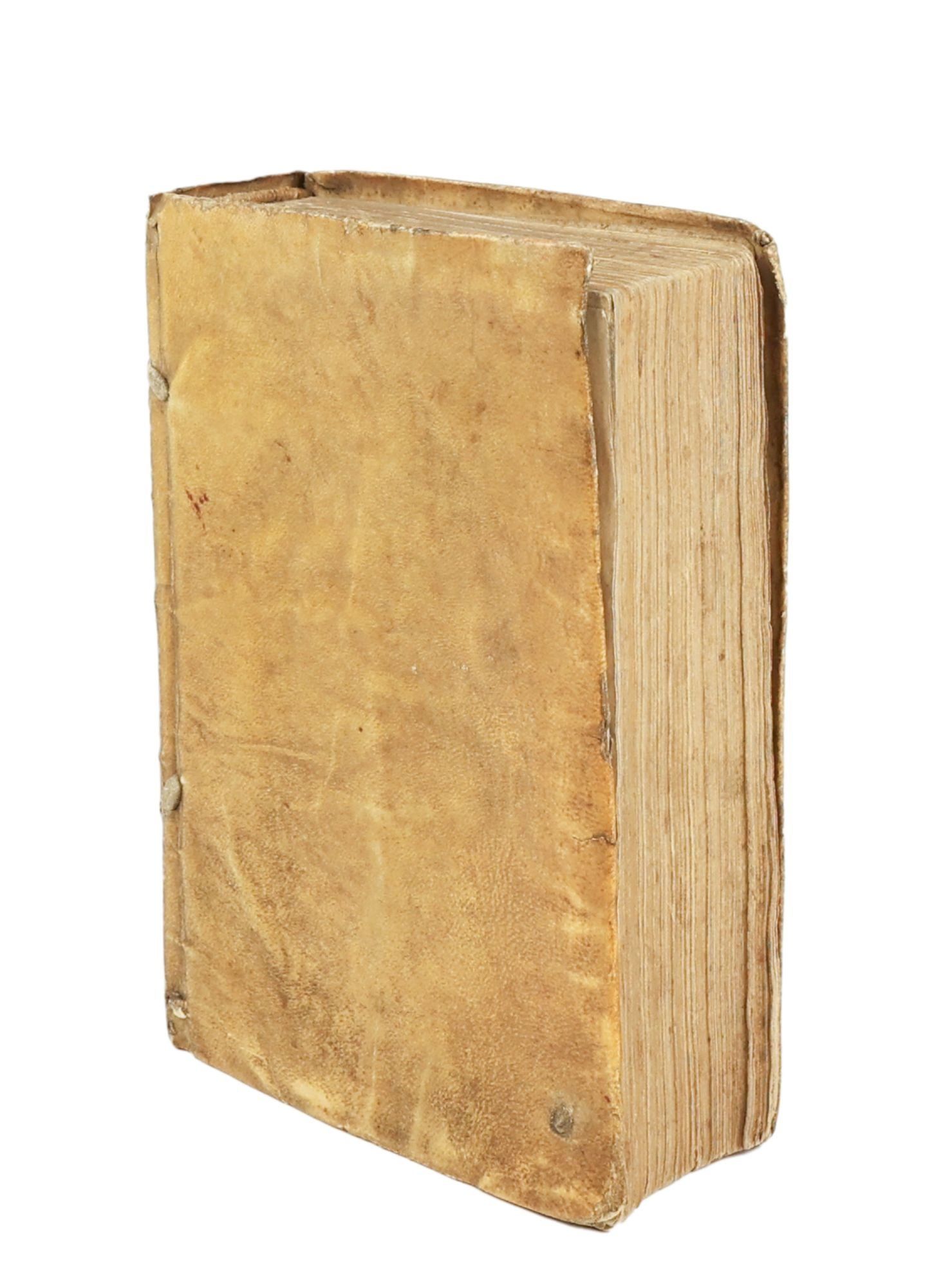
Venice: In aedibus Manutianus, 1566 and, 1567. WITH THE FIRST APPEARANCE OF AQUILES ESTAÇO’S COMMENTARIES. Hardcover. Fine. Bound in contemporary limp vellum (soiled, minor losses to vellum, lacking ties). Internally very good copies with a minor worm-trail in the blank gutter. Two small wormholes in the text. Minor soiling, a few marginal damp-stains, one gathering lightly browned (in Tibullus). All three Aldine devices nicely colored in a contemporary hand. Edited by the Portuguese humanist Aquiles Estaço (1524-1581), known as “Achilles Statius”. He was the first Catullan scholar to note the disjunction between Catullus 2 and its last three verses (Catullus 2b): “et vero haec cum superioribus usquequaque non cohaerent.”(p. 20)
“Achilles Statius (Aquiles Estaço) is a fundamental figure in the cultural landscape that characterized the papal city in the second half of the 1500s. Born in Valdiguera (Vidigueira) in 1524, he lived as a child in Parnambuco to follow his father, a career soldier, Upon his return to Portugal, he immersed himself in his studies under the aegis of prestigious teachers such as the grammarian and geographer João de Barros and the Latinist André de Resende. He completed his education in Coimbra with Azpilcueta and then in Paris and in Flanders, acquiring knowledge on the classics, poetry, and other fields that enabled him to absorb theology and interpret the sacred texts. He passed through Venice and Padua and finally settled in Rome where he had the opportunity to penetrate the cultural, religious and political life of the papal court… He was able to create in Rome a dense network of contacts in different fields, allowing him to experience up close the political, religious and cultural activities of the papal curia and the political and diplomatic actions carried out by the Lusitanian crown.”(Isabella Iannuzzi)
“Statius began the study of the Latin poets as a preparation for translating the Psalms and other scriptural passages into Latin verse, for he wanted to be able to represent the variety of biblical poetry with an appropriate rhythmic and metrical diversity. In the course of his reading he made detailed notes on Tibullus, Vergil, Lucretius, and Horace, as well as Catullus; urged by his friends to publish his work, he decided to begin with Catullus (1566). A commentary of Tibullus appeared in 1567. Statius' commentaries on the other poets were never published…
“Statius carried out his intention of writing sacred poetry in classical meters, for his paraphrases of the Psalms are to be found in a manuscript at the Biblioteca Vallicelliana (B 106), together with his Carmina sacra and Carmina profana. The poems contain little that is obviously Catullan, but they live up to the promise of metrical variety implied in the preface to the commentary on Catullus…
“In his commentary Statius is principally interested in textual problems, but he also makes a number of literary observations, usually on the effectiveness of individual words or phrases in their context. He not only explicates Catullan usage with the usual range of Latin and Greek authors but also frequently refers to inscriptions. His commentary contains numerous references to specific manuscripts and often cites the interpretations and emendations of other humanists, many of whom were his friends and contemporaries. Among others, he mentions Angelus Colotius, Fulvius Ursinus, Jacobus Corbinellus, Petrus Victorius, and Antonius Augustinus. That he never mentions the work of Muretus suggests an antagonism or rivalry between the two scholars, at least on Statius' part.”(Gaiser, Catullus, CTC VII, p. 265)
Catullus:
"Catullus’ name and poetry are traditionally associated with the 'neoteric revolution'; indeed, they are the most important document of it. It is a revolution in literary taste but also a revolution in ethics. While at a time of acute crisis for the Republic the old moral and political values of the 'civitas' are crumbling, personal 'otium' becomes the attractive alternative to communal life, the space in which to devote oneself to culture, poetry, friendship, and love. The small universe of the individual, with its joys and dramas, is identified with the very horizon of existence, and literary activity no longer turns towards epic and tragedy, the genres that speak for the state and its values, but rather toward lyric, towards personal poetry, which is introverted and suitable for embracing and expressing the small events of private life.
"[Catullus’ poetry] achieved a vast and immediate success among cultivated Latin readers. In particular, it exercised a profound influence upon the Augustan poets (with the exception of Horace). Not only the elegists, who regard Catullus as one of their most important literary ancestors, but also the Vergil of the 'Eclogues' and the Dido episode slip irresistibly into the language of Catullus when they combine erotic passion with refined diction and baroque style."(Conte)
Tibullus:
"[Tibullus’] style reveals at every point, and with extraordinary regularity, the effort made towards a writing of extreme care, in which simplicity itself is the laborious result of an artistic choice, or rather the visible sign of a trust in words and their expressive force, without the need for distortions or pathetic intensifications of the discourse. The limpidity of expression seems to be the product of immediacy; the effort of composition remains hidden beneath the smooth surface of an apparently spontaneous writing… The rhythm has a certain light, singable quality, a regular cadence, which often approaches the resonance of rhyme when, with the words distributed in a balanced way between the first and the second half of the pentameter, the sounds that end the second half of the verse echoes the end of the first. This form of expression exerts a conspicuous influence on the technique of the Ovidian couplet…
"‘Terse and elegant’: thus described by Quintilian, who sees in him the classic of Roman elegiac poetry, Tibullus is already admired by the ancients for his style, which is simple and luminous, free and refined. The lexical purity, the fluid movement of the thoughts, harmoniously linked together and without the abrupt swerves of Propertius, the fine, delicate tones, often gently dreaming, the very economy of mythological learning, the light ironic smile-all these qualities give to his poetry the charm of stylistic maturity and expressive naturalness."(Conte).
“Achilles Statius (Aquiles Estaço) is a fundamental figure in the cultural landscape that characterized the papal city in the second half of the 1500s. Born in Valdiguera (Vidigueira) in 1524, he lived as a child in Parnambuco to follow his father, a career soldier, Upon his return to Portugal, he immersed himself in his studies under the aegis of prestigious teachers such as the grammarian and geographer João de Barros and the Latinist André de Resende. He completed his education in Coimbra with Azpilcueta and then in Paris and in Flanders, acquiring knowledge on the classics, poetry, and other fields that enabled him to absorb theology and interpret the sacred texts. He passed through Venice and Padua and finally settled in Rome where he had the opportunity to penetrate the cultural, religious and political life of the papal court… He was able to create in Rome a dense network of contacts in different fields, allowing him to experience up close the political, religious and cultural activities of the papal curia and the political and diplomatic actions carried out by the Lusitanian crown.”(Isabella Iannuzzi)
“Statius began the study of the Latin poets as a preparation for translating the Psalms and other scriptural passages into Latin verse, for he wanted to be able to represent the variety of biblical poetry with an appropriate rhythmic and metrical diversity. In the course of his reading he made detailed notes on Tibullus, Vergil, Lucretius, and Horace, as well as Catullus; urged by his friends to publish his work, he decided to begin with Catullus (1566). A commentary of Tibullus appeared in 1567. Statius' commentaries on the other poets were never published…
“Statius carried out his intention of writing sacred poetry in classical meters, for his paraphrases of the Psalms are to be found in a manuscript at the Biblioteca Vallicelliana (B 106), together with his Carmina sacra and Carmina profana. The poems contain little that is obviously Catullan, but they live up to the promise of metrical variety implied in the preface to the commentary on Catullus…
“In his commentary Statius is principally interested in textual problems, but he also makes a number of literary observations, usually on the effectiveness of individual words or phrases in their context. He not only explicates Catullan usage with the usual range of Latin and Greek authors but also frequently refers to inscriptions. His commentary contains numerous references to specific manuscripts and often cites the interpretations and emendations of other humanists, many of whom were his friends and contemporaries. Among others, he mentions Angelus Colotius, Fulvius Ursinus, Jacobus Corbinellus, Petrus Victorius, and Antonius Augustinus. That he never mentions the work of Muretus suggests an antagonism or rivalry between the two scholars, at least on Statius' part.”(Gaiser, Catullus, CTC VII, p. 265)
Catullus:
"Catullus’ name and poetry are traditionally associated with the 'neoteric revolution'; indeed, they are the most important document of it. It is a revolution in literary taste but also a revolution in ethics. While at a time of acute crisis for the Republic the old moral and political values of the 'civitas' are crumbling, personal 'otium' becomes the attractive alternative to communal life, the space in which to devote oneself to culture, poetry, friendship, and love. The small universe of the individual, with its joys and dramas, is identified with the very horizon of existence, and literary activity no longer turns towards epic and tragedy, the genres that speak for the state and its values, but rather toward lyric, towards personal poetry, which is introverted and suitable for embracing and expressing the small events of private life.
"[Catullus’ poetry] achieved a vast and immediate success among cultivated Latin readers. In particular, it exercised a profound influence upon the Augustan poets (with the exception of Horace). Not only the elegists, who regard Catullus as one of their most important literary ancestors, but also the Vergil of the 'Eclogues' and the Dido episode slip irresistibly into the language of Catullus when they combine erotic passion with refined diction and baroque style."(Conte)
Tibullus:
"[Tibullus’] style reveals at every point, and with extraordinary regularity, the effort made towards a writing of extreme care, in which simplicity itself is the laborious result of an artistic choice, or rather the visible sign of a trust in words and their expressive force, without the need for distortions or pathetic intensifications of the discourse. The limpidity of expression seems to be the product of immediacy; the effort of composition remains hidden beneath the smooth surface of an apparently spontaneous writing… The rhythm has a certain light, singable quality, a regular cadence, which often approaches the resonance of rhyme when, with the words distributed in a balanced way between the first and the second half of the pentameter, the sounds that end the second half of the verse echoes the end of the first. This form of expression exerts a conspicuous influence on the technique of the Ovidian couplet…
"‘Terse and elegant’: thus described by Quintilian, who sees in him the classic of Roman elegiac poetry, Tibullus is already admired by the ancients for his style, which is simple and luminous, free and refined. The lexical purity, the fluid movement of the thoughts, harmoniously linked together and without the abrupt swerves of Propertius, the fine, delicate tones, often gently dreaming, the very economy of mythological learning, the light ironic smile-all these qualities give to his poetry the charm of stylistic maturity and expressive naturalness."(Conte).
Details
Title
Catvllvs cvm commentario Achillis Statii Lvsitani [Bound with]: Tibvllvs cvm commentario Achillis Statii Lvsitani
Author
Catullus, Gaius Valerius (ca. 84-54 BC); Tibullus (ca. 50-18 BC)
Binding
Hardcover
Condition
Fine
Publisher
In aedibus Manutianus, 1566 and: Venice
Date
1567
Edition
WITH THE FIRST APPEARANCE OF AQUILES ESTAÇO’S COMMENTARIES