

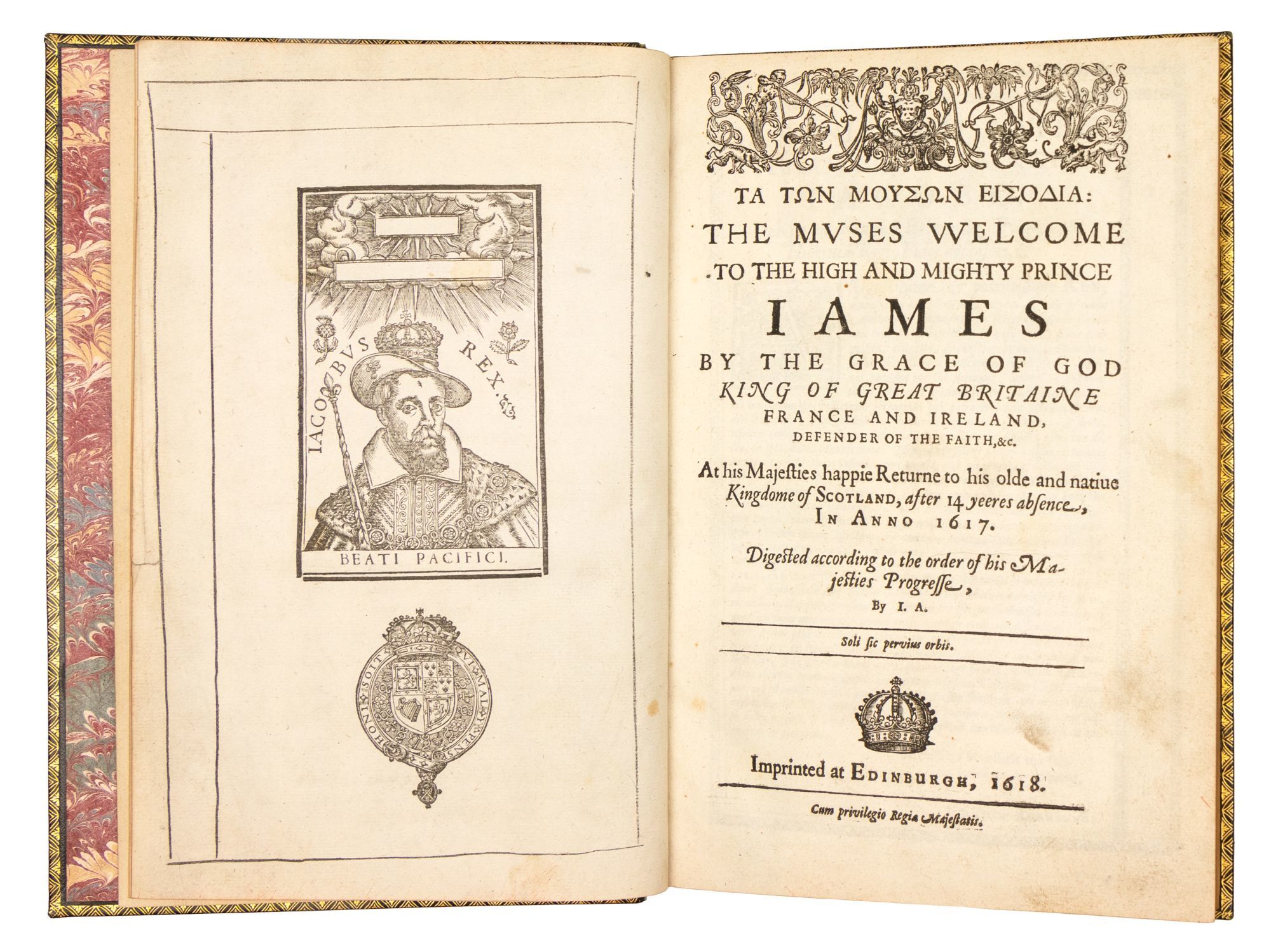
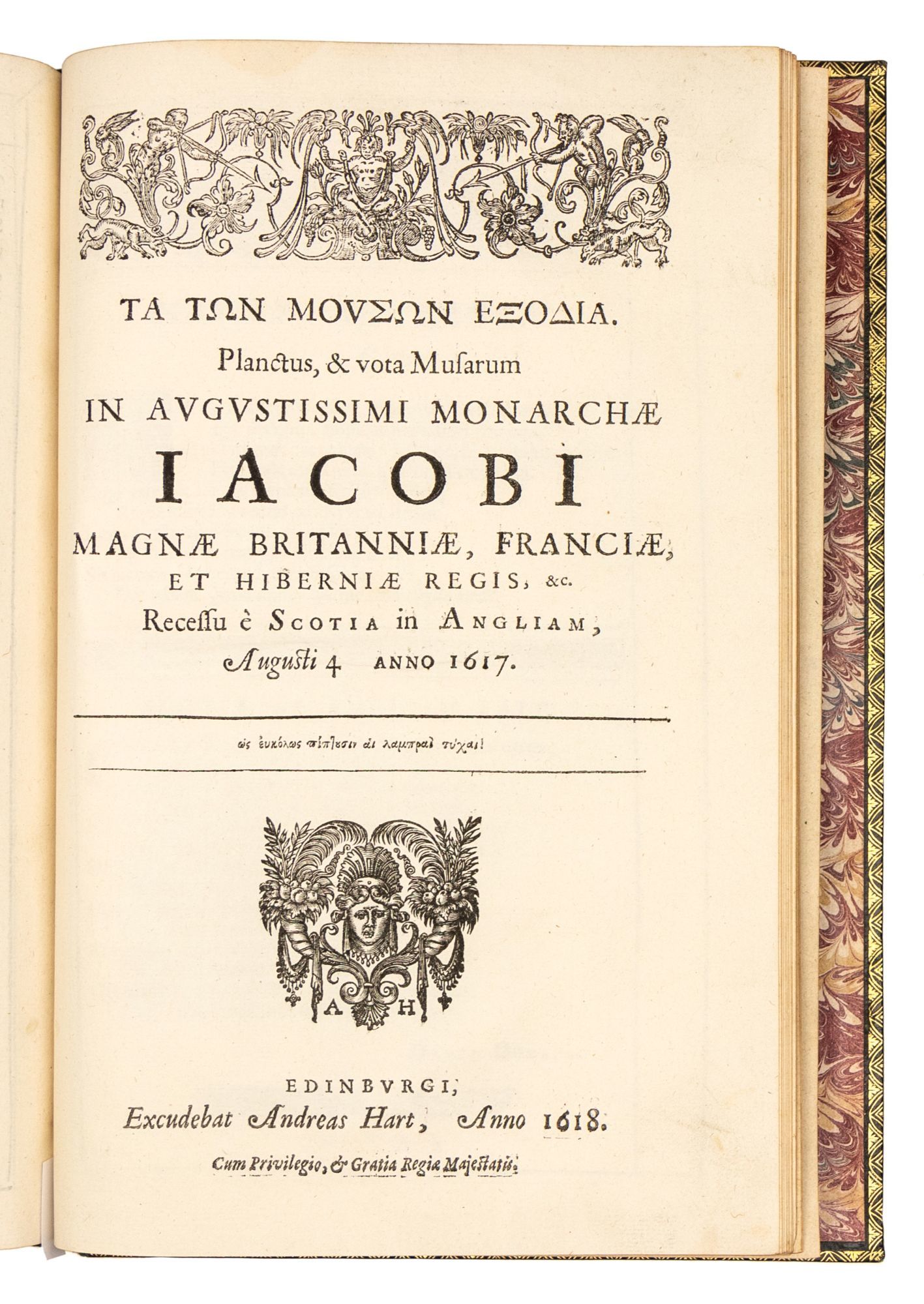
Ta tōn Mousōn eisodia: = The Muses welcome to the high and mightie prince Iames by the grace of God King of Great Britaine France and Ireland, defender of the faith &c. At His Majesties happie returne to his olde and natiue kingdome of Scotland, after 14 yeeres absence, in anno 1617. Digested according to the order of his Majesties progresse, by I.A. [bound with, as often] Ta tōn Musōn exodia (STC 142)
- Hardcover
- Imprinted at Edinburgh: [s.n.], 1618
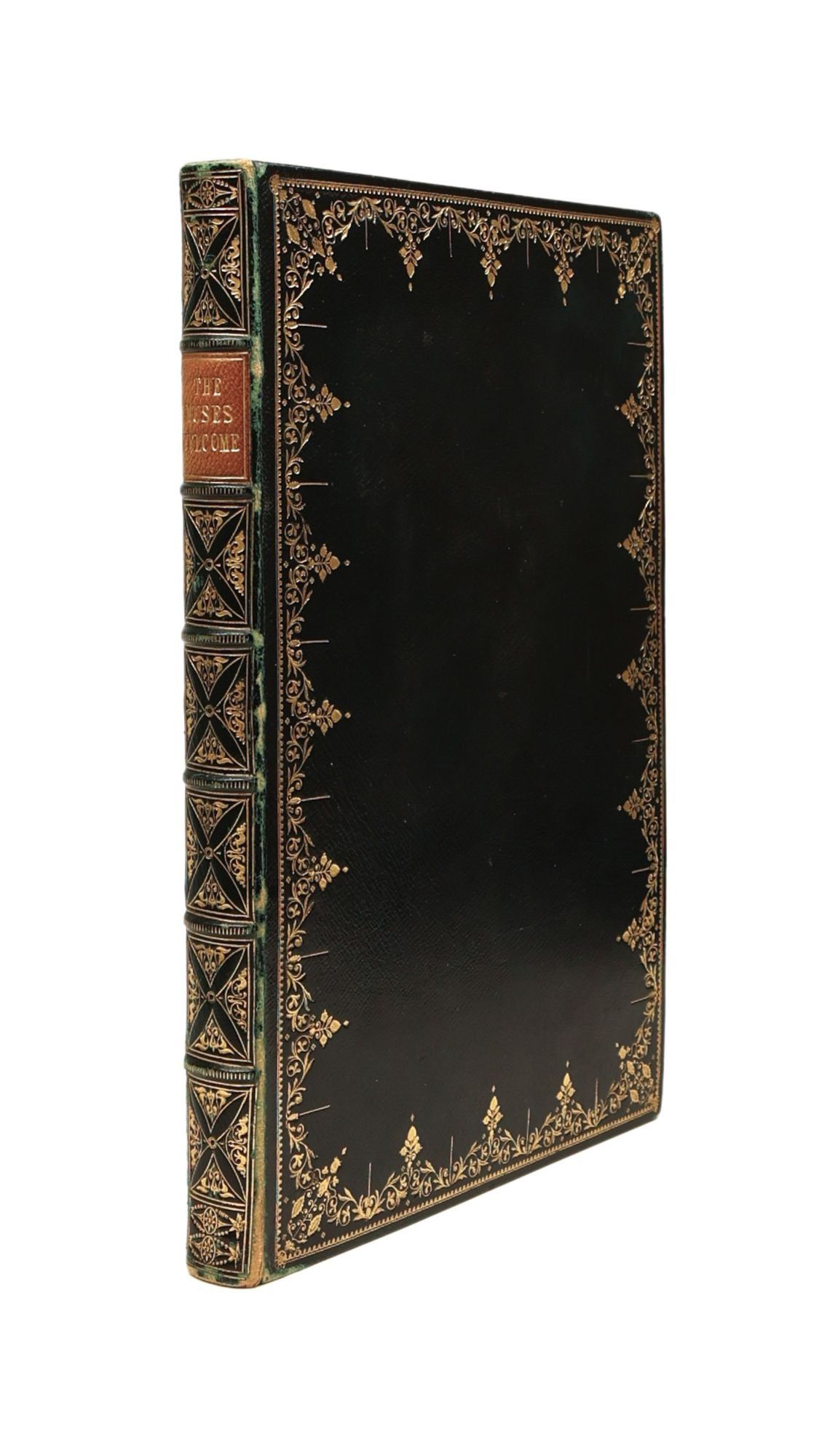
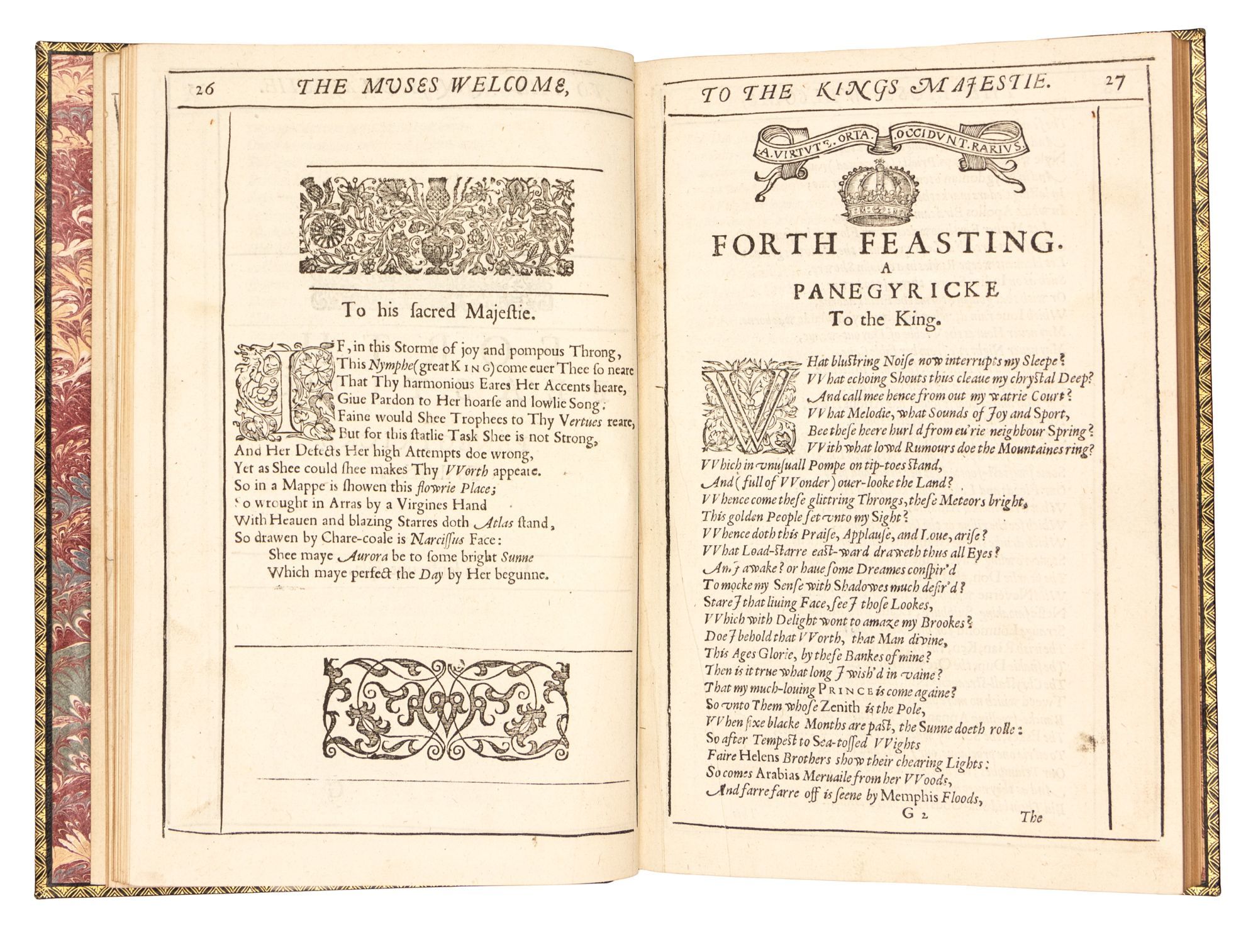
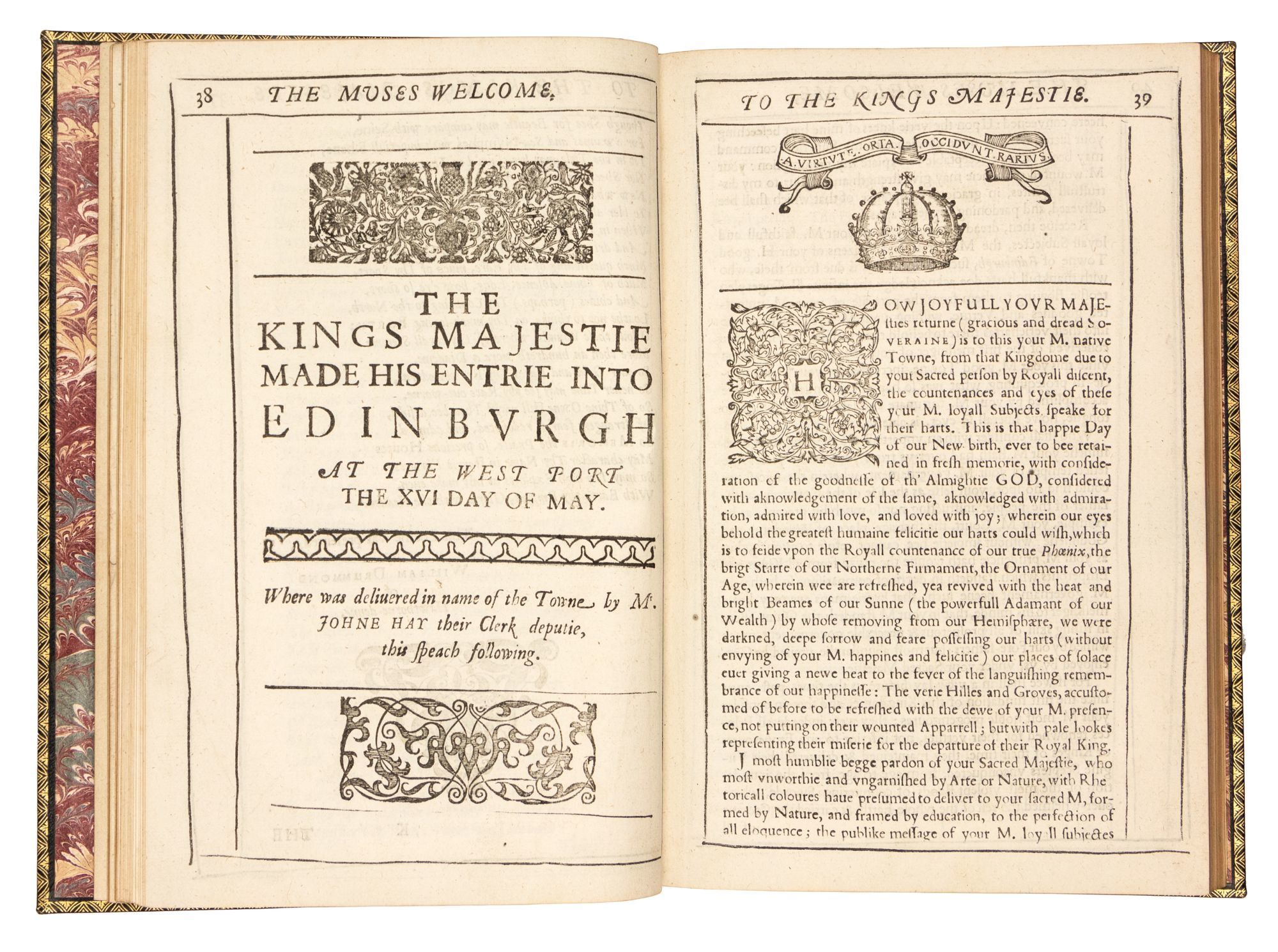
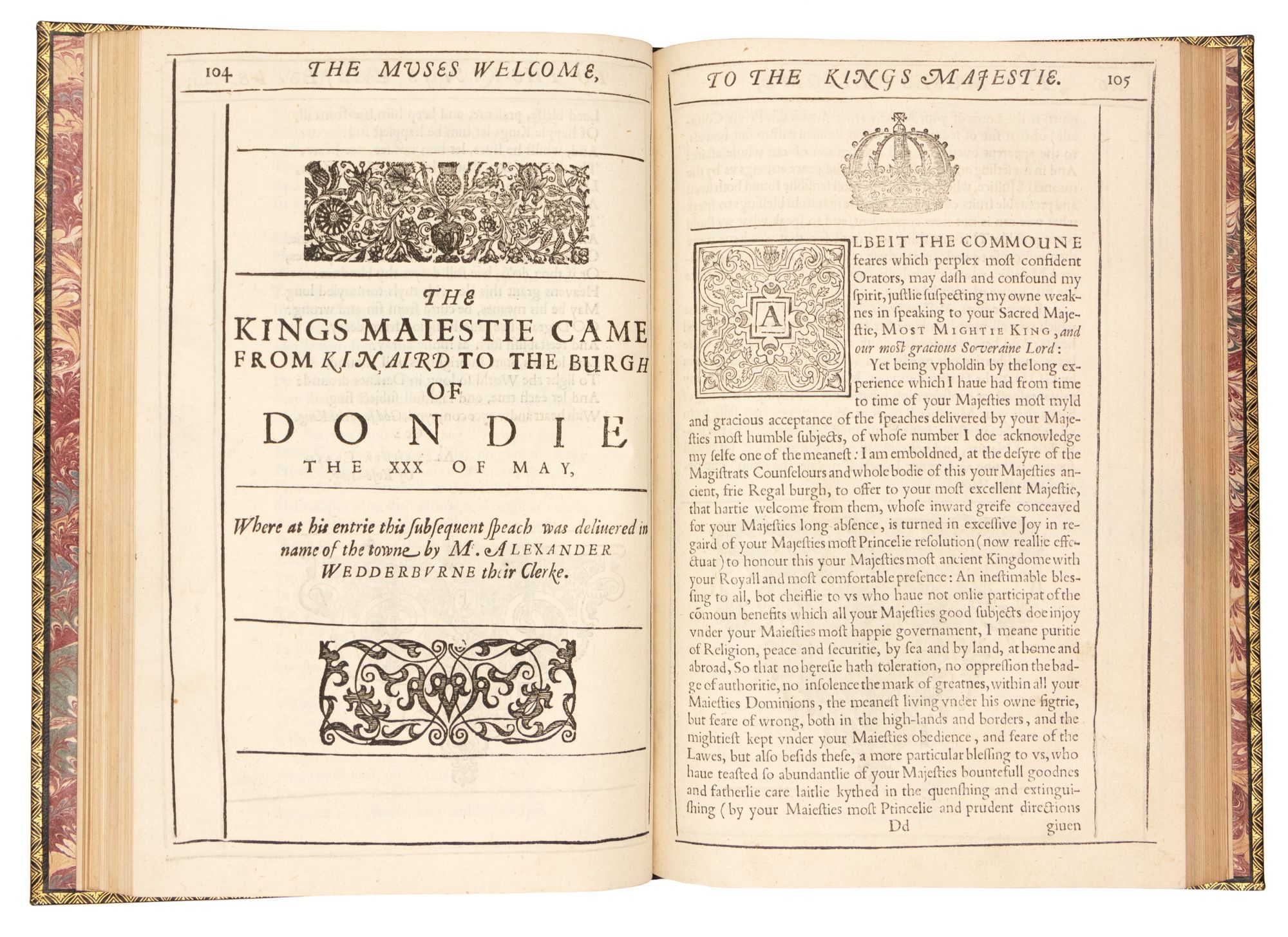
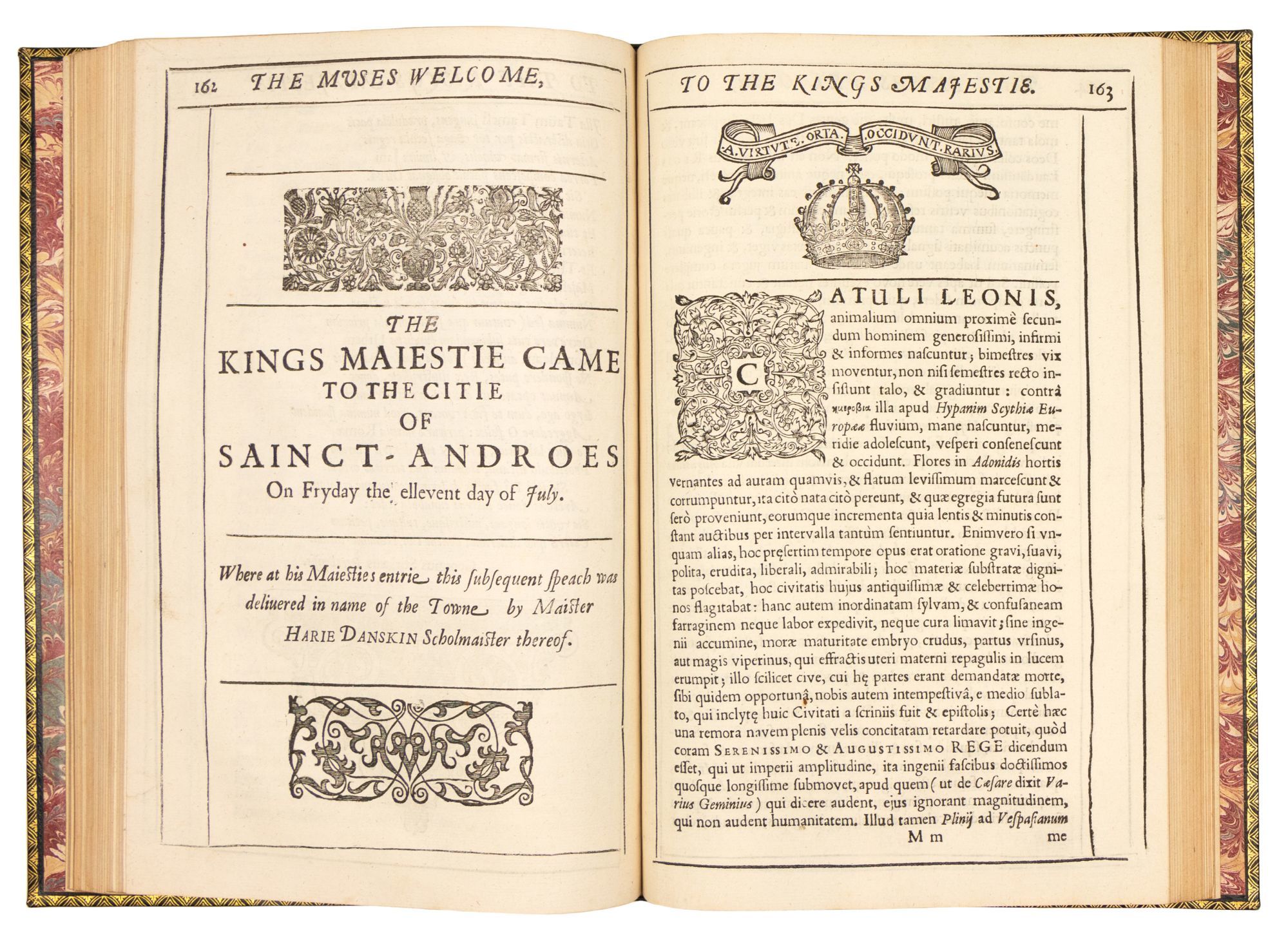
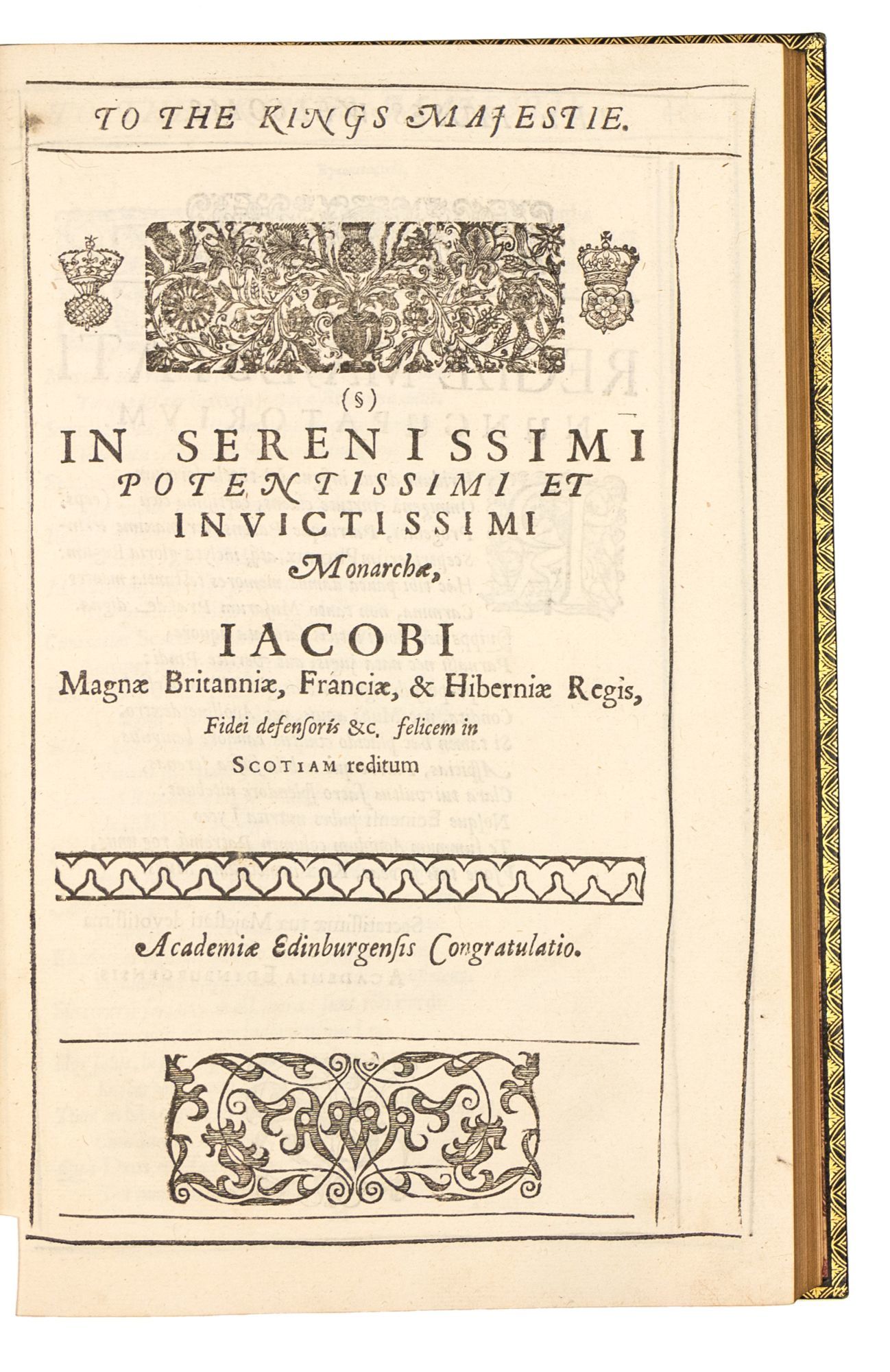
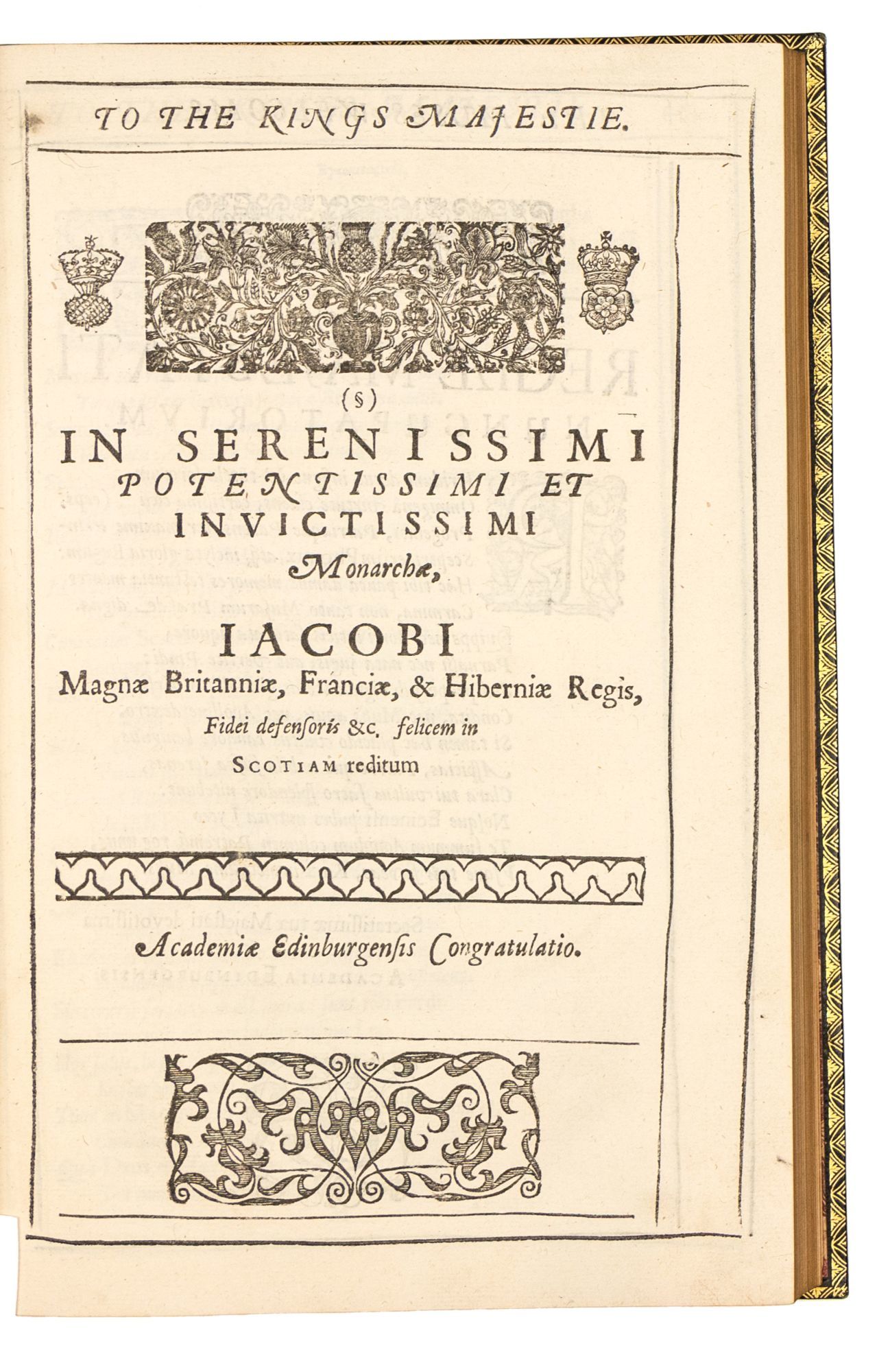
Imprinted at Edinburgh: [s.n.], 1618. FIRST EDITION, SECOND ISSUE. "A reissue of STC 140 (Edinburgh: Thomas Finlason, 1618). Hardcover. Fine. With cancel title page and dedication printed by A. Hart; Page 109-12 are a cancel bifolium printed in London by the Eliot's Court Press. Cf. STC. This copy is bound with bound with, as often, "Ta tōn Musōn exodia" (see STC 142). There are two variants of Hart's issue, the other with line 3 in the title reading "To the High and". A woodcut portrait of King James VI/I and the royal arms appears on the first leaf. The text is richly adorned with a variety of woodcut ornaments and elaborate initials. A fine copy in 19th c. straight-grain green morocco, richly tooled in gold (hinges rubbed, with light wear at the head and foot of the spine.) The text is in excellent condition with just some light stains on p. 142-3, a small natural paper flaw affecting a few letters on leaf Pp3, and a light water-stain to leaf Xx2.
A splendid production, promoted by King James VI and I himself, commemorating the king's return to Scotland in 1617, where he was presented with poems of welcome and praise, collected in this deluxe volume. In addition to the Latin poems, the book features three English poems: William Drummond's "Forth Feasting" and two untitled poems by Alexander Craig (ca. 1567-1624), delivered at Kinnaird, and William Mure (1594-1657), presented at Hamilton; and a number of English speeches. There are also seven poems in Greek. "Each of the relevant stages in the king's progress is introduced (with a few exceptions, where space is tight) on a separate and impressive title page, with details of the date and place....
"With over sixty individual contributors, 'The Muses' Welcome to the High and Mightie Prince James' (henceforth TMW) was written on the occasion of the return of King James VI and I to Scotland, after fourteen years, in 1617. Its acclamations are delivered with considerable ingenuity and skill in more than 130 poems, which range in length from short epigrams to much longer hexameter panegyrics. Such an assembly of verse to celebrate an itinerant sovereign has few if any parallels in any Neo-Latin context. Moreover, TMW is presented as a travelogue: a record, with precise dates, of the king's journey or 'progress' through some fifteen towns and other places in his northern realm, from Dundee to Drumlanrig (two visits are noted for Stirling, and at least two for Edinburgh. The poets form part of a landscape, an unselfconsciously Latinised landscape, which they rejoice to see rejuvenated by James' return...
"TMW is a snapshot of Scotland in a particular summer, or rather perhaps a group photograph (one of the livelier kind). A real work of cerebration as well as celebration by the Scottish towns and cities, TMW is testimony to Scotland's cultural and educational achievements, at a moment which coincides with the zenith of Scottish Latin verse. Finally-though of course this is the first point that the reader experiences-TMW is a delight to handle and peruse, because of its generous dimensions, its use throughout of a large italic font, its ample spacing, and its clear and dignified announcement of each new place visited and the date of arrival. This fine appearance is hardly surprising, for it was commissioned by the king himself, evidently well pleased by the poetic homage presented to him in these three months, and entrusted by him to Edinburgh's leading printers. He also made careful provision for the distribution of eighty copies, which may or may not comprise the whole print run...
"The [King's] itinerary according to TMW is as follows: Dunglass, Seton, Edinburgh, Falkland, Kinnaird, Dundee, Edinburgh a second time, Dalkeith, Stirling, Perth, St. Andrews, Stirling a second time, Glasgow, Paisley, Hamilton, Sanquhar, Drumlanrig, Dumfries. It confines itself to the places where the king was welcomed with 'poesies' or, occasionally, just a speech. The McNeills ("The Scottish progress of James VI, 1617") add to this from their own viewpoint, but only in a single place is there a significant difference. They add, with good evidence, James' journey to Cavard from Dunglass...
"The arranging and organising of the ambitious poetic timetable and the 'call for poems' would have been no easy task. Suitable poets would have to be found, involving local initiative but also tight central planning. And of course it was advisable that the eventual poetry be vetted for quality and sensitivity. Many of the writers in TMW are unknown or little-known, though in some places we can see better-known poets contributing their talents. In no case do we find that a poem has been recycled from another location, and although, inevitably, evidence of shared sentiments, and sometimes similar verbal expression, do appear, the absence of overlap or borrowing (let alone plagiarism) is notable."
At least 80 copies were printed, at the King's request: "The dean of his majesty's chapel, William, bishop of Galloway, was tasked with the provision of eighty copies, with forty going to the king and forty to be distributed "amongst the prelattis, nobilitie, and counsellouris" of the kingdom. Whether the king's chosen printers, named as Finlason and Hart, to whom this directive was sent, confined themselves to the eighty copies required by James is not certain; there was surely potential demand from people over and above the people specified, such as teachers and university staff, and other members of the general public who were familiar with Latin...
"The picture of himself as a king outstanding in justice and virtue, and in religious devotion and literary patronage, will have cheered James when (one imagines) he dipped into TMW as time and health allowed. He would have found its recreation of the literary atmosphere of the great classical poets and the manipulation of the classical language in his honour gratifying, perhaps inspiring. He valued Latin highly, and the Latin of TMW is on the whole not particularly difficult for one with some experience of poetic vocabulary, of the nature of poetic word-order, and of the commoner figures of speech and thought, and with access to details of classical mythology...
"Like King James, modern readers and researchers may not, indeed should not, try to read the work, or even one or two particular sections, in one go. But perseverance and, one hopes, increasing critical attention to TMW will show the attractions of this great assemblage of poetry, ingenious in conception, varied in expression, skilful in metre, expert in articulation and ornament, astute in allusion and intertextuality, and an outstanding addition to the Latinate Scottish delights of the Jacobean era."(Gibson, The King Returns: 'The Muses' Welcome' (1618), in Neo-Latin Literature and Literary Culture in Early Modern Scotland, Ch. 5, p.126 ff.).
A splendid production, promoted by King James VI and I himself, commemorating the king's return to Scotland in 1617, where he was presented with poems of welcome and praise, collected in this deluxe volume. In addition to the Latin poems, the book features three English poems: William Drummond's "Forth Feasting" and two untitled poems by Alexander Craig (ca. 1567-1624), delivered at Kinnaird, and William Mure (1594-1657), presented at Hamilton; and a number of English speeches. There are also seven poems in Greek. "Each of the relevant stages in the king's progress is introduced (with a few exceptions, where space is tight) on a separate and impressive title page, with details of the date and place....
"With over sixty individual contributors, 'The Muses' Welcome to the High and Mightie Prince James' (henceforth TMW) was written on the occasion of the return of King James VI and I to Scotland, after fourteen years, in 1617. Its acclamations are delivered with considerable ingenuity and skill in more than 130 poems, which range in length from short epigrams to much longer hexameter panegyrics. Such an assembly of verse to celebrate an itinerant sovereign has few if any parallels in any Neo-Latin context. Moreover, TMW is presented as a travelogue: a record, with precise dates, of the king's journey or 'progress' through some fifteen towns and other places in his northern realm, from Dundee to Drumlanrig (two visits are noted for Stirling, and at least two for Edinburgh. The poets form part of a landscape, an unselfconsciously Latinised landscape, which they rejoice to see rejuvenated by James' return...
"TMW is a snapshot of Scotland in a particular summer, or rather perhaps a group photograph (one of the livelier kind). A real work of cerebration as well as celebration by the Scottish towns and cities, TMW is testimony to Scotland's cultural and educational achievements, at a moment which coincides with the zenith of Scottish Latin verse. Finally-though of course this is the first point that the reader experiences-TMW is a delight to handle and peruse, because of its generous dimensions, its use throughout of a large italic font, its ample spacing, and its clear and dignified announcement of each new place visited and the date of arrival. This fine appearance is hardly surprising, for it was commissioned by the king himself, evidently well pleased by the poetic homage presented to him in these three months, and entrusted by him to Edinburgh's leading printers. He also made careful provision for the distribution of eighty copies, which may or may not comprise the whole print run...
"The [King's] itinerary according to TMW is as follows: Dunglass, Seton, Edinburgh, Falkland, Kinnaird, Dundee, Edinburgh a second time, Dalkeith, Stirling, Perth, St. Andrews, Stirling a second time, Glasgow, Paisley, Hamilton, Sanquhar, Drumlanrig, Dumfries. It confines itself to the places where the king was welcomed with 'poesies' or, occasionally, just a speech. The McNeills ("The Scottish progress of James VI, 1617") add to this from their own viewpoint, but only in a single place is there a significant difference. They add, with good evidence, James' journey to Cavard from Dunglass...
"The arranging and organising of the ambitious poetic timetable and the 'call for poems' would have been no easy task. Suitable poets would have to be found, involving local initiative but also tight central planning. And of course it was advisable that the eventual poetry be vetted for quality and sensitivity. Many of the writers in TMW are unknown or little-known, though in some places we can see better-known poets contributing their talents. In no case do we find that a poem has been recycled from another location, and although, inevitably, evidence of shared sentiments, and sometimes similar verbal expression, do appear, the absence of overlap or borrowing (let alone plagiarism) is notable."
At least 80 copies were printed, at the King's request: "The dean of his majesty's chapel, William, bishop of Galloway, was tasked with the provision of eighty copies, with forty going to the king and forty to be distributed "amongst the prelattis, nobilitie, and counsellouris" of the kingdom. Whether the king's chosen printers, named as Finlason and Hart, to whom this directive was sent, confined themselves to the eighty copies required by James is not certain; there was surely potential demand from people over and above the people specified, such as teachers and university staff, and other members of the general public who were familiar with Latin...
"The picture of himself as a king outstanding in justice and virtue, and in religious devotion and literary patronage, will have cheered James when (one imagines) he dipped into TMW as time and health allowed. He would have found its recreation of the literary atmosphere of the great classical poets and the manipulation of the classical language in his honour gratifying, perhaps inspiring. He valued Latin highly, and the Latin of TMW is on the whole not particularly difficult for one with some experience of poetic vocabulary, of the nature of poetic word-order, and of the commoner figures of speech and thought, and with access to details of classical mythology...
"Like King James, modern readers and researchers may not, indeed should not, try to read the work, or even one or two particular sections, in one go. But perseverance and, one hopes, increasing critical attention to TMW will show the attractions of this great assemblage of poetry, ingenious in conception, varied in expression, skilful in metre, expert in articulation and ornament, astute in allusion and intertextuality, and an outstanding addition to the Latinate Scottish delights of the Jacobean era."(Gibson, The King Returns: 'The Muses' Welcome' (1618), in Neo-Latin Literature and Literary Culture in Early Modern Scotland, Ch. 5, p.126 ff.).
Details
Title
Ta tōn Mousōn eisodia: = The Muses welcome to the high and mightie prince Iames by the grace of God King of Great Britaine France and Ireland, defender of the faith &c. At His Majesties happie returne to his olde and natiue kingdome of Scotland, after 14 yeeres absence, in anno 1617. Digested according to the order of his Majesties progresse, by I.A. [bound with, as often] Ta tōn Musōn exodia (STC 142)
Author
[James I, King of England (1566-1625) & James VI of Scotland] Drummond, William (1585-1649); Hay, John, 1546-1607; Hume, David (1558-1629); Boyd, Robert (1578-1627), et al.
Binding
Hardcover
Condition
Fine
Publisher
[s.n.]: Imprinted at Edinburgh
Date
1618
Edition
FIRST EDITION, SECOND ISSUE. "A reissue of STC 140 (Edinburgh: T