

An Experiment in Modern Music: Rhapsody in Blue
- New York: Aeolian Hall, 1924
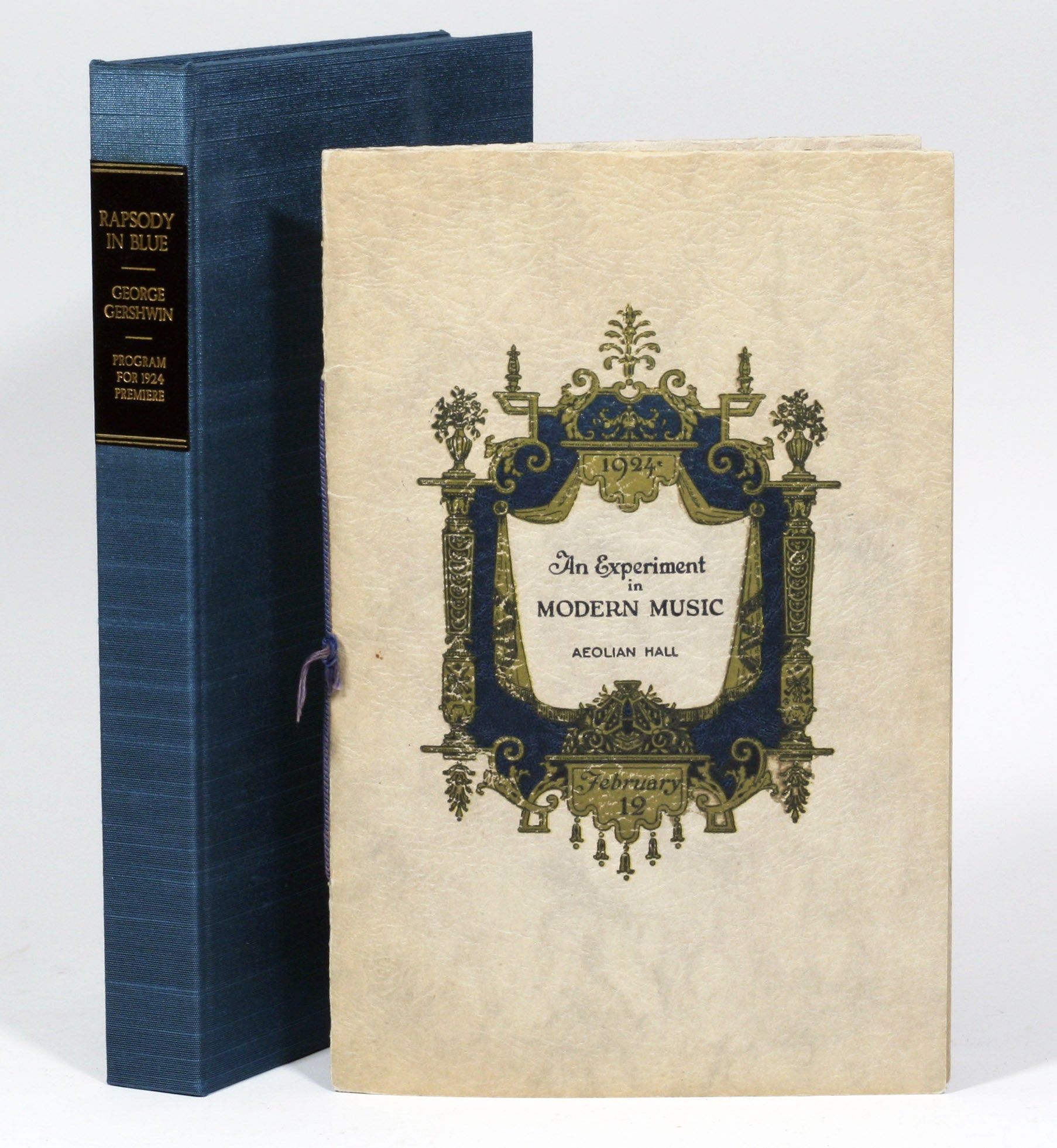
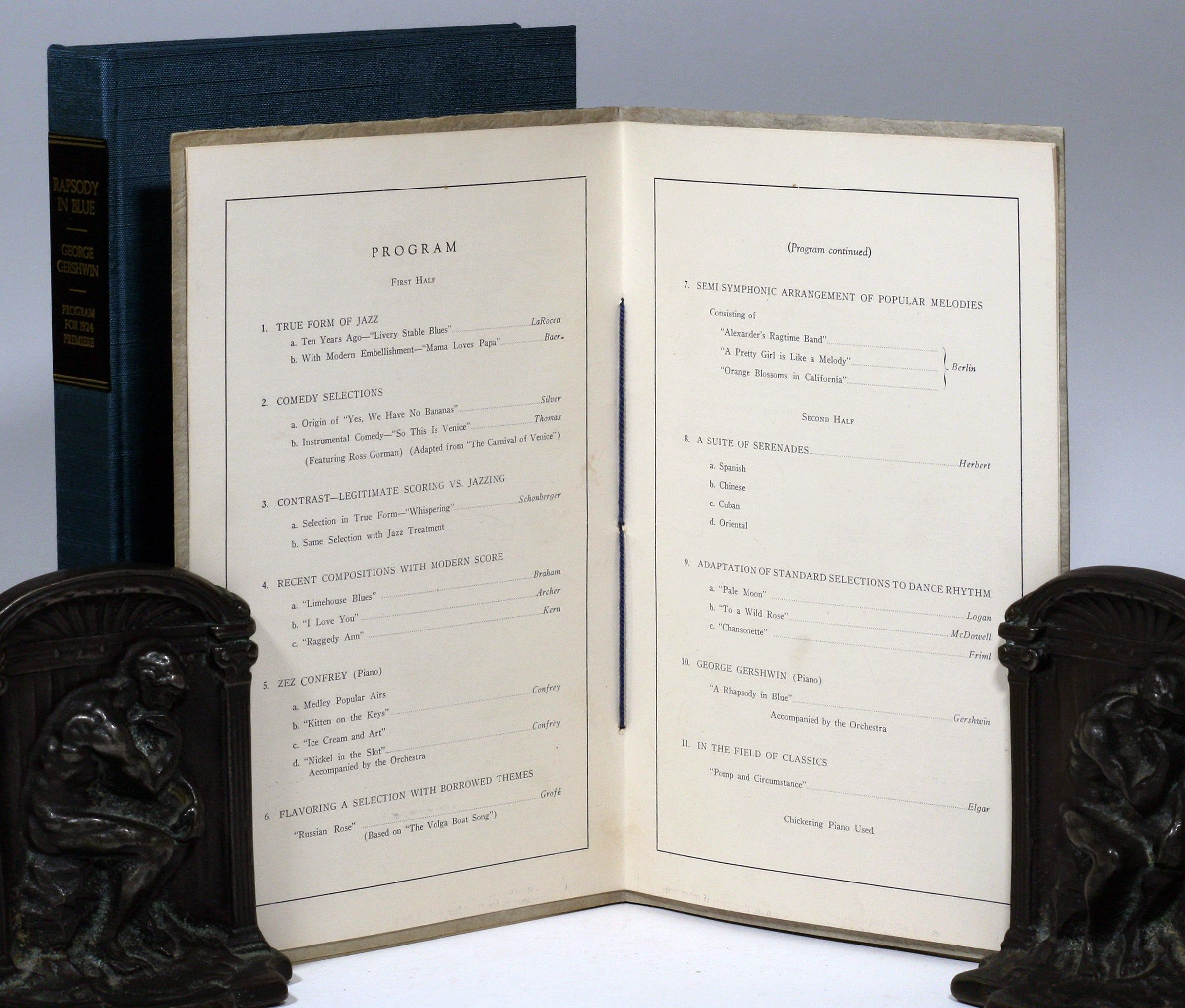
New York: Aeolian Hall, 1924. First edition. Very Good. ORIGINAL PROGRAM FOR THE FIRST PERFORMANCE OF GERSHWIN'S RHAPSODY IN BLUE. About six weeks before the premiere of Rhapsody in Blue, George Gershwin was shooting pool at the Ambassador Billiard Parlor, on Broadway and 52nd Street when his brother, Ira, entered the hall carrying an early edition of the New York Tribune. Ira proceeded to read an article from the paper, announcing a new experimental music concert organized by bandleader Paul Whiteman. In this concert, Ira continued, a piece by George Gershwin would be performed. [Adrian Symphony Orchestra]
This was news to Gershwin, who had been asked some months earlier by Whiteman to contribute a piece but had turned down the request, believing the several months not enough time. And now, Gershwin had only six weeks. Whiteman, as it turned out, had decided to include Gershwin’s name after learning his musical nemesis—Vincent Lopez—would be releasing a similar concert series. Whiteman knew Gershwin’s name would bring his concert more coverage and went ahead with the inclusion hoping to propel his concert above Lopez’s [Adrian Symphony Orchestra].
Understanding Whiteman’s difficult position, Gershwin agreed to write the piece, planning to begin work during an upcoming train ride from New York to Boston, where he was headed for an out-of-town preview for a new musical of his. Gershwin later claimed that the sounds of this train, hitching and roaring down the track, inspired the thematic division of his score into five themes: Ritornello, Train (aptly named), Stride, Shuffle, and Love. Gershwin hoped to harness the energy of modern machinery in this piece, to convey the hustle and bustle of city life. [Adrian Symphony Orchestra]; [Dotsey]
As Gershwin later commented on his writing process:
“I set to work composing with unwonted rapidity. No set plan was in my mind – no structure to which my music would conform. The rhapsody, as you see, began as a purpose, not a plan. I tried to conceive the composition as a whole. I heard it as a sort of musical kaleidoscope of America – of our vast melting-pot, of our unduplicated national pep, of our blues, our metropolitan madness.” [Dotsey]
Gershwin himself had been raised in close contact with the diverse musical traditions of the Lower East Side, exposed to the competing influences of Russian, Eastern European, African American, and popular American music. Resultantly, he decided that a mixture of jazz, classical, in conjunction with the rhythmic, and thematic implements of almost all these styles, was the perfect medium for portraying the city’s kaleidoscopic bustle. [Adrian Symphony Orchestra]
Rhapsody in Blue received mixed reviews upon its release. The New York Times noted the piece displayed “extraordinary talent,” and public opinion was largely positive. Still, many critics felt that Rhapsody in Blue lacked focus, calling it a string of disconnected themes. [Hebblethwaite], [Adrian Symphony Orchestra]
Much of this confusion stemmed from the genuinely innovative fusion at the heart of Rhapsody in Blue. As mentioned, Gershwin took classical form and infused it with the varied musical influences of his youth—blues, ragtime, Jewish folk music, and Harlem jazz. To some extent, Gerswhin’s intention was to write these genres in a way which concentrated their essence within small segments of a classical concerto, as a more culturally dominant format of music. Though some viewed these borrowings as derivative of their original cultural contexts, Gershwin’s usages of Klezmer-like arrangements, for example, nonetheless represented a groundbreaking expansion of popular music, enabling the usage of non-classical genres in dominant American culture. [Adrian Symphony Orchestra]; [Dotsey]
Later reflecting on his work, Gershwin wrote about his usage of Jazz:
“There had been so much chatter about the limitations of jazz, not to speak of the manifest misunderstandings of its function. Jazz, they said, had to be in strict time. It had to cling to dance rhythms. I resolved, if possible, to kill that misconception with one sturdy blow.” [Dotsey]
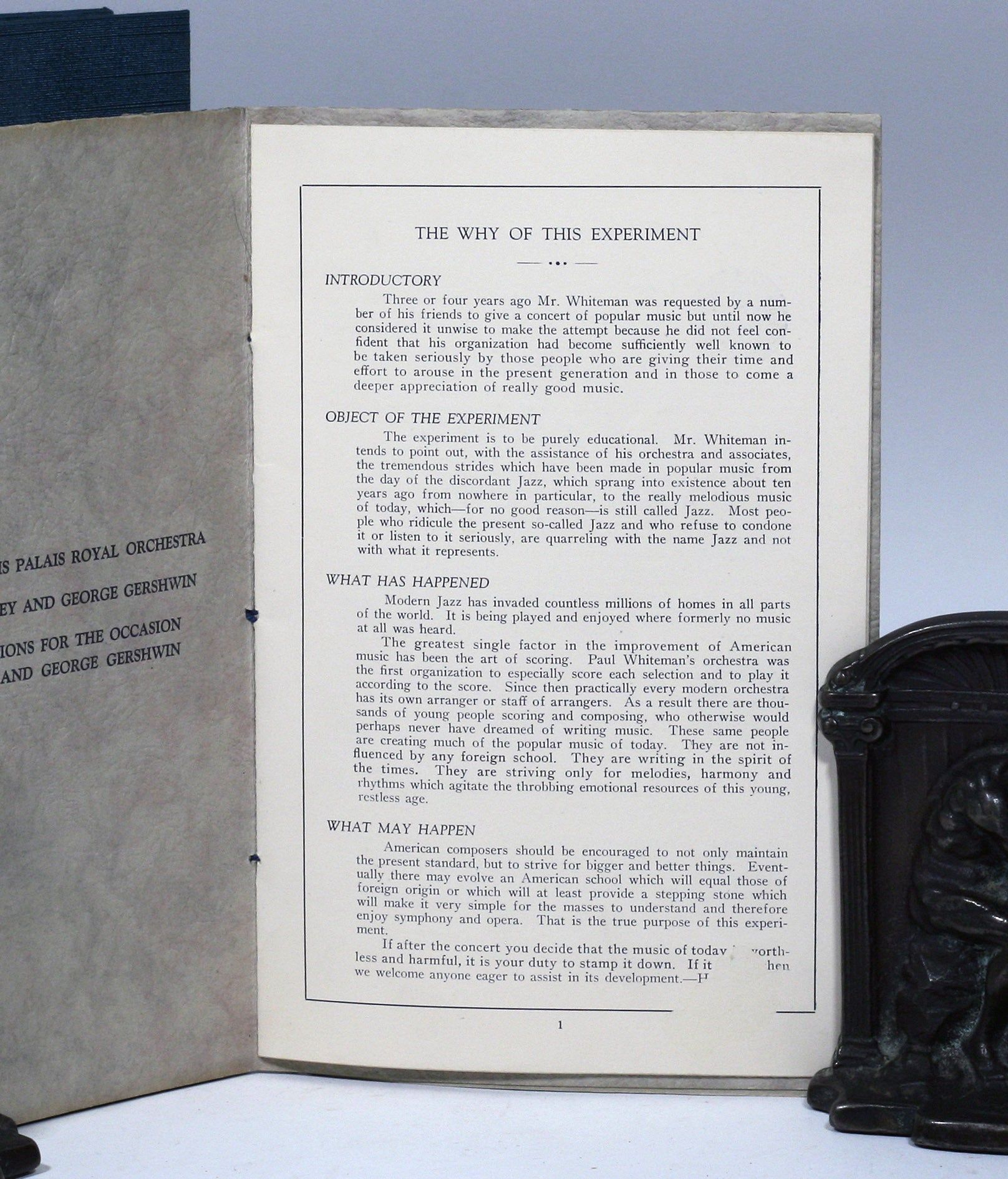
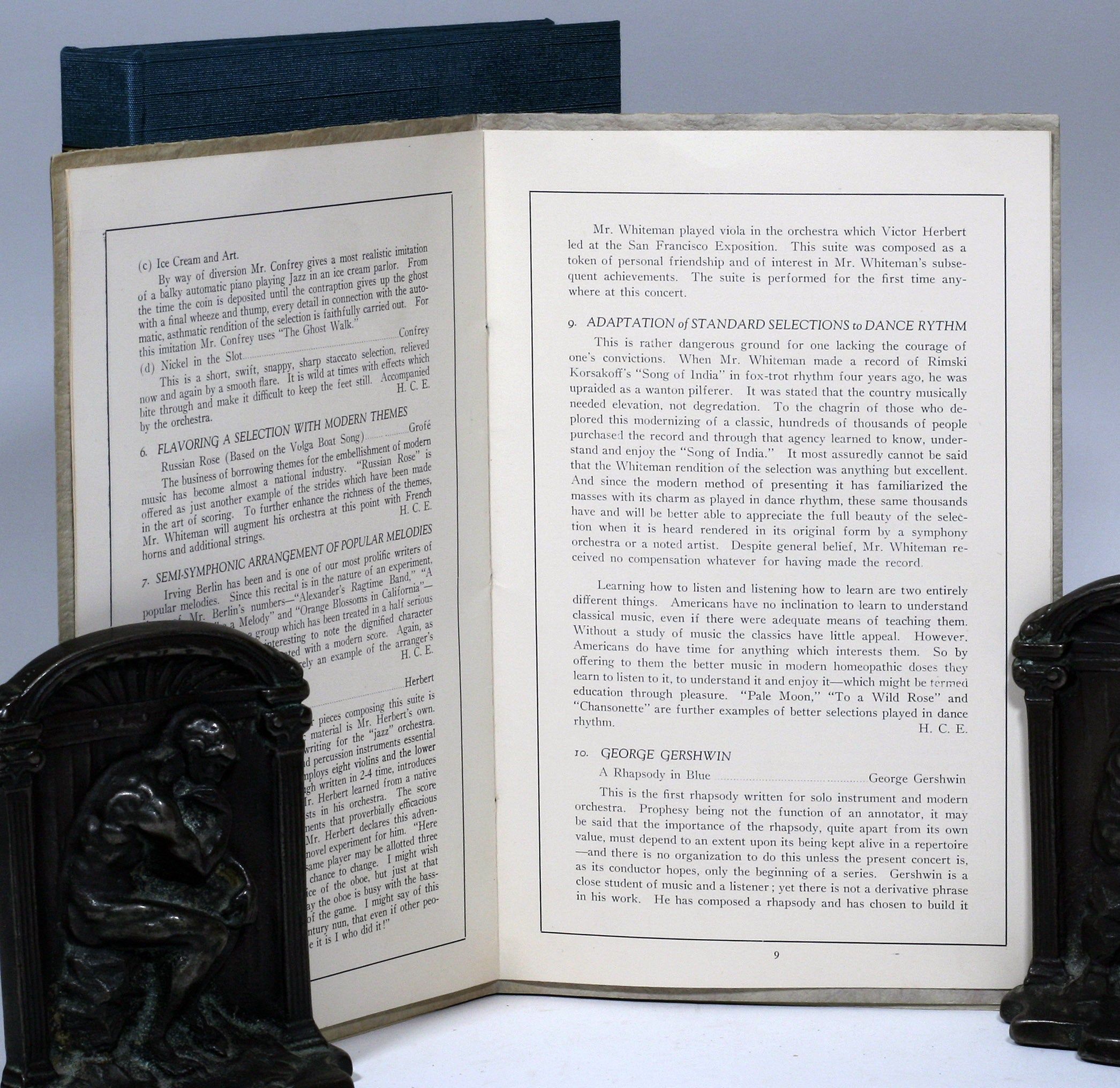
Although Gershwin hoped to expand the possibilities of jazz, he failed to credit the African American traditions that clearly inspired him, claiming in this program that jazz “sprang into existence ten years ago from nowhere in particular.” In this way, Gershwin’s Great American kaleidoscope remained incomplete.
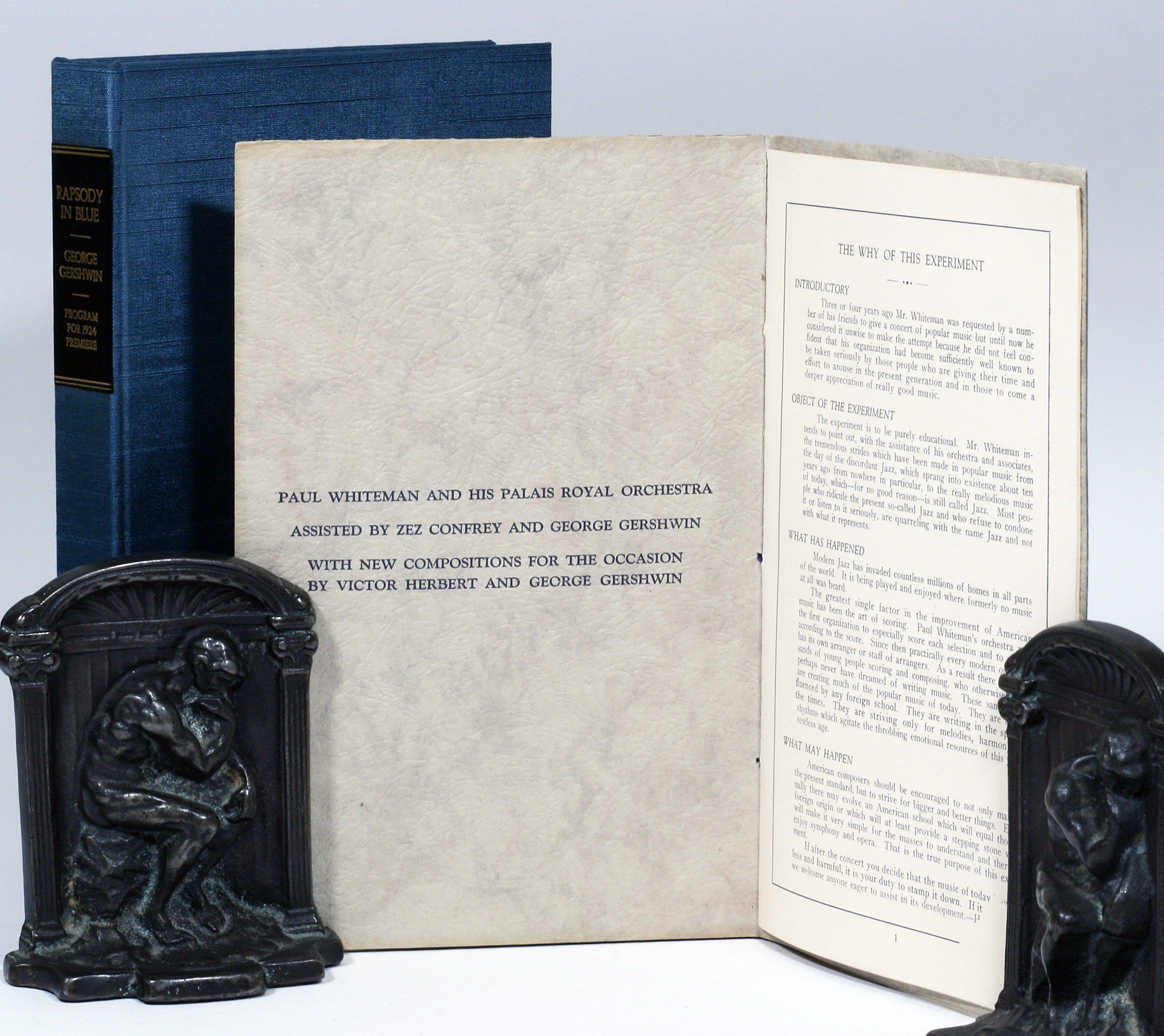
Despite being one of the most famous works of the 20th century, audiences will never know exactly what the original performance sounded like. Pressed for time, Gershwin improvised many of the solo parts himself. This program is one of the very few surviving records of that original performance. Although enough programs were printed for a 1100 seat hall, only a few examples survive. No copies exist at auction and there are only three institutional holdings— at the New York Public Library, the George and Ira Gershwin Collection at the Library of Congress, and the Center for Popular Music at Middle Tennessee State University.
Rhapsody in Blue is loud, dramatic, and undeniably iconic—but few, if any, living people remember the sensation and sound of its improvised premiere. Very few material records have been preserved. This program offers a rare opportunity to relive the texture of that historic moment.
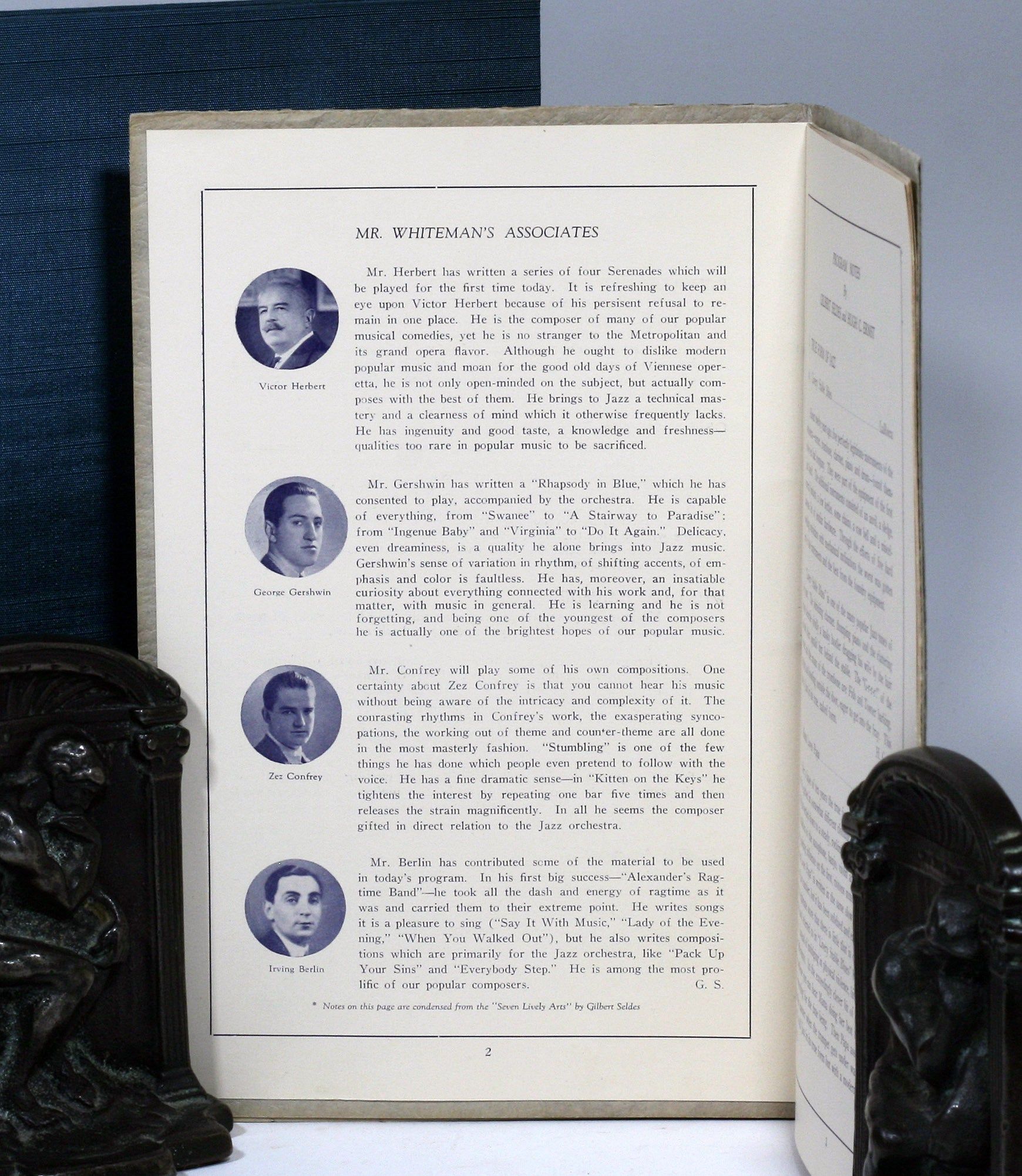
The show’s program provides biographies of Whiteman’s collaborators. The biography of Gershwin reads as follows:
“Mr. Gershwin has written a “Rhapsody in Blue,” which he has consented to play, accompanied by the orchestra. He is capable of everything, from “Swanee” to “A Stairway to Paradise”: from “Ingenue Baby” and “Virginia” to “Do It Again.” Delicacy, even dreaminess, is a quality he alone brings into Jazz music. Gershwin’s sense of variation in rhythm, of shifting accents, of emphasis and color is faultless. He has, moreover, an insatiable curiosity about everything connected with his work and, for that matter, with music in general. He is learning and he is not forgetting, and being one of the youngest of the composers he is actually one of the brightest hopes of our popular music.”
Further descriptions of Gershwin’s Rhapsody in Blue:
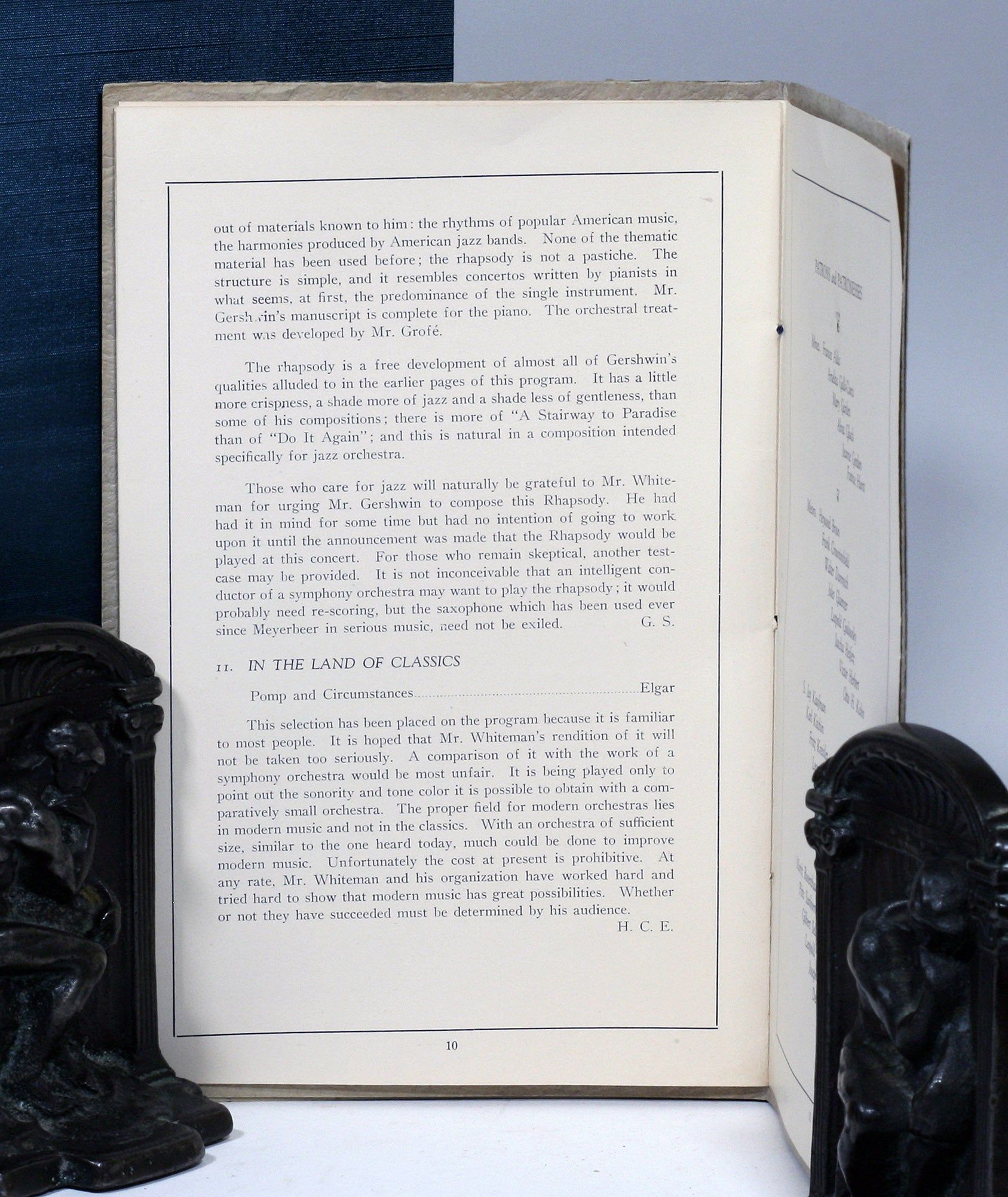
“This is the first rhapsody written for solo instrument and modern orchestra. Prophesy being not the function of an annotator, it may be said that the importance of the rhapsody, quite apart from its own value, must depend to an extent upon its being kept alive in a repertoire—and there is no organization to do this unless the present concert is, as its conductor hopes, only the beginning of a series. Gershwin is a close student of music and a listener; yet there is not a derivative phrase in his work. He has composed a rhapsody and has chosen to build it out of materials known to him: the rhythms of popular American music, the harmonies produced by American jazz bands. None of the thematic material has been used before; the rhapsody is not a pastiche. The structure is simple, and it resembles concertos written by pianists in what seems, at first, the predominance of the single instrument. Mr. Gershwin’s manuscript is complete for the piano. The orchestral treatment was developed by Mr. Grofé.
The rhapsody is a free development of almost all of Gershwin’s qualities alluded to in the earlier pages of this program. It has a little more crispness, a shade more of jazz and a shade less of gentleness, than some of his compositions; there is more of “A Stairway to Paradise” than of “Do It Again”; and this is natural in a composition intended specifically for jazz orchestra.
Those who care for jazz will naturally be grateful to Mr. Whiteman for urging Mr. Gershwin to compose this Rhapsody. He had had it in mind for some time but had no intention of going to work upon it until the announcement was made that the Rhapsody would be played at this concert. For those who remain skeptical, another test-case may be provided. It is not inconceivable that an intelligent conductor of a symphony orchestra may want to play the rhapsody; it would probably need re-scoring, but the saxophone which has been used ever since Meyerbeer in serious music, need not be exiled.”
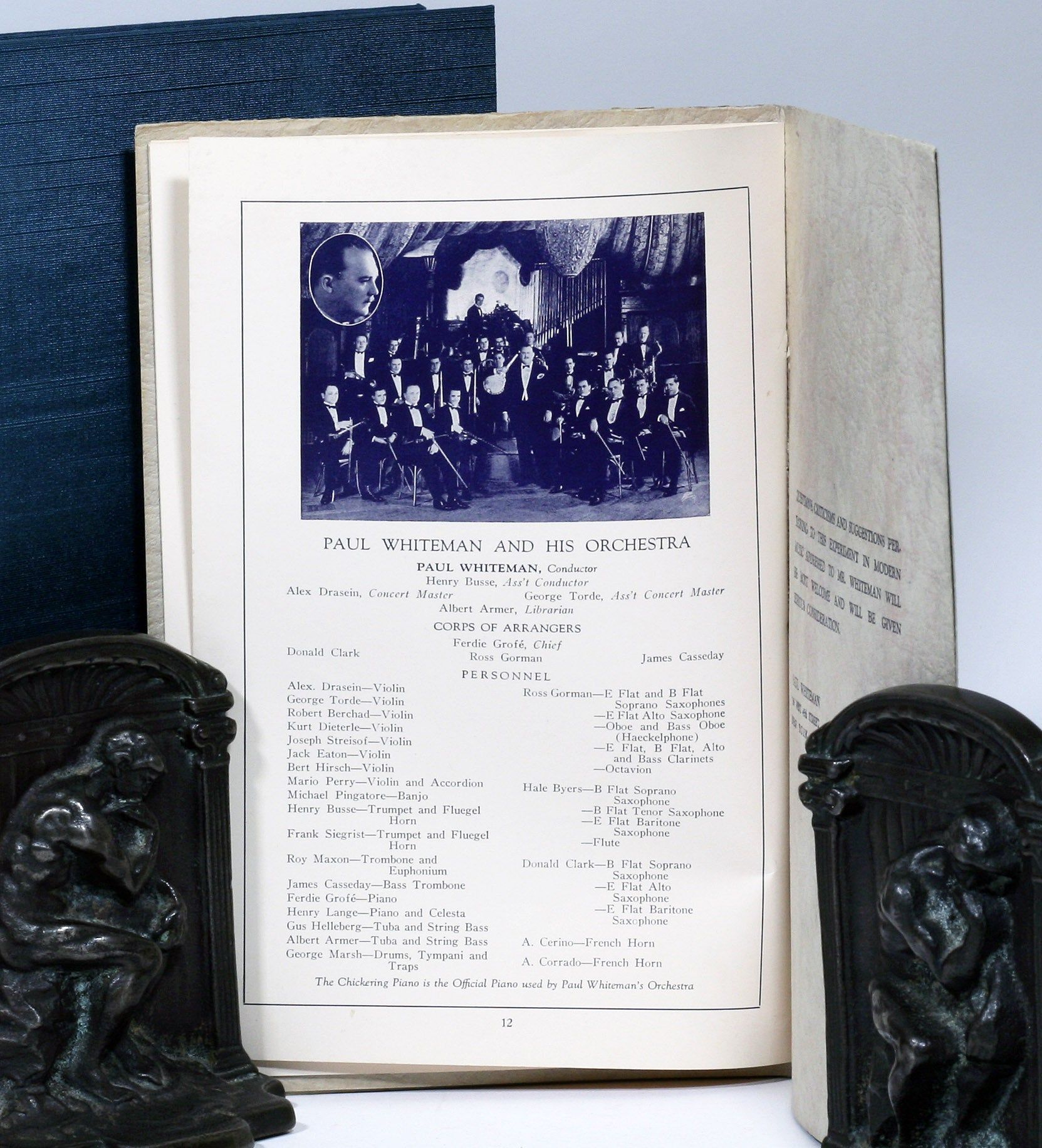
The program also includes photos of Mr. Whiteman and his band, alongside collaborators such as Gershwin and Victor Herbert.
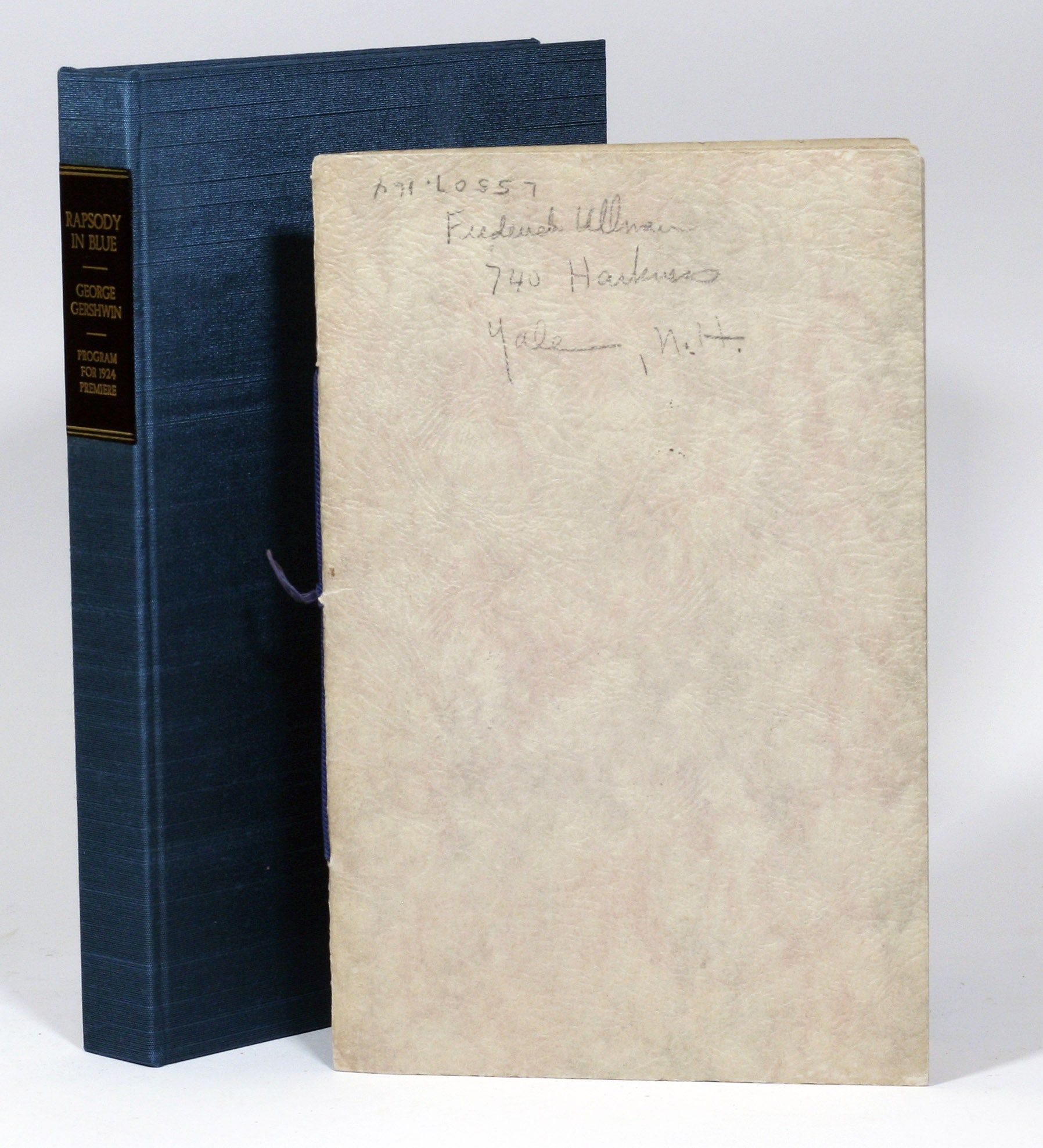
Provenance: With signature and Yale address of "Frederick Ullman" in pencil on back. Anecdotally, later gifted by Ira Gershwin's wife Lenore to her vocational nurse and caretaker; appearing on the market now for the first time.
New York: Aeolian Hall, 1924. Concert program, measuring 9.5 x 6.25 inches. 12 pages in original decorated textured grey wrappers; side-stitched with original blue cord. Housed in custom silk box. Abrasion to text at bottom of page 1 with loss of a few words. Wrappers in a remarkable state of preservation; very clean and fresh, with some light rubbing to cover decoration (corresponding to the textured ridges on cover).
EXCEEDINGLY RARE: We find no records at auction, and three institutional holdings only: at the New York Public Library, the George and Ira Gershwin Collection at the Library of Congress, and the Center for Popular Music at Middle Tennessee State University.
This was news to Gershwin, who had been asked some months earlier by Whiteman to contribute a piece but had turned down the request, believing the several months not enough time. And now, Gershwin had only six weeks. Whiteman, as it turned out, had decided to include Gershwin’s name after learning his musical nemesis—Vincent Lopez—would be releasing a similar concert series. Whiteman knew Gershwin’s name would bring his concert more coverage and went ahead with the inclusion hoping to propel his concert above Lopez’s [Adrian Symphony Orchestra].
Understanding Whiteman’s difficult position, Gershwin agreed to write the piece, planning to begin work during an upcoming train ride from New York to Boston, where he was headed for an out-of-town preview for a new musical of his. Gershwin later claimed that the sounds of this train, hitching and roaring down the track, inspired the thematic division of his score into five themes: Ritornello, Train (aptly named), Stride, Shuffle, and Love. Gershwin hoped to harness the energy of modern machinery in this piece, to convey the hustle and bustle of city life. [Adrian Symphony Orchestra]; [Dotsey]
As Gershwin later commented on his writing process:
“I set to work composing with unwonted rapidity. No set plan was in my mind – no structure to which my music would conform. The rhapsody, as you see, began as a purpose, not a plan. I tried to conceive the composition as a whole. I heard it as a sort of musical kaleidoscope of America – of our vast melting-pot, of our unduplicated national pep, of our blues, our metropolitan madness.” [Dotsey]
Gershwin himself had been raised in close contact with the diverse musical traditions of the Lower East Side, exposed to the competing influences of Russian, Eastern European, African American, and popular American music. Resultantly, he decided that a mixture of jazz, classical, in conjunction with the rhythmic, and thematic implements of almost all these styles, was the perfect medium for portraying the city’s kaleidoscopic bustle. [Adrian Symphony Orchestra]
Rhapsody in Blue received mixed reviews upon its release. The New York Times noted the piece displayed “extraordinary talent,” and public opinion was largely positive. Still, many critics felt that Rhapsody in Blue lacked focus, calling it a string of disconnected themes. [Hebblethwaite], [Adrian Symphony Orchestra]
Much of this confusion stemmed from the genuinely innovative fusion at the heart of Rhapsody in Blue. As mentioned, Gershwin took classical form and infused it with the varied musical influences of his youth—blues, ragtime, Jewish folk music, and Harlem jazz. To some extent, Gerswhin’s intention was to write these genres in a way which concentrated their essence within small segments of a classical concerto, as a more culturally dominant format of music. Though some viewed these borrowings as derivative of their original cultural contexts, Gershwin’s usages of Klezmer-like arrangements, for example, nonetheless represented a groundbreaking expansion of popular music, enabling the usage of non-classical genres in dominant American culture. [Adrian Symphony Orchestra]; [Dotsey]
Later reflecting on his work, Gershwin wrote about his usage of Jazz:
“There had been so much chatter about the limitations of jazz, not to speak of the manifest misunderstandings of its function. Jazz, they said, had to be in strict time. It had to cling to dance rhythms. I resolved, if possible, to kill that misconception with one sturdy blow.” [Dotsey]
Although Gershwin hoped to expand the possibilities of jazz, he failed to credit the African American traditions that clearly inspired him, claiming in this program that jazz “sprang into existence ten years ago from nowhere in particular.” In this way, Gershwin’s Great American kaleidoscope remained incomplete.
Despite being one of the most famous works of the 20th century, audiences will never know exactly what the original performance sounded like. Pressed for time, Gershwin improvised many of the solo parts himself. This program is one of the very few surviving records of that original performance. Although enough programs were printed for a 1100 seat hall, only a few examples survive. No copies exist at auction and there are only three institutional holdings— at the New York Public Library, the George and Ira Gershwin Collection at the Library of Congress, and the Center for Popular Music at Middle Tennessee State University.
Rhapsody in Blue is loud, dramatic, and undeniably iconic—but few, if any, living people remember the sensation and sound of its improvised premiere. Very few material records have been preserved. This program offers a rare opportunity to relive the texture of that historic moment.
The show’s program provides biographies of Whiteman’s collaborators. The biography of Gershwin reads as follows:
“Mr. Gershwin has written a “Rhapsody in Blue,” which he has consented to play, accompanied by the orchestra. He is capable of everything, from “Swanee” to “A Stairway to Paradise”: from “Ingenue Baby” and “Virginia” to “Do It Again.” Delicacy, even dreaminess, is a quality he alone brings into Jazz music. Gershwin’s sense of variation in rhythm, of shifting accents, of emphasis and color is faultless. He has, moreover, an insatiable curiosity about everything connected with his work and, for that matter, with music in general. He is learning and he is not forgetting, and being one of the youngest of the composers he is actually one of the brightest hopes of our popular music.”
Further descriptions of Gershwin’s Rhapsody in Blue:
“This is the first rhapsody written for solo instrument and modern orchestra. Prophesy being not the function of an annotator, it may be said that the importance of the rhapsody, quite apart from its own value, must depend to an extent upon its being kept alive in a repertoire—and there is no organization to do this unless the present concert is, as its conductor hopes, only the beginning of a series. Gershwin is a close student of music and a listener; yet there is not a derivative phrase in his work. He has composed a rhapsody and has chosen to build it out of materials known to him: the rhythms of popular American music, the harmonies produced by American jazz bands. None of the thematic material has been used before; the rhapsody is not a pastiche. The structure is simple, and it resembles concertos written by pianists in what seems, at first, the predominance of the single instrument. Mr. Gershwin’s manuscript is complete for the piano. The orchestral treatment was developed by Mr. Grofé.
The rhapsody is a free development of almost all of Gershwin’s qualities alluded to in the earlier pages of this program. It has a little more crispness, a shade more of jazz and a shade less of gentleness, than some of his compositions; there is more of “A Stairway to Paradise” than of “Do It Again”; and this is natural in a composition intended specifically for jazz orchestra.
Those who care for jazz will naturally be grateful to Mr. Whiteman for urging Mr. Gershwin to compose this Rhapsody. He had had it in mind for some time but had no intention of going to work upon it until the announcement was made that the Rhapsody would be played at this concert. For those who remain skeptical, another test-case may be provided. It is not inconceivable that an intelligent conductor of a symphony orchestra may want to play the rhapsody; it would probably need re-scoring, but the saxophone which has been used ever since Meyerbeer in serious music, need not be exiled.”
The program also includes photos of Mr. Whiteman and his band, alongside collaborators such as Gershwin and Victor Herbert.
Provenance: With signature and Yale address of "Frederick Ullman" in pencil on back. Anecdotally, later gifted by Ira Gershwin's wife Lenore to her vocational nurse and caretaker; appearing on the market now for the first time.
New York: Aeolian Hall, 1924. Concert program, measuring 9.5 x 6.25 inches. 12 pages in original decorated textured grey wrappers; side-stitched with original blue cord. Housed in custom silk box. Abrasion to text at bottom of page 1 with loss of a few words. Wrappers in a remarkable state of preservation; very clean and fresh, with some light rubbing to cover decoration (corresponding to the textured ridges on cover).
EXCEEDINGLY RARE: We find no records at auction, and three institutional holdings only: at the New York Public Library, the George and Ira Gershwin Collection at the Library of Congress, and the Center for Popular Music at Middle Tennessee State University.
Details
Title
An Experiment in Modern Music: Rhapsody in Blue
Author
GERSHWIN, GEORGE
Condition
Very Good
Publisher
Aeolian Hall: New York
Date
1924
Edition
First edition