

Original 1968 Face the Nation Transcript of Tom Hayden's Interview, on Youth Radicalism, Revolution, and the Vietnam War
- 1968
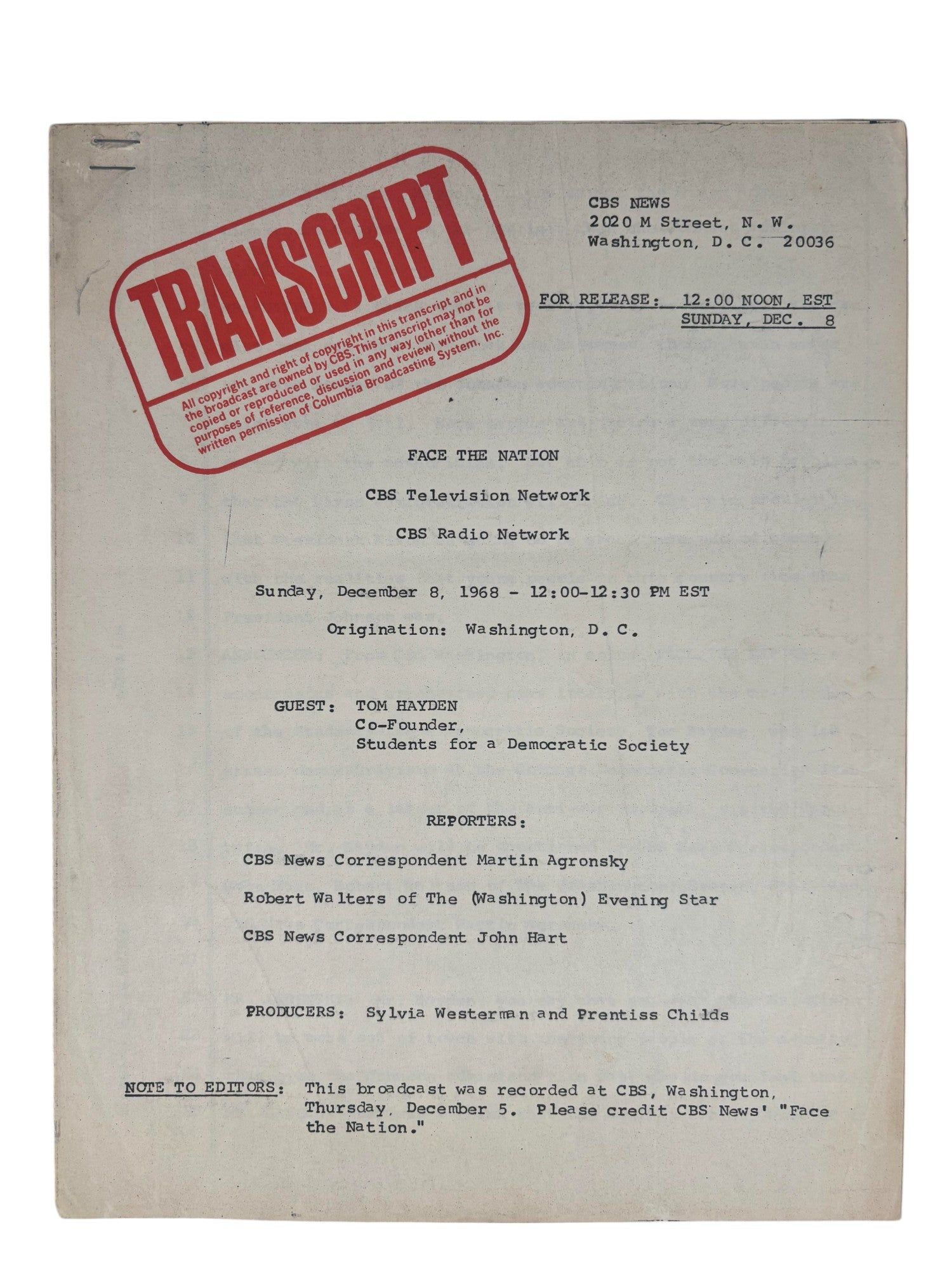
1968. [Counterculture] [Vietnam War] SDS New Left leader Tom Hayden on CBS News' Face the Nation, December 8, 1968. Original CBS News transcript addressing the New Left, youth radicalism, and Nixon's America. Washington, D.C.: CBS News, 1968. Original mimeographed transcript, 11" x 8.5", 16 pages. Marked "TRANSCRIPT" in red on front wrapper, with release date and broadcast details printed at top. Scarce original broadcast transcript of Face the Nation, aired December 8, 1968, featuring Tom Hayden, co-founder of Students for a Democratic Society (SDS) and a principal theorist of the New Left. Interviewed just months after the police riot at the Democratic National Convention in Chicago-where Hayden was a principal organizer of the protests-this nationally televised appearance marked one of the most visible attempts to articulate radical youth perspectives to a mainstream American audience.
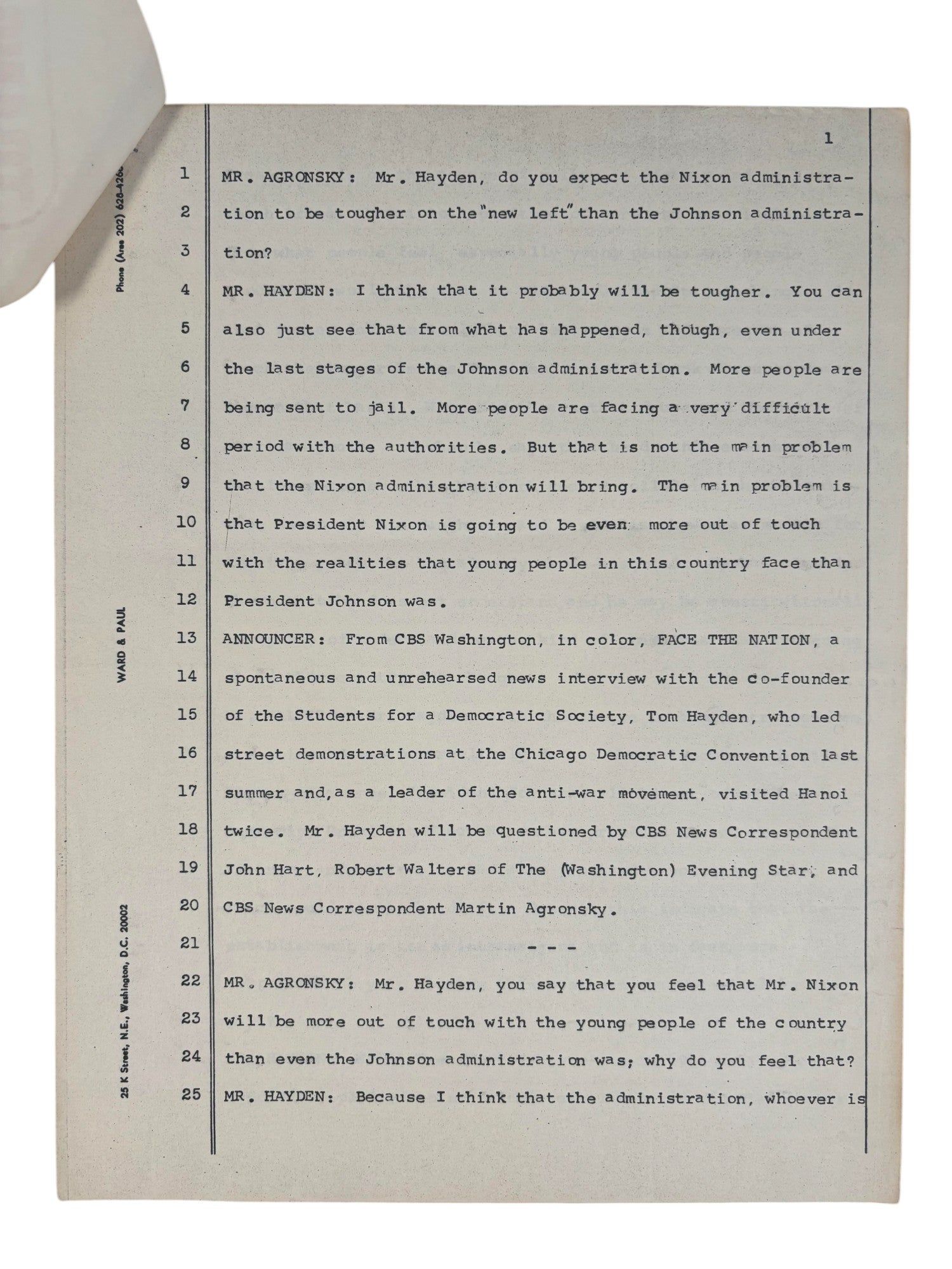
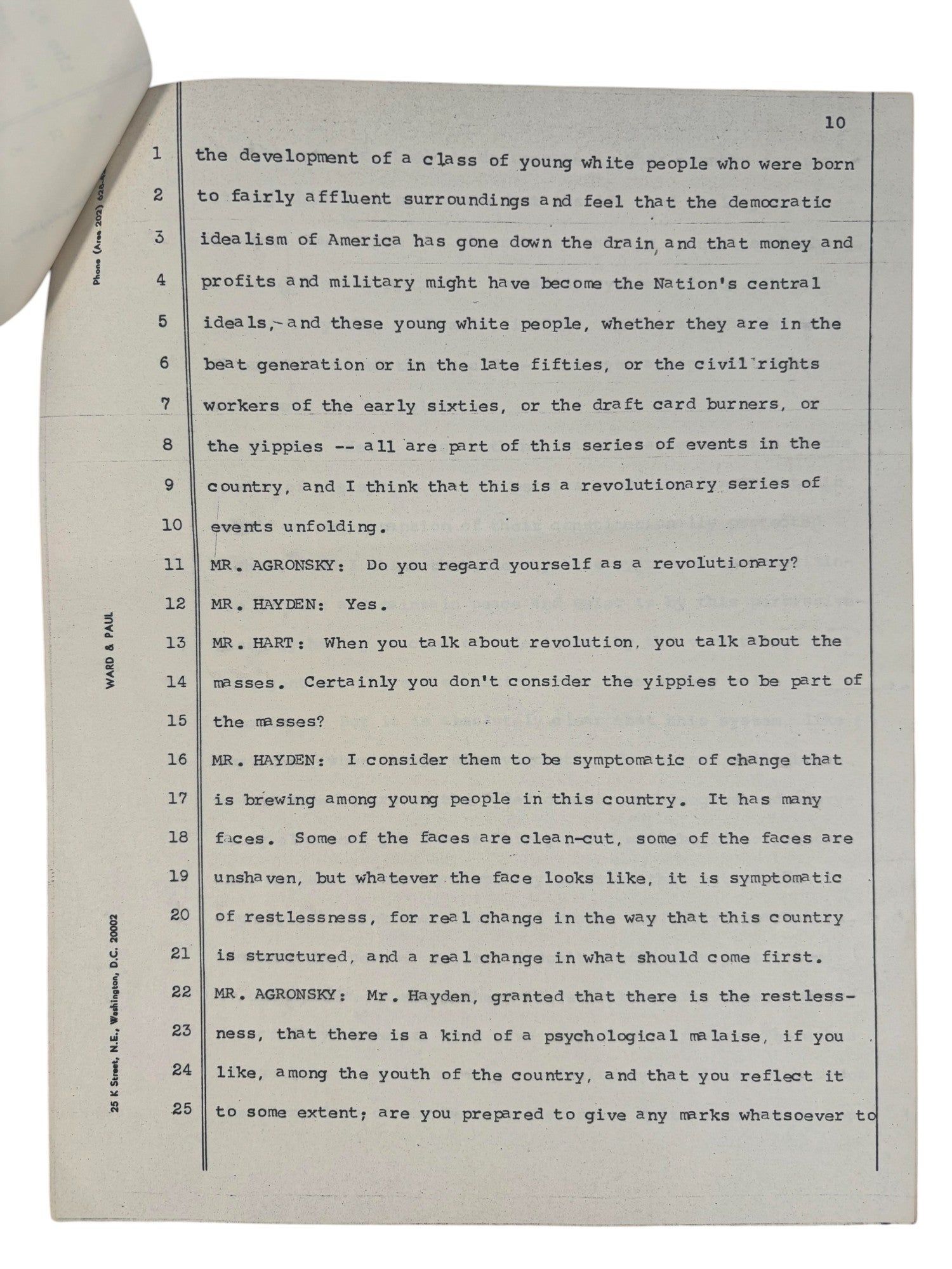
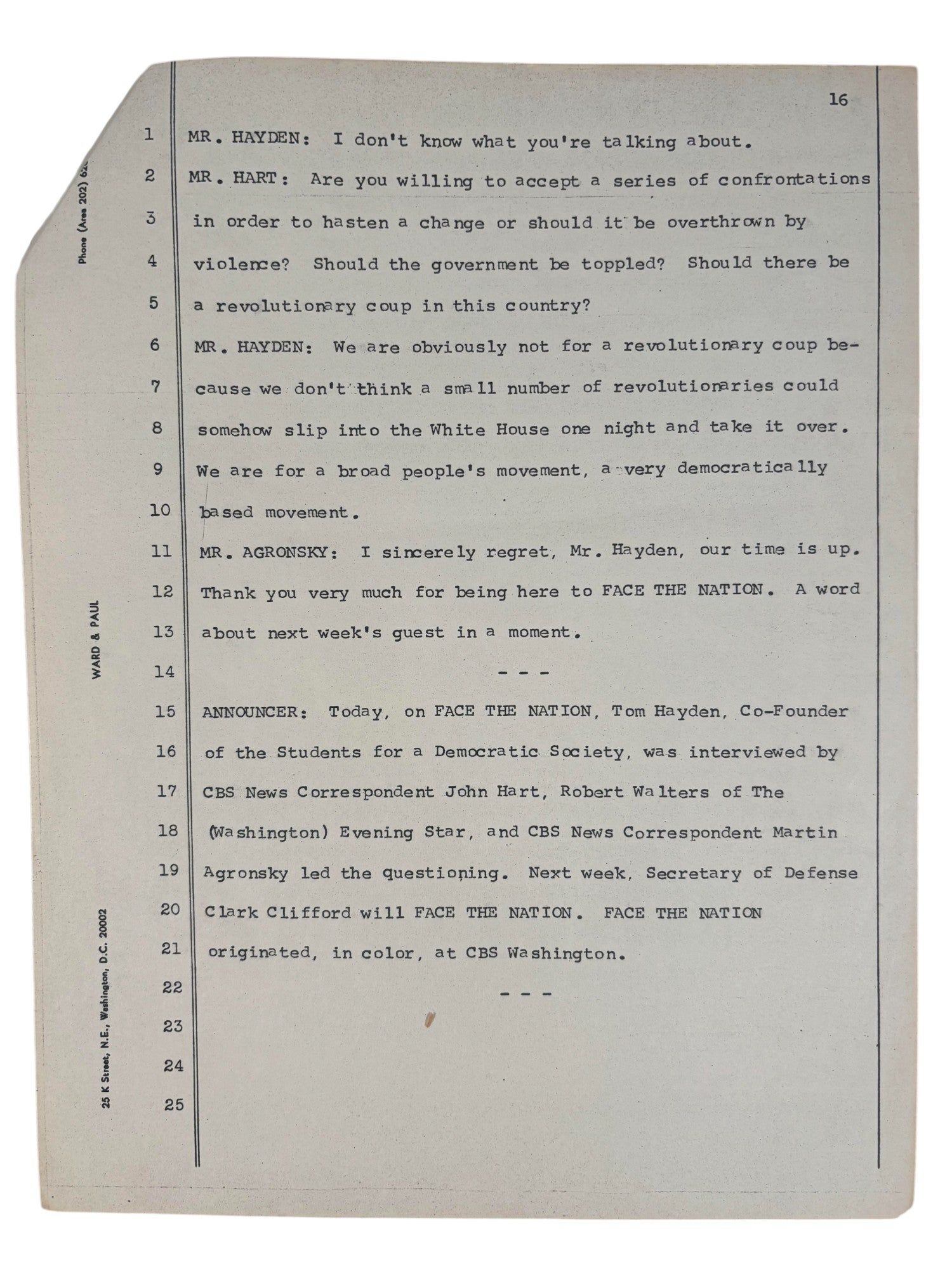
Introduced as "a leader of the anti-war movement" who had also "visited Hanoi twice", Hayden is questioned by CBS correspondents Martin Agronsky, John Hart, and Robert Walters on youth activism, civil disobedience, and revolutionary change. Asked whether he believed Nixon's administration would be harder on the New Left than Johnson's, Hayden replied: "I think that it probably will be tougher... More people are being sent to jail. More people are facing a very difficult period with the authorities. But that is not the main problem... The main problem is that President Nixon is going to be even more out of touch with the realities that young people in this country face than President Johnson was." Hayden repeatedly returns to the alienation of youth, situating their activism within a broader context of social and ideological breakdown. On page 10, he declares: "The democratic idealism of America has gone down the drain, and that money and profits and military might have become the Nation's central ideals... These young white people, whether they are in the beat generation or in the late fifties, or the civil rights workers of the early sixties, or the draft card burners, or the yippies-all are part of this series of events in the country, and I think that this is a revolutionary series of events unfolding."Asked pointedly, "Do you regard yourself as a revolutionary?" Hayden responds simply: "Yes." Yet he carefully distances himself from armed insurrection or coup-style upheaval. On page 16, he asserts: "We are obviously not for a revolutionary coup because we don't think a small number of revolutionaries could somehow slip into the White House one night and take it over. We are for a broad people's movement, a very democratically based movement."
The tone of the interview is cautious but direct, as the CBS correspondents seek to portray Hayden as either a dangerous radical or an articulate spokesman for generational discontent. When Hart pushes Hayden on the legitimacy of confrontation or violence, Hayden answers, "I don't know what you're talking about." This restrained but confident demeanor helped define his public reputation in the wake of the DNC protests, particularly as he and others faced conspiracy charges in what would become the infamous Chicago Seven trial the following year. Tom Hayden was, by 1968, one of the most visible figures of the American New Left. As the primary author of the Port Huron Statement (1962), Hayden had articulated SDS's early call for "participatory democracy" and grassroots activism. By the late 1960s, SDS had evolved into a decentralized movement involved in organizing draft resistance, supporting Black liberation, and confronting U.S. imperialism at home and abroad. Hayden's visibility was heightened not only by his involvement in Chicago but also by his 1965 visit to North Vietnam-a gesture that marked him as a traitor to some and a hero to others.
The Face the Nation appearance was one of the few mainstream media platforms where a radical antiwar voice reached a national audience during the election aftermath of 1968, a year defined by assassination, uprisings, and generational crisis. The program aired just weeks after Richard Nixon's victory and offered a snapshot of a volatile and rapidly polarizing American landscape. While mainstream press reviews of the interview were mixed, with some calling it "measured" and others "provocative", it remains a landmark moment in the history of U.S. televised dissent. An exceptional primary source capturing the rhetorical strategy and revolutionary vision of one of the 1960s' most consequential activists. Seldom seen in the trade, this complete, unredacted broadcast transcript offers a rare record of how the New Left attempted to challenge the Cold War consensus in real time, through national media. Light toning and edgewear; faint staple rust; very good.
Introduced as "a leader of the anti-war movement" who had also "visited Hanoi twice", Hayden is questioned by CBS correspondents Martin Agronsky, John Hart, and Robert Walters on youth activism, civil disobedience, and revolutionary change. Asked whether he believed Nixon's administration would be harder on the New Left than Johnson's, Hayden replied: "I think that it probably will be tougher... More people are being sent to jail. More people are facing a very difficult period with the authorities. But that is not the main problem... The main problem is that President Nixon is going to be even more out of touch with the realities that young people in this country face than President Johnson was." Hayden repeatedly returns to the alienation of youth, situating their activism within a broader context of social and ideological breakdown. On page 10, he declares: "The democratic idealism of America has gone down the drain, and that money and profits and military might have become the Nation's central ideals... These young white people, whether they are in the beat generation or in the late fifties, or the civil rights workers of the early sixties, or the draft card burners, or the yippies-all are part of this series of events in the country, and I think that this is a revolutionary series of events unfolding."Asked pointedly, "Do you regard yourself as a revolutionary?" Hayden responds simply: "Yes." Yet he carefully distances himself from armed insurrection or coup-style upheaval. On page 16, he asserts: "We are obviously not for a revolutionary coup because we don't think a small number of revolutionaries could somehow slip into the White House one night and take it over. We are for a broad people's movement, a very democratically based movement."
The tone of the interview is cautious but direct, as the CBS correspondents seek to portray Hayden as either a dangerous radical or an articulate spokesman for generational discontent. When Hart pushes Hayden on the legitimacy of confrontation or violence, Hayden answers, "I don't know what you're talking about." This restrained but confident demeanor helped define his public reputation in the wake of the DNC protests, particularly as he and others faced conspiracy charges in what would become the infamous Chicago Seven trial the following year. Tom Hayden was, by 1968, one of the most visible figures of the American New Left. As the primary author of the Port Huron Statement (1962), Hayden had articulated SDS's early call for "participatory democracy" and grassroots activism. By the late 1960s, SDS had evolved into a decentralized movement involved in organizing draft resistance, supporting Black liberation, and confronting U.S. imperialism at home and abroad. Hayden's visibility was heightened not only by his involvement in Chicago but also by his 1965 visit to North Vietnam-a gesture that marked him as a traitor to some and a hero to others.
The Face the Nation appearance was one of the few mainstream media platforms where a radical antiwar voice reached a national audience during the election aftermath of 1968, a year defined by assassination, uprisings, and generational crisis. The program aired just weeks after Richard Nixon's victory and offered a snapshot of a volatile and rapidly polarizing American landscape. While mainstream press reviews of the interview were mixed, with some calling it "measured" and others "provocative", it remains a landmark moment in the history of U.S. televised dissent. An exceptional primary source capturing the rhetorical strategy and revolutionary vision of one of the 1960s' most consequential activists. Seldom seen in the trade, this complete, unredacted broadcast transcript offers a rare record of how the New Left attempted to challenge the Cold War consensus in real time, through national media. Light toning and edgewear; faint staple rust; very good.
Details
Title
Original 1968 Face the Nation Transcript of Tom Hayden's Interview, on Youth Radicalism, Revolution, and the Vietnam War
Author
Tom Hayden; Radical Activism
Condition
Unknown
Date
1968