

Vietnam War Antiwar Mobilization and Student Organizing for the November 1969 March on Washington
- 1969
1969. Student Mobilization Committee to End the War in Vietnam, Fall Offensive Against the War in Vietnam handbill archive, 1969, documents grassroots antiwar mobilization in the weeks surrounding the November 15 March on Washington and supports research into student organizing, Vietnam War dissent, protest communications, and the relationship between antiwar activism and civil rights language. The material documents the system of mass antiwar protest coordination through locally distributed leaflets, public calls for disciplined nonviolence, strike-and-march scheduling, and visual appeals to interracial and cross-movement solidarity, revealing how organizers sought to convert dispersed campus opposition into a visible national demonstration. The Student Mobilization Committee was a national coalition active from 1966 to 1973, and the November 1969 Washington action drew more than 500,000 demonstrators after the October Moratorium and alongside New Mobilization Committee activity, making these handbills useful evidence of how antiwar organizations framed participation, legality, and public legitimacy during one of the largest Vietnam War protests in the United States.
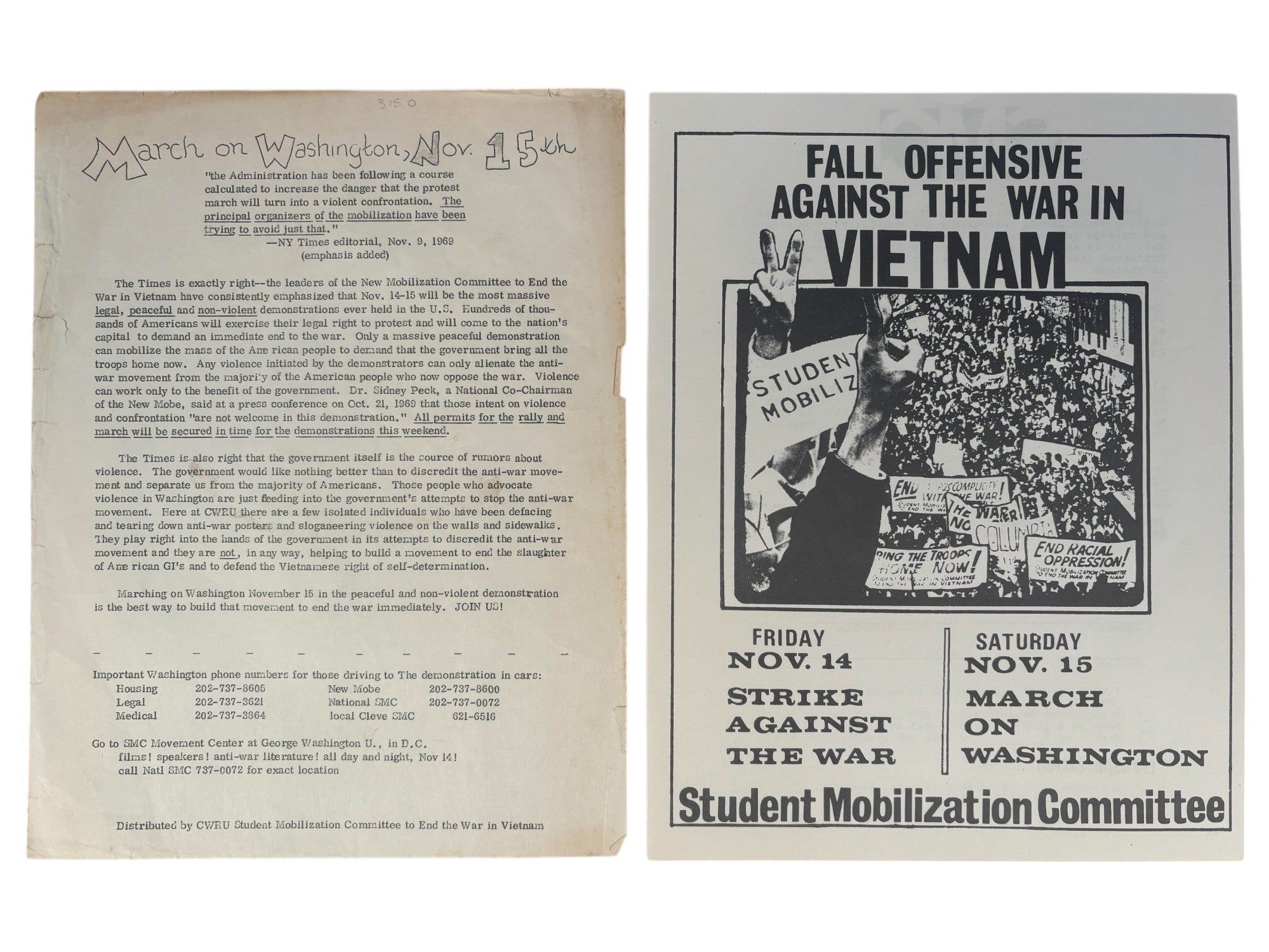
Two original handbills issued in connection with the November 14 and 15, 1969 antiwar actions in Washington, D.C., comprising one mimeographed leaflet distributed by the CWRU Student Mobilization Committee and one offset-printed graphic leaflet headed "FALL OFFENSIVE AGAINST THE WAR IN VIETNAM," each approximately 8½ x 11 inches. The mimeographed leaflet opens with a quoted November 9, 1969 New York Times editorial warning that "The Administration has been following a course calculated to increase the danger that the protest march will turn into a violent confrontation," and answers with the committee's insistence that "Nov. 14-15 will be the most massive legal, peaceful and non-violent demonstrations ever held in the U.S." Its text explains the functional logic of the protest effort, arguing that "Only a massive peaceful demonstration of the American people can require the government to end the conflict and bring the troops home now," while also identifying government rhetoric as a threat to the movement's legitimacy: "The source of rumors about violence... is the government itself." The second leaflet uses bold graphic design and a black-and-white protest photograph showing demonstrators, one raising a peace sign, with placards reading "End the War Now!" and "Bring the Troops Home Now!" and a background banner declaring "End Racial Oppression!" Beneath the image, the leaflet gives the coordinated schedule: "FRIDAY NOV. 14 / STRIKE AGAINST THE WAR" and "SATURDAY NOV. 15 / MARCH ON WASHINGTON," linking workplace and campus strike tactics to the mass Washington demonstration.
Student Mobilization Committee to End the War in Vietnam. Nov. 14-15 peaceful and non-violent demonstrations leaflet. Cleveland: CWRU Student Mobilization Committee, 1969. Mimeographed organizing handbill using press quotation, rebuttal, and direct appeal to defend the planned Washington demonstrations against anticipated claims of violence. The leaflet shows the mechanisms of antiwar communication in practice: organizers framed participation as peaceful, legal, and morally necessary, urging readers that "Marching on Washington November 15 in the peaceful and non-violent demonstration is the best way to build that movement to end the war immediately. JOIN US!" [2] Student Mobilization Committee to End the War in Vietnam. Fall Offensive Against the War in Vietnam. Washington, D.C.: Student Mobilization Committee to End the War in Vietnam, 1969. Offset-printed handbill combining protest imagery, antiwar slogans, and a two-day action calendar for the November 14 strike and November 15 March on Washington. The inclusion of the banner "End Racial Oppression!" places the antiwar action within a broader field of late-1960s radical politics, where opposition to U.S. military policy intersected visually and rhetorically with civil rights and racial justice claims. Light toning, minor edge wear, and small creases, very good. Compact evidence of the messaging infrastructure behind the November 1969 antiwar mobilization, preserving both the defensive language of nonviolence and the public visual vocabulary used to recruit participants for national protest.
Two original handbills issued in connection with the November 14 and 15, 1969 antiwar actions in Washington, D.C., comprising one mimeographed leaflet distributed by the CWRU Student Mobilization Committee and one offset-printed graphic leaflet headed "FALL OFFENSIVE AGAINST THE WAR IN VIETNAM," each approximately 8½ x 11 inches. The mimeographed leaflet opens with a quoted November 9, 1969 New York Times editorial warning that "The Administration has been following a course calculated to increase the danger that the protest march will turn into a violent confrontation," and answers with the committee's insistence that "Nov. 14-15 will be the most massive legal, peaceful and non-violent demonstrations ever held in the U.S." Its text explains the functional logic of the protest effort, arguing that "Only a massive peaceful demonstration of the American people can require the government to end the conflict and bring the troops home now," while also identifying government rhetoric as a threat to the movement's legitimacy: "The source of rumors about violence... is the government itself." The second leaflet uses bold graphic design and a black-and-white protest photograph showing demonstrators, one raising a peace sign, with placards reading "End the War Now!" and "Bring the Troops Home Now!" and a background banner declaring "End Racial Oppression!" Beneath the image, the leaflet gives the coordinated schedule: "FRIDAY NOV. 14 / STRIKE AGAINST THE WAR" and "SATURDAY NOV. 15 / MARCH ON WASHINGTON," linking workplace and campus strike tactics to the mass Washington demonstration.
Student Mobilization Committee to End the War in Vietnam. Nov. 14-15 peaceful and non-violent demonstrations leaflet. Cleveland: CWRU Student Mobilization Committee, 1969. Mimeographed organizing handbill using press quotation, rebuttal, and direct appeal to defend the planned Washington demonstrations against anticipated claims of violence. The leaflet shows the mechanisms of antiwar communication in practice: organizers framed participation as peaceful, legal, and morally necessary, urging readers that "Marching on Washington November 15 in the peaceful and non-violent demonstration is the best way to build that movement to end the war immediately. JOIN US!" [2] Student Mobilization Committee to End the War in Vietnam. Fall Offensive Against the War in Vietnam. Washington, D.C.: Student Mobilization Committee to End the War in Vietnam, 1969. Offset-printed handbill combining protest imagery, antiwar slogans, and a two-day action calendar for the November 14 strike and November 15 March on Washington. The inclusion of the banner "End Racial Oppression!" places the antiwar action within a broader field of late-1960s radical politics, where opposition to U.S. military policy intersected visually and rhetorically with civil rights and racial justice claims. Light toning, minor edge wear, and small creases, very good. Compact evidence of the messaging infrastructure behind the November 1969 antiwar mobilization, preserving both the defensive language of nonviolence and the public visual vocabulary used to recruit participants for national protest.
Details
Title
Vietnam War Antiwar Mobilization and Student Organizing for the November 1969 March on Washington
Author
March on Washington
Condition
Unknown
Date
1969