

Vietnam War Protest Documents Showing Military Dissent, Port Chicago Direct Action, SANE Petitioning, and Women Strike for Peace Budget Critique
- SIGNED
- 1965
1965. Student Peace Union, SANE, Women Strike for Peace, and Contra Costa Citizens Against the War in Vietnam antiwar ephemera archive, 1965 and 1966, documents the early system of Vietnam War opposition before mass antiwar demonstrations became the movement's dominant public form. The archive shows the mechanisms of early peace mobilization through enlisted servicemen's testimony, newspaper-ad petitioning, economic argument, congressional criticism, and planned obstruction of military logistics, revealing how dissent moved between elite public statements, women's peace activism, campus networks, and local civil disobedience. In 1965, the antiwar movement remained a loose coalition built around teach-ins, lobbying, persuasion, rallies, picketing, and independent local actions, while radicals increasingly connected the war to domestic injustice and American power; these documents provide primary-source evidence for studying that formative transition from policy dissent to organized resistance.
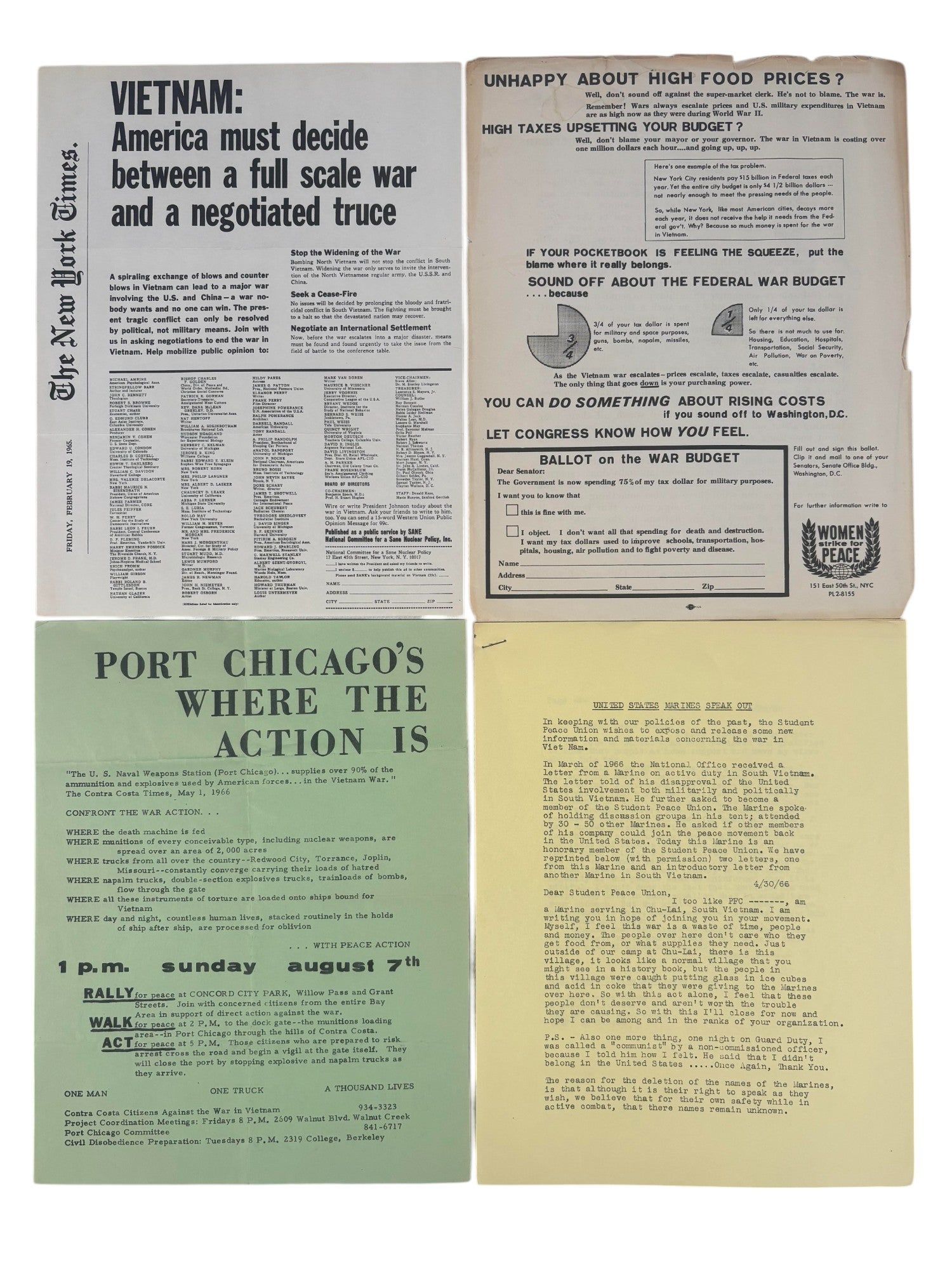
Four antiwar documents dating from 1965 to 1966, issued by or associated with the National Committee for a Sane Nuclear Policy, Women Strike for Peace, the Student Peace Union, and Contra Costa Citizens Against the War in Vietnam, with formats including mimeographed circulars, flyers, and broadsides. The materials include a SANE broadside reproducing a February 19, 1965 New York Times advertisement, a double-sided Women Strike for Peace and J. William Fulbright budget-and-war broadside from 1965, a Student Peace Union circular dated April 30, 1966 containing anonymous letters from Marines stationed at Chu Lai, and a Contra Costa protest flyer calling for action at Port Chicago on August 7, 1966. The archive differentiates several strands of early antiwar practice: public appeals by nationally known signatories, women's household-economy critique of military spending, active-duty military dissent circulated through student networks, and locally organized direct action aimed at munitions shipment infrastructure. Port Chicago carried additional historical resonance as a military logistics site associated with the 1944 munitions explosion and subsequent Black sailors' resistance to unsafe loading conditions, making its later use as a Vietnam protest site especially charged within histories of war labor, race, and military discipline.
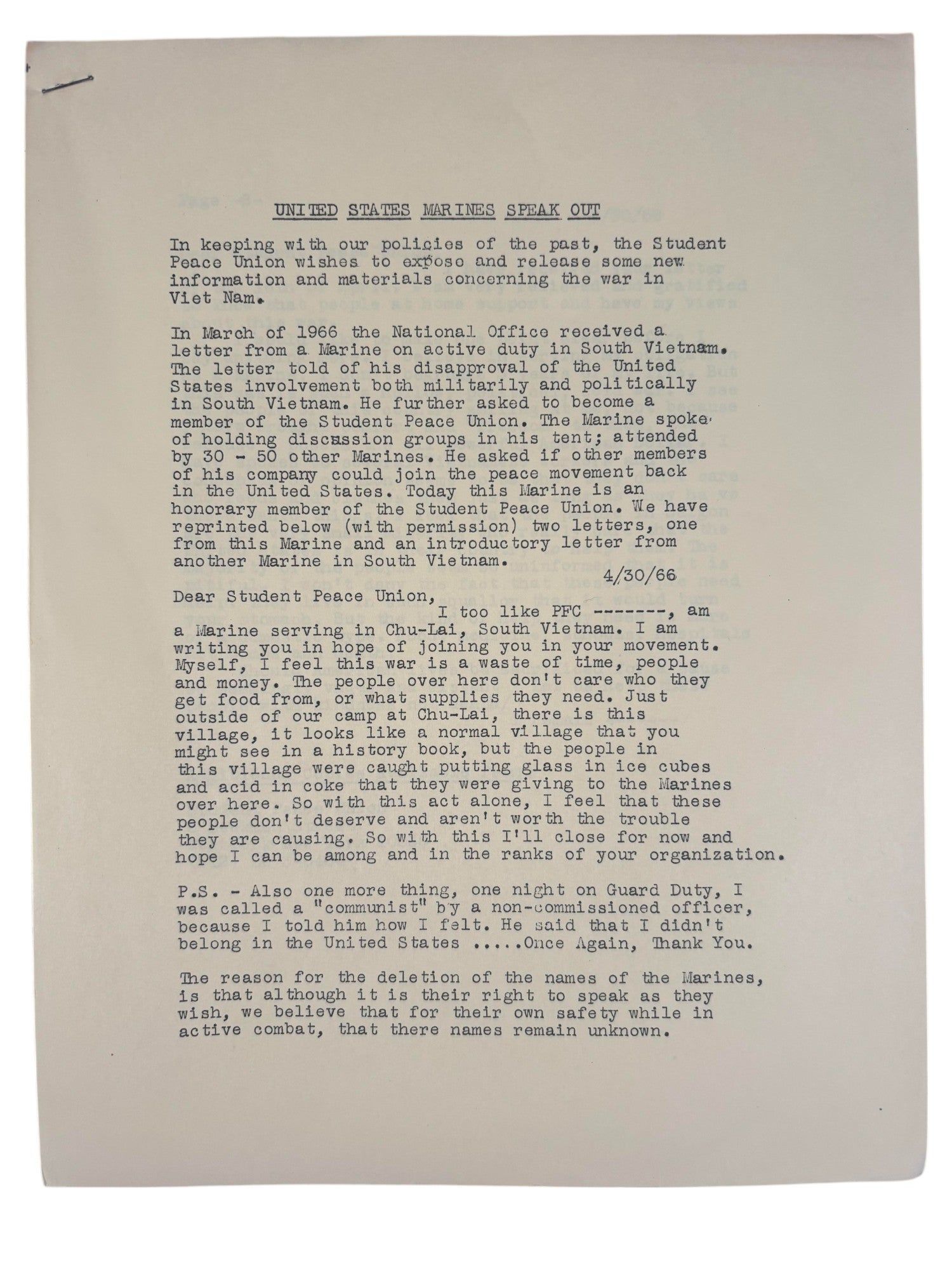
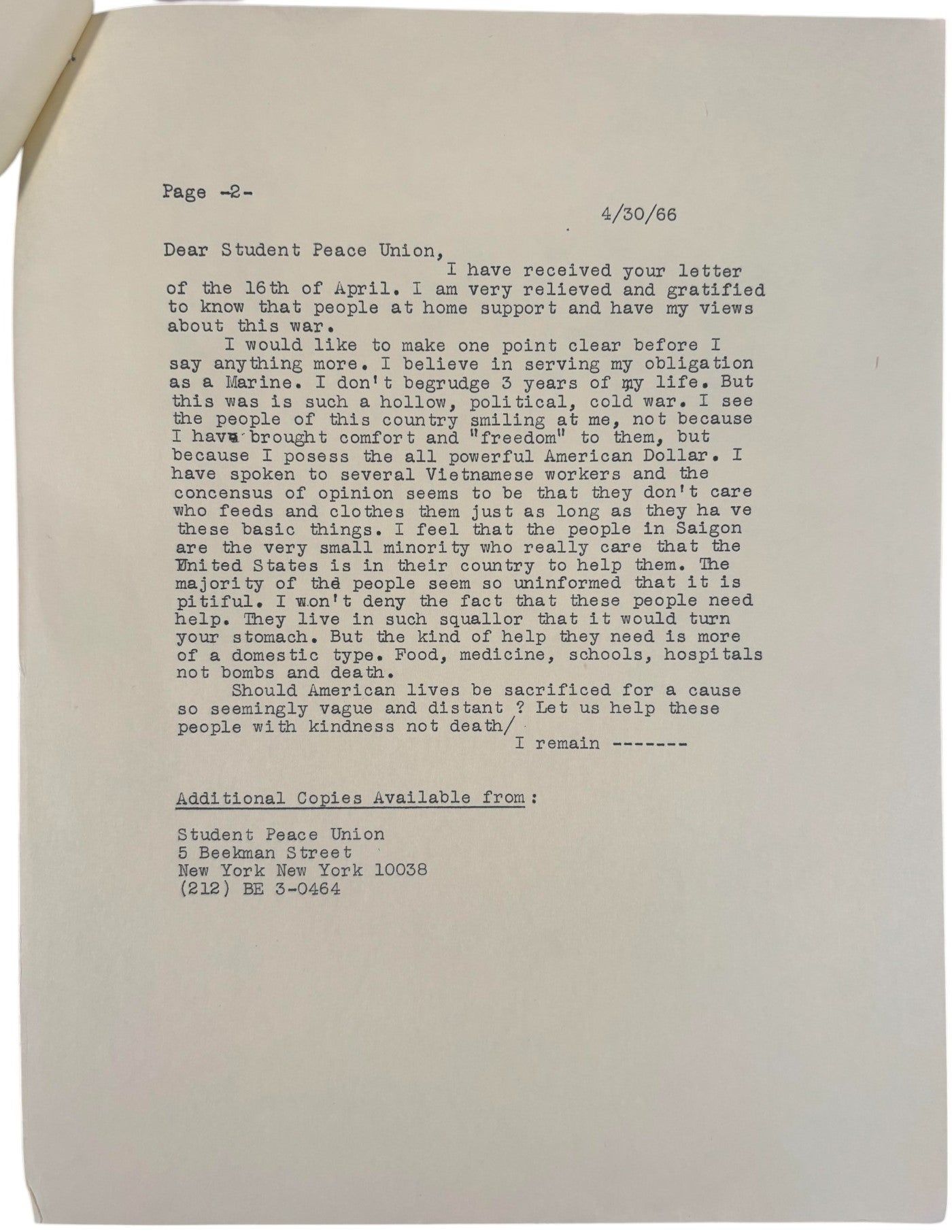
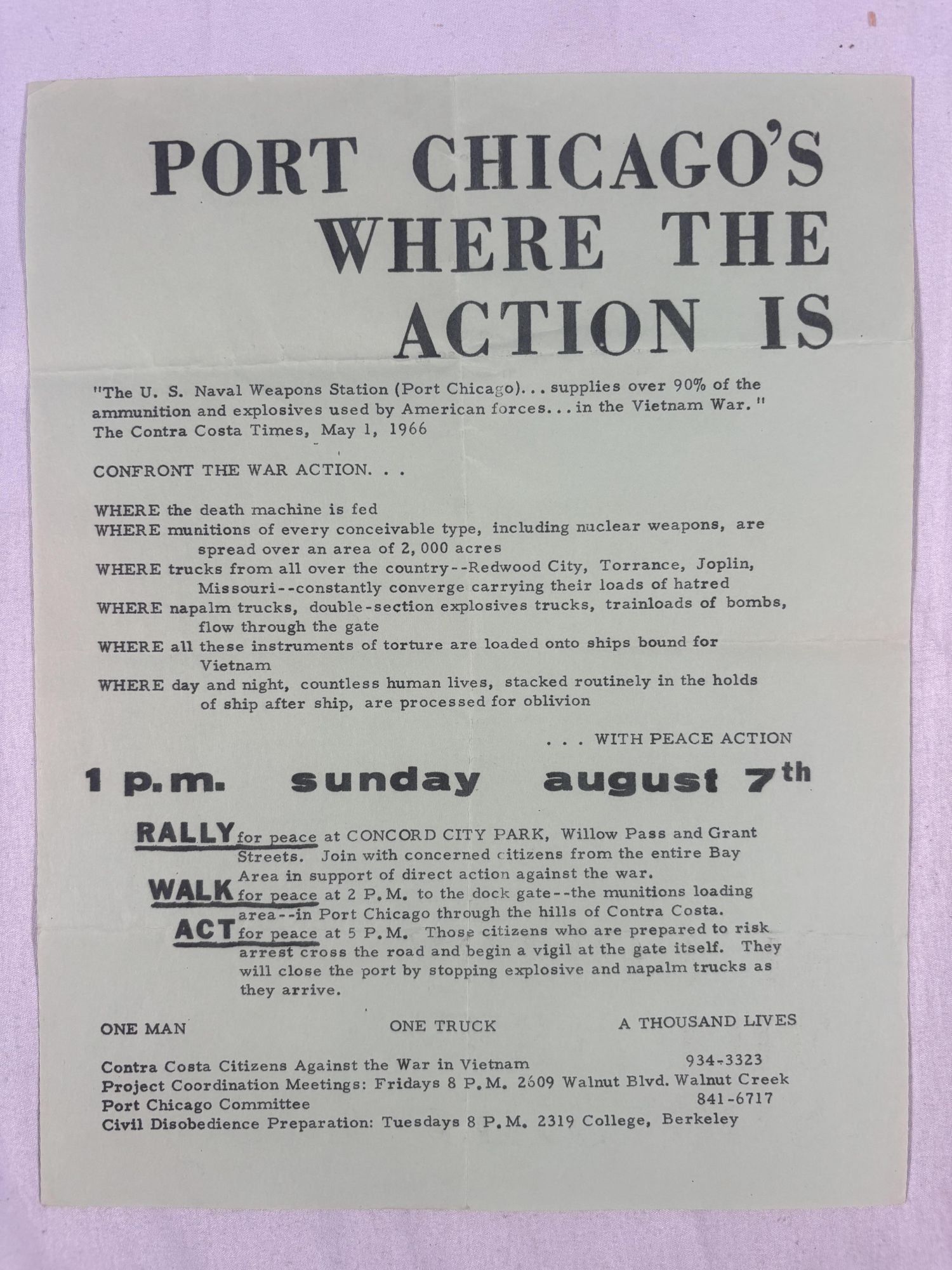
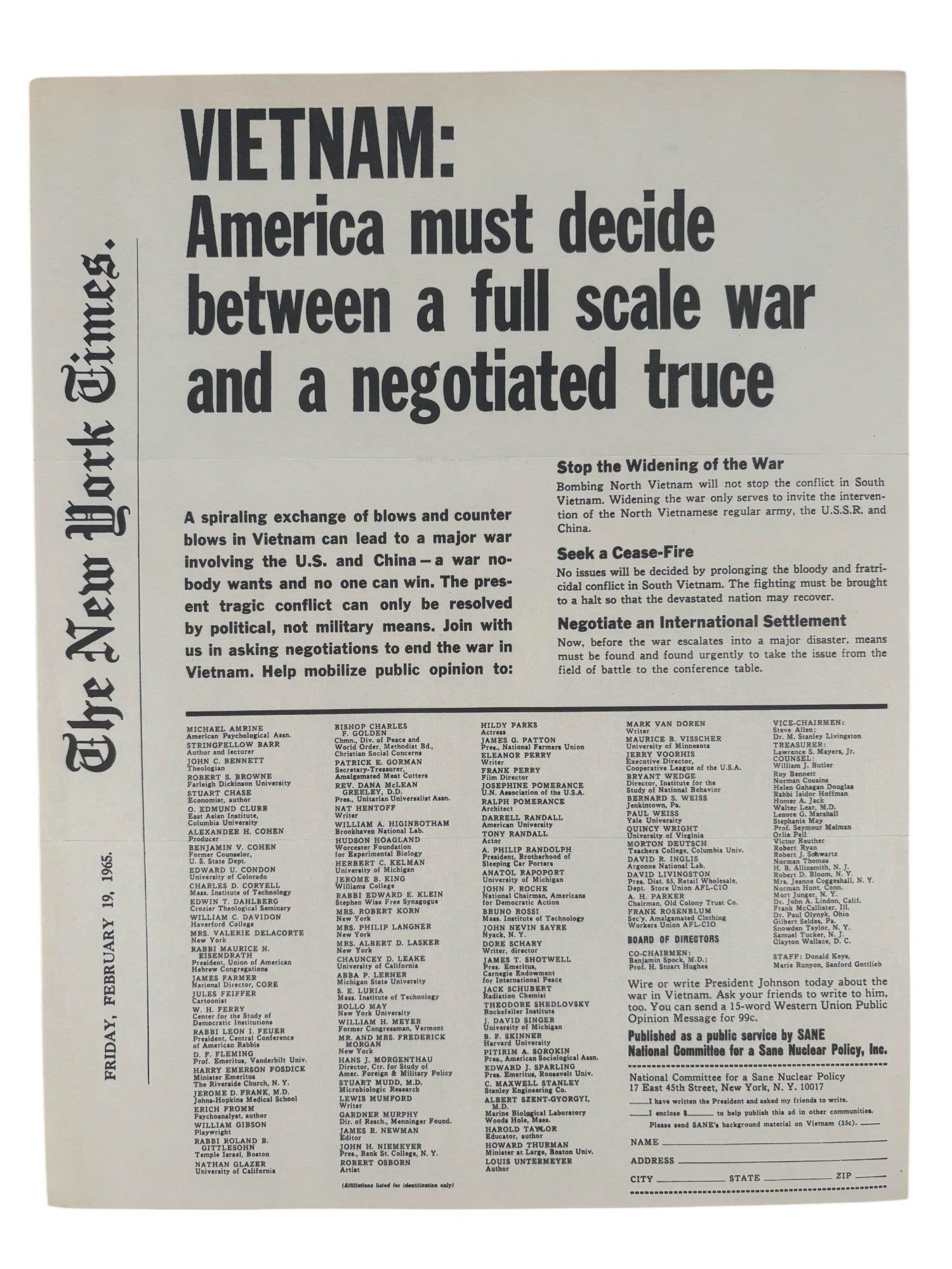
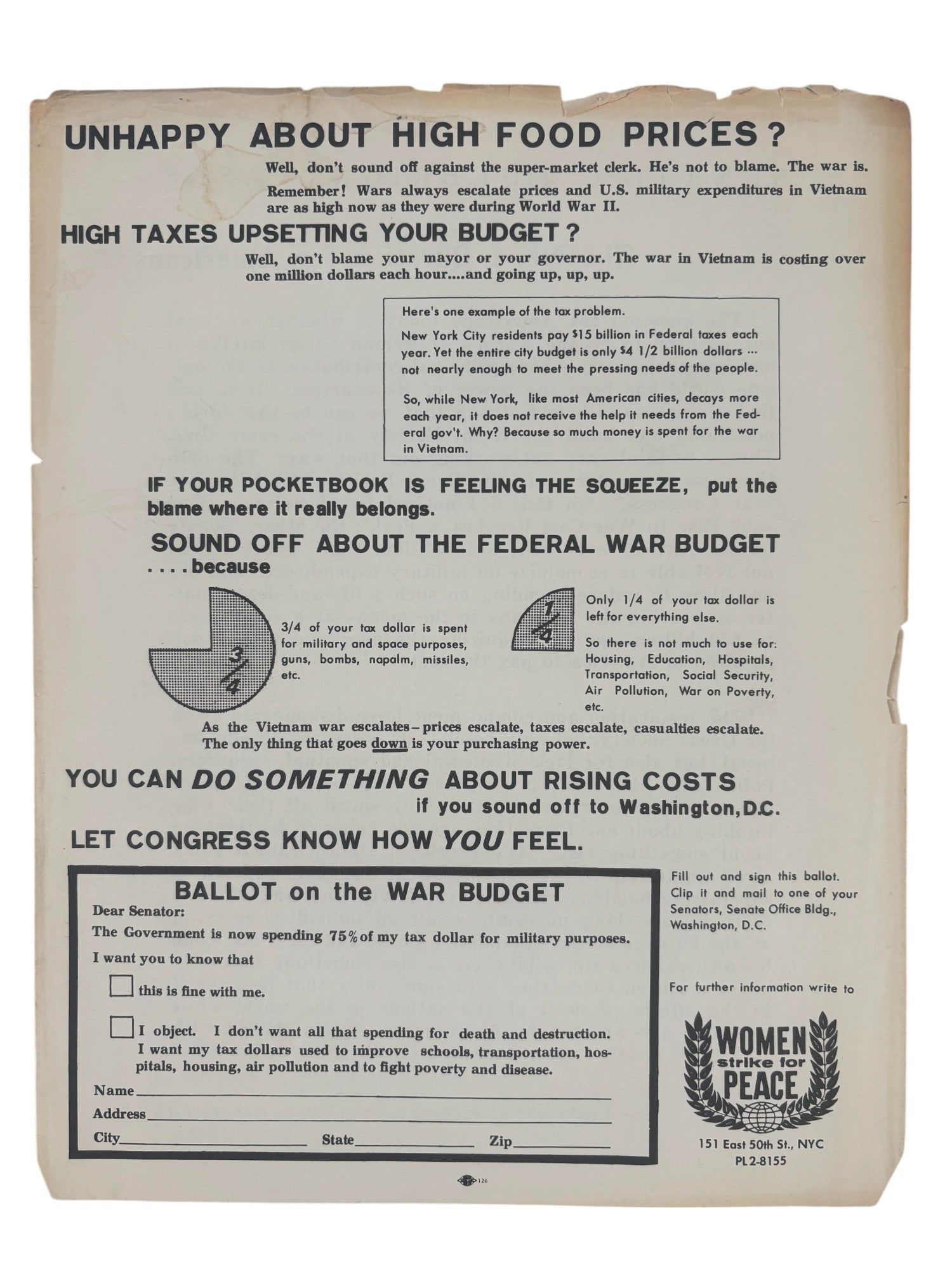
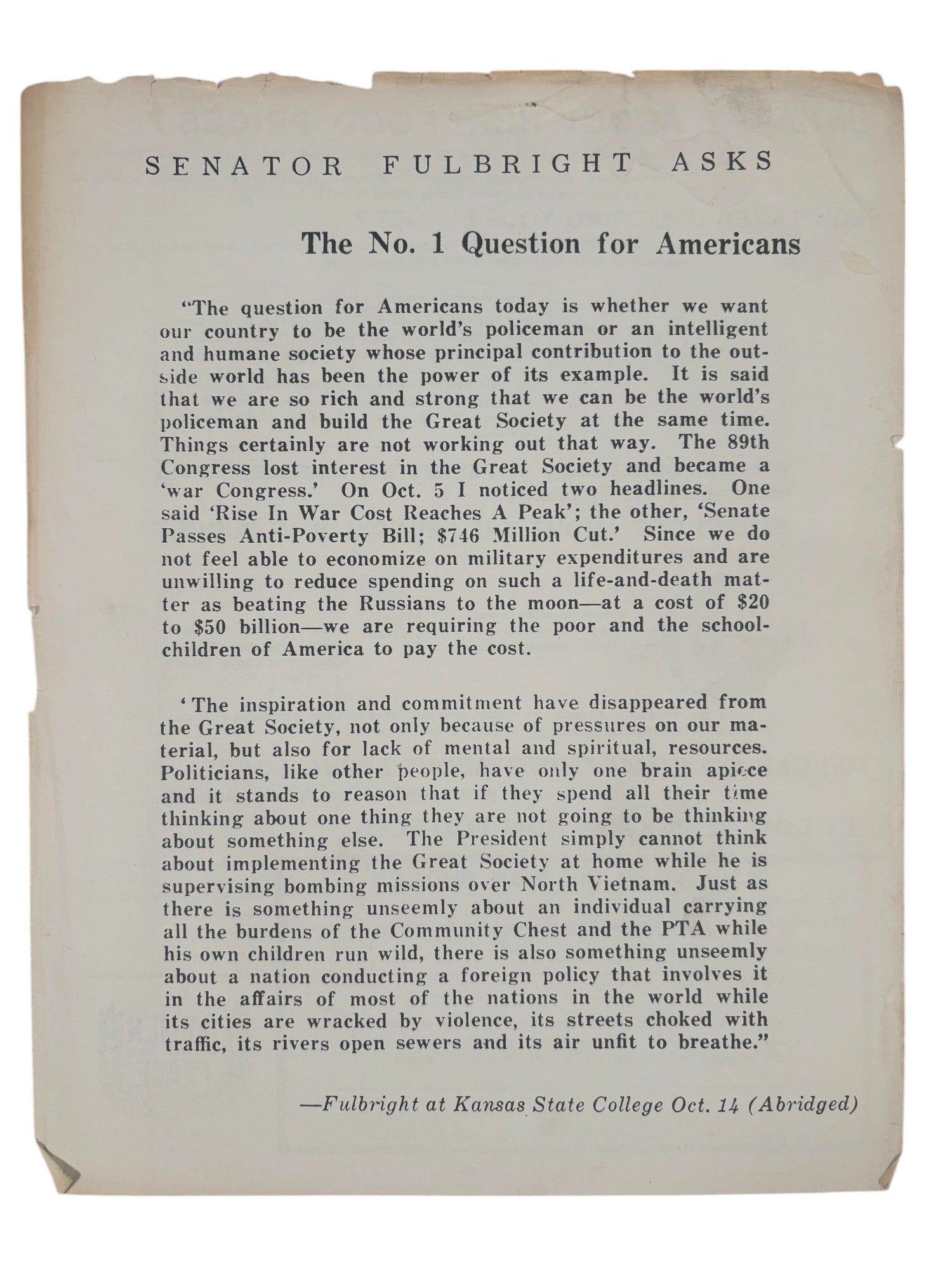
National Committee for a Sane Nuclear Policy. Vietnam: America must decide between a full scale war and a negotiated truce. New York: National Committee for a Sane Nuclear Policy, 1965. Broadside reproducing a full-page advertisement originally printed in The New York Times on February 19, 1965, warning that escalation in Vietnam could produce "a major war involving the U.S. and China-a war nobody wants and no one can win." The statement, signed by figures including Dr. Benjamin Spock, Linus Pauling, Norman Mailer, I.F. Stone, and clergy, labor, academic, and literary figures, urges ceasefire, negotiation, and public pressure on Congress and the White House, demonstrating how established liberal and pacifist networks converted newspaper advertising into political mobilization. [2] Women Strike for Peace and Fulbright, J. William. Unhappy About High Food Prices? [N.p.]: Women Strike for Peace, 1965. Double-sided broadside connecting the cost of Vietnam to food prices, taxation, and domestic social need, with a pie chart asserting that "3/4 of your tax dollar is spent for military and space purposes" and a "Ballot on the War Budget" stating, "I object. I don't want all that spending for death and destruction." The verso prints an abridged version of Senator J. William Fulbright's October 14, 1965 Kansas State College address, in which he asks whether the United States wants to be "the world's policeman" or "an intelligent and humane society," linking women's peace activism to Senate-level critique from the longtime chairman of the Foreign Relations Committee, whose papers document his central role in Vietnam-era foreign policy debate. Student Peace Union. United States Marines Speak Out. [N.p.]: Student Peace Union, 1966. Two-page mimeographed circular dated April 30, 1966, reproducing letters from two anonymous Marines stationed in Chu Lai, South Vietnam, with names withheld for safety. The first Marine writes, "I feel this war is a waste of time, people and money," while the second calls the conflict "a hollow, political, cold war" and pleads, "Let us help these people with kindness not death," offering unusually direct evidence of active-duty moral opposition circulated through student antiwar networks. [4] Contra Costa Citizens Against the War in Vietnam. Port Chicago's Where the Action Is. Contra Costa County: Contra Costa Citizens Against the War in Vietnam, 1966. Green flyer announcing an August 7 day of coordinated protest and civil disobedience at the U.S. Naval Weapons Station at Port Chicago, with instructions to rally at Concord City Park, march to the munitions gate, and maintain a vigil by those "prepared to risk arrest." The text identifies Port Chicago as a site through which ammunition and explosives for Vietnam passed and uses stark language to describe napalm trucks, explosives trucks, and "trainloads of bombs," ending with the slogan "One man / One truck / A thousand lives," showing how local organizers translated antiwar conviction into targeted obstruction of military supply lines. Condition information not supplied in the provided description, and overall condition cannot be responsibly assigned without examination. Substantive early antiwar archive preserving the movement's developing infrastructure of persuasion, dissent, and direct action during the first major phase of Vietnam escalation.
Four antiwar documents dating from 1965 to 1966, issued by or associated with the National Committee for a Sane Nuclear Policy, Women Strike for Peace, the Student Peace Union, and Contra Costa Citizens Against the War in Vietnam, with formats including mimeographed circulars, flyers, and broadsides. The materials include a SANE broadside reproducing a February 19, 1965 New York Times advertisement, a double-sided Women Strike for Peace and J. William Fulbright budget-and-war broadside from 1965, a Student Peace Union circular dated April 30, 1966 containing anonymous letters from Marines stationed at Chu Lai, and a Contra Costa protest flyer calling for action at Port Chicago on August 7, 1966. The archive differentiates several strands of early antiwar practice: public appeals by nationally known signatories, women's household-economy critique of military spending, active-duty military dissent circulated through student networks, and locally organized direct action aimed at munitions shipment infrastructure. Port Chicago carried additional historical resonance as a military logistics site associated with the 1944 munitions explosion and subsequent Black sailors' resistance to unsafe loading conditions, making its later use as a Vietnam protest site especially charged within histories of war labor, race, and military discipline.
National Committee for a Sane Nuclear Policy. Vietnam: America must decide between a full scale war and a negotiated truce. New York: National Committee for a Sane Nuclear Policy, 1965. Broadside reproducing a full-page advertisement originally printed in The New York Times on February 19, 1965, warning that escalation in Vietnam could produce "a major war involving the U.S. and China-a war nobody wants and no one can win." The statement, signed by figures including Dr. Benjamin Spock, Linus Pauling, Norman Mailer, I.F. Stone, and clergy, labor, academic, and literary figures, urges ceasefire, negotiation, and public pressure on Congress and the White House, demonstrating how established liberal and pacifist networks converted newspaper advertising into political mobilization. [2] Women Strike for Peace and Fulbright, J. William. Unhappy About High Food Prices? [N.p.]: Women Strike for Peace, 1965. Double-sided broadside connecting the cost of Vietnam to food prices, taxation, and domestic social need, with a pie chart asserting that "3/4 of your tax dollar is spent for military and space purposes" and a "Ballot on the War Budget" stating, "I object. I don't want all that spending for death and destruction." The verso prints an abridged version of Senator J. William Fulbright's October 14, 1965 Kansas State College address, in which he asks whether the United States wants to be "the world's policeman" or "an intelligent and humane society," linking women's peace activism to Senate-level critique from the longtime chairman of the Foreign Relations Committee, whose papers document his central role in Vietnam-era foreign policy debate. Student Peace Union. United States Marines Speak Out. [N.p.]: Student Peace Union, 1966. Two-page mimeographed circular dated April 30, 1966, reproducing letters from two anonymous Marines stationed in Chu Lai, South Vietnam, with names withheld for safety. The first Marine writes, "I feel this war is a waste of time, people and money," while the second calls the conflict "a hollow, political, cold war" and pleads, "Let us help these people with kindness not death," offering unusually direct evidence of active-duty moral opposition circulated through student antiwar networks. [4] Contra Costa Citizens Against the War in Vietnam. Port Chicago's Where the Action Is. Contra Costa County: Contra Costa Citizens Against the War in Vietnam, 1966. Green flyer announcing an August 7 day of coordinated protest and civil disobedience at the U.S. Naval Weapons Station at Port Chicago, with instructions to rally at Concord City Park, march to the munitions gate, and maintain a vigil by those "prepared to risk arrest." The text identifies Port Chicago as a site through which ammunition and explosives for Vietnam passed and uses stark language to describe napalm trucks, explosives trucks, and "trainloads of bombs," ending with the slogan "One man / One truck / A thousand lives," showing how local organizers translated antiwar conviction into targeted obstruction of military supply lines. Condition information not supplied in the provided description, and overall condition cannot be responsibly assigned without examination. Substantive early antiwar archive preserving the movement's developing infrastructure of persuasion, dissent, and direct action during the first major phase of Vietnam escalation.
Details
Title
Vietnam War Protest Documents Showing Military Dissent, Port Chicago Direct Action, SANE Petitioning, and Women Strike for Peace Budget Critique
Author
Antiwar Protest Movement
Condition
Unknown
Date
1965