

OPERA IN QUATTUOR TOMOS DISTRIBUTA
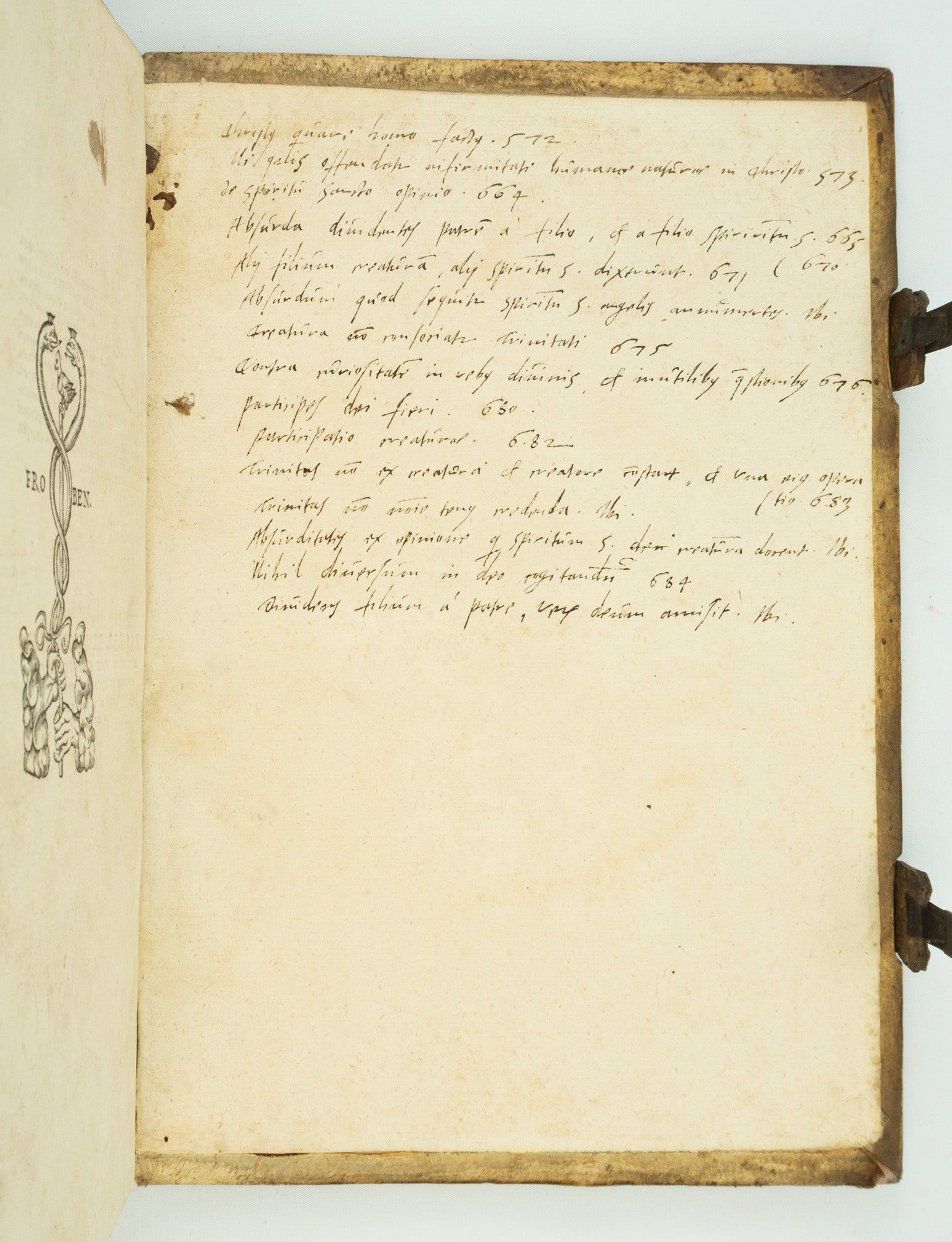
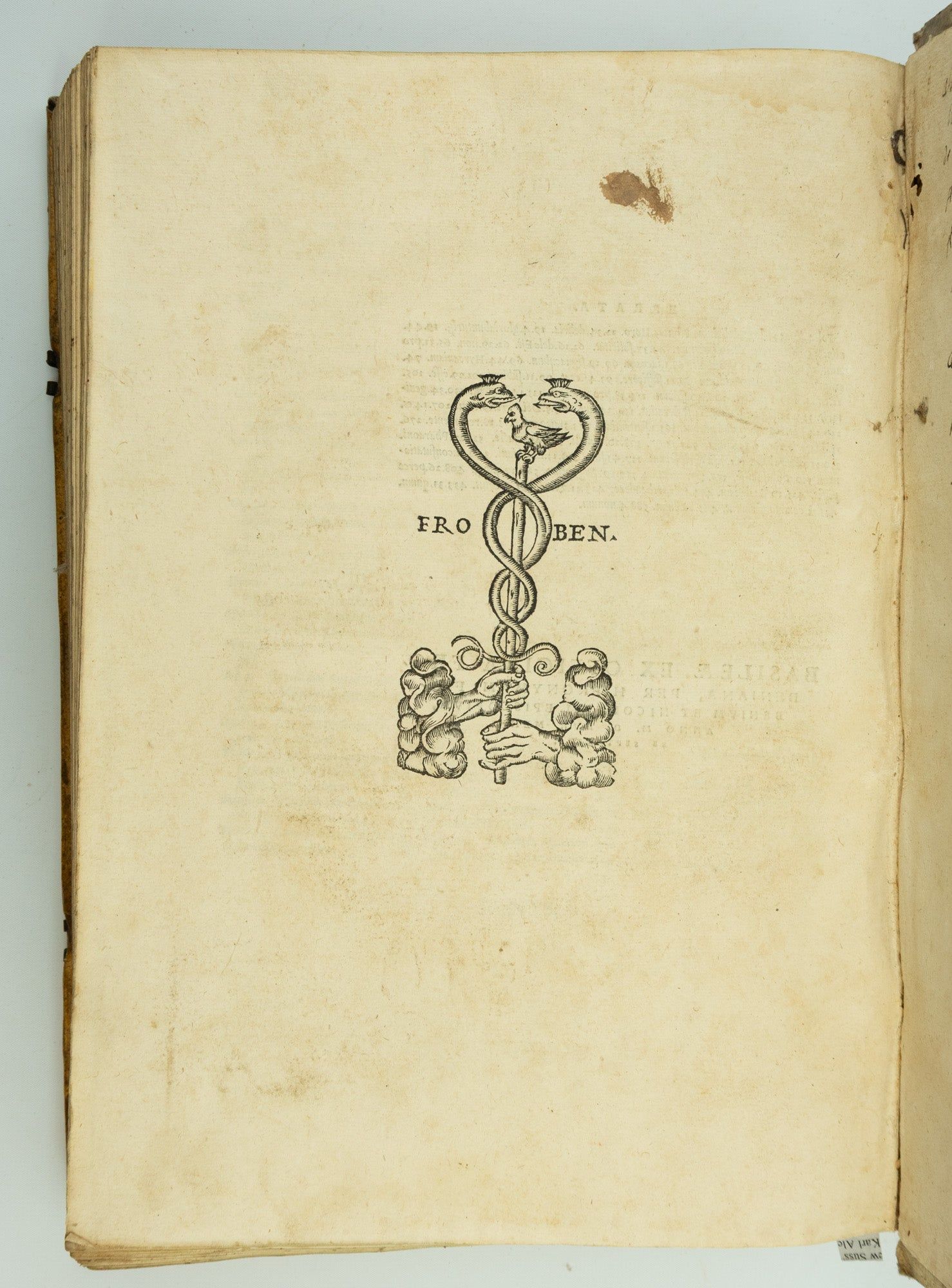
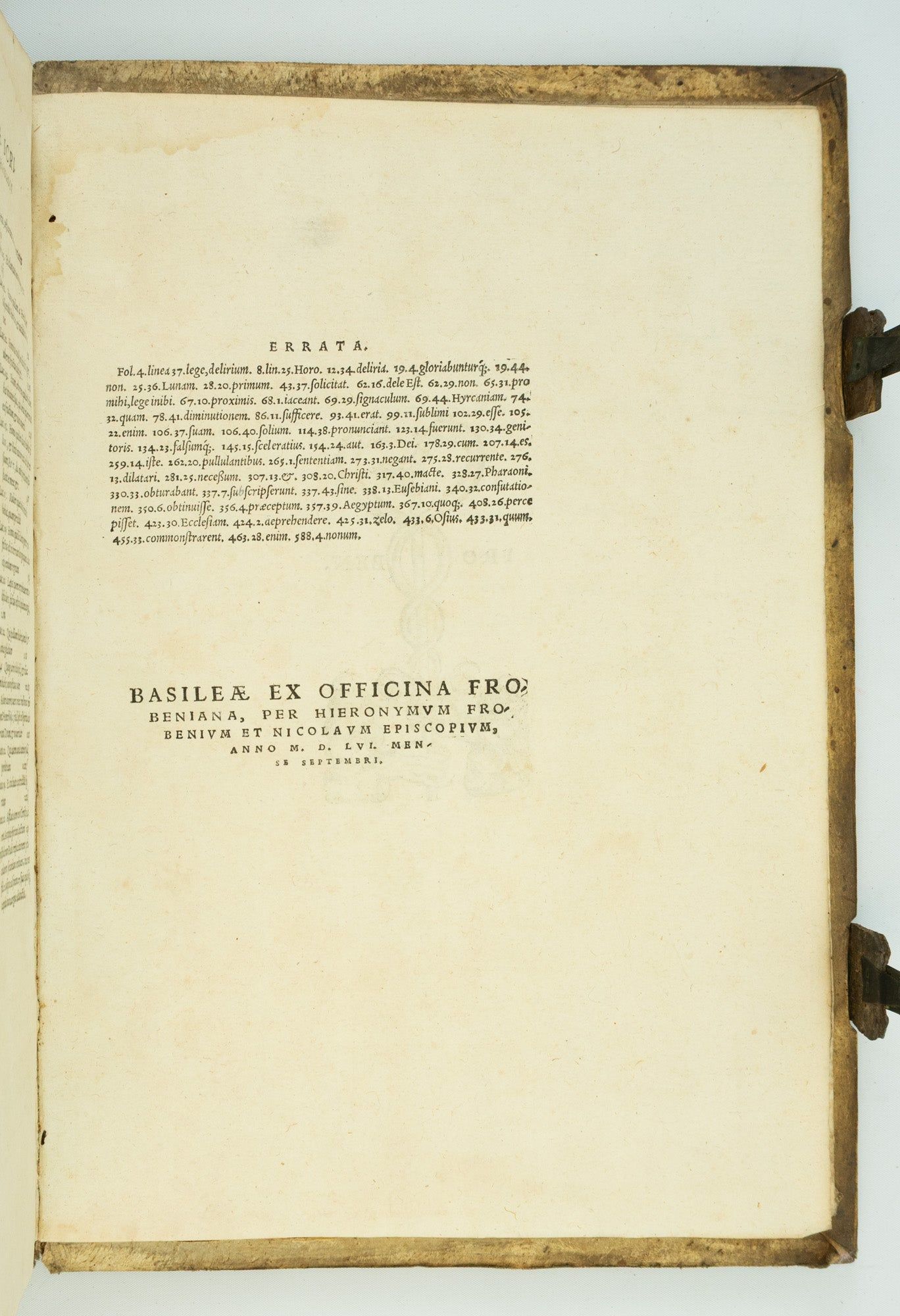
- Basel: [Hieronymus] Froben, 1556
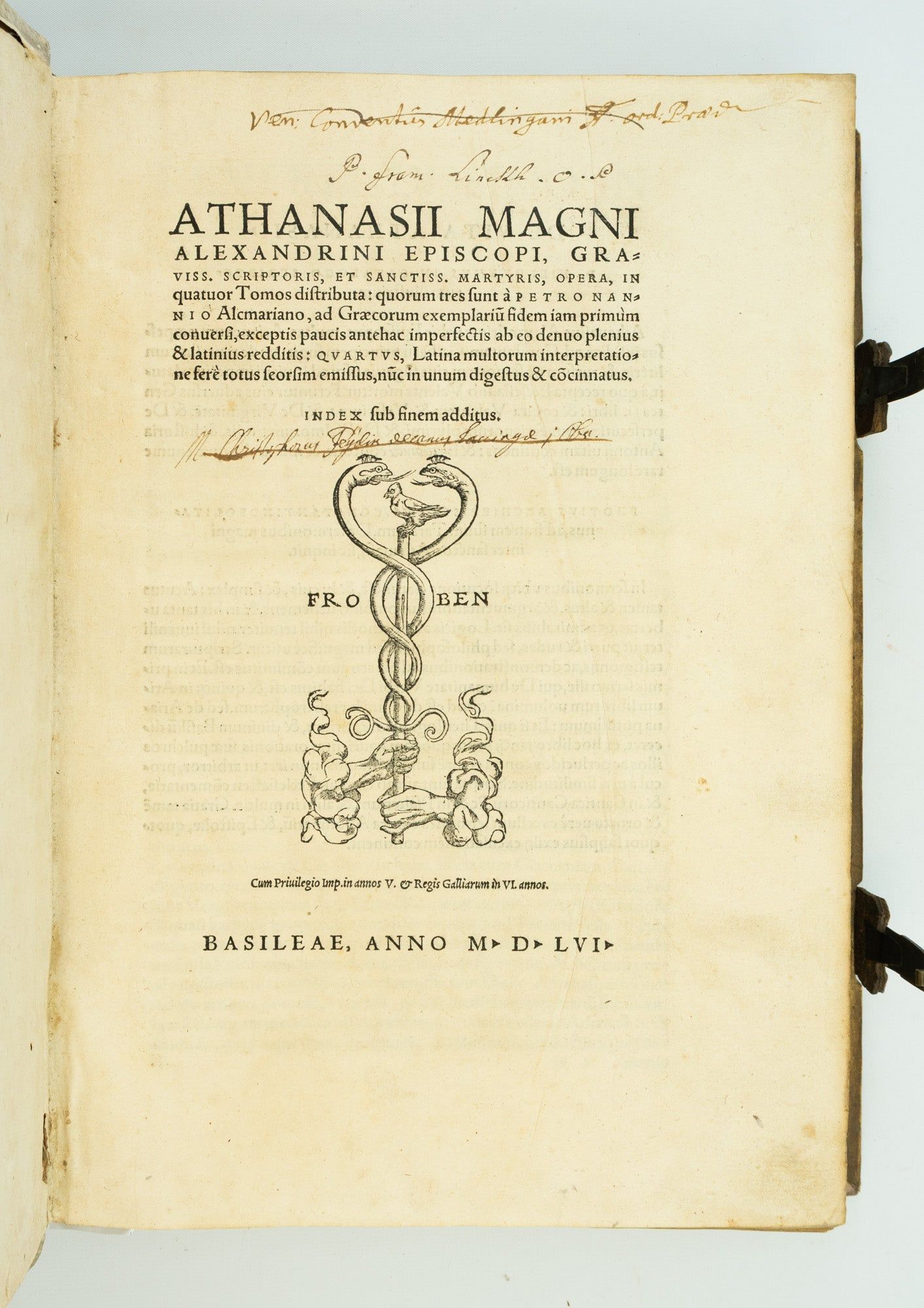
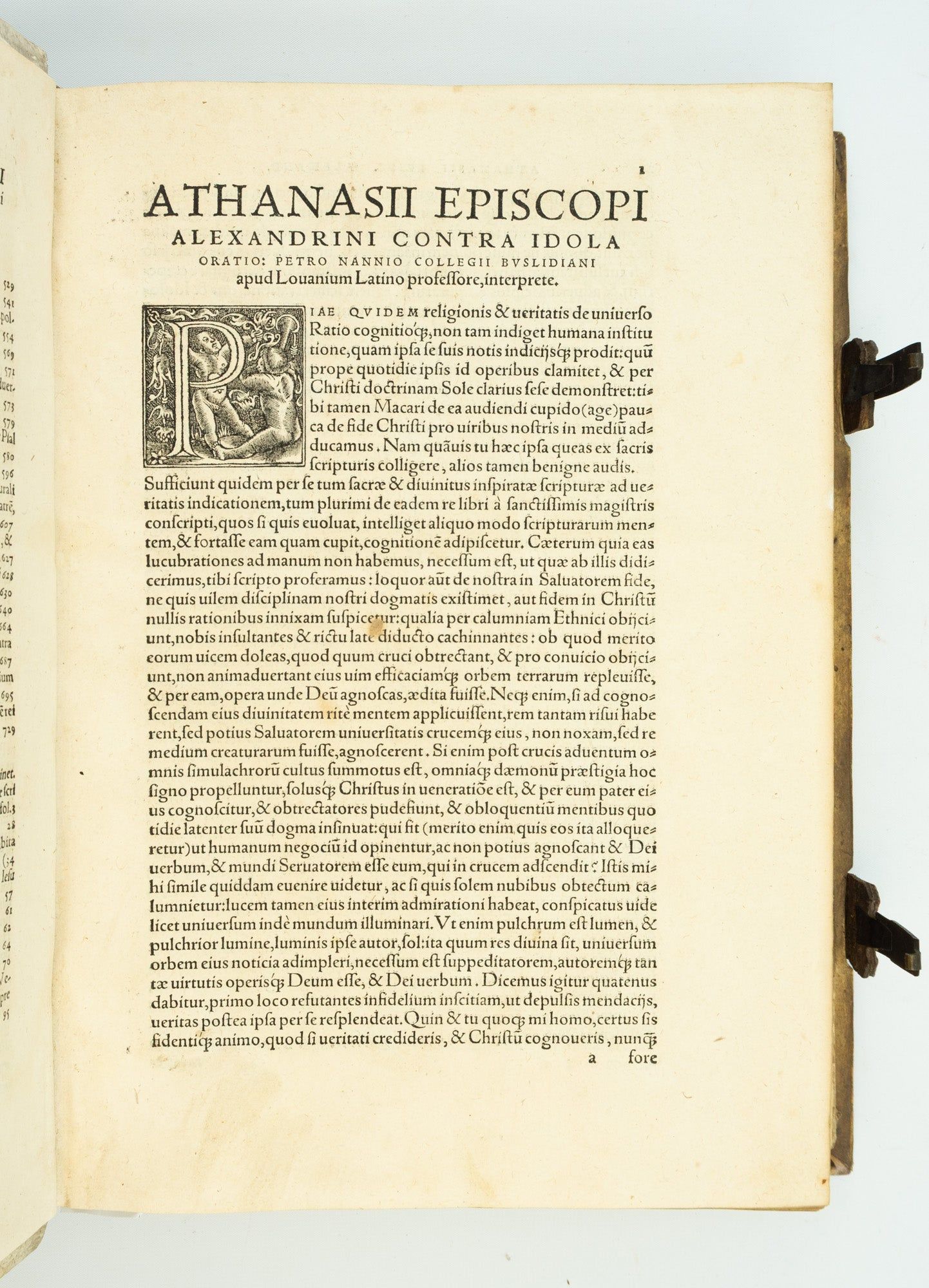
Basel: [Hieronymus] Froben, 1556. First Edition of this Latin Translation. 343 x 235 mm. (13 1/2 x 9 1/4"). 4 p.l., 730, 142, [2] (blank) pp., [12] leaves. Translated from the Greek by Petrus Nannius and Wolfgang Musculus.
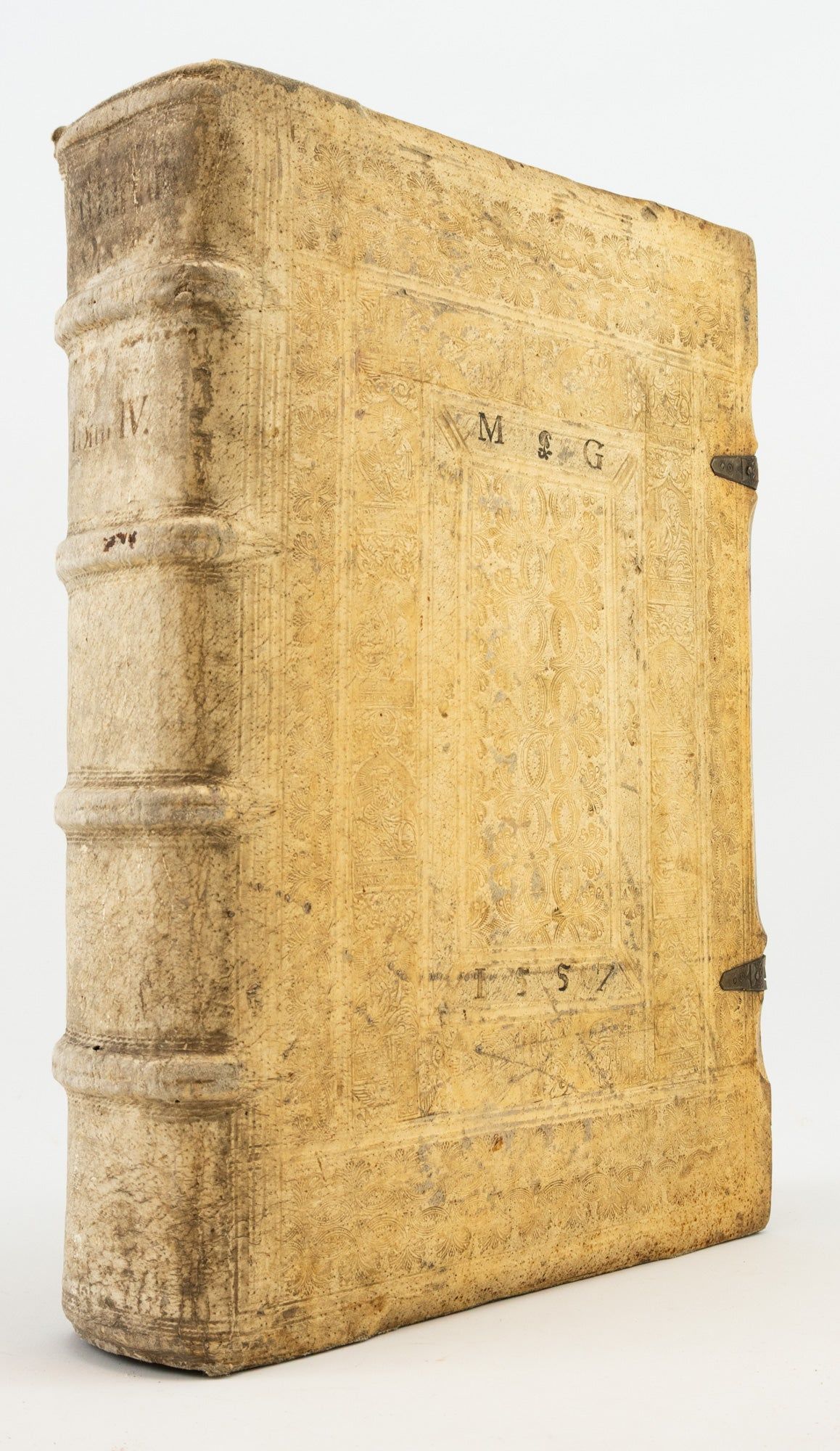
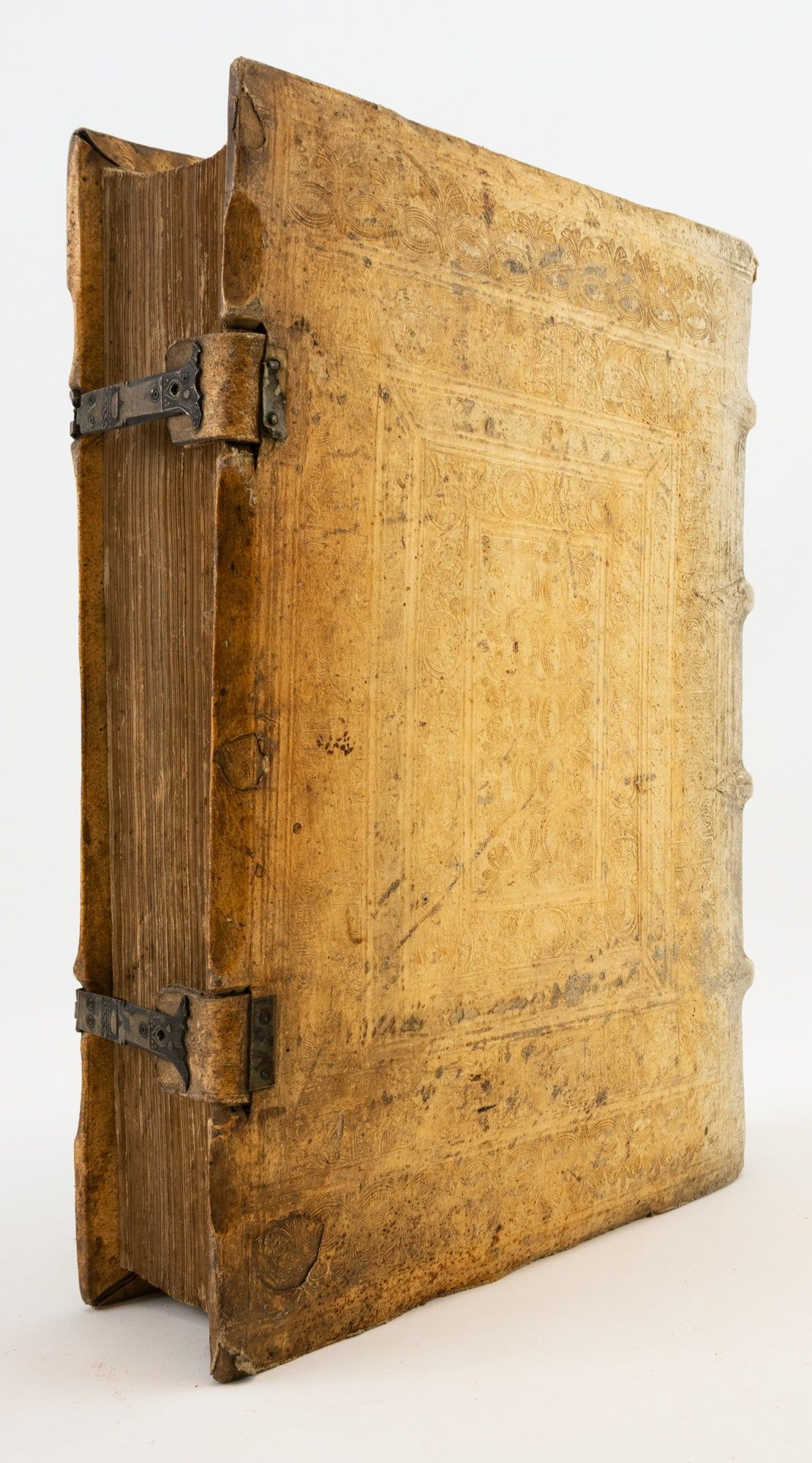
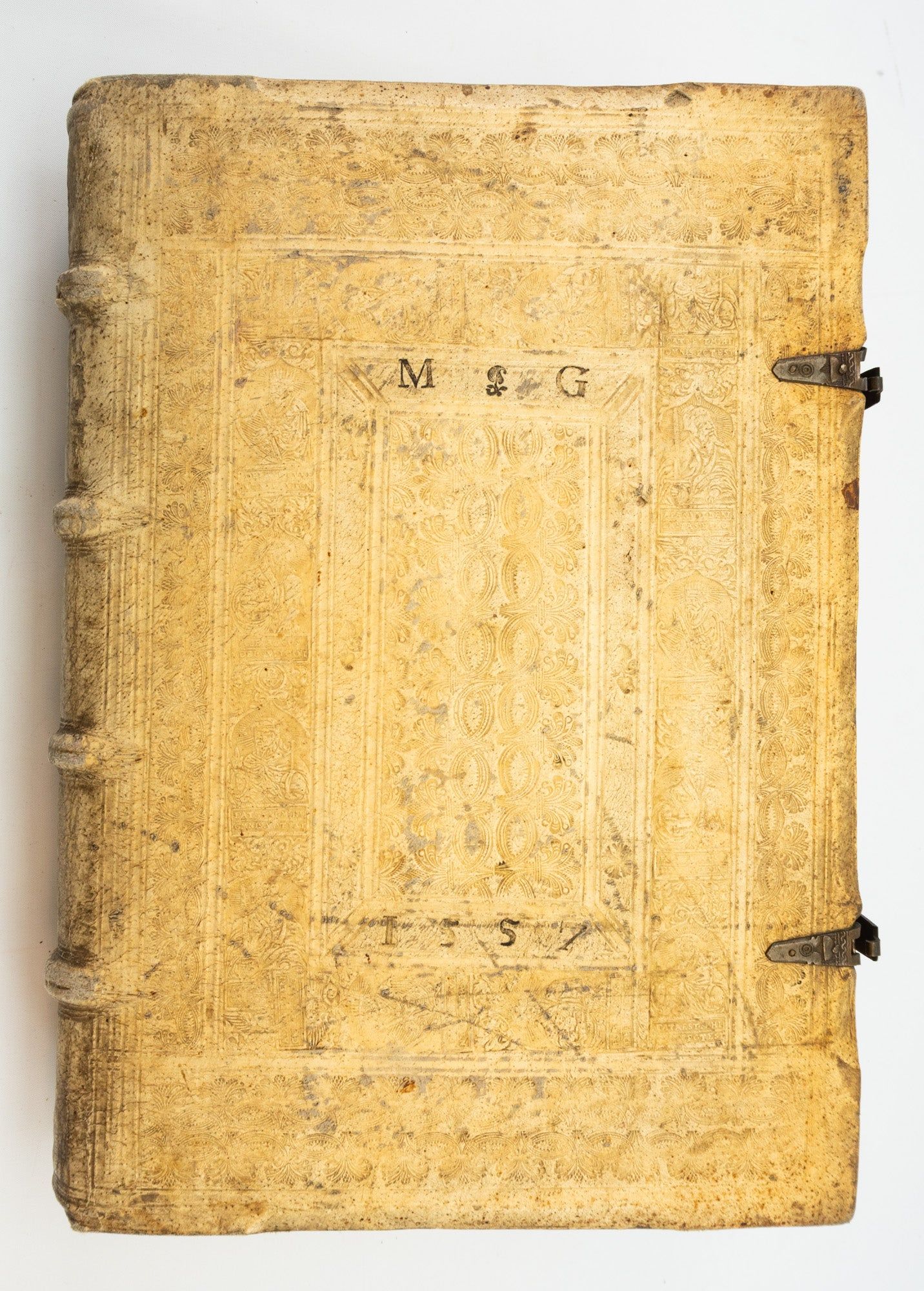
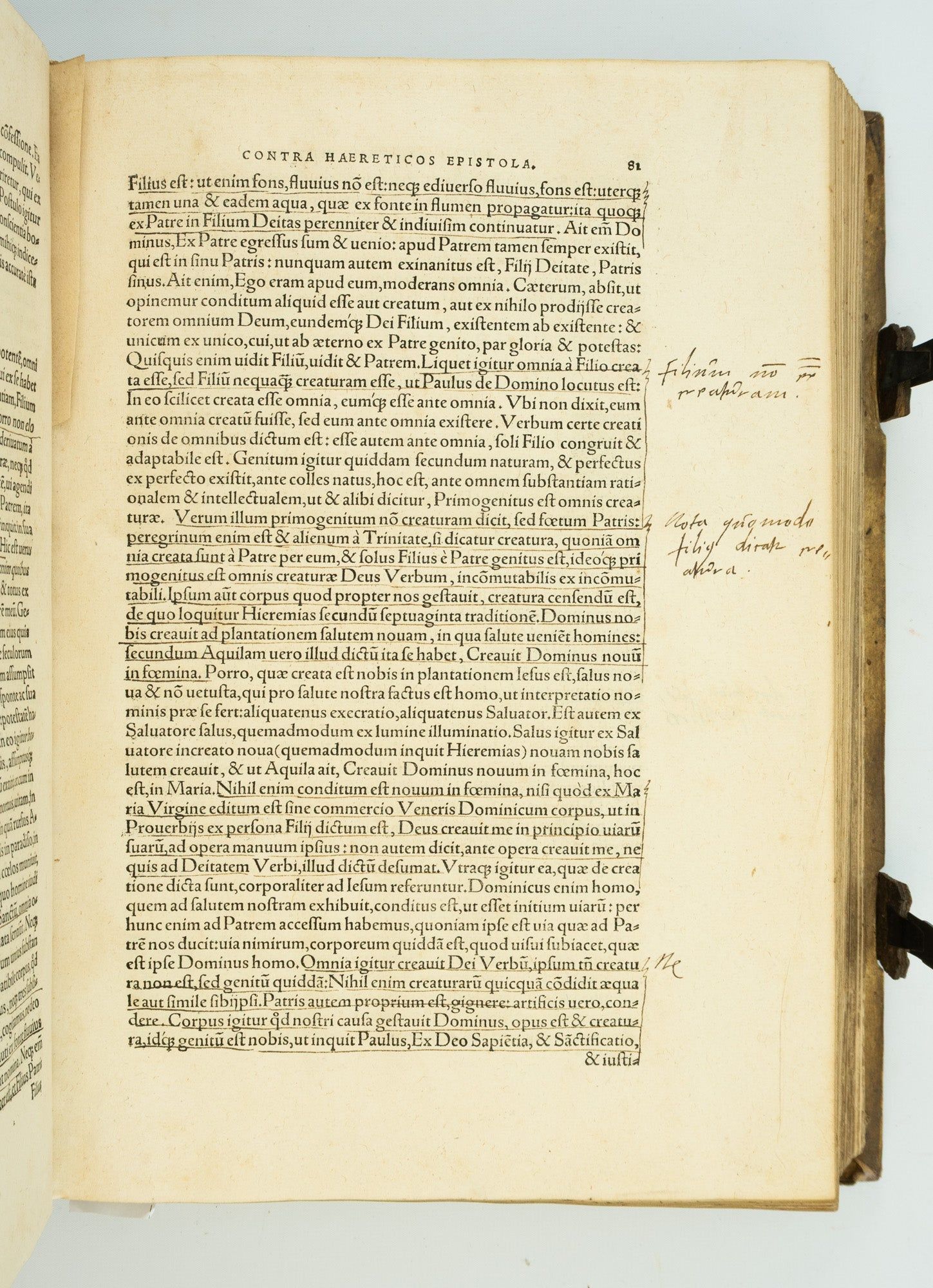
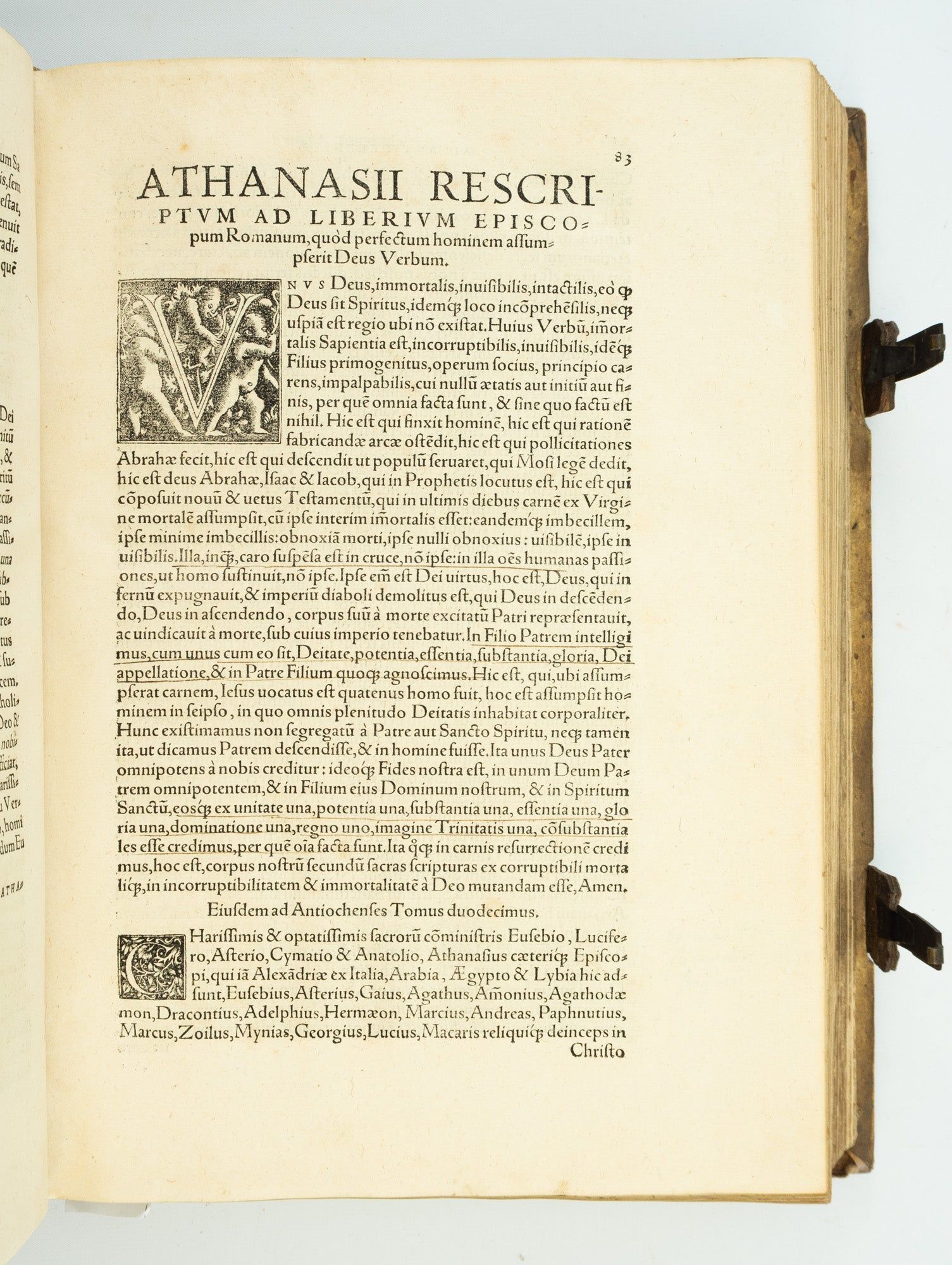
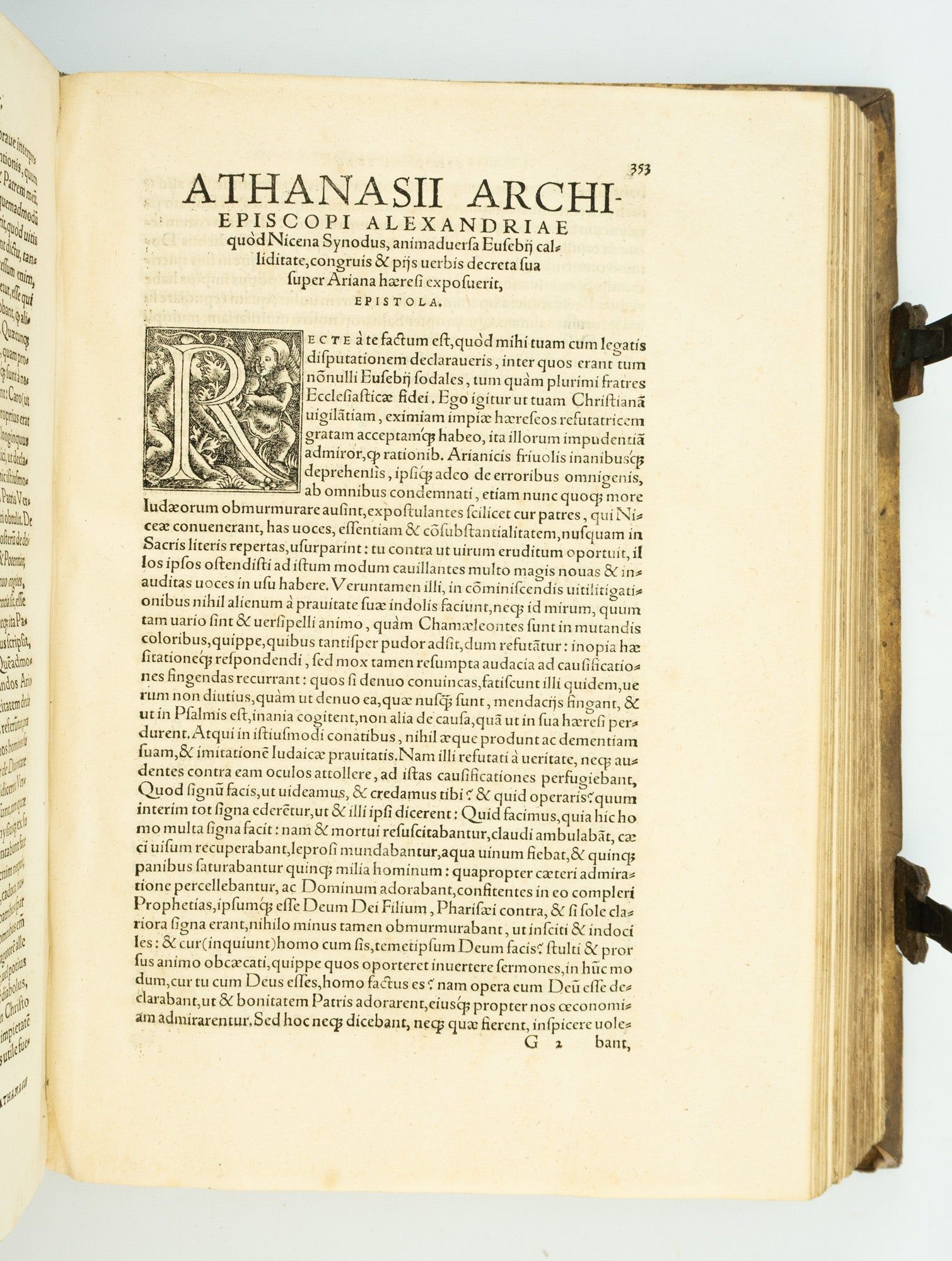
Contemporary blind-stamped pigskin over bevelled wooden boards by Balthasar Wernher of Lauingen, covers framed by palmette rolls and a roll signed with the initials B. W. that features half-figures of Christ as Salvator Mundi, St. Paul, St. John the Baptist, and King David, central panel of upper cover with vertical palmette rolls, the blank frame around it with the letters "M G" above the panel (separated by turnip tool), the date 1557 below the panel, central panel on the lower cover with the same tooling, but surrounded by a frame with a roll of medallions of the Reformers, raised bands, ink lettering to a couple of panels, two original brass catches and catchplates (one catchplate defective). Printer's woodcut device to title page and final page, numerous decorative woodcut initials. Title page with three early ink owner inscriptions; occasional early ink marginalia and underlining. VD16 A 3980; Adams A-2083; Hoffmann I, 415. For the binding: Haebler I, 475, 3; EBDB roll r003786 and workshop w004477. Binding somewhat soiled and chafed, pigskin at one corner rubbed away, one-inch circular hole on back board (a contemporary issue, with tooling impressed on the wood beneath), isolated minor marginal stains or mild foxing, other trivial imperfections, but an extremely pleasing copy, very fresh internally, with excellent margins, in a completely satisfying unrestored contemporary binding.
This collected edition of the writings of the Church Father and leading advocate of the doctrine of the Trinity comes in a lovely binding by a known German workshop. The Einbanddatenbank ("Bookbinding Database," or EBDB) of the German Research Foundation attributes the Salvator Mundi/St. Paul/King David/John the Baptist roll to Lauingen binder Balthazar Wernher (ca. 1525-74/75), whose initials appear in the panel featuring Christ. His workshop was active ca. 1555-75; the date on our binding indicates it was produced near the beginning of his career. One of the four great Eastern Doctors of the Church and the Patriarch of Alexandria, St. Athanasius (ca. 297 - 373) led the fight against the Arian doctrine, which held that Christ was a creation of God the Father rather than consubstantial with Him. Athansius’ writings on the Incarnation and the Trinity, which make up most of the text here, were enormously influential. According to Catholic historian Cornelius Clifford, "Athanasius was the greatest champion of Catholic belief on the subject of the Incarnation that the Church has ever known and in his lifetime earned the characteristic title of 'Father of Orthodoxy', by which he has been distinguished ever since." The English theologian (and Cardinal) John Henry Newman declared Athanasius a "principal instrument, after the Apostles, by which the sacred truths of Christianity have been conveyed and secured to the world." This translation of his writings was one of the final works by the Dutch humanist Petrus Nannius (Pieter Nannick, 1496-1557), a contemporary of Erasmus. The printer here was Hieronymus Froben, who took over the family business from his father Johann Froben (1460-1527), a central figure in the printing history of the 15th and early 16th centuries who played a key role both in the intellectual ferment of the northern Renaissance and the theological turmoil of the Reformation. Our substantial large folio binding, with its thick boards and four sets of muscular double bands, provides an appropriate reflection of the weightiness of the works it contains..
Contemporary blind-stamped pigskin over bevelled wooden boards by Balthasar Wernher of Lauingen, covers framed by palmette rolls and a roll signed with the initials B. W. that features half-figures of Christ as Salvator Mundi, St. Paul, St. John the Baptist, and King David, central panel of upper cover with vertical palmette rolls, the blank frame around it with the letters "M G" above the panel (separated by turnip tool), the date 1557 below the panel, central panel on the lower cover with the same tooling, but surrounded by a frame with a roll of medallions of the Reformers, raised bands, ink lettering to a couple of panels, two original brass catches and catchplates (one catchplate defective). Printer's woodcut device to title page and final page, numerous decorative woodcut initials. Title page with three early ink owner inscriptions; occasional early ink marginalia and underlining. VD16 A 3980; Adams A-2083; Hoffmann I, 415. For the binding: Haebler I, 475, 3; EBDB roll r003786 and workshop w004477. Binding somewhat soiled and chafed, pigskin at one corner rubbed away, one-inch circular hole on back board (a contemporary issue, with tooling impressed on the wood beneath), isolated minor marginal stains or mild foxing, other trivial imperfections, but an extremely pleasing copy, very fresh internally, with excellent margins, in a completely satisfying unrestored contemporary binding.
This collected edition of the writings of the Church Father and leading advocate of the doctrine of the Trinity comes in a lovely binding by a known German workshop. The Einbanddatenbank ("Bookbinding Database," or EBDB) of the German Research Foundation attributes the Salvator Mundi/St. Paul/King David/John the Baptist roll to Lauingen binder Balthazar Wernher (ca. 1525-74/75), whose initials appear in the panel featuring Christ. His workshop was active ca. 1555-75; the date on our binding indicates it was produced near the beginning of his career. One of the four great Eastern Doctors of the Church and the Patriarch of Alexandria, St. Athanasius (ca. 297 - 373) led the fight against the Arian doctrine, which held that Christ was a creation of God the Father rather than consubstantial with Him. Athansius’ writings on the Incarnation and the Trinity, which make up most of the text here, were enormously influential. According to Catholic historian Cornelius Clifford, "Athanasius was the greatest champion of Catholic belief on the subject of the Incarnation that the Church has ever known and in his lifetime earned the characteristic title of 'Father of Orthodoxy', by which he has been distinguished ever since." The English theologian (and Cardinal) John Henry Newman declared Athanasius a "principal instrument, after the Apostles, by which the sacred truths of Christianity have been conveyed and secured to the world." This translation of his writings was one of the final works by the Dutch humanist Petrus Nannius (Pieter Nannick, 1496-1557), a contemporary of Erasmus. The printer here was Hieronymus Froben, who took over the family business from his father Johann Froben (1460-1527), a central figure in the printing history of the 15th and early 16th centuries who played a key role both in the intellectual ferment of the northern Renaissance and the theological turmoil of the Reformation. Our substantial large folio binding, with its thick boards and four sets of muscular double bands, provides an appropriate reflection of the weightiness of the works it contains..
Details
Title
OPERA IN QUATTUOR TOMOS DISTRIBUTA
Author
(BINDINGS - 16TH CENTURY, BALTHASAR WERNHER). ATHANASIUS ALEXANDRINUS
Condition
Unknown
Publisher
[Hieronymus] Froben: Basel
Date
1556
Edition
First Edition of this Latin Translation