

Signed Photograph and Typed Letter Signed
- SIGNED
- Carmel by the Sea: np, 1927
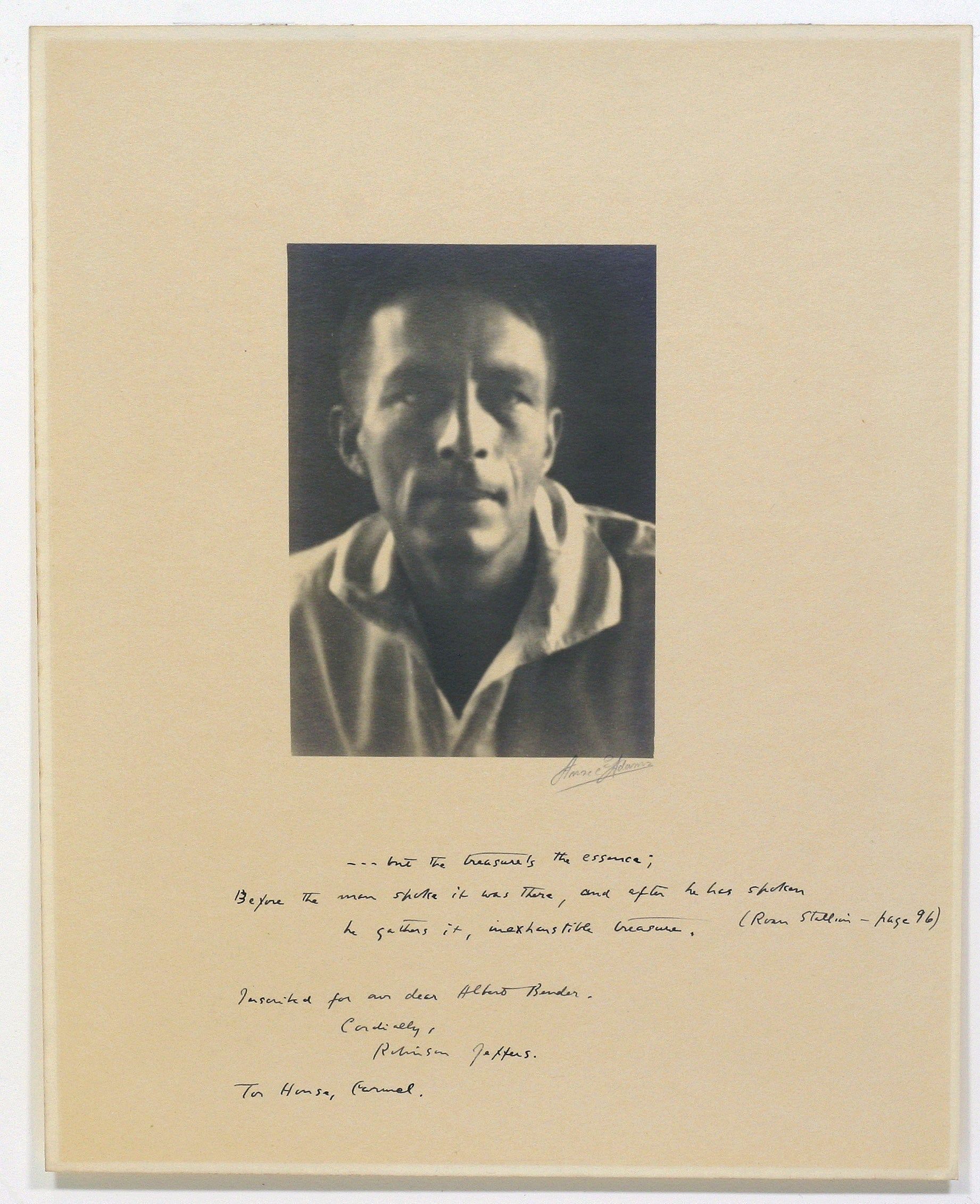
Carmel by the Sea: np, 1927. First edition. Very Good. ANSEL ADAMS'S ICONIC PORTRAIT OF ROBINSON JEFFERS, SIGNED BY ADAMS AND INSCRIBED IN VERSE BY JEFFERS TO THEIR PATRON ALBERT BENDER.
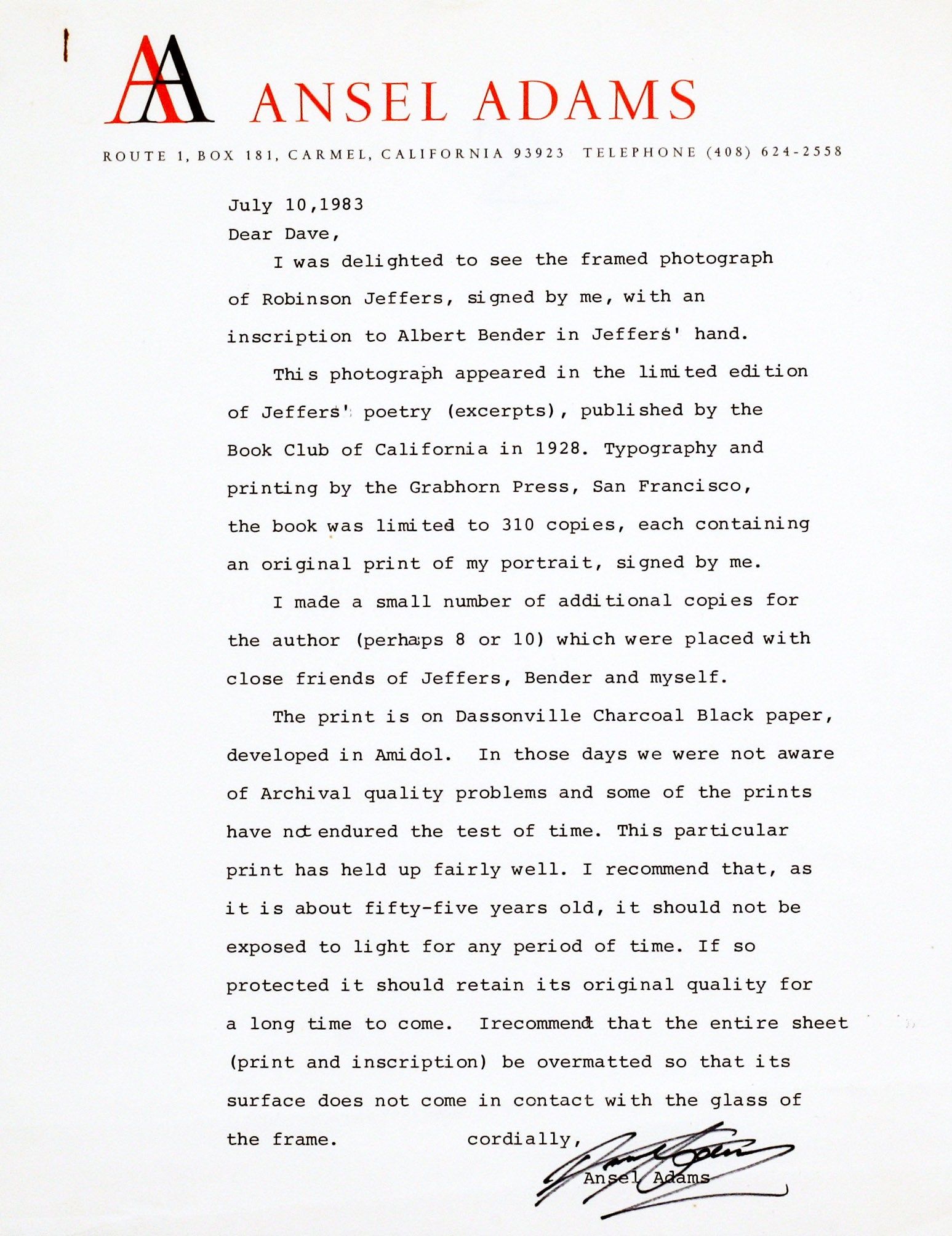
WITH SIGNED LETTER FROM ADAMS TO PHOTOGRAPHER DAVE BOHN DESCRIBING THE HISTORY AND CREATION OF THE PHOTO.
EXTREMELY SCARCE: ACCORDING TO ADAMS, ONE OF ONLY ABOUT 8-10 PRINTS MADE. Jeffers and Adams first met at Jeffers’s home, the hand-constructed 'Tor House' in Carmel-by-the-sea. Both Adams and Jeffers were deeply connected to the Big Sur region—a landscape that profoundly shaped their works.
Adams was immediately impressed by Jeffers:
“Jeffers was awaiting us—a tall man with a hard face and a bold shock of hair. He was wearing an open shirt and knickers. Quiet and shy in manner and voice, he possessed a strange presence with his rugged features and relentless glance…. I sensed a power of personality that I have rarely felt. We had nothing important to say to each other at the time, so we said nothing. One did not make small talk with Robinson Jeffers” [Adams].
This portrait was taken by Adams in 1927, and used as the frontispiece for the signed limited edition of Jeffers's Poems published by the Grabhorn Press in 1928.
“Jeffers needed a likeness of himself for his next book. Inexperienced in the area of portraiture, Ansel photographed him using intense side lighting with a wide-open shutter that provided no depth of field. The result was a soft, gauzy image that did not speak truthfully of its sitter; in it Jeffers’s strong, angular features seem unnaturally gentled, and a shy smile curves upward on his lips. Maybe the poet saw himself differently than did others, for he chose Ansel’s portrait for the frontispiece of the collection” [Alinder].
The year proved to be a pivotal one for the young Ansel Adams. By the end of 1927, Adams created his first fully visualized photograph: Monolith, the face of Dome. During this year, Adams also came under the artistic influence of photographer Edward Weston and arts patron Albert Bender. Bender’s personal and creative influence, along with his financial support, spurred Adams’s works to publishing, giving Adams the confidence to pursue more extended photography trips [Turnage].
Artistically, Jeffers embraced the smallness of human experience, claiming mankind too self-centered to appreciate ‘the astonishing beauty of things.’ It is no surprise, then, that Adams admired Jeffers. Both artists remained committed to determining a rightful relationship between human and nature [Turnage].
Ansel Adams’s art is identified with this profound vastness—stark mountains rendered in black and white, clear lakes stretching into the horizon. His work did not pursue realism. Rather, Adams sought to intensify and purify the physical drama of nature, aiming to fill the viewer with a sense of the sublime. Adams’s photography was rooted in conservationism, emphasizing what he termed the ‘spiritual-emotional’ dimensions of nature, opposing the tides of resortism that threatened to privatize and overdevelop national parks.
Critics described Adams as a photographer of idealized, bygone environments: parks without people, mountains without mountaineers. But such a view overlooked the reality that many of the landscapes Adams photographed were, in fact, under active preservation. These parks and forests were protected, in part, because of Adams’s very own photography and the activism of groups like the Sierra Club with which Adams collaborated. Although Adams often claimed to be “uninfluenced,” he was firmly situated within the traditions of the American Transcendentalists, a philosophical lineage that included Ralph Waldo Emerson, Henry David Thoreau, and John Muir [Coffin].
Robinson Jeffers, too, stood as a torchbearer of a grand lineage. A poet of the American West, Jeffers’s poetry was laden with classical allusions—retellings of epic Greek myths and tragedies. However, as Greek tragedian Euripides before him, more than mythic recreation, Jeffers focused on the individual psychologies of his characters. Drawing inspiration from Nietzsche, Jeffers articulated “Inhumanism,” as the ethos underlying his poetry.
Adams was drawn to this philosophy of Inhumanism:
“Jeffers was a dramatist, deeply concerned with the ebb and flow of humanity in the chaos of an inhuman cosmos, writing of the eternal realities of the natural world where man is but an accidental phenomenon….. Jeffers saw man as inseparable from nature; thus man must conduct himself accordingly or he is doomed. Jeffers was a prophet of our age” [Adams].
––––––
Signed by Adams below the image and inscribed by Jeffers with lines of verse from his poem "The Treasure".
“....but He treasures the essence;
Beyond The man shake it was There, and often he has shaken
he gathers it, inexhaustible treasure. (Roan Stallian -- page 96)
Inscribed for an dear Albert Bender
Cordially,
Robinson Jeffers
Tor House, Carmel”
AN IMPORTANT ASSOCIATION COPY: The recipient, Albert Bender, was among the most influential patrons of the early twentieth-century American arts. A devoted supporter of Robinson Jeffers, Bender championed the poet during his formative years, fostering his reputation as the great literary voice of the California coast. Even more decisively, Bender underwrote the publication of Ansel Adams’s first portfolio, Parmelian Prints of the High Sierras (1927), thereby launching Adams’s career as a photographer of national importance. Through his friendship, financial support, and extraordinary network of connections, Bender not only encouraged Jeffers and Adams individually, but also helped to link the literary and visual arts of the American West in a shared cultural moment.
The photograph was later acquired by wilderness photographer Dave Bohn, who asked Adams to write the following letter, explaining the origin and circumstances of the photo (letter included):
This letter reads in full:
July 10, 1983
Dear Dave,
I was delighted to see the framed photograph of Robinson Jeffers, signed by me, with an inscription to Albert Bender in Jeffers' hand.
This photograph appeared in the limited edition of Jeffers' poetry (excerpts), published by the Book Club of California in 1928. Typography and printing by the Grabhorn Press, San Francisco, the book was limited to 310 copies, each containing an original print of my portrait, signed by me.
I made a small number of additional copies for the author (perhaps 8 or 10) which were placed with close friends of Jeffers, Bender and myself.
The print is on Dassonville Charcoal Black paper, developed in Amidol. In those days we were not aware of Archival quality problems and some of the prints have not endured the test of time. This particular print has held up fairly well. I recommend that, as it is about fifty-five years old, it should not be exposed to light for any period of time. If so protected it should retain its original quality for a long time to come. I recommend that the entire sheet (print and inscription) be overmatted so that its surface does not come in contact with the glass of the frame.
Cordially,
Ansel Adams [signed]
Size: Sheet = approx. 8x10 in. Image = 3 1/8 x 4 3/8 in. Letter = 8 1/2 x 11 inches on Adams's Carmel stationery. Letter fine. Photograph and inscription fine; a little matte burn (from previous framing) on extreme edges of sheet. Housed in custom presentation folder.
EXCEEDINGLY RARE, and with important association.
References:
- Alinder, Mary Street. Ansel Adams: A Biography. 1st ed. New York: Henry Holt and Company, 1996.
- Adams, Ansel. Ansel Adams: An Autobiography. Edited by Mary Street Alinder, Little, Brown, 1985.
- Coffin, Arthur B. "Jeffers, Robinson (1887-1962), poet." American National Biography.
- Turnage, William A. "Adams, Ansel (1902-1984), photographer and environmentalist." American National Biography. 1 Feb. 2000.
WITH SIGNED LETTER FROM ADAMS TO PHOTOGRAPHER DAVE BOHN DESCRIBING THE HISTORY AND CREATION OF THE PHOTO.
EXTREMELY SCARCE: ACCORDING TO ADAMS, ONE OF ONLY ABOUT 8-10 PRINTS MADE. Jeffers and Adams first met at Jeffers’s home, the hand-constructed 'Tor House' in Carmel-by-the-sea. Both Adams and Jeffers were deeply connected to the Big Sur region—a landscape that profoundly shaped their works.
Adams was immediately impressed by Jeffers:
“Jeffers was awaiting us—a tall man with a hard face and a bold shock of hair. He was wearing an open shirt and knickers. Quiet and shy in manner and voice, he possessed a strange presence with his rugged features and relentless glance…. I sensed a power of personality that I have rarely felt. We had nothing important to say to each other at the time, so we said nothing. One did not make small talk with Robinson Jeffers” [Adams].
This portrait was taken by Adams in 1927, and used as the frontispiece for the signed limited edition of Jeffers's Poems published by the Grabhorn Press in 1928.
“Jeffers needed a likeness of himself for his next book. Inexperienced in the area of portraiture, Ansel photographed him using intense side lighting with a wide-open shutter that provided no depth of field. The result was a soft, gauzy image that did not speak truthfully of its sitter; in it Jeffers’s strong, angular features seem unnaturally gentled, and a shy smile curves upward on his lips. Maybe the poet saw himself differently than did others, for he chose Ansel’s portrait for the frontispiece of the collection” [Alinder].
The year proved to be a pivotal one for the young Ansel Adams. By the end of 1927, Adams created his first fully visualized photograph: Monolith, the face of Dome. During this year, Adams also came under the artistic influence of photographer Edward Weston and arts patron Albert Bender. Bender’s personal and creative influence, along with his financial support, spurred Adams’s works to publishing, giving Adams the confidence to pursue more extended photography trips [Turnage].
Artistically, Jeffers embraced the smallness of human experience, claiming mankind too self-centered to appreciate ‘the astonishing beauty of things.’ It is no surprise, then, that Adams admired Jeffers. Both artists remained committed to determining a rightful relationship between human and nature [Turnage].
Ansel Adams’s art is identified with this profound vastness—stark mountains rendered in black and white, clear lakes stretching into the horizon. His work did not pursue realism. Rather, Adams sought to intensify and purify the physical drama of nature, aiming to fill the viewer with a sense of the sublime. Adams’s photography was rooted in conservationism, emphasizing what he termed the ‘spiritual-emotional’ dimensions of nature, opposing the tides of resortism that threatened to privatize and overdevelop national parks.
Critics described Adams as a photographer of idealized, bygone environments: parks without people, mountains without mountaineers. But such a view overlooked the reality that many of the landscapes Adams photographed were, in fact, under active preservation. These parks and forests were protected, in part, because of Adams’s very own photography and the activism of groups like the Sierra Club with which Adams collaborated. Although Adams often claimed to be “uninfluenced,” he was firmly situated within the traditions of the American Transcendentalists, a philosophical lineage that included Ralph Waldo Emerson, Henry David Thoreau, and John Muir [Coffin].
Robinson Jeffers, too, stood as a torchbearer of a grand lineage. A poet of the American West, Jeffers’s poetry was laden with classical allusions—retellings of epic Greek myths and tragedies. However, as Greek tragedian Euripides before him, more than mythic recreation, Jeffers focused on the individual psychologies of his characters. Drawing inspiration from Nietzsche, Jeffers articulated “Inhumanism,” as the ethos underlying his poetry.
Adams was drawn to this philosophy of Inhumanism:
“Jeffers was a dramatist, deeply concerned with the ebb and flow of humanity in the chaos of an inhuman cosmos, writing of the eternal realities of the natural world where man is but an accidental phenomenon….. Jeffers saw man as inseparable from nature; thus man must conduct himself accordingly or he is doomed. Jeffers was a prophet of our age” [Adams].
––––––
Signed by Adams below the image and inscribed by Jeffers with lines of verse from his poem "The Treasure".
“....but He treasures the essence;
Beyond The man shake it was There, and often he has shaken
he gathers it, inexhaustible treasure. (Roan Stallian -- page 96)
Inscribed for an dear Albert Bender
Cordially,
Robinson Jeffers
Tor House, Carmel”
AN IMPORTANT ASSOCIATION COPY: The recipient, Albert Bender, was among the most influential patrons of the early twentieth-century American arts. A devoted supporter of Robinson Jeffers, Bender championed the poet during his formative years, fostering his reputation as the great literary voice of the California coast. Even more decisively, Bender underwrote the publication of Ansel Adams’s first portfolio, Parmelian Prints of the High Sierras (1927), thereby launching Adams’s career as a photographer of national importance. Through his friendship, financial support, and extraordinary network of connections, Bender not only encouraged Jeffers and Adams individually, but also helped to link the literary and visual arts of the American West in a shared cultural moment.
The photograph was later acquired by wilderness photographer Dave Bohn, who asked Adams to write the following letter, explaining the origin and circumstances of the photo (letter included):
This letter reads in full:
July 10, 1983
Dear Dave,
I was delighted to see the framed photograph of Robinson Jeffers, signed by me, with an inscription to Albert Bender in Jeffers' hand.
This photograph appeared in the limited edition of Jeffers' poetry (excerpts), published by the Book Club of California in 1928. Typography and printing by the Grabhorn Press, San Francisco, the book was limited to 310 copies, each containing an original print of my portrait, signed by me.
I made a small number of additional copies for the author (perhaps 8 or 10) which were placed with close friends of Jeffers, Bender and myself.
The print is on Dassonville Charcoal Black paper, developed in Amidol. In those days we were not aware of Archival quality problems and some of the prints have not endured the test of time. This particular print has held up fairly well. I recommend that, as it is about fifty-five years old, it should not be exposed to light for any period of time. If so protected it should retain its original quality for a long time to come. I recommend that the entire sheet (print and inscription) be overmatted so that its surface does not come in contact with the glass of the frame.
Cordially,
Ansel Adams [signed]
Size: Sheet = approx. 8x10 in. Image = 3 1/8 x 4 3/8 in. Letter = 8 1/2 x 11 inches on Adams's Carmel stationery. Letter fine. Photograph and inscription fine; a little matte burn (from previous framing) on extreme edges of sheet. Housed in custom presentation folder.
EXCEEDINGLY RARE, and with important association.
References:
- Alinder, Mary Street. Ansel Adams: A Biography. 1st ed. New York: Henry Holt and Company, 1996.
- Adams, Ansel. Ansel Adams: An Autobiography. Edited by Mary Street Alinder, Little, Brown, 1985.
- Coffin, Arthur B. "Jeffers, Robinson (1887-1962), poet." American National Biography.
- Turnage, William A. "Adams, Ansel (1902-1984), photographer and environmentalist." American National Biography. 1 Feb. 2000.
Details
Title
Signed Photograph and Typed Letter Signed
Author
ADAMS, ANSEL; JEFFERS, ROBINSON
Condition
Very Good
Publisher
np: Carmel by the Sea
Date
1927
Edition
First edition