

[Broadside:] De tous les objets de Police & de surveillance confiés aux soins de l’administration, celui de la mendicité a dû le plus particulièrement fixer l’attention & exciter la sollicitude du Magistrat dans les circonstances présentes. Ce fléau semble s’accroître chaque jour dans notre ville..
![[Broadside:] De tous les objets de Police & de sur](https://d3525k1ryd2155.cloudfront.net/h/836/639/1693639836.0.x.jpg)
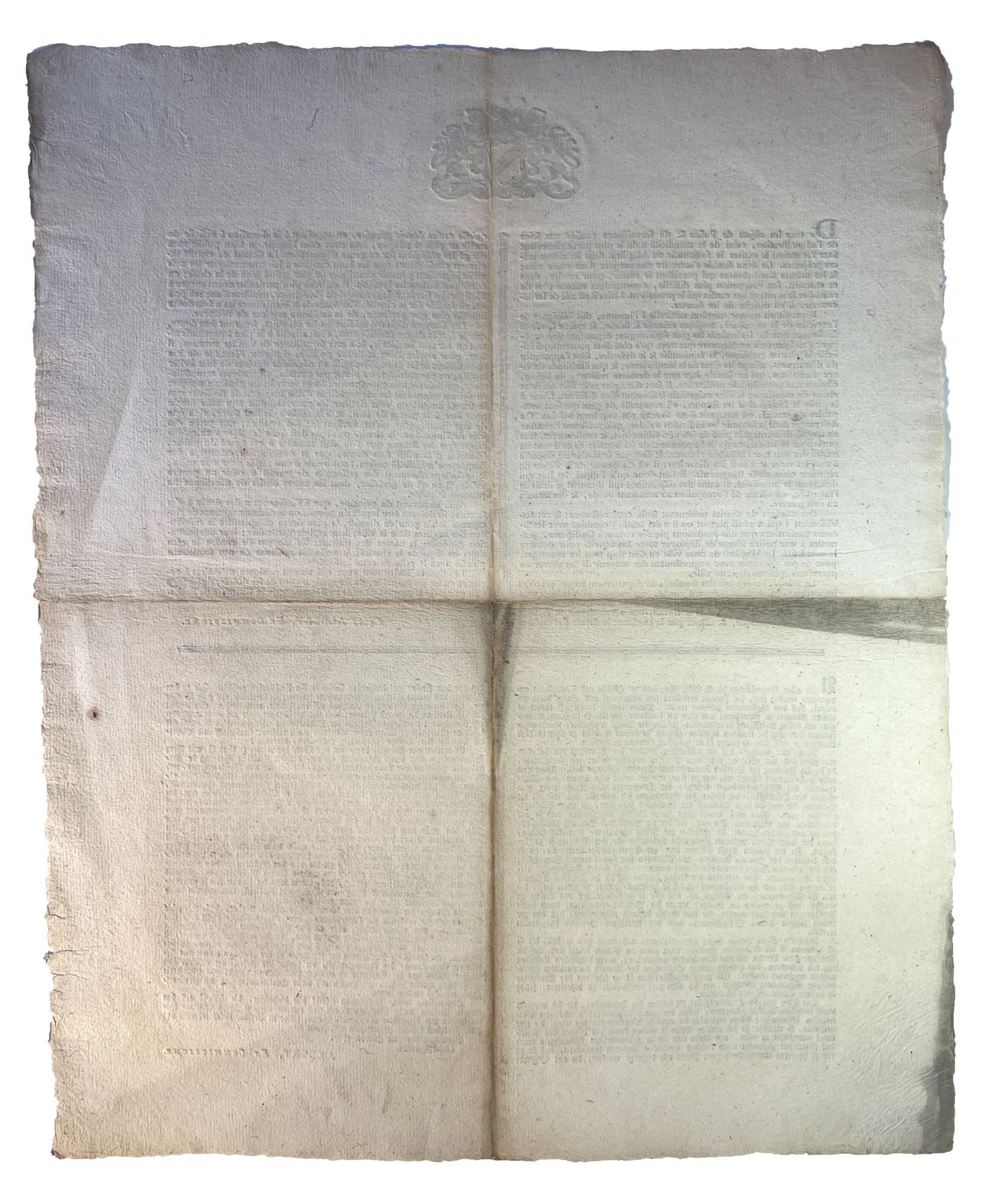
- Strasbourg: [Jean François Le Roux], 1789
Strasbourg: [Jean François Le Roux], 1789. Folio broadsheet (525 x 432 mm). Double column, French text on top and German text below, divided into four quadrilaterals by a horizontal thick and thin rule and a vertical woodcut of an ivy-entwined pole, woodcut arms of Strasbourg at top. The texts signed “Albert, Ex Commission.” Deckle edges, formerly folded, tiny tear at fold juncture, folds slightly browned, and darkened on verso. ***
A broadside invitation to the citizens of Strasbourg to share with the Secretariat of the Police Commissariat their views on how best to set up workhouses, euphemistically called ateliers, as part of the campaign to eliminate beggars.
Four months after the storming of the Bastille — echoed a week later in Strasbourg, where on July 21st the Hotel de Ville was sacked — the authorities launched a democratic appeal to the citizenry to help them deal with the age-old problem of homelessness and vagrancy. Revolutionary events notwithstanding, little had changed in the 25 years since Séguier de Saint-Brisson had published his plea against the prison mentality of the law-and-order establishment. The author of this broadside (one Albert, a member of an anti-poverty Commission) makes the usual clichéd distinction between the “good” poor, hard-working or infirm, and those professional beggars who are steeped in vice. The plan outlined is firmly one of poorhouses, where the arrested homeless are to be imprisoned and enslaved; the commission asks the public simply to help brainstorm their implementation.
It had evidently become clear by this time that large-scale poorhouses did not work well, and the trend was now toward smaller local establishments. The loyal citizens of Strasbourg, and clerics in particular, since they have experience in charitable work, are asked to advise on the details: where the ateliers should be set up, how they should be administered, what kind of work should be assigned to the inhabitants, and what their relationship should be with existing charitable institutions.
I locate no other copies of the broadside, but the text was published at the same time in a 6-page quarto pamphlet, in the same typeface and with the same woodcut arms; the printer “Johann Franz Le Roux” is identified in its colophon. (The copy at the University of Tübingen is digitized.) Le Roux, printer for the King, the Bishopric, and the City, was 89 years old at the time; he died a few months later (cf. the website Maisons de Strasbourg).
Not in Garnier, Essai de bibliographie charitable, which lists 3 pieces relating to Strasbourg, from 1803, 1836 and 1842 (no. 1487-1489).
A broadside invitation to the citizens of Strasbourg to share with the Secretariat of the Police Commissariat their views on how best to set up workhouses, euphemistically called ateliers, as part of the campaign to eliminate beggars.
Four months after the storming of the Bastille — echoed a week later in Strasbourg, where on July 21st the Hotel de Ville was sacked — the authorities launched a democratic appeal to the citizenry to help them deal with the age-old problem of homelessness and vagrancy. Revolutionary events notwithstanding, little had changed in the 25 years since Séguier de Saint-Brisson had published his plea against the prison mentality of the law-and-order establishment. The author of this broadside (one Albert, a member of an anti-poverty Commission) makes the usual clichéd distinction between the “good” poor, hard-working or infirm, and those professional beggars who are steeped in vice. The plan outlined is firmly one of poorhouses, where the arrested homeless are to be imprisoned and enslaved; the commission asks the public simply to help brainstorm their implementation.
It had evidently become clear by this time that large-scale poorhouses did not work well, and the trend was now toward smaller local establishments. The loyal citizens of Strasbourg, and clerics in particular, since they have experience in charitable work, are asked to advise on the details: where the ateliers should be set up, how they should be administered, what kind of work should be assigned to the inhabitants, and what their relationship should be with existing charitable institutions.
I locate no other copies of the broadside, but the text was published at the same time in a 6-page quarto pamphlet, in the same typeface and with the same woodcut arms; the printer “Johann Franz Le Roux” is identified in its colophon. (The copy at the University of Tübingen is digitized.) Le Roux, printer for the King, the Bishopric, and the City, was 89 years old at the time; he died a few months later (cf. the website Maisons de Strasbourg).
Not in Garnier, Essai de bibliographie charitable, which lists 3 pieces relating to Strasbourg, from 1803, 1836 and 1842 (no. 1487-1489).
Details
Title
[Broadside:] De tous les objets de Police & de surveillance confiés aux soins de l’administration, celui de la mendicité a dû le plus particulièrement fixer l’attention & exciter la sollicitude du Magistrat dans les circonstances présentes. Ce fléau semble s’accroître chaque jour dans notre ville..
Author
POVERTY — HOMELESSNESS — STRASBOURG
Condition
Unknown
Publisher
[Jean François Le Roux]: Strasbourg
Date
1789