

Civil Rights and Free Speech Advocacy in the ACLU's Civil Liberties During 1965
- SIGNED
- 1965
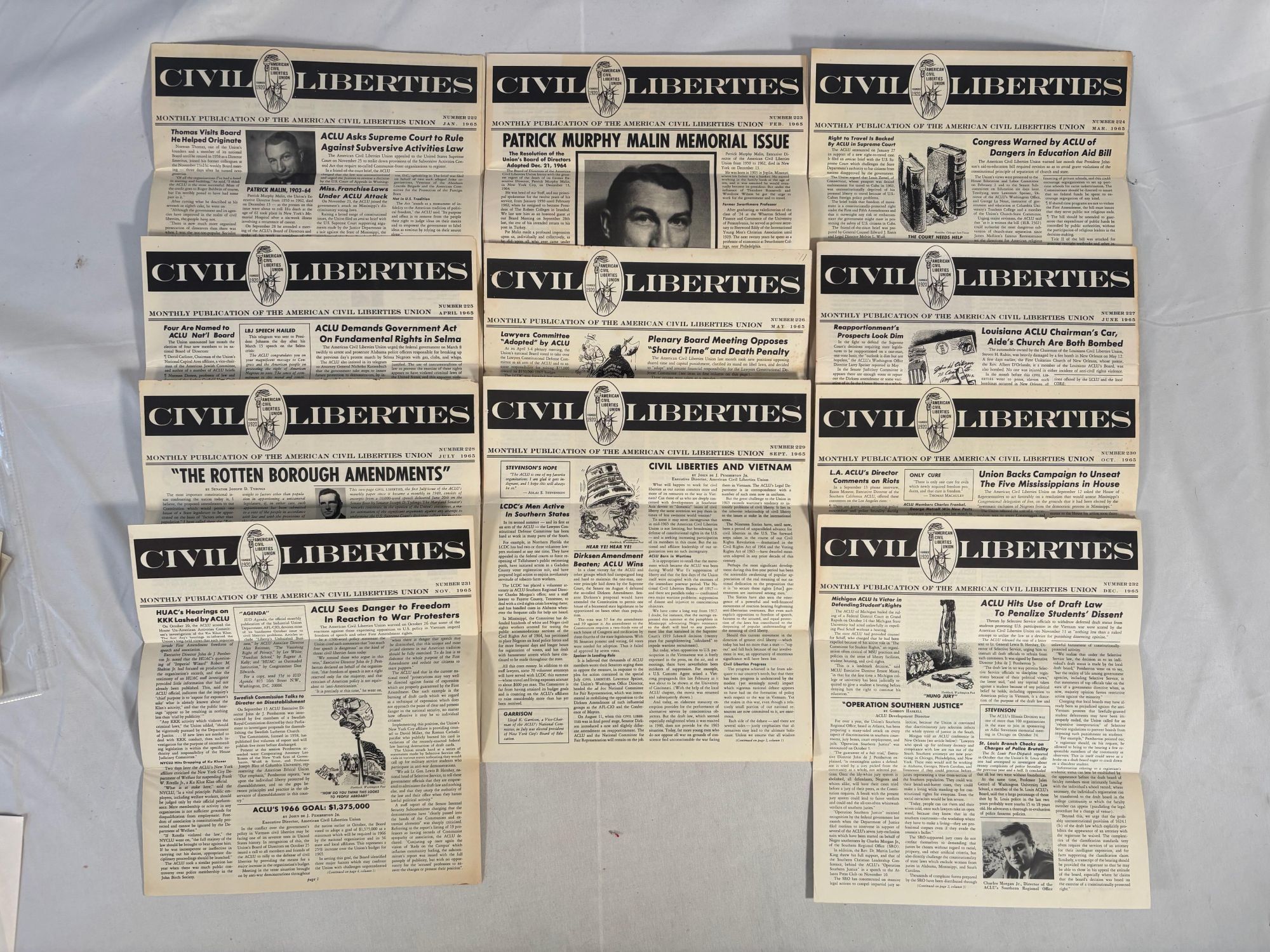
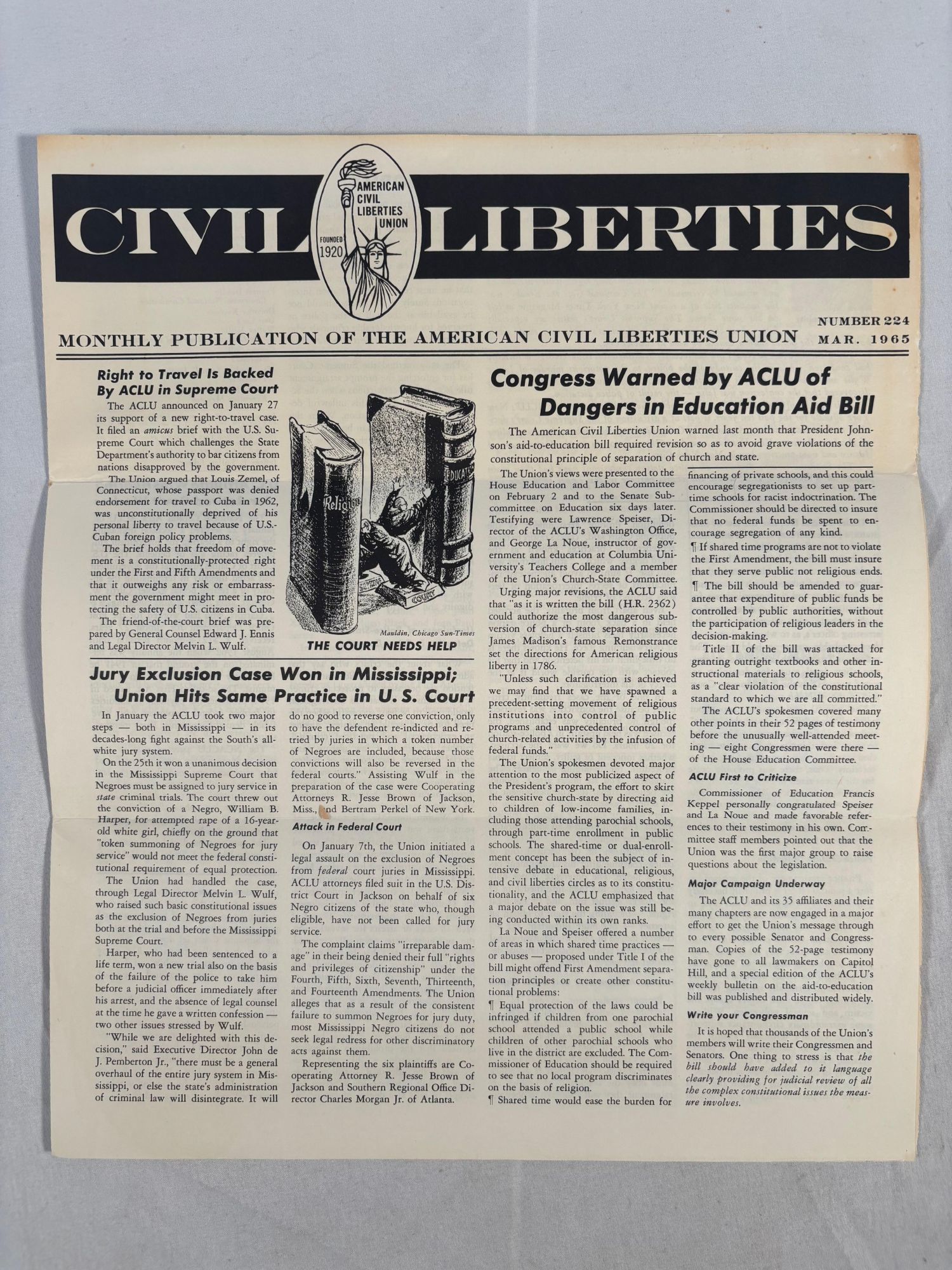
1965. American Civil Liberties Union, Civil Liberties complete 1965 run, documents the ACLU's legal-advocacy and public-communication system during a year defined by Black voting-rights organizing, Southern racial violence, censorship disputes, anti-communist legal restrictions, and the first expansion of Vietnam War dissent. The material documents constitutional advocacy through monthly newsletters, case reports, organizational statements, legislative criticism, and calls for federal action, revealing how the ACLU translated litigation, public policy, and movement crises into a regular print record for supporters. The Selma campaign in March 1965 became a decisive national voting-rights crisis after marchers were attacked at the Edmund Pettus Bridge, and the Voting Rights Act was signed later that year to bar racial discrimination in voting; this run provides primary-source evidence for studying how a national civil liberties organization framed those events through law, speech, and federal responsibility.
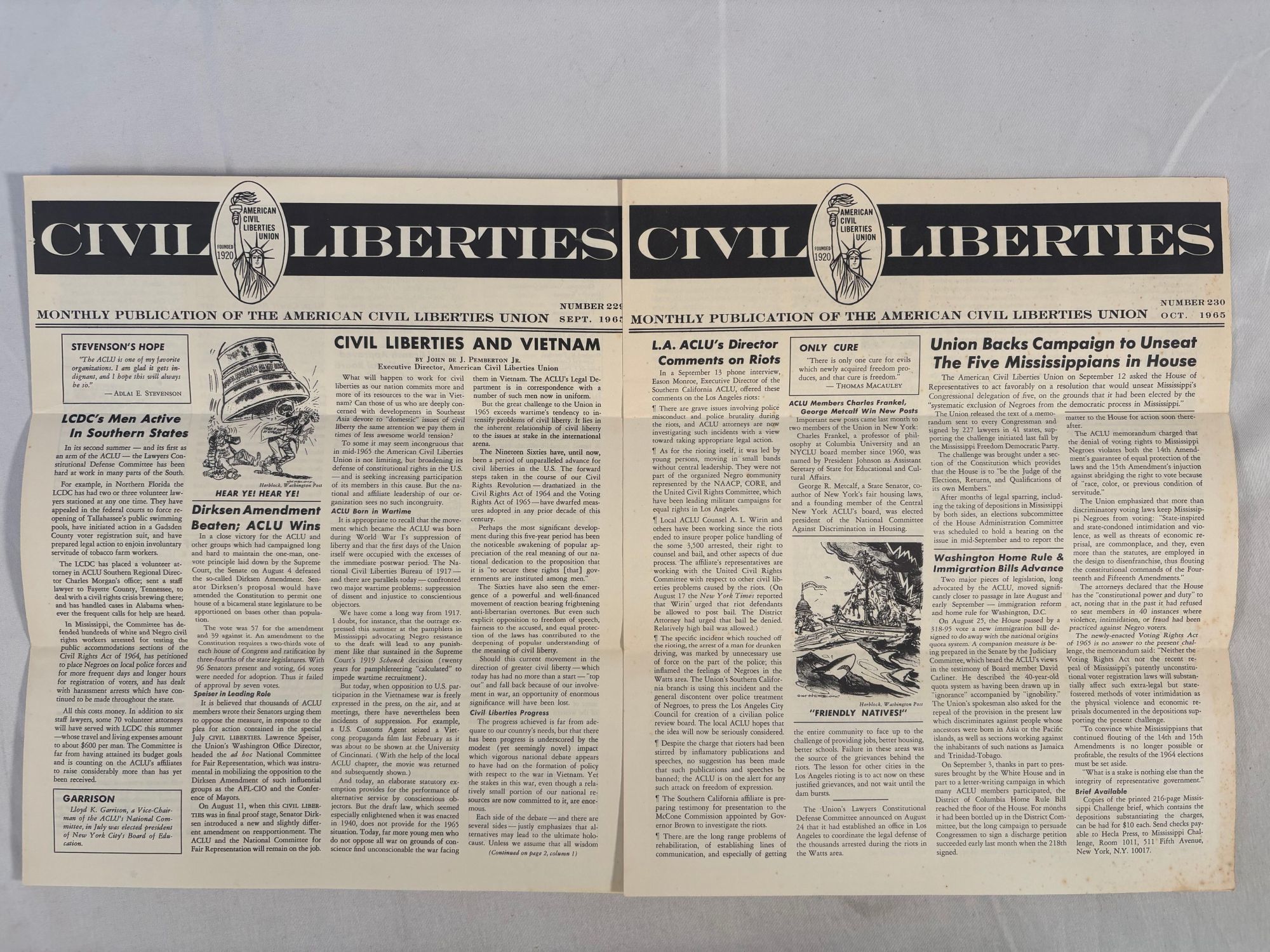
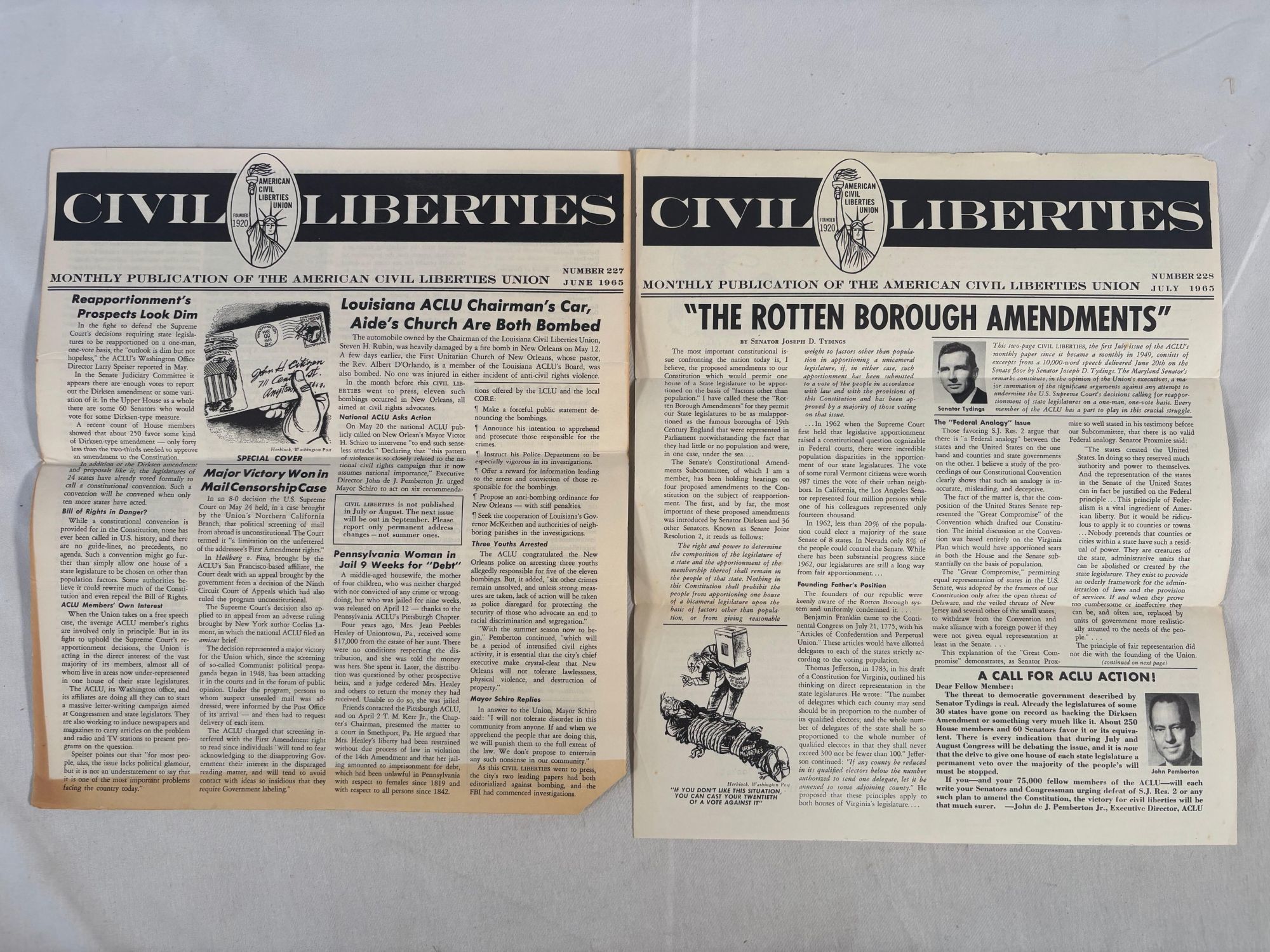
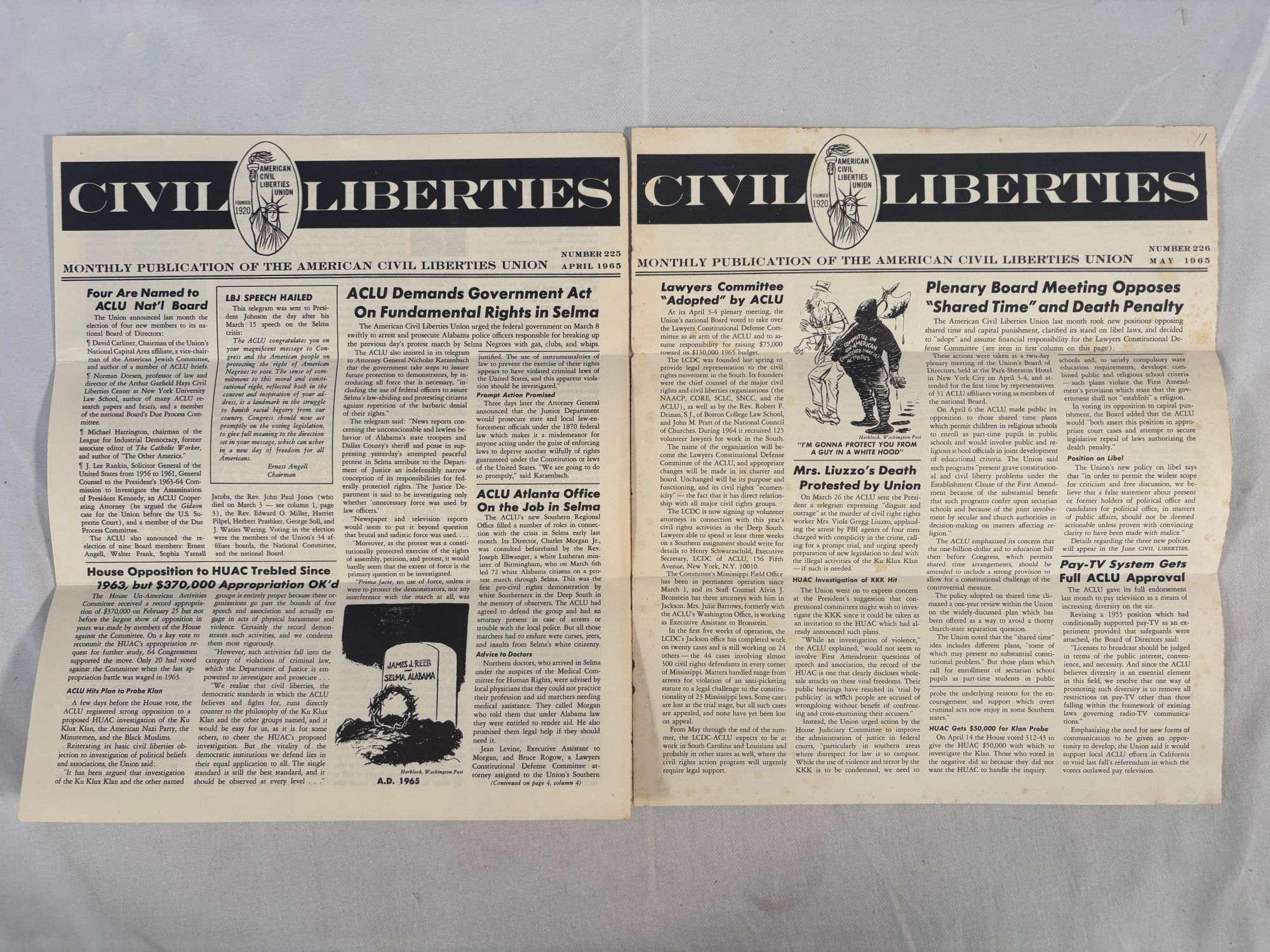
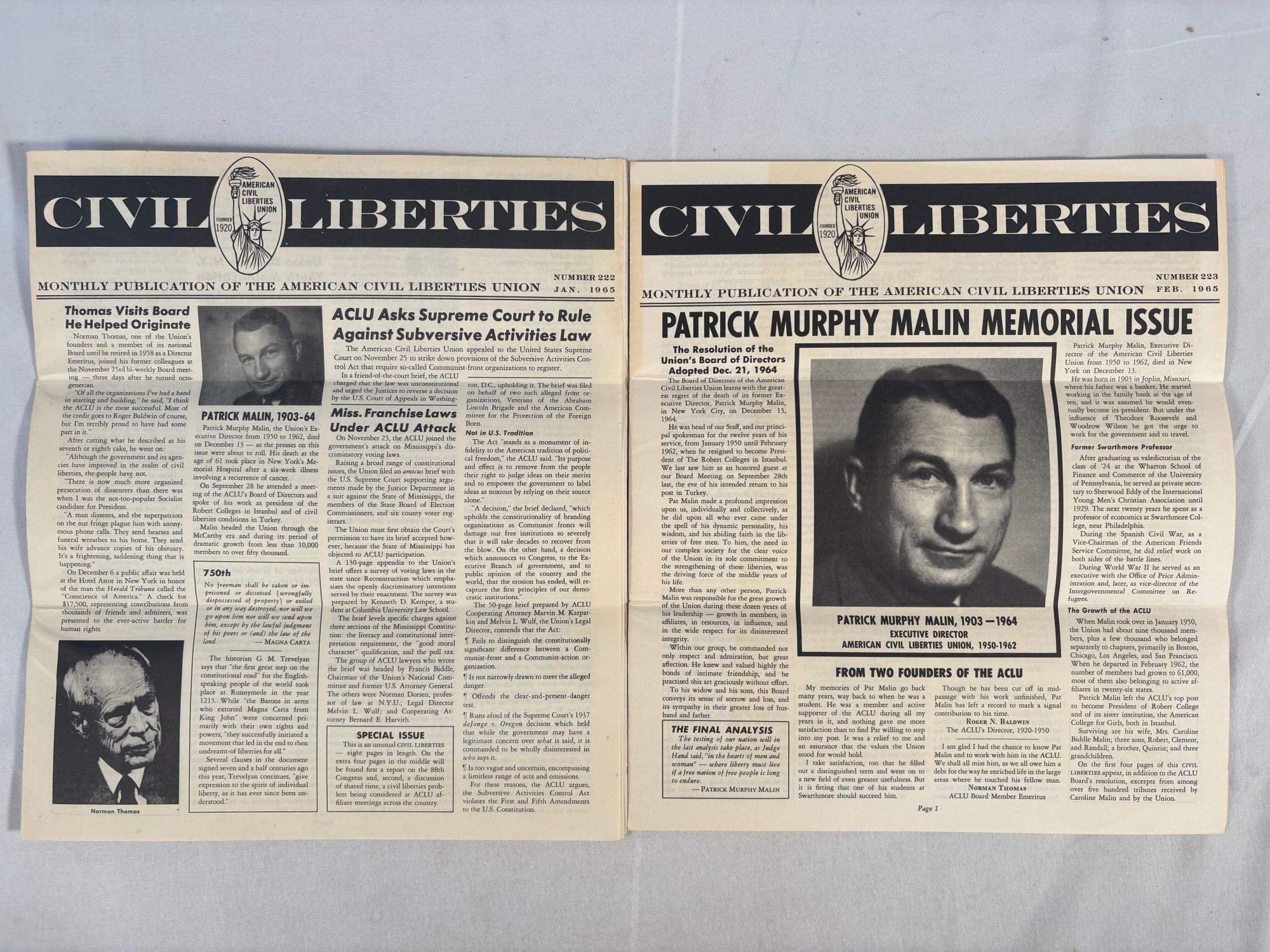
Civil Liberties. New York: American Civil Liberties Union, January-December 1965. Eleven issues, no August issue published. Complete 1965 run of the ACLU's monthly publication, each issue 4 to 6 pages, printed in 8½ x 11 inch tabloid format and folded for mailing. The sequence includes coverage of Supreme Court briefs challenging "subversive activities" statutes and Mississippi voting restrictions; a March report on a legal victory restoring an excluded Black juror to service; the April headline "ACLU Demands Government Act on Fundamental Rights in Selma"; May reporting on the murder of Viola Liuzzo by Ku Klux Klan members after the Selma-to-Montgomery voting-rights march; mid-year coverage of bombings targeting a Black church and the Louisiana ACLU chairman; and federal cases involving censorship of "allegedly obscene" literature. Later issues expand the year's civil-liberties field beyond Southern racial justice: July features Senator Joseph Tydings's critique of malapportioned legislatures in "The Rotten Borough Amendments," September's "Civil Liberties and Vietnam" marks the newsletter's attention to antiwar dissent, and November condemns the "Use of Draft Law to Penalize Students' Dissent." Viola Liuzzo's murder on March 25, 1965, after she traveled to Alabama to assist the Selma campaign, became one of the most visible examples of racial terror surrounding the voting-rights struggle.
[1] American Civil Liberties Union. Civil Liberties. New York: American Civil Liberties Union, January 1965. Opening issue in the year's run, reporting civil liberties litigation and constitutional conflicts at the beginning of a year that would sharply expand the organization's public engagement with voting rights and protest. Its coverage of briefs and legal challenges to anti-subversive and voting restrictions shows the mechanisms of ACLU advocacy before the Selma crisis became the year's central national civil rights event. [2] American Civil Liberties Union. Civil Liberties. New York: American Civil Liberties Union, February 1965. Continues the newsletter's reporting on litigation, loyalty standards, and constitutional protections. The issue belongs to the pre-Selma sequence in which the ACLU presented civil liberties as an interlocking field of speech, association, jury service, voting access, and state power. [3] American Civil Liberties Union. Civil Liberties. New York: American Civil Liberties Union, March 1965. Reports a legal victory restoring an excluded Black juror to service, linking courtroom participation to the broader struggle over Black civic inclusion. The issue records how civil rights conflict appeared not only through public protest but also through jury access, state courts, and procedural equality. [4] American Civil Liberties Union. Civil Liberties. New York: American Civil Liberties Union, April 1965. Features the declaration "ACLU Demands Government Act on Fundamental Rights in Selma," directly placing the organization within the national legal response to violence against voting-rights marchers. The issue demonstrates how the ACLU used its newsletter to demand federal responsibility after state violence threatened political participation. [5] American Civil Liberties Union. Civil Liberties. New York: American Civil Liberties Union, May 1965. Reports on the murder of Viola Liuzzo by Ku Klux Klan members and frames her killing within racial terror and legal impunity surrounding voting-rights work. The issue is especially significant for documenting how a civil liberties organization interpreted violence against white and Black civil rights workers as an attack on constitutional democracy. [6] American Civil Liberties Union. Civil Liberties. New York: American Civil Liberties Union, June 1965. Covers bombings targeting both a Black church and the Louisiana ACLU chairman, placing racial violence, civil liberties work, and intimidation of legal advocates in the same field of concern. The issue also reflects the newsletter's attention to censorship and federal prosecutions involving "allegedly obscene" literature. [7] American Civil Liberties Union. Civil Liberties. New York: American Civil Liberties Union, July 1965. Includes Senator Joseph Tydings's "The Rotten Borough Amendments," a critique of malapportioned legislatures that connects civil liberties to representation and equal political power. Its contents broaden the run's relevance from direct racial violence to structural questions of democratic governance. [8] American Civil Liberties Union. Civil Liberties. New York: American Civil Liberties Union, September 1965. The issue "Civil Liberties and Vietnam" documents the organization's growing attention to dissent as U.S. military involvement in Southeast Asia intensified. It marks a shift from civil rights and anti-communist legal questions toward wartime speech, protest, and the constitutional status of opposition. [9] American Civil Liberties Union. Civil Liberties. New York: American Civil Liberties Union, October 1965. Continues the fall sequence of reporting on constitutional law, speech, protest, and government authority. In the context of the complete run, the issue helps trace how the ACLU connected civil rights advocacy to emerging debates over Vietnam-era dissent. [10] American Civil Liberties Union. Civil Liberties. New York: American Civil Liberties Union, November 1965. Explicitly condemns "Use of Draft Law to Penalize Students' Dissent," documenting the collision between student protest, military obligation, and federal enforcement. The issue is an early record of the civil-liberties framework that would become central to antiwar litigation and campus protest in the later 1960s. [11] American Civil Liberties Union. Civil Liberties. New York: American Civil Liberties Union, December 1965. Closing issue of the year's run, completing a sequence that follows the ACLU's response to voting rights, racial violence, obscenity law, loyalty standards, malapportionment, Vietnam dissent, and draft protest. Its placement at year's end gives the archive value as a complete record of the organization's monthly public-facing legal priorities in 1965.
Light age toning, consistent horizontal fold lines from mailing, and minor edge wear throughout; all issues complete and legible with no significant loss of text, very good overall. Complete 1965 run preserving the ACLU's contemporaneous legal and ideological response to the Civil Rights Movement, Selma, racial terror, censorship, anti-communist legal frameworks, and the early constitutional defense of Vietnam War dissent.
Civil Liberties. New York: American Civil Liberties Union, January-December 1965. Eleven issues, no August issue published. Complete 1965 run of the ACLU's monthly publication, each issue 4 to 6 pages, printed in 8½ x 11 inch tabloid format and folded for mailing. The sequence includes coverage of Supreme Court briefs challenging "subversive activities" statutes and Mississippi voting restrictions; a March report on a legal victory restoring an excluded Black juror to service; the April headline "ACLU Demands Government Act on Fundamental Rights in Selma"; May reporting on the murder of Viola Liuzzo by Ku Klux Klan members after the Selma-to-Montgomery voting-rights march; mid-year coverage of bombings targeting a Black church and the Louisiana ACLU chairman; and federal cases involving censorship of "allegedly obscene" literature. Later issues expand the year's civil-liberties field beyond Southern racial justice: July features Senator Joseph Tydings's critique of malapportioned legislatures in "The Rotten Borough Amendments," September's "Civil Liberties and Vietnam" marks the newsletter's attention to antiwar dissent, and November condemns the "Use of Draft Law to Penalize Students' Dissent." Viola Liuzzo's murder on March 25, 1965, after she traveled to Alabama to assist the Selma campaign, became one of the most visible examples of racial terror surrounding the voting-rights struggle.
[1] American Civil Liberties Union. Civil Liberties. New York: American Civil Liberties Union, January 1965. Opening issue in the year's run, reporting civil liberties litigation and constitutional conflicts at the beginning of a year that would sharply expand the organization's public engagement with voting rights and protest. Its coverage of briefs and legal challenges to anti-subversive and voting restrictions shows the mechanisms of ACLU advocacy before the Selma crisis became the year's central national civil rights event. [2] American Civil Liberties Union. Civil Liberties. New York: American Civil Liberties Union, February 1965. Continues the newsletter's reporting on litigation, loyalty standards, and constitutional protections. The issue belongs to the pre-Selma sequence in which the ACLU presented civil liberties as an interlocking field of speech, association, jury service, voting access, and state power. [3] American Civil Liberties Union. Civil Liberties. New York: American Civil Liberties Union, March 1965. Reports a legal victory restoring an excluded Black juror to service, linking courtroom participation to the broader struggle over Black civic inclusion. The issue records how civil rights conflict appeared not only through public protest but also through jury access, state courts, and procedural equality. [4] American Civil Liberties Union. Civil Liberties. New York: American Civil Liberties Union, April 1965. Features the declaration "ACLU Demands Government Act on Fundamental Rights in Selma," directly placing the organization within the national legal response to violence against voting-rights marchers. The issue demonstrates how the ACLU used its newsletter to demand federal responsibility after state violence threatened political participation. [5] American Civil Liberties Union. Civil Liberties. New York: American Civil Liberties Union, May 1965. Reports on the murder of Viola Liuzzo by Ku Klux Klan members and frames her killing within racial terror and legal impunity surrounding voting-rights work. The issue is especially significant for documenting how a civil liberties organization interpreted violence against white and Black civil rights workers as an attack on constitutional democracy. [6] American Civil Liberties Union. Civil Liberties. New York: American Civil Liberties Union, June 1965. Covers bombings targeting both a Black church and the Louisiana ACLU chairman, placing racial violence, civil liberties work, and intimidation of legal advocates in the same field of concern. The issue also reflects the newsletter's attention to censorship and federal prosecutions involving "allegedly obscene" literature. [7] American Civil Liberties Union. Civil Liberties. New York: American Civil Liberties Union, July 1965. Includes Senator Joseph Tydings's "The Rotten Borough Amendments," a critique of malapportioned legislatures that connects civil liberties to representation and equal political power. Its contents broaden the run's relevance from direct racial violence to structural questions of democratic governance. [8] American Civil Liberties Union. Civil Liberties. New York: American Civil Liberties Union, September 1965. The issue "Civil Liberties and Vietnam" documents the organization's growing attention to dissent as U.S. military involvement in Southeast Asia intensified. It marks a shift from civil rights and anti-communist legal questions toward wartime speech, protest, and the constitutional status of opposition. [9] American Civil Liberties Union. Civil Liberties. New York: American Civil Liberties Union, October 1965. Continues the fall sequence of reporting on constitutional law, speech, protest, and government authority. In the context of the complete run, the issue helps trace how the ACLU connected civil rights advocacy to emerging debates over Vietnam-era dissent. [10] American Civil Liberties Union. Civil Liberties. New York: American Civil Liberties Union, November 1965. Explicitly condemns "Use of Draft Law to Penalize Students' Dissent," documenting the collision between student protest, military obligation, and federal enforcement. The issue is an early record of the civil-liberties framework that would become central to antiwar litigation and campus protest in the later 1960s. [11] American Civil Liberties Union. Civil Liberties. New York: American Civil Liberties Union, December 1965. Closing issue of the year's run, completing a sequence that follows the ACLU's response to voting rights, racial violence, obscenity law, loyalty standards, malapportionment, Vietnam dissent, and draft protest. Its placement at year's end gives the archive value as a complete record of the organization's monthly public-facing legal priorities in 1965.
Light age toning, consistent horizontal fold lines from mailing, and minor edge wear throughout; all issues complete and legible with no significant loss of text, very good overall. Complete 1965 run preserving the ACLU's contemporaneous legal and ideological response to the Civil Rights Movement, Selma, racial terror, censorship, anti-communist legal frameworks, and the early constitutional defense of Vietnam War dissent.
Details
Title
Civil Rights and Free Speech Advocacy in the ACLU's Civil Liberties During 1965
Author
ACLU 1965 Civil Liberties Newsletter
Condition
Unknown
Date
1965