

Visages
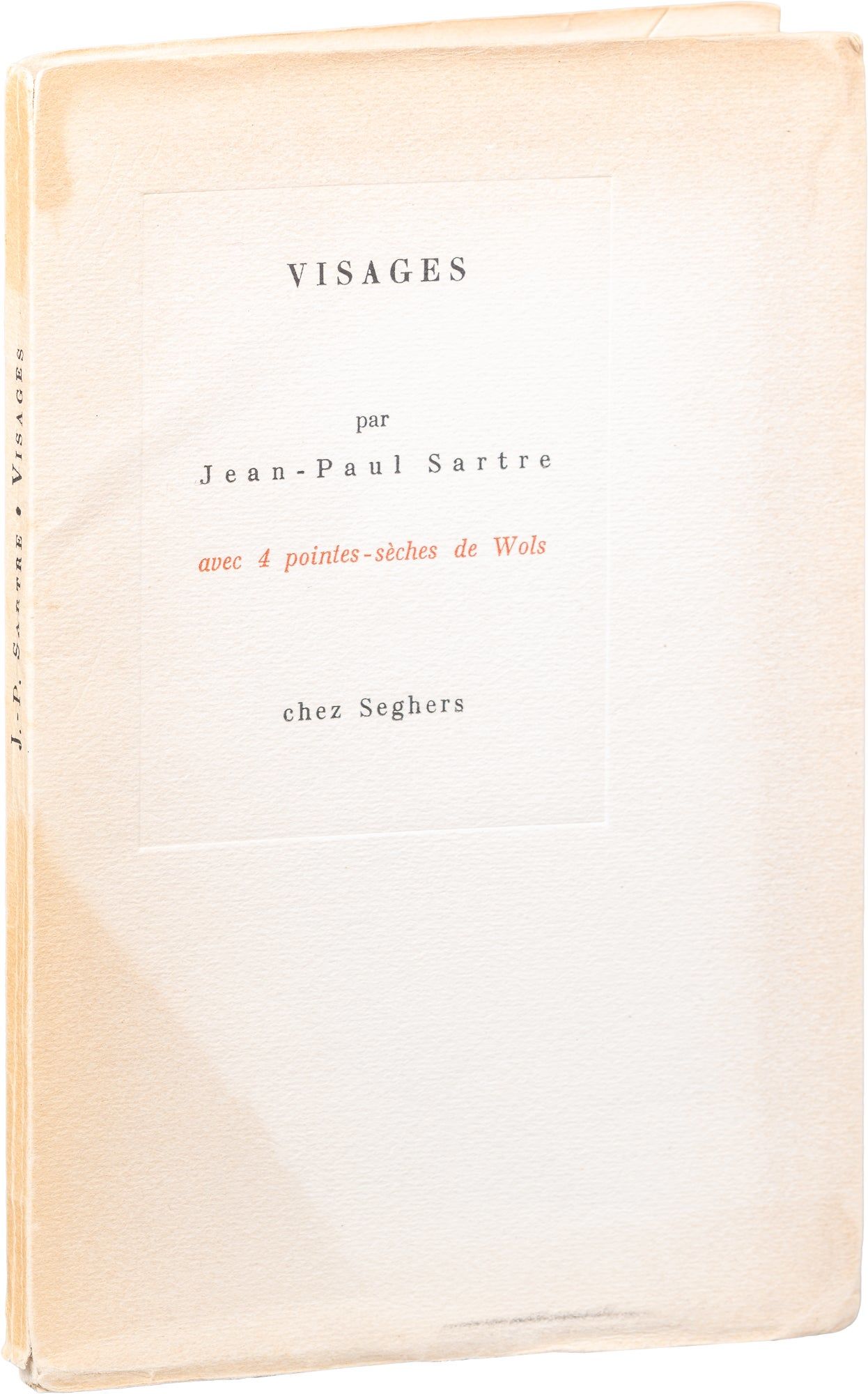
- Paris: Seghers, 1948
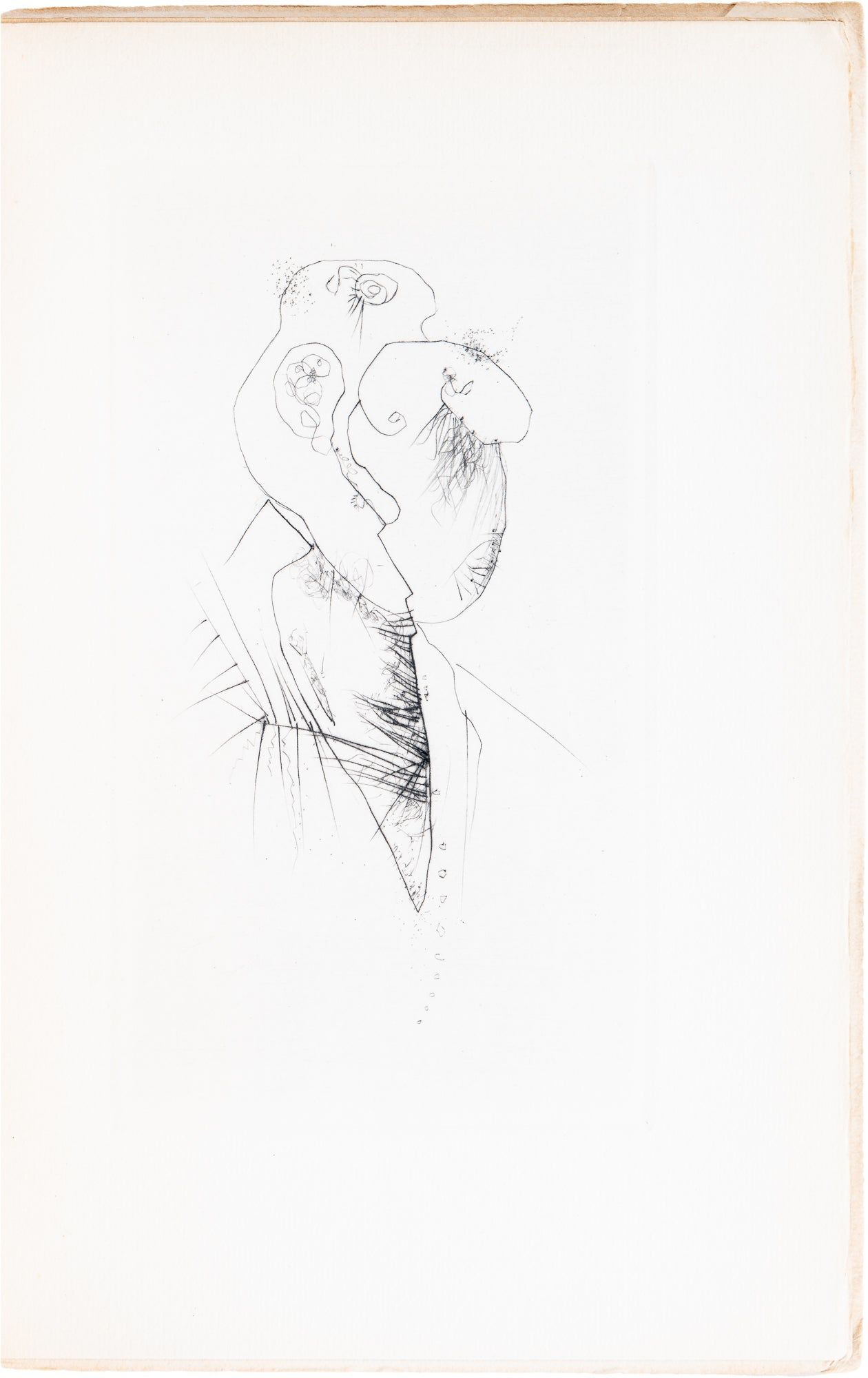
Paris: Seghers, 1948. First Edition. First printing, original wrappers, number 231 of 900 copies on Crèvecoeur du Marais paper (there were also 15 copies on Chine paper and 10 hors commerce copies for the author and illustrator). In French. Toning and rubbing, ownership signature to the front blank, else very good and internally clean. 41pp. with 4 drypoint etchings by Wols (Alfred Otto Wolfgang Schulze). "Visages" is a philosophical meditation on the human face as a site of meaning, power, and magical significance that transcends mere physical materiality. Sartre contrasts a hypothetical "society of statues"(rational, balanced, and just but faceless) with human society, which he characterizes as a "society of faces" ruled by these mysterious, idol-like objects that we carry on our bodies. He critiques psychological reductionism that treats faces as mere mechanical assemblages of muscle movements, arguing instead that faces are "natural fetishes" that possess an irreducible wholeness and immediate emotional presence. Exploring how faces function as sacred, taboo objects in human social relations; comparing them to religious relics carried in procession or totemic idols paraded through streets. Sartre emphasizes the paradox that while we cannot see our own faces directly, we learn about ourselves through encountering the faces of others, suggesting that facial recognition operates through an immediate, pre-cognitive apprehension rather than learned interpretation. Sartre steadily and concisely works out his idea that faces serve as the fundamental medium through which we experience otherness, emotion, and the irreducible mystery of human consciousness made visible.
Sartre's conception of faces as natural fetishes offers a prescient critique of contemporary digital culture, where complex AI algorithms and facial recognition systems have transformed faces into quantifiable data points while paradoxically amplifying their social power through algorithmic curation of visual content and digital self-presentation. His insight that we access human consciousness through direct facial encounters takes on new dimensions in an era where authentic otherness becomes increasingly mediated by screens, filters, and algorithms that may fundamentally alter our pre-cognitive apprehension of human meaning. The ultimate irony is to be realized when Sartre's diverse landscape of human consciousness gets reduced to Instagram-filtered variations on the same theme, with our society of faces rapidly converging to the point where everyone looks like the Kardashians, or thinks they do, or wishes they do and the algorithm will happily indulge the delusion.
Wols (Alfred Otto Wolfgang Schulze, 1913-1951) was one of the most significant avant-garde artists of the mid-twentieth century. Born in Berlin, Wols fled Nazi Germany and became deeply embedded in Parisian intellectual circles, where he developed his distinctive style as a pioneer of European lyrical abstraction and a key figure in tachism and informal art movements. His spontaneous, gestural approach to mark-making and his exploration of organic, biomorphic forms profoundly influenced post-war European art. Wols's four drypoint etchings in this volume exemplify his mastery of intimate, introspective imagery that complements Sartre's literary vision. The artist's tragic early death at age 38 cut short a career that had already established him as a crucial bridge between Surrealism and Abstract Expressionism, making his collaborative works with major literary figures like Sartre particularly significant in documenting the cross-pollination between existentialist philosophy and avant-garde visual art in post-war Paris.
Sartre's conception of faces as natural fetishes offers a prescient critique of contemporary digital culture, where complex AI algorithms and facial recognition systems have transformed faces into quantifiable data points while paradoxically amplifying their social power through algorithmic curation of visual content and digital self-presentation. His insight that we access human consciousness through direct facial encounters takes on new dimensions in an era where authentic otherness becomes increasingly mediated by screens, filters, and algorithms that may fundamentally alter our pre-cognitive apprehension of human meaning. The ultimate irony is to be realized when Sartre's diverse landscape of human consciousness gets reduced to Instagram-filtered variations on the same theme, with our society of faces rapidly converging to the point where everyone looks like the Kardashians, or thinks they do, or wishes they do and the algorithm will happily indulge the delusion.
Wols (Alfred Otto Wolfgang Schulze, 1913-1951) was one of the most significant avant-garde artists of the mid-twentieth century. Born in Berlin, Wols fled Nazi Germany and became deeply embedded in Parisian intellectual circles, where he developed his distinctive style as a pioneer of European lyrical abstraction and a key figure in tachism and informal art movements. His spontaneous, gestural approach to mark-making and his exploration of organic, biomorphic forms profoundly influenced post-war European art. Wols's four drypoint etchings in this volume exemplify his mastery of intimate, introspective imagery that complements Sartre's literary vision. The artist's tragic early death at age 38 cut short a career that had already established him as a crucial bridge between Surrealism and Abstract Expressionism, making his collaborative works with major literary figures like Sartre particularly significant in documenting the cross-pollination between existentialist philosophy and avant-garde visual art in post-war Paris.
Details
Title
Visages
Author
Sartre, Jean-Paul [illus. Wols]
Condition
Unknown
Publisher
Seghers: Paris
Date
1948
Edition
First Edition