

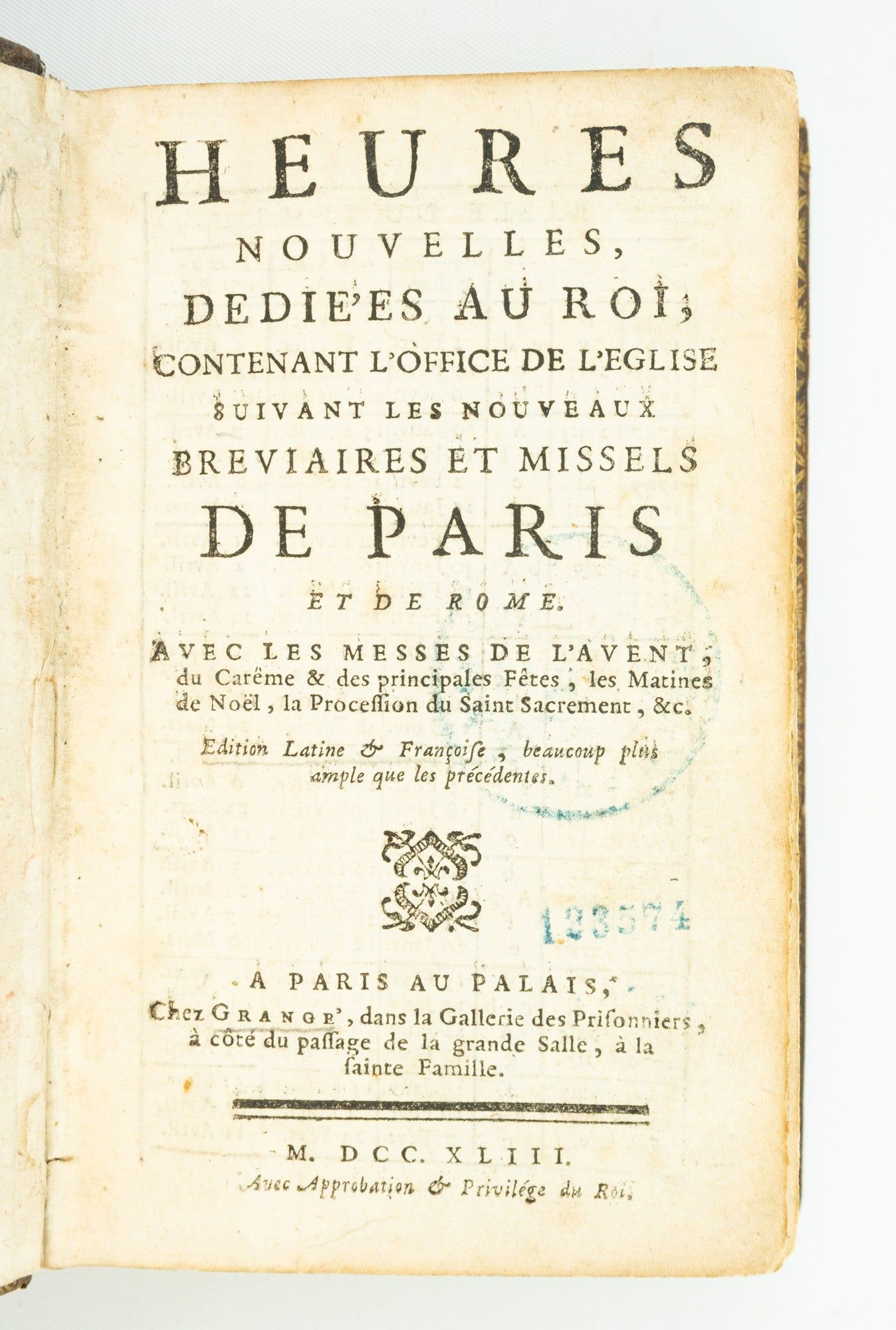
HEURES NOUVELLES
- Paris: Chez Grange, 1743
Paris: Chez Grange, 1743. 136 x 85 mm. (5 5/8 x 3 1/4"). 6 p.l., 592, [8] pp.
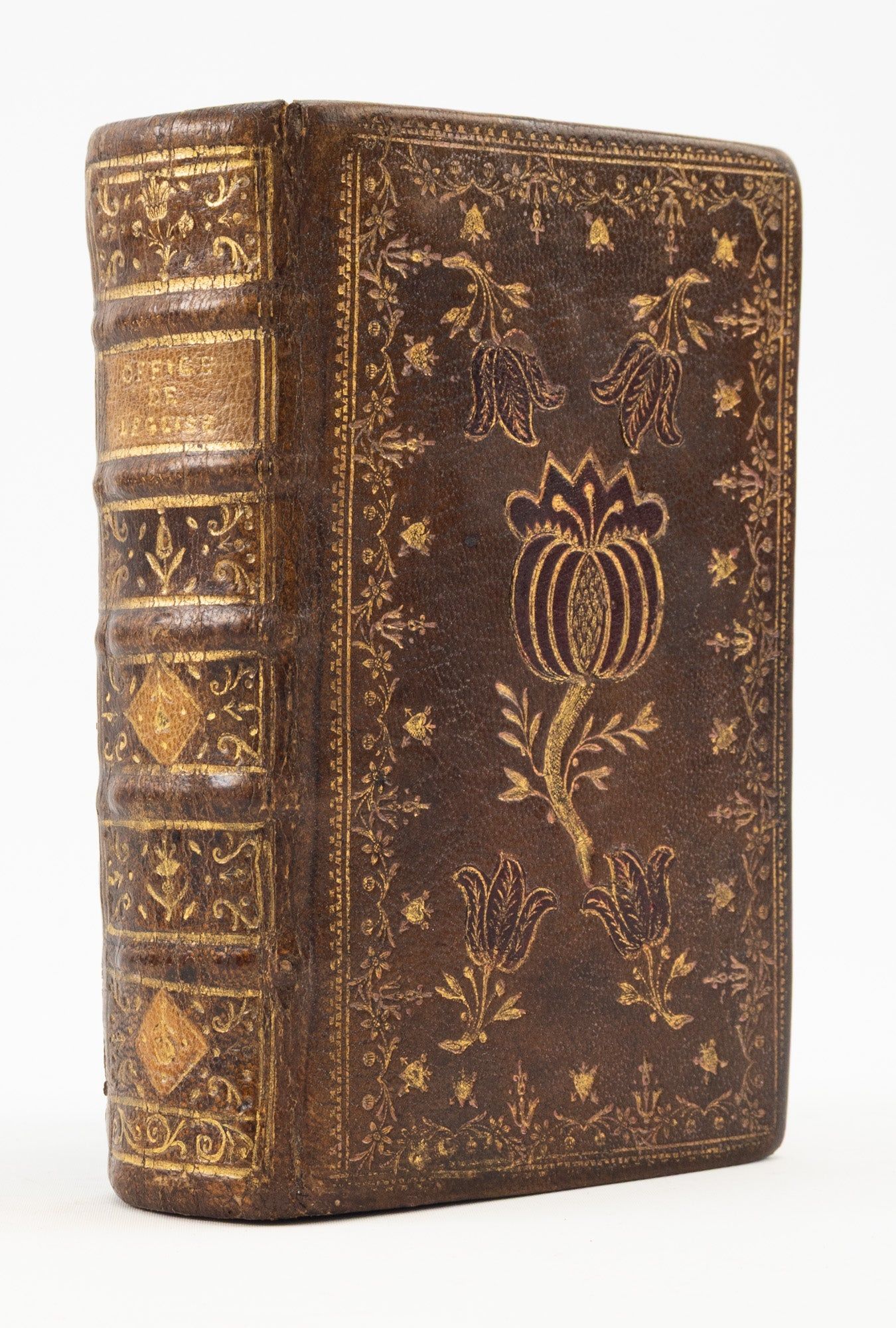
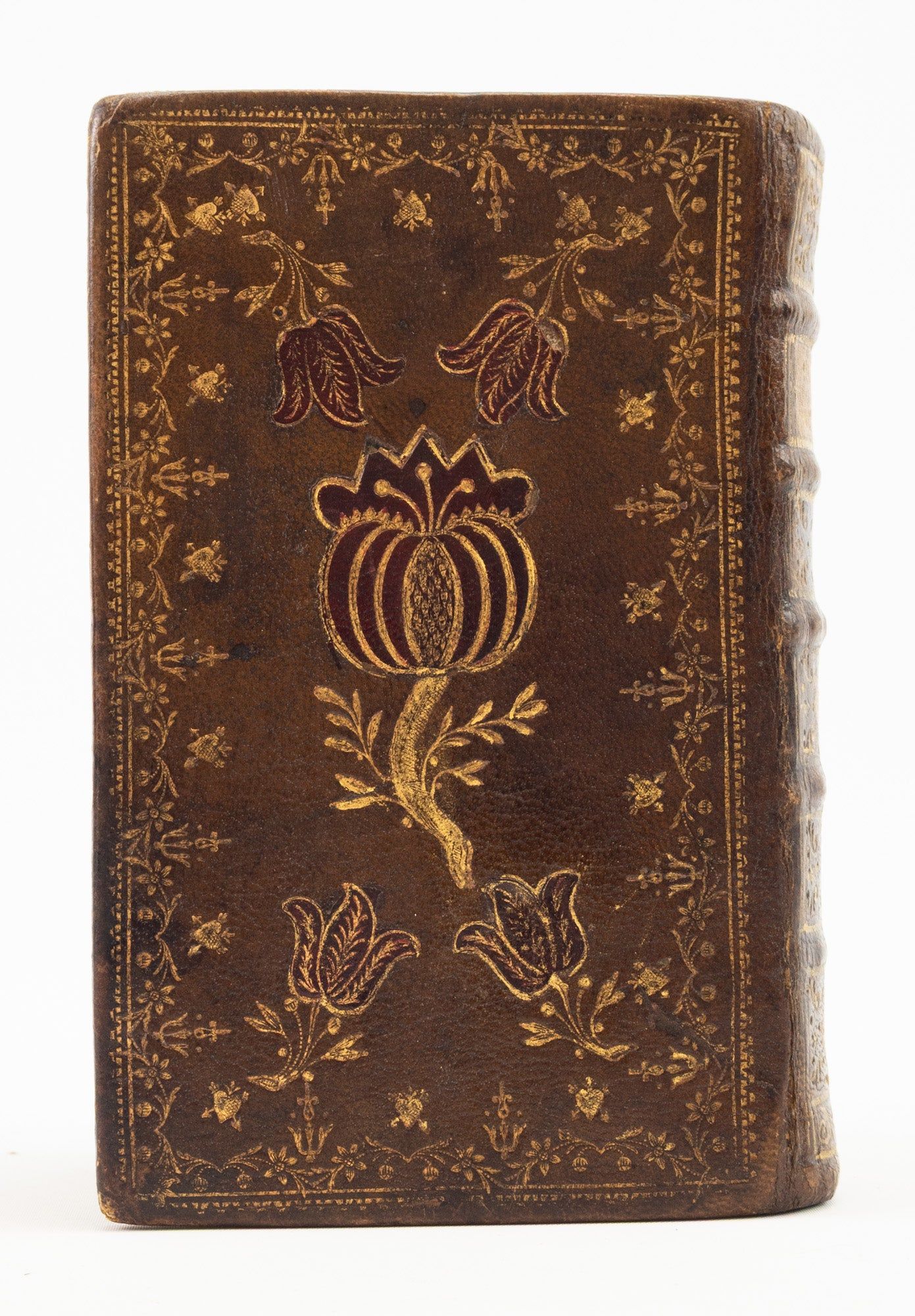
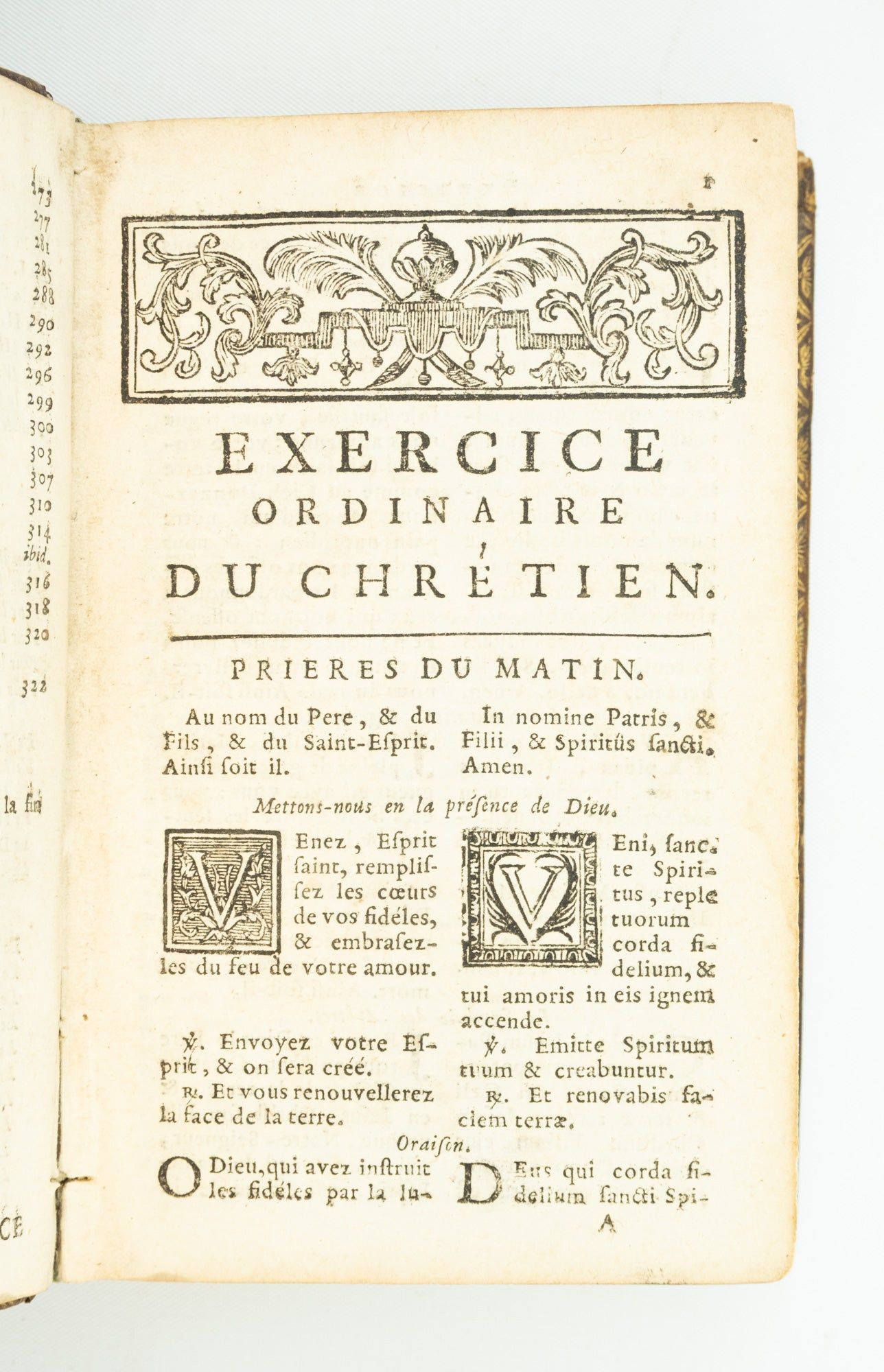
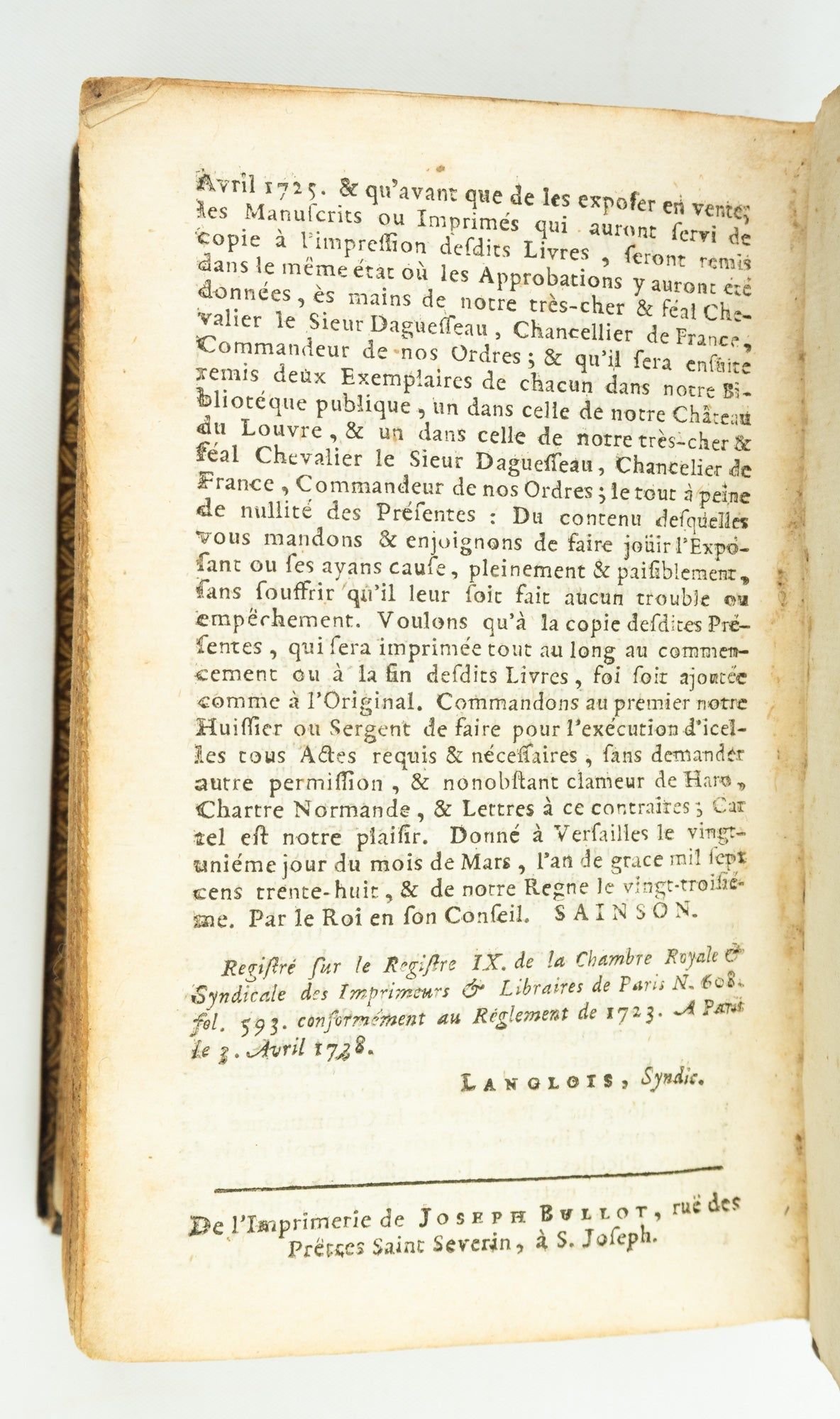
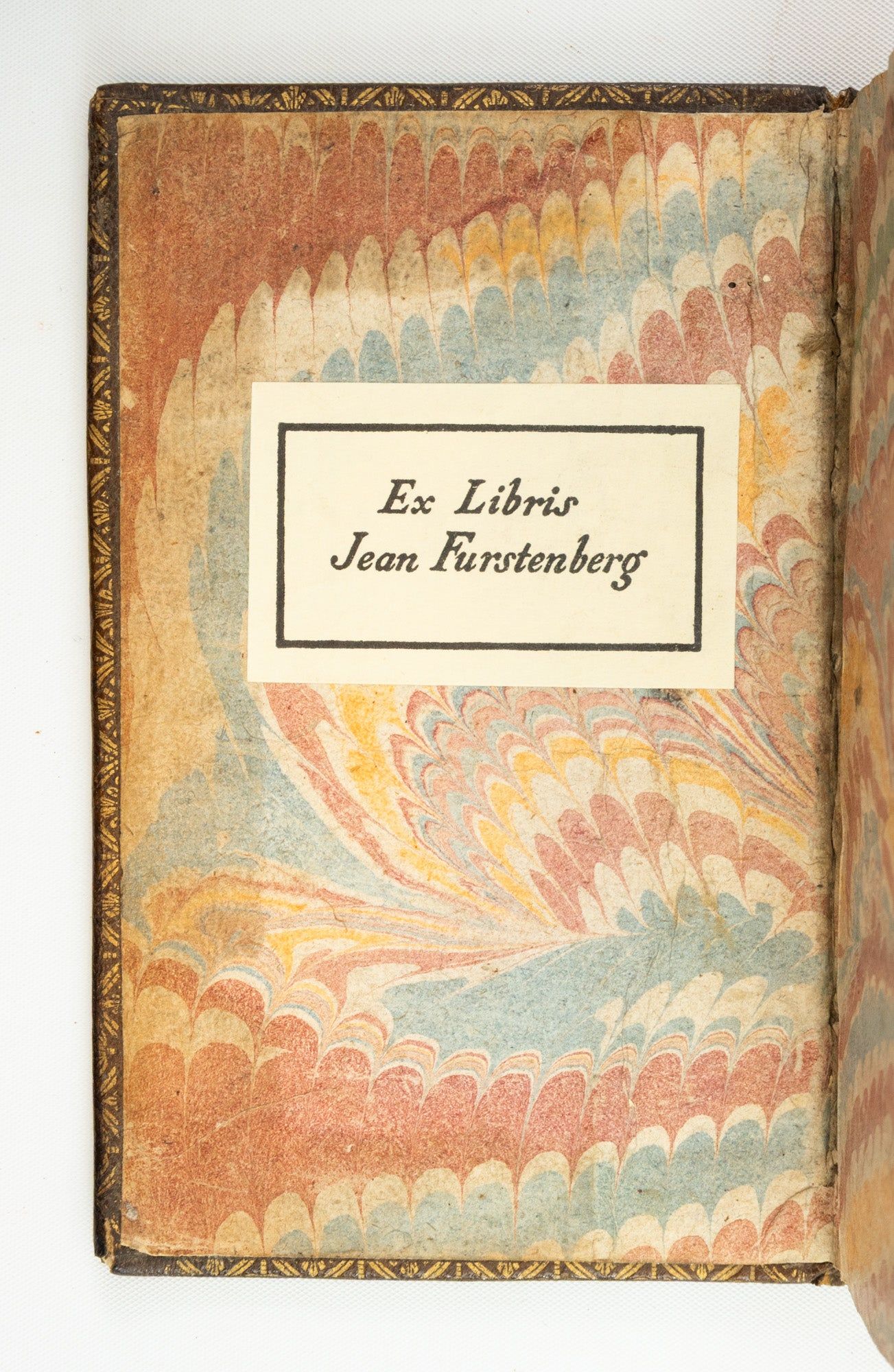
VERY PRETTY CONTEMPORARY PARISIAN BROWN MOROCCO, GILT AND INLAID, BY THE "ATELIER À LA TULIPE," covers with floral frame accented with heart tool pierced by two arrows, a large pomegranate of gilt-tooled inlaid dark red morocco at center, four inlaid red morocco tulips at each corner, raised bands, spine compartments with small gilt botanical tool at center, two of these on inlaid tan morocco lozenges, tan morocco label, marbled endpapers, all edges gilt. Text in French and Latin in parallel columns. Front pastedown with ex-libris of Jean Fürstenberg; verso of front free endpaper with early ink inscription: "Bibl. Schol." With a handwritten note, once tipped onto the final page of daily prayers, with handwritten Latin prayers in a contemporary hand. For the binding: Foot, "Henry Davis Gift" III, 179 (Davis 561); Michon, "Les Reliures Mosaiquées du XVIIIe siècle," pp. 51-2 and no. 223. Corners a little rubbed, front free endpaper creased, one leaf with old thin marginal glue stain (from once tipped-in manuscript prayers that are now laid in), one lower corner torn away, costing a few letters at the ends of seven lines on each side, other minor defects from devoted use, but an excellent specimen nevertheless, the text generally clean and with nothing approaching a major defect, and the unsophisticated binding very well preserved.
This prayer book in French and Latin comes in a charming binding by a workshop Michon dubbed "Atelier à la tulipe" after the distinctive three-petalled flower that appears on the covers here. Foot records a 1752 edition of "Heures Nouvelles" in a binding nearly identical to ours: a large central pomegranate on the covers, with a tulip in each corner, a delicate gilt frame, and a spine in six compartments with a gilt flower or fruit at center, in two cases (as here) on inlaid citron morocco. According to Michon, the "tulipe" workshop, active from 1740 to 1785, was closer in style to Derome than to Padeloup, though it had its own distinctive style, one which emphasized harmonious mosaic designs. The pomegranate that dominates the boards is a Catholic symbol of the Passion of Christ, and is often featured in Renaissance paintings of the Madonna and Child. This symbolism was no doubt meaningful to the early owner, given the signs here of devoted use: in addition to text neatly marked with "+" signs at the places where one should make the sign of the cross, this person also tipped in a leaf with seven neatly written short prayers in Latin for protection and purification, to be said while one is washing, getting dressed, and preparing for the day ahead. Even dedicated use could not dim the beauty of our binding, which attracted the eye of collector and connoisseur Jean (or Hans) Fürstenberg (1890-1982), a discriminating bibliophile of refined taste, who assembled one of the great collections of the 20th century, especially rich in fine and historic bookbindings and noted for its outstanding condition. Although not common, bindings from this atelier nevertheless appear at auction from time to time, invariably in small format like the present book, and generally commanding significant sums of money (as a typical example and good comparable, a 1761 "Heures Royales" of precisely the same size and basic decoration as ours sold in 2017 at Alde for €2,375)..
VERY PRETTY CONTEMPORARY PARISIAN BROWN MOROCCO, GILT AND INLAID, BY THE "ATELIER À LA TULIPE," covers with floral frame accented with heart tool pierced by two arrows, a large pomegranate of gilt-tooled inlaid dark red morocco at center, four inlaid red morocco tulips at each corner, raised bands, spine compartments with small gilt botanical tool at center, two of these on inlaid tan morocco lozenges, tan morocco label, marbled endpapers, all edges gilt. Text in French and Latin in parallel columns. Front pastedown with ex-libris of Jean Fürstenberg; verso of front free endpaper with early ink inscription: "Bibl. Schol." With a handwritten note, once tipped onto the final page of daily prayers, with handwritten Latin prayers in a contemporary hand. For the binding: Foot, "Henry Davis Gift" III, 179 (Davis 561); Michon, "Les Reliures Mosaiquées du XVIIIe siècle," pp. 51-2 and no. 223. Corners a little rubbed, front free endpaper creased, one leaf with old thin marginal glue stain (from once tipped-in manuscript prayers that are now laid in), one lower corner torn away, costing a few letters at the ends of seven lines on each side, other minor defects from devoted use, but an excellent specimen nevertheless, the text generally clean and with nothing approaching a major defect, and the unsophisticated binding very well preserved.
This prayer book in French and Latin comes in a charming binding by a workshop Michon dubbed "Atelier à la tulipe" after the distinctive three-petalled flower that appears on the covers here. Foot records a 1752 edition of "Heures Nouvelles" in a binding nearly identical to ours: a large central pomegranate on the covers, with a tulip in each corner, a delicate gilt frame, and a spine in six compartments with a gilt flower or fruit at center, in two cases (as here) on inlaid citron morocco. According to Michon, the "tulipe" workshop, active from 1740 to 1785, was closer in style to Derome than to Padeloup, though it had its own distinctive style, one which emphasized harmonious mosaic designs. The pomegranate that dominates the boards is a Catholic symbol of the Passion of Christ, and is often featured in Renaissance paintings of the Madonna and Child. This symbolism was no doubt meaningful to the early owner, given the signs here of devoted use: in addition to text neatly marked with "+" signs at the places where one should make the sign of the cross, this person also tipped in a leaf with seven neatly written short prayers in Latin for protection and purification, to be said while one is washing, getting dressed, and preparing for the day ahead. Even dedicated use could not dim the beauty of our binding, which attracted the eye of collector and connoisseur Jean (or Hans) Fürstenberg (1890-1982), a discriminating bibliophile of refined taste, who assembled one of the great collections of the 20th century, especially rich in fine and historic bookbindings and noted for its outstanding condition. Although not common, bindings from this atelier nevertheless appear at auction from time to time, invariably in small format like the present book, and generally commanding significant sums of money (as a typical example and good comparable, a 1761 "Heures Royales" of precisely the same size and basic decoration as ours sold in 2017 at Alde for €2,375)..
Details
Title
HEURES NOUVELLES
Author
(BINDINGS - 18TH CENTURY FRENCH, "ATELIER À LA TULIPE")
Condition
Unknown
Publisher
Chez Grange: Paris
Date
1743