

TEXT IN LATIN
- Italy (Florence) , completed in 1536
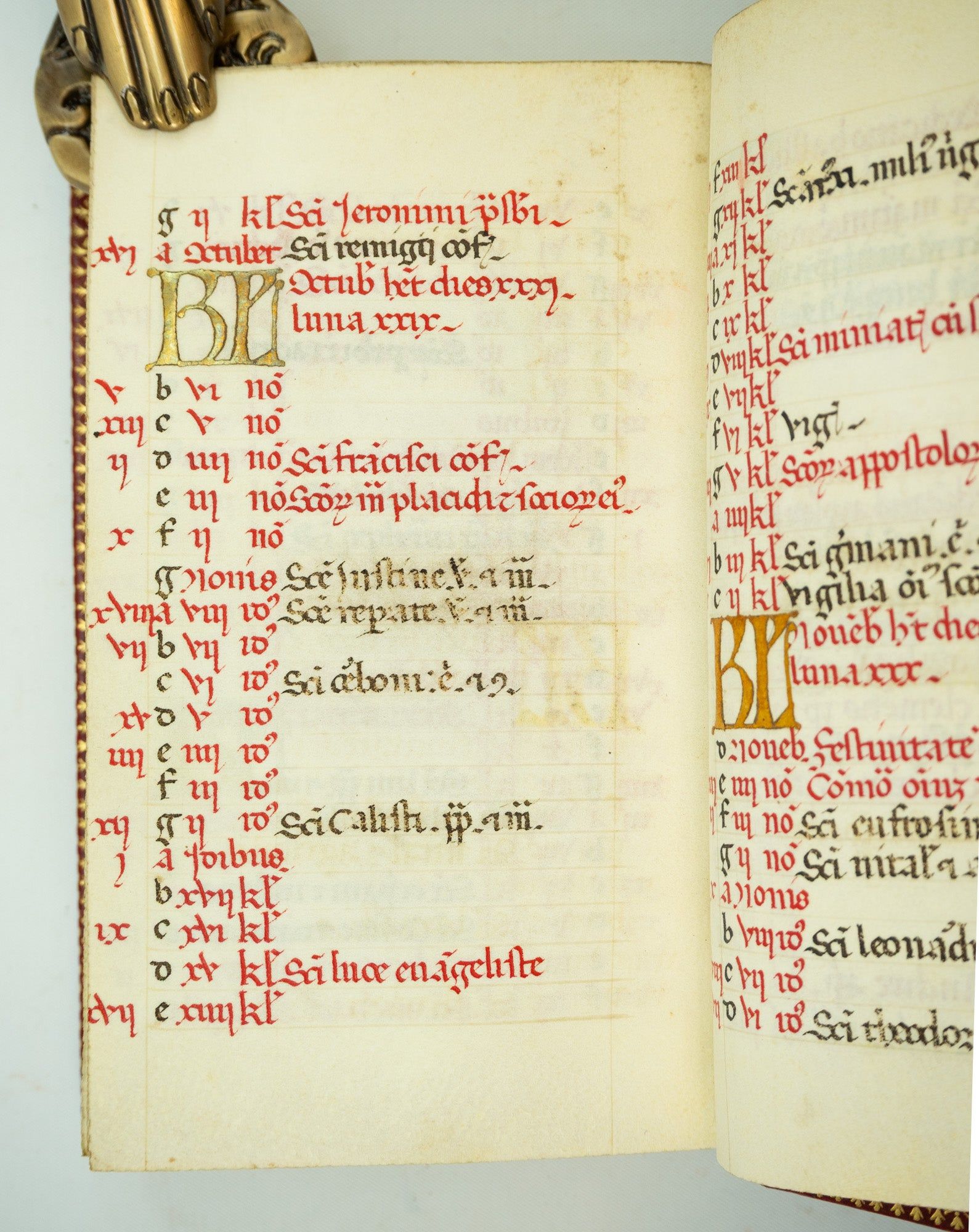
Italy (Florence), completed in 1536. 155 x 96 mm. (6 1/8 x 3 3/4"). Single column, 17 lines, in a rounded gothic hand. 225 leaves (first leaf and last three leaves blank). One signature bound upside-down, the calendar bound at end, but COMPLETE. With modern foliation in pencil ([i], 225 leaves, f. 222 omitted in numbering).
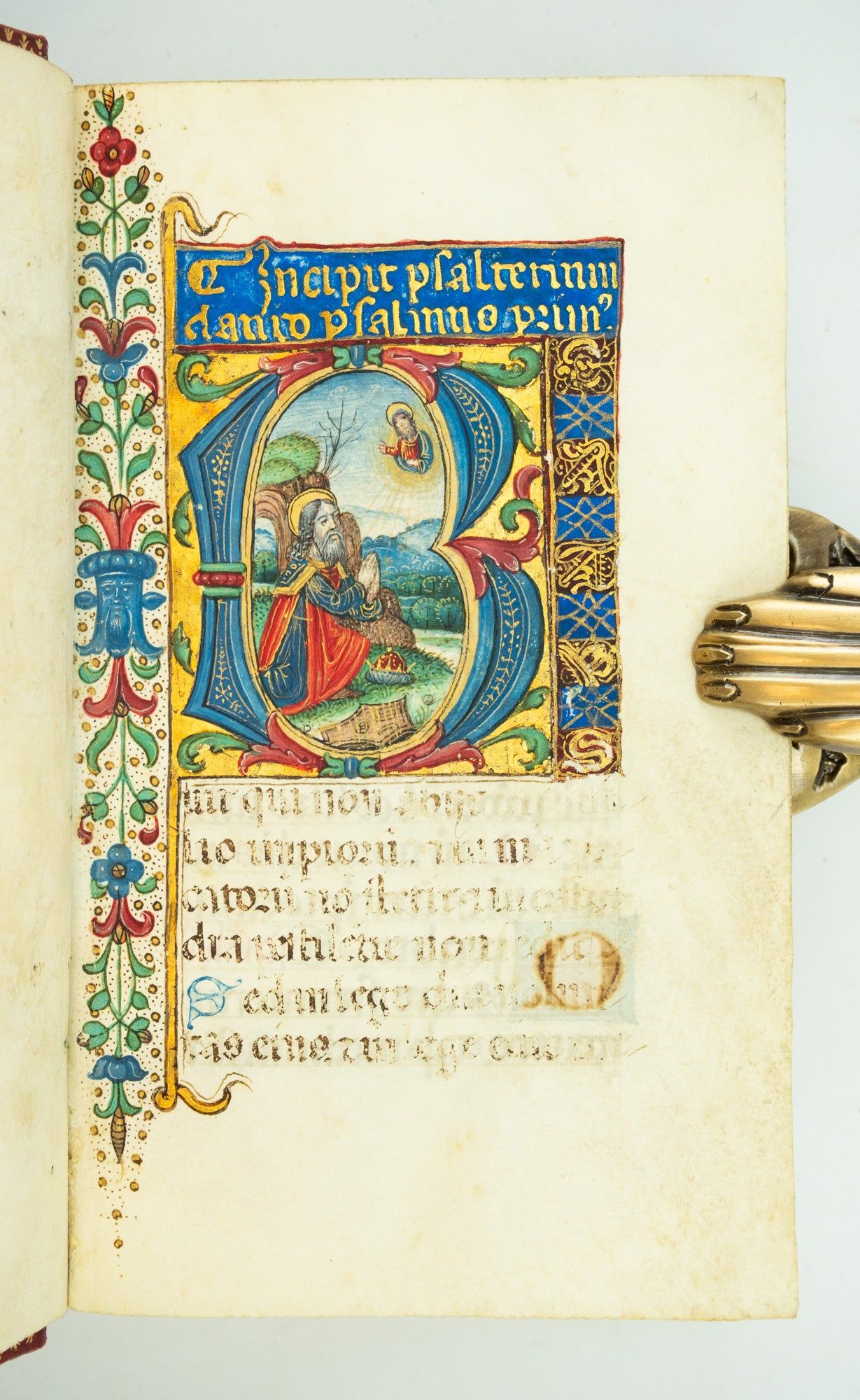
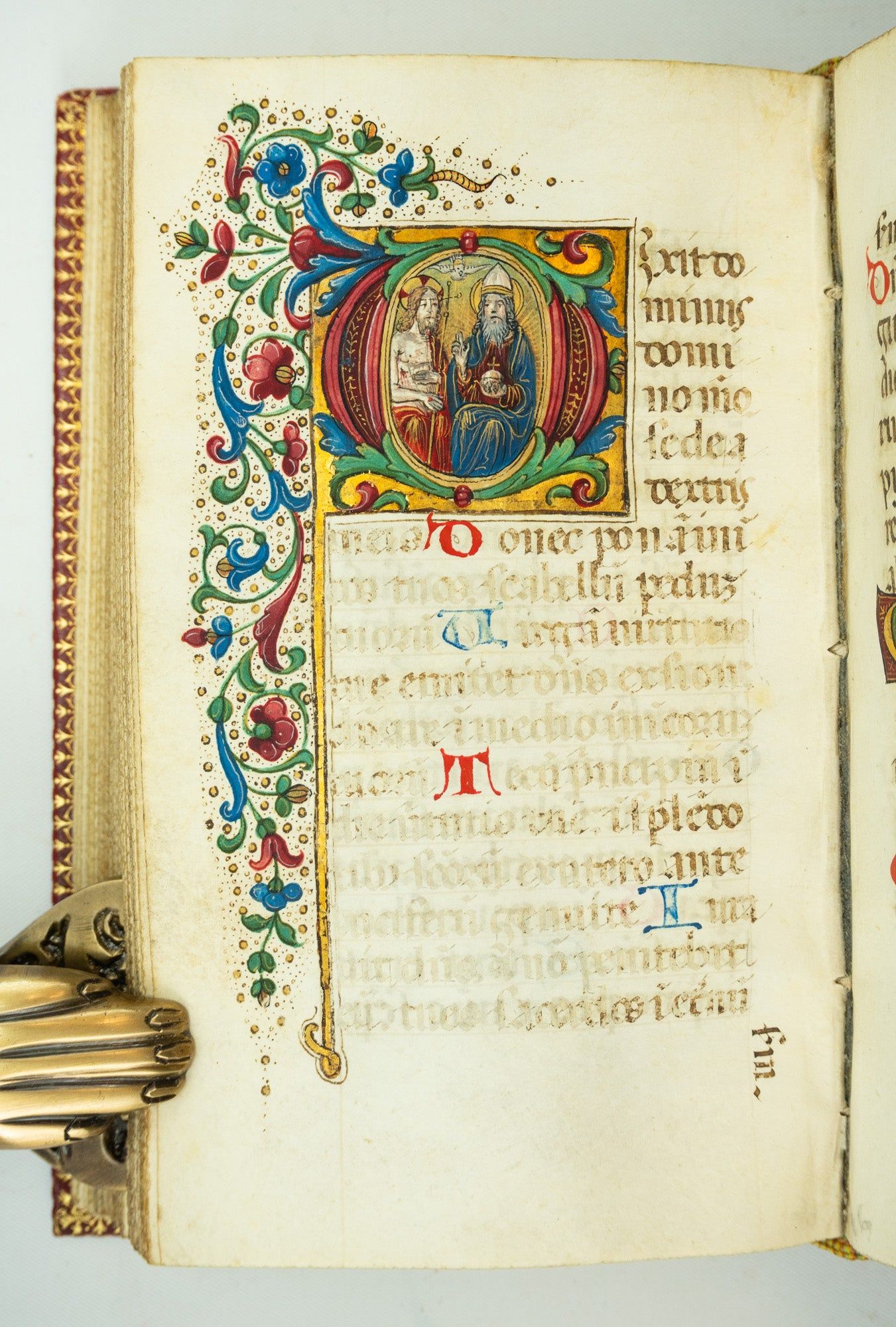
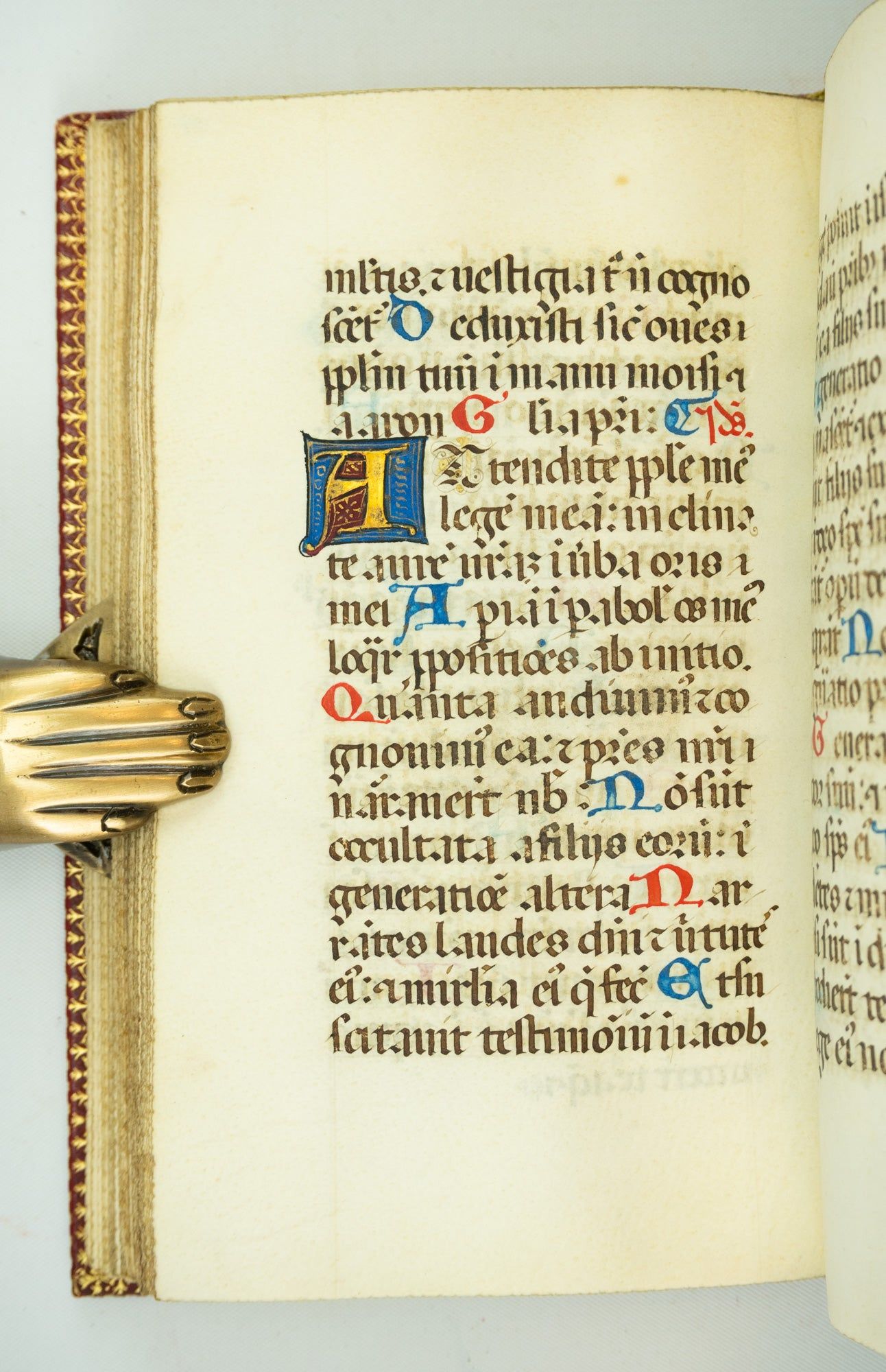
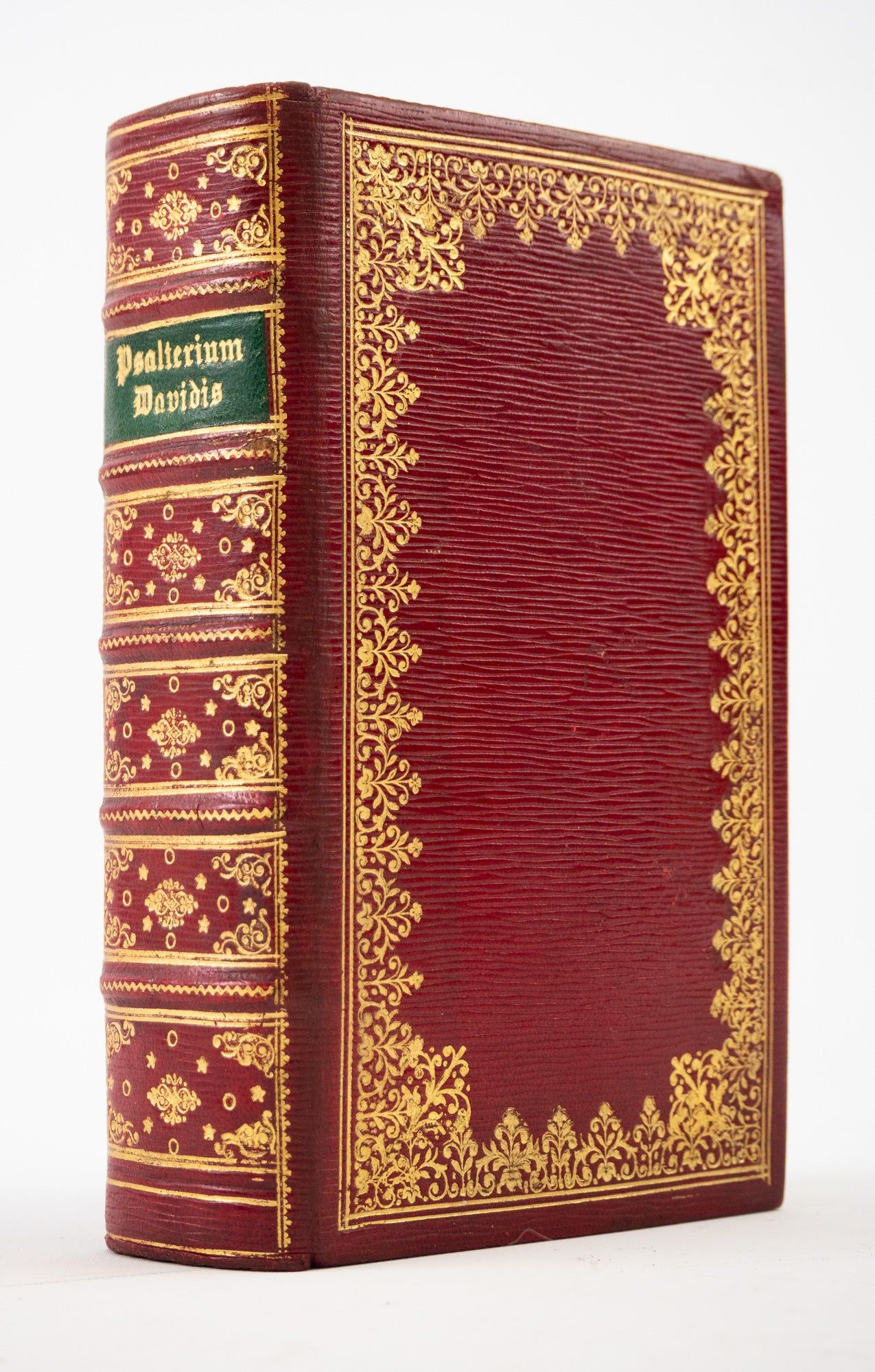
Attractive 19th century red straight-grain morocco, covers with lacy gilt border, raised bands, compartments with floral a scrolling tools with small stars and bezants, green morocco label with gilt lettering, gilt floral turn-ins, all edges gilt and gauffered. In a fine modern pebble-grained red morocco folding box by A. Lobstein, gilt lettering on spine, lined with velvet. Rubrics in red, numerous one-line initials and paragraph marks in red or blue, many two-line gilt initials on ground of two colors (red, blue, green, or purple) with small gold embellishments, three-line "KL" initials for each calendar month in gilt, TWO LARGE HISTORIATED INITIALS, the first measuring approximately 11 lines (65 mm.) and featuring King David in prayer, the initial painted blue and embellished with green and pink acanthus on gold ground, surrounded on two sides by bars of gilt lettering on blue and pink ground, inner margin decorated with colorful floral motifs decorated with gilt bezants, the second initial measuring six lines (35 mm.) and featuring the Holy Trinity, the initial painted pink with colorful acanthus on gilt ground, and with a similar floral border in the outer margin and extending over the initial along the top. See: Alexander, "The Painted Page," nos. 1, 3 & 4; and Salmi, "Italian Miniatures," frontispiece and pp. 52-53. Text rather faded in places (though sense always recoverable), isolated insignificant rubbing or chipping to the gilt, a handful of trivial stains and instances of soiling or foxing, but a nevertheless lovely manuscript--very clean and fresh, with wide margins, and the historiated initials especially well preserved. (Just the slightest signs of use to the lustrous binding.).
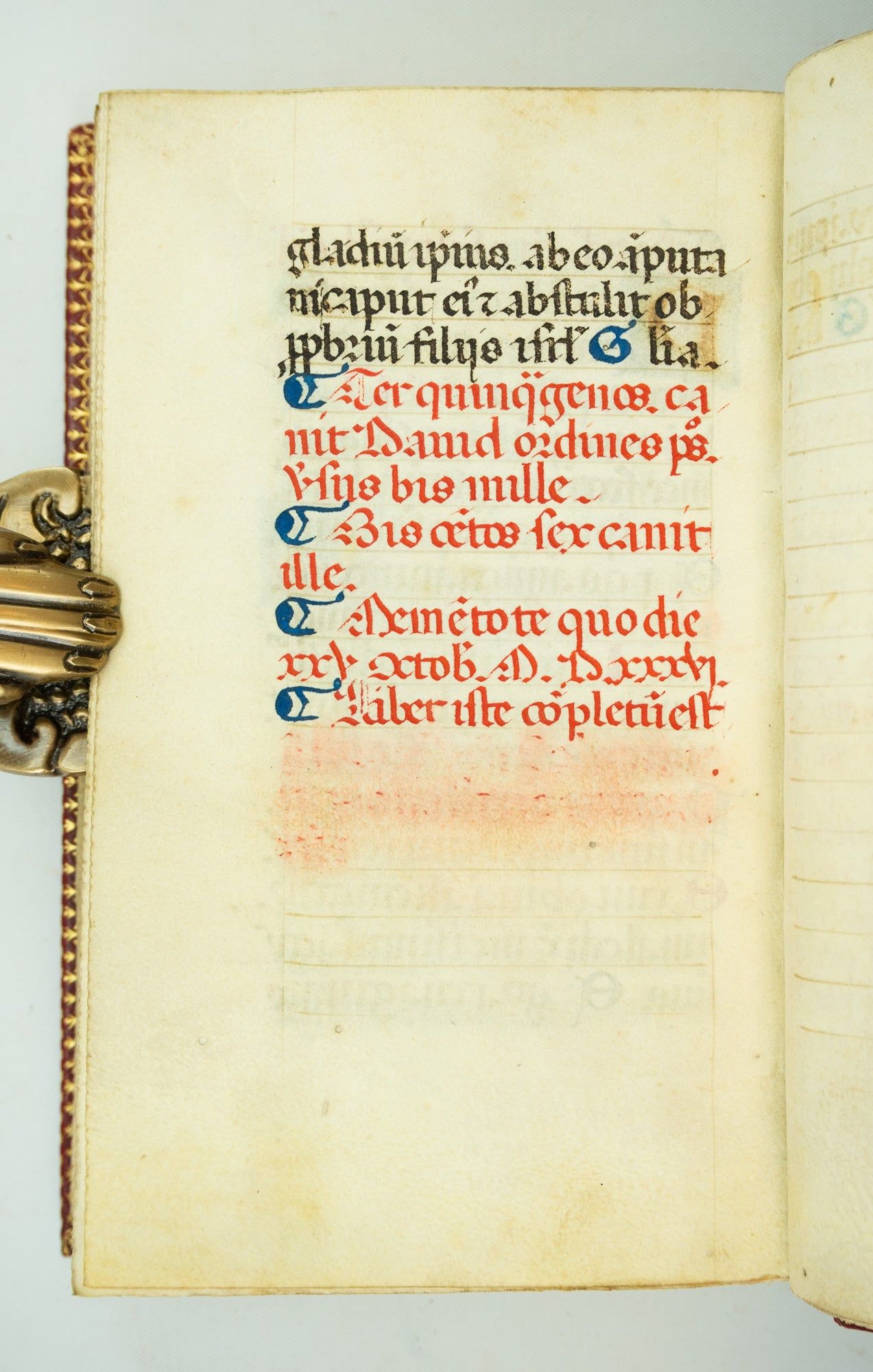
This is a fine example of Florentine manuscript production from the early 16th century, with a beautiful, rounded gothic script, sparkling initials, and historiation that suggests a link to some of the most important miniaturists of the period. The decoration is composed of rich jewel tones, and includes a half-page initial opening "Beatus vir," depicting King David in prayer, and a smaller "D" opening Psalm 109 ("Dixit Dominus Domino meo: a sede adextris meis"), depicting the Holy Trinity. Each initial is embellished by a lovely partial border of floral motifs and many gilt bezants in a typical Florentine style. The large "Beatus vir" initial is particularly well done, with excellent molding and shading, and careful attention to even the smallest hair on David's beard. Into a relatively small space the artist manages to fit an entire outdoor scene complete with foreground, middle ground, and background, including rolling hills, a river, and a distinctive rock formation that adds dimension, scale, and a sense of realism to the painting. Although whoever had the box made for this work attributed the manuscript to Giovanni Boccardi, known as Boccardino il Vecchio (1460-1529), the figures and border decoration are stylistically closer to the work of two other contemporary workshops: that of Attavante degli Attavanti (1452-1525), and brothers Gherardo (1445-97) and Monte (1448-1532) di Giovanni del Fora. Of Attavante, Salmi notes that he was "At one time, the most celebrated miniaturist of the Renaissance," and Alexander says that he "was one of the most successful entrepreneurs in the Florentine book trade in obtaining commissions from patrons outside Florence." He counted European royalty among his patrons, and executed celebrated manuscripts for Mattias Corvinus, King of Hungary, and Manuel I, King of Portugal, as well as high ranking members of the church, including Pope Leo X. Among the many hands employed by Attavante were those of Gherardo and Monte di Giovanni del Fora, which explains the closely related styles of the two workshops. Salmi notes that "As expert miniaturists, Gherardo and Monte composed magnificent interiors, evoking historical events, and landscapes of great depth and drama, abounding in descriptive details and precious minutiae worthy of the Books of Hours of Flemish and French Masters." In addition to stylistic similarities, we have been able to find two other examples of miniatures with compositions that are very close to the "Beatus vir" initial in the present work, both of which are attributed to Gherardo and Monte Giovanni del Fora or their workshop. These are: an "S" initial in a Choirbook at the Museo dell'Opera di S. Maria del Fiore (we found a black & white reproduction only); and a full-page miniature in the Biblioteca Medicea Laurenziana (MS Plut. 15.17). Like our opening initial, these miniatures both depict King David kneeling in prayer, dressed in similarly draped and shaped garments (in the miniature with color reproductions available, the garments are identically colored red and blue), with an unusual lobed harp on the ground, and a rocky outcropping in the background. Most notably, in the latter miniature as well as our initial, this rock formation includes a natural archway that has formed over a river. If we are to believe the final rubricated lines, indicating that the manuscript was completed on 25 October 1536, then the historiated initials were probably painted by an artist who was, at the very least, quite familiar with the work of the aforementioned miniaturists, if not directly employed by one of their workshops. The most likely workshop would be that of Monte Giovanni del Fora, who died in 1532--four years before this work was supposedly completed. It is perhaps even conceivable that the production of the Psalter took long enough that the initials might have been executed during Monte's lifetime. It is unfortunate that three lines in the colophon have been erased, as they may have provided additional information about the making of this manuscript. Whatever the case may be, this is a lovely object with tasteful decoration that clearly echoes the work of some of Florence's finest workshops. Italian prayer books such as this are increasingly difficult to come by, and the present item, being complete and in excellent condition, would be a fine addition to any private or institutional collection..
Attractive 19th century red straight-grain morocco, covers with lacy gilt border, raised bands, compartments with floral a scrolling tools with small stars and bezants, green morocco label with gilt lettering, gilt floral turn-ins, all edges gilt and gauffered. In a fine modern pebble-grained red morocco folding box by A. Lobstein, gilt lettering on spine, lined with velvet. Rubrics in red, numerous one-line initials and paragraph marks in red or blue, many two-line gilt initials on ground of two colors (red, blue, green, or purple) with small gold embellishments, three-line "KL" initials for each calendar month in gilt, TWO LARGE HISTORIATED INITIALS, the first measuring approximately 11 lines (65 mm.) and featuring King David in prayer, the initial painted blue and embellished with green and pink acanthus on gold ground, surrounded on two sides by bars of gilt lettering on blue and pink ground, inner margin decorated with colorful floral motifs decorated with gilt bezants, the second initial measuring six lines (35 mm.) and featuring the Holy Trinity, the initial painted pink with colorful acanthus on gilt ground, and with a similar floral border in the outer margin and extending over the initial along the top. See: Alexander, "The Painted Page," nos. 1, 3 & 4; and Salmi, "Italian Miniatures," frontispiece and pp. 52-53. Text rather faded in places (though sense always recoverable), isolated insignificant rubbing or chipping to the gilt, a handful of trivial stains and instances of soiling or foxing, but a nevertheless lovely manuscript--very clean and fresh, with wide margins, and the historiated initials especially well preserved. (Just the slightest signs of use to the lustrous binding.).
This is a fine example of Florentine manuscript production from the early 16th century, with a beautiful, rounded gothic script, sparkling initials, and historiation that suggests a link to some of the most important miniaturists of the period. The decoration is composed of rich jewel tones, and includes a half-page initial opening "Beatus vir," depicting King David in prayer, and a smaller "D" opening Psalm 109 ("Dixit Dominus Domino meo: a sede adextris meis"), depicting the Holy Trinity. Each initial is embellished by a lovely partial border of floral motifs and many gilt bezants in a typical Florentine style. The large "Beatus vir" initial is particularly well done, with excellent molding and shading, and careful attention to even the smallest hair on David's beard. Into a relatively small space the artist manages to fit an entire outdoor scene complete with foreground, middle ground, and background, including rolling hills, a river, and a distinctive rock formation that adds dimension, scale, and a sense of realism to the painting. Although whoever had the box made for this work attributed the manuscript to Giovanni Boccardi, known as Boccardino il Vecchio (1460-1529), the figures and border decoration are stylistically closer to the work of two other contemporary workshops: that of Attavante degli Attavanti (1452-1525), and brothers Gherardo (1445-97) and Monte (1448-1532) di Giovanni del Fora. Of Attavante, Salmi notes that he was "At one time, the most celebrated miniaturist of the Renaissance," and Alexander says that he "was one of the most successful entrepreneurs in the Florentine book trade in obtaining commissions from patrons outside Florence." He counted European royalty among his patrons, and executed celebrated manuscripts for Mattias Corvinus, King of Hungary, and Manuel I, King of Portugal, as well as high ranking members of the church, including Pope Leo X. Among the many hands employed by Attavante were those of Gherardo and Monte di Giovanni del Fora, which explains the closely related styles of the two workshops. Salmi notes that "As expert miniaturists, Gherardo and Monte composed magnificent interiors, evoking historical events, and landscapes of great depth and drama, abounding in descriptive details and precious minutiae worthy of the Books of Hours of Flemish and French Masters." In addition to stylistic similarities, we have been able to find two other examples of miniatures with compositions that are very close to the "Beatus vir" initial in the present work, both of which are attributed to Gherardo and Monte Giovanni del Fora or their workshop. These are: an "S" initial in a Choirbook at the Museo dell'Opera di S. Maria del Fiore (we found a black & white reproduction only); and a full-page miniature in the Biblioteca Medicea Laurenziana (MS Plut. 15.17). Like our opening initial, these miniatures both depict King David kneeling in prayer, dressed in similarly draped and shaped garments (in the miniature with color reproductions available, the garments are identically colored red and blue), with an unusual lobed harp on the ground, and a rocky outcropping in the background. Most notably, in the latter miniature as well as our initial, this rock formation includes a natural archway that has formed over a river. If we are to believe the final rubricated lines, indicating that the manuscript was completed on 25 October 1536, then the historiated initials were probably painted by an artist who was, at the very least, quite familiar with the work of the aforementioned miniaturists, if not directly employed by one of their workshops. The most likely workshop would be that of Monte Giovanni del Fora, who died in 1532--four years before this work was supposedly completed. It is perhaps even conceivable that the production of the Psalter took long enough that the initials might have been executed during Monte's lifetime. It is unfortunate that three lines in the colophon have been erased, as they may have provided additional information about the making of this manuscript. Whatever the case may be, this is a lovely object with tasteful decoration that clearly echoes the work of some of Florence's finest workshops. Italian prayer books such as this are increasingly difficult to come by, and the present item, being complete and in excellent condition, would be a fine addition to any private or institutional collection..
Details
Title
TEXT IN LATIN
Author
A RENAISSANCE ILLUMINATED VELLUM MANUSCRIPT PSALTER, WITH TWO LARGE HISTORIATED INITIALS
Condition
Unknown
Publisher
Italy (Florence)
Date
completed in 1536