

Autograph Letter Signed (“Mort”), Dec. 12, 1918, no place; undoubtedly written in France but inexplicably postmarked by the French military post in Smyrna, Turkey, to Laurance J. Scott, Burlingame, California.
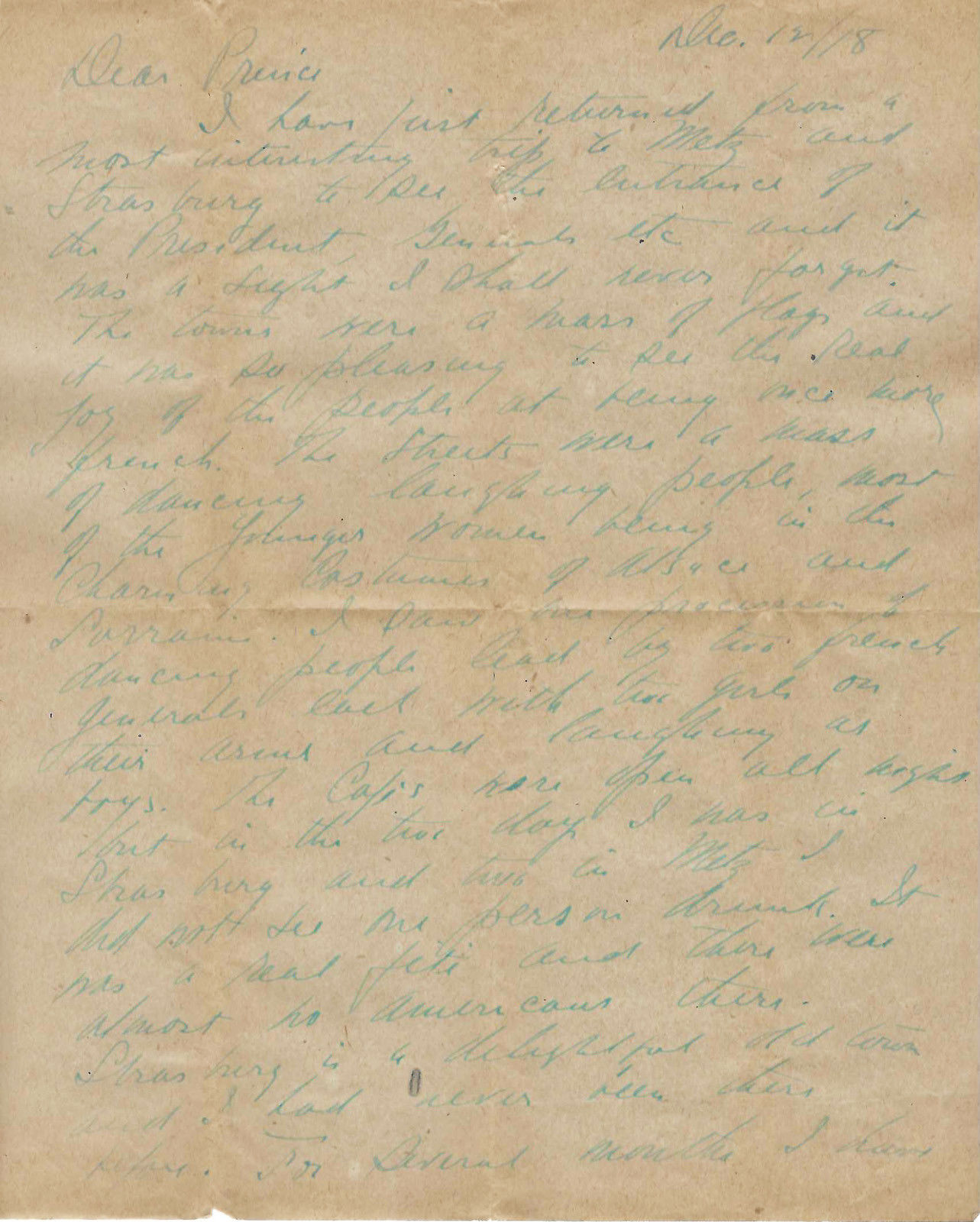
Quarto, 9 pages, plus original mailing envelope, paper folded, and lightly browned, otherwise in very good, clean and legible condition.
1918 US Military officer, American expatriate artist, volunteer Ambulance driver for the French at the start of the World War, witnesses President Wilson's arrival for the Peace Conference.
41 year-old Morton Burr Stelle, Jr. was a Cornell graduate, son of a Larchmont yachtsman from an old Virginia family, and a New York stockbroker who had retired at an early age to become an amateur painter in pre-war France. His wife, a relative of Republican Senator Mark Hanna, whom he had met at a tennis match, was the daughter of a millionaire Ohio breeder of racehorses. The recipient of this letter, the best man at Stelle's wedding, was son of the president of a San Francisco iron works who had been a best friend of President William McKinley's.
Living in his Villa in an artist's colony in Brittany when the European war began, Stelle had immediately joined the American Volunteer Motor Ambulance Corps founded by the French millionaire who headed the Morgan Bank in Paris to transport wounded Allied troops from the battlefields to French hospitals. The Corps was later numbered among its volunteers John Dos Passos, E.E. Cummings, and Ernest Hemingway, but when Stelle offered his services, it had only two ambulances and four drivers. While his wife became a Red Cross nurse in a hospital, he remained in the Corps through the entire years of War until the US entered the conflict, when he was commissioned as and transferred to the US Army Ambulance Service and Motor Transport Service as liaison to the French, commanding 30 American and 25 French officers and 1500 soldiers who organized the truck transport of nearly half a million soldiers, using "lanterns by night and in secret" during the bloody fighting in the fall of 1918. At War's end, he went to Metz to receive the Croix de Guerre, awarded him "for his untiring and earnest work" since the start of the War, "which I would rather have than be a General." He was thus present at Metz and Strasbourg "to see the entrance of the President, Generals, etc. and it was a sight I shall never forget. The towns were a mass of flags and it was so pleasing to see the real joy of the people, at being once more French. The Streets were a mass of dancing, laughing, people…I saw one procession of dancing people lead by two French Generals, last with two girls on their arms laughing as boys. The Cafes were open all night but… I did not see one person drunk. It was a real fete and there were almost no Americans there…I hope Wilsons trip over here will do him a lot of good…I believe it a good idea for him to see for himself what a shelled town looks like and to see at first hand the damage done by the Hun…" Where villages had been there was nothing left, "not a wall a foot high…The fields so torn by overlapping shell holes that I doubt if a man could ride a horse across the fields at that sport…" The defeated German was "still a danger and will be for years. He can do many things well and these we can learn from him. His cities are clean and his railroads are good, but he is Vulgar and Coarse from the highest down…"
Most of the letter is Stelle's gripe that he had not received a promised promotion to Lt. Colonel, but also a harrowing account of his wartime experiences that were far from the lifestyle of a rich dilettante. "The way to get promotion seems to be to sit at a desk in Washington." One of the ushers at his wedding had received done so, receiving that rank processing Artillery contracts at the War Department. Stelle read a letter from his friend, complaining of the "hard and trying life" in Washington, while he himself was at the front, having "worked hard all day and was wet and very cold as I was freezing and my feet were wet… and at night found myself forced to sleep in a… small and smoky… room with no windows as they had been shot away. From the windows one could see in the fields dead Americans French and Bosch." There was also no bed in the room, so Stelle dozed off wearing his uniform in a chair in front of a fire. To get my feet warm I had to get so close that my shins were too hot and all the time my back was freezing." The letter "was too funny to make me mad…" and having a good laugh, made him warmer.
He was proud of the American soldiers who had come "over there". "Our men have been wonderful fighters, young and very fit and would be stopped by nothing. But Stelle was "only waiting for my French decoration to come along to ask to get out" of the service. "I want to go home and dig in the garden and would not stay a month longer in the Army for any parade down the Champs Elysees. I have had war four years of it and am tired and my reason for going in was to beat the Boche at a time when my country thought otherwise. They are more than bean now and the boys from the rear can rush to the front for all I care and parade all they wish. I want to wear a straw hat and flannels…" He had no intention of returning to America. "…We have bought our place here and will rebuild after things settle…"
Details
Title
Autograph Letter Signed (“Mort”), Dec. 12, 1918, no place; undoubtedly written in France but inexplicably postmarked by the French military post in Smyrna, Turkey, to Laurance J. Scott, Burlingame, California.
Author
Stelle, Major Morton,
Condition
Unknown