

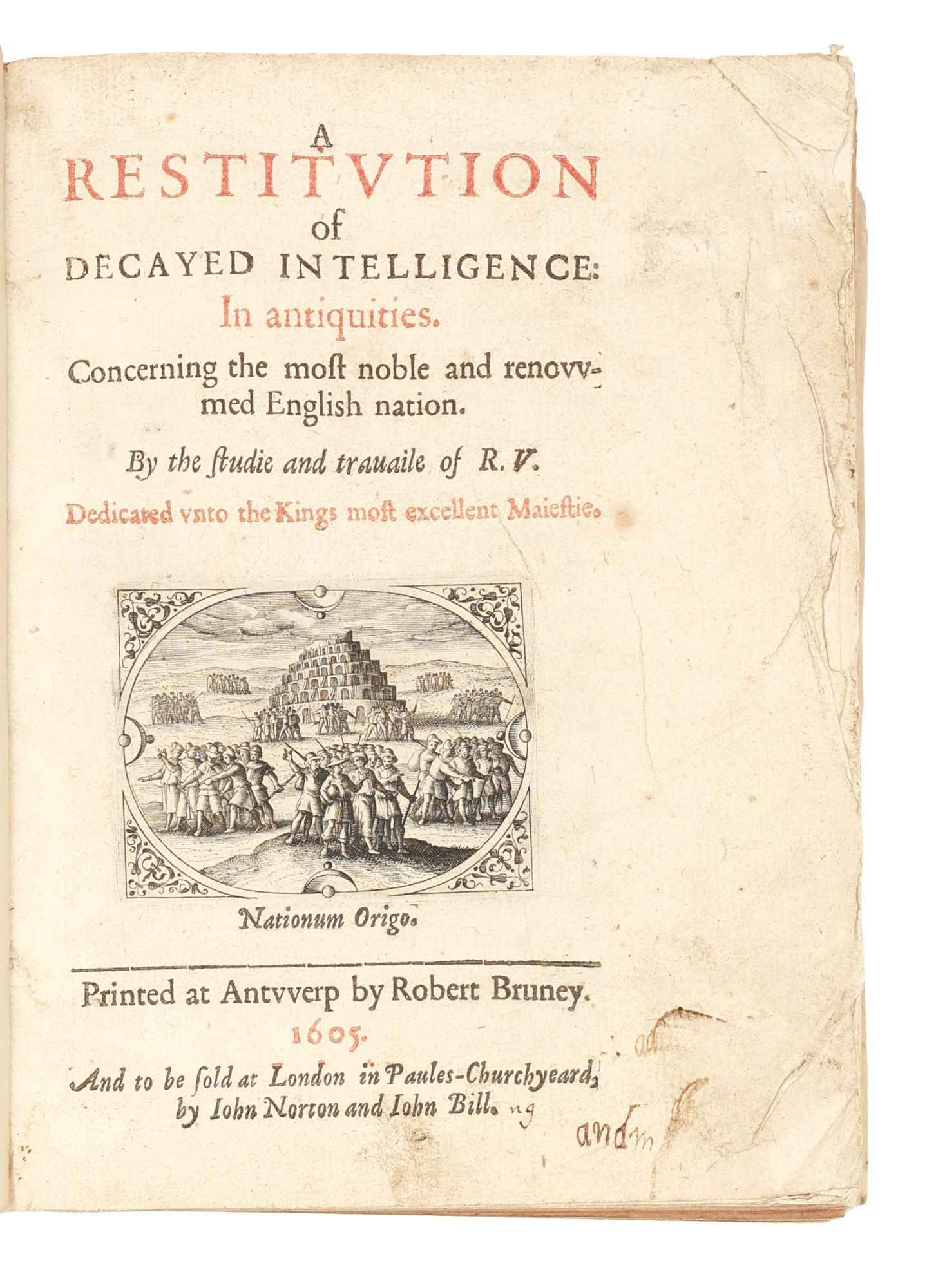
A restitvtion of decayed intelligence: in antiquities. Concerning the most noble and renovvmed English nation. By the studie and trauaile of R.V. Dedicated vnto the Kings most excellent Maiestie
- Hardcover
- Antwerp: by Robert Bruney, 1605. And to be sold at London in Paules-Churchyeard, by Iohn Norton and Iohn Bill, 1605
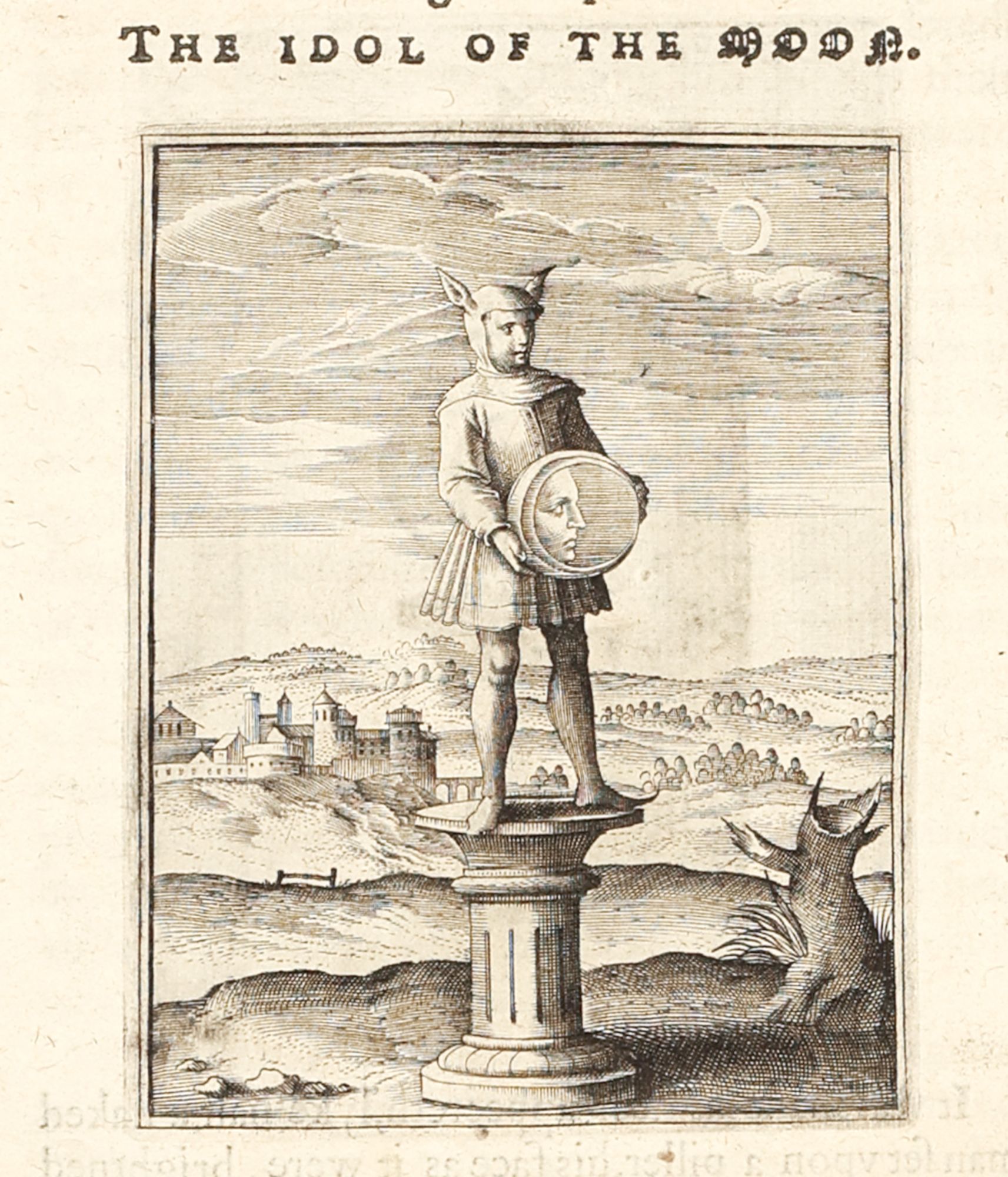
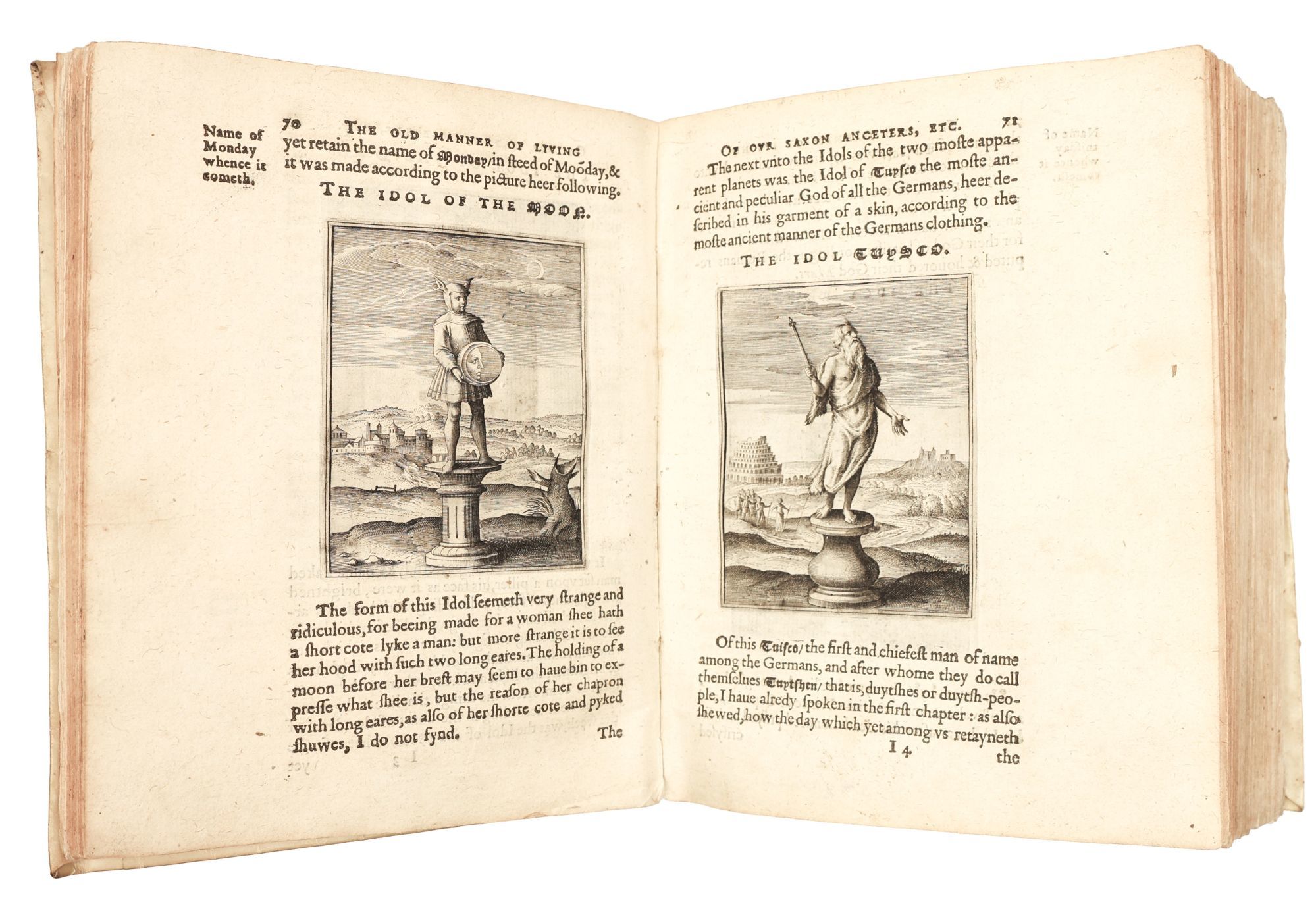
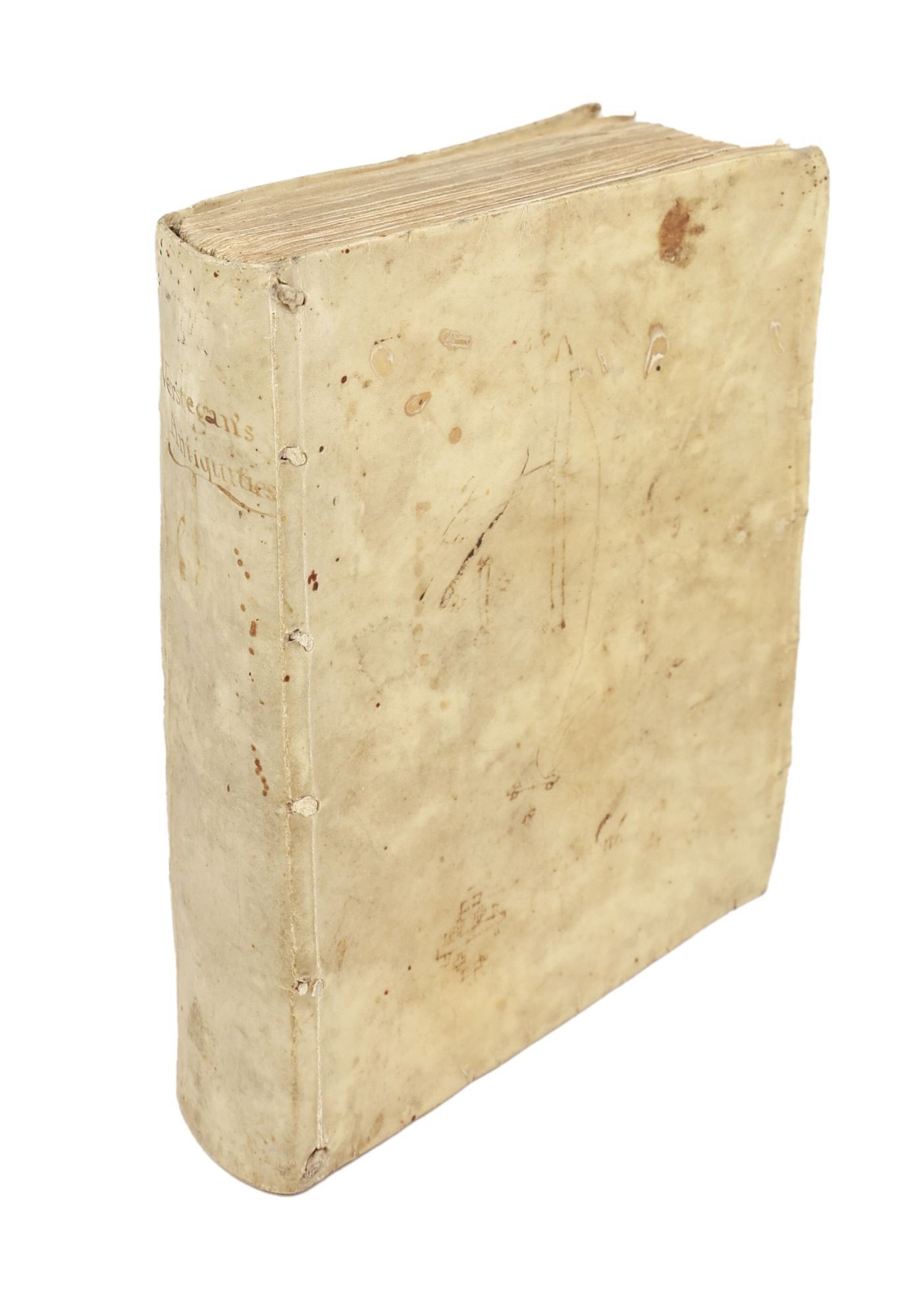
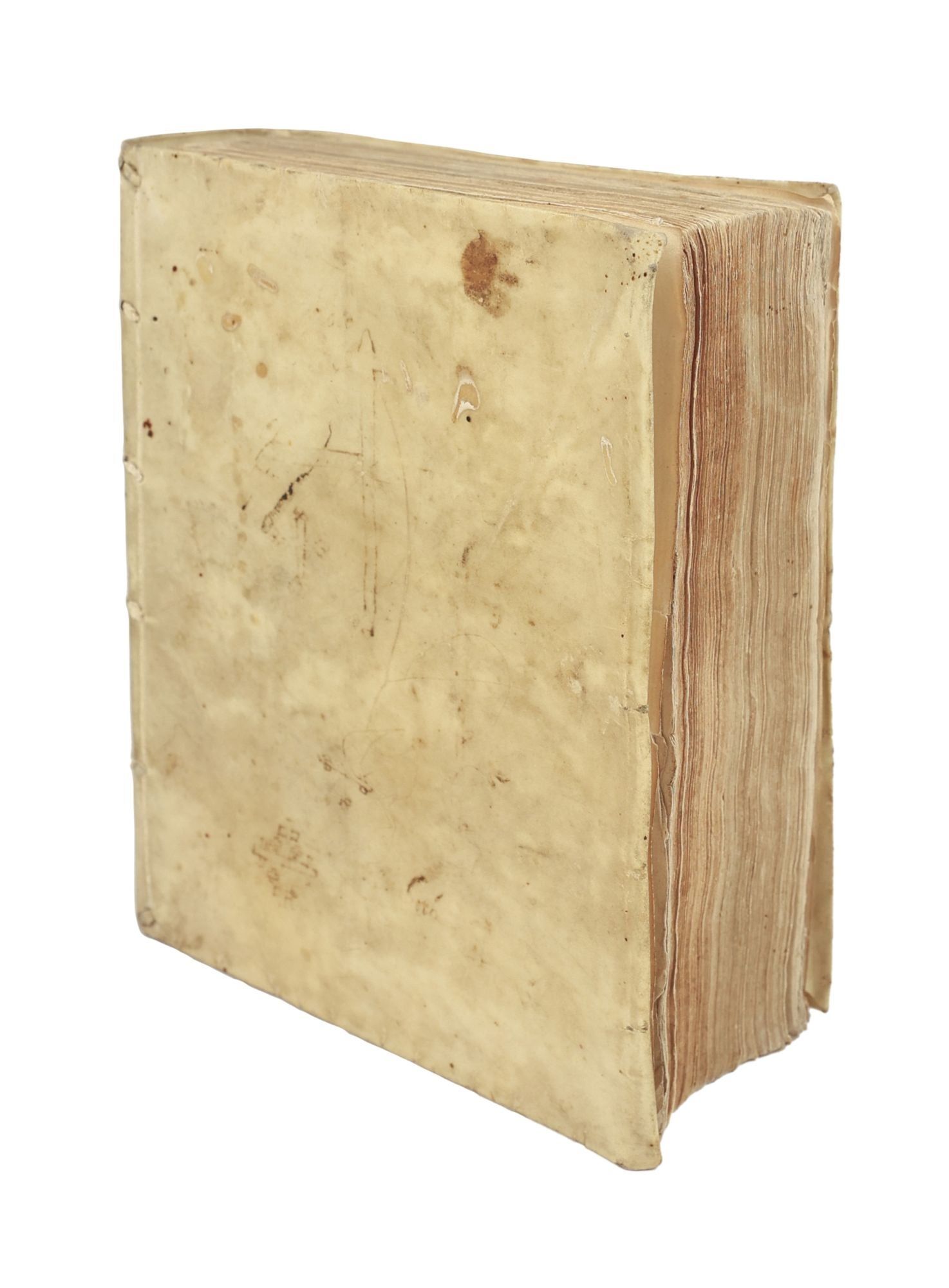
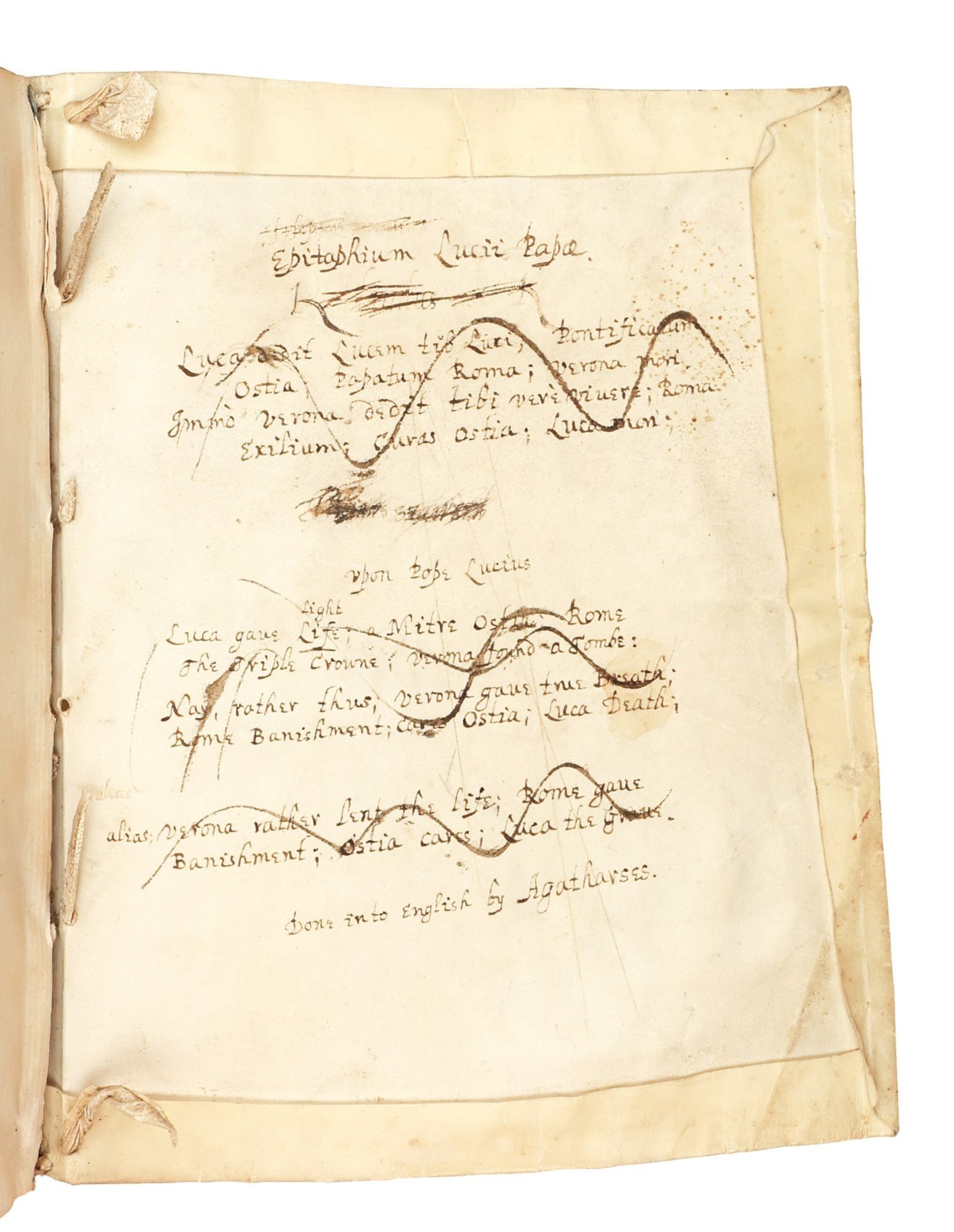
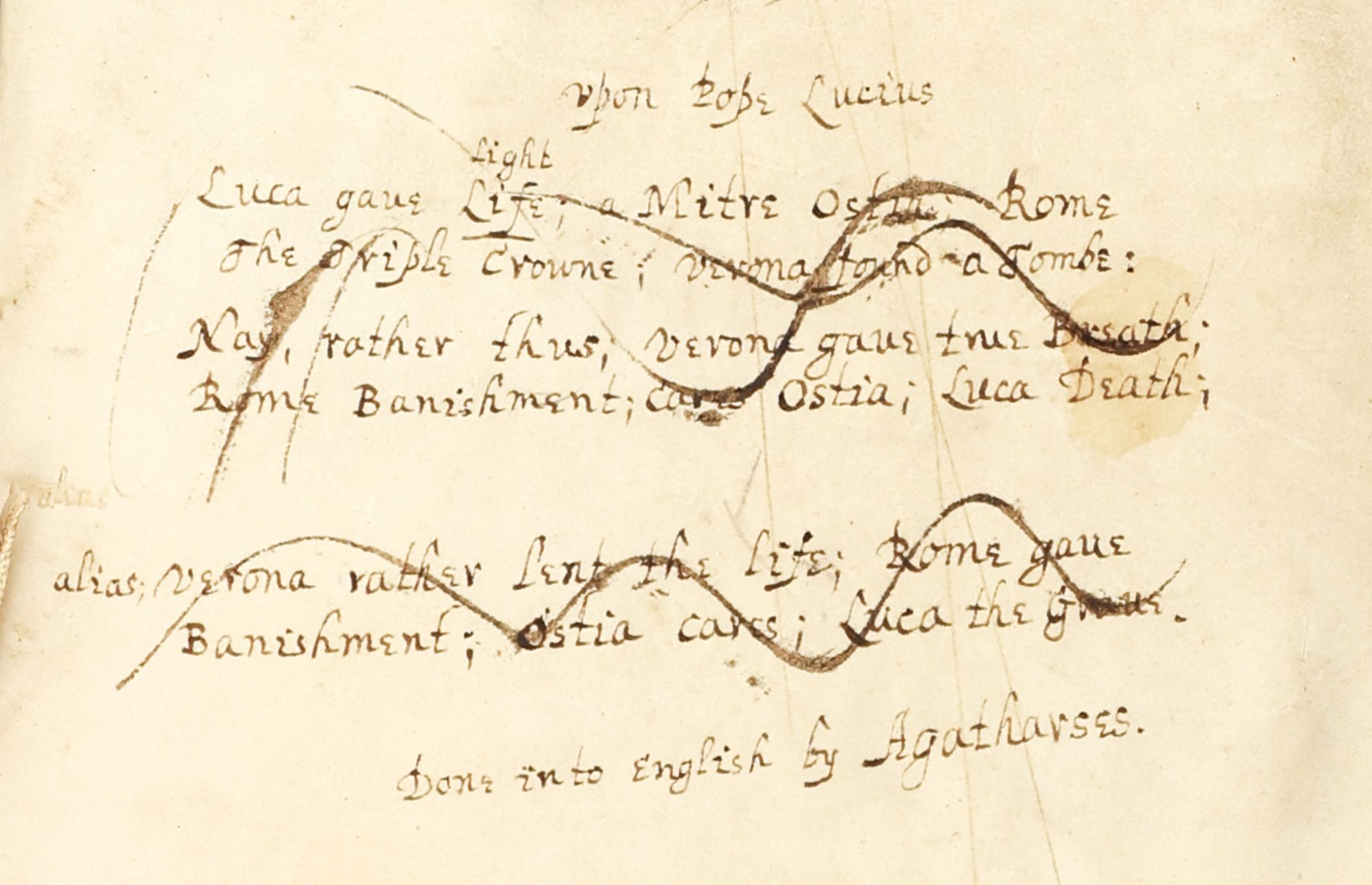
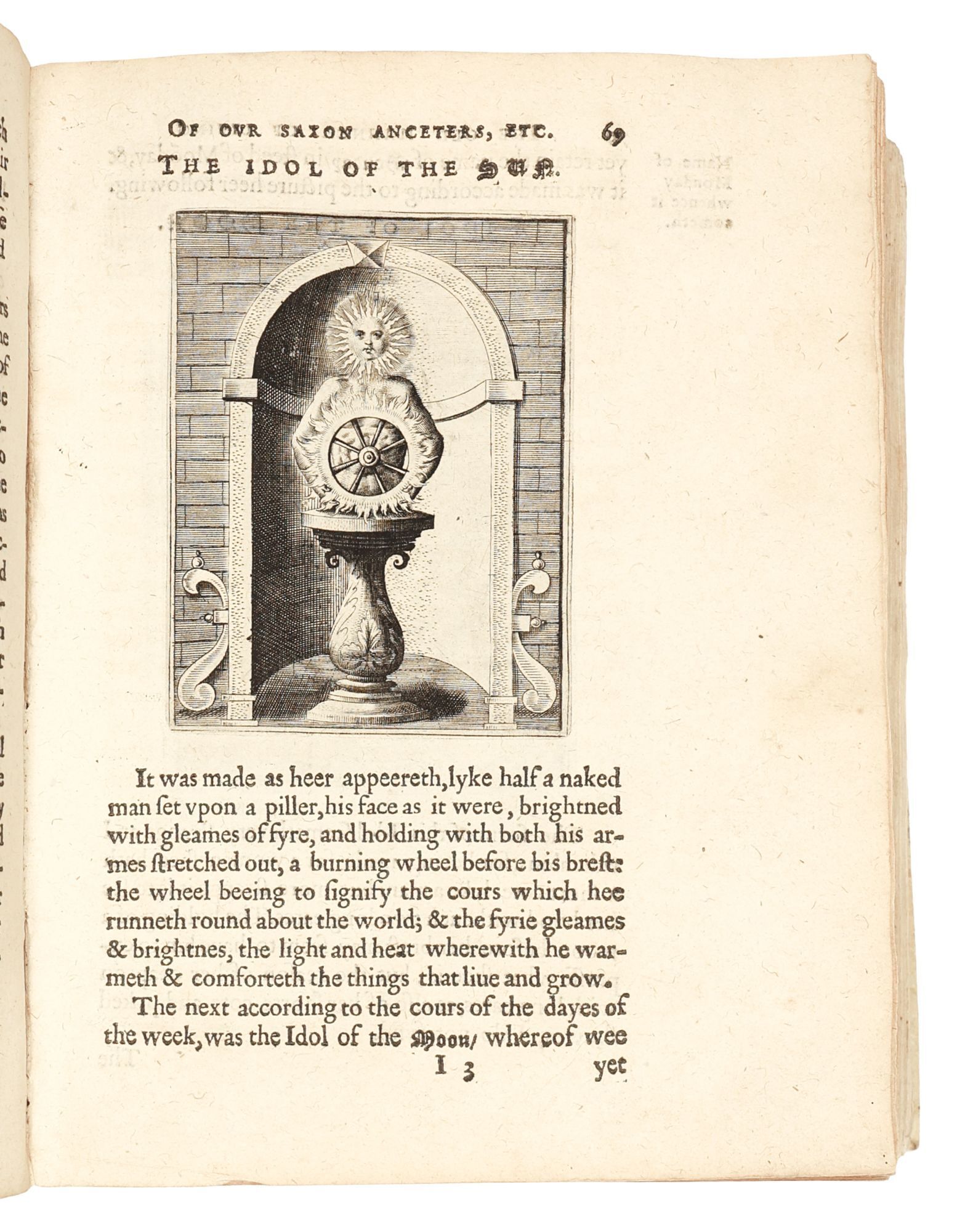
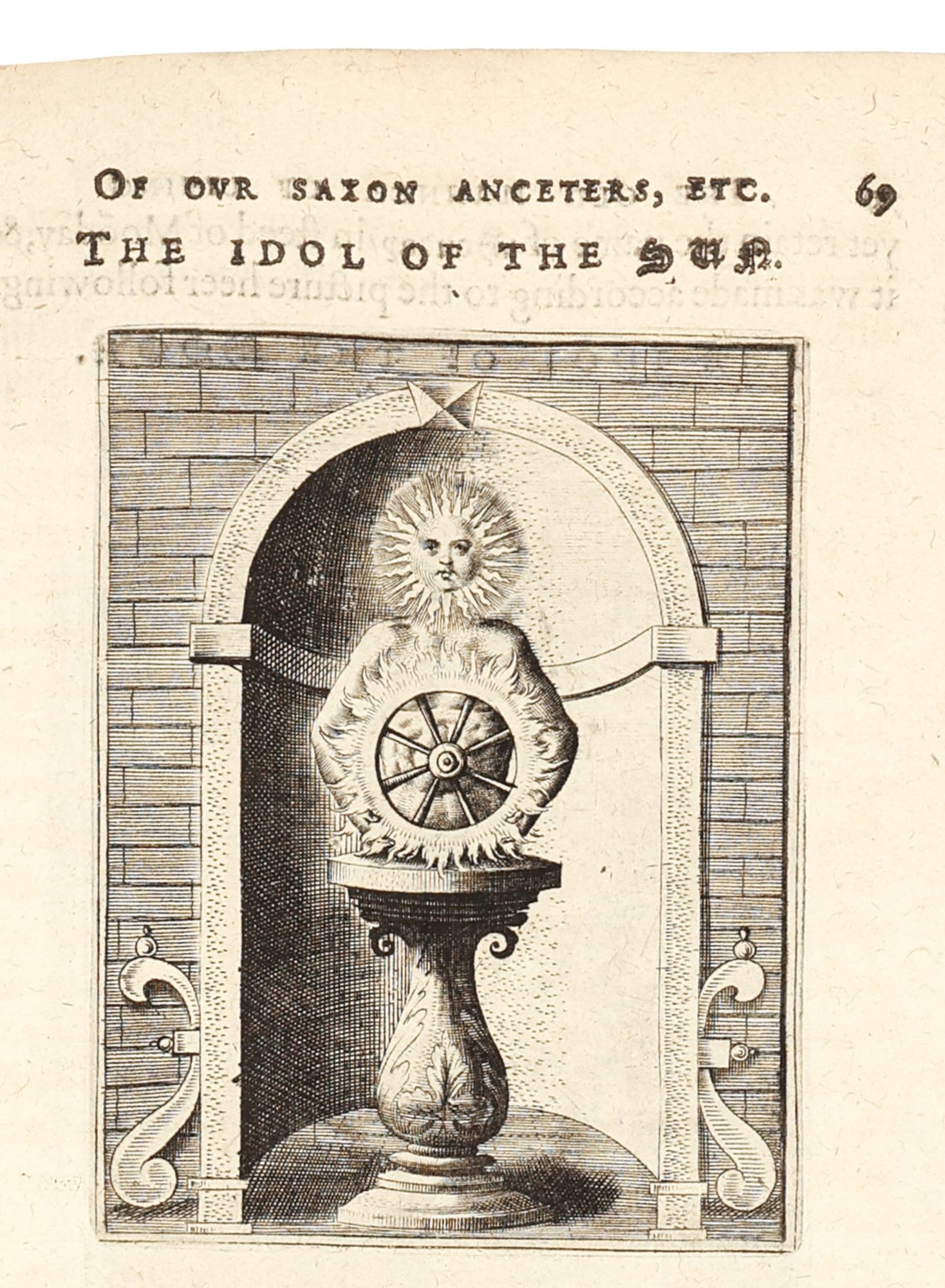
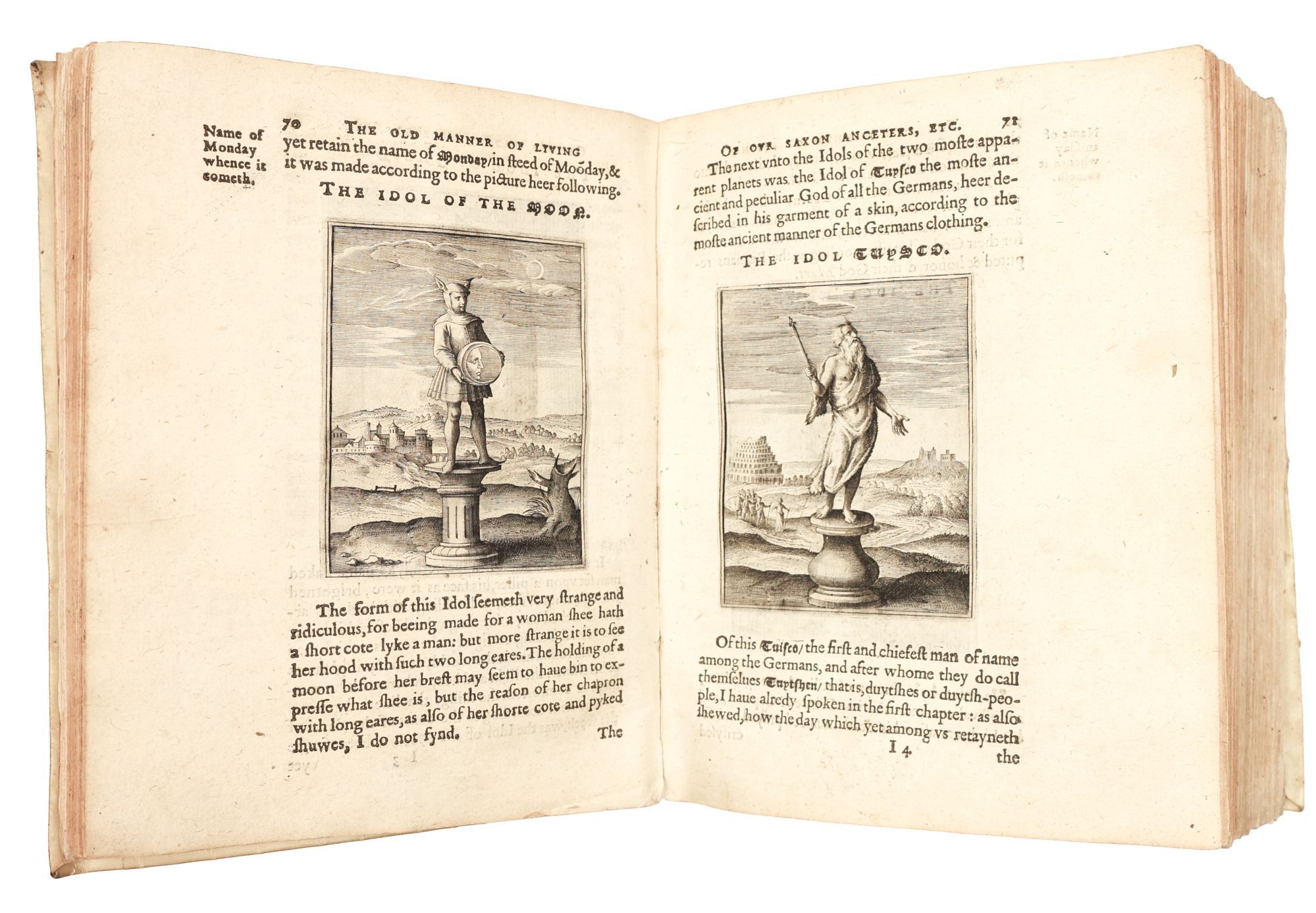
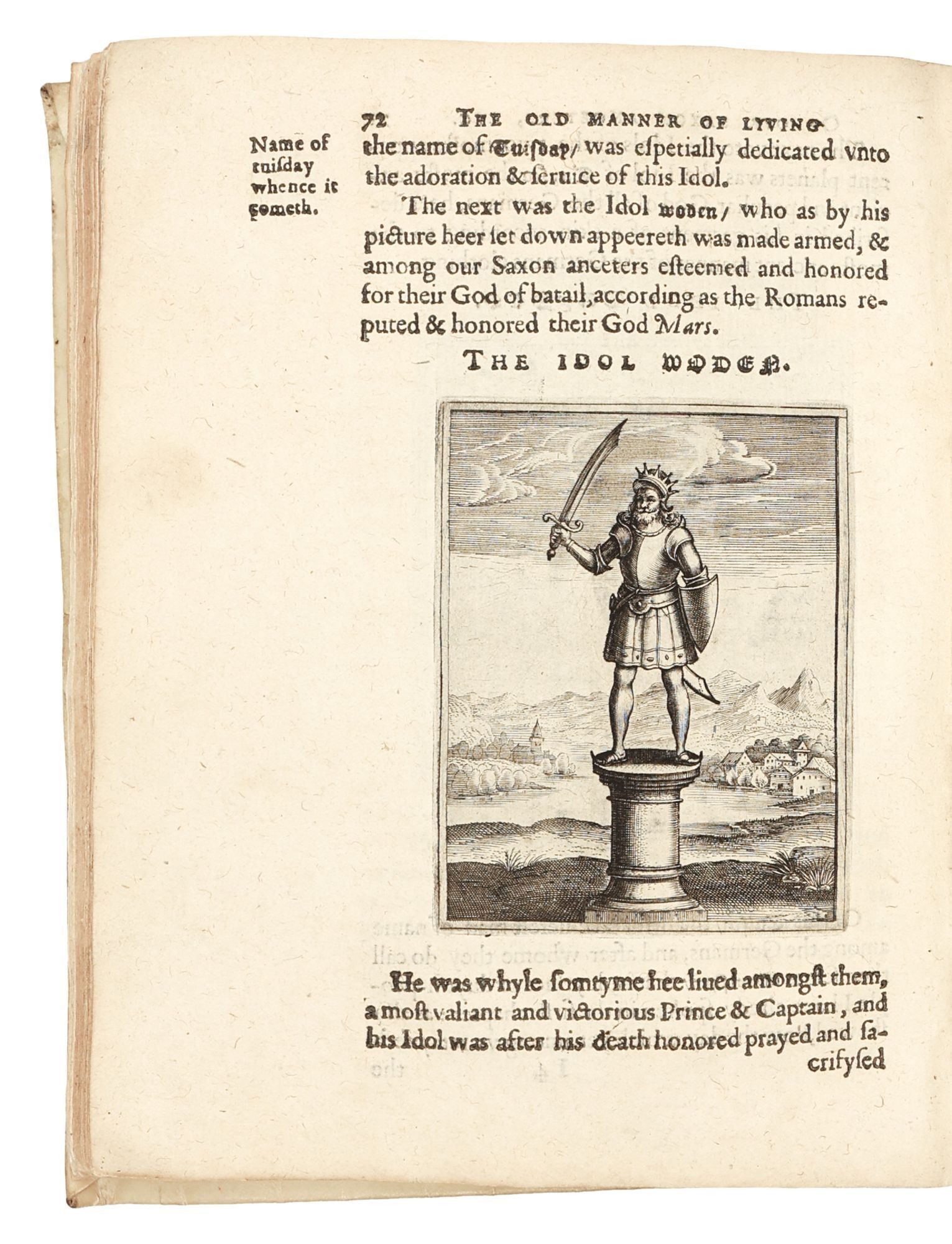
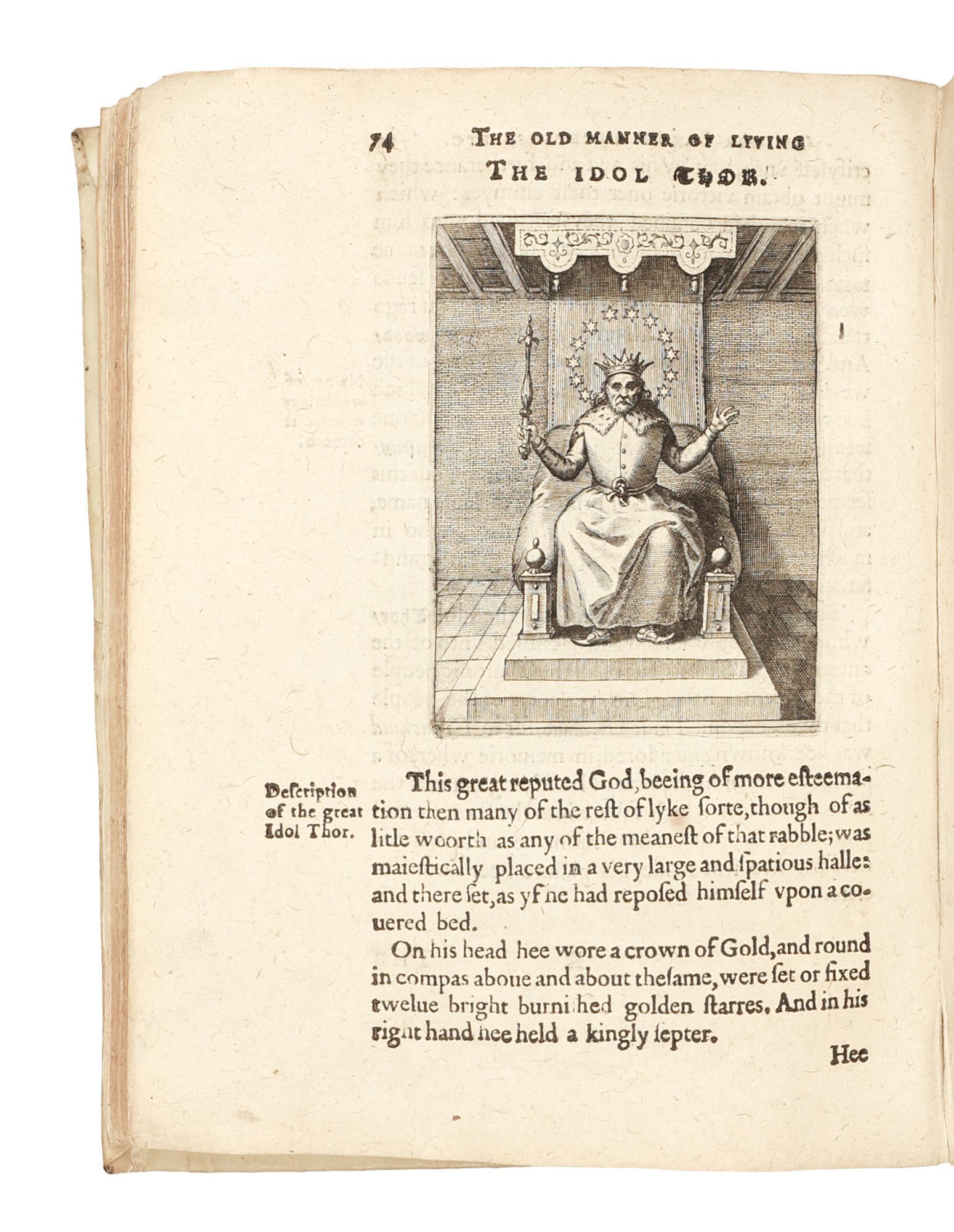
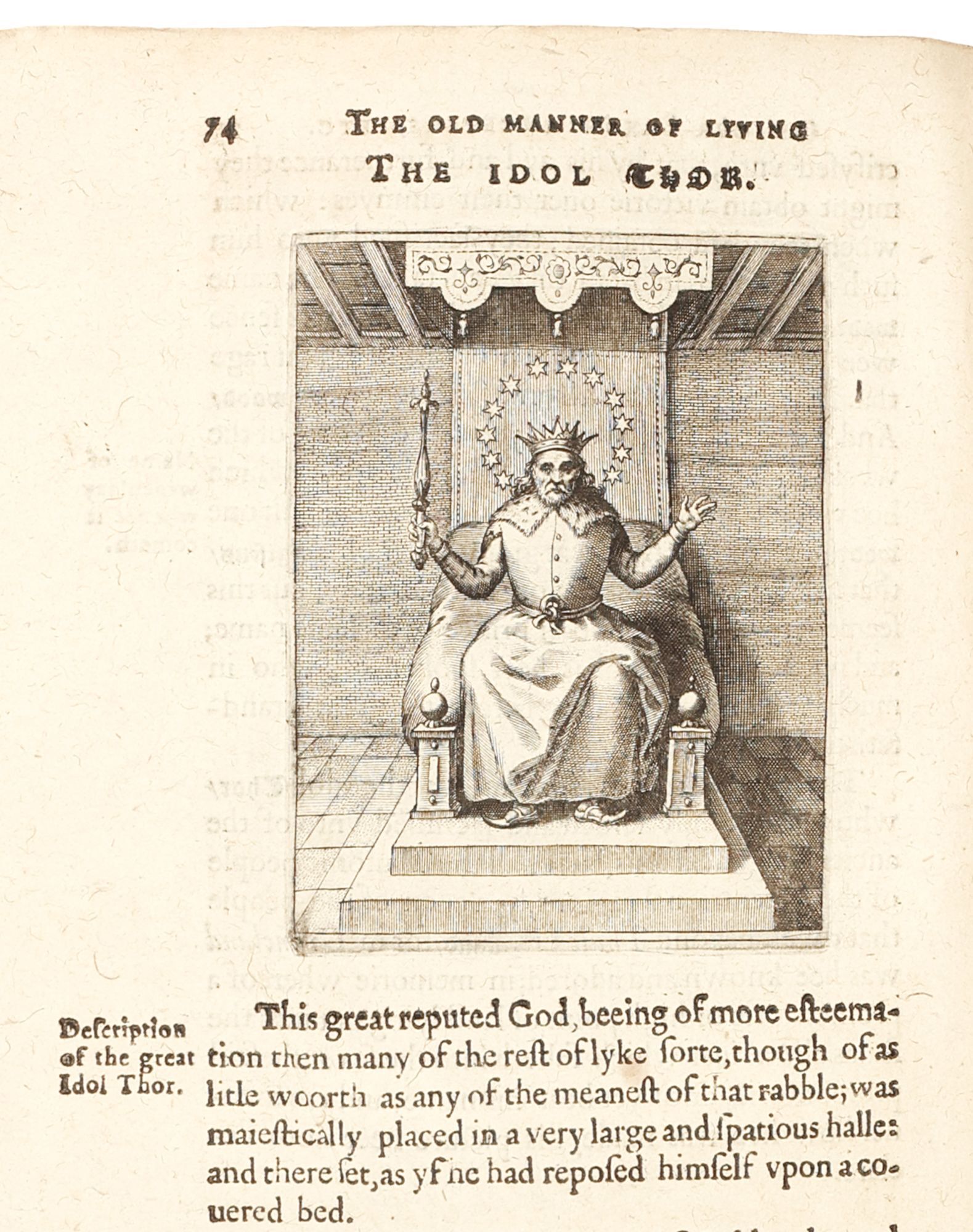
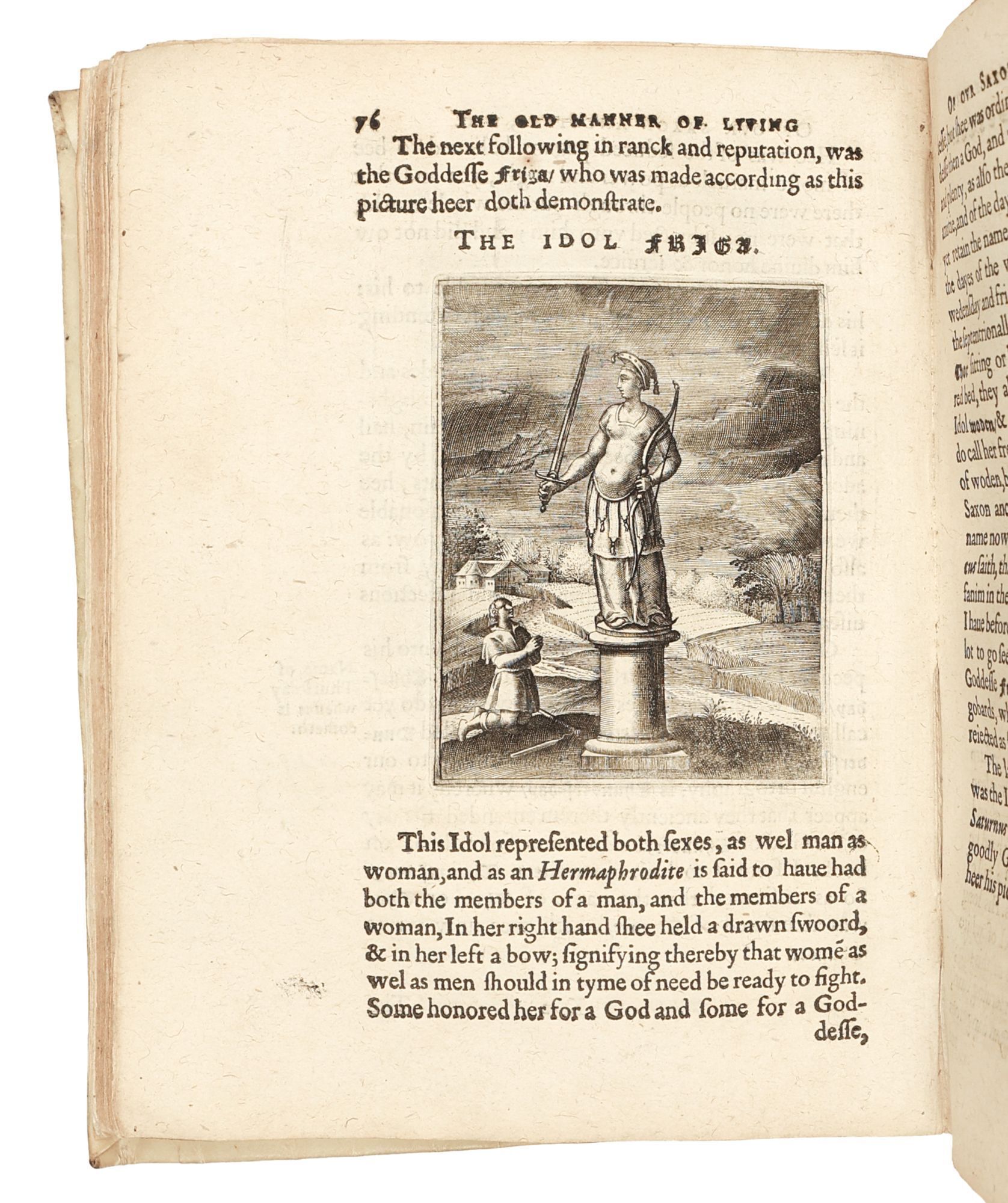
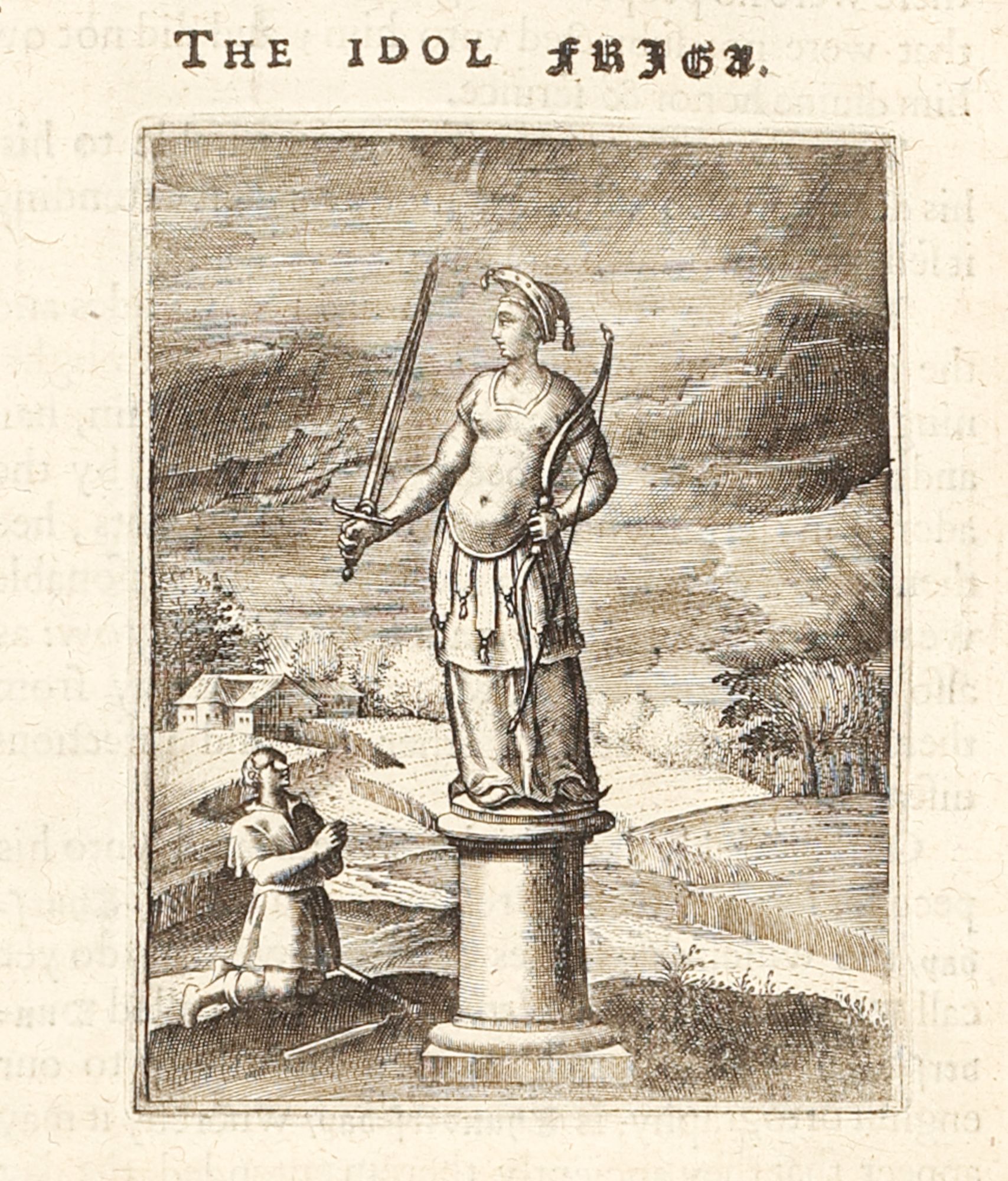
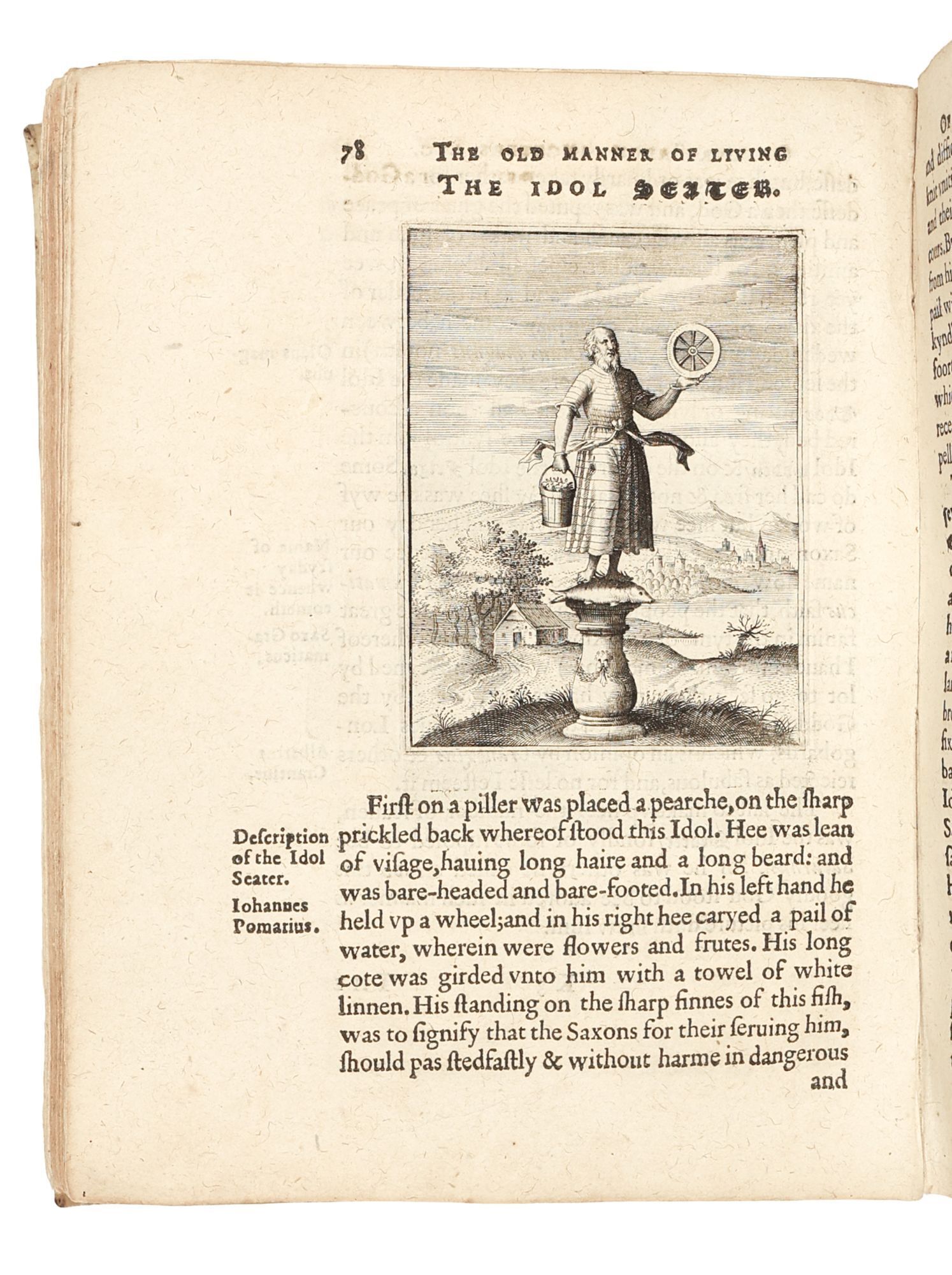
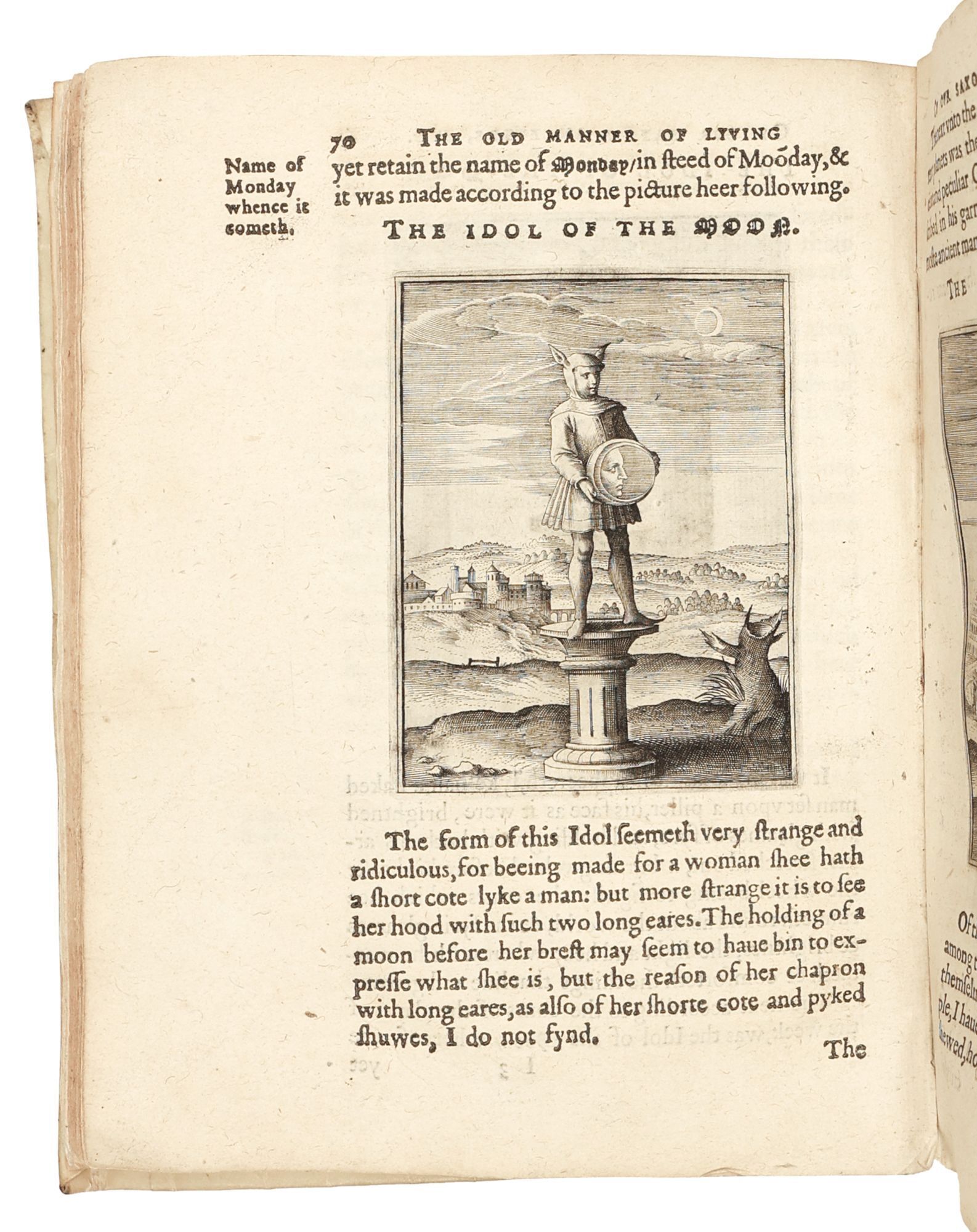
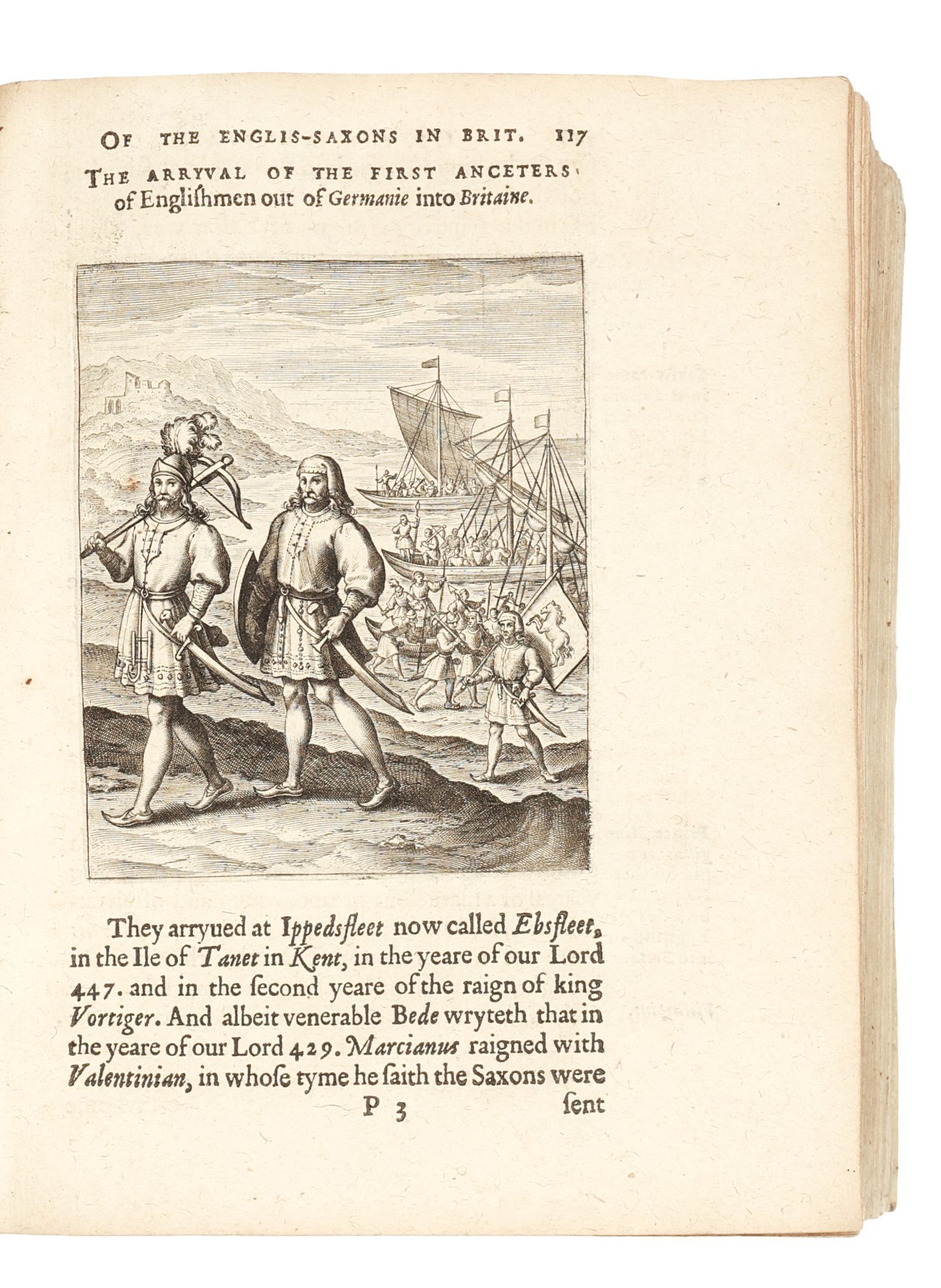
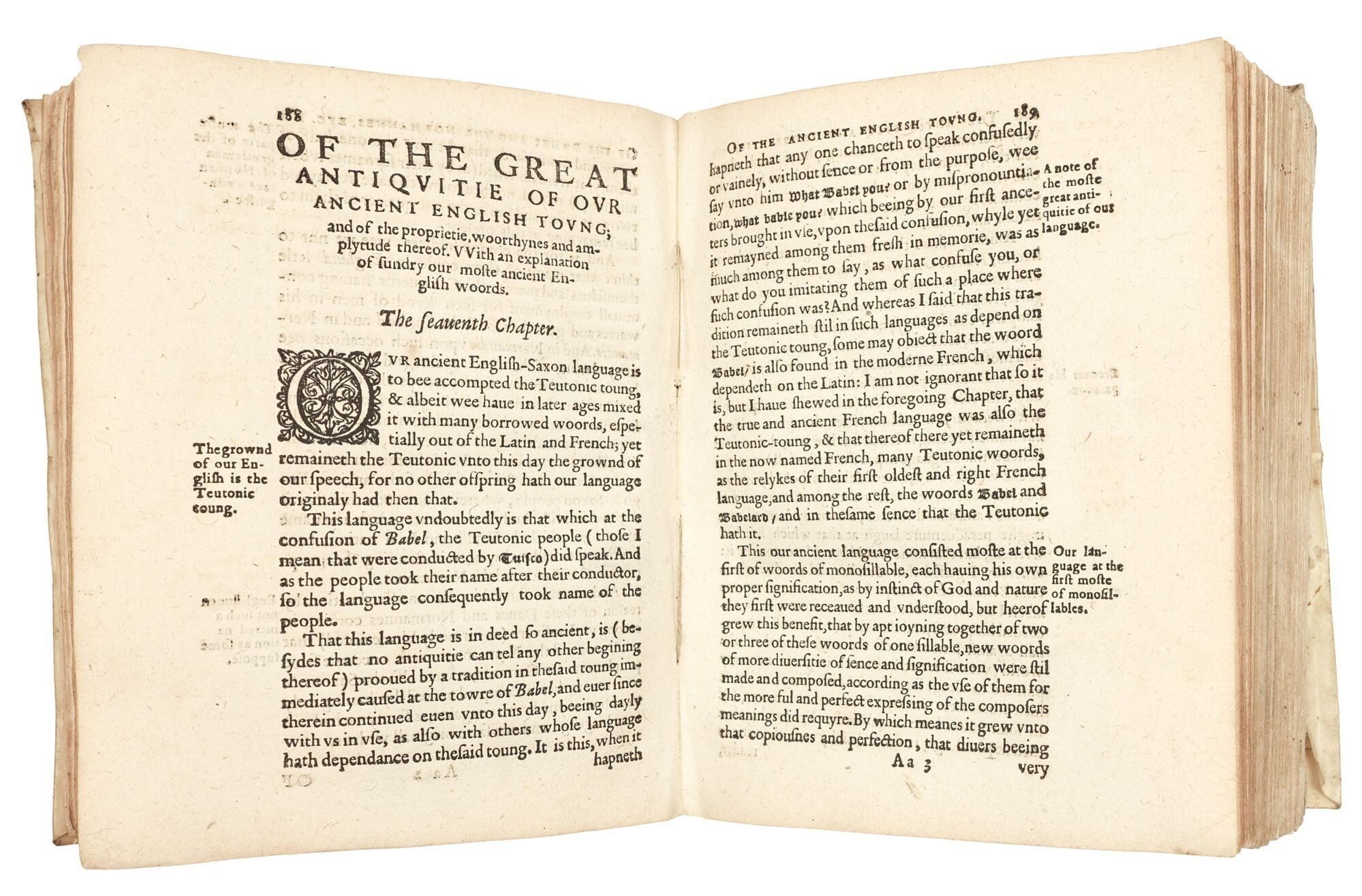
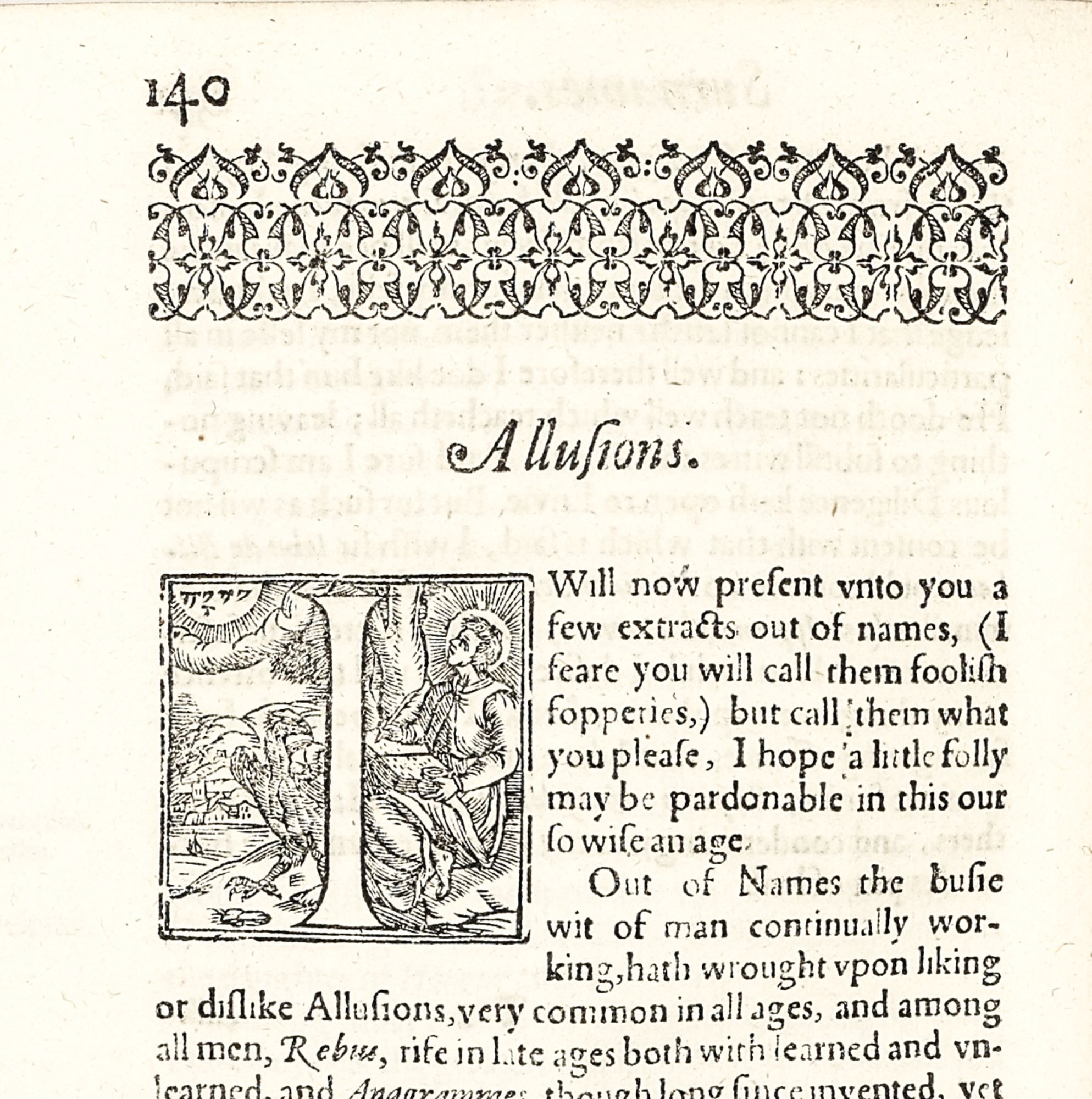
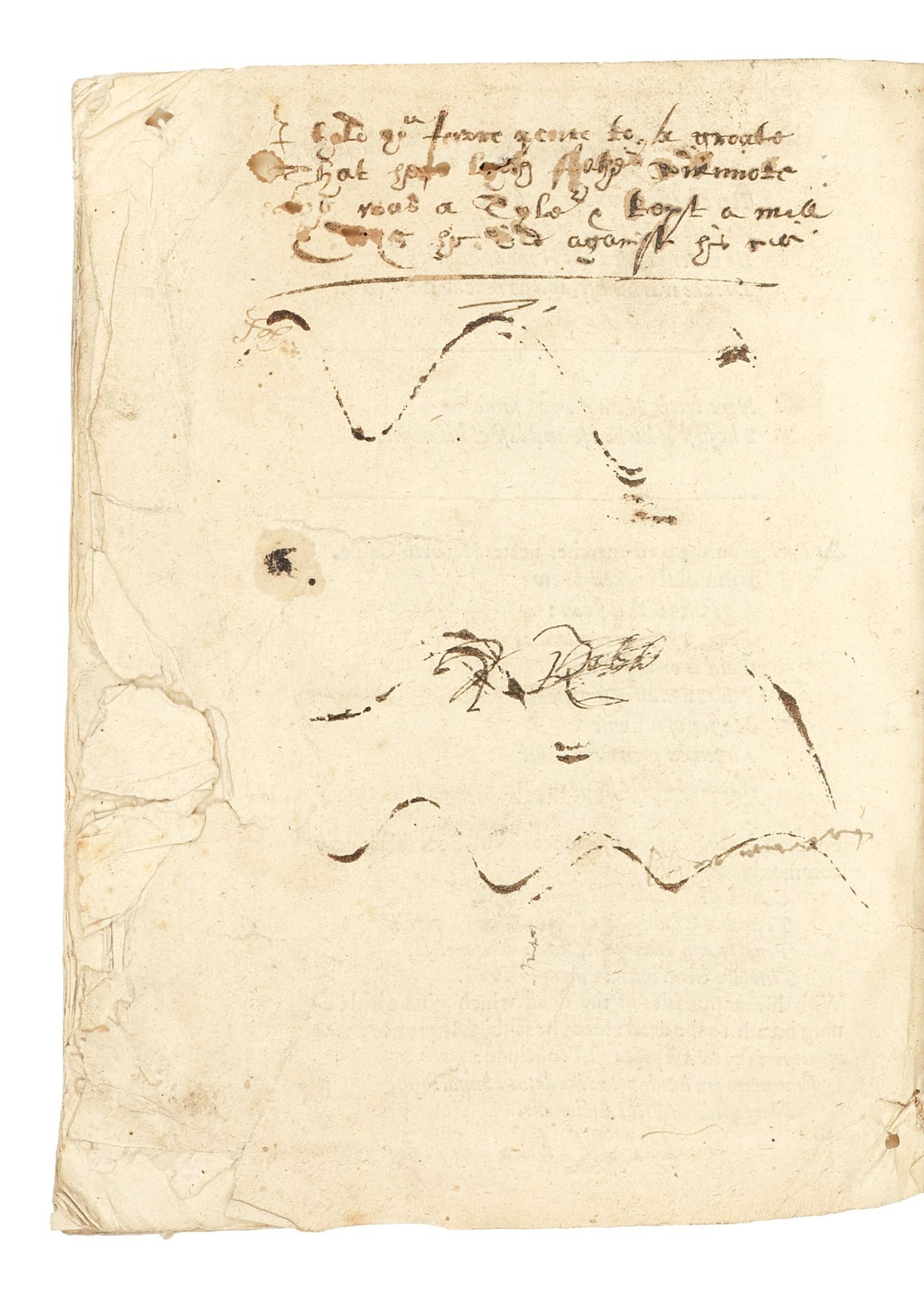
Antwerp: by Robert Bruney, 1605. And to be sold at London in Paules-Churchyeard, by Iohn Norton and Iohn Bill, 1605. FIRST EDITION, bound with the FIRST EDITION of Camden's "Remaines. Hardcover. Fine. The title page, printed in red and black, features an engraved vignette of the Tower of Babel. The text is illustrated with ten engravings by the author, including images of fossils, the Saxons arriving in Britain, the Teutonic Gods, and Ethelbert bringing Christianity to England. Two books bound together in contemporary limp vellum (lightly soiled, with small ink doodles and scuffs, corners bumped. With an early poem from the tomb of Pope Lucius III in original Latin and in English translation, on the inside of the rear cover. Flyleaves renewed. Very fresh copies of both works, though with wear to the first leaf, its fore-edge rumpled and creased, and further wear to the last three leaves, with small holes in the corner of the third to last leaf, tears and rumpled corners to the penultimate leaf, and loss of paper (not affecting the text) to the last leaf. A few marginal paper flaws, a few small rust spots (lvs. Ee1, Vv3, Vv4), a touch of worming in the gutter of gatherings a-e in the first work and a small worm-trail in the gutter of gatherings Aa-Dd in the second, not affecting the text. A few insignificant blemishes. There is a four-line poem in English on the verso of the final leaf (see photo.)
First edition of a seminal work of Anglo-Saxon scholarship, written by Richard Verstegan, printer, intelligencer, recusant sympathizer, and "one of the earliest identifiable newspapermen."(ODNB) The book includes the second-oldest Anglo-Saxon glossary and the first appearance in English of story of The Pied Piper of Hamelin (pp.85-87), ("...this fellow forsooth offred the townsmen for a certain somme of mony to rid the town of all the rattes that were in it (for at that tyme the burgers were with the vermin greatly annoyed....)" The section on the Teutonic gods (the Sun God, Moon God, Tuisco/Tuysco, Wodan, Thor, Friga, and Seater) is partly derived from Olaus Magnus. The engravings, Verstegan's own work, are derived from the same source.
"Richard Rowlands, alias Richard Verstegan (fl. 1565-1620), antiquary, born in the parish of St. Catherine, near the Tower of London, was grandson of Theodore Roland Verstegan, of an ancient Dutch family which was driven from Gelderland to England about 1500. Rowlands, after a good education, was entered at Christ Church, Oxford, in the beginning of 1565. While there, he distinguished himself by his study of early English history, and began to learn Anglo-Saxon. Soon after 1576, Rowlands removed to Antwerp, dropped his English name, and resumed the paternal Verstegan. He set up a printing press, wrote books, and, being an artist of no mean skill, engraved some of the cuts for them himself. He also acted as agent for the transmission of Catholic literature (some of which he printed), and letters to and from England, Spain, Rome, and the Netherlands. He was in frequent correspondence with Cardinal Allen and Robert Parsons, and for a time in their pay."(DNB)
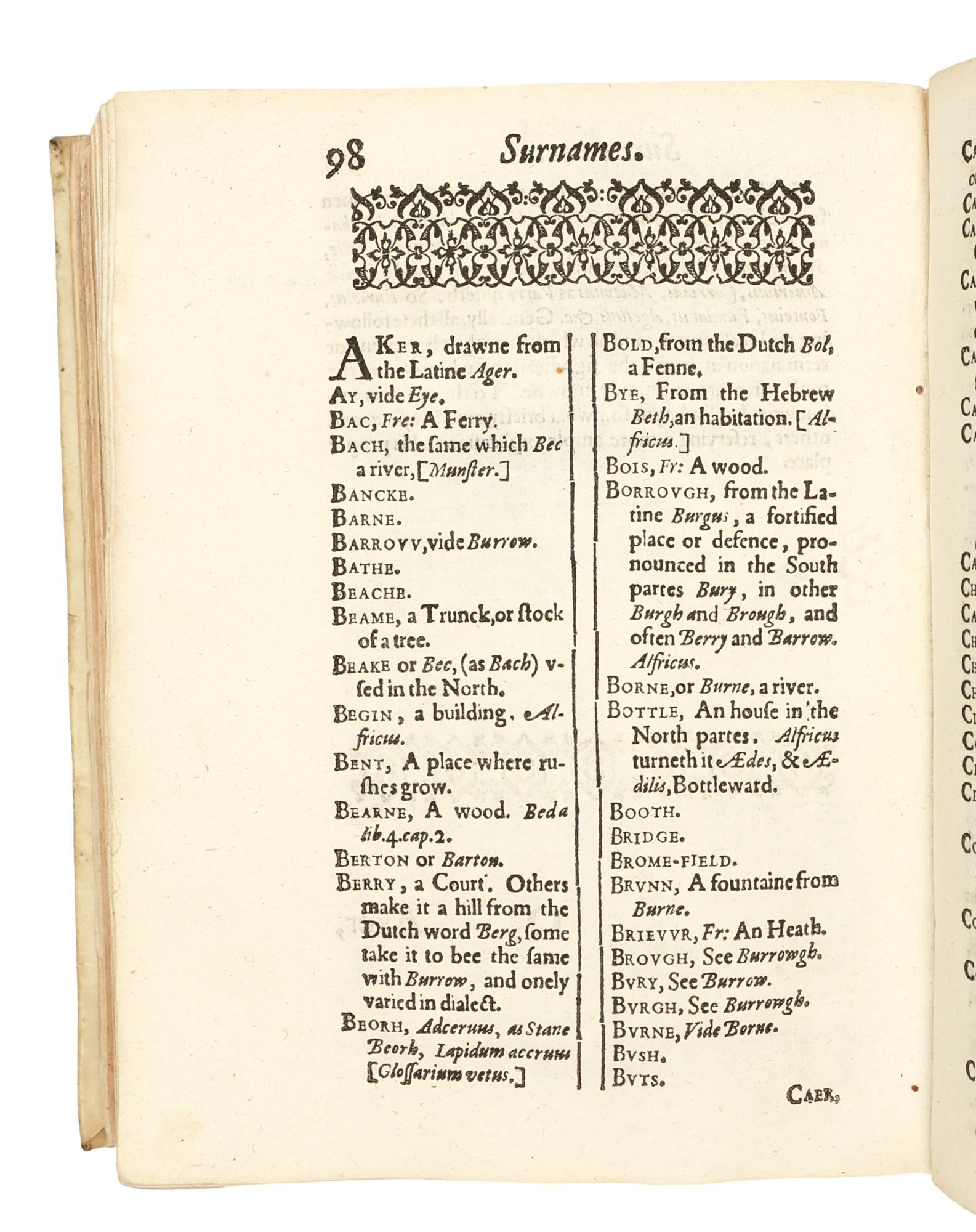
In his "Restitution of Decayed Intelligence in Antiquities concerning the English Nation", Verstegan explores the Germanic origins of the English people -describing the culture, language and customs of the ancient Saxons- and narrates the early invasions of Great Britain by the Germans. A large part of the work is given over to the development of the English language from the Anglo-Saxon tongue. Verstegan has compiled a short dictionary of early Anglo-Saxon words and an alphabetical list of names of Anglo-Saxon origin. The most entertaining part of this linguistic survey is the section "The Etymologies of our English names of Contempt" (Knave, Crone, Shrew etc.)
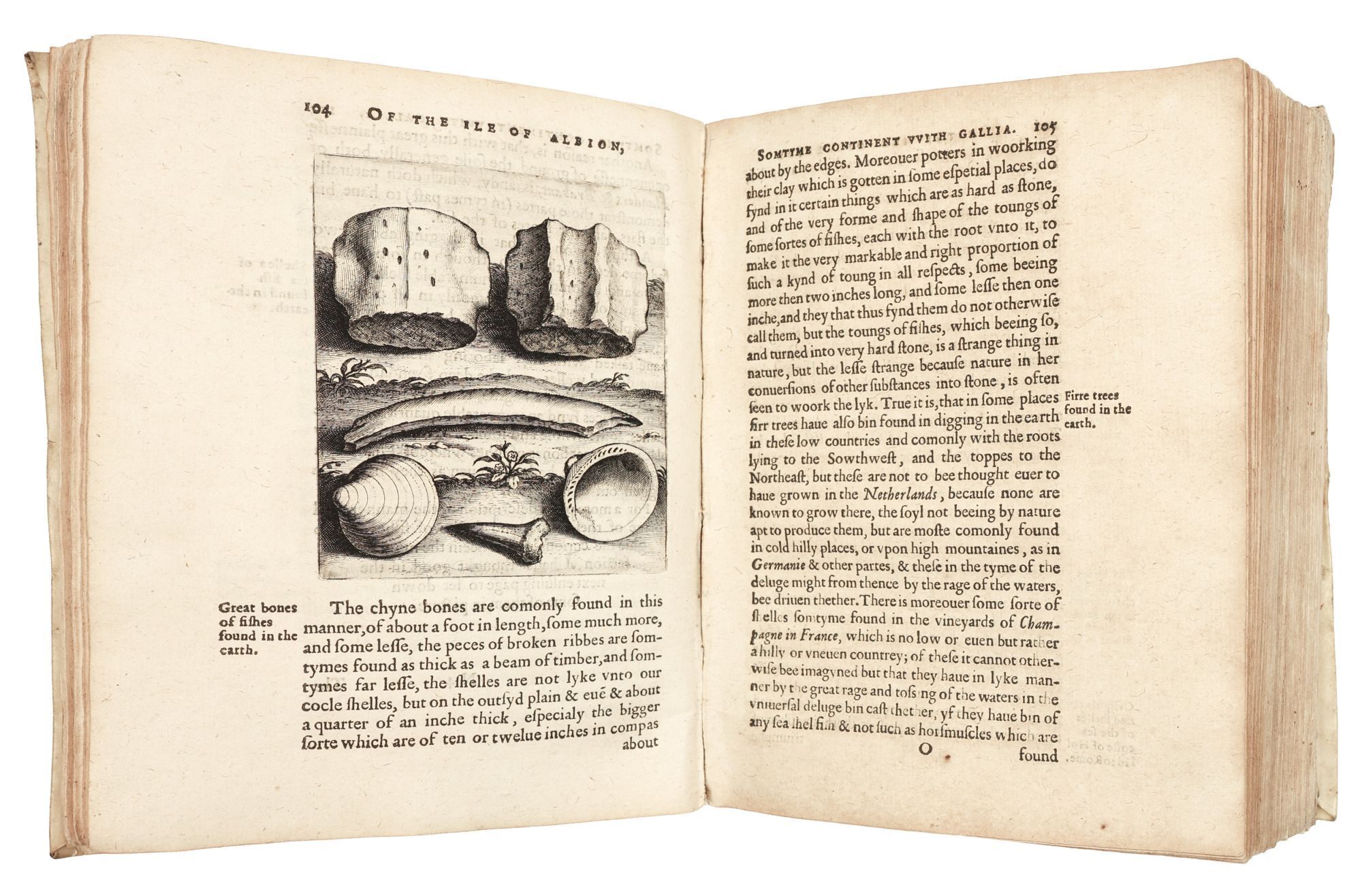
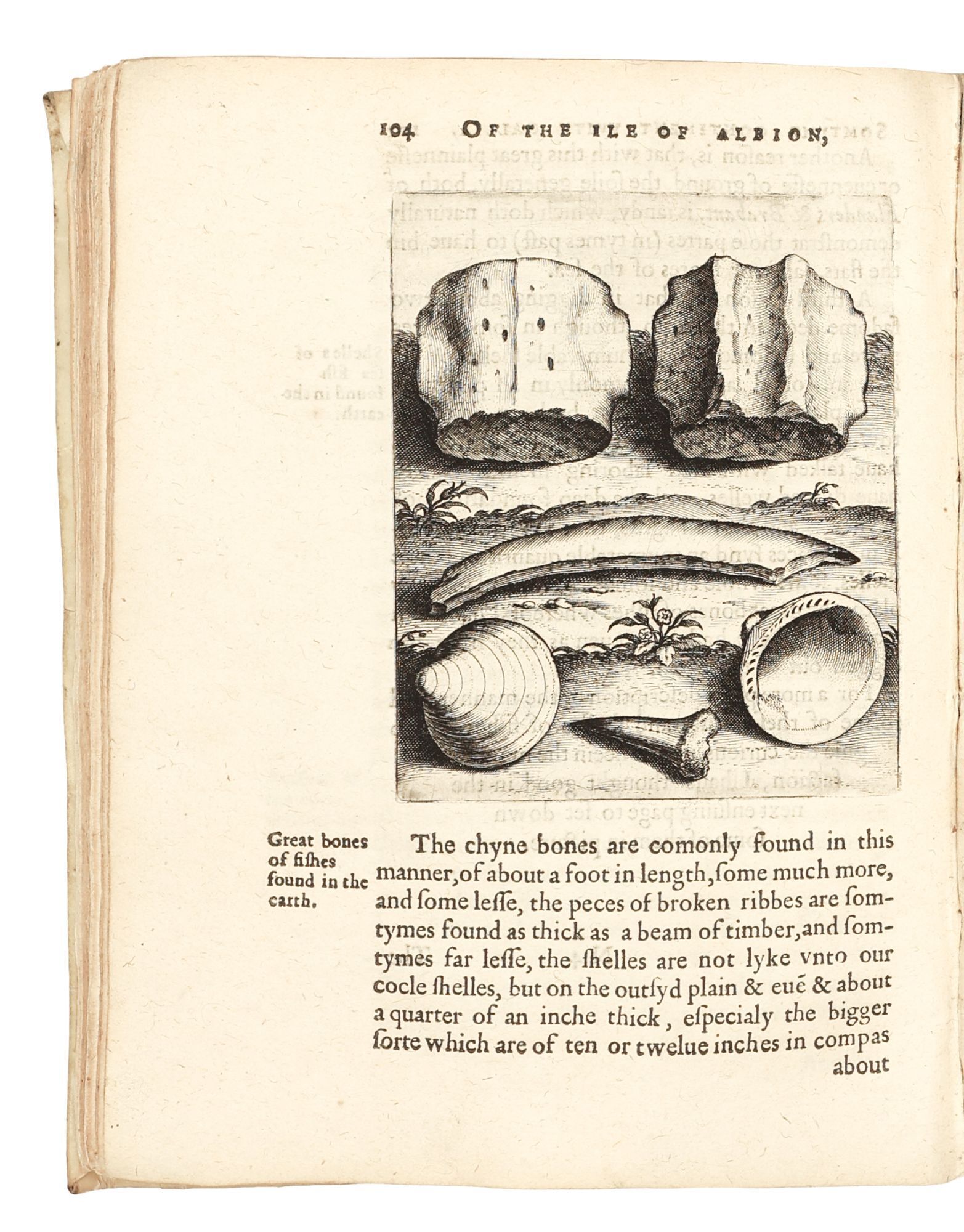
In the fourth chapter, Verstegan examines the topography and geology of England to prove that the British Isles were once attached by dry land to the European mainland. He begins by examining the composition of the facing shorelines of France and England, "both of one substance; that is of chalke and flint, the sides of both towards the sea...". He then draws on evidence from the topography of The Netherlands, which he finds "flat and plain" and undoubtedly recently submerged by the sea, to show that recurrent alterations in sea level are of post-diluvian occurrence. Verstegan also describes, at length and with a fine engraving, the great number of fossils ("the Great Bones of Fishes") found "about two fathoms down" in the soil of The Netherlands. He describes these gigantic bones (curiously turned to stone by nature) in great detail, and also notes fossilized "firre trees...thought never to have grown in The Netherlands", as well as numerous curious shells and the gigantic skull and bones of a "Sea Elephant" found in England in 1561.
"Verstegan offered a convincing theory of the Teutonic origin of the British people, which he buttressed with sensible evidence from Tacitus and other Roman historians, supplemented with philological material astutely used. He also introduced evidence of cultural and religious similarities with the ancient Germanic tribes encountered by the Romans. He acknowledged that his theory of Teutonic settlement lacked the glorious appeal of the far-fetched derivations from Troy or Greece or Scythia, but nonetheless he maintained there was a peculiar virtue in the Nordic line that was every bit as admirable as any Mediterranean inheritance. The repossession of Britain by the Saxons after the Roman occupation was a reinforcement of the old Teutonic strength. Verstegan admired the hardiness and energy of what he called the English Saxons (whom we would term the Anglo-Saxons) in their military and political affairs, just as he admired the spiritual brightness shown by their eager reception of Christianity. Above all, the vigor of the race was characterized by the English language, which overcame the Latin of the Romans and resisted the French of the Normans. A terse, witty, and sinewy language, it expressed the plain forthrightness of the English spirit. Although it showed the scars of its battles with Latin and French, it needed no meretricious ornaments from modern languages, and Verstegan was hostile to any new borrowings from Europe, or neologistic inventions, for 'our tongue is most copious if we please to make our most use thereof.'" (Graham Perry, The Seventeenth Century, The Intellectual and Cultural Context of English Literature, 1603-1700)
Allison & Rogers. Catholic books, 846; ESTC S116255; STC (2nd ed.), 21361
BOUND WITH:
"An ill cook cannot lick his own fingers". Proverbs, Sir Thomas More's witticisms, & The Lord's Prayer in Anglo Saxon
Camden, William (1551-1623)
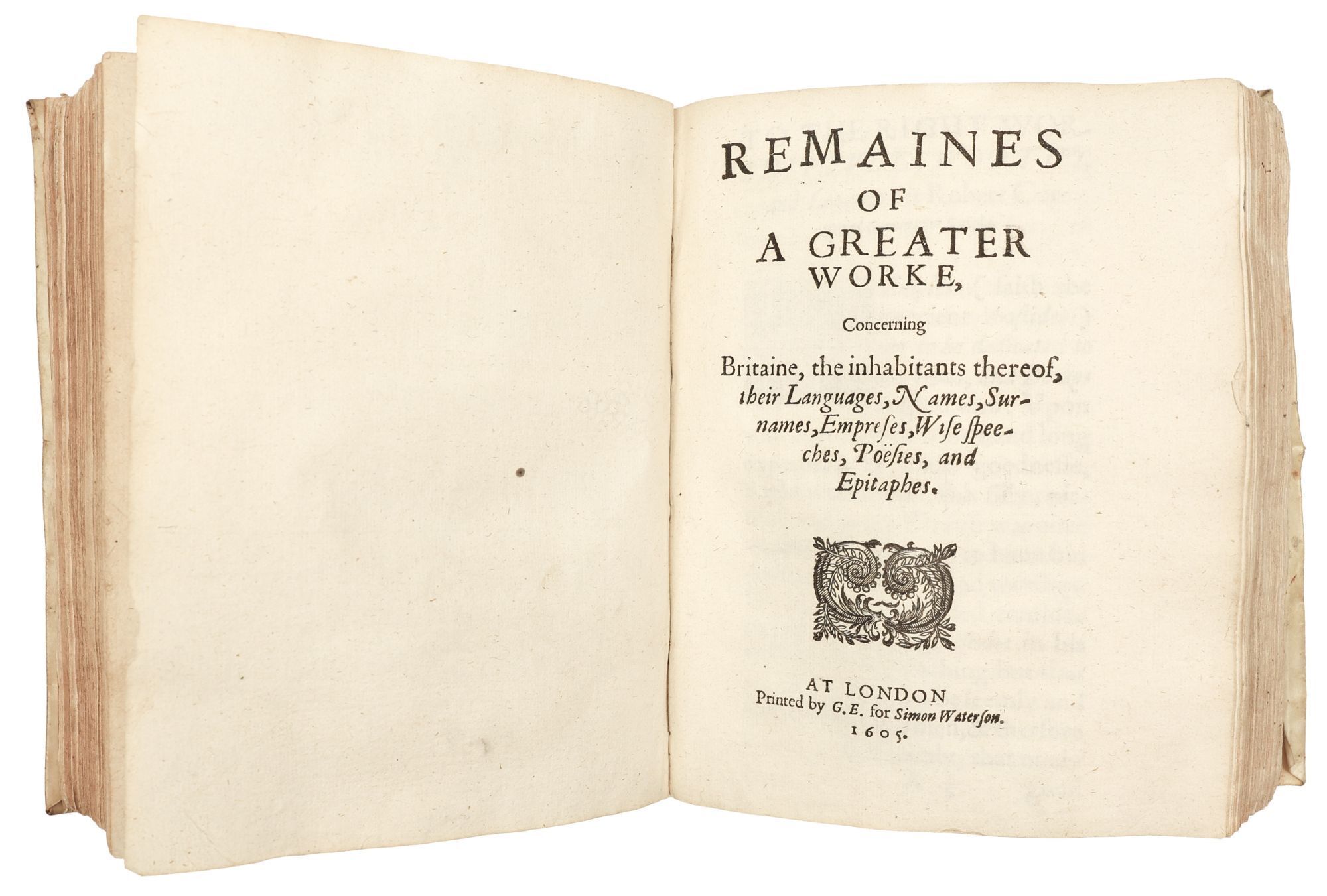
Remaines of a Greater Worke, Concerning Britaine and the Inhabitants Thereof, their Languages, Names, Surnames, Empreses, Wise Speeches, Poesies and Epitaphes.
London: Printed by G.E. for Simon Waterson, 1605
Quarto: 18.5 x 14 cm. [2, blank], [6], 235, [1], 59, [1, blank] pp. A-Z4, Aa-Gg4, Hh2. Blank leaf A1 present. Gathering g of the "Poems" is bound out of order between gatherings d and e.
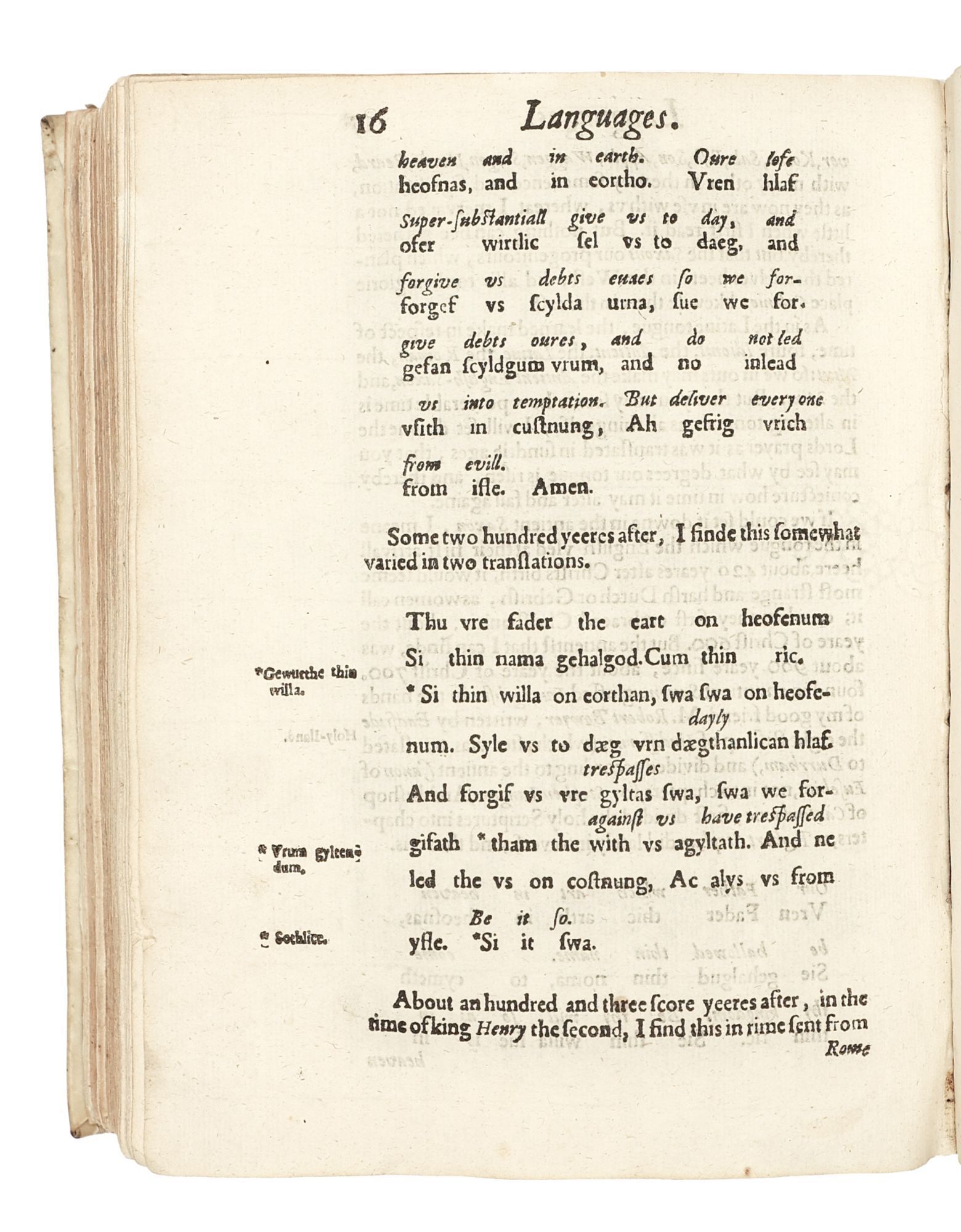
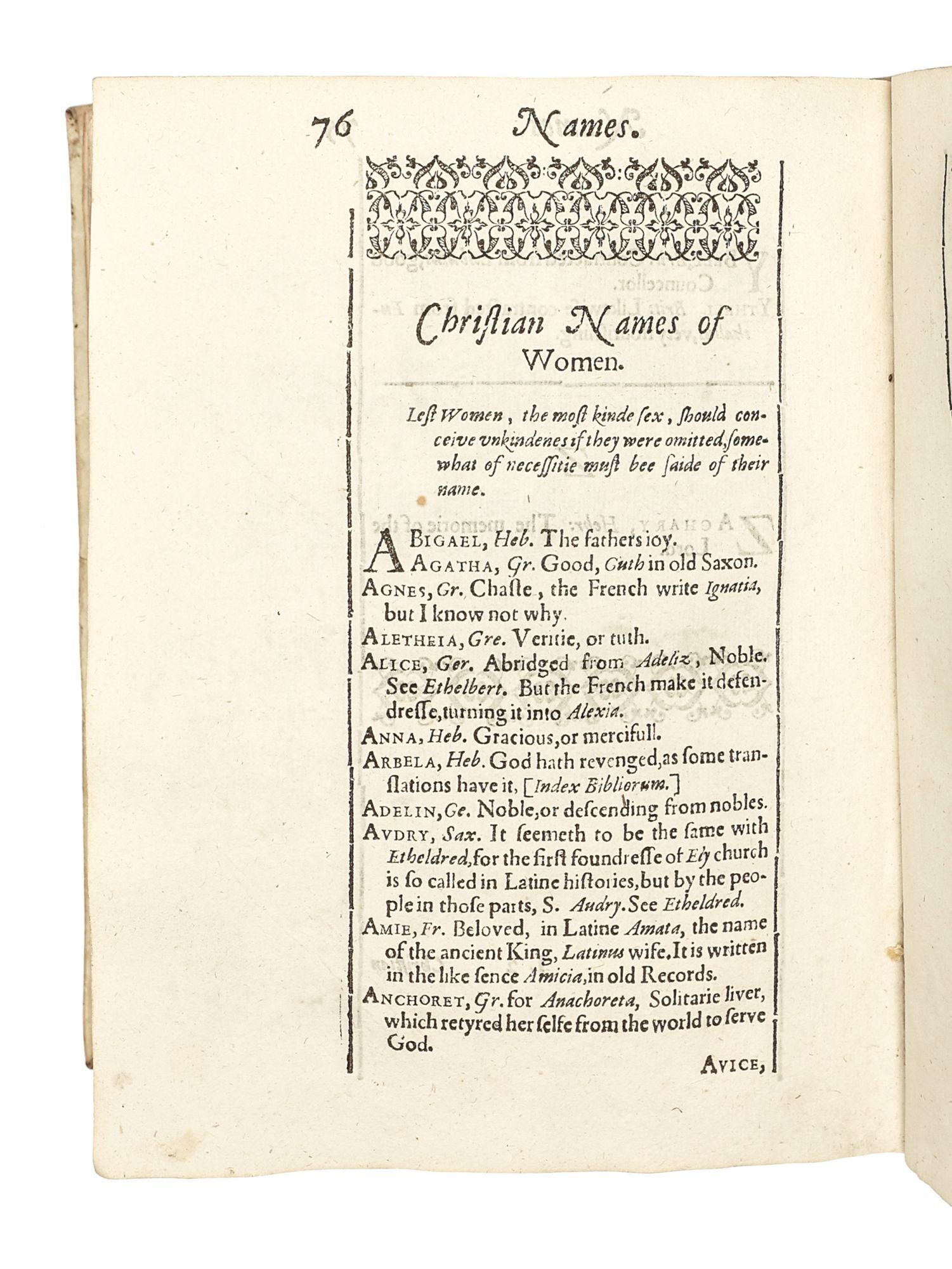
FIRST EDITION. Originally collected by Camden for inclusion in an edition of his "Britannia" that never materialized, the "Remaines" is full of curious riches that cover all manner of topic: descriptions of the climates, topography, and inhabitants of the British Isles; names (of both men and women) and their derivations; the development of the surname; various aspects of language and specific points of dialect; poetry; anagrams; acrostics; and proverbs (of which there are nearly 400 and these are quite delightful). In the chapter on languages, Camden demonstrates the development of English from the Anglo-Saxon tongue by reproducing five renderings of the Lord's Prayer, the first written "about the yeare of Christ 700 found in ancient Saxon glossed Evangelists, written by Eadfride, eighth bishop of Lindisfarne." And the last version "as it is in the translation of Wickeliffe".
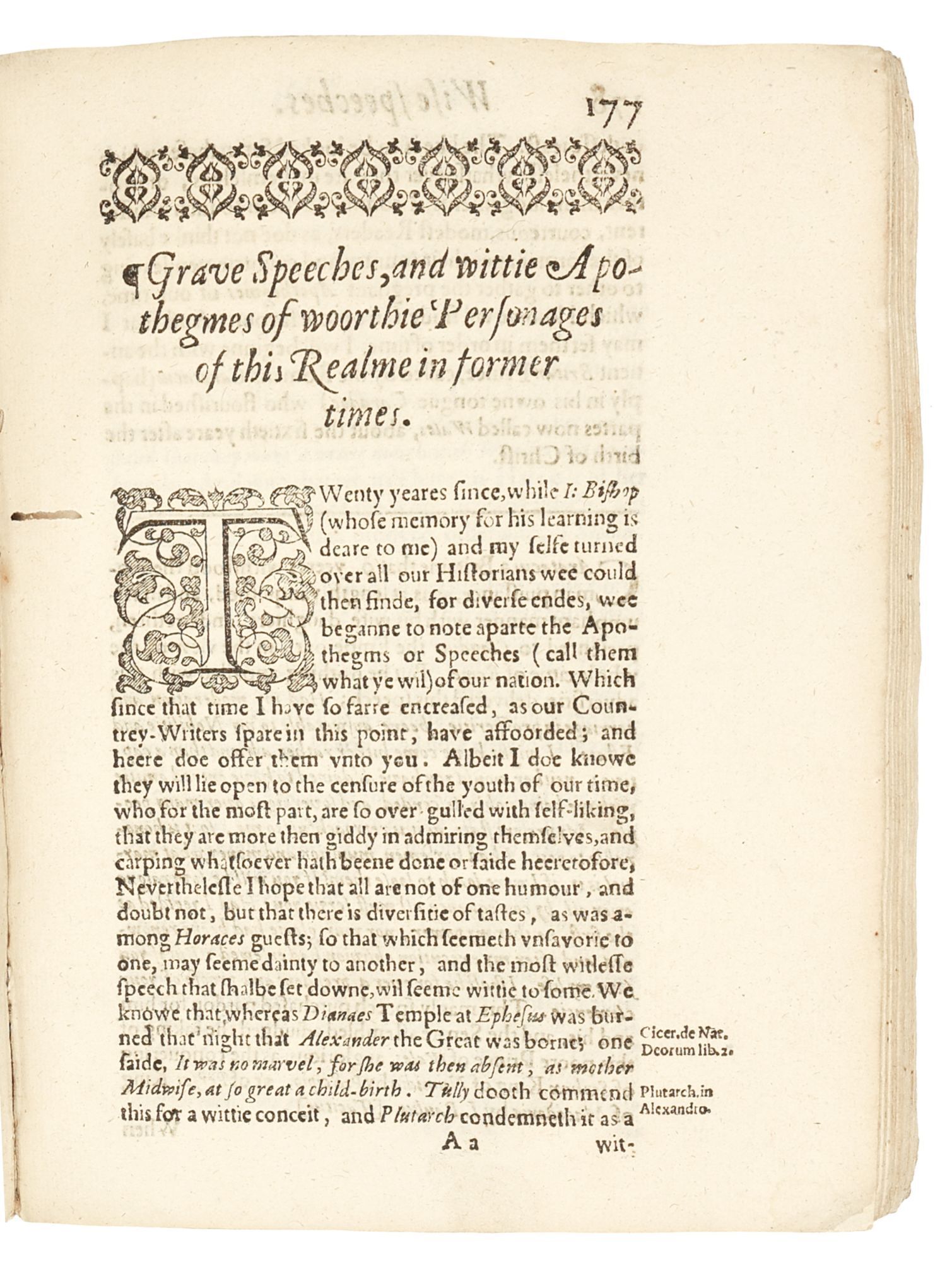
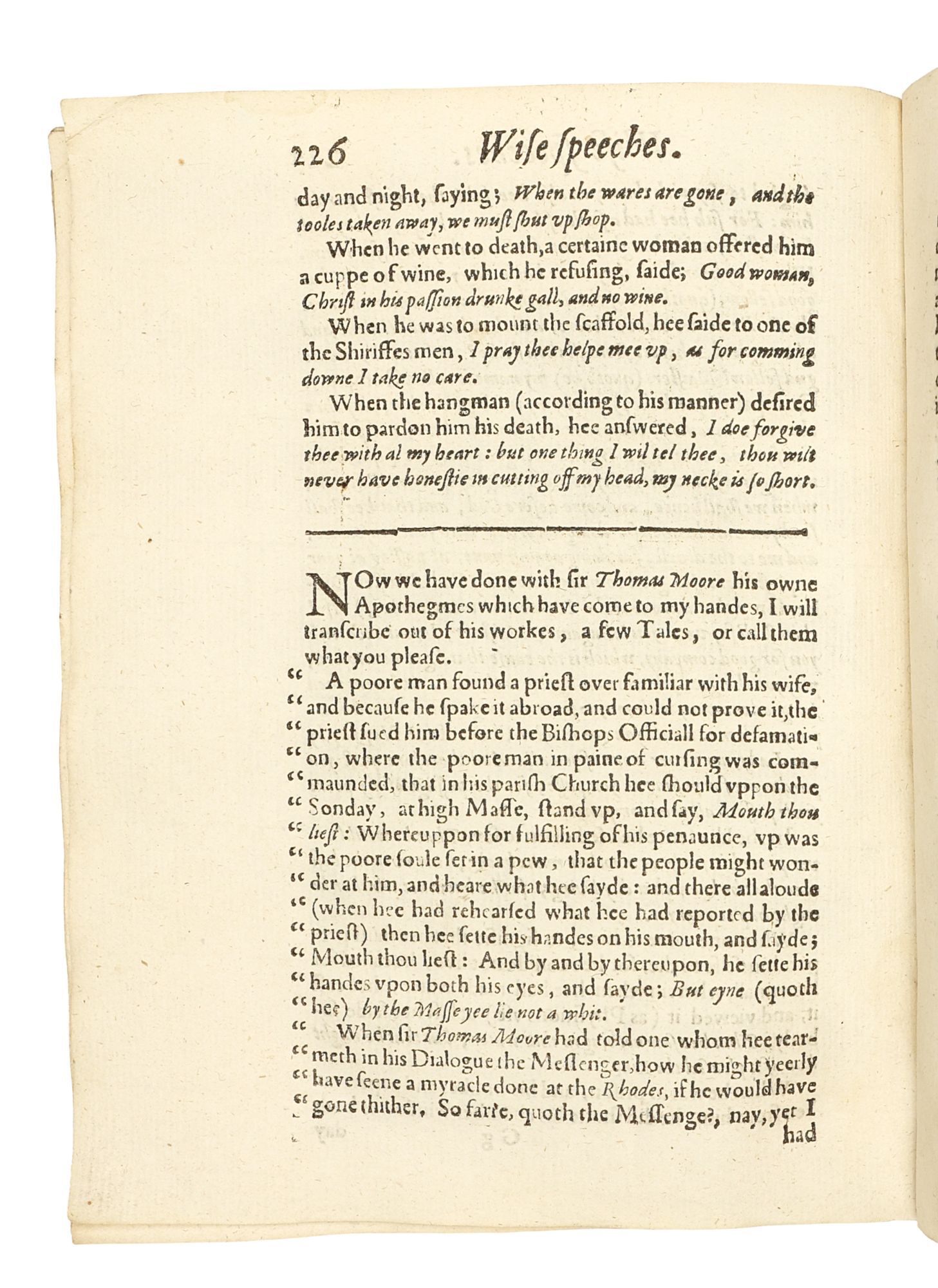
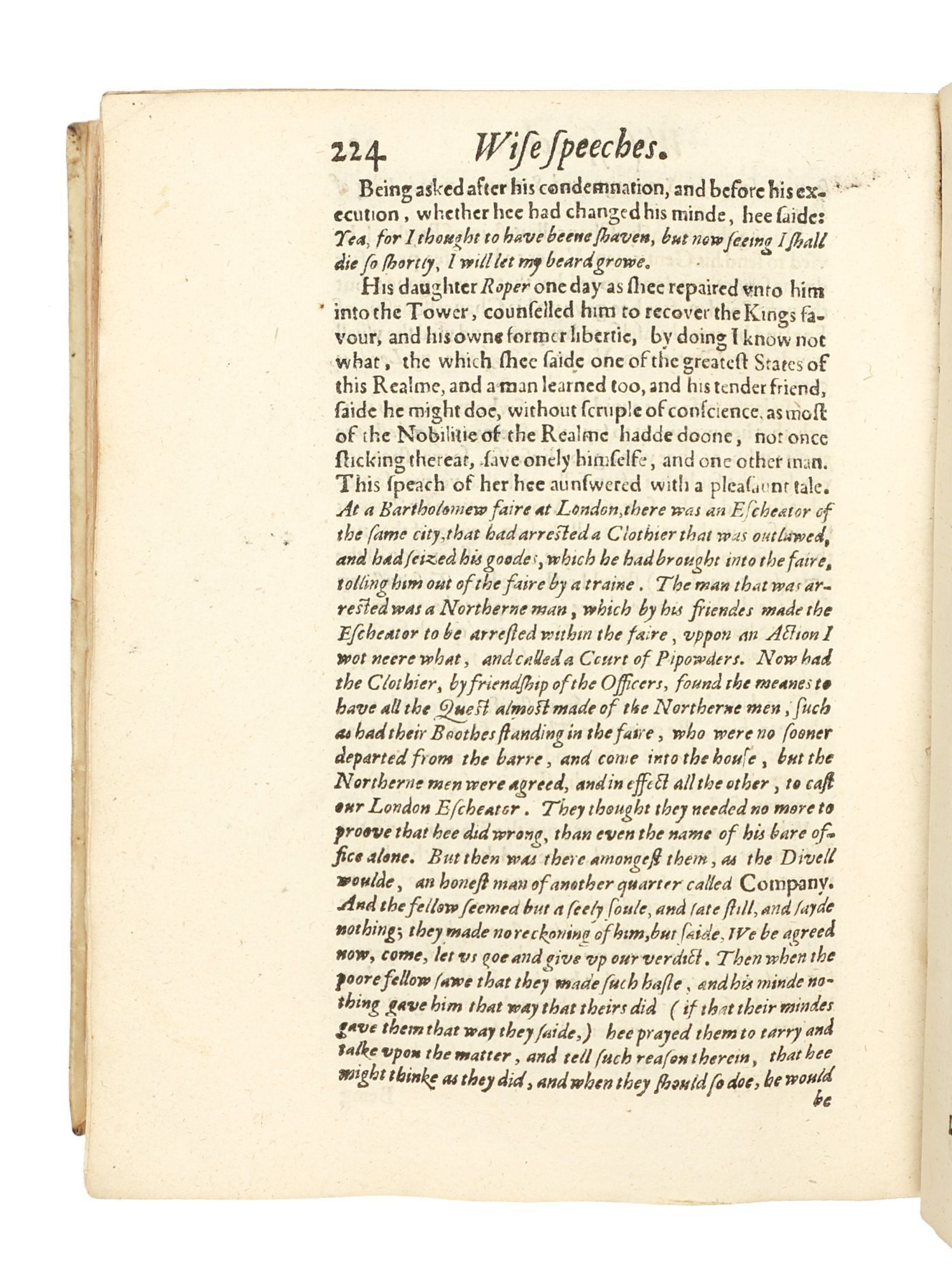
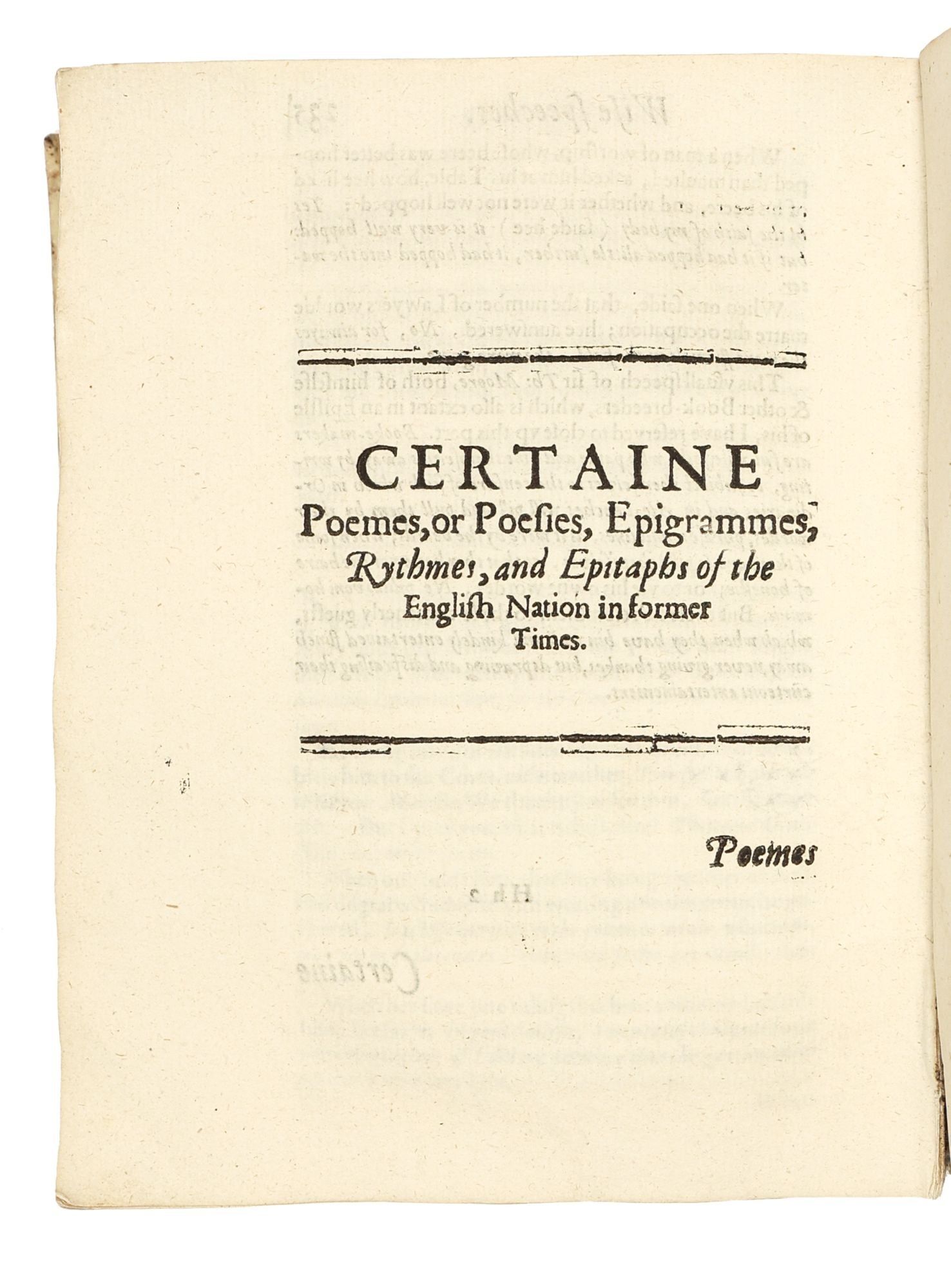
In the chapter "Wise Speeches", we find quotations from such notable figures as William the Conqueror, Richard III, the epigrammist John Heywood, and Sir Thomas More, including the latter's famous remarks on the scaffold. In the section "Poems", Camden names William Shakespeare as one of the great contemporary poets:
"If I would come to our time, what a world could I present to you out of Sir Philipp Sidney, Ed. Spencer, Samuel Daniel, Hugh Holland, Ben Johnson, Th. Campion, Mich. Drayton, George Chapman, John Marston, William Shakespeare, & other most pregnant witts of these our times, whom succeeding ages may justly admire."("Poems", p. 8)
The "Remaines" is also of interest for Camden's description of 136 unillustrated emblems under the heading "imprese", a word that he defines as "a device in a picture with his Motto, or Word, borne by noble and learned personages to notify some particular conceit of their own."
"William Camden has some claim to be considered as the founder, not merely of antiquarian studies, but also of the study of modern history. His name was distinguished in his lifetime, and his work enjoyed a long popularity after his death. It is, however, as the founder of the chair of history at Oxford, still known as the Camden professorship, and the first at any university in the country, that his name is preserved today... If Camden was not the first English historian (in the modern sense of the word), topographer and antiquarian, he was certainly the first to relate the three studies. The long tradition of accurate and coordinated antiquarian study in Great Britain is almost entirely due to Camden."(Printing and the Mind of Man).
First edition of a seminal work of Anglo-Saxon scholarship, written by Richard Verstegan, printer, intelligencer, recusant sympathizer, and "one of the earliest identifiable newspapermen."(ODNB) The book includes the second-oldest Anglo-Saxon glossary and the first appearance in English of story of The Pied Piper of Hamelin (pp.85-87), ("...this fellow forsooth offred the townsmen for a certain somme of mony to rid the town of all the rattes that were in it (for at that tyme the burgers were with the vermin greatly annoyed....)" The section on the Teutonic gods (the Sun God, Moon God, Tuisco/Tuysco, Wodan, Thor, Friga, and Seater) is partly derived from Olaus Magnus. The engravings, Verstegan's own work, are derived from the same source.
"Richard Rowlands, alias Richard Verstegan (fl. 1565-1620), antiquary, born in the parish of St. Catherine, near the Tower of London, was grandson of Theodore Roland Verstegan, of an ancient Dutch family which was driven from Gelderland to England about 1500. Rowlands, after a good education, was entered at Christ Church, Oxford, in the beginning of 1565. While there, he distinguished himself by his study of early English history, and began to learn Anglo-Saxon. Soon after 1576, Rowlands removed to Antwerp, dropped his English name, and resumed the paternal Verstegan. He set up a printing press, wrote books, and, being an artist of no mean skill, engraved some of the cuts for them himself. He also acted as agent for the transmission of Catholic literature (some of which he printed), and letters to and from England, Spain, Rome, and the Netherlands. He was in frequent correspondence with Cardinal Allen and Robert Parsons, and for a time in their pay."(DNB)
In his "Restitution of Decayed Intelligence in Antiquities concerning the English Nation", Verstegan explores the Germanic origins of the English people -describing the culture, language and customs of the ancient Saxons- and narrates the early invasions of Great Britain by the Germans. A large part of the work is given over to the development of the English language from the Anglo-Saxon tongue. Verstegan has compiled a short dictionary of early Anglo-Saxon words and an alphabetical list of names of Anglo-Saxon origin. The most entertaining part of this linguistic survey is the section "The Etymologies of our English names of Contempt" (Knave, Crone, Shrew etc.)
In the fourth chapter, Verstegan examines the topography and geology of England to prove that the British Isles were once attached by dry land to the European mainland. He begins by examining the composition of the facing shorelines of France and England, "both of one substance; that is of chalke and flint, the sides of both towards the sea...". He then draws on evidence from the topography of The Netherlands, which he finds "flat and plain" and undoubtedly recently submerged by the sea, to show that recurrent alterations in sea level are of post-diluvian occurrence. Verstegan also describes, at length and with a fine engraving, the great number of fossils ("the Great Bones of Fishes") found "about two fathoms down" in the soil of The Netherlands. He describes these gigantic bones (curiously turned to stone by nature) in great detail, and also notes fossilized "firre trees...thought never to have grown in The Netherlands", as well as numerous curious shells and the gigantic skull and bones of a "Sea Elephant" found in England in 1561.
"Verstegan offered a convincing theory of the Teutonic origin of the British people, which he buttressed with sensible evidence from Tacitus and other Roman historians, supplemented with philological material astutely used. He also introduced evidence of cultural and religious similarities with the ancient Germanic tribes encountered by the Romans. He acknowledged that his theory of Teutonic settlement lacked the glorious appeal of the far-fetched derivations from Troy or Greece or Scythia, but nonetheless he maintained there was a peculiar virtue in the Nordic line that was every bit as admirable as any Mediterranean inheritance. The repossession of Britain by the Saxons after the Roman occupation was a reinforcement of the old Teutonic strength. Verstegan admired the hardiness and energy of what he called the English Saxons (whom we would term the Anglo-Saxons) in their military and political affairs, just as he admired the spiritual brightness shown by their eager reception of Christianity. Above all, the vigor of the race was characterized by the English language, which overcame the Latin of the Romans and resisted the French of the Normans. A terse, witty, and sinewy language, it expressed the plain forthrightness of the English spirit. Although it showed the scars of its battles with Latin and French, it needed no meretricious ornaments from modern languages, and Verstegan was hostile to any new borrowings from Europe, or neologistic inventions, for 'our tongue is most copious if we please to make our most use thereof.'" (Graham Perry, The Seventeenth Century, The Intellectual and Cultural Context of English Literature, 1603-1700)
Allison & Rogers. Catholic books, 846; ESTC S116255; STC (2nd ed.), 21361
BOUND WITH:
"An ill cook cannot lick his own fingers". Proverbs, Sir Thomas More's witticisms, & The Lord's Prayer in Anglo Saxon
Camden, William (1551-1623)
Remaines of a Greater Worke, Concerning Britaine and the Inhabitants Thereof, their Languages, Names, Surnames, Empreses, Wise Speeches, Poesies and Epitaphes.
London: Printed by G.E. for Simon Waterson, 1605
Quarto: 18.5 x 14 cm. [2, blank], [6], 235, [1], 59, [1, blank] pp. A-Z4, Aa-Gg4, Hh2. Blank leaf A1 present. Gathering g of the "Poems" is bound out of order between gatherings d and e.
FIRST EDITION. Originally collected by Camden for inclusion in an edition of his "Britannia" that never materialized, the "Remaines" is full of curious riches that cover all manner of topic: descriptions of the climates, topography, and inhabitants of the British Isles; names (of both men and women) and their derivations; the development of the surname; various aspects of language and specific points of dialect; poetry; anagrams; acrostics; and proverbs (of which there are nearly 400 and these are quite delightful). In the chapter on languages, Camden demonstrates the development of English from the Anglo-Saxon tongue by reproducing five renderings of the Lord's Prayer, the first written "about the yeare of Christ 700 found in ancient Saxon glossed Evangelists, written by Eadfride, eighth bishop of Lindisfarne." And the last version "as it is in the translation of Wickeliffe".
In the chapter "Wise Speeches", we find quotations from such notable figures as William the Conqueror, Richard III, the epigrammist John Heywood, and Sir Thomas More, including the latter's famous remarks on the scaffold. In the section "Poems", Camden names William Shakespeare as one of the great contemporary poets:
"If I would come to our time, what a world could I present to you out of Sir Philipp Sidney, Ed. Spencer, Samuel Daniel, Hugh Holland, Ben Johnson, Th. Campion, Mich. Drayton, George Chapman, John Marston, William Shakespeare, & other most pregnant witts of these our times, whom succeeding ages may justly admire."("Poems", p. 8)
The "Remaines" is also of interest for Camden's description of 136 unillustrated emblems under the heading "imprese", a word that he defines as "a device in a picture with his Motto, or Word, borne by noble and learned personages to notify some particular conceit of their own."
"William Camden has some claim to be considered as the founder, not merely of antiquarian studies, but also of the study of modern history. His name was distinguished in his lifetime, and his work enjoyed a long popularity after his death. It is, however, as the founder of the chair of history at Oxford, still known as the Camden professorship, and the first at any university in the country, that his name is preserved today... If Camden was not the first English historian (in the modern sense of the word), topographer and antiquarian, he was certainly the first to relate the three studies. The long tradition of accurate and coordinated antiquarian study in Great Britain is almost entirely due to Camden."(Printing and the Mind of Man).
Details
Title
A restitvtion of decayed intelligence: in antiquities. Concerning the most noble and renovvmed English nation. By the studie and trauaile of R.V. Dedicated vnto the Kings most excellent Maiestie
Author
Rowlands, Richard [alias Richard Verstegan] (fl. 1565-1620)
Binding
Hardcover
Condition
Fine
Publisher
by Robert Bruney, 1605. And to be sold at London in Paules-Churchyeard, by Iohn Norton and Iohn Bill: Antwerp
Date
1605
Edition
FIRST EDITION, bound with the FIRST EDITION of Camden's "Remaine