

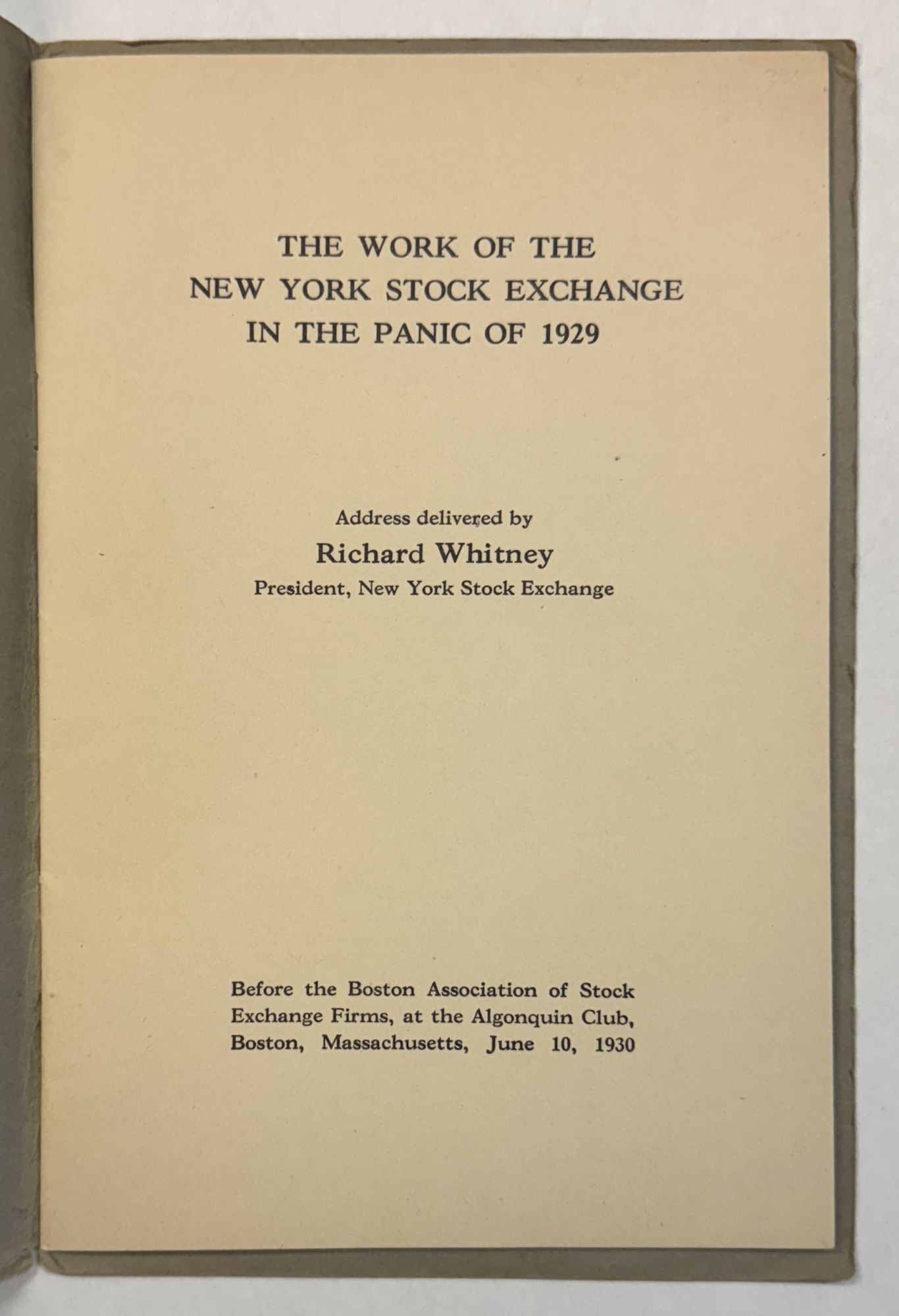
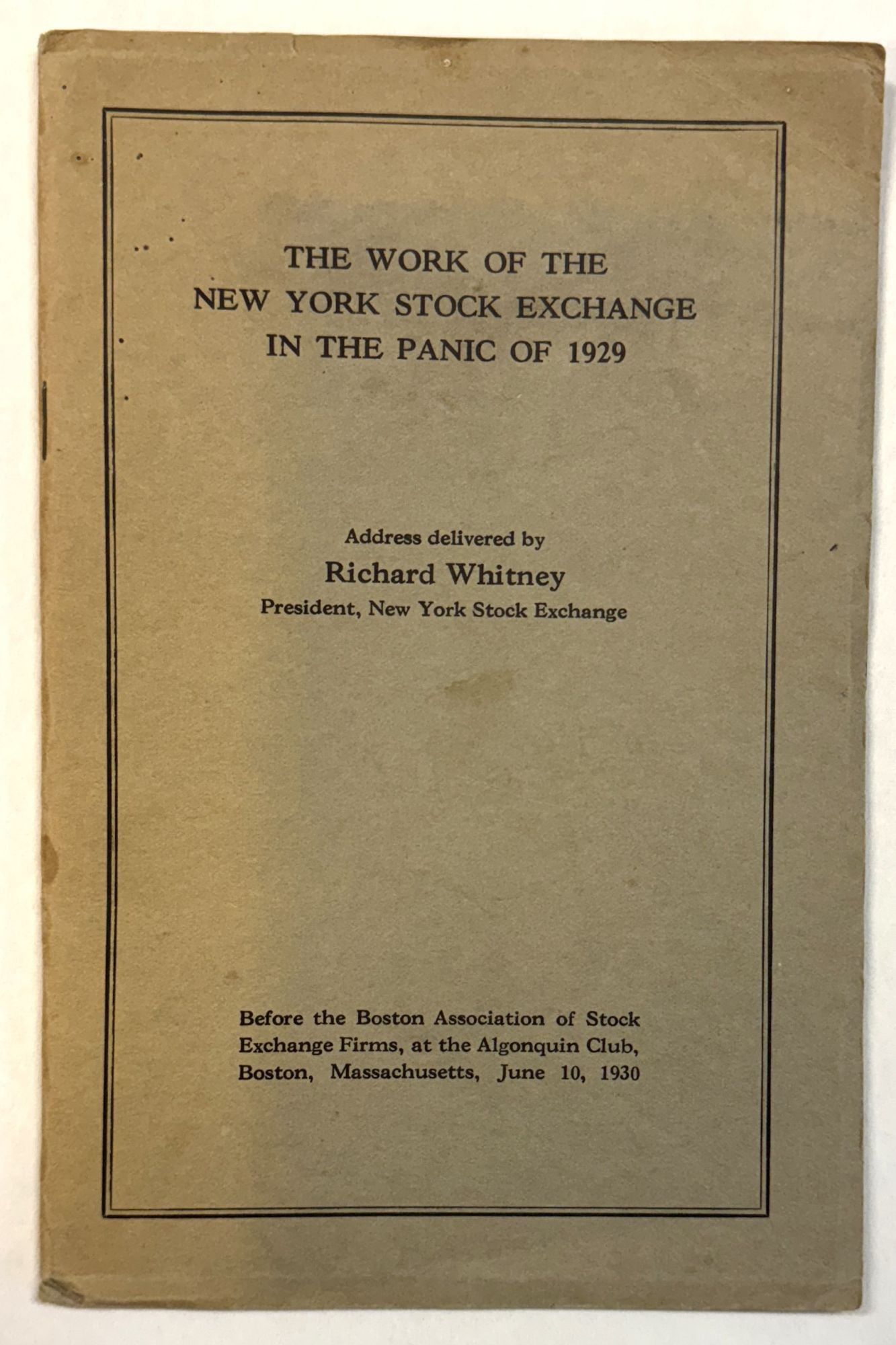
THE WORK OF THE NEW YORK STOCK EXCHANGE IN THE PANIC OF 1929. ADDRESS DELIVERED BY RICHARD WHITNEY, PRESIDENT, NEW YORK STOCK EXCHANGE. BEFORE THE BOSTON ASSOCIATION OF STOCK EXCHANGE FIRMS AT THE ALGONQUIN CLUB, BOSTON, MASSACHUSETTS, JUNE 10, 1930
- [Boston, MA , 1930
[Boston, MA, 1930. 29, [3 blank] pp. Original gray printed wrappers [minimal sunning and wear], two staples. Text clean. Near Fine.
Whitney explains, "I intend to confine my remarks wholly to the past, in describing certain episodes of the panic as they appeared at the time to the administration of the New York Stock Exchange . . . The volume of trading on the Exchange was active, but not at all out of hand. The downward trend of stock prices was gradual and several time interrupted by brisk rallies. Many people at the time complacently characterized this lower drift of prices as 'a healthy reaction' or 'a creeping bear market' . . . Everyone then realized the panic was on and that we must be ready for any emergency. . . When panic occurs, there is a sharp disillusionment of society as a whole, and a temporary absence of those customary assumptions upon the basis of which normal life proceeds. All at once, the inconceivable terrors of the unknown and the unfamiliar are thrust upon the public mind; confidence is paralyzed and until it is restored, chaos reigns." [pp.3-4]
Financier Richard Whitney [1888-1974] was Vice President of the New York Stock Exchange when the market crashed in October, 1929. Initially credited with halting the crash, he was quickly named became President of the Exchange. He gave a series of Addresses explaining the crash and defending the responses of his colleagues. This early Address examines the market effects of emotional upheaval, and the steps taken by bankers and other market players to stem the tide. .
Whitney's reputation came crashing down. He was imprisoned in 1938 for embezzlement. His New York Times obituary explains that Whitney, "unknown to all his admirers, was a miserably poor manager of his own financial affairs, and as he fell deeper and deeper into debt, he descended into thievery to cover himself. In 1938, exposed as the embezzler of funds entrusted to him by the stock exchange and the New York Yacht Club, of which he was treasurer, as well as misappropriating funds from his father-in-law's estate, the one-time hero of Wall Street was sent to Sing Sing Prison" [Richard Whitney, 86, Dies; Headed Stock Exchange" by Albin Krebs, The New York Times, 12/06/1974].
Whitney explains, "I intend to confine my remarks wholly to the past, in describing certain episodes of the panic as they appeared at the time to the administration of the New York Stock Exchange . . . The volume of trading on the Exchange was active, but not at all out of hand. The downward trend of stock prices was gradual and several time interrupted by brisk rallies. Many people at the time complacently characterized this lower drift of prices as 'a healthy reaction' or 'a creeping bear market' . . . Everyone then realized the panic was on and that we must be ready for any emergency. . . When panic occurs, there is a sharp disillusionment of society as a whole, and a temporary absence of those customary assumptions upon the basis of which normal life proceeds. All at once, the inconceivable terrors of the unknown and the unfamiliar are thrust upon the public mind; confidence is paralyzed and until it is restored, chaos reigns." [pp.3-4]
Financier Richard Whitney [1888-1974] was Vice President of the New York Stock Exchange when the market crashed in October, 1929. Initially credited with halting the crash, he was quickly named became President of the Exchange. He gave a series of Addresses explaining the crash and defending the responses of his colleagues. This early Address examines the market effects of emotional upheaval, and the steps taken by bankers and other market players to stem the tide. .
Whitney's reputation came crashing down. He was imprisoned in 1938 for embezzlement. His New York Times obituary explains that Whitney, "unknown to all his admirers, was a miserably poor manager of his own financial affairs, and as he fell deeper and deeper into debt, he descended into thievery to cover himself. In 1938, exposed as the embezzler of funds entrusted to him by the stock exchange and the New York Yacht Club, of which he was treasurer, as well as misappropriating funds from his father-in-law's estate, the one-time hero of Wall Street was sent to Sing Sing Prison" [Richard Whitney, 86, Dies; Headed Stock Exchange" by Albin Krebs, The New York Times, 12/06/1974].
Details
Title
THE WORK OF THE NEW YORK STOCK EXCHANGE IN THE PANIC OF 1929. ADDRESS DELIVERED BY RICHARD WHITNEY, PRESIDENT, NEW YORK STOCK EXCHANGE. BEFORE THE BOSTON ASSOCIATION OF STOCK EXCHANGE FIRMS AT THE ALGONQUIN CLUB, BOSTON, MASSACHUSETTS, JUNE 10, 1930
Author
Whitney, Richard
Condition
Unknown
Publisher
[Boston, MA
Date
1930