

SNCC Speaks for Itself: 1. The Basis of Black Power 2. Interview with Stokely Carmichael 3. Statement by Stokely Carmichael
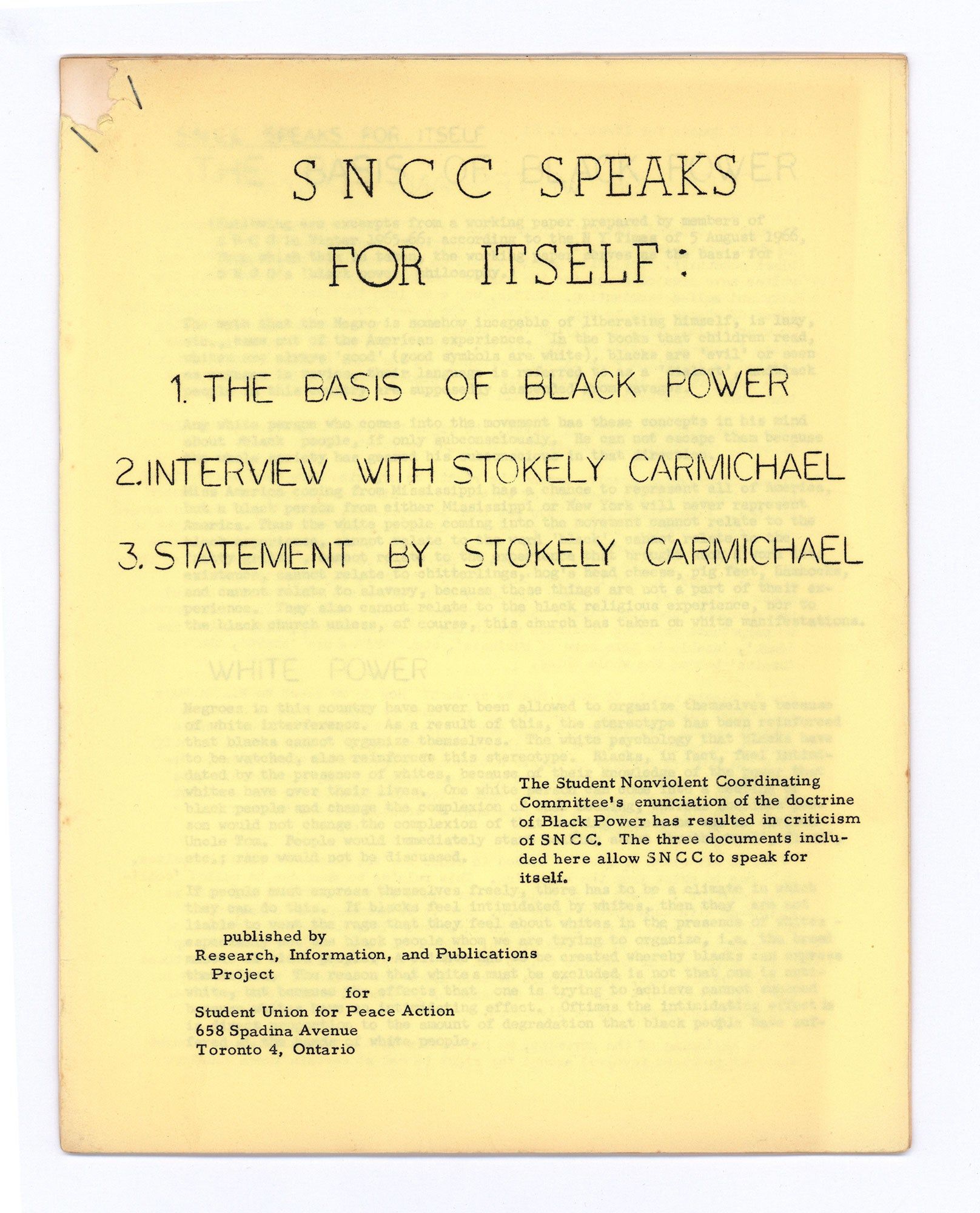
- Toronto, Ontario: Research, Information, and Publications Project for Student Union for Peace Action, [1966]
A Canadian edition of this compendium of SNCC statements and an interview with its president, Stokely Carmichael, first published in the U.S.
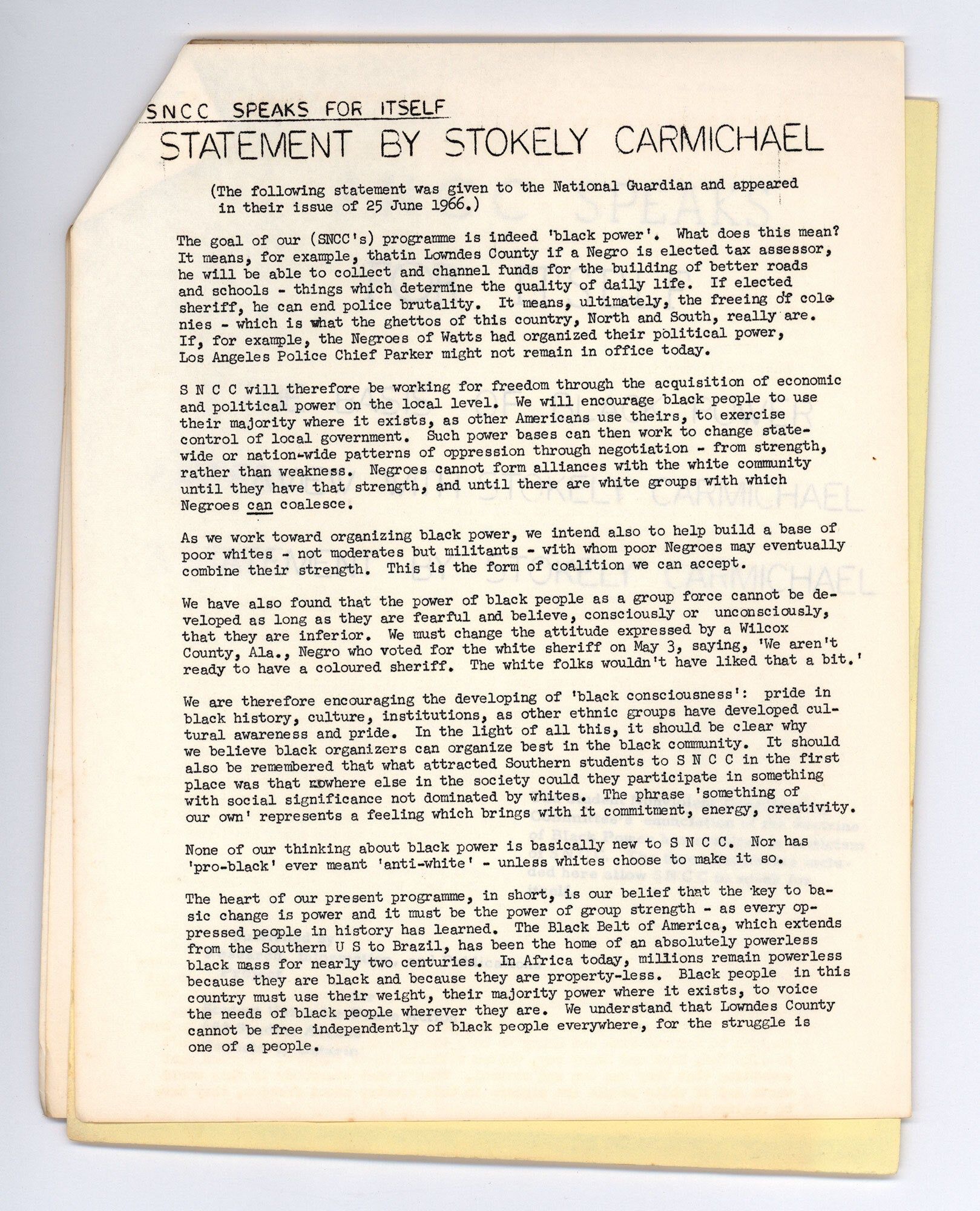
The collection opens with sections titled “The Basis of Black Power,” “White Power,” “Roles of White and Blacks,” “Black Self-Determination,” “White Radicals,” and “Black Identity.” These are introduced as “excerpts from a working paper prepared by members of SNCC in Winter 1965–66,” which, “according to the NY Times of 5 August 1966, from which this is taken,…serves as the basis for SNCC’s ‘black power’ philosophy.” What follows is a seven-page interview with Stokely Carmichael and a one-page statement by him.
The Student Nonviolent Coordinating Committee (SNCC) formed in 1960 in the wake of a series of lunch counter and university sit-ins, and quickly rose to prominence, with an early acknowledgement from Martin Luther King, Jr., who stated that: “What is new in your fight is the fact that it was initiated, fed, and sustained by students.” During the 1960s “there were more SNCC field secretaries working full time in southern communities than any civil rights organization before or since” (Cobb). The organization partnered briefly with the Black Panthers.
The Student Union for Peace Action (SUPA) emerged in Regina, Saskatchewan in 1964 out of the Combined Universities Campaign for Nuclear Disarmament. Though short-lived (1964–1967), it quickly spread to campuses across Canada, organizing community projects, protests, publications, etc. Composed mainly of young Canadians, SUPA embraced participatory democracy, calling for power to be exercised “from the bottom up” and critiquing the undue influence of corporations and elites on Canadian politics. Its mandate was sweeping, tackling issues of war, racism, poverty, and social injustice, while situating Canadian reform in the broader context of Cold War tensions and the Civil Rights Movement.
Central to SUPA’s intellectual and activist work was its Research, Information and Publications Project (RIPP), which produced articles analyzing Canadian society and foreign policy. These included Jim Harding’s Canada’s Indians, L. C. and F. W. Park’s Canadian Neocolonialism in Latin America, B. Roy Lemoine’s Quebec, A Double Revolution, and Stanley Gray’s Democracy and Social Change. This RIPP edition of SNCC Speaks for Itself is evidence of the organization making common cause with civil rights activists in the U.S. as well. Although SUPA dissolved by the late 1960s, its publications and ideals influenced subsequent organizations and shaped the direction of Canadian New Left thought.
OCLC records a single copy of this Canadian edition, at Temple University.
REFERENCES: Cobb, Charlie. “The Story of SNCC,” Digital SNCC Gateway online; “SUPA - Student Union for Peace Action” at Connections online.
Details
Title
SNCC Speaks for Itself: 1. The Basis of Black Power 2. Interview with Stokely Carmichael 3. Statement by Stokely Carmichael
Author
SNCC; Stokely Carmichael
Condition
Unknown
Publisher
Toronto, Ontario: Research, Information, and Publications Project for Student Union for Peace Action, [1966]