

POÈMES DE BRANDEBOURG
- Paris: NRF, 1947
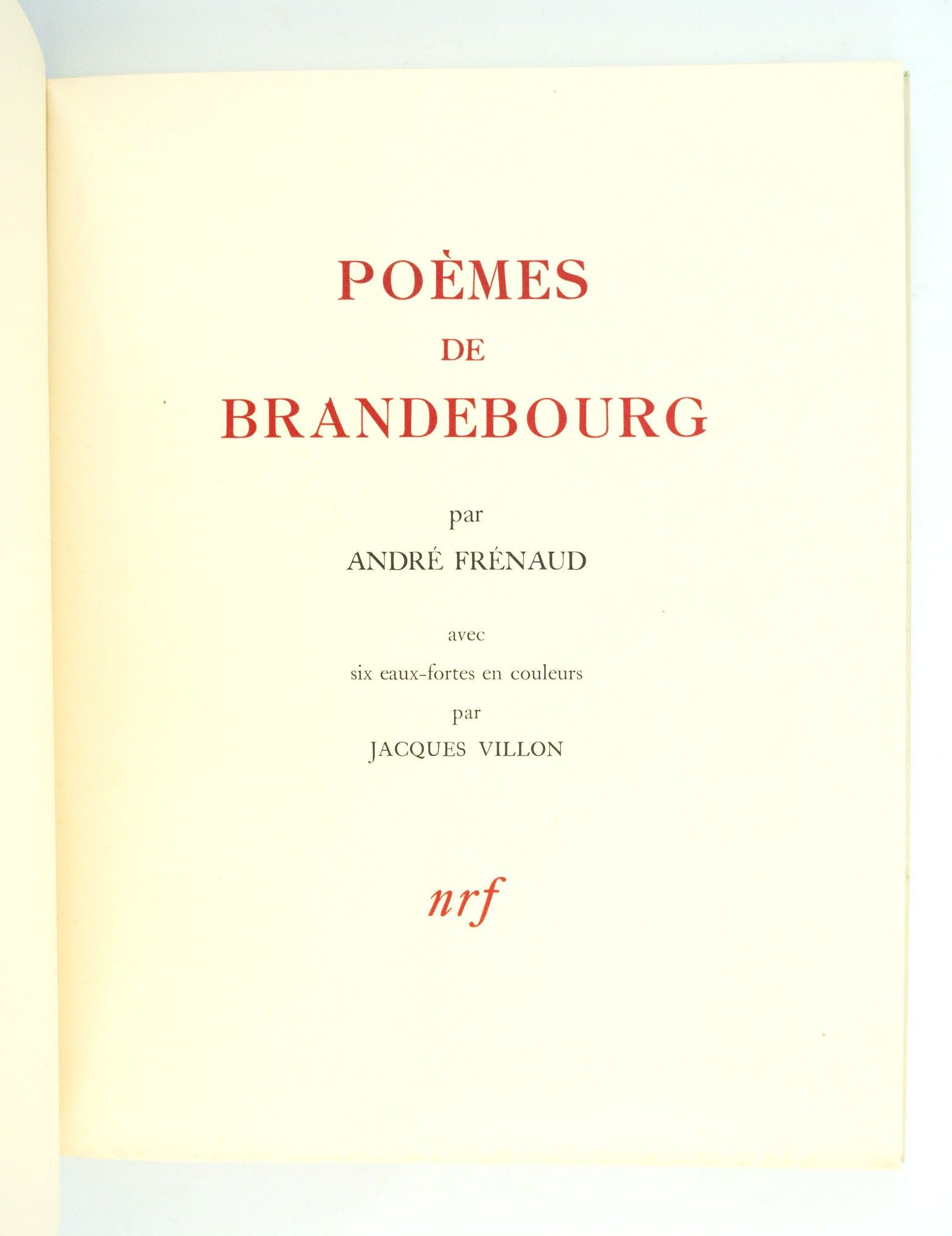
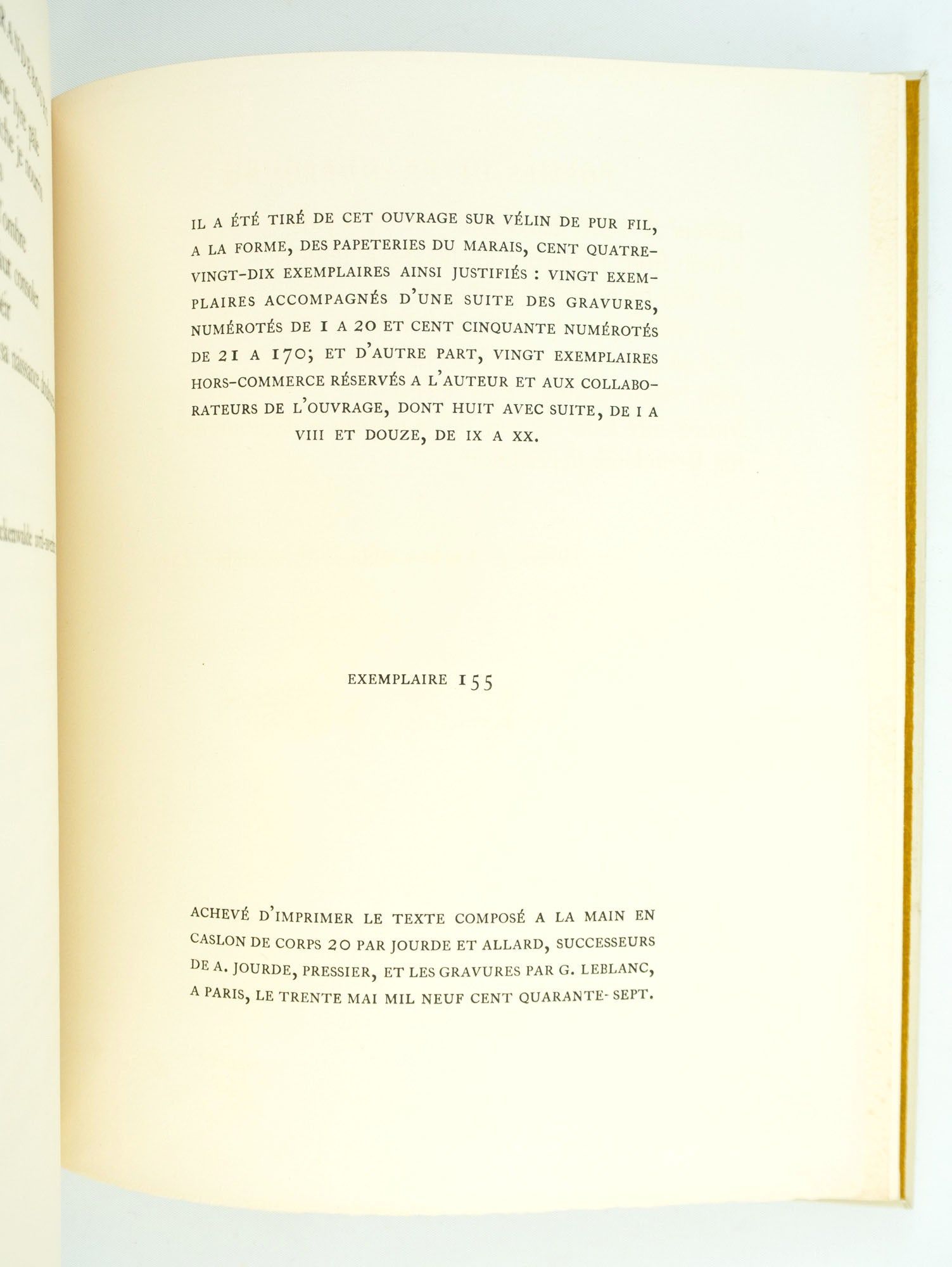
Paris: NRF, 1947. FIRST EDITION. No. 155 OF 170 NUMBERED COPIES, plus 20 hors commerces copies for the author and project collaborators. 282 x 225 mm. (11 1/8 x 8 3/4"). 77, [3] pp.
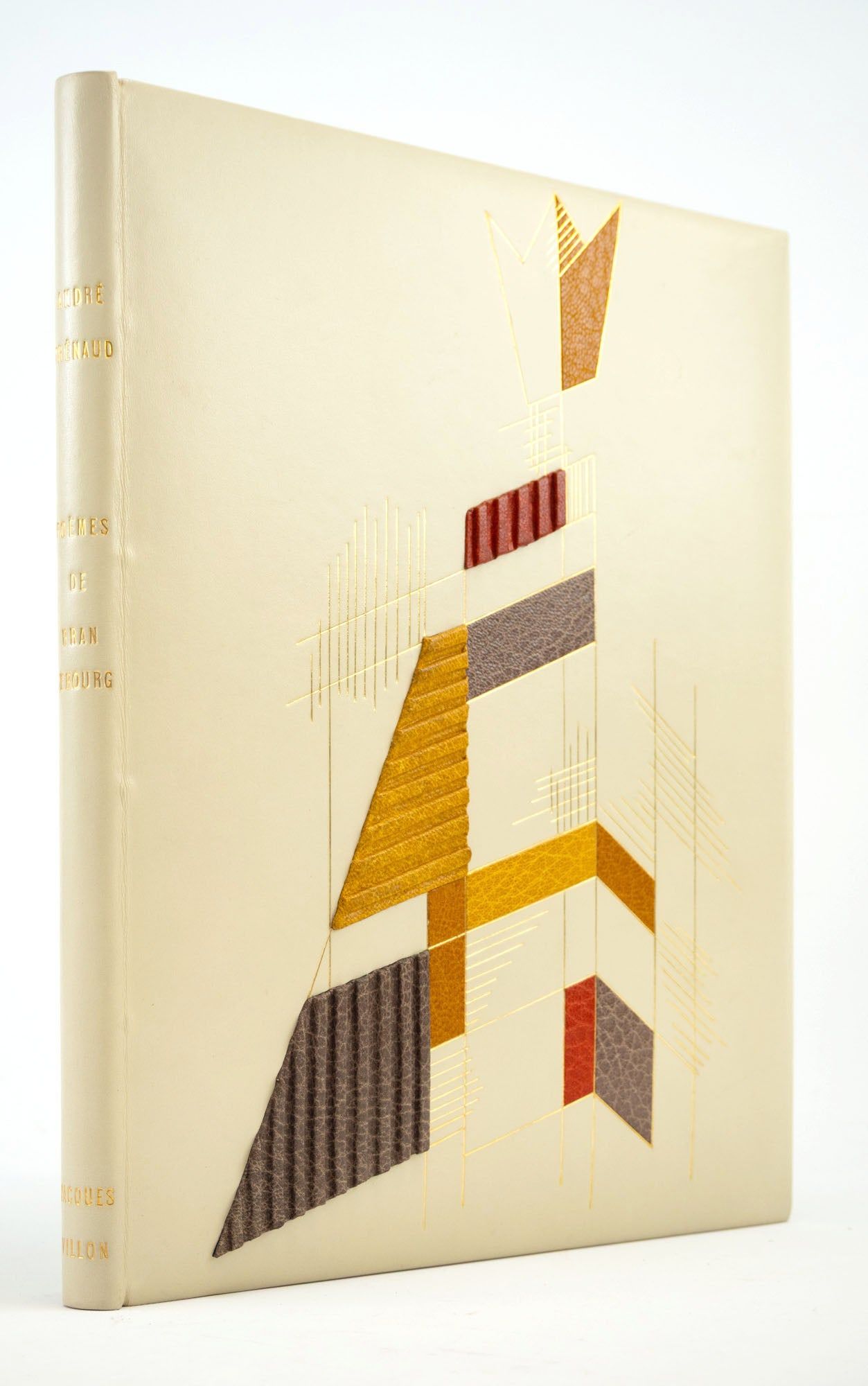
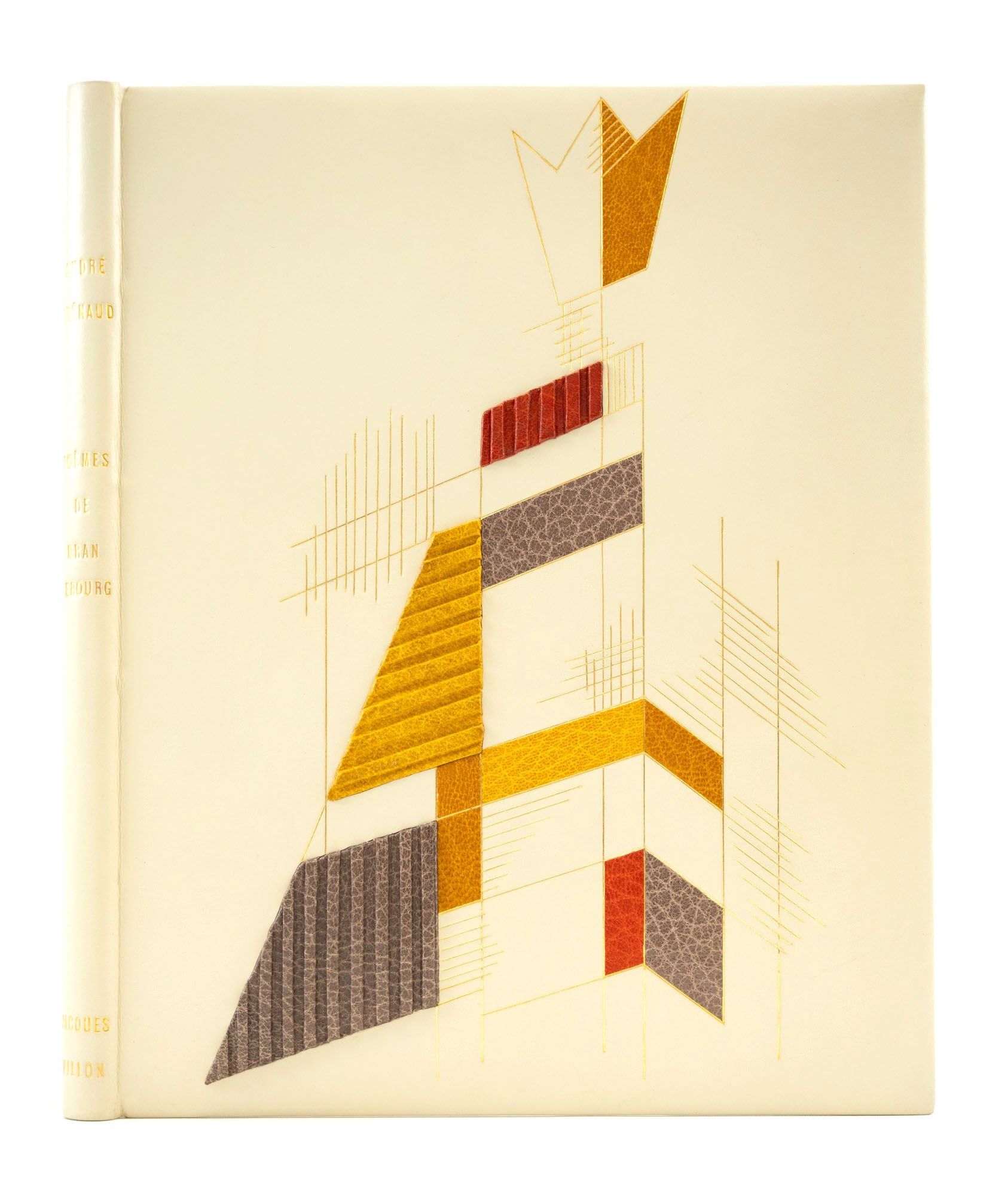
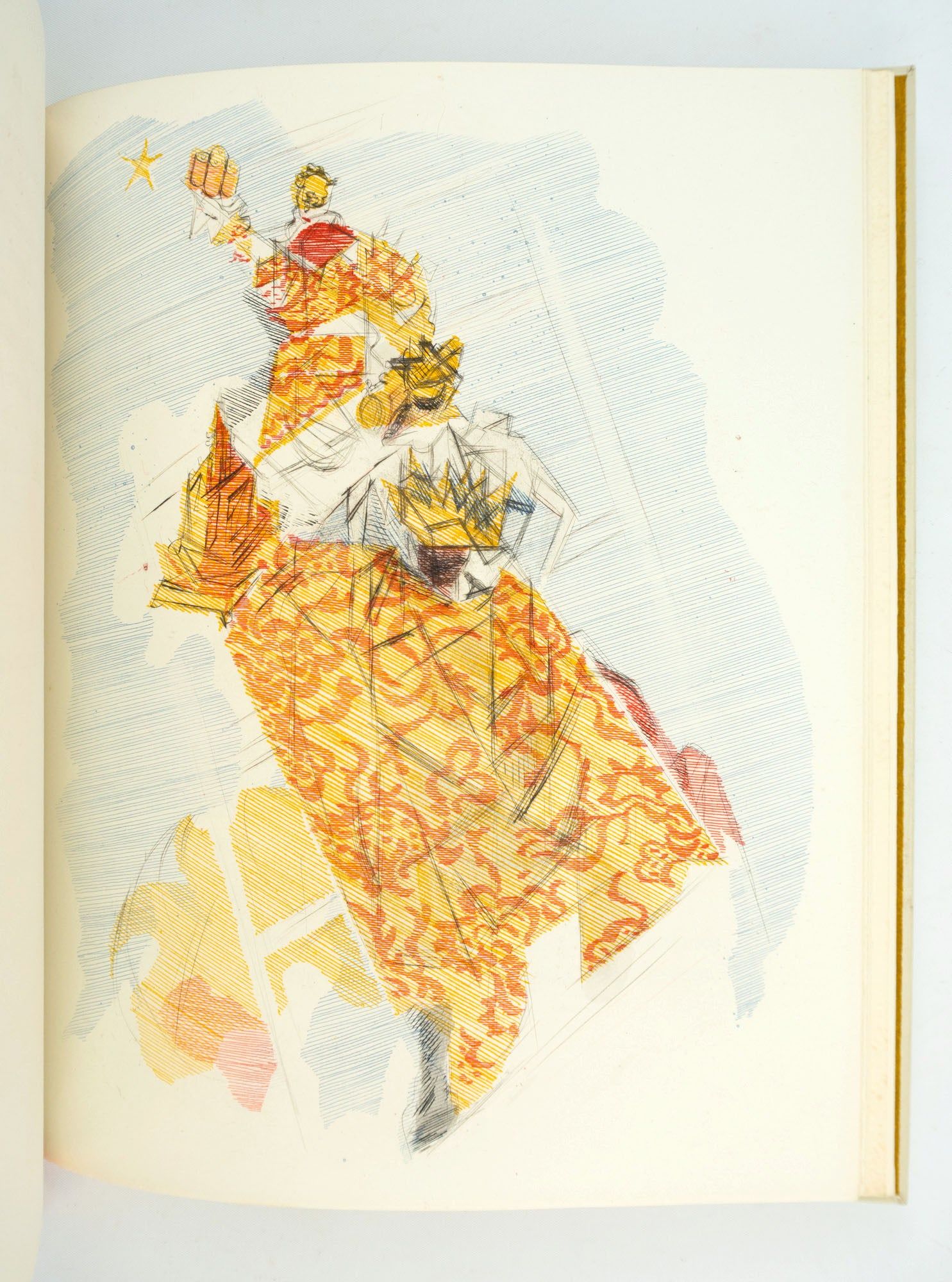
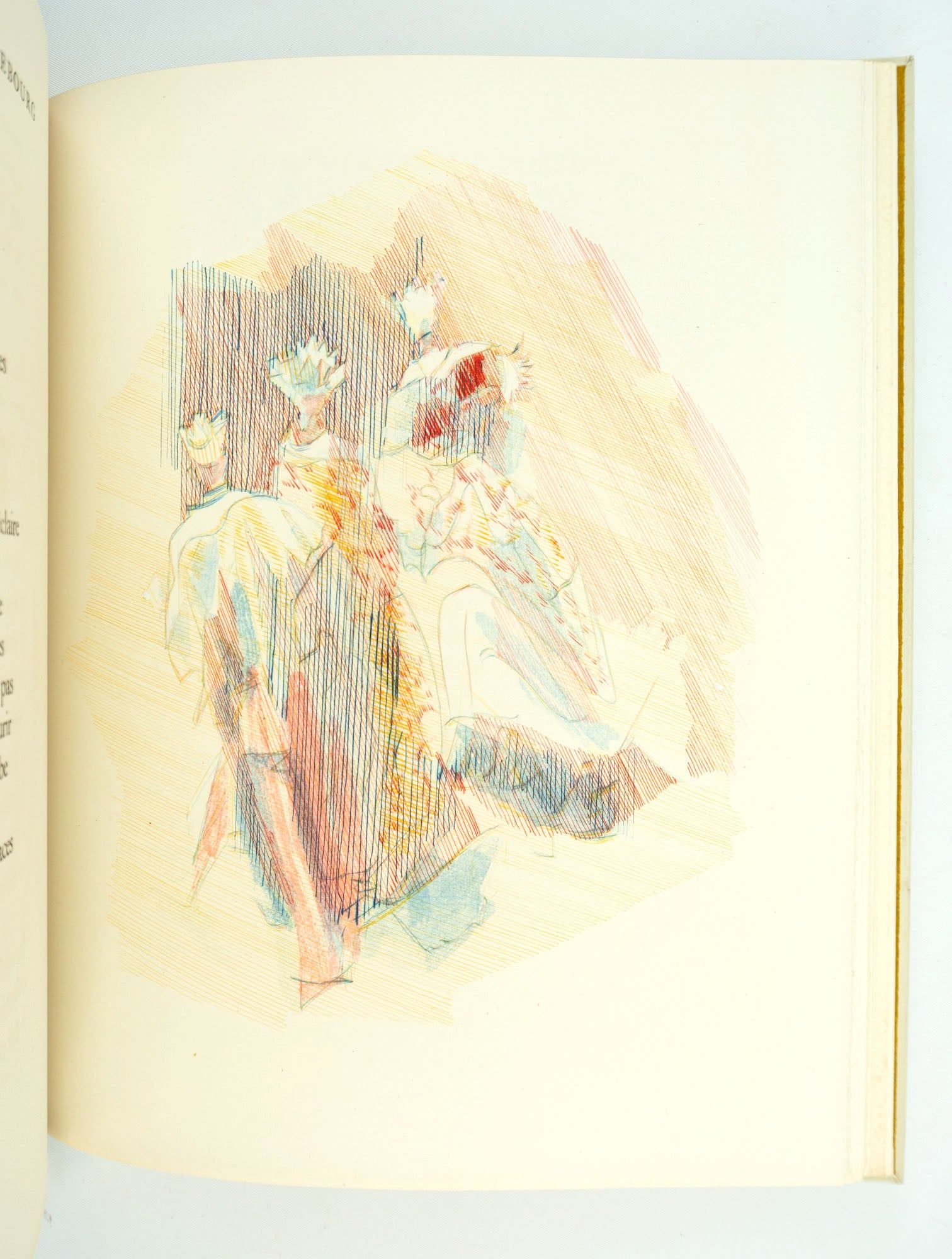
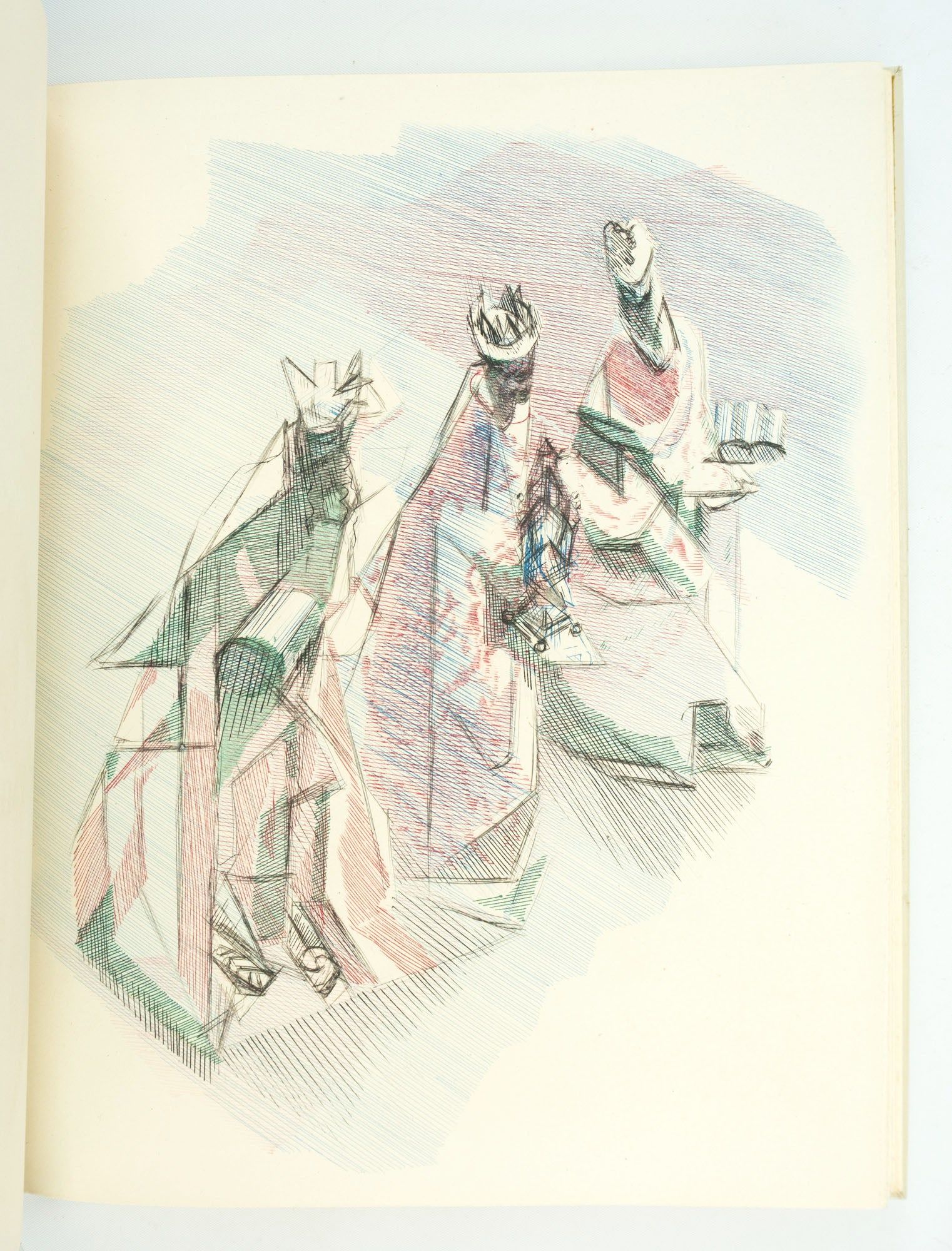
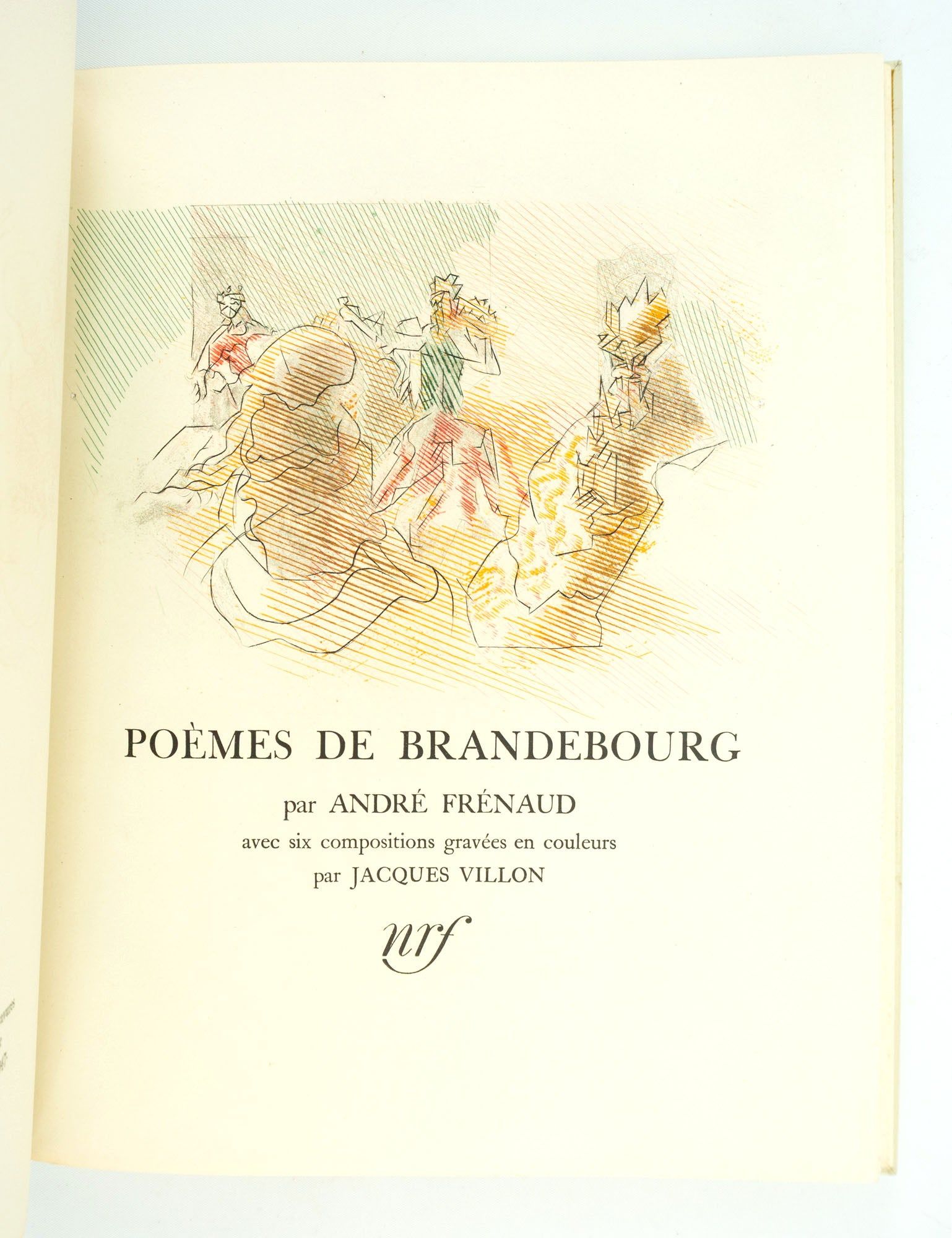
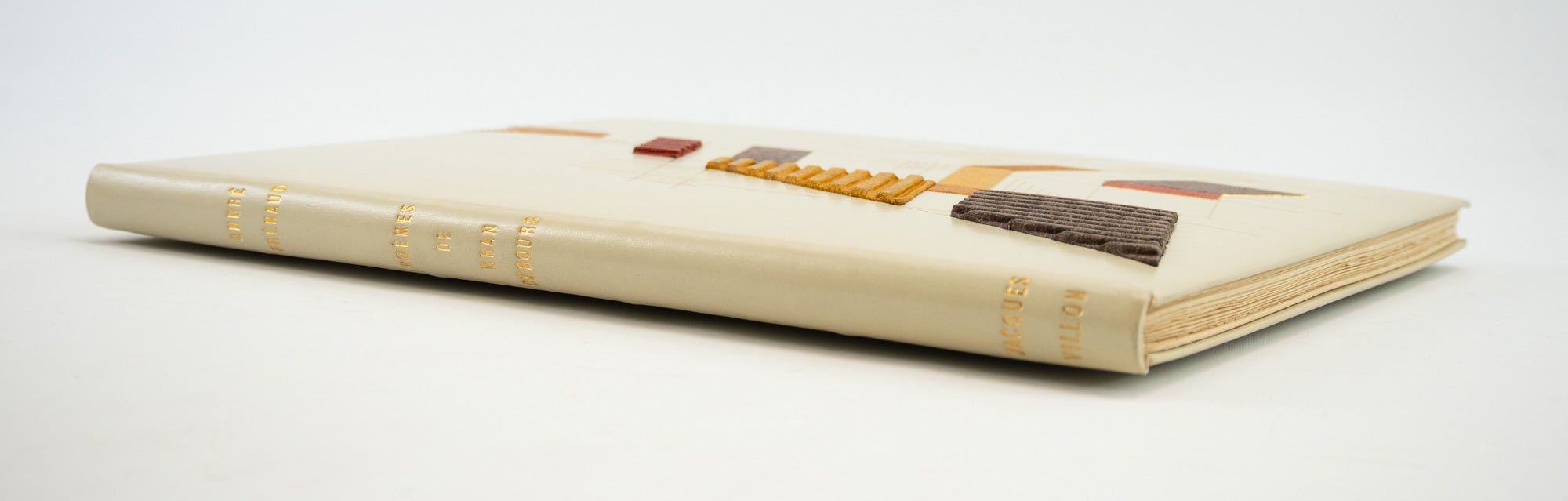
SUPERB CREAM-COLORED POLISHED CALF WITH MOSAIC INLAYS BY LOBSTEIN (stamp-signed on verso of front free endpaper) upper cover with Cubist crowned king silhouette based on Villon's etchings, with gilt lines and inlays in citron, gray, and vermillion morocco, three of the inlays with raised corrugation, smooth spine with gilt lettering, ochre handmade paper endpapers, leather hinges, top edge gilt. Original paper wrappers bound in. Housed in suede-lined wood veneer chemise with cream calf spine and fore edges, in a matching leather-lipped wooden slipcase. WITH SIX COLOR ETCHINGS BY JACQUES VILLON. Castleman, "A Century of Artists Books," p. 59, 128. Occasional faint offsetting or very light browning to leaves, but still A VERY FINE COPY, with virtually no signs of use.
Written when the author was a prisoner of war in Germany during World War II, this collection contains one of Frénaud's best-known poems, a reworking of the story of the Three Magi, whose images are interpreted in the etchings of Jacques Villon, and in our binding by Alain Lobstein. Frénaud (1907-93) worked as a civil servant before joining the army in 1939; he was captured in 1940 and spent two years in a Brandenburg labor camp before returning to France, where he joined the Resistance. His obituary in "The Independent" noted that he used scraps of papers taken from bags of cement as writing surfaces for his first poems. Surrealist poet Paul Eluard was impressed with Frénaud's verses, and published some in the pamphlets he produced for the Resistance. Many of the poems in the Brandenburg group are dedicated to one or another of Frénaud's fellow prisoners of war. When a copy of the work appeared in the MOMA exhibition "A Century of Artists Books," art historian Riva Castleman wrote in the accompanying catalogue: "In retelling the tale of the Three Kings, Frénaud wrote that they arrived too late, the Massacre of the Innocents had begun. Yet by following the star they continued to hope that the Savior of mankind existed, as those prisoners of the Germans to whom Frénaud dedicated his poems must have done." Villon (1875-1963) was born Gaston Duchamp into an artistic family: his younger siblings were sculptor Raymond Duchamp-Villon, Dada artist Marcel Duchamp, and painter Suzanne Duchamp-Crotti. Describing him as "one of the master etchers of [the 20th] century," Castleman notes that "Villon made some of the most colorful aquatints of the beautiful ladies of the belle epoque during the early 1900s. Shortly thereafter Cubism transformed his visual vocabulary into black and white. Only after World War II, still creating in the Cubist mode, did he return to color for the etchings in [the present] book." Alain Lobstein adapted Villon's Magi for the binding, using gilt and three-dimensional textures to convey the richness of their royal raiment. Lobstein (1927-2005) trained with the successor to Marius Michel, Georges Cretté (1893-1969), before marrying his teacher's daughter and taking over the workshop on Cretté's retirement. Lobstein's obituary in the journal "Arts et Metiers du Livre" (no. 252, Feb/Mar 2006) observes that over a 50-year career he created bindings in a variety of styles, from traditional and retrospective bindings to modern and art bindings. The account characterized him as "a teacher, a trainer . . . [who] knew how to transmit his knowledge with finesse, realism and generosity." According to Flety, Lobstein's bindings--in every genre--"retain a classicism of good quality which makes them appreciated by many bibliophiles." Whether the present example is classical is less relevant than whether it is imaginative, suggestive of content, and pleasing--and there is no doubt it is all three of those..
SUPERB CREAM-COLORED POLISHED CALF WITH MOSAIC INLAYS BY LOBSTEIN (stamp-signed on verso of front free endpaper) upper cover with Cubist crowned king silhouette based on Villon's etchings, with gilt lines and inlays in citron, gray, and vermillion morocco, three of the inlays with raised corrugation, smooth spine with gilt lettering, ochre handmade paper endpapers, leather hinges, top edge gilt. Original paper wrappers bound in. Housed in suede-lined wood veneer chemise with cream calf spine and fore edges, in a matching leather-lipped wooden slipcase. WITH SIX COLOR ETCHINGS BY JACQUES VILLON. Castleman, "A Century of Artists Books," p. 59, 128. Occasional faint offsetting or very light browning to leaves, but still A VERY FINE COPY, with virtually no signs of use.
Written when the author was a prisoner of war in Germany during World War II, this collection contains one of Frénaud's best-known poems, a reworking of the story of the Three Magi, whose images are interpreted in the etchings of Jacques Villon, and in our binding by Alain Lobstein. Frénaud (1907-93) worked as a civil servant before joining the army in 1939; he was captured in 1940 and spent two years in a Brandenburg labor camp before returning to France, where he joined the Resistance. His obituary in "The Independent" noted that he used scraps of papers taken from bags of cement as writing surfaces for his first poems. Surrealist poet Paul Eluard was impressed with Frénaud's verses, and published some in the pamphlets he produced for the Resistance. Many of the poems in the Brandenburg group are dedicated to one or another of Frénaud's fellow prisoners of war. When a copy of the work appeared in the MOMA exhibition "A Century of Artists Books," art historian Riva Castleman wrote in the accompanying catalogue: "In retelling the tale of the Three Kings, Frénaud wrote that they arrived too late, the Massacre of the Innocents had begun. Yet by following the star they continued to hope that the Savior of mankind existed, as those prisoners of the Germans to whom Frénaud dedicated his poems must have done." Villon (1875-1963) was born Gaston Duchamp into an artistic family: his younger siblings were sculptor Raymond Duchamp-Villon, Dada artist Marcel Duchamp, and painter Suzanne Duchamp-Crotti. Describing him as "one of the master etchers of [the 20th] century," Castleman notes that "Villon made some of the most colorful aquatints of the beautiful ladies of the belle epoque during the early 1900s. Shortly thereafter Cubism transformed his visual vocabulary into black and white. Only after World War II, still creating in the Cubist mode, did he return to color for the etchings in [the present] book." Alain Lobstein adapted Villon's Magi for the binding, using gilt and three-dimensional textures to convey the richness of their royal raiment. Lobstein (1927-2005) trained with the successor to Marius Michel, Georges Cretté (1893-1969), before marrying his teacher's daughter and taking over the workshop on Cretté's retirement. Lobstein's obituary in the journal "Arts et Metiers du Livre" (no. 252, Feb/Mar 2006) observes that over a 50-year career he created bindings in a variety of styles, from traditional and retrospective bindings to modern and art bindings. The account characterized him as "a teacher, a trainer . . . [who] knew how to transmit his knowledge with finesse, realism and generosity." According to Flety, Lobstein's bindings--in every genre--"retain a classicism of good quality which makes them appreciated by many bibliophiles." Whether the present example is classical is less relevant than whether it is imaginative, suggestive of content, and pleasing--and there is no doubt it is all three of those..
Details
Title
POÈMES DE BRANDEBOURG
Author
(BINDINGS - LOBSTEIN). FRÉNAUD, ANDRÉ. JACQUES VILLON, Illustrator
Condition
Unknown
Publisher
NRF: Paris
Date
1947
Edition
FIRST EDITION. No. 155 OF 170 NUMBERED COPIES, plus 20 hors comm