

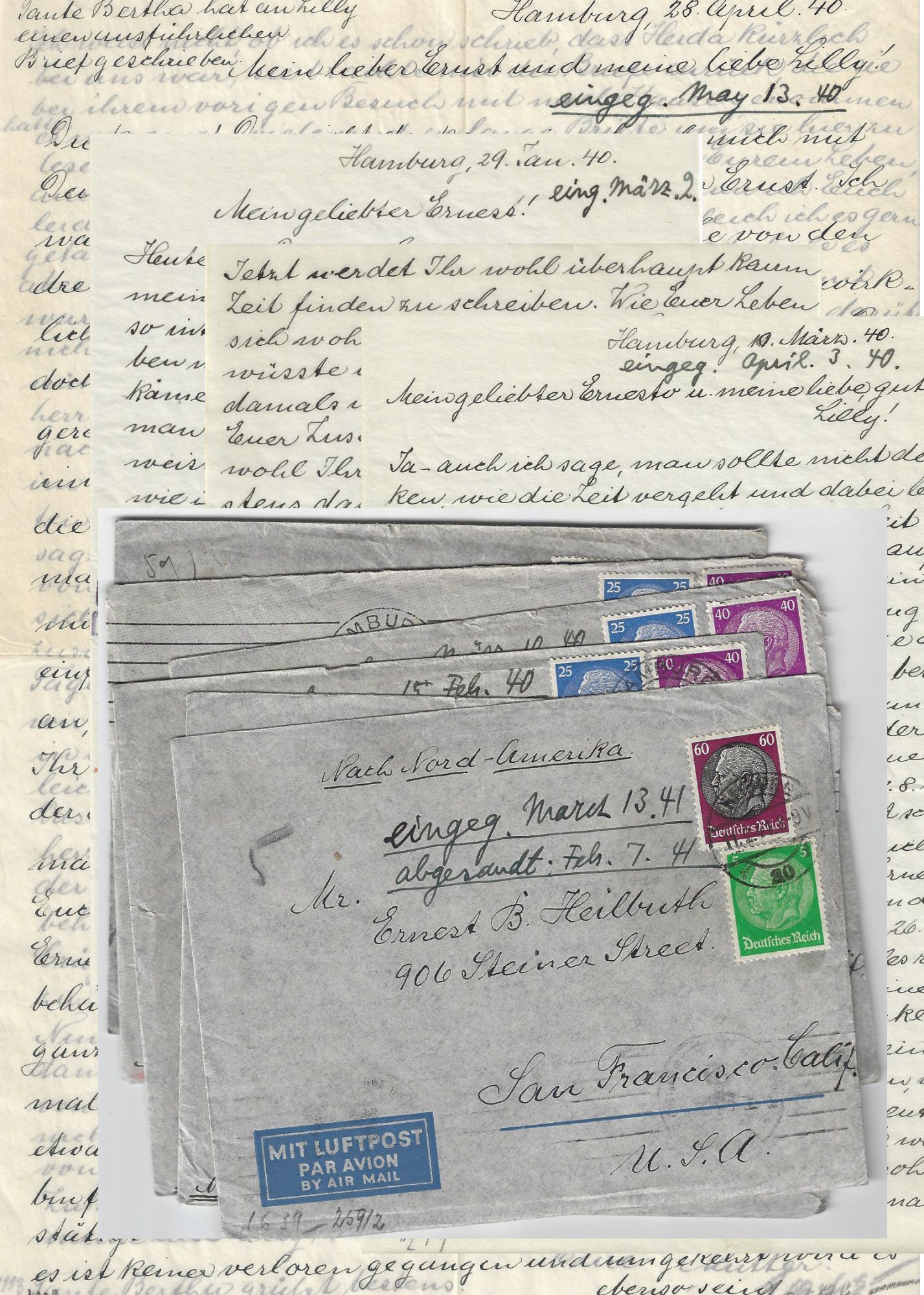
1940-1941 – Archive of letters from a Jewish mother in Hamburg, Germany to her son in San Francisco which stopped shortly before she was sent to the Theresienstadt concentration camp where she would die before the end of World War II
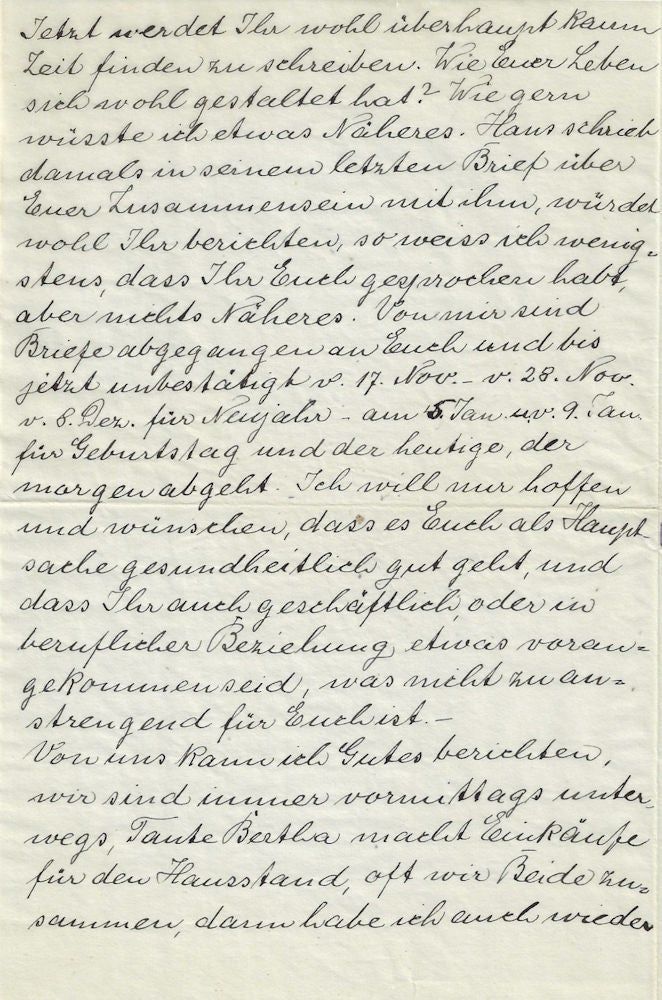
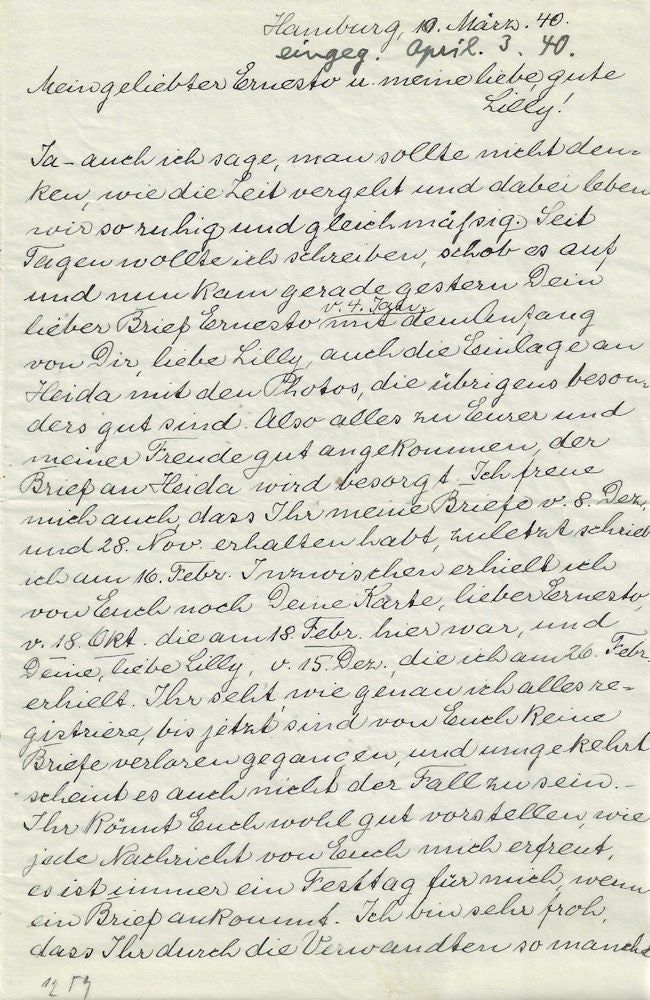
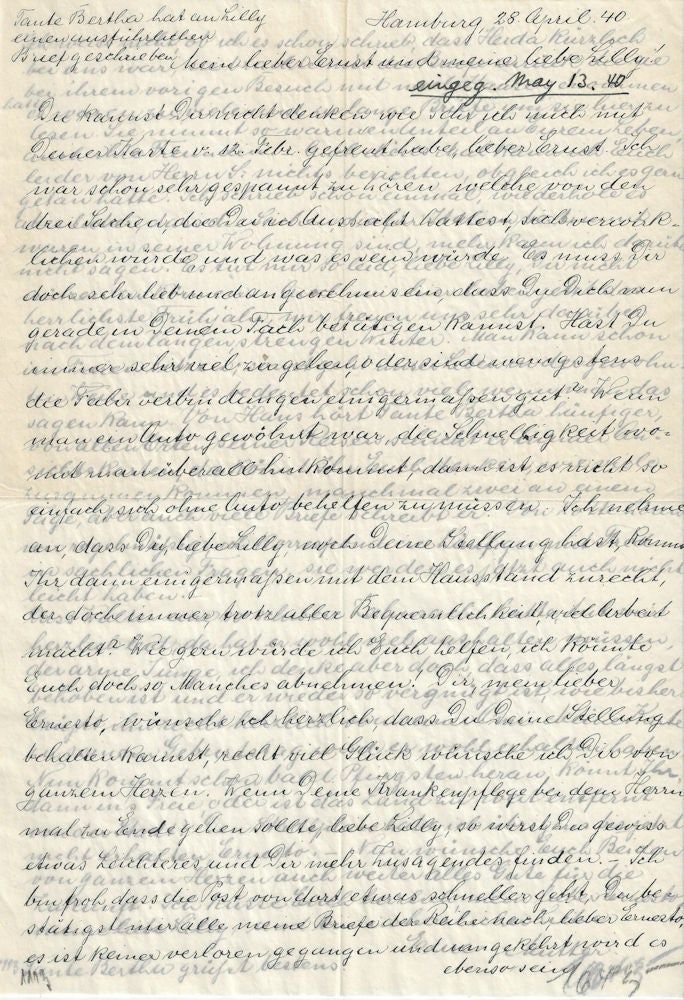
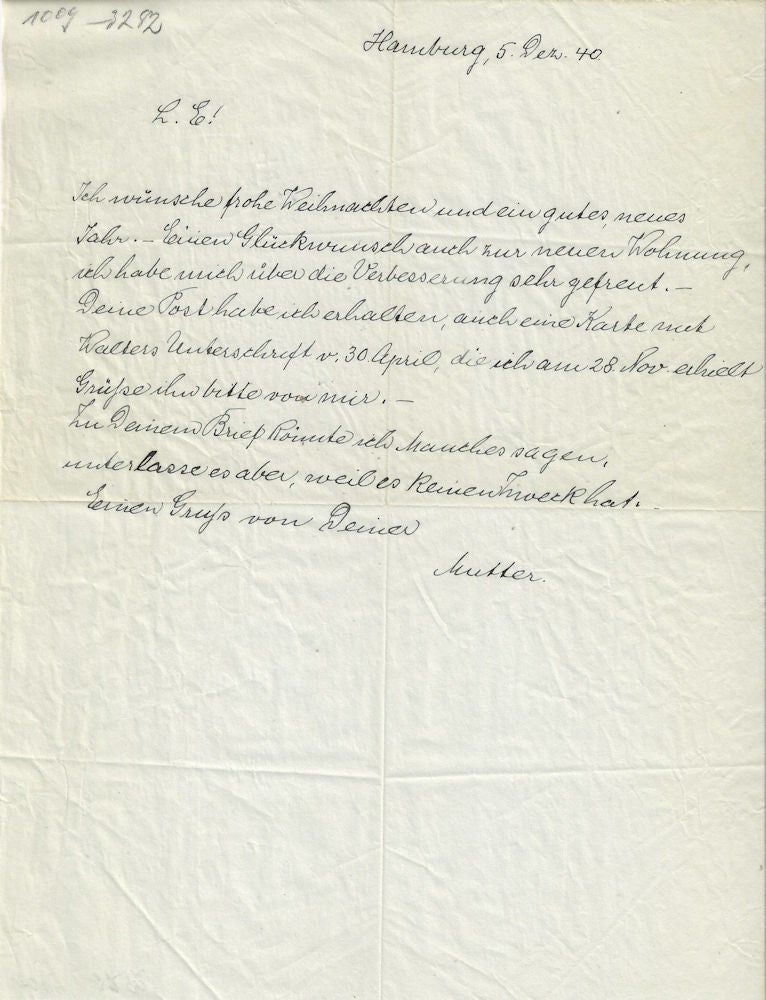
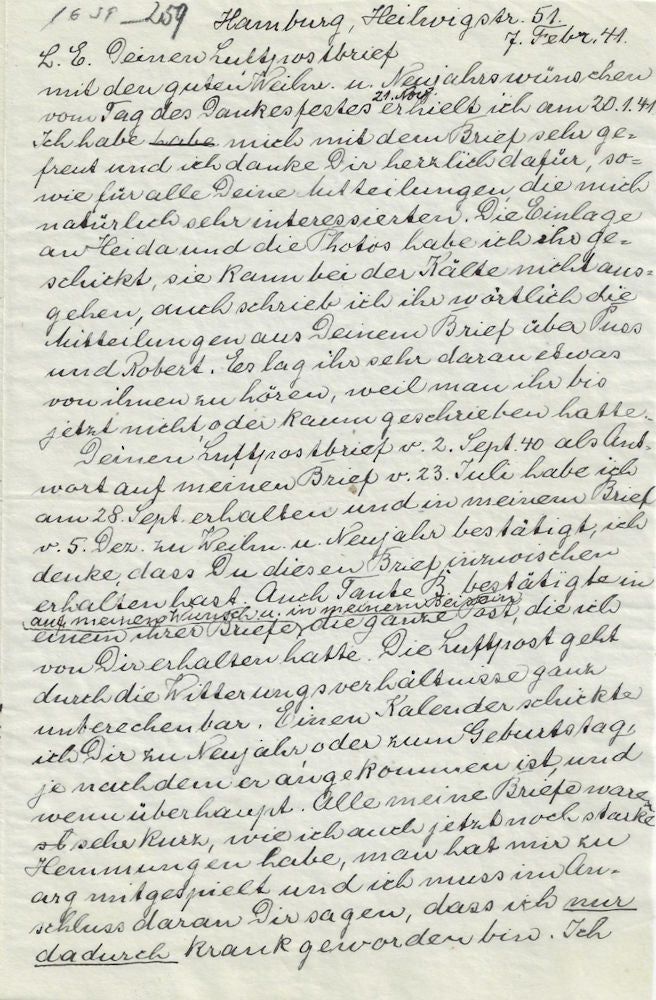
- Unbound
- Hamburg, Germany , 1941
Information about Thekla and Ernst is sparse. Thekla was born in 1872, Ernst in 1902. After her first husband, Ernst’s father, died, Thekla married Paul Bornstein in 1907. Ernst married Lilly in 1939. Ernst and the couple’s adopted teenage stepson, Walter Singer, left Germany just as persecution became intense. While mass, systematic murder would not begin until 1941, at the time these letters were written, the Nazis had just begun implementing brutal policies that impoverished and killed hundreds of thousands of Jews through starvation and disease in newly created ghettos where they were forced to live, isolated and separated from the gentile population.
Ernst and Walter arrived in New York on board the USS Manhattan, and Lilly joined them several days later, arriving on the USS George Washington. Together, they then made their way west and settled in California, where Ernst and Walter opened an auto parts store, and Lily worked as a practical nurse.
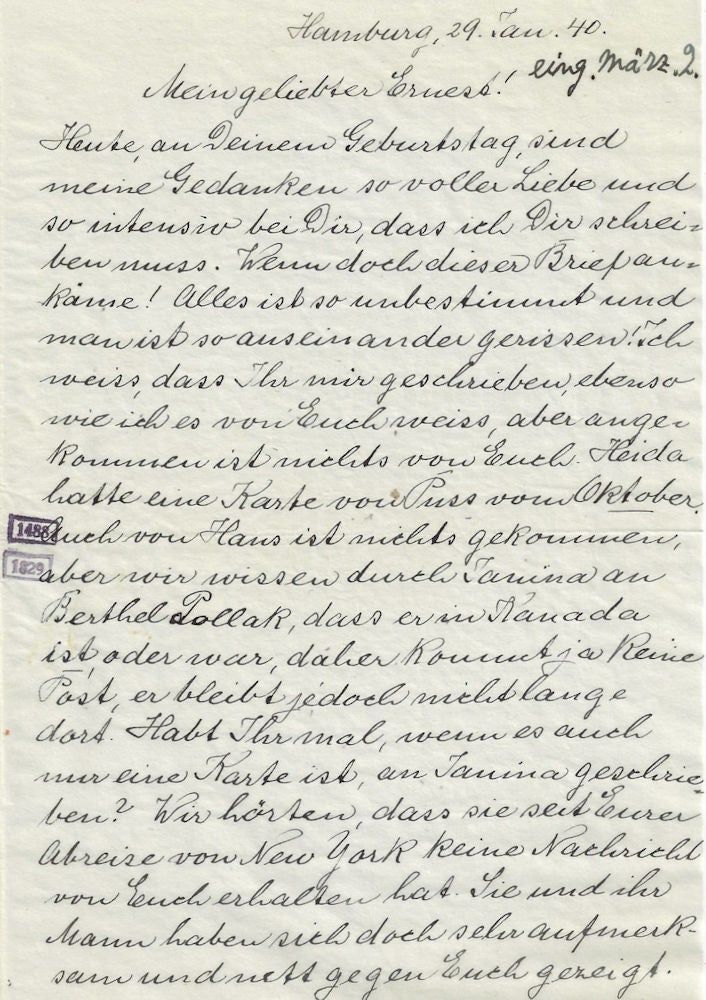
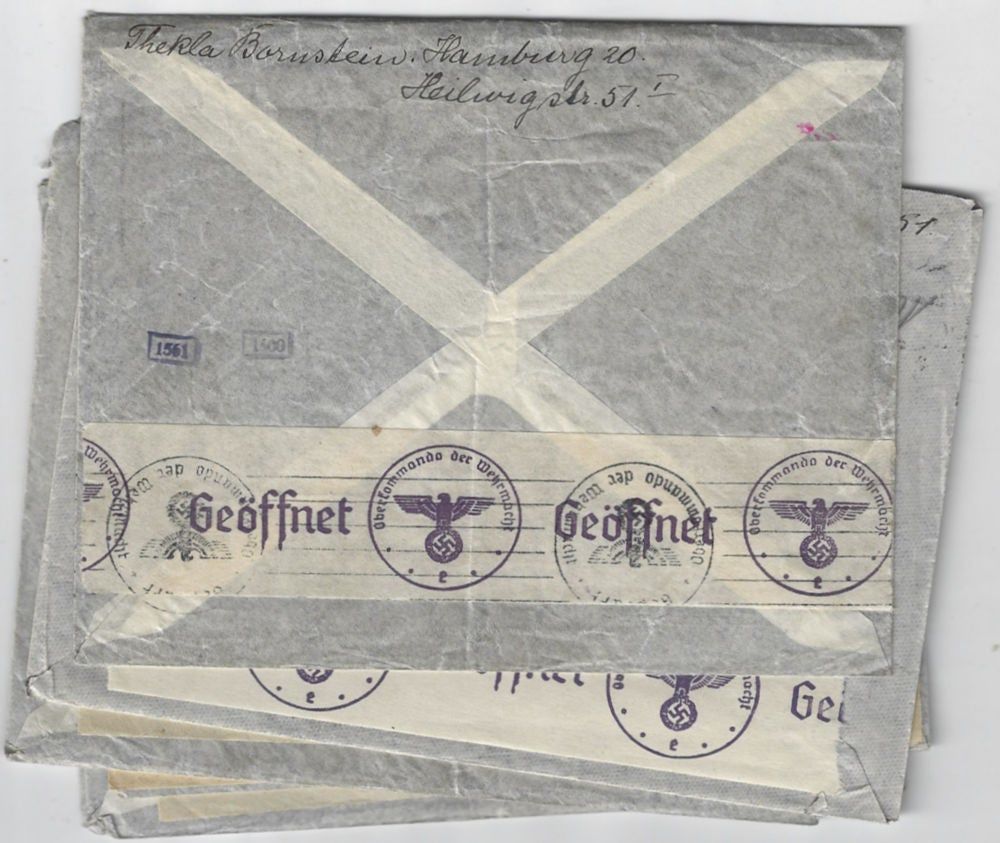
None of Thekla’s letters mention persecution of the Jews by the Nazis, which is understandable as all of them were censored by the Oberkommando, which was charged with ensuring no sensitive or negative information about the Third Reich was sent out of the country. (Internal censorship was the responsibility of Josef Goebbels’ Reich Ministry of Public Enlightenment and Propaganda.) Thekla did, however, keep Ernst aware of the status of family and friends, presumably those who had not yet been sent to concentration, forced labor, or extermination camps. As well, she continuously asked from whom he had heard. Her letters are generally upbeat and never express anything overtly negative about her situation. However, reading Google translations of her letters between the lines with hindsight, it is possible to infer her apprehension and resignation. For example,
“Everything is so vague and so torn apart.”
“From us, I can’t say good news.”
“I am very happy you have received so many messages from relatives.”
“Regarding your letter. I have a lot to say, but I’ll refrain from doing so because it has some relevance.”
“Your anger [has] played a role for me [but] life goes on in its new show.”
. Still, that did not save her. The Nazis constructed Theresienstadt at the Czech border town of Terezin in 1941 to serve two purposes. One was to serve as a transit camp for Jews being sent east to forced labor and extermination camps. The other was as an ersatz retirement ghetto for Jews whose disappearance might generate difficult-to-answer international attention and inquiries about persons over the age of 65, World War One veterans, and well-known cultural or political figures. The ghetto was also used for propaganda purposes, including a highly scripted stage visit by the International Red Cross that left the impression its residents were well treated, enjoying life, and able to enjoy a variety of activities, when, in fact, nothing could have been further from the truth.Life at Theresienstadt was only marginally better than in other concentration camps. Although the ghetto was governed by a Jewish Council of Elders, the Council was completely dependent upon the Nazis. Food was scarce, clothing was sparse, people doubled or tripled-up in primitive beds stacked three-high, sanitation was poor, fresh water was intermittent, and disease ran rampant because although there was a hospital, it had no medicine. 33,000 of the ghetto’s 140,000 prisoners died from deprivation, starvation, and disease.
At the time Thkla sent her last letter to Ernst, she would have been about 69 years old and was, no doubt, rounded up the following November along with all of Hamburg’s 1,955 Jews and transported to Theresienstadt. Only 22 of that group survived the war, Lilly was not among them. Although neither the date nor the cause of her death was recorded, her name appears on the ghetto’s list of deceased prisoners.
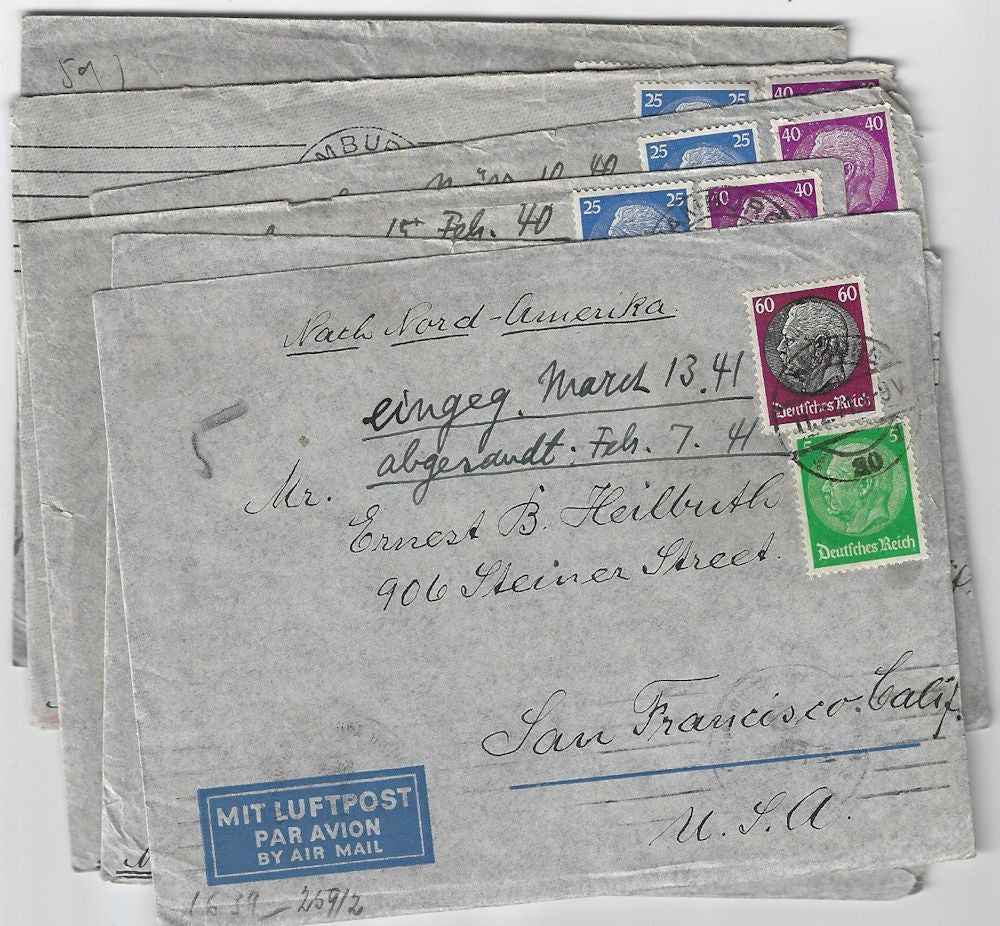
The Hindenburg medallion stamps that frank these letters were first issued in 1932 to honor the former Field Marshal Paul von Hindenburg, who had partially restored calmness in post-World War One following his election as President of the Weimar Republic. Hindenburg was a popular figure and so were these stamps, which were originally printed on paper with a ‘waffle’ watermark. Recognizing Hindenburg’s popularity, when he died in 1934, the Nazis, who had assumed control of the government the year before choreographed a massive Wagnerian funeral in his honor and continued to issue this series of stamps in an attempt to suggest that they had Hindenburg’s full support. There was, however, one small difference in the stamps; they were then printed on paper with very a visible swastika watermark, nearly impossible to miss when affixing them to an envelope.
(For more information, see “Theresienstadt: ‘Retirement Settlement’ for German and Austrian Jews” at the Holocaust Museum website, Hoffman’s “Highlights from Hamburg-A Delicate Balance” at the Jewish Chicago Family Service website, Gedenkbuch - Opfer der Verfolgung der Juden unter der nationalsozialistischen Gewaltherrschaft in Deutschland 1933-1945 (Memorial Book - Victims of the Persecution of Jews under National Socialist Tyranny in Germany 1933-1945) at the Bundesaarchiv, and Coffey’s “The Riddle of the Hindenburg Medallions” at the Richard Frajola website.)
Postal cards and letters from prisoners held at the Theresienstadt concentration camp, though scarce, are far more common than correspondence from prisoners held at other camps or ghettos and even Jews that had not yet been rounded up. Other papers related to Ernst Heilbuth are held by the Holocaust Museum in Washington D.C.
.Details
Title
1940-1941 – Archive of letters from a Jewish mother in Hamburg, Germany to her son in San Francisco which stopped shortly before she was sent to the Theresienstadt concentration camp where she would die before the end of World War II
Author
Thekla Bornstein
Binding
Unbound
Condition
Very Good
Publisher
Hamburg, Germany
Date
1941