

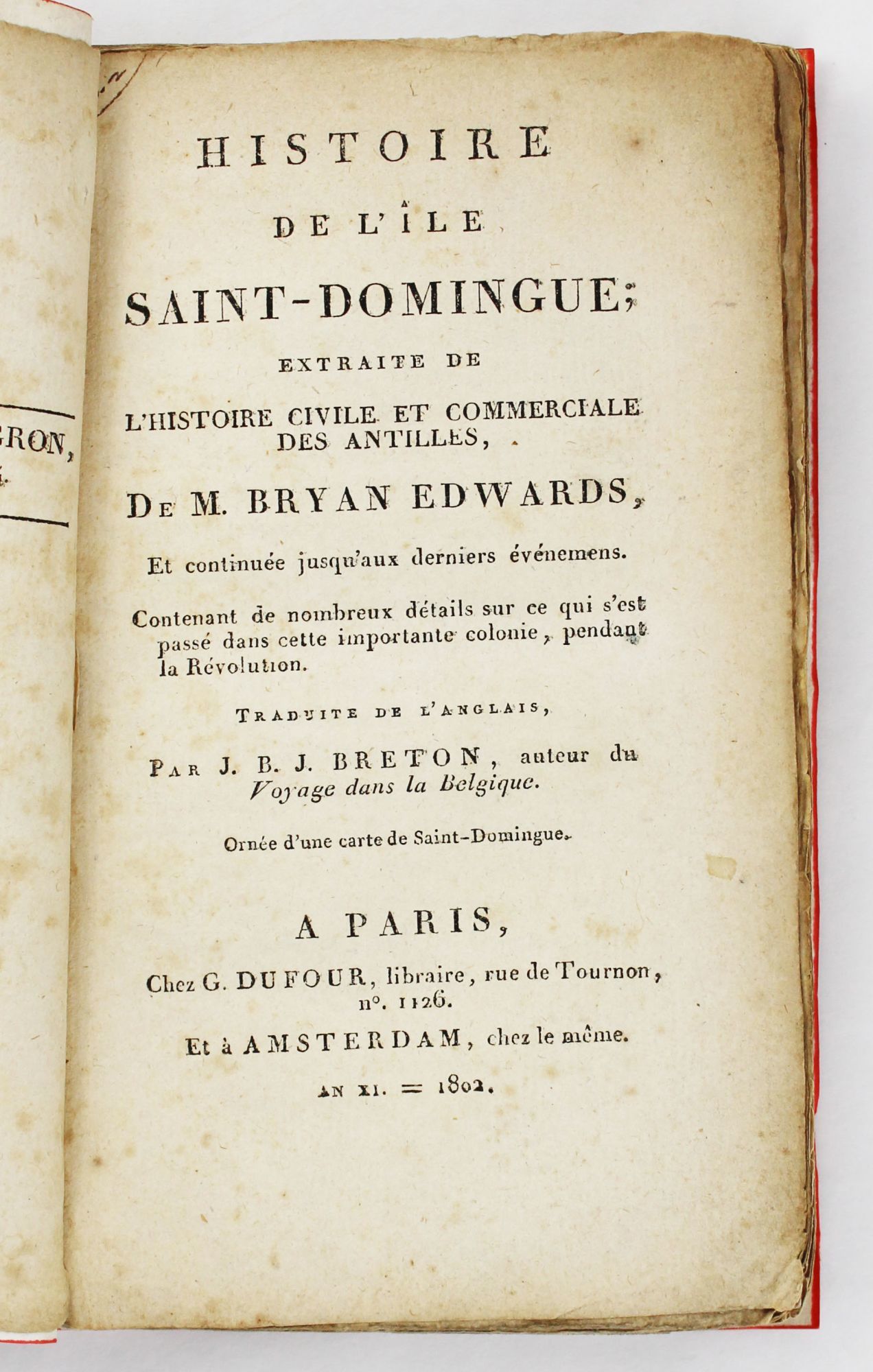
Histoire de l'Ile Saint-Domingue; Extraite de l'Histoire Civile et Commerciale des Antilles
- Paris , 1802
Paris, 1802. Very good.. [4],xii,209pp., plus folding map. Contemporary marbled wrappers. Minor edge wear and rubbing to wrappers. Occasional minor foxing to text, small repair in gutter of half title. Untrimmed. First French edition of this notable history of Saint-Domingue translated by Jean-Baptiste Joseph Breton, which was highly popular at the time of its publication. The text is supplemented with a folding map of Saint-Domingue engraved by Blondeau. Bryan Edwards was a British plantation owner based in Jamaica who directly benefitted from the transatlantic slave trade; conservative estimates place the number of people he enslaved at 1,500. A prominent figure in the politics of the West Indies in the late-18th century, Edwards was opposed to abolition but open to the improvement of the conditions for enslaved people in the region. In 1791, he joined a British relief expedition to the French colony of Saint Domingue. One of the wealthiest colonies in the Caribbean, those enslaved by French settlers rose up in rebellion following the French Revolution of 1789. The revolt, known as the Haitian Revolution, would eventually be successful and in 1804 the colony would achieve independence as the first free Black nation in the Americas. Edwards' main purpose in traveling to the island was to gain information about the causes and consequences of the Haitian Revolution, which he published in 1797. In the course of his historical narrative, Edwards claims that 30,000 people died during the rebellion. He blamed the revolt on the treatment of enslaved people by the French settlers on the island. After relating the history of the island since its discovery by Christopher Columbus, the book devotes a significant portion to the events that took place in Saint-Domingue between the slave revolt of 1791 and the surrender of the key figure of the Haitian Revolution, Toussaint Louverture in 1802. The abolition of slavery, decreed on February 4, 1794, and applied in all French colonies except Bourbon Island and the Mascarenes, was revoked in 1802.
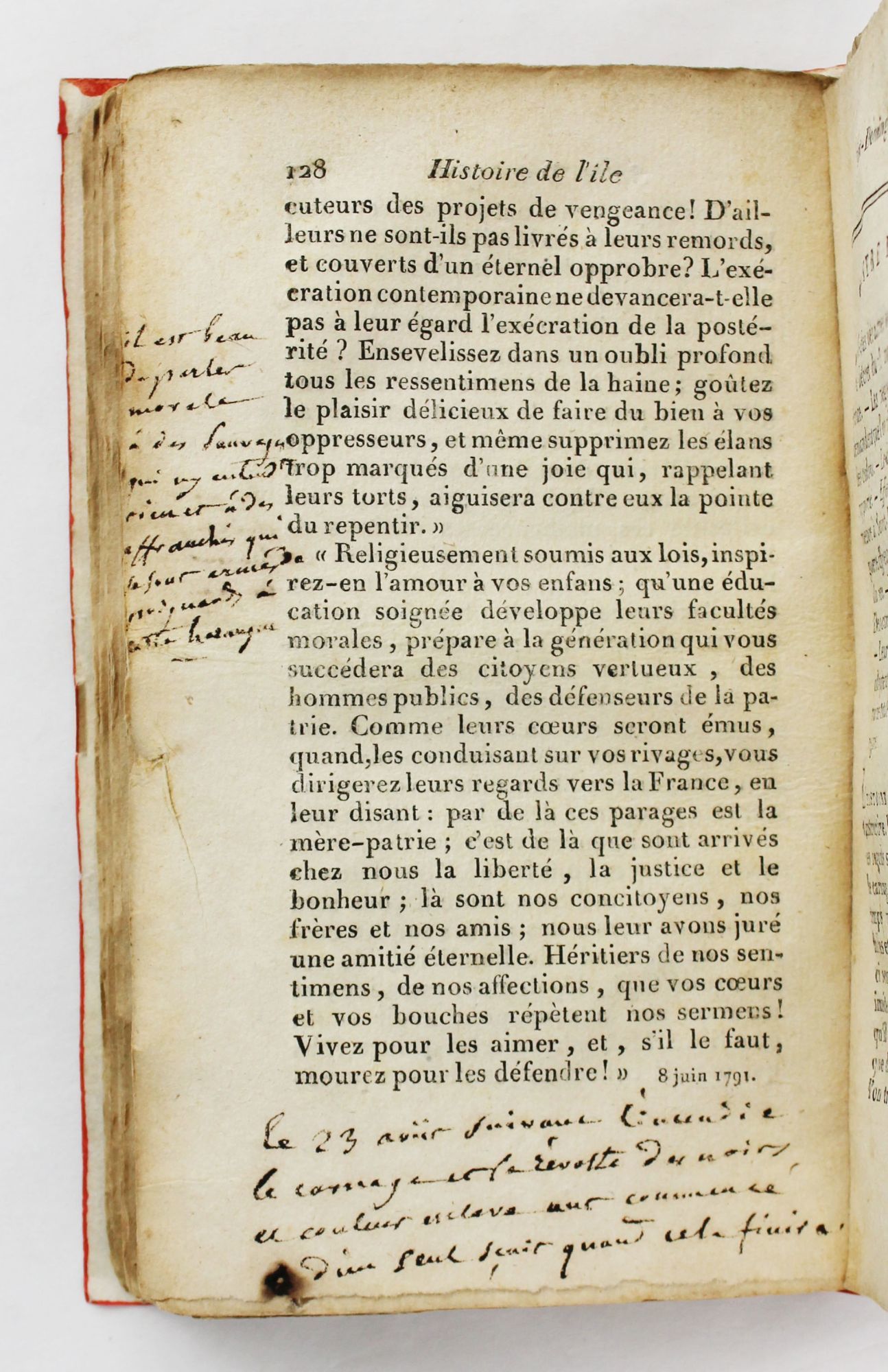
The present copy of Edwards' history is particularly interesting for the wealth of manuscript annotations and corrections in French, added around 1802 or 1803 by a contemporary reader, most likely a slave owner and a witness to the Haitian Revolution. Under the date of June 8, 1791 (at the end of Abbé Grégoire’s letter reproduced in full in the book), the commentator notes: "On August 23, the fire, carnage, and black revolt began. Only God knows when it will end” (p. 128). The racist reactions and pro-slavery comments of this commentator, while shocking to modern sensibilities, serve as a subject of study for modern historians and provide insight into the mindset of a pro-slavery advocate at the end of the 18th century. This volume contains nearly a hundred handwritten marginal notes, including comments, observations, simple affirmations ("true," "true fact," "truth"), or refutations ("false," "this is false"). The commentator also makes numerous corrections to details, figures, and historical facts. For instance, he asserts that Toussaint Louverture’s army was six thousand men, not thirty thousand as stated in the book (p. 180). The annotator's reactions to the circular letter of Abbé Grégoire -- one of the founders of the Société des Amis des Noirs, for the equality of whites and free blacks in the colonies and the abolition of the slave trade and slavery -- are particularly revealing. The book reproduces in full the "Letter to the Men of Color of Saint-Domingue" (pp. 116–128). After referring to "le perfide Raynal" ("the perfidious Raynal," p. 114), the reader notes: "How much harm this letter has caused!" (p. 116). Regarding the Saint-Domingue slave revolt, he writes: "Ils ont égorgé leurs pères naturels" ("They have slaughtered their natural fathers," p. 125). In response to Grégoire’s statement: "Un jour des députés de couleur franchiront l’Océan pour venir siéger dans la diète nationale...un jour le soleil n’éclairera parmi vous que des hommes libres" ("One day, deputies of color will cross the ocean to sit in the national assembly...one day, the sun will shine only on free men among you"). He further comments that "Provocation à la révolte des noirs, au meurtre, à l’incendie" ("A call for black revolt, for murder, for fire"). When Grégoire urges French citizens to "alléger les peines de ces malheureuses victimes" ("ease the suffering of these unfortunate victims"), the commentator replies, "Les noirs vivent plus heureux que les paysans en France" ("Blacks live happier lives than peasants in France," p. 127). Faced with the passage urging the abandonment of all hatred and resentment, the annotator writes, "il est beau de parler morale à des sauvages qu’y n’y entendent rien et à des affranchis qui se sont armés de poignards à cette harangue" ("It is easy to speak of morality to savages who understand nothing of it and to freedmen who took up daggers at these words," p. 128).
The text on pp.161-162 reads, in part: "On a calculé que plus de dix mille rebelles avaient peri par le fer ou par la famine; que plusieurs centaines d'entr'eux avaient succombé sous la main du bourreau, et avaient expiré sur la roue, genre de châtiment et de mort si cruel et si barbare, qu'il n'est pas d'atrocités et de crimes qui puissent le justifier chez une nation civilisée." The annotator responds in the margin: "Voilà les fruits amers de la Lettre de Grégoire des amis des noirs" ("These are the bitter fruits of Grégoire’s letter and the Friends of the Blacks." pp. 161–162). A unique copy of Edwards' history of Saint Domingue with a legion of contemporary annotations in the margins worthy of extensive further study in the modern age.
The present copy of Edwards' history is particularly interesting for the wealth of manuscript annotations and corrections in French, added around 1802 or 1803 by a contemporary reader, most likely a slave owner and a witness to the Haitian Revolution. Under the date of June 8, 1791 (at the end of Abbé Grégoire’s letter reproduced in full in the book), the commentator notes: "On August 23, the fire, carnage, and black revolt began. Only God knows when it will end” (p. 128). The racist reactions and pro-slavery comments of this commentator, while shocking to modern sensibilities, serve as a subject of study for modern historians and provide insight into the mindset of a pro-slavery advocate at the end of the 18th century. This volume contains nearly a hundred handwritten marginal notes, including comments, observations, simple affirmations ("true," "true fact," "truth"), or refutations ("false," "this is false"). The commentator also makes numerous corrections to details, figures, and historical facts. For instance, he asserts that Toussaint Louverture’s army was six thousand men, not thirty thousand as stated in the book (p. 180). The annotator's reactions to the circular letter of Abbé Grégoire -- one of the founders of the Société des Amis des Noirs, for the equality of whites and free blacks in the colonies and the abolition of the slave trade and slavery -- are particularly revealing. The book reproduces in full the "Letter to the Men of Color of Saint-Domingue" (pp. 116–128). After referring to "le perfide Raynal" ("the perfidious Raynal," p. 114), the reader notes: "How much harm this letter has caused!" (p. 116). Regarding the Saint-Domingue slave revolt, he writes: "Ils ont égorgé leurs pères naturels" ("They have slaughtered their natural fathers," p. 125). In response to Grégoire’s statement: "Un jour des députés de couleur franchiront l’Océan pour venir siéger dans la diète nationale...un jour le soleil n’éclairera parmi vous que des hommes libres" ("One day, deputies of color will cross the ocean to sit in the national assembly...one day, the sun will shine only on free men among you"). He further comments that "Provocation à la révolte des noirs, au meurtre, à l’incendie" ("A call for black revolt, for murder, for fire"). When Grégoire urges French citizens to "alléger les peines de ces malheureuses victimes" ("ease the suffering of these unfortunate victims"), the commentator replies, "Les noirs vivent plus heureux que les paysans en France" ("Blacks live happier lives than peasants in France," p. 127). Faced with the passage urging the abandonment of all hatred and resentment, the annotator writes, "il est beau de parler morale à des sauvages qu’y n’y entendent rien et à des affranchis qui se sont armés de poignards à cette harangue" ("It is easy to speak of morality to savages who understand nothing of it and to freedmen who took up daggers at these words," p. 128).
The text on pp.161-162 reads, in part: "On a calculé que plus de dix mille rebelles avaient peri par le fer ou par la famine; que plusieurs centaines d'entr'eux avaient succombé sous la main du bourreau, et avaient expiré sur la roue, genre de châtiment et de mort si cruel et si barbare, qu'il n'est pas d'atrocités et de crimes qui puissent le justifier chez une nation civilisée." The annotator responds in the margin: "Voilà les fruits amers de la Lettre de Grégoire des amis des noirs" ("These are the bitter fruits of Grégoire’s letter and the Friends of the Blacks." pp. 161–162). A unique copy of Edwards' history of Saint Domingue with a legion of contemporary annotations in the margins worthy of extensive further study in the modern age.
Details
Title
Histoire de l'Ile Saint-Domingue; Extraite de l'Histoire Civile et Commerciale des Antilles
Author
Edwards, Bryan
Condition
Very Good
Publisher
Paris
Date
1802