

[Autograph Draft Letter by Booker T. Washington, Addressed to Hon. John Knox, Pertaining to the "Grandfather Clause" and Other Issues Limiting African-American Suffrage Being Discussed During the Alabama State Constitutional Convention of 1901]
- [Tuskegee, Al.]: July 23, 1901
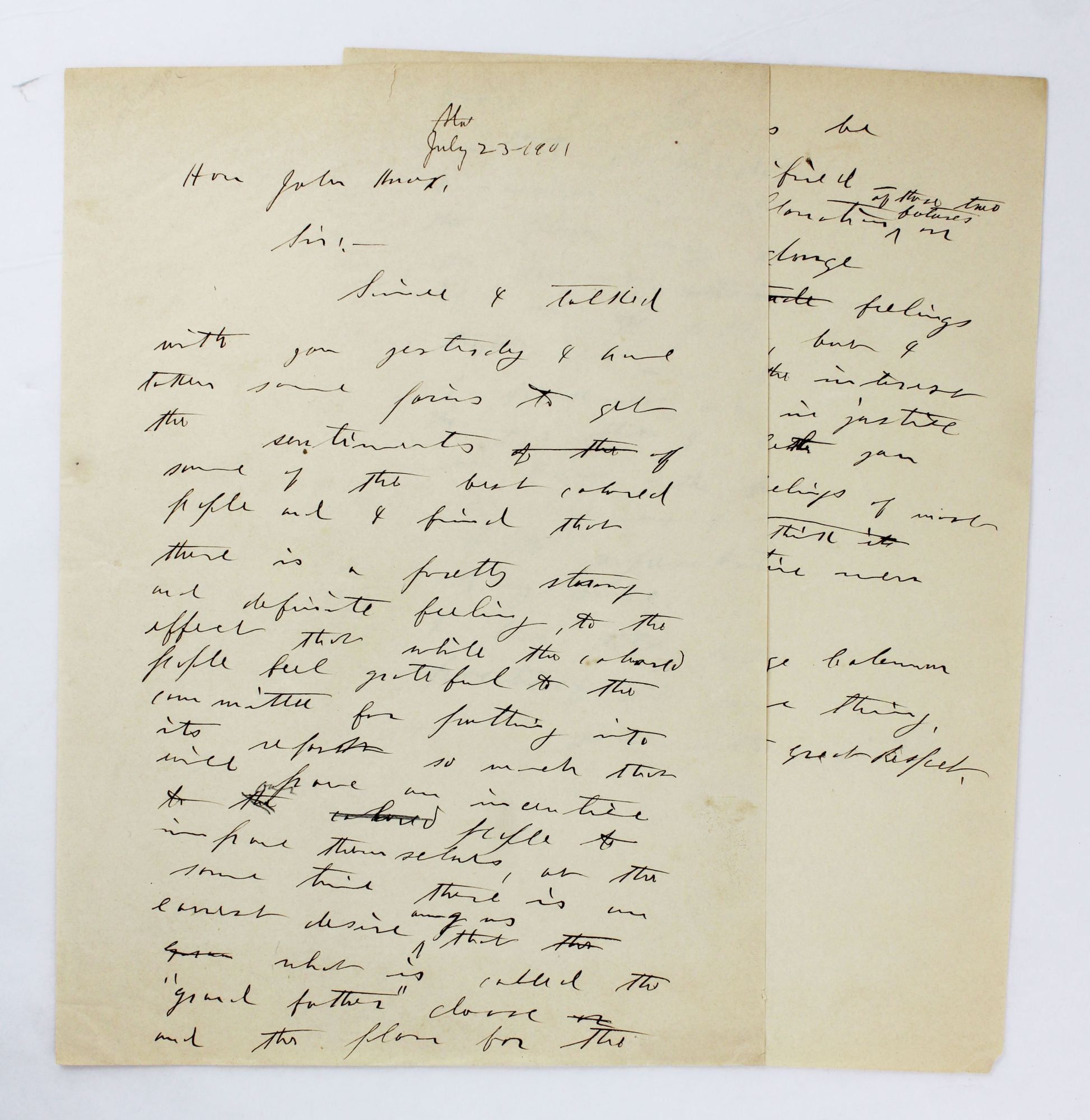
[Tuskegee, Al.]: July 23, 1901. Very good.. [2]pp. on plain paper. Minor wear and creasing. An unsigned and apparently unsent letter draft by Booker T. Washington expressing his disapproval of the Alabama Constitutional Convention's consideration of a "grandfather clause" and the employment of county "board of registrars" which sought to severely limit voting rights of the African-American population. Washington's draft was written in the midst of the convention, which took place between May and September of 1901. Washington has addressed the draft to the Honorable John Knox, who was serving as the president of the convention. Knox is notorious today for asking in his opening address at the 1901 convention: "And what is it that we want to do? Why, it is, within the limits imposed by the Federal Constitution, to establish white supremacy in this State." The grandfather clause and the county board of registrars went a long way to accomplishing this goal.
The full text of the present draft by Washington reads, with relevant emendations: "Hon. John Knox. Sir: Since I talked with you yesterday I have taken some pains to get the sentiments of some of the best colored people and I find that there is a pretty strong and definite feeling, to the effect that while the colored people feel grateful to the committee for putting into its report so much that will have an incentive to our people to improve themselves, at the same time there is an earnest desire among us that what is called the ‘grand father’ clause and the plan for the board of registrars be omitted or modified. Discussion and explanation of those two features on the floor may change the present attitude feelings of our people, but I thought it in the interest of frankness, and in justice to you that I let you know the feelings of my race as I think it most of the representative men of my race. I have told Judge Coleman practically the same thing."
Sadly, both of the specific provisions mentioned by Washington -- the grandfather clause and the board of registrars -- were codified into law by the Alabama State Constitutional Convention. In brief, and according to the Encyclopedia Britannica, the grandfather clause provided that "those who had enjoyed the right to vote prior to 1866 or 1867, and their lineal descendants, would be exempt from recently enacted educational, property, or tax requirements for voting." This automatically excluded all African American men, who were not granted the right to vote until 1870 after passage of the Fifteenth Amendment. Further, the establishment of boards of registrars in each Alabama county allowed for those local officials to drag their feet, arbitrarily deny voter registration applications, reject applicants for perceived "suspicious" character, and more. Some of the legal tenets codified in Alabama's 1901 constitution have never been fully expunged, and have affected African American voting rights from 1901, through the Civil Rights Movement, and even to the present day. Ironically, it is another Coleman in Alabama who has, in modern times, sought to rectify the racism inherent in the 1901 constitution. Alabama House Representative Merika Coleman, Democrat of Pleasant Grove, has worked as recently as 2022 to remove racist language from the 1901 constitution.
This draft letter was not the first communication Washington made to the convention. In late-May of 1901, Washington and twenty-three additional Black leaders signed their names to a five-page address sent to the state constitutional convention, basically reminding the delegates of the state of Black life in Alabama, and noting that most African Americans were hard-working, law-abiding citizens devoted to the state. The authors of the address also asked that "The Negro...since he is taxed, works for the roads, is punished for crime, is called upon to defend his country, that he have some humble share in choosing those who rule over him, especially when he has proven his worthiness by becoming a taxpayer and a worthy reliable citizen." The convention all but ignored this plea from the most prominent African-American citizens in Alabama. Interestingly, the present draft letter was written the same year as the publication of Washington's autobiography, Up from Slavery, and three months before Washington dined with President Theodore Roosevelt at the White House. The latter sparked controversy from the usual suspects, as this was generally considered the first time a Black man met publicly with the president on equal terms. A unique communication from a legendary African-American leader in Alabama, as relevant today for fighting racist codification of the law as when it was written in 1901. Interestingly, the letter is accompanied by an invoice from noted autograph dealer Walter R. Benjamin, who notes that "This is the first handwritten item by B.T.W. I have ever seen. Very scarce.
The full text of the present draft by Washington reads, with relevant emendations: "Hon. John Knox. Sir: Since I talked with you yesterday I have taken some pains to get the sentiments of some of the best colored people and I find that there is a pretty strong and definite feeling, to the effect that while the colored people feel grateful to the committee for putting into its report so much that will have an incentive to our people to improve themselves, at the same time there is an earnest desire among us that what is called the ‘grand father’ clause and the plan for the board of registrars be omitted or modified. Discussion and explanation of those two features on the floor may change the present attitude feelings of our people, but I thought it in the interest of frankness, and in justice to you that I let you know the feelings of my race as I think it most of the representative men of my race. I have told Judge Coleman practically the same thing."
Sadly, both of the specific provisions mentioned by Washington -- the grandfather clause and the board of registrars -- were codified into law by the Alabama State Constitutional Convention. In brief, and according to the Encyclopedia Britannica, the grandfather clause provided that "those who had enjoyed the right to vote prior to 1866 or 1867, and their lineal descendants, would be exempt from recently enacted educational, property, or tax requirements for voting." This automatically excluded all African American men, who were not granted the right to vote until 1870 after passage of the Fifteenth Amendment. Further, the establishment of boards of registrars in each Alabama county allowed for those local officials to drag their feet, arbitrarily deny voter registration applications, reject applicants for perceived "suspicious" character, and more. Some of the legal tenets codified in Alabama's 1901 constitution have never been fully expunged, and have affected African American voting rights from 1901, through the Civil Rights Movement, and even to the present day. Ironically, it is another Coleman in Alabama who has, in modern times, sought to rectify the racism inherent in the 1901 constitution. Alabama House Representative Merika Coleman, Democrat of Pleasant Grove, has worked as recently as 2022 to remove racist language from the 1901 constitution.
This draft letter was not the first communication Washington made to the convention. In late-May of 1901, Washington and twenty-three additional Black leaders signed their names to a five-page address sent to the state constitutional convention, basically reminding the delegates of the state of Black life in Alabama, and noting that most African Americans were hard-working, law-abiding citizens devoted to the state. The authors of the address also asked that "The Negro...since he is taxed, works for the roads, is punished for crime, is called upon to defend his country, that he have some humble share in choosing those who rule over him, especially when he has proven his worthiness by becoming a taxpayer and a worthy reliable citizen." The convention all but ignored this plea from the most prominent African-American citizens in Alabama. Interestingly, the present draft letter was written the same year as the publication of Washington's autobiography, Up from Slavery, and three months before Washington dined with President Theodore Roosevelt at the White House. The latter sparked controversy from the usual suspects, as this was generally considered the first time a Black man met publicly with the president on equal terms. A unique communication from a legendary African-American leader in Alabama, as relevant today for fighting racist codification of the law as when it was written in 1901. Interestingly, the letter is accompanied by an invoice from noted autograph dealer Walter R. Benjamin, who notes that "This is the first handwritten item by B.T.W. I have ever seen. Very scarce.
Details
Title
[Autograph Draft Letter by Booker T. Washington, Addressed to Hon. John Knox, Pertaining to the "Grandfather Clause" and Other Issues Limiting African-American Suffrage Being Discussed During the Alabama State Constitutional Convention of 1901]
Author
Washington, Booker T.
Condition
Very Good
Publisher
July 23: [Tuskegee, Al.]
Date
1901