

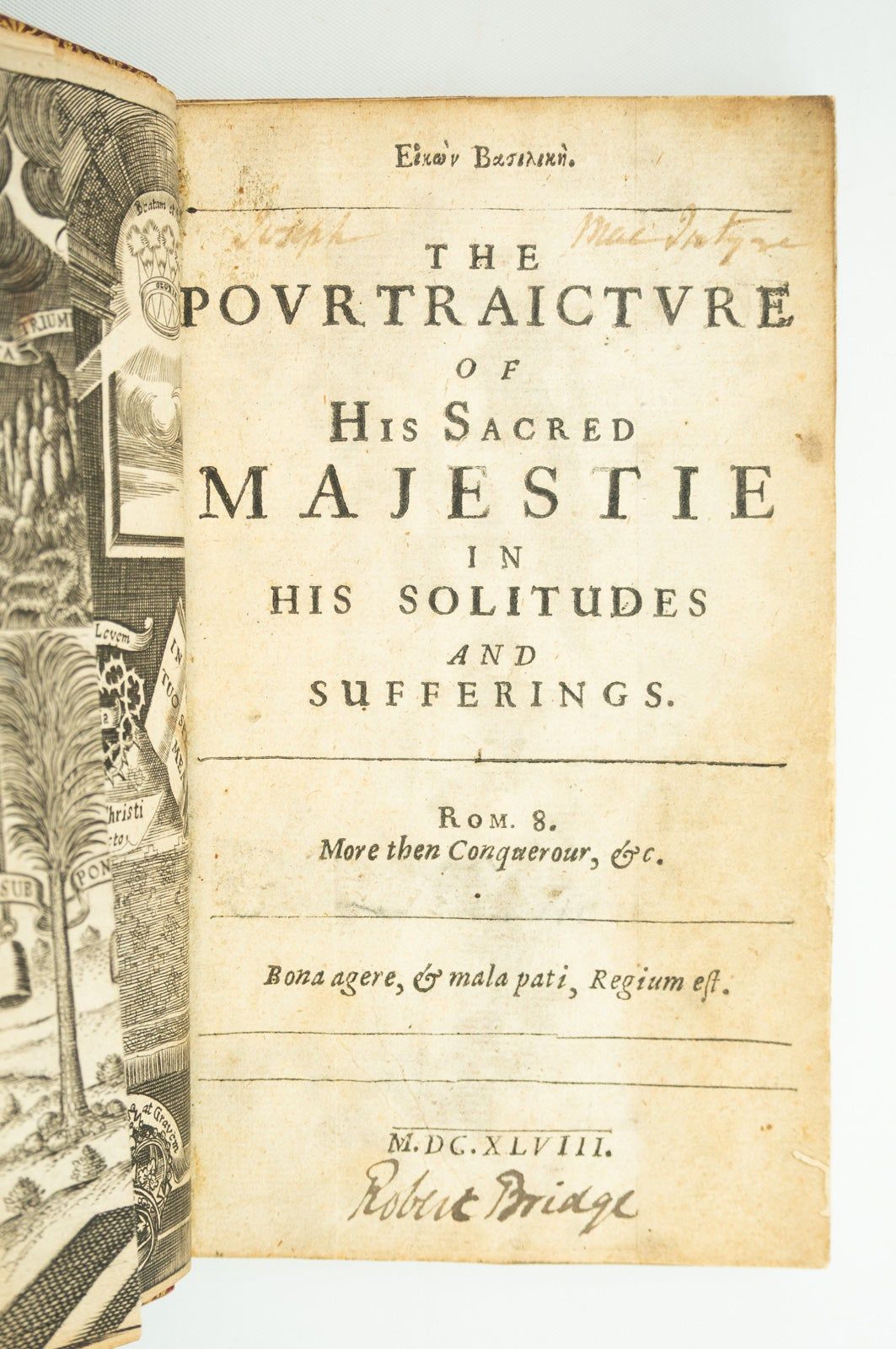
[In Greek:] EIKON BASILIKE. [Then:] THE POURTRAICTURE OF HIS SACRED MAJESTIE IN HIS SOLITUDES AND SUFFERINGS. [with] A PERFECT COPIE OF PRAYERS USED BY HIS MAJESTIE IN THE TIME OF HIS SUFFERINGS
![[In Greek:] EIKON BASILIKE. [Then:] THE POURTRAICT](https://d3525k1ryd2155.cloudfront.net/h/433/273/1701273433.0.x.jpg)
- [London]: s.n., 1648 [but 1649]
[London]: s.n., 1648 [but 1649]. 162 x 98 mm. (6 3/8 x 3 7/8"). 3 p.l., 208, 107-154, 255-302, [16] pp. (pagination irregular, but text complete).
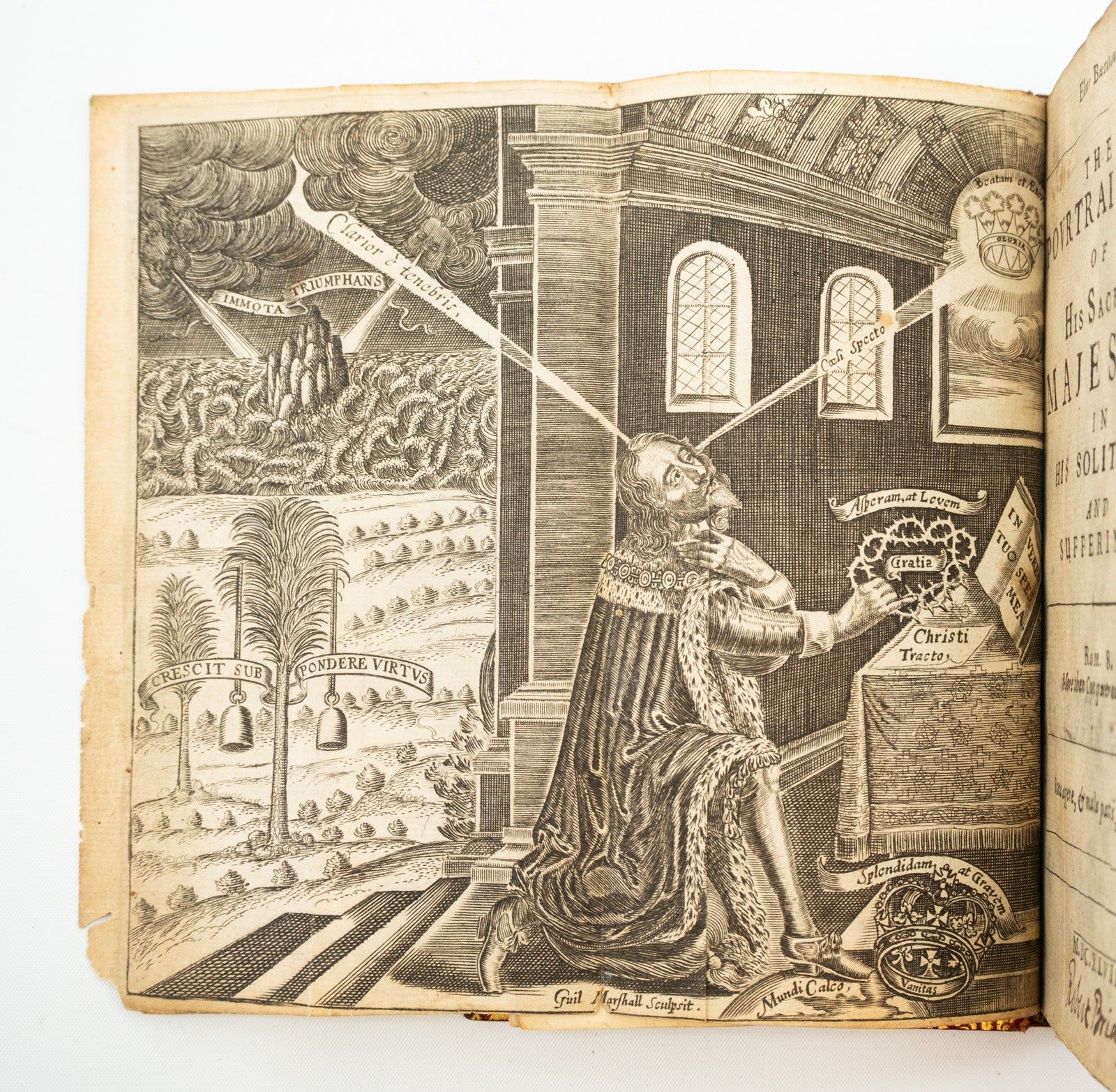
Attractive early 19th century red pebble-grain morocco, gilt, covers with double rule border, frame of lancet and volute tools, raised bands, spine gilt in compartments with saltire formed by lancet tools, gilt lettering, gilt turn-ins, marbled endpapers, all edges gilt. With a folding engraved portrait of Charles I kneeling in prayer, signed by Guil. Marshall. Front flyleaf and title page with ink owner inscription of Robert Bridge; title page with faded ink signature of Joseph MacIntyre. Almack 15; Madan 21; Wing E-283; ESTC R29848. Covers with trivial soiling, frontispiece faintly browned (and with two tiny chips and a short wormtrail), title leaf backed and slightly soiled, first half of the book with faint, narrow vertical dampstain to fore margin, last three pages lightly soiled and with a few small ink trials, but still a very good copy of a book normally found in poor shape, the text quite fresh, and the later binding with only insignificant signs of use.
Nicely bound and opening with a fine and touching engraving, this is an early printing of a work purporting to be the meditations of Charles I, recorded during the Great Rebellion and originally published shortly before his execution, with copies actually being offered for sale on the day of his demise. Afterwards, the strong popular appeal of the book prompted repeated printings, produced, as Almack notes, "amidst dangers and difficulties.” Despite those fraught conditions at the press, Almack observes that "the engraved plate [in our volume] is in a fine early impression." And he mentions that the final Prayers of the Sovereign near the end of our volume--which are not listed in the table of contents and are not present in all copies--were specially printed for this edition. The work's musings on Parliament, religion, battle, family, and death present the portrait of a troubled, conscientious, and virtuous king. Royalists maintained that they saw the manuscript in the hands of the monarch, but soon after publication, a rumor began to circulate that it was the work of the ecclesiastic John Gauden (the book concludes with an epitaph for Charles I signed by "I. H."). Perhaps Gauden (1605-62) came into possession of a manuscript penned by the king, but similarities of the text here to Gauden's other writings suggest that he injected much of his own belief into the present text. Whoever the author, the book was most effective in establishing the murdered king as a martyr. Dismayed, Parliament recruited Milton to present a point-by-point answer, issued in his scathing 1649 "Eikonoklastes"--a work that got the author arrested when the monarchy was restored in 1660. Dean of Essex during the English Civil War, Gauden was initially sympathetic to republican demands, but he became more and more doubtful of the merits of the rebellion as it progressed. The execution of the anointed king was the breaking point for him, and he denounced Cromwell as a murderer. After Charles II was again installed on the throne, Gauden was given the bishopric of Worcester as a reward for his support of the restored order..
Attractive early 19th century red pebble-grain morocco, gilt, covers with double rule border, frame of lancet and volute tools, raised bands, spine gilt in compartments with saltire formed by lancet tools, gilt lettering, gilt turn-ins, marbled endpapers, all edges gilt. With a folding engraved portrait of Charles I kneeling in prayer, signed by Guil. Marshall. Front flyleaf and title page with ink owner inscription of Robert Bridge; title page with faded ink signature of Joseph MacIntyre. Almack 15; Madan 21; Wing E-283; ESTC R29848. Covers with trivial soiling, frontispiece faintly browned (and with two tiny chips and a short wormtrail), title leaf backed and slightly soiled, first half of the book with faint, narrow vertical dampstain to fore margin, last three pages lightly soiled and with a few small ink trials, but still a very good copy of a book normally found in poor shape, the text quite fresh, and the later binding with only insignificant signs of use.
Nicely bound and opening with a fine and touching engraving, this is an early printing of a work purporting to be the meditations of Charles I, recorded during the Great Rebellion and originally published shortly before his execution, with copies actually being offered for sale on the day of his demise. Afterwards, the strong popular appeal of the book prompted repeated printings, produced, as Almack notes, "amidst dangers and difficulties.” Despite those fraught conditions at the press, Almack observes that "the engraved plate [in our volume] is in a fine early impression." And he mentions that the final Prayers of the Sovereign near the end of our volume--which are not listed in the table of contents and are not present in all copies--were specially printed for this edition. The work's musings on Parliament, religion, battle, family, and death present the portrait of a troubled, conscientious, and virtuous king. Royalists maintained that they saw the manuscript in the hands of the monarch, but soon after publication, a rumor began to circulate that it was the work of the ecclesiastic John Gauden (the book concludes with an epitaph for Charles I signed by "I. H."). Perhaps Gauden (1605-62) came into possession of a manuscript penned by the king, but similarities of the text here to Gauden's other writings suggest that he injected much of his own belief into the present text. Whoever the author, the book was most effective in establishing the murdered king as a martyr. Dismayed, Parliament recruited Milton to present a point-by-point answer, issued in his scathing 1649 "Eikonoklastes"--a work that got the author arrested when the monarchy was restored in 1660. Dean of Essex during the English Civil War, Gauden was initially sympathetic to republican demands, but he became more and more doubtful of the merits of the rebellion as it progressed. The execution of the anointed king was the breaking point for him, and he denounced Cromwell as a murderer. After Charles II was again installed on the throne, Gauden was given the bishopric of Worcester as a reward for his support of the restored order..
Details
Title
[In Greek:] EIKON BASILIKE. [Then:] THE POURTRAICTURE OF HIS SACRED MAJESTIE IN HIS SOLITUDES AND SUFFERINGS. [with] A PERFECT COPIE OF PRAYERS USED BY HIS MAJESTIE IN THE TIME OF HIS SUFFERINGS
Author
(CHARLES I). [GAUDEN, JOHN]
Condition
Unknown
Publisher
s.n.: [London]
Date
1648 [but 1649]