

[WOMEN / LGBTQ / MUSIC]. "Dear Friend" - Communication from Olivia Records, the Lesbian-Feminist Record Label Collective
![[WOMEN / LGBTQ / MUSIC]. "Dear Friend" - Communica](https://d3525k1ryd2155.cloudfront.net/h/724/402/1701402724.0.x.0.jpg)
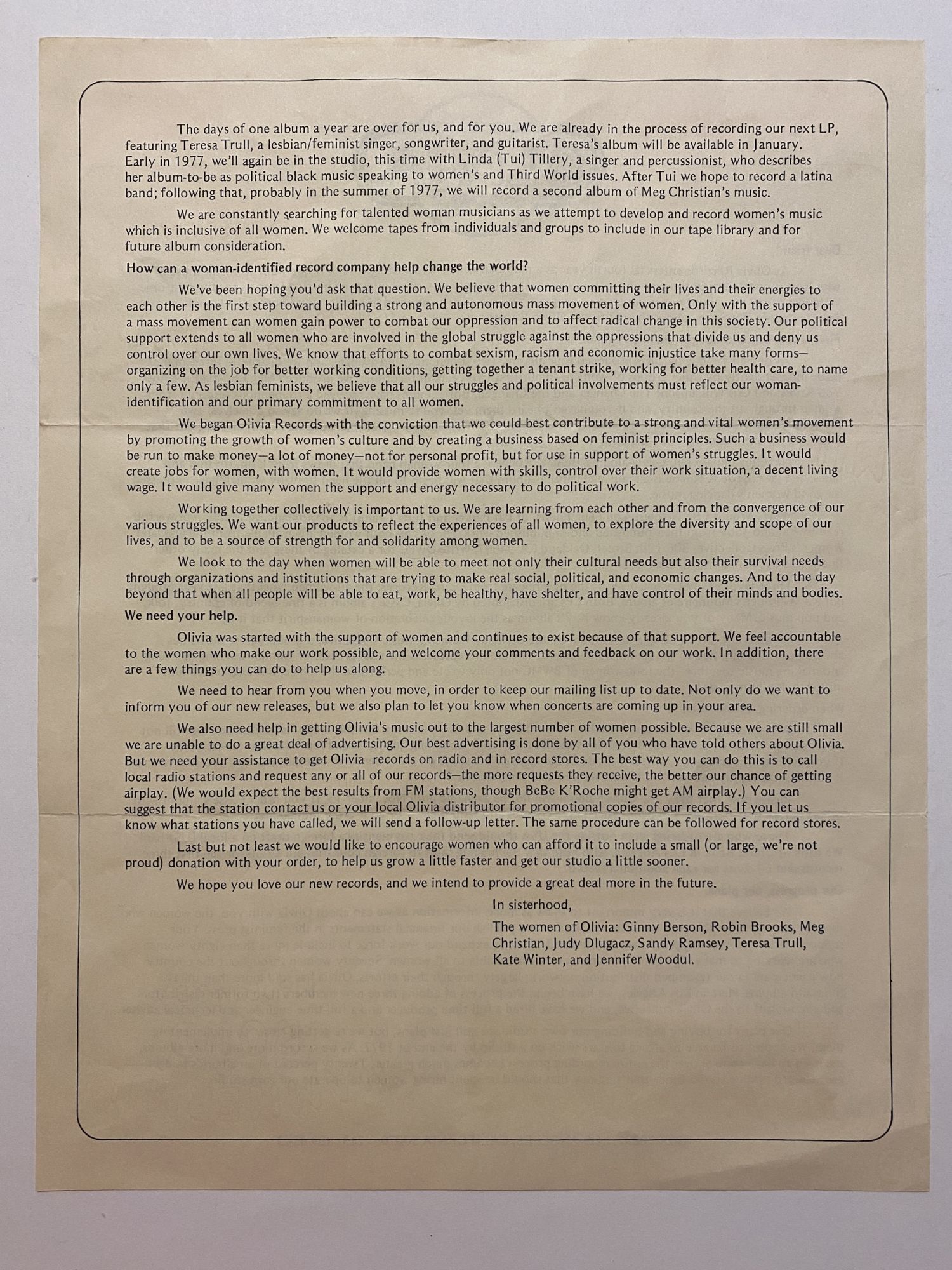
- Los Angeles , 1976
Los Angeles, 1976. Very good. Single sheet (8.5" x 11"(printed on both sides, Olivia Records logo on p. 1. Two horizontal folds, some expected creasing (not objectionable). In excellent condition, suitable for exhibition and study. VALUABLE PRIMARY SOURCE MATERIAL CONCERNING A VISIONARY WOMEN-OWNED-AND-OPERATED RECORD LABEL FOUNDED IN 1973. OLIVIA RECORDS WAS THE FIRST RECORD LABEL IN AMERICA THAT FOCUSED ON MUSIC BY AND FOR WOMEN. OFFERED HERE IS A RARE COMMUNICATION TO "FRIENDS" DISCUSSING THE PROGRESS, PLANS AND POLITICS OF THIS REMARKABLE LESBIAN-FEMINIST COLLECTIVE.
While the DYI aesthetic of the Olivia Records followed that of Memphis-based Sun Records (to which is credited with the advent of commercial Rock-and-Roll), it preceded punk and post-punk luminaries of the late 1970s such as the UK's New Hormones (Buzzcocks) and Factory (Joy Division), and Hermosa Beach's SST (Black Flag). Its constituents similarly marginalized, Olivia Records likewise rejected mainstream capitalists pressures, while maintaining an unwavering commitment to its artists and its ideologies. In its way, Olivia Records was even more important than all of the above, as it was far more than a commercial venture founded by someone who had been repeatedly rejected by major labels. Olivia Records was a non-profit collective that sought to combat oppression and to affect radical change, to combat sexism, racism and economic injustice.
The collective did so by furthering lesbian-identified commerce with acoustic folk music, to whom fans bonded (and to each other). Olivia Records achieved a degree of success which impacted the landscape of popular music, especially in the middle to late 1980s with the rise of lesbian-coded female folk-based singer/songwriters, some of whom recorded on major labels. Olivia Records played a significant role in the "women's music" movement, creating opportunities for female artists and influencing the broader cultural landscape through its advocacy for women's and lesbian rights. By 1995, the collective ceased to release music, but its legacy as the first record company to produce and distribute
"women's music" is secure.
Our communication evidently accompanied a catalogue (not longer present) for four Olivia Records albums, two songbooks and a single. Herein our authors ask: "HOW CAN A WOMAN-IDENTIFIED RECORD COMPANY CHANGE THE WORLD?"
CATALOGUER'S NOTE: We assign the date "1976" because on p. 2 the text references the forthcoming album of Teresa Trull, a lesbian/feminist singer-songwriter, which "will be available in January 1977."
§ Bonnie Morris, "Olivia Records: The Production of a Movement" in: Journal of Lesbian Studies (June 2015) vol. 19, no. 3, pp. 290-304.
While the DYI aesthetic of the Olivia Records followed that of Memphis-based Sun Records (to which is credited with the advent of commercial Rock-and-Roll), it preceded punk and post-punk luminaries of the late 1970s such as the UK's New Hormones (Buzzcocks) and Factory (Joy Division), and Hermosa Beach's SST (Black Flag). Its constituents similarly marginalized, Olivia Records likewise rejected mainstream capitalists pressures, while maintaining an unwavering commitment to its artists and its ideologies. In its way, Olivia Records was even more important than all of the above, as it was far more than a commercial venture founded by someone who had been repeatedly rejected by major labels. Olivia Records was a non-profit collective that sought to combat oppression and to affect radical change, to combat sexism, racism and economic injustice.
The collective did so by furthering lesbian-identified commerce with acoustic folk music, to whom fans bonded (and to each other). Olivia Records achieved a degree of success which impacted the landscape of popular music, especially in the middle to late 1980s with the rise of lesbian-coded female folk-based singer/songwriters, some of whom recorded on major labels. Olivia Records played a significant role in the "women's music" movement, creating opportunities for female artists and influencing the broader cultural landscape through its advocacy for women's and lesbian rights. By 1995, the collective ceased to release music, but its legacy as the first record company to produce and distribute
"women's music" is secure.
Our communication evidently accompanied a catalogue (not longer present) for four Olivia Records albums, two songbooks and a single. Herein our authors ask: "HOW CAN A WOMAN-IDENTIFIED RECORD COMPANY CHANGE THE WORLD?"
CATALOGUER'S NOTE: We assign the date "1976" because on p. 2 the text references the forthcoming album of Teresa Trull, a lesbian/feminist singer-songwriter, which "will be available in January 1977."
§ Bonnie Morris, "Olivia Records: The Production of a Movement" in: Journal of Lesbian Studies (June 2015) vol. 19, no. 3, pp. 290-304.
Details
Title
[WOMEN / LGBTQ / MUSIC]. "Dear Friend" - Communication from Olivia Records, the Lesbian-Feminist Record Label Collective
Author
Olivia Records
Condition
Very Good
Publisher
Los Angeles
Date
1976