

Imperatorum romanorum omnium orientalium et occidentalium verissimae imagines
- SIGNED Hardcover
- Zurich: Andreas Gessner, 1559
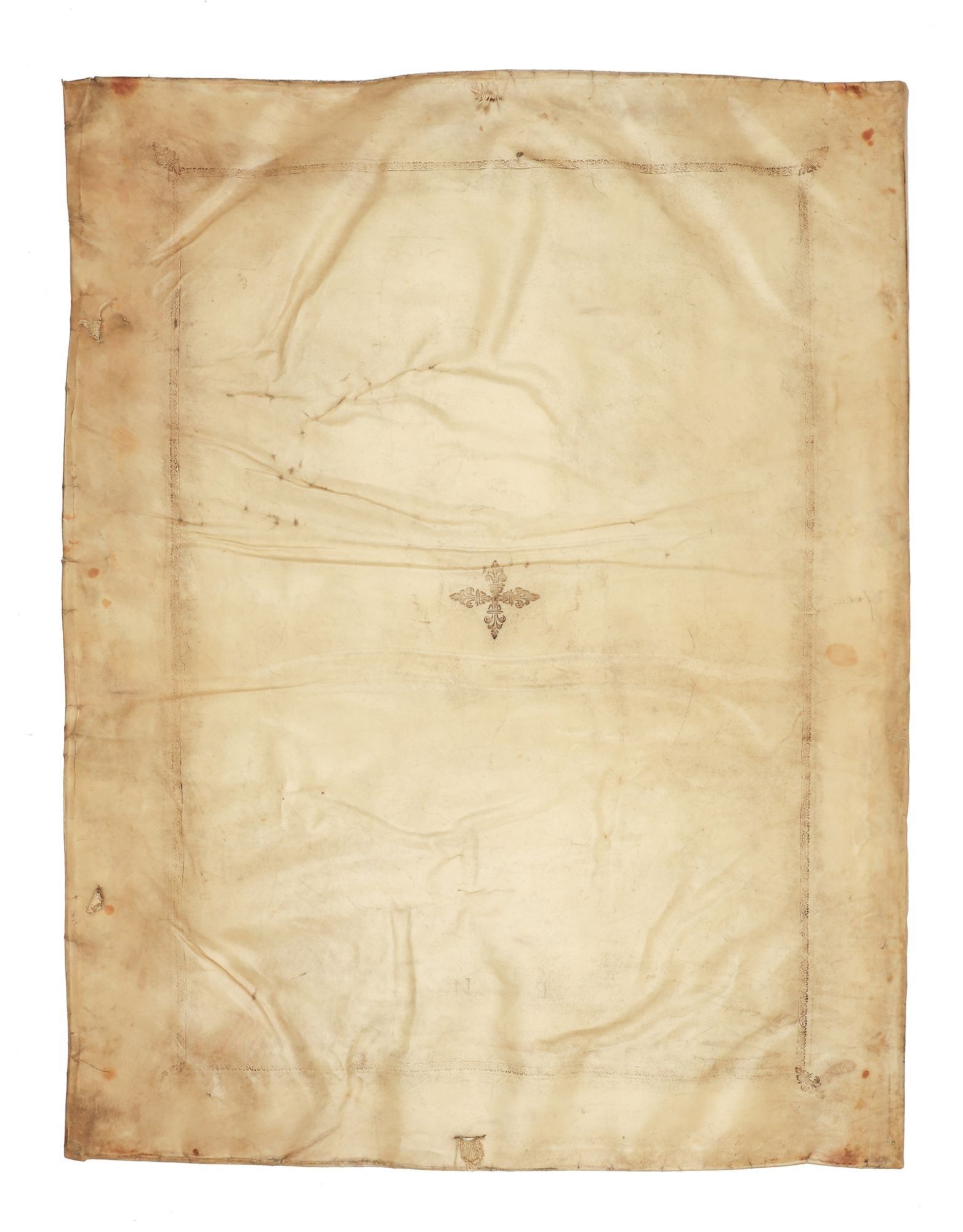
Zurich: Andreas Gessner, 1559. SOLE EDITION. Hardcover. Fine. Bound in contemporary limp vellum (mild soiling, a bit rumpled, re-cased, endpapers renewed, lacking ties), the boards blind-ruled with a large central compartment with small tools at the corners and a central armorial stamp. (re-cased, endpapers renewed) A fine copy with light marginal soiling and minor foxing. The individual leaves are on guards, with some early staining and small paper flaws in the innermost part of the gutter. Discreet marginal paper repairs to title, leaves of first gathering, and final leaf (decorative border at bottom of final leaf perhaps inlaid from another copy). With the bookplate of the German mathematician Constantin Carathédory (1873-1950) on the front pastedown; ink stamp on the title page verso of the Ducal Library of Gotha. A landmark in numismatic literature and the history of coin collecting.
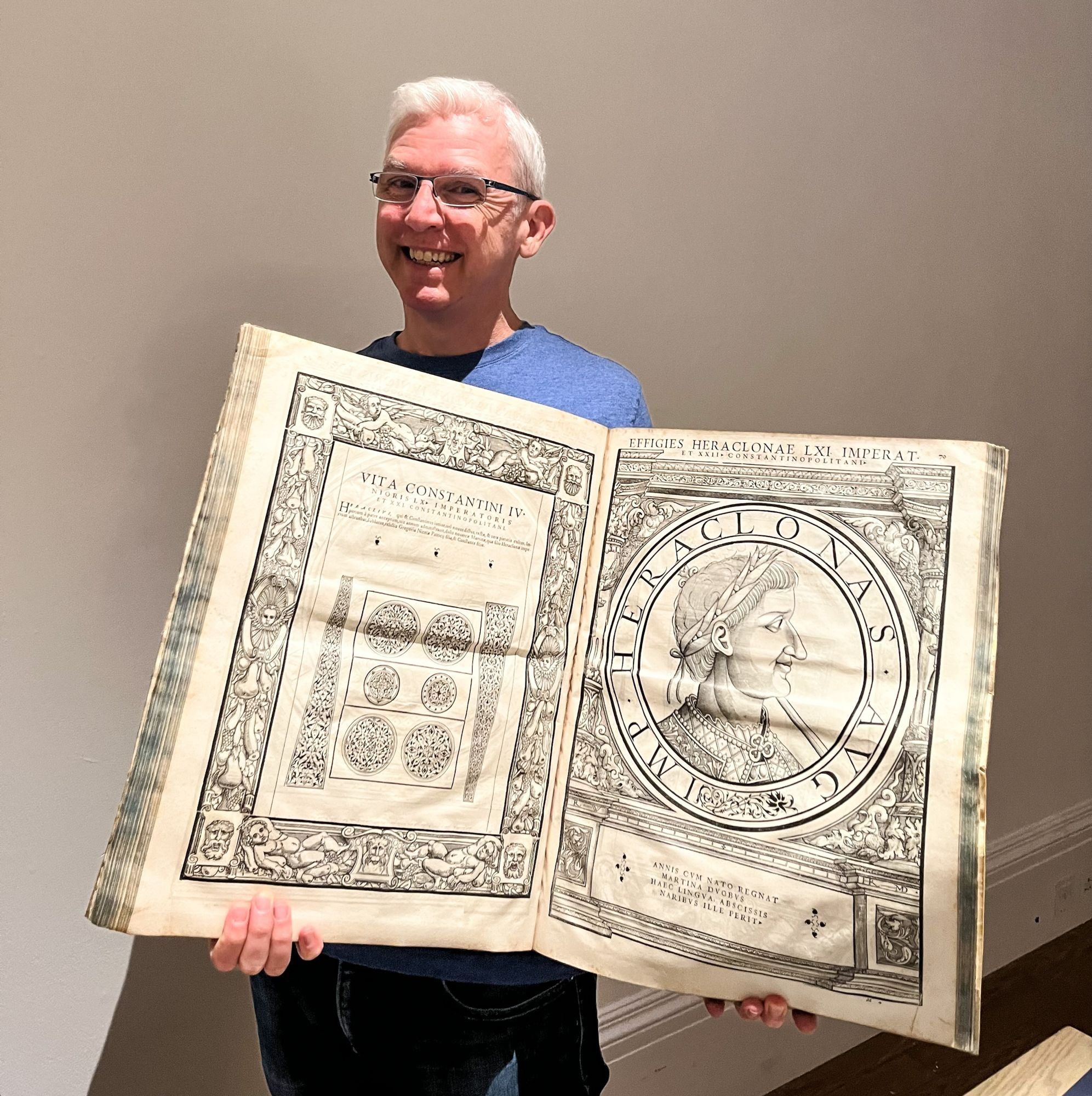
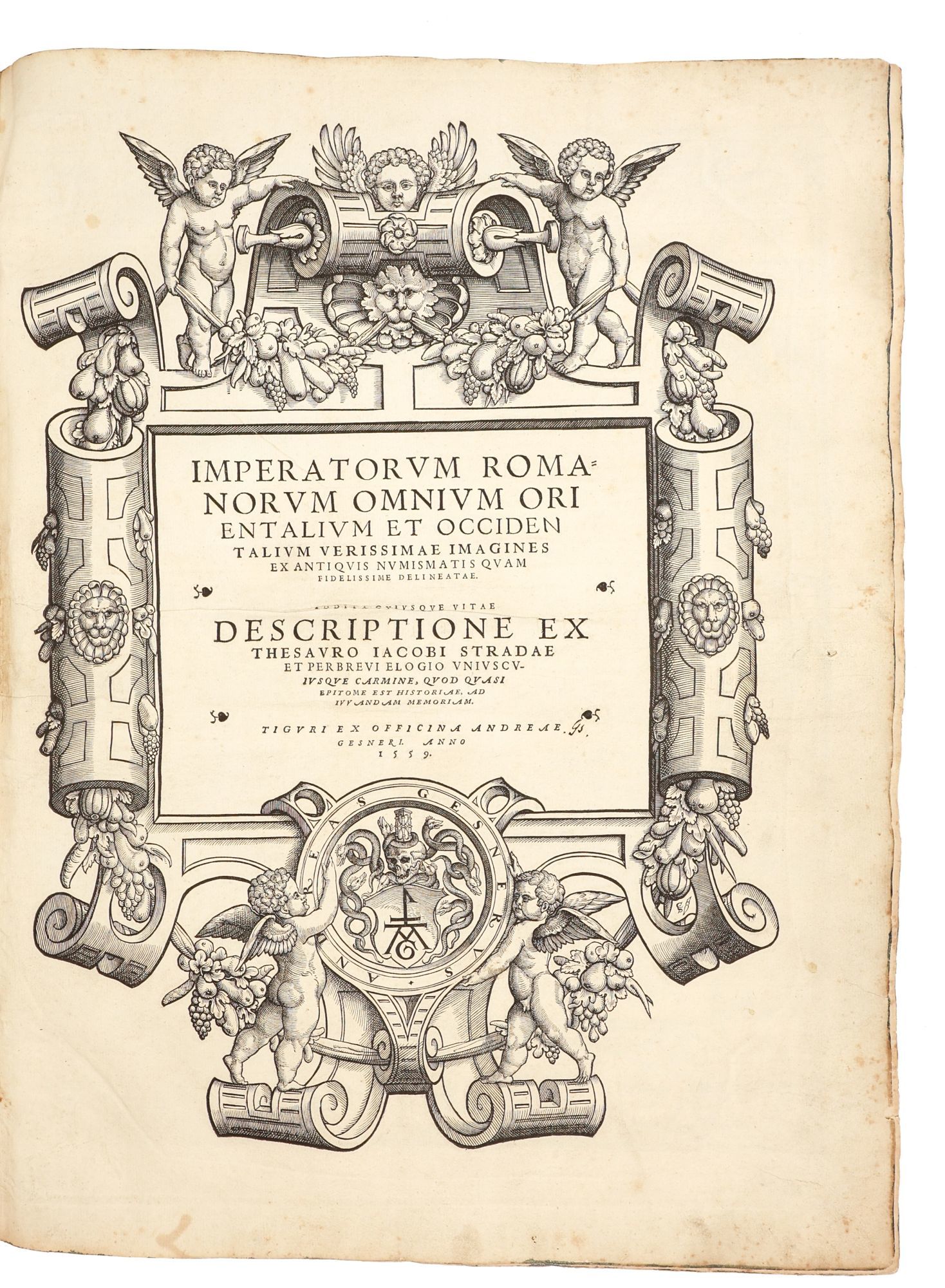
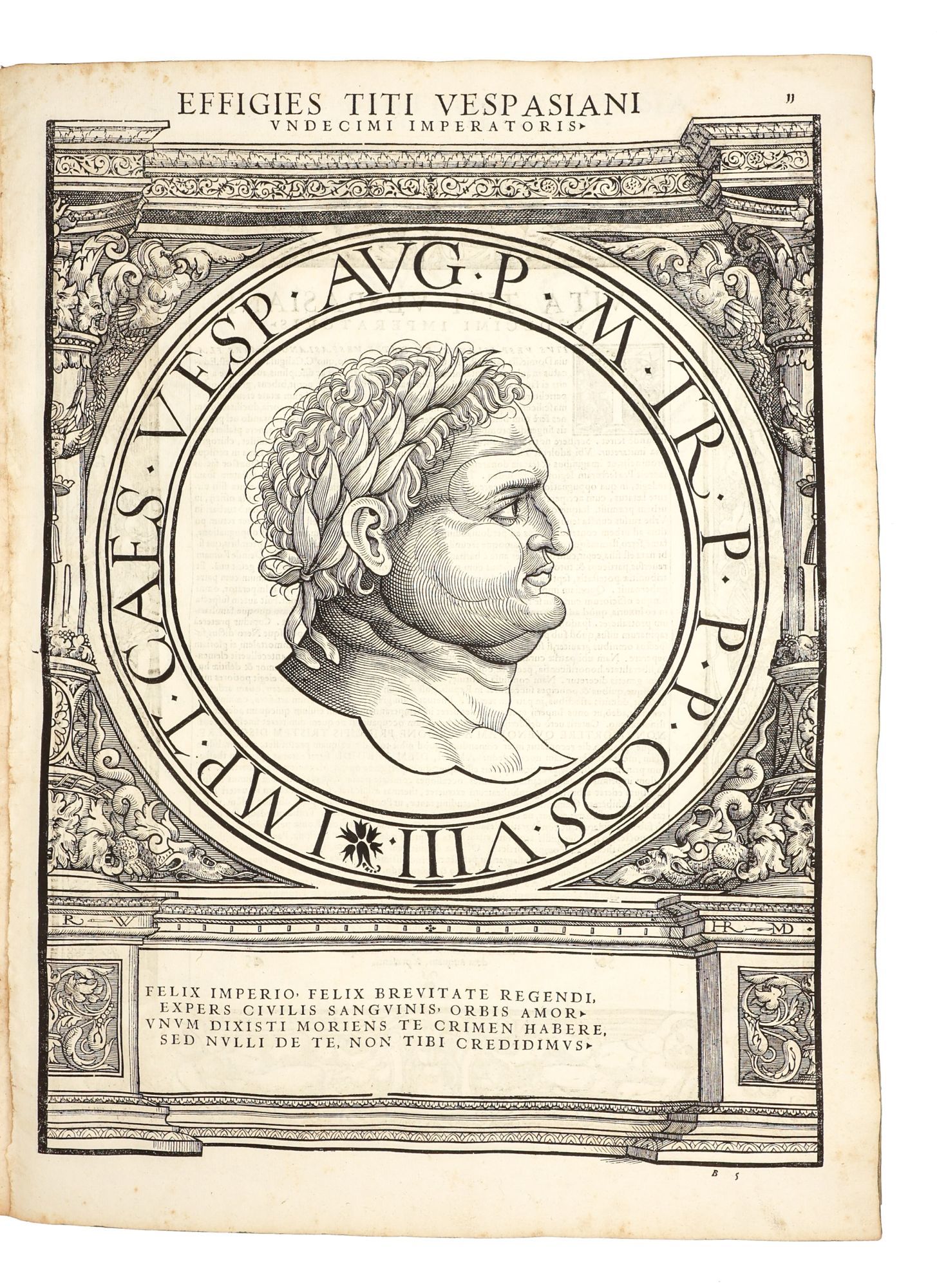
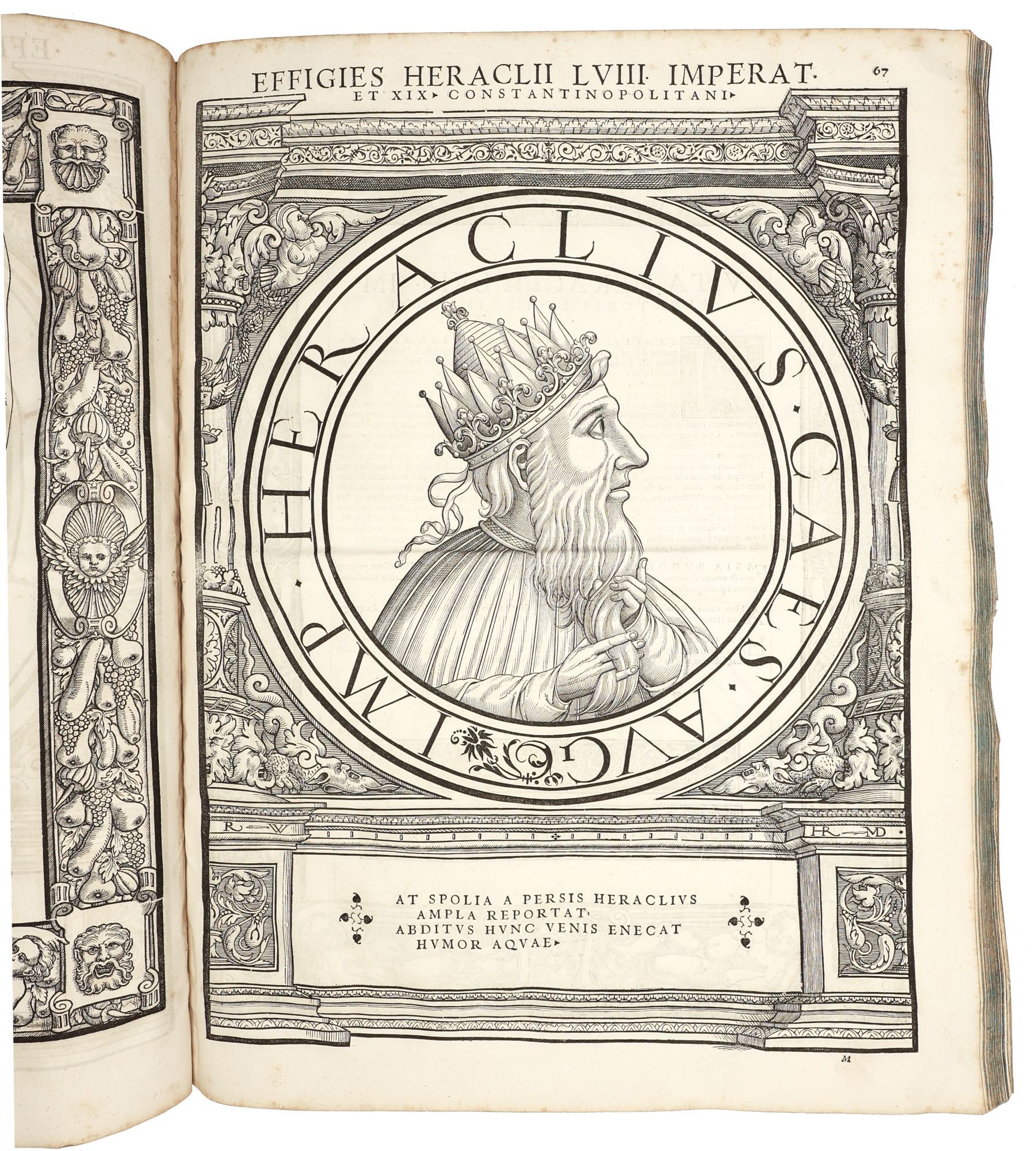
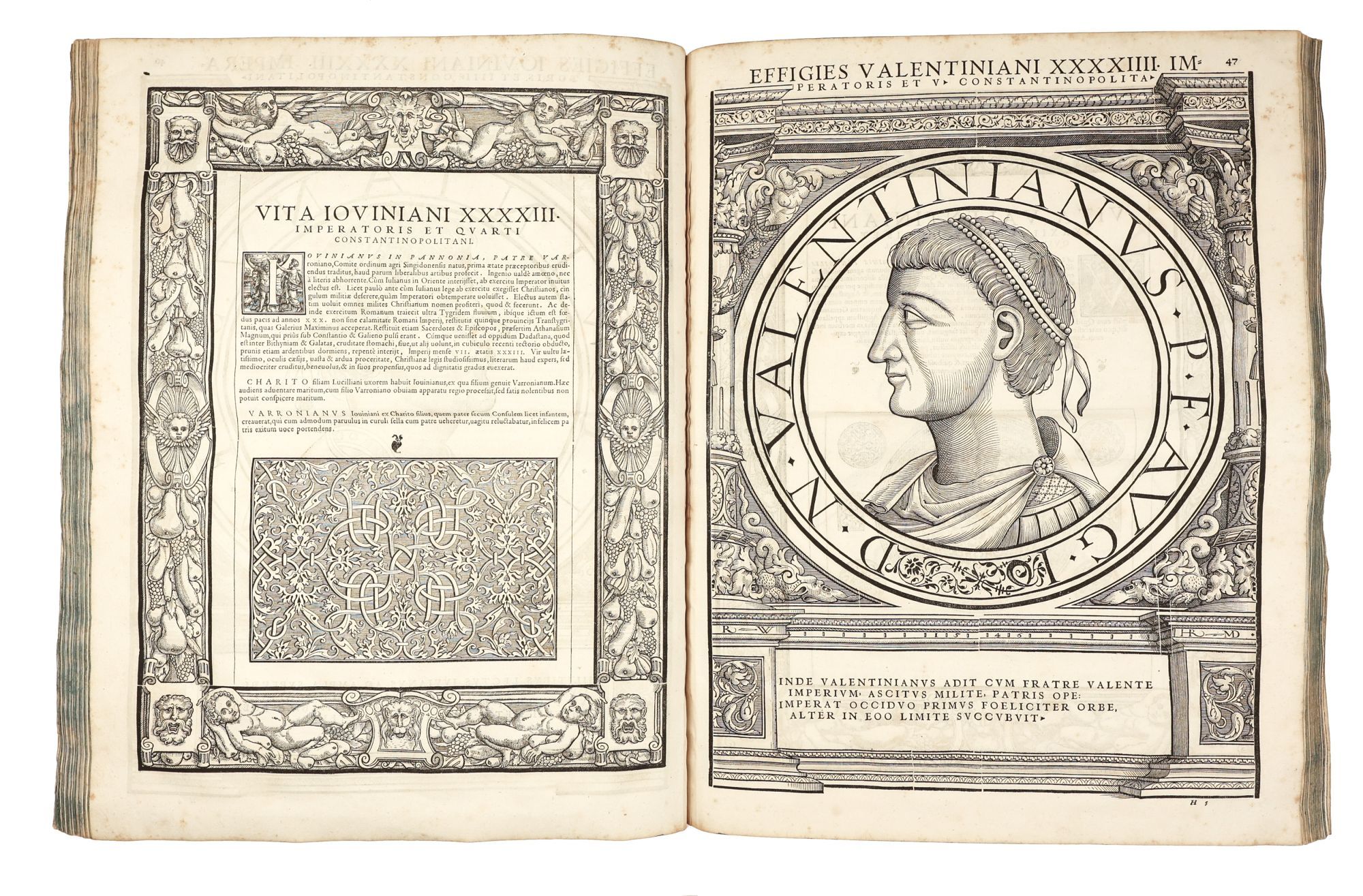
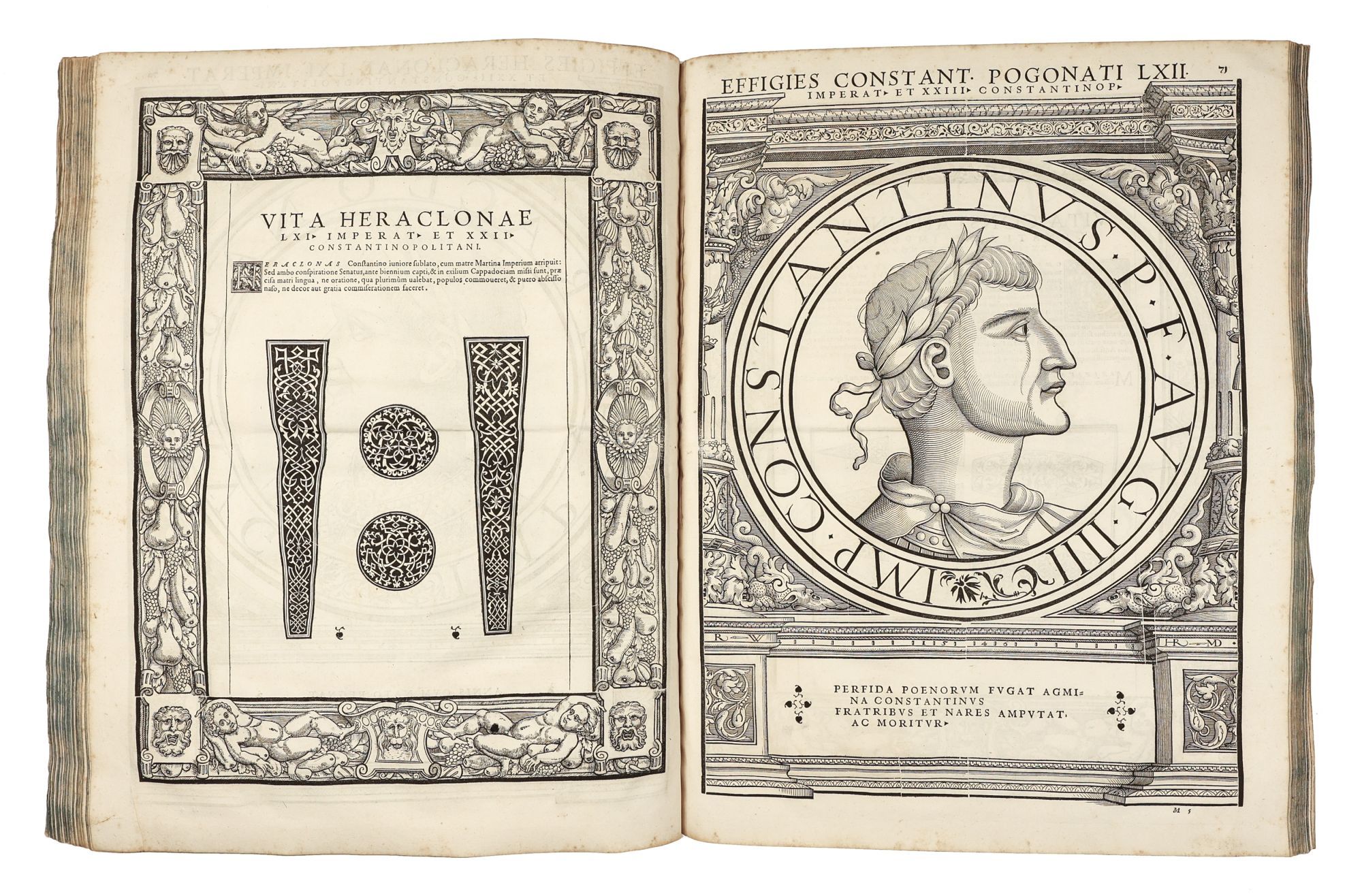
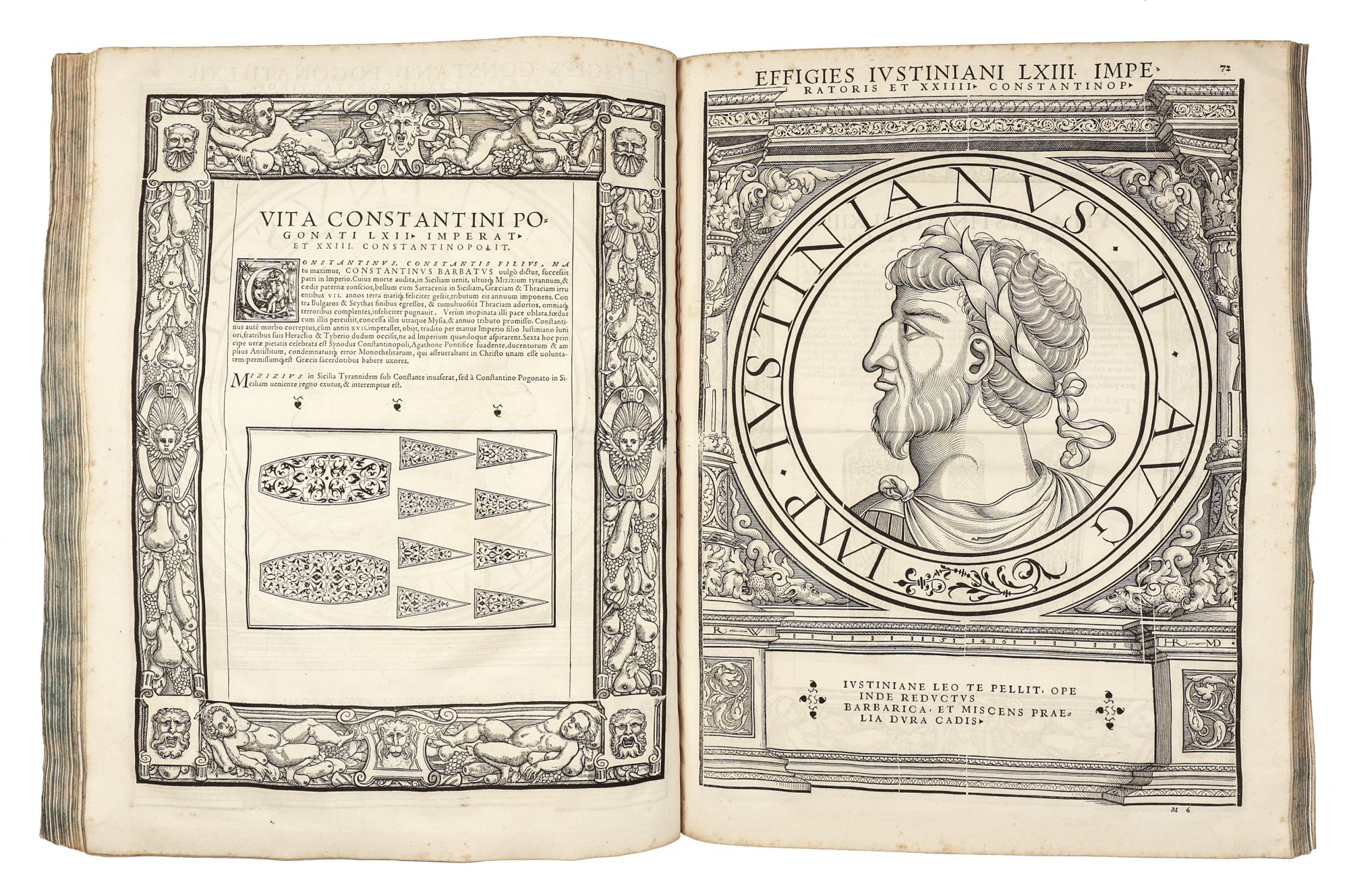
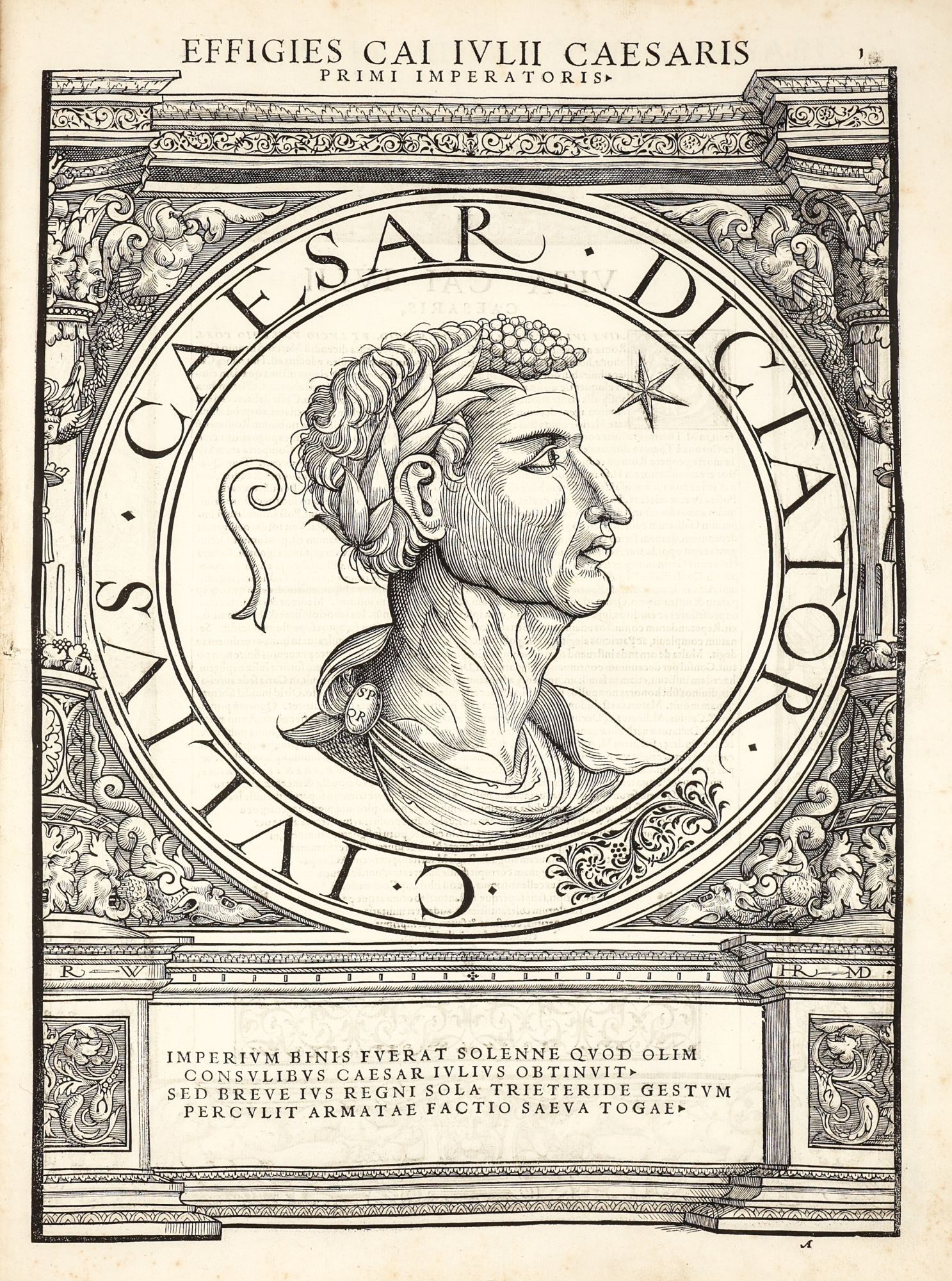
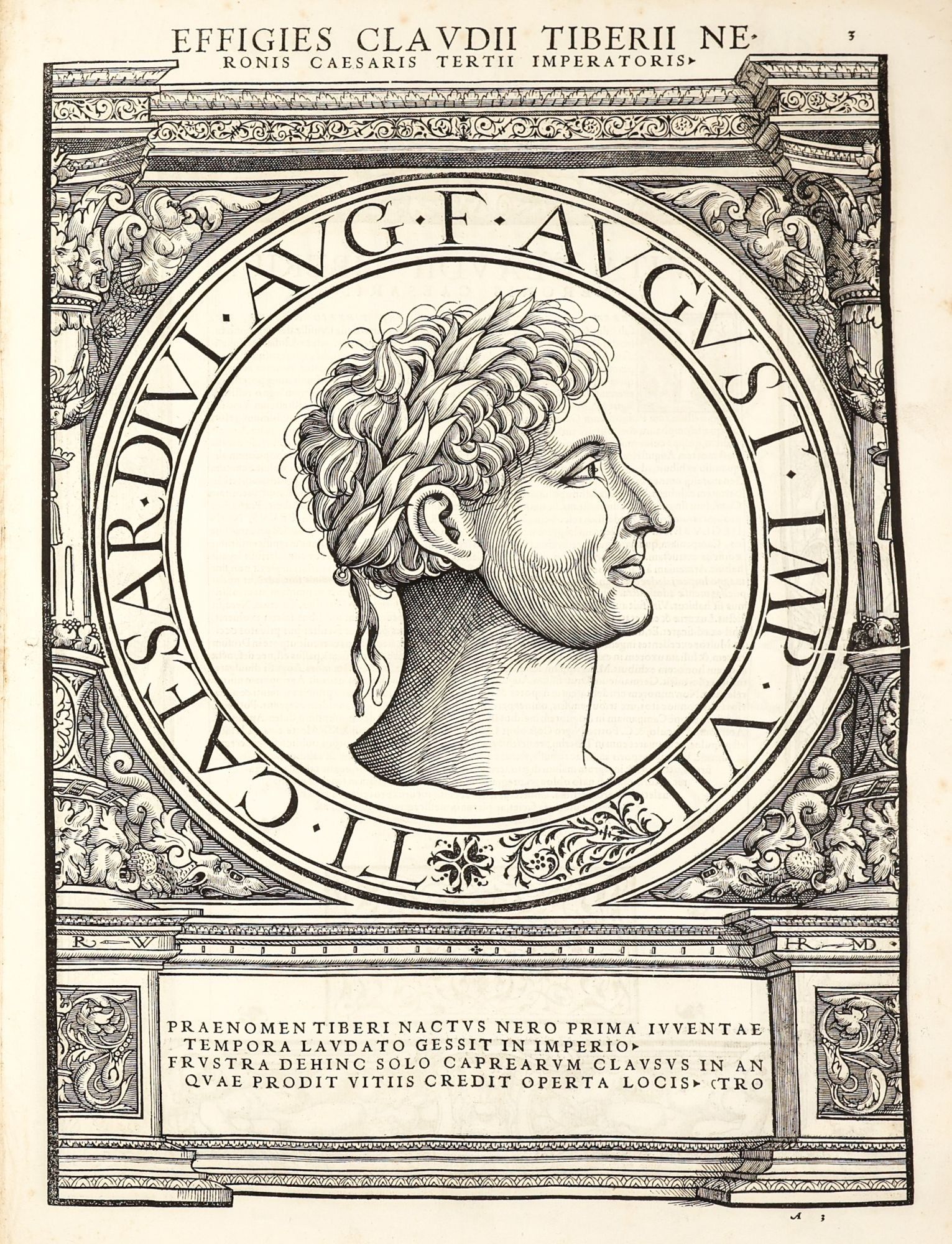
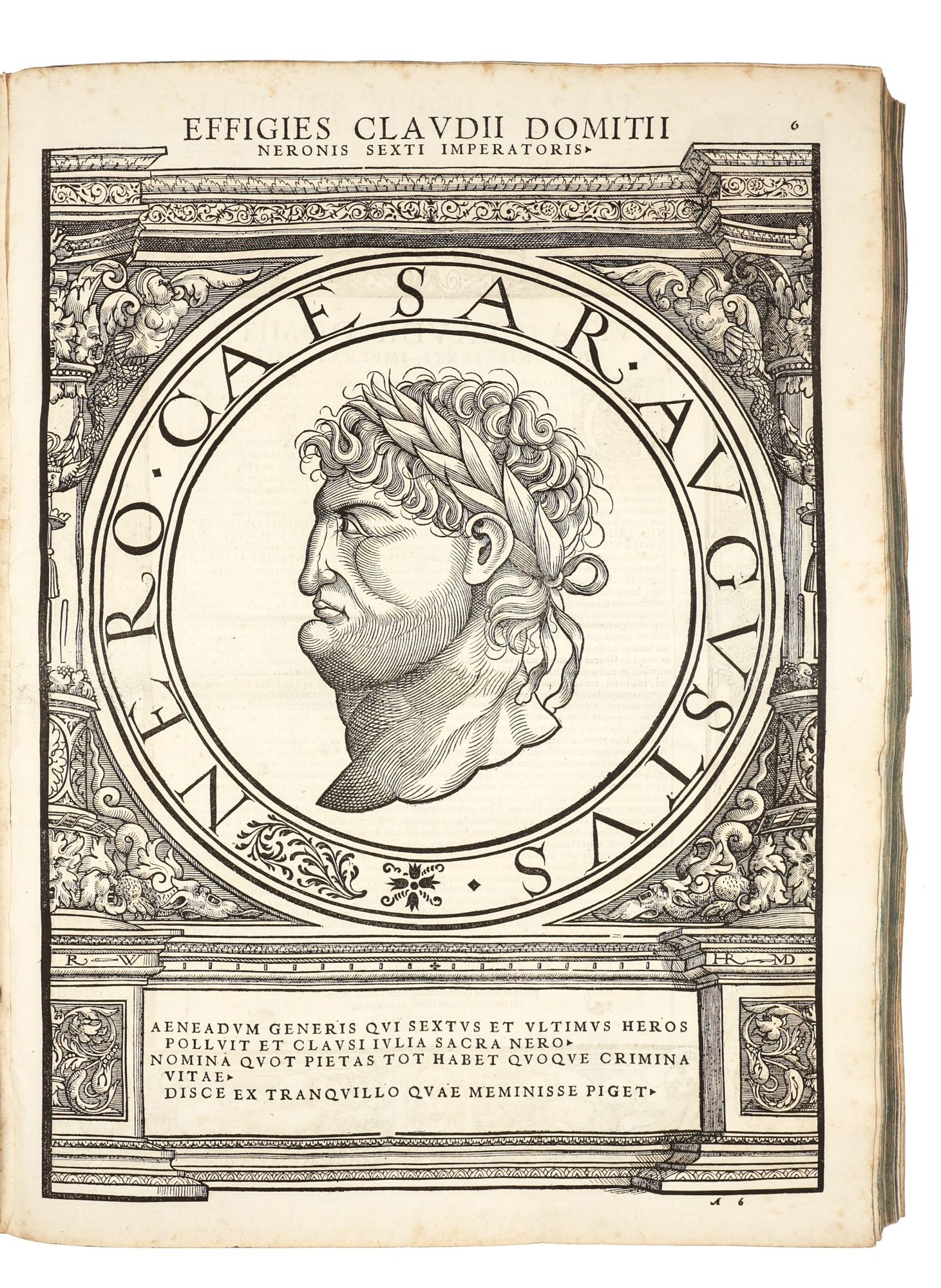
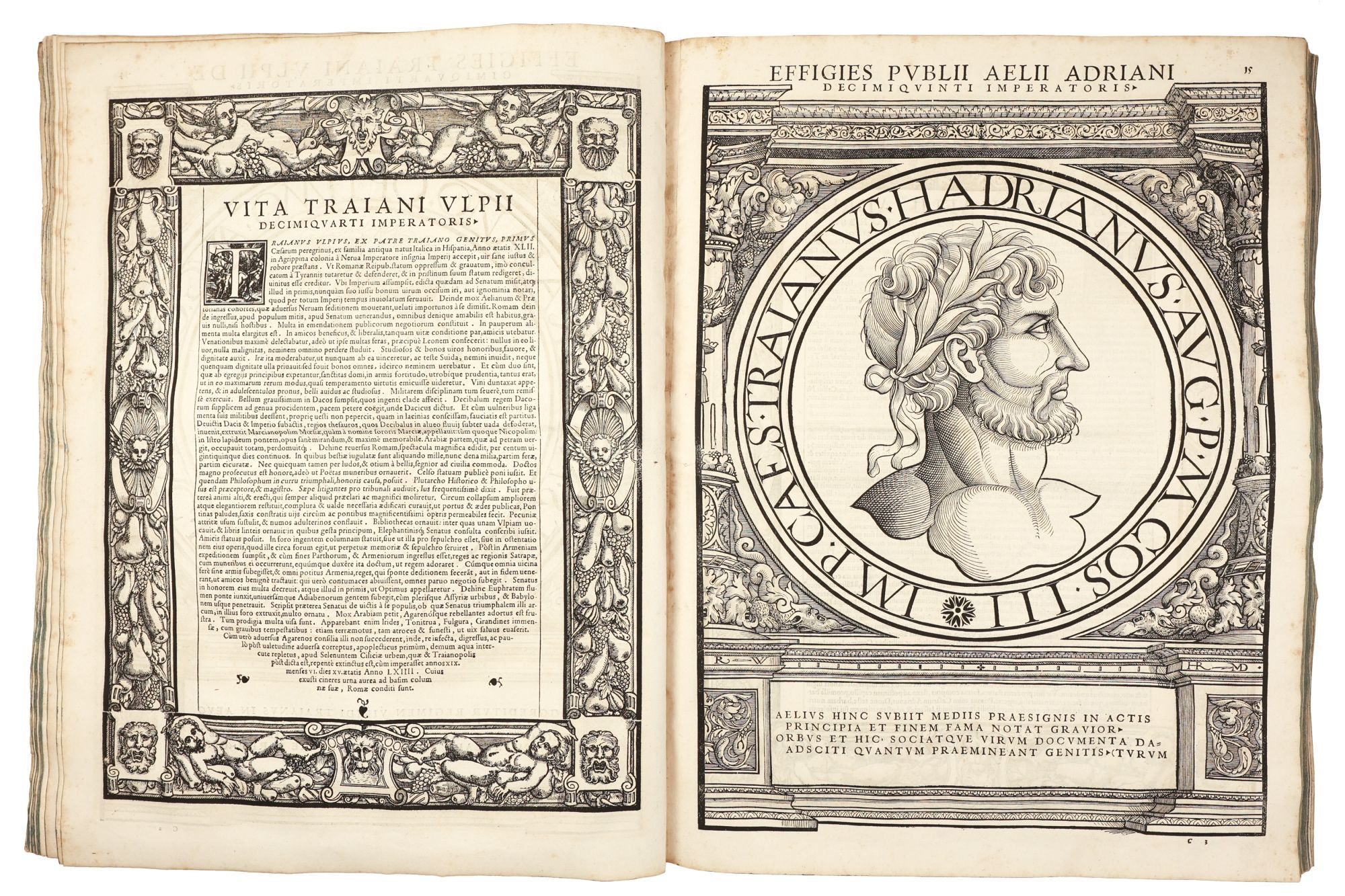
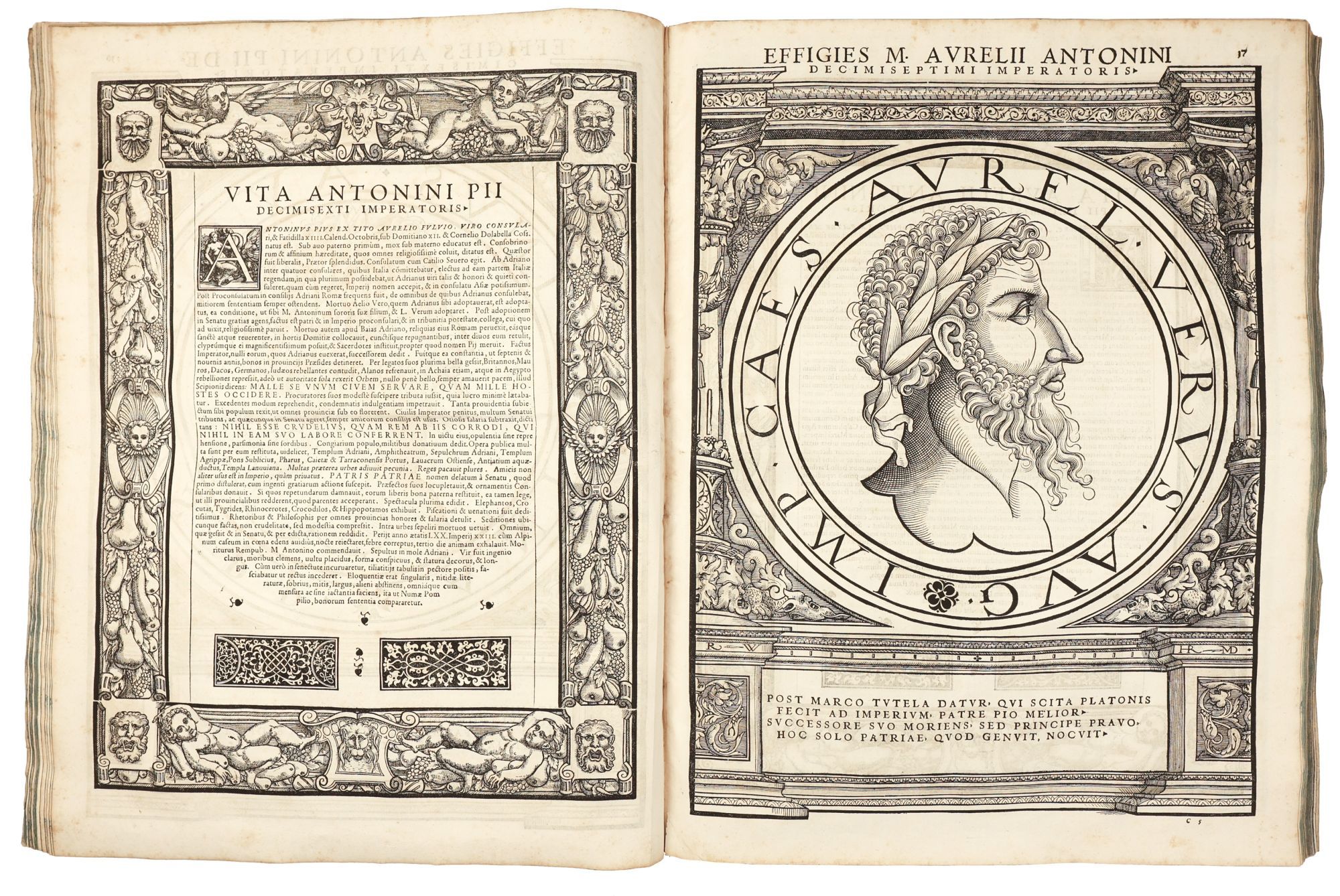
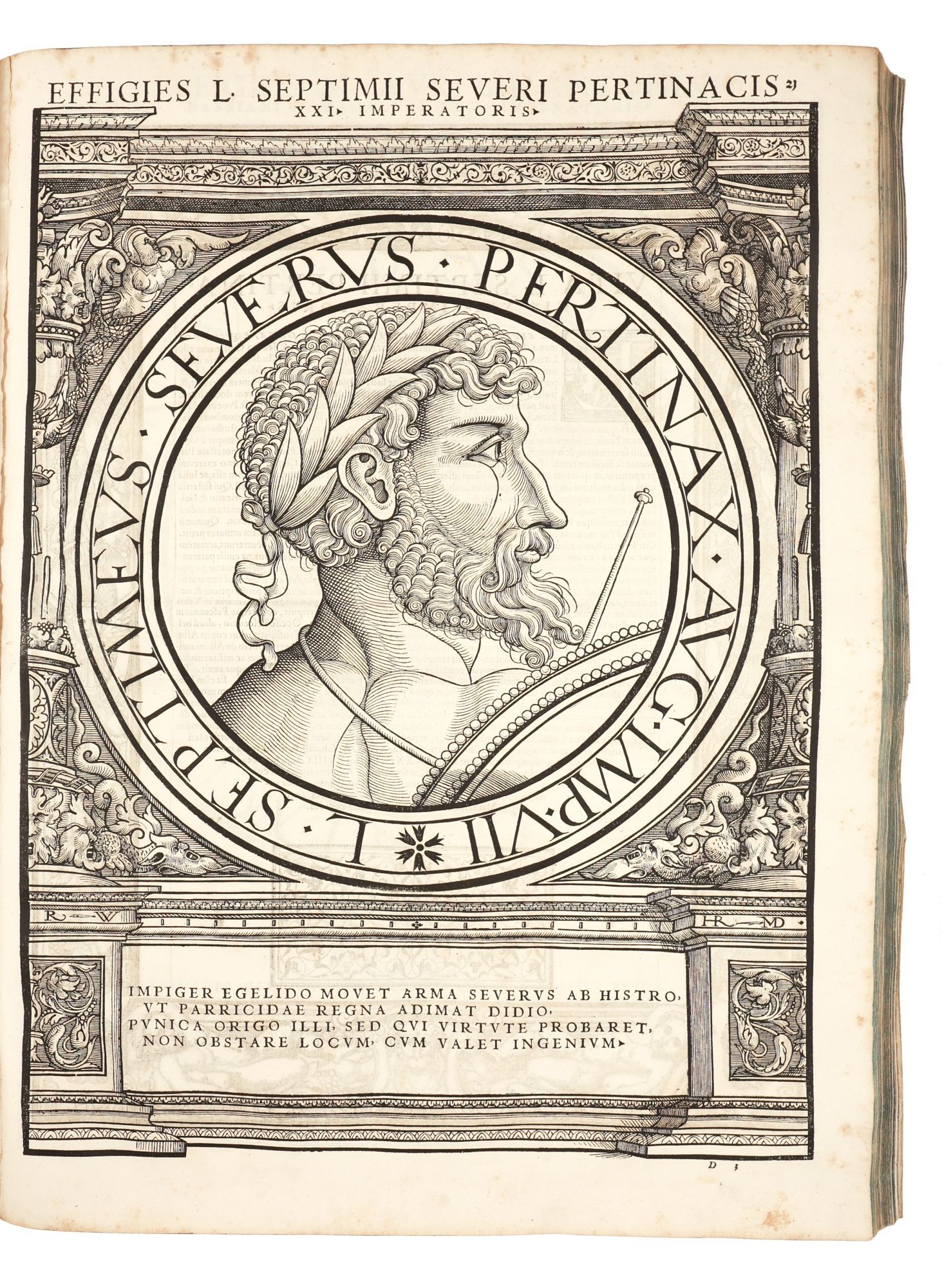
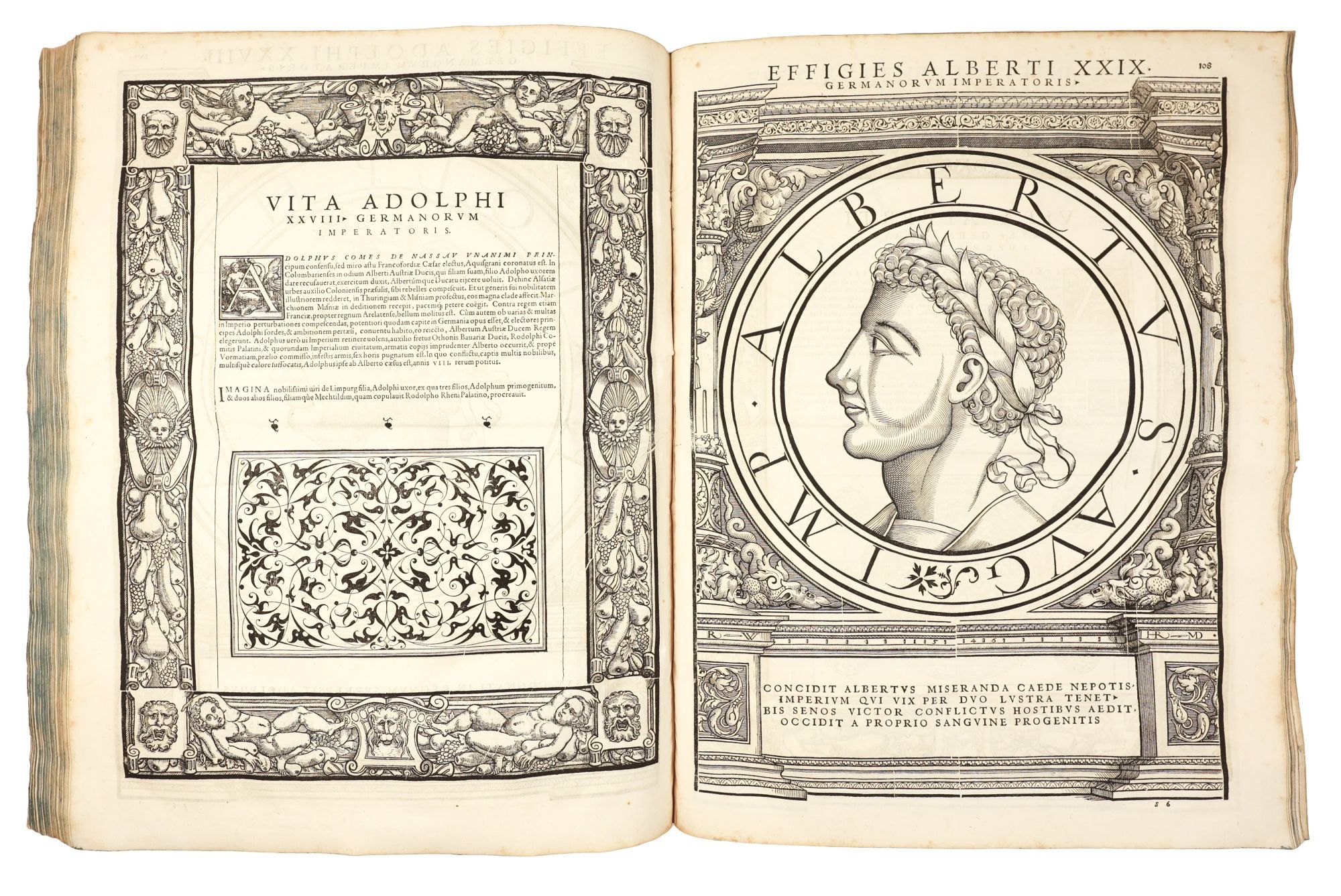
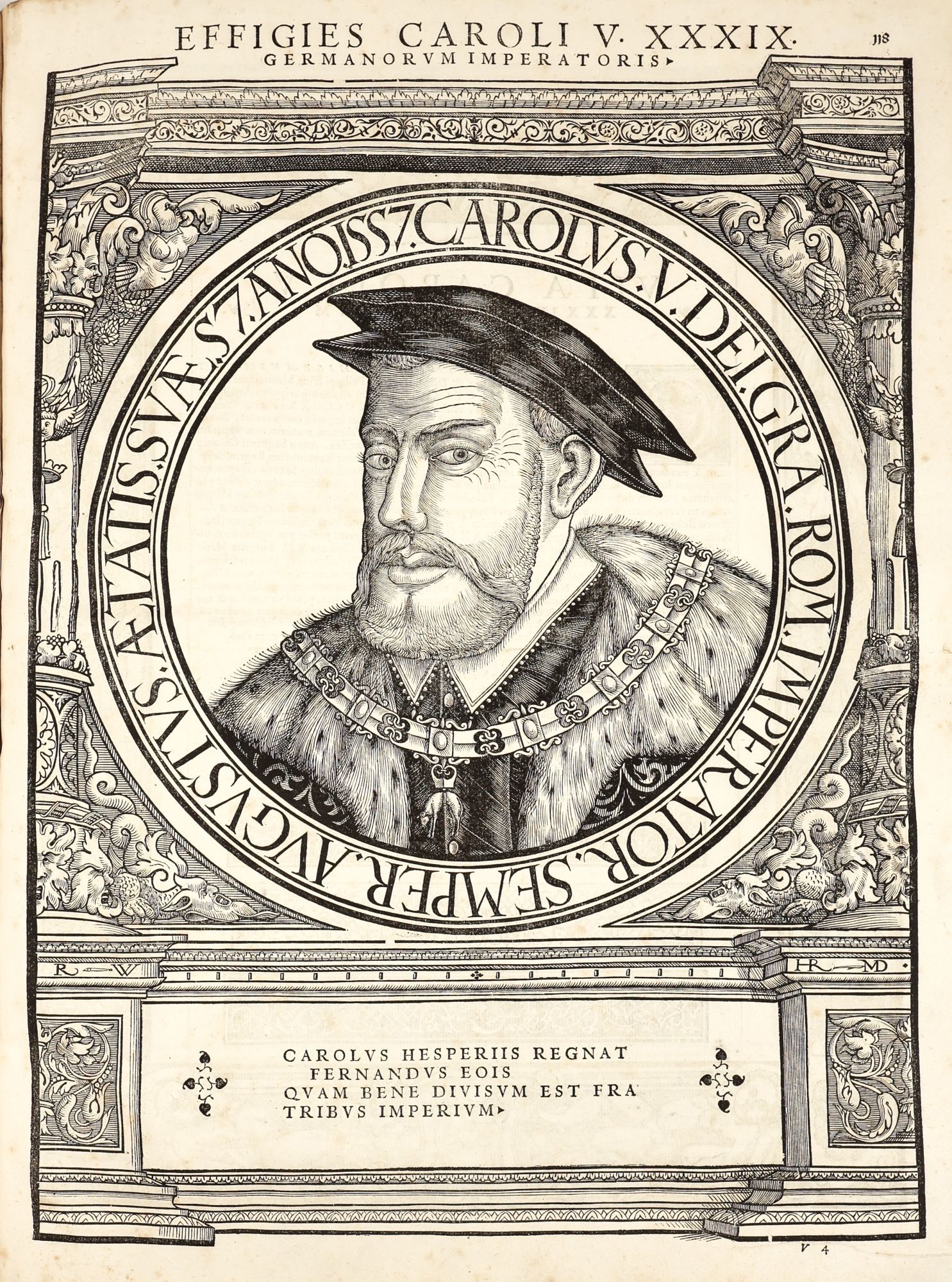
Magnificently illustrated with 118 extremely large woodcut medallion portraits of Roman, Carolingian, and Holy Roman emperors, surrounded by inscriptions in imitation of coins. Each portrait image is set within an elaborate ornamental frame with grotesques, putti, cherubs, and arrangements of fruit. The woodcut borders, signed R W (with a quill pen) and HR MD (with a wood engraver's knife) are, according to Nagler, the work of the Zürich woodcutter and painter Rudolf Wyssenbach (active 1545-1560) and Hans Rudolf Manuel Deutsch (1525-1571). The text pages, which also have woodcut borders, also feature elaborate decorative patterns, designed for intarsia and metalwork by Peter Flötner, and first printed in his "Kunstbuch"(Zurich, 1549). The title page border (signed C.S.) is by Christoph Schweitzer (active 1558-1562), and was possibly designed by Jos Murer (1530-1580).
I. "The Most Accurate Likenesses of All of the Roman Emperors of the Eastern and Western Empires"(1559)
SOLE EDITION of this masterpiece of book design by the Swiss publisher Andreas Gessner, inspired by the numismatic encyclopedia compiled by the antiquarian, goldsmith, architect, collector and antiquities dealer Jacopo Strada (1507-1588). The book shares strong affinities with Strada's great, unpublished, multi-volume thesaurus of coins and medals (about which see below), which had been commissioned by the German banker, collector, and art patron Hans Jacob Fugger (1516-1557).
In 1553, Jacopo Strada had published an epitome of his growing numismatic collection in a quarto volume entitled "Epitome Thesauri Antiquitatum", which featured coin-sized (4 cm.) woodcuts of 391 of imperial coins from his collection. These were accompanied by letterpress transcriptions of the coins' inscriptions and biographies of the subjects.
In 1557, Andreas Gessner printed a new edition of Strada's "Epitome", also with small woodcuts. For his monumental 1559 "Imagines"("The Most Accurate Likenesses of All of the Roman Emperors of the Eastern and Western Empires"), Gessner reprinted Strada's biographies and inscriptions. For the 118 woodcut medallion portraits, Gessner drew from the images in Strada's "Epitome" as well as the important coin books of Andrea Fulvio (1517), Johann Huttich (1534), and Guillaume Rouille (1553). He has also copied some actual coins.
In his introduction to this 1559 volume, Andreas Gessner explains his motivations for producing this book of nearly life-sized Roman imperial portraits, executed in profile in the manner or coins and medals. Gessner tells us that he had been working for some time on portraits of the Roman emperors to be used as decoration -in the manner of Paolo Giovio- in dining rooms and banqueting halls. The grand, single-sheet portraits in the "Imagines" can now serve this function for purchasers wishing to decorate their own homes (presumably they are to serve as models for artists to render paintings.) The lives of the emperors, taken from Jacopo Strada's illustrated "Epitome" of his coin collection, will edify and provide grist for dinner conversation.
For the antiquarian interested in numismatics, Gessner set out to improve upon earlier coin books, in which the coins and medals were illustrated by small woodcuts. These required keen eyesight to study. The much larger format of the "Imagines" has allowed for more accurate depictions of the emperors and, consequently, will make consultation of the portraits much easier.
Gessner has divided his series into three "classes": the ancient emperors from Julius Caesar to Constantine; from Constantine to Charlemagne; and from Charlemagne to the reigning emperor, Ferdinand I. Although the last portrait is that of Ferdinand's brother and predecessor, Charles V (abdicated 1556, died 1558), the inscription reads "Charles reigns in the west Ferdinand in the east. How well is rule divided between two brothers!"
I. The Paper Museum: Gessner's "Imagines" & Strada's "Magnum ac Novum Opus":
"I have not limited myself merely to know the names and to recognize the portraits of the ancient personalities [depicted on the coins], but have learnt by long and assiduous study not only to draw them on paper, but also to model them both in gold and other metals and in marble." -Jacopo Strada to King Maximilian II, June 1559
A renowned antiquarian and artist, Jacopo Strada served as official antiquary to three emperors: Ferdinand I, Maximilian II and Rudolf II. He was an avid collector of antiquities, particularly of coins, and served as an agent for great collectors, most notably the German banker and arts patron Hans Jacob Fugger (1516-1557). In Titian's well-known portrait of Strada, now in the Kunsthistorisches Museum, Vienna, the richly-dressed antiquarian is shown handling an ancient sculpture over a table on which lies another, fragmentary sculpture and a number of coins.
Beginning around 1550, Strada began work on his monumental 36-volume manuscript catalogue of imperial medals and coins, commissioned by Hans Jacob Fugger (1516-1557), titled "Magnum ac Novum Opus continens descriptionem imaginum, numismatum omnium tam Orientalium quam Occidentalium Imperatorum ac Tyrannorum". Strada's manuscript "includes more than 9,000 large and very detailed illustrations of coins and medals executed in pen and ink on folio. Together with the rest of Fugger's library and collection, the volumes became the property of Duke Albrecht V of Bavaria in 1566." The catalogue is "the most comprehensive corpus of ancient coins and medals composed during the sixteenth century. Therefore, it constitutes one of the central works in the history of numismatics as a scholarly discipline."(Heenes, Jacopo da Strada)
Strada, His Network, & His Sources:
"Strada's understanding of the antiquary as a profession was not limited to numismatics, his own specialism... Besides documenting ancient coins, Strada himself also engaged in measuring Roman ruins and commissioned documentation of ancient sculpture and other figurative antiquities from other artists, implying that all such remains of ancient civilizations were worthy of careful study and were relevant to his 'profession' as an antiquary. Strada asserted that the knowledge of such material remains, and the art of correctly interpreting them, required both practical experience and specialized knowledge. These are professional qualifications...
"Born in Mantua around 1515, in his youth Strada travelled widely in Italy and perhaps beyond, and then around 1540 moved to Germany, where he lived and worked in Nuremberg. In the early 1550s he again spent some years in travel, living in Lyon, Rome and Venice. Even after 1558, when he settled in Vienna as architect and antiquary to Emperor Ferdinand I, his business affairs often took him to Germany and Italy. On the basis of the provenances Strada gives for the coins he illustrates, it is possible not only to reconstruct in part his own, personal coin collection, but also to find out more about some of the most important collections of the mid-sixteenth century, for example those of his teacher Giulio Romano, of Antonio Agustín, Archbishop of Tarragona, and of the antiquarian Enea Vico.
"In 1553, Strada travelled from Lyon, where he met Guillaume Du Choul and Sebastiano Serlio, to Rome. In the eternal city, he acquired antiquities during the following two years on behalf of his patron Johann Jakob Fugger, and amassed an extensive collection of drawings of antiquarian and artistic content. This collection, which may be considered a predecessor of Cassiano dal Pozzo's Museo cartaceo ("paper museum"), formed the basis of a very ambitious programme of publications, which however failed. Strada's commission of the numismatic drawings for the 'Magnum Opus' was an integral part of this programme of collecting of documentation, as it is clear from a description of Strada's activities in the 'Trattato della pittura' of the artist Giovanni Battista Armenini, who had been part of the team."(Heenes, "Jacopo Strada's 'Magnum Opus ac Novum Opus': a Sixteenth-century Numismatic Corpus")
For a comprehensive treatment of Strada, see Dirk Jacob Hansen, "Jacopo Strada and Cultural Patronage at The Imperial Court" (2019)
Note: It has been conjectured by some that it was Strada who planned this deluxe edition as a tribute to his new patron, Ferdinand I of Austria, elected Holy Roman Emperor in 1556, who owned an important numismatic collection. Ferdinand took Strada into his service in the spring of 1558 and, in 1560, appointed him imperial architect for the emperor's projects in Vienna. But in the absence of a dedication by Strada and the clear intention of the publisher, this is unlikely.
Magnificently illustrated with 118 extremely large woodcut medallion portraits of Roman, Carolingian, and Holy Roman emperors, surrounded by inscriptions in imitation of coins. Each portrait image is set within an elaborate ornamental frame with grotesques, putti, cherubs, and arrangements of fruit. The woodcut borders, signed R W (with a quill pen) and HR MD (with a wood engraver's knife) are, according to Nagler, the work of the Zürich woodcutter and painter Rudolf Wyssenbach (active 1545-1560) and Hans Rudolf Manuel Deutsch (1525-1571). The text pages, which also have woodcut borders, also feature elaborate decorative patterns, designed for intarsia and metalwork by Peter Flötner, and first printed in his "Kunstbuch"(Zurich, 1549). The title page border (signed C.S.) is by Christoph Schweitzer (active 1558-1562), and was possibly designed by Jos Murer (1530-1580).
I. "The Most Accurate Likenesses of All of the Roman Emperors of the Eastern and Western Empires"(1559)
SOLE EDITION of this masterpiece of book design by the Swiss publisher Andreas Gessner, inspired by the numismatic encyclopedia compiled by the antiquarian, goldsmith, architect, collector and antiquities dealer Jacopo Strada (1507-1588). The book shares strong affinities with Strada's great, unpublished, multi-volume thesaurus of coins and medals (about which see below), which had been commissioned by the German banker, collector, and art patron Hans Jacob Fugger (1516-1557).
In 1553, Jacopo Strada had published an epitome of his growing numismatic collection in a quarto volume entitled "Epitome Thesauri Antiquitatum", which featured coin-sized (4 cm.) woodcuts of 391 of imperial coins from his collection. These were accompanied by letterpress transcriptions of the coins' inscriptions and biographies of the subjects.
In 1557, Andreas Gessner printed a new edition of Strada's "Epitome", also with small woodcuts. For his monumental 1559 "Imagines"("The Most Accurate Likenesses of All of the Roman Emperors of the Eastern and Western Empires"), Gessner reprinted Strada's biographies and inscriptions. For the 118 woodcut medallion portraits, Gessner drew from the images in Strada's "Epitome" as well as the important coin books of Andrea Fulvio (1517), Johann Huttich (1534), and Guillaume Rouille (1553). He has also copied some actual coins.
In his introduction to this 1559 volume, Andreas Gessner explains his motivations for producing this book of nearly life-sized Roman imperial portraits, executed in profile in the manner or coins and medals. Gessner tells us that he had been working for some time on portraits of the Roman emperors to be used as decoration -in the manner of Paolo Giovio- in dining rooms and banqueting halls. The grand, single-sheet portraits in the "Imagines" can now serve this function for purchasers wishing to decorate their own homes (presumably they are to serve as models for artists to render paintings.) The lives of the emperors, taken from Jacopo Strada's illustrated "Epitome" of his coin collection, will edify and provide grist for dinner conversation.
For the antiquarian interested in numismatics, Gessner set out to improve upon earlier coin books, in which the coins and medals were illustrated by small woodcuts. These required keen eyesight to study. The much larger format of the "Imagines" has allowed for more accurate depictions of the emperors and, consequently, will make consultation of the portraits much easier.
Gessner has divided his series into three "classes": the ancient emperors from Julius Caesar to Constantine; from Constantine to Charlemagne; and from Charlemagne to the reigning emperor, Ferdinand I. Although the last portrait is that of Ferdinand's brother and predecessor, Charles V (abdicated 1556, died 1558), the inscription reads "Charles reigns in the west Ferdinand in the east. How well is rule divided between two brothers!"
I. The Paper Museum: Gessner's "Imagines" & Strada's "Magnum ac Novum Opus":
"I have not limited myself merely to know the names and to recognize the portraits of the ancient personalities [depicted on the coins], but have learnt by long and assiduous study not only to draw them on paper, but also to model them both in gold and other metals and in marble." -Jacopo Strada to King Maximilian II, June 1559
A renowned antiquarian and artist, Jacopo Strada served as official antiquary to three emperors: Ferdinand I, Maximilian II and Rudolf II. He was an avid collector of antiquities, particularly of coins, and served as an agent for great collectors, most notably the German banker and arts patron Hans Jacob Fugger (1516-1557). In Titian's well-known portrait of Strada, now in the Kunsthistorisches Museum, Vienna, the richly-dressed antiquarian is shown handling an ancient sculpture over a table on which lies another, fragmentary sculpture and a number of coins.
Beginning around 1550, Strada began work on his monumental 36-volume manuscript catalogue of imperial medals and coins, commissioned by Hans Jacob Fugger (1516-1557), titled "Magnum ac Novum Opus continens descriptionem imaginum, numismatum omnium tam Orientalium quam Occidentalium Imperatorum ac Tyrannorum". Strada's manuscript "includes more than 9,000 large and very detailed illustrations of coins and medals executed in pen and ink on folio. Together with the rest of Fugger's library and collection, the volumes became the property of Duke Albrecht V of Bavaria in 1566." The catalogue is "the most comprehensive corpus of ancient coins and medals composed during the sixteenth century. Therefore, it constitutes one of the central works in the history of numismatics as a scholarly discipline."(Heenes, Jacopo da Strada)
Strada, His Network, & His Sources:
"Strada's understanding of the antiquary as a profession was not limited to numismatics, his own specialism... Besides documenting ancient coins, Strada himself also engaged in measuring Roman ruins and commissioned documentation of ancient sculpture and other figurative antiquities from other artists, implying that all such remains of ancient civilizations were worthy of careful study and were relevant to his 'profession' as an antiquary. Strada asserted that the knowledge of such material remains, and the art of correctly interpreting them, required both practical experience and specialized knowledge. These are professional qualifications...
"Born in Mantua around 1515, in his youth Strada travelled widely in Italy and perhaps beyond, and then around 1540 moved to Germany, where he lived and worked in Nuremberg. In the early 1550s he again spent some years in travel, living in Lyon, Rome and Venice. Even after 1558, when he settled in Vienna as architect and antiquary to Emperor Ferdinand I, his business affairs often took him to Germany and Italy. On the basis of the provenances Strada gives for the coins he illustrates, it is possible not only to reconstruct in part his own, personal coin collection, but also to find out more about some of the most important collections of the mid-sixteenth century, for example those of his teacher Giulio Romano, of Antonio Agustín, Archbishop of Tarragona, and of the antiquarian Enea Vico.
"In 1553, Strada travelled from Lyon, where he met Guillaume Du Choul and Sebastiano Serlio, to Rome. In the eternal city, he acquired antiquities during the following two years on behalf of his patron Johann Jakob Fugger, and amassed an extensive collection of drawings of antiquarian and artistic content. This collection, which may be considered a predecessor of Cassiano dal Pozzo's Museo cartaceo ("paper museum"), formed the basis of a very ambitious programme of publications, which however failed. Strada's commission of the numismatic drawings for the 'Magnum Opus' was an integral part of this programme of collecting of documentation, as it is clear from a description of Strada's activities in the 'Trattato della pittura' of the artist Giovanni Battista Armenini, who had been part of the team."(Heenes, "Jacopo Strada's 'Magnum Opus ac Novum Opus': a Sixteenth-century Numismatic Corpus")
For a comprehensive treatment of Strada, see Dirk Jacob Hansen, "Jacopo Strada and Cultural Patronage at The Imperial Court" (2019)
Note: It has been conjectured by some that it was Strada who planned this deluxe edition as a tribute to his new patron, Ferdinand I of Austria, elected Holy Roman Emperor in 1556, who owned an important numismatic collection. Ferdinand took Strada into his service in the spring of 1558 and, in 1560, appointed him imperial architect for the emperor's projects in Vienna. But in the absence of a dedication by Strada and the clear intention of the publisher, this is unlikely.
Details
Title
Imperatorum romanorum omnium orientalium et occidentalium verissimae imagines
Author
Strada, Jacopo (1507-1588); Gessner, Andreas (1513-1559)
Binding
Hardcover
Condition
Fine
Publisher
Andreas Gessner: Zurich
Date
1559
Edition
SOLE EDITION