

Molecular Structure of Nucleic Acids: A Structure for Deoxyribose Nucleic Acid; Molecular Structure of Deoxypentose Nucleic Acids; Molecular Configuration in Sodium Thymonucleate; Three papers from Nature, Vol. 171, No. 4356, April 25, 1953
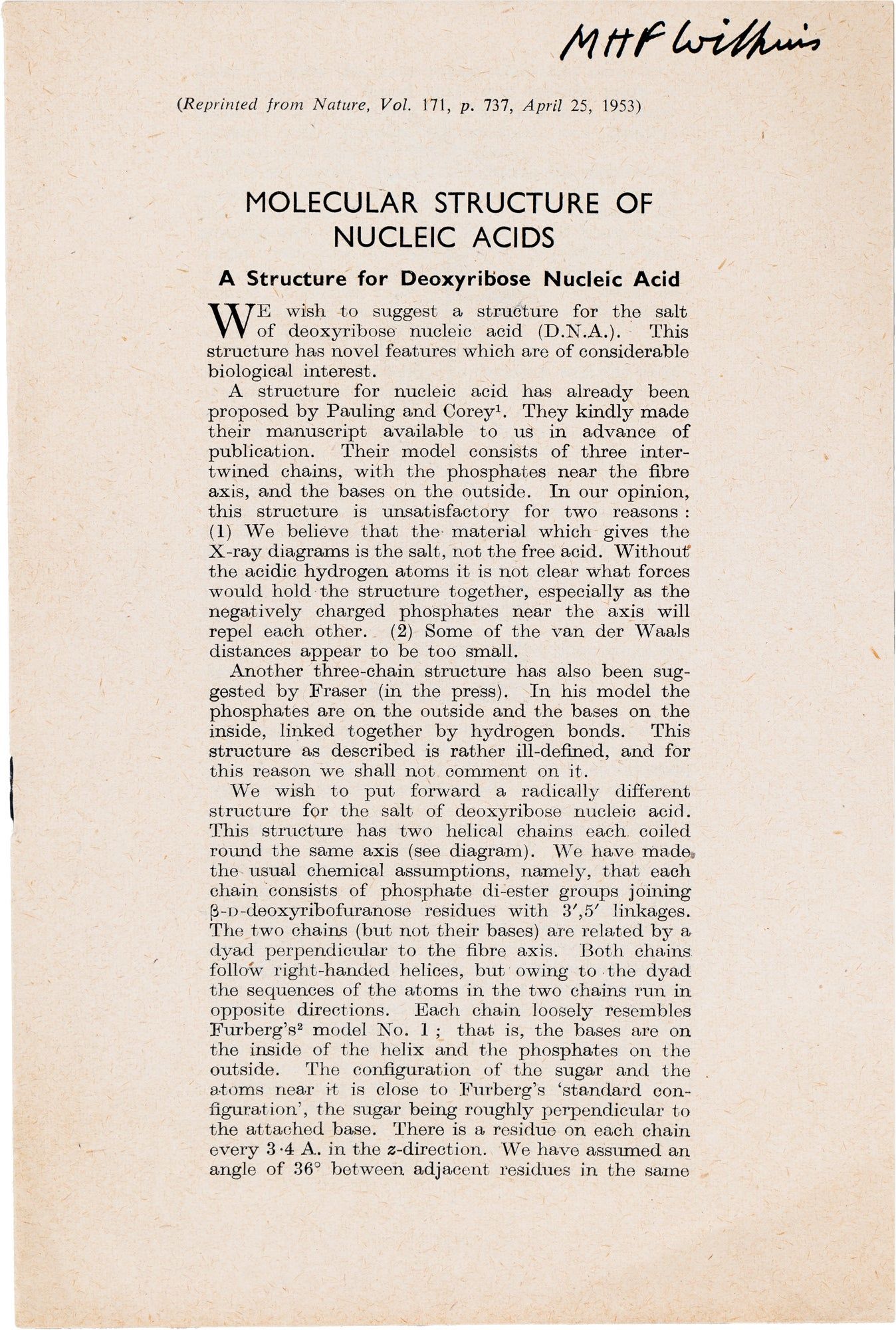
- SIGNED
- St. Albans: Fisher, Knight & Co, 1953
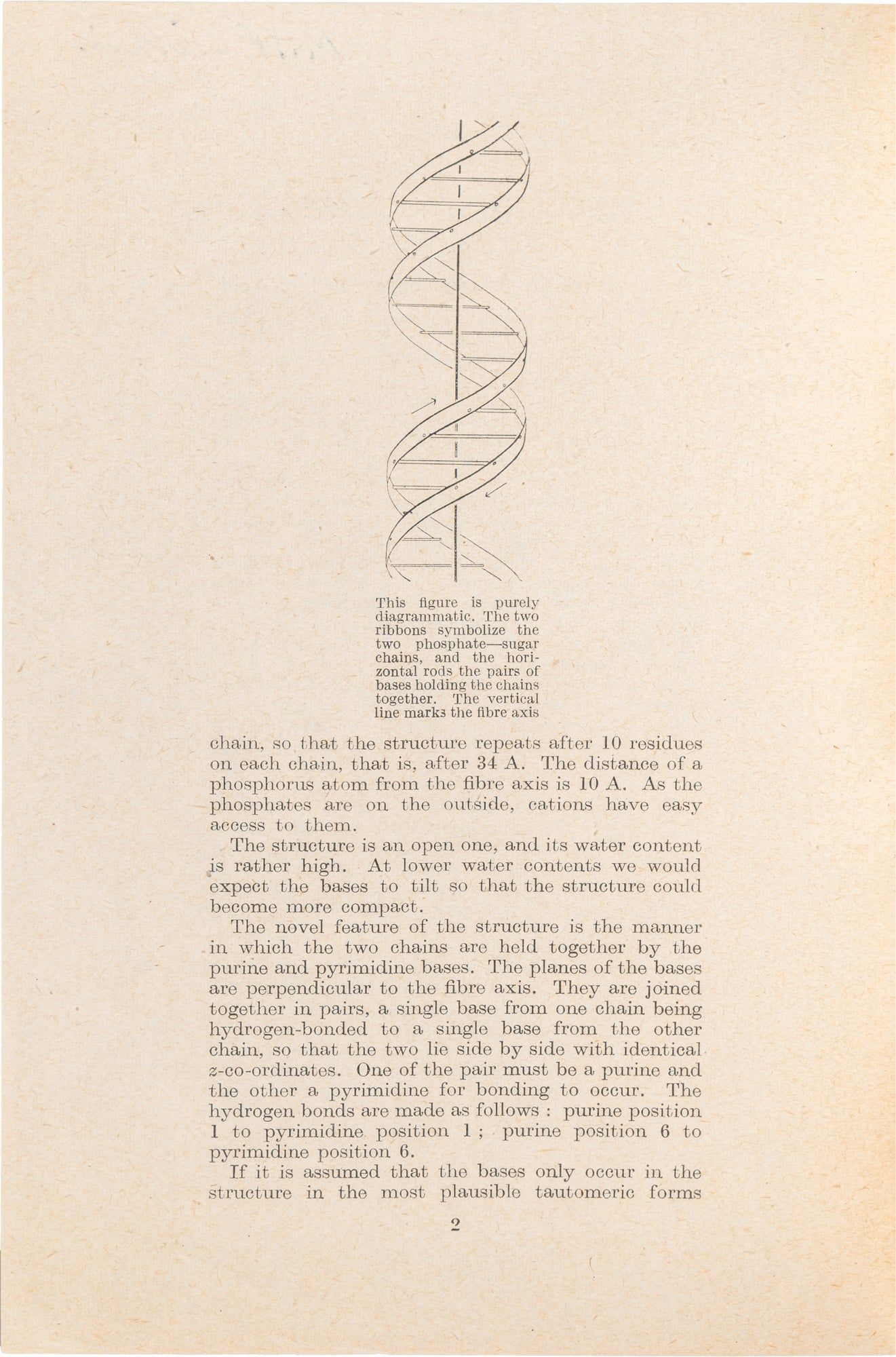
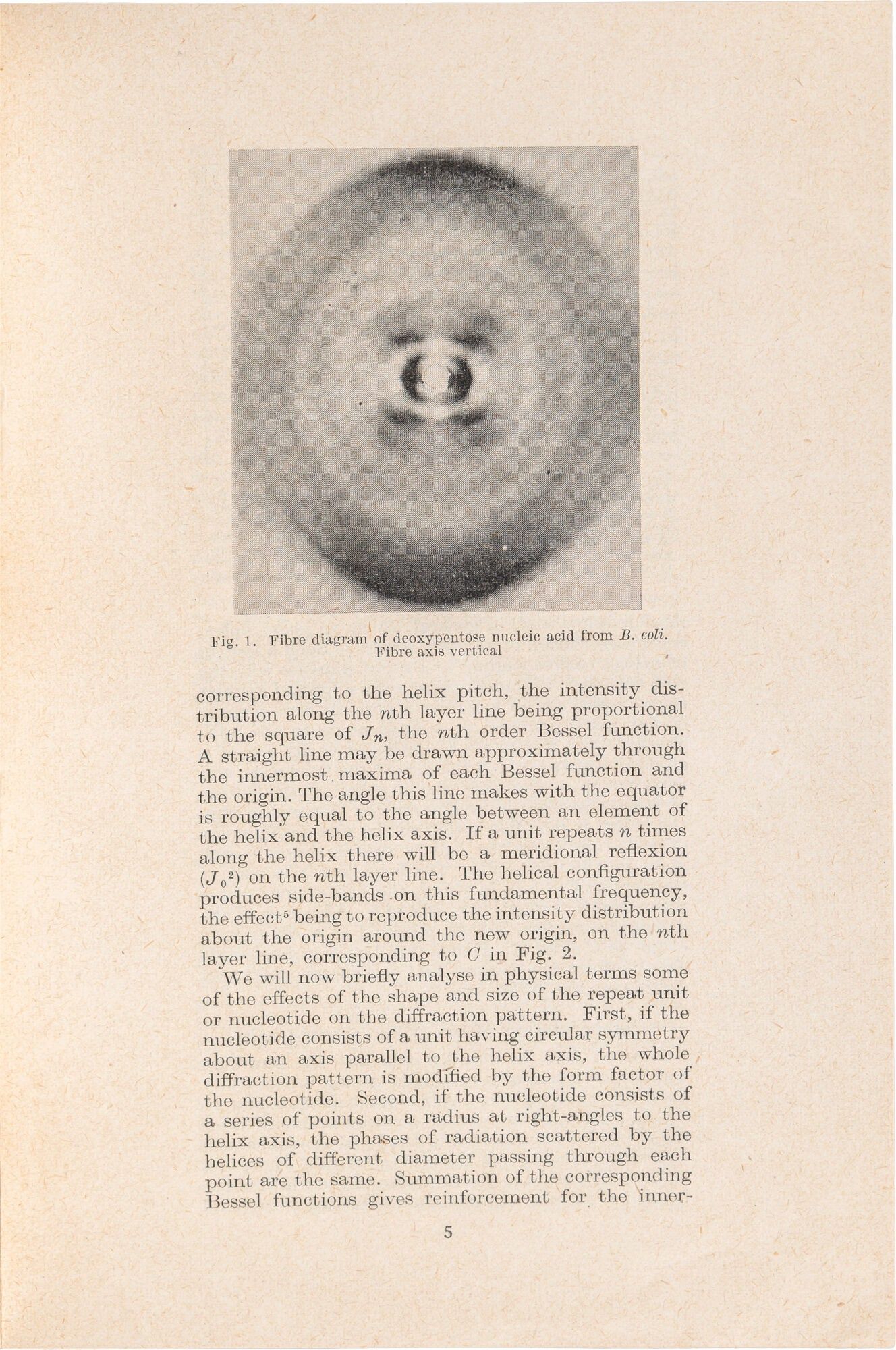
St. Albans: Fisher, Knight & Co, 1953. First Edition. Offprint, 8vo (210 x 140mm), pp. 14, with two diagrams (including the double helix) and two illustrations from photographs. The three-paper offprint issue, of the primary record of the co-discovery of the molecular structure of DNA, the most transformative moment in twentieth-century biology. Stapled in self-wrappers as issued. Signed by Maurice Wilkins on the first page. Very lightly toned and a coulpe soft creases, near fine. Grolier Club, One Hundred Books Famous in Medicine, 99; Dibner, Heralds of Science, 200. Garrison-Morton 256.3; Judson, Eighth Day of Creation, pp. 145-56. Ex-Dr. Myron Printzmetal. The discovery of DNA's double helix structure emerged from an intense period of competitive collaboration between research teams at Cambridge and King's College London. Watson and Crick's theoretical breakthrough synthesized crucial experimental evidence from multiple sources: Erwin Chargaff's base composition rules demonstrating the 1:1 ratio of adenine to thymine and guanine to cytosine, X-ray crystallographic data revealing DNA's helical structure, and most critically, the precise measurements of backbone positioning and molecular dimensions. Their elegant model proposed complementary base pairing (A-T and C-G) held together by hydrogen bonds, immediately suggesting a mechanism for genetic replication where each strand could serve as a template for its complement. The accompanying papers by Wilkins, Stokes, and Wilson, and by Franklin and Gosling, provided essential experimental validation through X-ray diffraction analysis, creating a unified presentation of both theoretical insight and empirical evidence that established the foundation of molecular biology.
The contentious history surrounding this discovery has generated enduring scholarly debate, particularly regarding the systematic marginalization of Rosalind Franklin's contributions. Franklin's meticulous X-ray crystallographic work, conducted with her graduate student Raymond Gosling, had independently determined many key structural features including the antiparallel orientation of DNA strands, the external positioning of phosphate groups, and precise helical parameters. Her famous "Photograph 51" provided definitive evidence of DNA's helical structure, while her systematic analysis of A-form and B-form DNA revealed critical dimensions that enabled Watson and Crick's model construction. As Brenda Maddox documents in "Rosalind Franklin: The Dark Lady of DNA," Franklin's data was shown to Watson and Crick without her knowledge through Maurice Wilkins, creating an ethical controversy that persists in discussions of scientific collaboration and gender bias. Franklin's death from ovarian cancer in 1958, four years before the Nobel Prize was awarded to Watson, Crick, and Wilkins, has intensified debates about recognition and the complex dynamics of mid-twentieth century scientific discovery, with many scholars arguing that her rigorous experimental approach was as fundamental to the breakthrough as the theoretical modeling that received greater acclaim.
This publication represents the founding document of modern molecular biology, establishing the conceptual framework for understanding heredity, genetic replication, and the molecular basis of life itself. The discovery immediately suggested mechanisms for protein synthesis and genetic information transfer, creating the theoretical foundation for subsequent developments in genetic engineering, biotechnology, and genomic medicine. As Francis Crick later observed, the structure's elegant simplicity—with its complementary base pairing and antiparallel strands—provided not merely a static model but a dynamic mechanism explaining how genetic information could be accurately copied and transmitted across generations. The offprint's scientific significance extends far beyond its immediate discovery, representing the moment when biology transformed from a primarily descriptive science into a molecular discipline capable of manipulating the fundamental mechanisms of life, establishing the intellectual foundation for the biotechnology revolution that continues to reshape medicine, agriculture, and our understanding of evolutionary processes seventy years after its publication.
The contentious history surrounding this discovery has generated enduring scholarly debate, particularly regarding the systematic marginalization of Rosalind Franklin's contributions. Franklin's meticulous X-ray crystallographic work, conducted with her graduate student Raymond Gosling, had independently determined many key structural features including the antiparallel orientation of DNA strands, the external positioning of phosphate groups, and precise helical parameters. Her famous "Photograph 51" provided definitive evidence of DNA's helical structure, while her systematic analysis of A-form and B-form DNA revealed critical dimensions that enabled Watson and Crick's model construction. As Brenda Maddox documents in "Rosalind Franklin: The Dark Lady of DNA," Franklin's data was shown to Watson and Crick without her knowledge through Maurice Wilkins, creating an ethical controversy that persists in discussions of scientific collaboration and gender bias. Franklin's death from ovarian cancer in 1958, four years before the Nobel Prize was awarded to Watson, Crick, and Wilkins, has intensified debates about recognition and the complex dynamics of mid-twentieth century scientific discovery, with many scholars arguing that her rigorous experimental approach was as fundamental to the breakthrough as the theoretical modeling that received greater acclaim.
This publication represents the founding document of modern molecular biology, establishing the conceptual framework for understanding heredity, genetic replication, and the molecular basis of life itself. The discovery immediately suggested mechanisms for protein synthesis and genetic information transfer, creating the theoretical foundation for subsequent developments in genetic engineering, biotechnology, and genomic medicine. As Francis Crick later observed, the structure's elegant simplicity—with its complementary base pairing and antiparallel strands—provided not merely a static model but a dynamic mechanism explaining how genetic information could be accurately copied and transmitted across generations. The offprint's scientific significance extends far beyond its immediate discovery, representing the moment when biology transformed from a primarily descriptive science into a molecular discipline capable of manipulating the fundamental mechanisms of life, establishing the intellectual foundation for the biotechnology revolution that continues to reshape medicine, agriculture, and our understanding of evolutionary processes seventy years after its publication.
Details
Title
Molecular Structure of Nucleic Acids: A Structure for Deoxyribose Nucleic Acid; Molecular Structure of Deoxypentose Nucleic Acids; Molecular Configuration in Sodium Thymonucleate; Three papers from Nature, Vol. 171, No. 4356, April 25, 1953
Author
Watson, J. D.; Crick, F. H. C.; Wilkins, M. H. F., Stokes, A. R. & Wilson, H. R.; Franklin, R. E. & Gosling, R. G.
Condition
Unknown
Publisher
Fisher, Knight & Co: St. Albans
Date
1953
Edition
First Edition