

NOBEL. The Lamentable Decline in Self-Satisfaction
- SIGNED
- New York: W. Wood & Co., 1947
New York: W. Wood & Co., 1947. First printing.
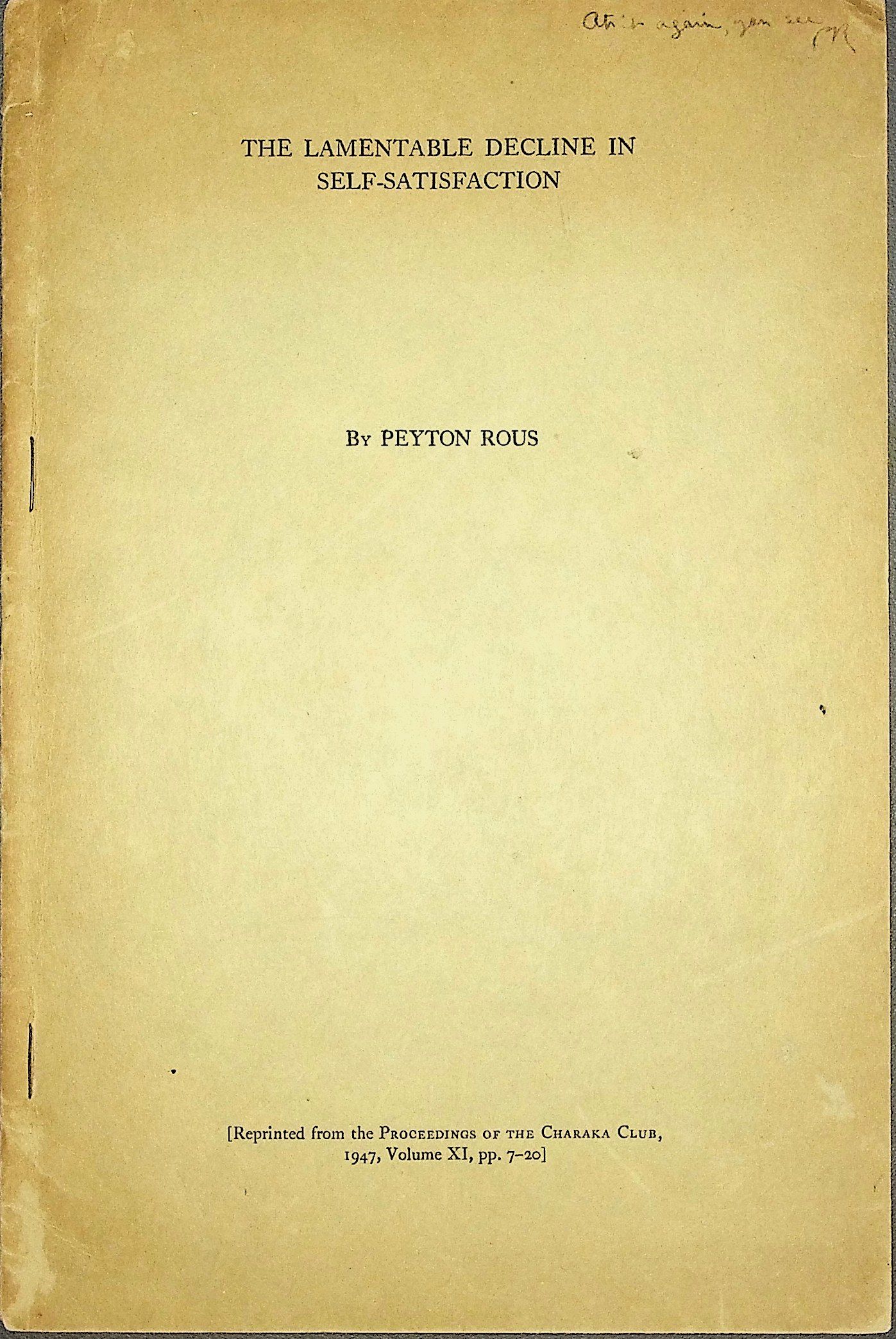
FIRST PRINTING OF FAMOUS ESSAY BY NOBEL LAUREATE PEYTON ROUS, INSCRIBED BY HIM.
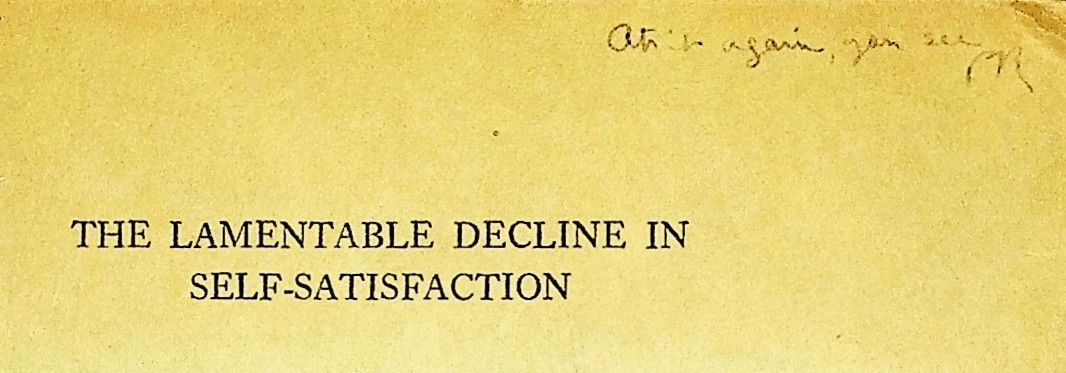
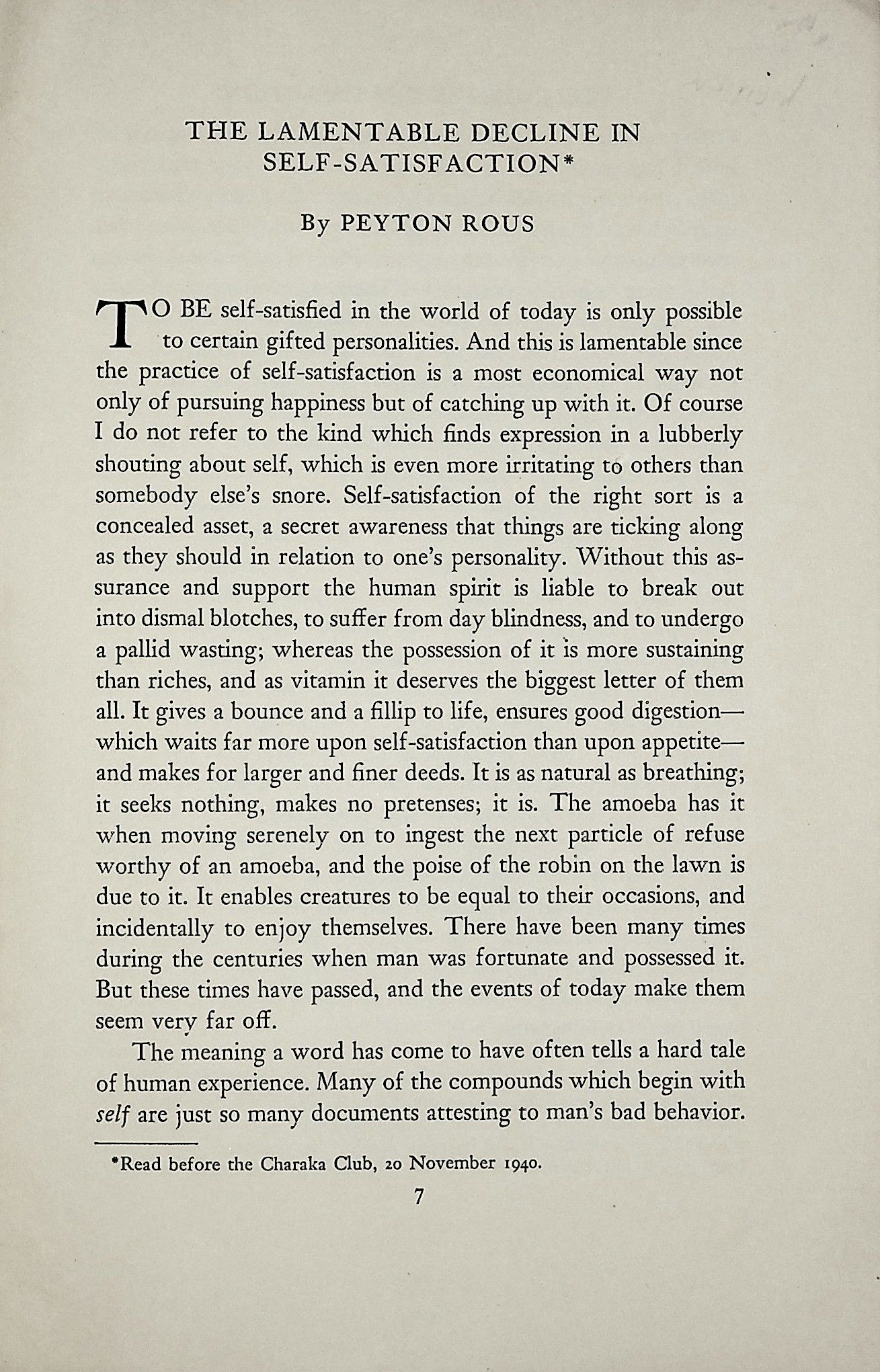
15x22.5 cm offprint, printed paper wraps, stapled, inscribed upper right cover, "At it again, you see, PR", paginated 7-20 pp. Footnote: "Read before the Charaka Club, 20 November 1940". Browning to wraps, very good in custom archival mylar cover.
This essay by Peyton Rous was first published in Proceedings of the Charaka Club in 1947, and subsequently reprinted in Perspectives in Biology and Medicine, Volume 9, Number 4, Summer 1966, pp. 439-449, published by Johns Hopkins University Press. The essay was cited in Rous's obituary in Nature, "Aside from his own publications (some 300 in all) Rous also contributed to scientific presentation and acted as editor of the Journal of Experimental Medicine for over thirty years. His width of cultivation could also be seen in most amusing and lighthearted ways, as on tactlessness, and the lamentable decline in self-satisfaction. . . . When the history of cancer research comes to be written, he will rank with the highest in honour."--Obituary, Nature Vol. 226, April 25, 1970.
PEYTON ROUS (1879 - 1970) received his B.A. and M.D. from Johns Hopkins University. In 1966 he was awarded a Nobel Prize in Physiology or Medicine for his work built on his demonstrating that a malignant sarcoma growing on a domestic chicken could be transferred to another fowl simply by exposing the healthy bird to a cell-free filtrate. This finding, that cancer could be transmitted by a virus (now known as the Rous sarcoma virus, a retrovirus), was widely discredited by most of the field's experts at that time. Since he was a relative newcomer, it was several years before anyone even tried to replicate his prescient results. Although some influential researchers were convinced enough to nominate him to the Nobel Committee as early as 1926 (and in many subsequent years) he did not receive the award until 40 years later.
THE CHARAKA CLUB was founded in 1898 by a group of five doctors: Charles Dana, Joseph Collins, Ward A. Holden, Frederick Peterson, and Bernard Sachs, who shared an interest in the historical, literary and artistic aspects of medicine. The society's first name was the Medico-Historical Club. In 1900, the name was changed to the Charaka Club, after the legendary Indian physician who compiled a book of ancient medical texts. At the club dinners, various members presented papers on literature, art, and history, usually related to medical history. Beginning in 1902, many of these papers were published in The Proceedings of the Charaka Club. Twelve volumes were produced, the last in 1988.
Details
Title
NOBEL. The Lamentable Decline in Self-Satisfaction
Author
Rous, Peyton
Condition
Unknown
Publisher
W. Wood & Co.: New York
Date
1947
Edition
First printing