

Theodore Roosevelt: We are the Real Heirs to the Legacy of Abraham Lincoln and the Representatives of the People
“The Progressive Party stands today precisely where the Republican Party stood in the days of Lincoln”
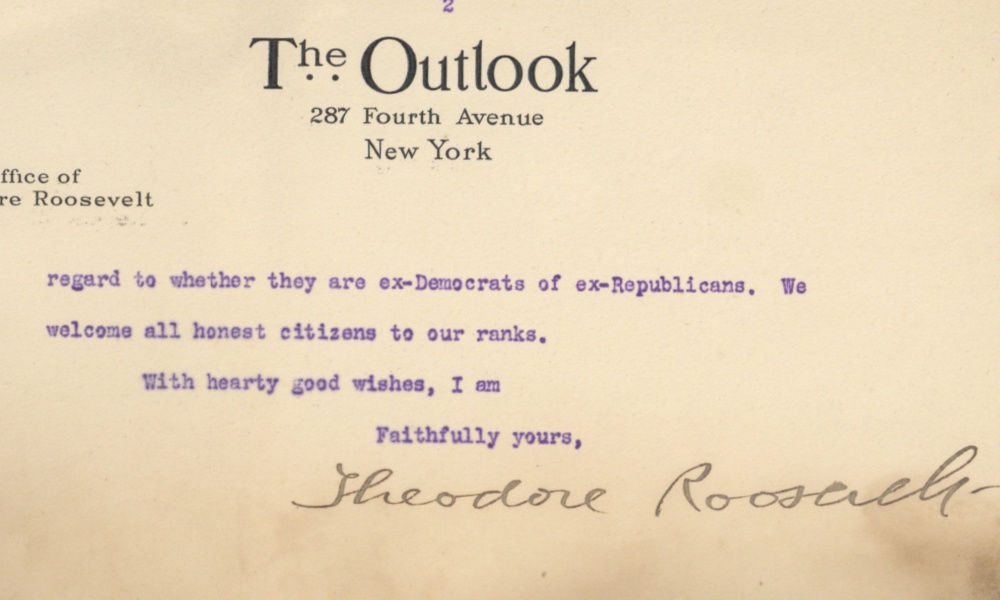
- SIGNED
- 24/01/1913
This is a new party, one with no allegiance to a boss but just to the people: ""It is as idle to talk of our amalgamating with either of the old party machines as it would have been to talk of the Lincoln Republicans amalgamating either with the Bourbon Democrats or the Cotton Whigs of their day.""
“There is no place in our ranks for the boss, for the man who represents the alliance between privilege in business and privilege in politics… The only way they can efficiently fight for social and industrial justice, for political and economic freedom, for equality of opportunity, is by joining the Progressive Party. They shall have exact equality of treatment with us without regard to whether they are ex-Democrats of ex-Republicans. We welcome all honest citizens to our ranks.”
Theodore Roosevelt first came to the presidency in 1901, following the assassination of William McKinley, but won election in his own right in 1904 and proved an extremely popular chief executive. Shortly after the election of 1904, he announced that he would not be a candidate four years later—though he was so much the idol of the masses that he could easily have gained the Republican nomination in 1908. Adhering to his pledge, however, he arranged the nomination of his secretary of war, William Howard Taft, who was easily elected president in 1908. Taft faced a restless public and a split Republican Party. National progressivism was nearly at high tide, and a large group of Republican progressives sat in both houses of Congress. These Republicans, like a majority of Americans, demanded reforms - such as tariff reductions, an income tax, the direct election of senators, social justice, and stricter railroad and corporation regulations. Taft was much more conservative philosophically than Roosevelt, and failed to advance progressive ideals.
Republican insurgents were determined to prevent Taft’s renomination in 1912. They found their leader in Roosevelt, who had become increasingly alienated from Taft and who made a whirlwind campaign for the presidential nomination in the winter and spring of 1912. TR swept the presidential primaries, but Taft and conservative Republicans controlled the powerful state organizations and the Republican National Committee, and when the Republicans gathered at their national convention in June 1912 it proved a bitter, divisive affair. And so complete was Taft’s supporters’ control over the party machinery that delegate challenges made by Roosevelt were all beaten back—leading Roosevelt to refuse to have his name entered into nomination. Taft was nominated on the first ballot. Convinced that the bosses had stolen the nomination from him, Roosevelt led his followers out of the Republican convention. In August they organized the Progressive (“Bull Moose”) Party and named Roosevelt to lead their third-party cause.
The Democrats emerged from their convention having nominated Woodrow Wilson. Roosevelt and the Bull Moose movement stressed its progressive, reform credentials, even controversially backing women’s suffrage. For Taft, his single objective in the 1912 campaign was to defeat Roosevelt. The real contest, however, was between Roosevelt and Wilson for control of the progressive majority. Campaigning strenuously on a platform that he called the New Nationalism, Roosevelt demanded effective control of big business through a strong federal commission, radical tax reform, and a whole series of measures to put the federal government squarely into the business of social and economic reform.
On election day, November 5, Roosevelt outpolled Taft but failed to win many Democratic progressives away from Wilson. Though Wilson captured only about 42 percent of the popular vote, he won 435 electoral votes. Between them, Roosevelt and Taft secured 7.6 million votes—1.3 million more than Wilson—but Roosevelt won only 88 electoral votes, and Taft won only 8. Taft’s 8 electoral votes represented the worst performance by an incumbent seeking reelection. But the defeat was stinging for TR and the Progressives as well.
In the wake of the 1912 defeat, TR worked hard to rally the troops, continue to advocate progressive ideals, and move the party forward. Typed letter signed, two pages, on his The Outlook letterhead, New York, January 24, 1913, to W.C. McDonald of the Progressive Club of Worcester, Mass., comparing the Progressives to the Lincoln Republicans (whom he calls progressive), highlighting their fight for social and industrial justice, and for the public good over privilege. “I earnestly wish I could be with you on January 28th to greet the Progressives of Worcester County. As this is impossible I send you a letter of good will.
“The Progressive Party stands today precisely where the Republican Party stood in the days of Lincoln, when it was the progressive party of the nation. It is as idle to talk of our amalgamating with either of the old party machines as it would have been to talk of the Lincoln Republicans amalgamating either with the Bourbon Democrats or the Cotton Whigs of their day. We stand absolutely for our platform; we believe in applying the principles of that platform to party management as well as to the government. There is no place in our ranks for the boss, for the man who represents the alliance between privilege in business and privilege in politics.
“I firmly believe that there are literally millions of progressives among the rank and file both of the Republican and Democratic parties, and that these men will sooner or later realize that they can do nothing where they are, and that the only way they can efficiently fight for social and industrial justice, for political and economic freedom, for equality of opportunity, is by joining the Progressive Party. They shall have exact equality of treatment with us without regard to whether they are ex-Democrats of ex-Republicans. We welcome all honest citizens to our ranks.”
TR adds a PS. “P.S. I cannot join that club excepting as an honorary member, because otherwise I should be required to join clubs all over the country. I have, however, signed the form you enclosed.”
An extraordinary and moving letter comparing the Progressives to the party of Lincoln, and laying out clearly what the Progressive Party stands for and who is welcome to join its ranks.
After the party's defeat in 1912, it went into rapid decline in elections, disappearing by 1920. But its spirit and programs were not forgotten, and would be resurrected with great success by TR’s cousin and nephew-in-law, Franklin D. Roosevelt.
Details
Title
Theodore Roosevelt: We are the Real Heirs to the Legacy of Abraham Lincoln and the Representatives of the People
Author
Theodore Roosevelt
Condition
Unknown
Date
24/01/1913