

Commander of the Haitian Slave Revolt Toussaint Louverture, Just After His Treaty with the British, Pays a Loyal Officer for His Command of the Northwest Coast
A very early and rare letter of the ""Haitian Napoleon,"" written before he had control over the entire country
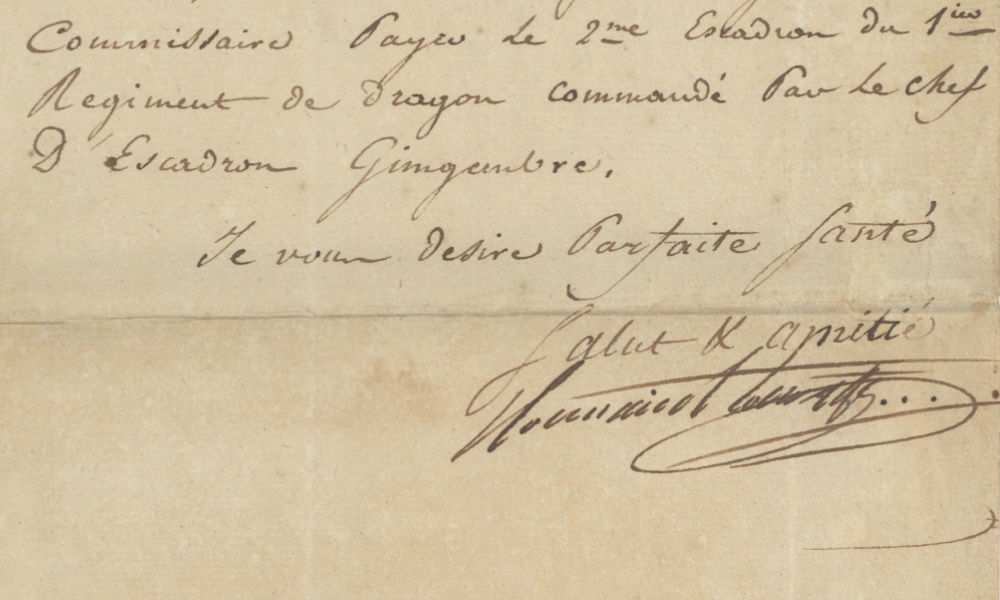
- SIGNED
- 24/05/1798
At the time of the outset of the French Revolution, Haiti was the French colony of Saint Domingue. The colony featured large slave plantations that generated the cash crops of sugar, coffee, and cotton. This was a very profitable colony to the French, owing largely to the sugar plantations. By the 1780s nearly two-thirds of French trade flowed through Saint Domingue, and the island supplied nearly half of Europe with sugar.
The Haitian Revolution was a complex web of affairs. At one point there were over a half dozen parties involved, all fighting for different purposes. Alliances were fickle, as entities changed allegiance based on who was offering the best deal. The revolution began not only as a slave revolt, but also as a class struggle among white landowners, non-landowners, and the free black landowners. The French military became involved, as did the British and Spanish forces.
In August 1791 a full-fledged slave revolt began. In March 1793, the French assembly granted full rights and French citizenship to free black people and those of mixed race. The white planter class however objected and further violence erupted. The French sent military forces and a new governor to enact these measures. At this point England and Spain joined the fight. While the English sought to restore order and sided with the white social class, the Spanish, who controlled the other side of the island, saw an opportunity in the dysfunction. When the French in 1794 ordered all slaves freed, the ire turned against the English, who now sent more forces to quell the revolt. In 1795, the Spanish signed a deal with the French and exited the conflict.
Toussaint Louverture, a former slave, emerged as the leader of the slaves seeking their freedom in the Haitian Revolution. He drew inspiration from the ongoing French Revolution and previous American Revolution to evolve his group’s demands and ultimate goals.
At the same time, the French Directoire government which now ruled France was considerably less revolutionary than it had been. Suspicions began to brew that it might reconsider the abolition of slavery. In November 1797, Louverture wrote again to the Directoire, assuring them of his loyalty, but reminding them firmly that abolition must be maintained.
And for the British, the benefit began to be outweighed by the cost, an enormous loss of life. On April 30, 1798, Louverture signed a treaty with British Army officer Thomas Maitland, exchanging the withdrawal of British troops from western Saint-Domingue (Haiti) in return for a general amnesty for the French counter-revolutionaries in those areas. In May, Port-au-Prince was returned to French rule in an atmosphere of order and celebration.
Gingembre-Trop-Fort, also a former slave, was one of Louverture's loyal officers. He was described with exaggerated uniform accoutrements, a sword almost as tall as he was, wearing “large and heavy rings” and with a pillow to his saddle already “covered in velours with gold fringes.” Interestingly, his name in French means ""too strong ginger.""
Letter signed, May 24, 1798, Port Republicain (former name of Port-au-Prince), to ""Citizen Deneyve, Commissary (Quartermaster) of Wars for the Army of the Northwest Coast"", with integral address leaf. ""Citoyen Commissary, please pay the 2nd Squadron of the 1st Regiment of Dragoons, Commanded by the Squadron Chief Gingembre.""
Letters of Louverture are very uncommon. This is a particularly early one, having been signed before he took control over the entire country.
This was not the end of the conflict, as tensions with France were about to increase and would test Louverture.
Details
Title
Commander of the Haitian Slave Revolt Toussaint Louverture, Just After His Treaty with the British, Pays a Loyal Officer for His Command of the Northwest Coast
Author
Toussaint Louverture
Condition
Unknown
Date
24/05/1798