

Deuxième Symphonie (Simineur) pour Orchestre ... Partition d'Orchestre - Prix _6 Rbl. Parties d'Orchestre net 10 _ 20 cop. Edition redigée par N. Rimsky-Korsakoff et A. Glazunoff ... Propriété des editeurs pour tous pays. [Score]
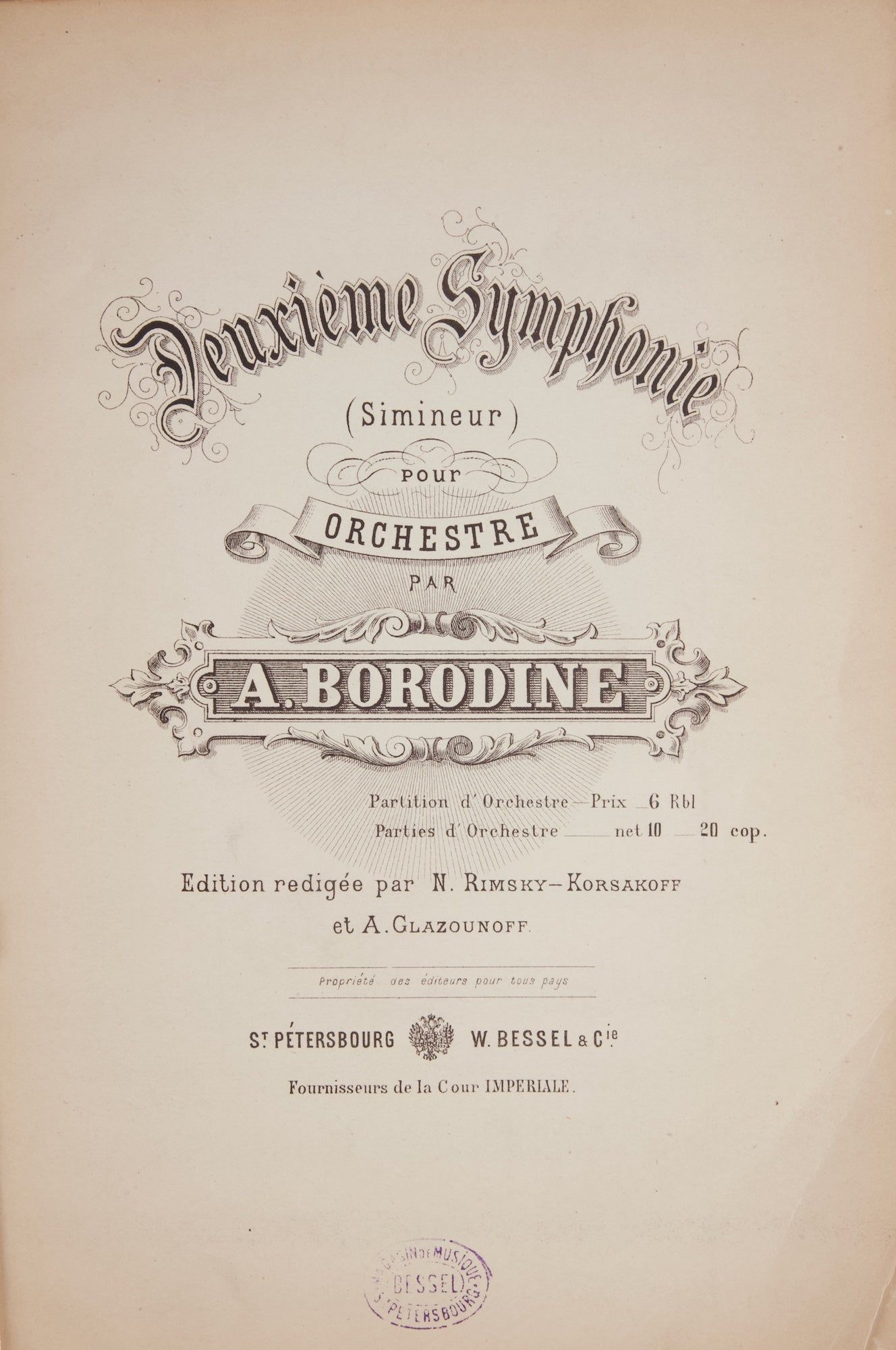
- St. Pétersbourg: W. Bessel & Cie [PN 671], 1880
St. Pétersbourg: W. Bessel & Cie [PN 671], 1880. Quarto. Original gray publisher's printed wrappers with catalogue of instrumental works to verso of lower. [i] (title), 2-156 pp.
Small oval publisher's handstamp to foot of title.
Wrappers considerably worn and chipped with significant losses to margins, affecting price list and content to lower outer portion; detached, with spine and blank inner margin reinforced with black cloth tape. Minor loss to blank lower outer corners of first ca. 15 leaves; some signatures loose. Revised by Rimsky-Korsakov and Glazunov, printed from plates of the first, ca. 1877, edition.
"The B minor Symphony is the most important large-scale work to be completed entirely by Borodin himself, and one of his greatest works. It is a close relative of both Prince Igor and the abortive Mlada, two theatre works which diverted the composer's attention, off and on, during the symphony's extended gestation period. According to memoirs of Nikolay Kashkin, the symphony's striking opening theme originated in an abandoned chorus of Polovtsians, and Borodin's principal Soviet biographer has cited several other instances of melodic congruence between Igor or Mladaand the symphony. ...
The first movement constitutes one of Borodin's most imaginative sonata forms. Its opening theme, brusque and epigrammatic, combines both the major and minor 3rd above the tonic, and except for the E♮ (an upper neighbour) constitutes an octatonic subcollection. ... Other instances of interplay between major and minor 3rd, found scattered throughout the symphony, may be traced to this terse opening theme. ... The lyrical second theme (first heard in the conventional key of D major) provides effective contrast and acts as a cyclic element in the symphony, easily recognized in the trio of the scherzo, more distantly echoed in the finale. ... The mercurial scherzo, in F major, draws much of its effect from the rhythmic contrast between the two principal ideas, the first firmly on the beat, the second syncopated. The Andante begins with one of Borodin's most serene melodies, its second phrase embodying the ornamental grace notes typical of his lyric tunes. This memorable melody is heard in varying orchestrations, in a free sectional design; some of the contrasting material subtly incorporates the interplay between minor and major 3rds found in the first movement. The finale is another sonata movement, freer than the first; perhaps its most striking moment is a whole-tone passage from the development, the theme of which is echoed in both Mlada and the prologue of Prince Igor." Robert W. Oldani in Grove Music Online.
Small oval publisher's handstamp to foot of title.
Wrappers considerably worn and chipped with significant losses to margins, affecting price list and content to lower outer portion; detached, with spine and blank inner margin reinforced with black cloth tape. Minor loss to blank lower outer corners of first ca. 15 leaves; some signatures loose. Revised by Rimsky-Korsakov and Glazunov, printed from plates of the first, ca. 1877, edition.
"The B minor Symphony is the most important large-scale work to be completed entirely by Borodin himself, and one of his greatest works. It is a close relative of both Prince Igor and the abortive Mlada, two theatre works which diverted the composer's attention, off and on, during the symphony's extended gestation period. According to memoirs of Nikolay Kashkin, the symphony's striking opening theme originated in an abandoned chorus of Polovtsians, and Borodin's principal Soviet biographer has cited several other instances of melodic congruence between Igor or Mladaand the symphony. ...
The first movement constitutes one of Borodin's most imaginative sonata forms. Its opening theme, brusque and epigrammatic, combines both the major and minor 3rd above the tonic, and except for the E♮ (an upper neighbour) constitutes an octatonic subcollection. ... Other instances of interplay between major and minor 3rd, found scattered throughout the symphony, may be traced to this terse opening theme. ... The lyrical second theme (first heard in the conventional key of D major) provides effective contrast and acts as a cyclic element in the symphony, easily recognized in the trio of the scherzo, more distantly echoed in the finale. ... The mercurial scherzo, in F major, draws much of its effect from the rhythmic contrast between the two principal ideas, the first firmly on the beat, the second syncopated. The Andante begins with one of Borodin's most serene melodies, its second phrase embodying the ornamental grace notes typical of his lyric tunes. This memorable melody is heard in varying orchestrations, in a free sectional design; some of the contrasting material subtly incorporates the interplay between minor and major 3rds found in the first movement. The finale is another sonata movement, freer than the first; perhaps its most striking moment is a whole-tone passage from the development, the theme of which is echoed in both Mlada and the prologue of Prince Igor." Robert W. Oldani in Grove Music Online.
Details
Title
Deuxième Symphonie (Simineur) pour Orchestre ... Partition d'Orchestre - Prix _6 Rbl. Parties d'Orchestre net 10 _ 20 cop. Edition redigée par N. Rimsky-Korsakoff et A. Glazunoff ... Propriété des editeurs pour tous pays. [Score]
Author
BORODIN, Aleksandr 1833-1887
Condition
Unknown
Publisher
W. Bessel & Cie [PN 671]: St. Pétersbourg
Date
1880