

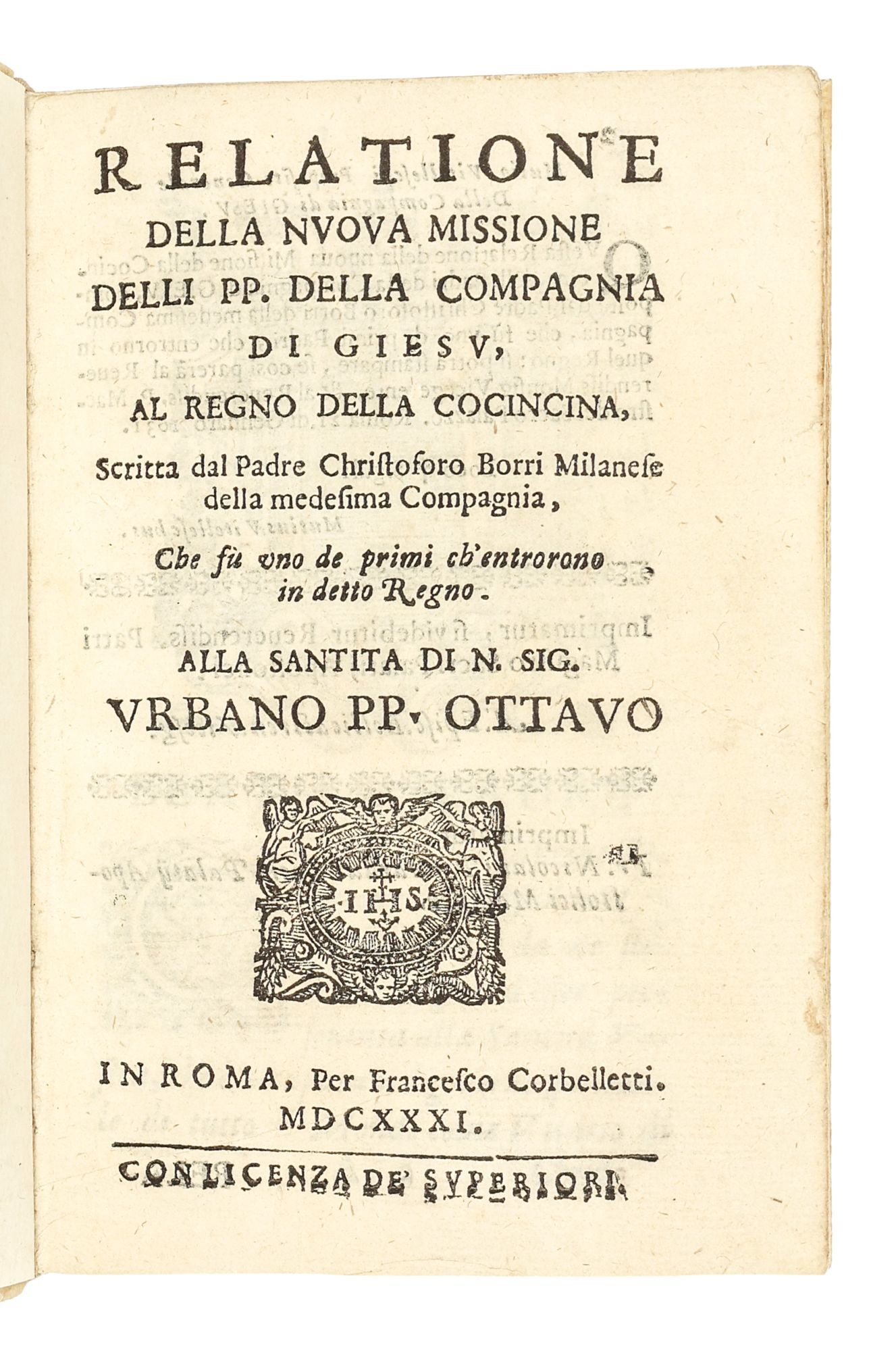
Relatione della nuova Missione delli Padri della Compagnia di Giesù, al regno della Cocincina

- Hardcover
- Rome: Francesco Corbelletti, 1631
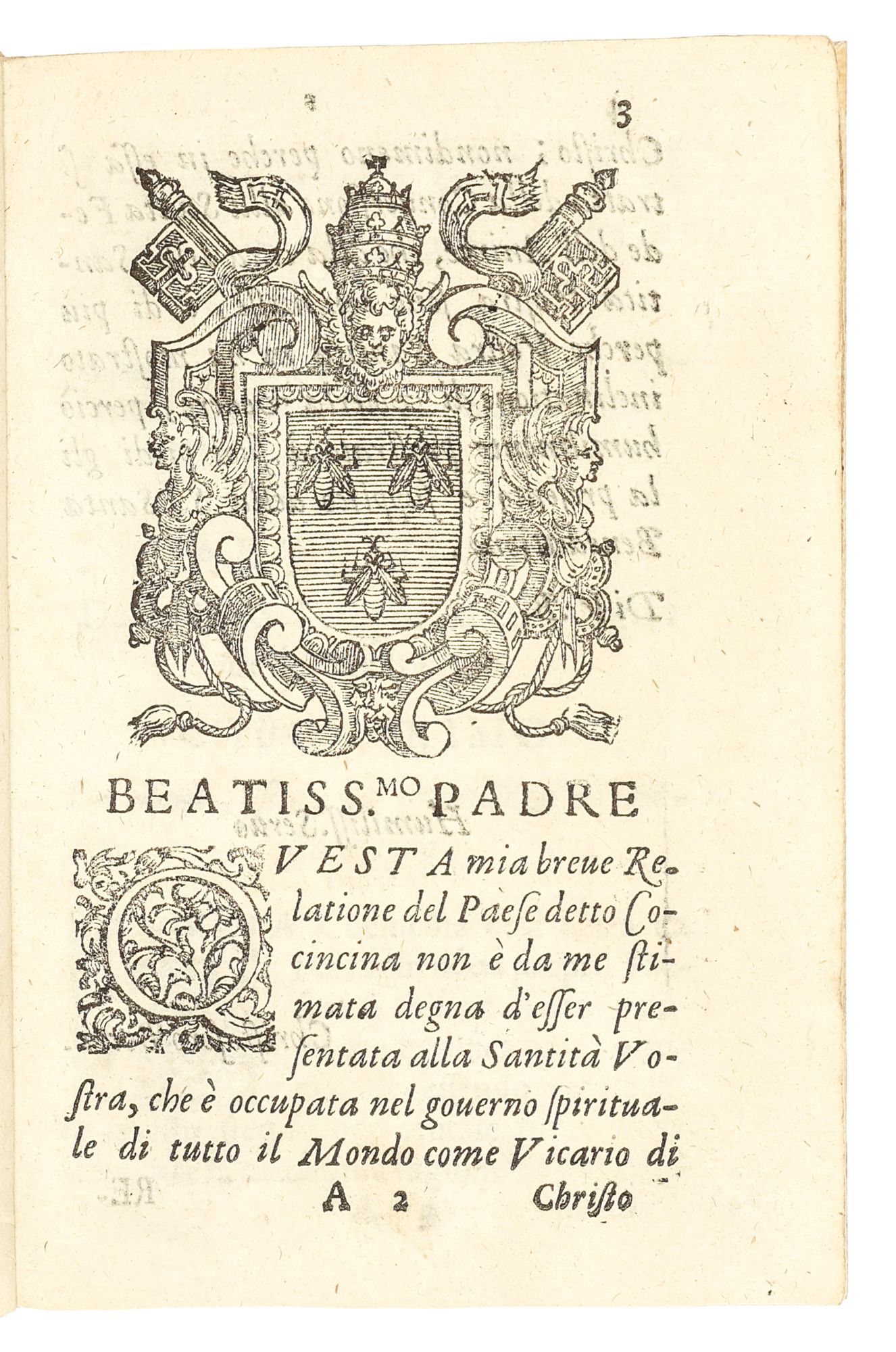
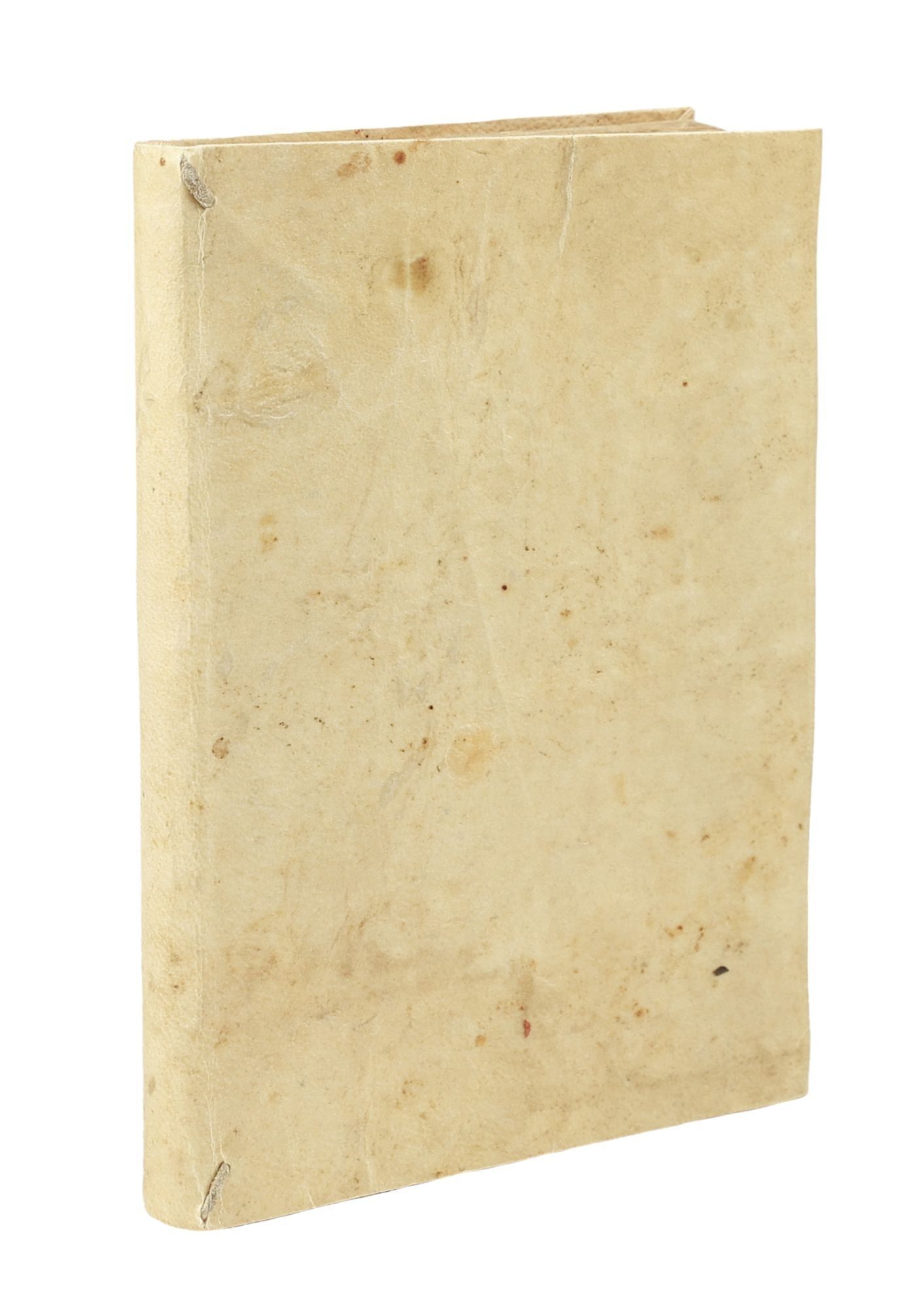
Rome: Francesco Corbelletti, 1631. FIRST EDITION. Hardcover. Fine. Bound in early 20th c. stiff parchment, ruled in red, with elegant pen-work in red and black on the spine. A nice copy, perhaps lightly washed. With woodcut arms of the dedicatee, Pope Urban VIII, with the Barberini arms, on p. 3. FIRST EDITION of this important account of Vietnam, the first report on Vietnam written by a European. Written from the author's own experiences during his residence in the Nguyễn domains, in what is now central and southern Vietnam, between 1618 and 1621, the work presents the author's direct observations of the land's geography, climate, and natural resources; its political administration, commerce, and social customs (including descriptions of indigenous religions); as well as a narrative of the progress of the nascent Jesuit mission.
The Italian Jesuit scientist (a heliocentrist and supporter of Galileo), arrived in Cochinchina in late 1617 or early 1618, when the missionary presence was still in its infancy and marked by uncertainty. Expecting hostility or even martyrdom, Borri instead found a courteous reception and went on to spend four productive years in the country. During that time, he strengthened the mission, established lasting relations with local communities, and conducted scientific research. In Chapter 5 he records his predictions and observations of two lunar eclipses and the solar eclipse of 22 May 1621.
Although Borri's Relatione contains no sustained Vietnamese text, it is among the earliest European works to record Vietnamese (Cochinchinese) words phonetically in the Latin alphabet-chiefly titles such as Onsaij (ông sãi, "monk"), Omgne (ông nghè, "court official"), and place names like Faifò (Hội An) and Turon *(Đà Nẵng). These spellings document early European attempts to capture Vietnamese sounds before the creation of the systematic Romanized script quốc ngữ by later Jesuits such as Alexandre de Rhodes.
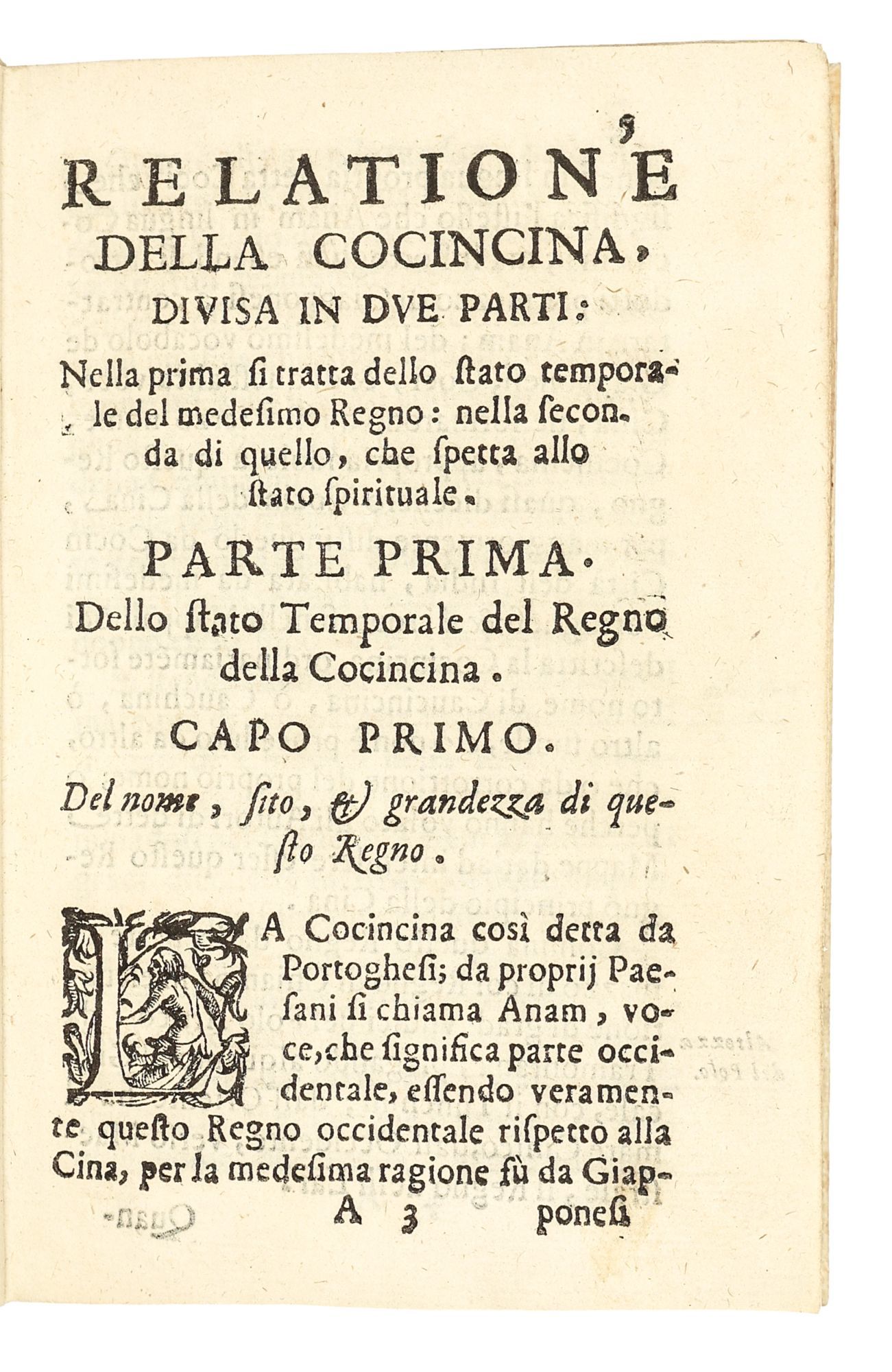
The book is structured in two parts, the first dealing with the geography and culture of Vietnam.
BOOK I - The Temporal State of Cochinchina
Borri introduces Cocincina (Cochinchina), the area corresponding roughly to central and southern Vietnam, ruled by the Nguyễn lords. He explains the etymology of the name (from "Coci," a Japanese term for Annam, and "China"), and locates the country between Tunchim (Tonkin, northern Vietnam) and Chiampà (Champa, south-central Vietnam). He praises its fertility, mild climate, and dense population, portraying it as a prosperous and well-governed realm suited for missionary enterprise.
He describes a region of temperate weather divided between rainy and dry seasons. The atmosphere, he notes, is wholesome and pure, free from epidemic disease. He admires the regularity of the monsoon winds, which bring both agricultural abundance and maritime prosperity.
In Chapter 3, Borri offers a lush catalogue of agricultural wealth-rice, sugar, fruits, and aromatic woods like aloes and calambac. Borri likens the fertility of Cocincina to that of Italy itself and emphasizes divine providence in the country's abundance. He observes that the people are skilled in irrigation and land management.
In Chapter 4, "Of Elephants and the Abadas" (Rhinoceroses), Borri turns to fauna, describing elephants used in labor and war, and the abada (rhinoceros) found in the forests. He recounts local stories and adds European natural-philosophical reflections, presenting the animals as symbols of strength and divine order.
An ethnographic portrait follows; Borri comments on the politeness and intelligence of the Cocincinesi (Vietnamese), their industry, and sense of honor. He also notes "superstitious" elements in religion and medicine, describing their use of herbal cures and astrological diagnosis. The men wear loose garments; women are modest and industrious. The society, he writes, prizes civility and filial duty.
Chapter 6 - Of the Political and Civil Government
The government is structured hierarchically: the Nguyễn lord rules from Sinvuà (Huế) through governors of provinces such as Quamguya (Quảng Ngãi), Cacciam (Qui Nhơn), and Pulucambì (Phú Yên). Laws are administered with Confucian-like decorum; justice is swift and often exemplary. The administration balances severity and generosity, maintaining peace and prosperity.
Chapter 7 describes the Nguyễn ruler's military might and his conflicts with Tunchim (Tonkin). The king commands numerous elephants and disciplined troops, and Borri marvels at the discipline and courage of the soldiers. He describes the long rivalry between the Nguyễn and Trịnh dynasties as both political and moral warfare.
Borri ends Book I with a vivid description of Faifò (Hội An) and Turon (Đà Nẵng), flourishing harbors open to Japanese, Portuguese, and Chinese traders. The openness of the ports makes Cocincina a meeting point of East and West, its commercial wealth feeding the royal treasury and preparing the ground for Christian missions.
Book II is Borri's account of the Jesuit Mission and the progress -and setbacks- of bringing Christianity to Vietnam.
Borri recounts the first entrance of Jesuit missionaries into Turon (Đà Nẵng) and Cacciam (Qui Nhơn). Welcomed by local officials, they erect two churches and begin preaching through interpreters. The early success, marked by curiosity and goodwill from the people, seems to promise a great harvest of conversions.
Soon misfortune strikes. Drought and famine are blamed on the Jesuits, and persecution erupts. Borri himself is sent from Macao (Macau) to aid the mission, traveling in disguise. Miraculously, torrential rains begin at his arrival, which locals interpret as proof of divine favor, and hostility ceases.
The Governor of Pulucambì (Phú Yên or Quy Nhơn) befriends the missionaries, grants them land, and builds a church and residence. His protection allows the Fathers to preach publicly and win respect at court. The chapter emphasizes how local authority could shelter fragile missions.
Tragedy follows. The Governor dies suddenly of fever while hunting, before baptism. Borri mourns him as a noble pagan whose sympathy for Christianity nearly transformed the province. With his death, the missionaries lose all support and return to poverty and danger.
After three years of hardship in Pulucambì, divine providence renews the mission. The wife of an ambassador from Nuoecman (Nước Mặn), moved by Borri's preaching, requests baptism, followed by twenty-five of her ladies. She receives the Christian name Orsola (Ursula). Later her husband, the Ambasciadore Ignatio (Ignatius), and many courtiers convert, marking the first flowering of Christianity among the elite.
Borri narrates conversions among scholars and astrologers. One notable case involves a royal astrologer who mispredicted an eclipse that Borri accurately forecast using European astronomy. The accuracy of Jesuit science impresses the court, leading several literati to study Christian doctrine and some to convert.
There are descriptions of priests and Onsaij (Buddhist Clergy) being converted to Christianity. A Buddhist monk named Onsaij Ly, for instance, becomes an exemplary Christian, living a pious life, preaching publicly, and converting others-including learned monks and nobles. Borri interprets this as proof that divine grace can penetrate the highest orders of gentile religion.
Borri next surveys native religious systems, tracing them to Xaca (Śākyamuni Buddha) and noting similarities with pagan errors known to Europe. He divides the sects into philosophers, idolaters, and astrologers, arguing that their doctrines contain echoes of the Gospel distorted by ignorance.
Borri describes healings, answered prayers, and deliverance from storms as proofs of divine favor confirming the truth of the new faith among simple folk. By the time Borri writes, Faifò (Hội An), Turon (Đà Nẵng), and Cacciam (Qui Nhơn) all possess flourishing Christian congregations with churches, catechists, and sacraments. The Jesuits administer baptisms and establish schools, creating a stable Christian presence in the kingdom.
Chapter 11 - On the Kingdom of Tonkin
Borri turns north to Tunchim (Tonkin), ruled by the Trịnh lords. He sketches its wealth, learning, and openness to European contact, predicting that Tonkin too will embrace Christianity, complementing the progress in Cochinchina.
In his final chapter, Borri concludes with an exalted description of Cochinchina-its beauty, healthful climate, wealth in gold, silk, and aromatic woods, and the sweetness and liberality of its people. He insists that the land lacks only 'many of God's angels,' meaning apostolic missionaries, to become a piece of heaven on earth. He contrasts the openness of Cochinchina, where foreigners may live freely, with the restrictions of China, affirming that here the Gospel may flourish without disguise.
Further reading: Olga Dror, "Phantasmatic Conchinchina", in "Views of Seventeenth-century Vietnam", pp. 23-59).
The Italian Jesuit scientist (a heliocentrist and supporter of Galileo), arrived in Cochinchina in late 1617 or early 1618, when the missionary presence was still in its infancy and marked by uncertainty. Expecting hostility or even martyrdom, Borri instead found a courteous reception and went on to spend four productive years in the country. During that time, he strengthened the mission, established lasting relations with local communities, and conducted scientific research. In Chapter 5 he records his predictions and observations of two lunar eclipses and the solar eclipse of 22 May 1621.
Although Borri's Relatione contains no sustained Vietnamese text, it is among the earliest European works to record Vietnamese (Cochinchinese) words phonetically in the Latin alphabet-chiefly titles such as Onsaij (ông sãi, "monk"), Omgne (ông nghè, "court official"), and place names like Faifò (Hội An) and Turon *(Đà Nẵng). These spellings document early European attempts to capture Vietnamese sounds before the creation of the systematic Romanized script quốc ngữ by later Jesuits such as Alexandre de Rhodes.
The book is structured in two parts, the first dealing with the geography and culture of Vietnam.
BOOK I - The Temporal State of Cochinchina
Borri introduces Cocincina (Cochinchina), the area corresponding roughly to central and southern Vietnam, ruled by the Nguyễn lords. He explains the etymology of the name (from "Coci," a Japanese term for Annam, and "China"), and locates the country between Tunchim (Tonkin, northern Vietnam) and Chiampà (Champa, south-central Vietnam). He praises its fertility, mild climate, and dense population, portraying it as a prosperous and well-governed realm suited for missionary enterprise.
He describes a region of temperate weather divided between rainy and dry seasons. The atmosphere, he notes, is wholesome and pure, free from epidemic disease. He admires the regularity of the monsoon winds, which bring both agricultural abundance and maritime prosperity.
In Chapter 3, Borri offers a lush catalogue of agricultural wealth-rice, sugar, fruits, and aromatic woods like aloes and calambac. Borri likens the fertility of Cocincina to that of Italy itself and emphasizes divine providence in the country's abundance. He observes that the people are skilled in irrigation and land management.
In Chapter 4, "Of Elephants and the Abadas" (Rhinoceroses), Borri turns to fauna, describing elephants used in labor and war, and the abada (rhinoceros) found in the forests. He recounts local stories and adds European natural-philosophical reflections, presenting the animals as symbols of strength and divine order.
An ethnographic portrait follows; Borri comments on the politeness and intelligence of the Cocincinesi (Vietnamese), their industry, and sense of honor. He also notes "superstitious" elements in religion and medicine, describing their use of herbal cures and astrological diagnosis. The men wear loose garments; women are modest and industrious. The society, he writes, prizes civility and filial duty.
Chapter 6 - Of the Political and Civil Government
The government is structured hierarchically: the Nguyễn lord rules from Sinvuà (Huế) through governors of provinces such as Quamguya (Quảng Ngãi), Cacciam (Qui Nhơn), and Pulucambì (Phú Yên). Laws are administered with Confucian-like decorum; justice is swift and often exemplary. The administration balances severity and generosity, maintaining peace and prosperity.
Chapter 7 describes the Nguyễn ruler's military might and his conflicts with Tunchim (Tonkin). The king commands numerous elephants and disciplined troops, and Borri marvels at the discipline and courage of the soldiers. He describes the long rivalry between the Nguyễn and Trịnh dynasties as both political and moral warfare.
Borri ends Book I with a vivid description of Faifò (Hội An) and Turon (Đà Nẵng), flourishing harbors open to Japanese, Portuguese, and Chinese traders. The openness of the ports makes Cocincina a meeting point of East and West, its commercial wealth feeding the royal treasury and preparing the ground for Christian missions.
Book II is Borri's account of the Jesuit Mission and the progress -and setbacks- of bringing Christianity to Vietnam.
Borri recounts the first entrance of Jesuit missionaries into Turon (Đà Nẵng) and Cacciam (Qui Nhơn). Welcomed by local officials, they erect two churches and begin preaching through interpreters. The early success, marked by curiosity and goodwill from the people, seems to promise a great harvest of conversions.
Soon misfortune strikes. Drought and famine are blamed on the Jesuits, and persecution erupts. Borri himself is sent from Macao (Macau) to aid the mission, traveling in disguise. Miraculously, torrential rains begin at his arrival, which locals interpret as proof of divine favor, and hostility ceases.
The Governor of Pulucambì (Phú Yên or Quy Nhơn) befriends the missionaries, grants them land, and builds a church and residence. His protection allows the Fathers to preach publicly and win respect at court. The chapter emphasizes how local authority could shelter fragile missions.
Tragedy follows. The Governor dies suddenly of fever while hunting, before baptism. Borri mourns him as a noble pagan whose sympathy for Christianity nearly transformed the province. With his death, the missionaries lose all support and return to poverty and danger.
After three years of hardship in Pulucambì, divine providence renews the mission. The wife of an ambassador from Nuoecman (Nước Mặn), moved by Borri's preaching, requests baptism, followed by twenty-five of her ladies. She receives the Christian name Orsola (Ursula). Later her husband, the Ambasciadore Ignatio (Ignatius), and many courtiers convert, marking the first flowering of Christianity among the elite.
Borri narrates conversions among scholars and astrologers. One notable case involves a royal astrologer who mispredicted an eclipse that Borri accurately forecast using European astronomy. The accuracy of Jesuit science impresses the court, leading several literati to study Christian doctrine and some to convert.
There are descriptions of priests and Onsaij (Buddhist Clergy) being converted to Christianity. A Buddhist monk named Onsaij Ly, for instance, becomes an exemplary Christian, living a pious life, preaching publicly, and converting others-including learned monks and nobles. Borri interprets this as proof that divine grace can penetrate the highest orders of gentile religion.
Borri next surveys native religious systems, tracing them to Xaca (Śākyamuni Buddha) and noting similarities with pagan errors known to Europe. He divides the sects into philosophers, idolaters, and astrologers, arguing that their doctrines contain echoes of the Gospel distorted by ignorance.
Borri describes healings, answered prayers, and deliverance from storms as proofs of divine favor confirming the truth of the new faith among simple folk. By the time Borri writes, Faifò (Hội An), Turon (Đà Nẵng), and Cacciam (Qui Nhơn) all possess flourishing Christian congregations with churches, catechists, and sacraments. The Jesuits administer baptisms and establish schools, creating a stable Christian presence in the kingdom.
Chapter 11 - On the Kingdom of Tonkin
Borri turns north to Tunchim (Tonkin), ruled by the Trịnh lords. He sketches its wealth, learning, and openness to European contact, predicting that Tonkin too will embrace Christianity, complementing the progress in Cochinchina.
In his final chapter, Borri concludes with an exalted description of Cochinchina-its beauty, healthful climate, wealth in gold, silk, and aromatic woods, and the sweetness and liberality of its people. He insists that the land lacks only 'many of God's angels,' meaning apostolic missionaries, to become a piece of heaven on earth. He contrasts the openness of Cochinchina, where foreigners may live freely, with the restrictions of China, affirming that here the Gospel may flourish without disguise.
Further reading: Olga Dror, "Phantasmatic Conchinchina", in "Views of Seventeenth-century Vietnam", pp. 23-59).
Details
Title
Relatione della nuova Missione delli Padri della Compagnia di Giesù, al regno della Cocincina
Author
VIETNAM. Borri, Cristoforo, S.J. (1583-1632)
Binding
Hardcover
Condition
Fine
Publisher
Francesco Corbelletti: Rome
Date
1631
Edition
FIRST EDITION