

Manuscript on paper, entitled on first leaf of text “Shōkaku fugō.”
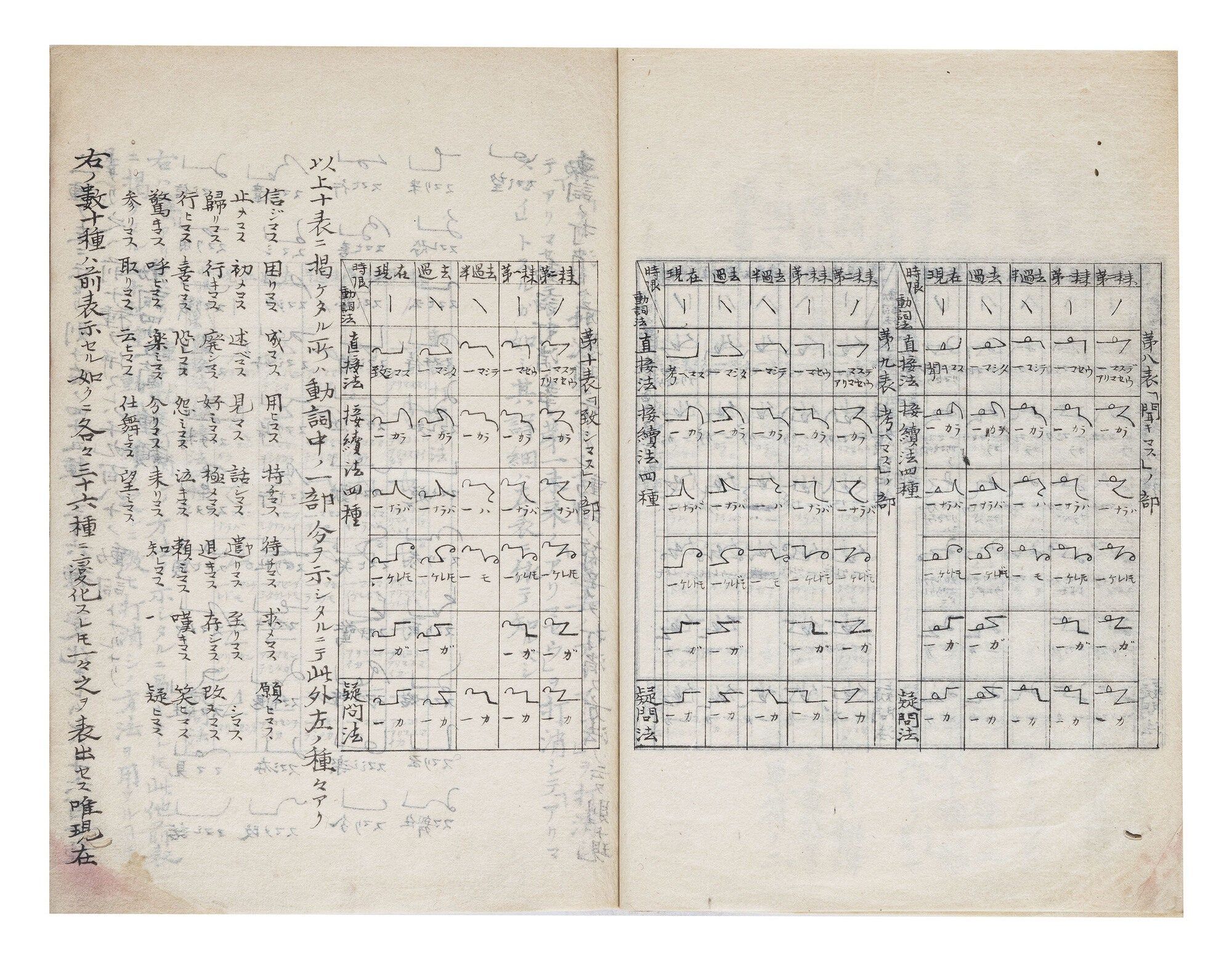
18 folding leaves. 8vo (262 x 186 mm.), orig. brown wrappers, new stitching. [Japan]: late 19th century.
“At the end of the Edo period Japanese ambassadors traveling abroad noted the presence of stenographers during their interviews, and after the Meiji Restoration a few Western books on shorthand appeared in Tokyo bookstores and in the private libraries of government secretaries. On several occasions in the first two decades of Meiji, individuals or groups sought to adapt Western shorthand for Japanese, but their attempts were quickly aborted, often owing to a dogged insistence that the essentially phonetic script preserve the ideographic utility of Chinese characters. As the Meiji period progressed and political assemblies, including rather spirited speeches and debates, added momentum to the development and circulation of newspapers throughout the nation, the need for an effective method of transcribing oratory kept alive the quest for a Japanese shorthand. From 1878 through 1881 Takusari Koki 田鎖綱紀, 1854-1938, a young man of samurai heritage from Iwate prefecture [who had received rudimentary lessons in Graham shorthand from the American Robert G. Carlyle, a mining specialist employed by the Meiji government], toyed with possible Japanese stenographic systems and then approached the task with greater seriousness, using various Western shorthand systems as well as inventing those of his own…
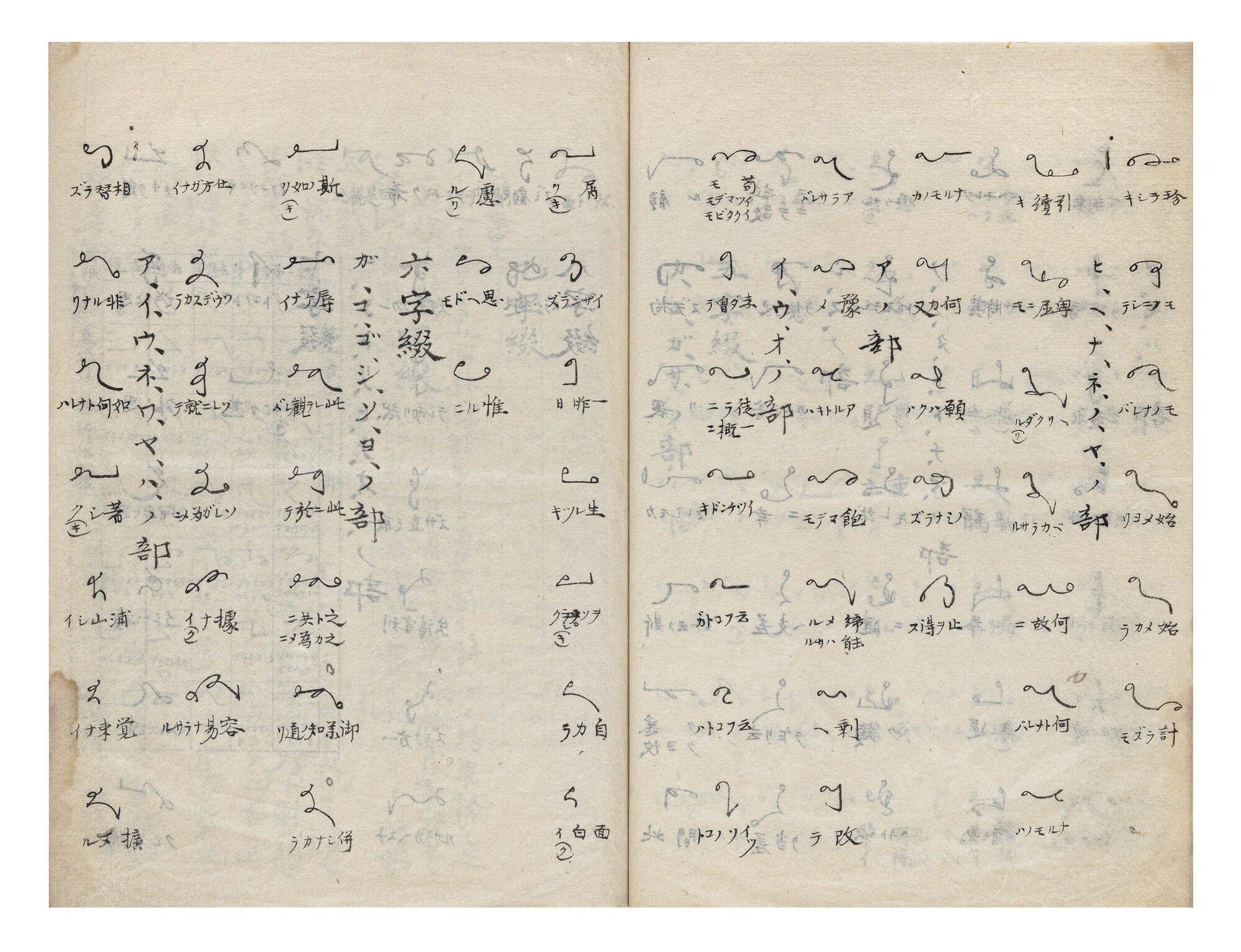
“At first, like his predecessors in the enterprise, Takusari concentrated on abbreviating both sounds and kanji, but this system quickly grew ungainly owing to the large number of distinct characters. He then adopted a phonetic approach, modeled upon Graham and more suited to Japanese, that separated vowel sounds and initial consonants into marks representing the angles found in a circle…
“In 1882 an enthusiastic supporter of Takusari’s embryonic shorthand system published an article in Jijishimpō describing Takusari’s plight and indigent circumstances, waxing eloquent on shorthand’s potential…
“After the appearance of this article several would-be students approached Takusari about the possibility of his offering a training program in sokki. By the end of the year he had enrolled forty students, seventeen of whom continued through the primarily theoretical course to graduate in May 1883. Some of these first graduates went on to become professional stenographers, and others later became famous teachers or politicians. Over the following few years new members joined their ranks and a number of alternative sokki styles, suited to the pragmatic demands of simultaneous transcription, branched off from Takusari’s prototype.”–J. Scott Miller, “Japanese Shorthand and Sokkibon” in Monumenta Nipponica, Vol. 49, No. 4 (Winter 1994), pp. 473-74.
Our attractive manuscript begins with a description of the shorthand system, starting with two syllables reduced to one shorthand symbol, up to 11 syllables. It continues with variations and other phonetic and grammatical considerations and complications.
Fine copy. Minor worming.
“At the end of the Edo period Japanese ambassadors traveling abroad noted the presence of stenographers during their interviews, and after the Meiji Restoration a few Western books on shorthand appeared in Tokyo bookstores and in the private libraries of government secretaries. On several occasions in the first two decades of Meiji, individuals or groups sought to adapt Western shorthand for Japanese, but their attempts were quickly aborted, often owing to a dogged insistence that the essentially phonetic script preserve the ideographic utility of Chinese characters. As the Meiji period progressed and political assemblies, including rather spirited speeches and debates, added momentum to the development and circulation of newspapers throughout the nation, the need for an effective method of transcribing oratory kept alive the quest for a Japanese shorthand. From 1878 through 1881 Takusari Koki 田鎖綱紀, 1854-1938, a young man of samurai heritage from Iwate prefecture [who had received rudimentary lessons in Graham shorthand from the American Robert G. Carlyle, a mining specialist employed by the Meiji government], toyed with possible Japanese stenographic systems and then approached the task with greater seriousness, using various Western shorthand systems as well as inventing those of his own…
“At first, like his predecessors in the enterprise, Takusari concentrated on abbreviating both sounds and kanji, but this system quickly grew ungainly owing to the large number of distinct characters. He then adopted a phonetic approach, modeled upon Graham and more suited to Japanese, that separated vowel sounds and initial consonants into marks representing the angles found in a circle…
“In 1882 an enthusiastic supporter of Takusari’s embryonic shorthand system published an article in Jijishimpō describing Takusari’s plight and indigent circumstances, waxing eloquent on shorthand’s potential…
“After the appearance of this article several would-be students approached Takusari about the possibility of his offering a training program in sokki. By the end of the year he had enrolled forty students, seventeen of whom continued through the primarily theoretical course to graduate in May 1883. Some of these first graduates went on to become professional stenographers, and others later became famous teachers or politicians. Over the following few years new members joined their ranks and a number of alternative sokki styles, suited to the pragmatic demands of simultaneous transcription, branched off from Takusari’s prototype.”–J. Scott Miller, “Japanese Shorthand and Sokkibon” in Monumenta Nipponica, Vol. 49, No. 4 (Winter 1994), pp. 473-74.
Our attractive manuscript begins with a description of the shorthand system, starting with two syllables reduced to one shorthand symbol, up to 11 syllables. It continues with variations and other phonetic and grammatical considerations and complications.
Fine copy. Minor worming.
Details
Title
Manuscript on paper, entitled on first leaf of text “Shōkaku fugō.”
Author
SHŌKAKU FUGŌ 省画符号 (JAPANESE SHORTHAND)
Condition
Unknown