

Tongguk myŏngsan-ki 東國名山記 [Records of Famous Mountains in Korea]
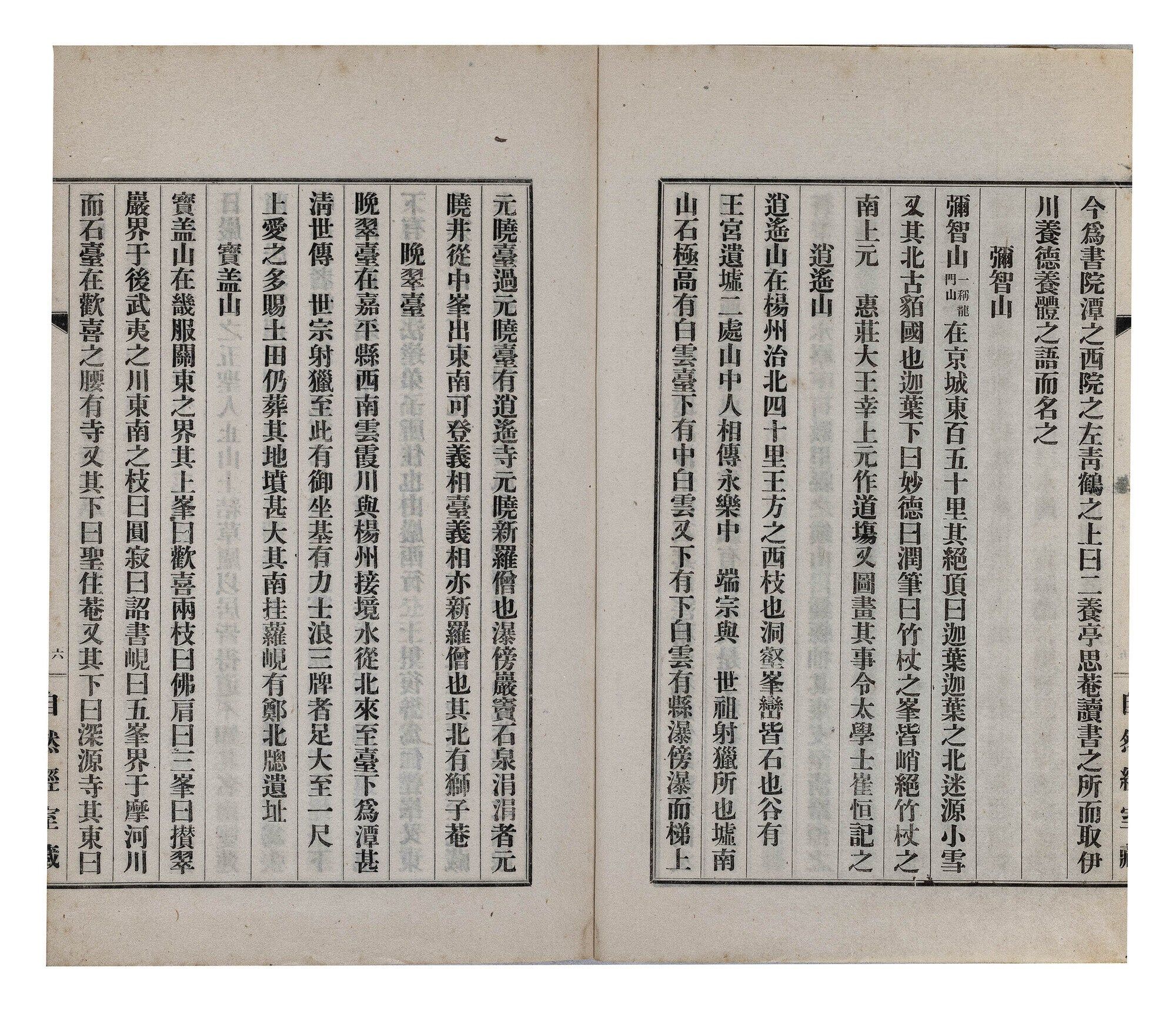
51 folding leaves. Large 8vo (270 x 180 mm.), orig. yellow patterned semi-stiff wrappers. Kyŏngsŏng (Seoul): Irhan Sŏbang 日韓書房, 1909.
An uncommon geographical treatise from the late Chosŏn period, compiled by Sŏng Hae-ŭng (1760-1839) during the reign of King Jeongjo (r. 1776-1800). This work surveys approximately 100 of Korea’s most celebrated scenic and historic mountains and sites, organized into nine regions: Gyeongdo, Giro, Haeseo, Gwanso, Hojung, Honam, Yeongnam, Gwandong, and Gwanbuk. Sŏng provides detailed descriptions of each site’s landscape, topography, legendary figures, historical episodes, and the cultural ethnography of local people.
Sŏng Hae-ŭng, appointed as a librarian at the Gyujanggak (Royal Library) in 1788, is regarded as a key figure in the second generation of the sirhak (practical learning) movement. Offering a dynamic and critical alternative to prevailing Neo-Confucian orthodoxy, the sirhak movement championed empirical research and the reform of society by grounding knowledge in practical observation and verification. Tongguk myŏngsan-ki epitomizes such spirit.
Beyond its original import, our 1909 republication by Irhan Sŏbang — an affiliated printing house of the Tokyo School of Foreign Languages alumni association — invites special attention. Released at a time when Korea was becoming accessible to the Japanese upper-middle class and as expanding rail and ship networks hinted at the dawn of modern travel, this book uniquely bridged documentary tradition and early stirrings of tourism interest. Resonating with the established East Asian genre of literary and geographical exploration — for example, seen in Japan’s celebrated meisho zue (“illustrated guides to famous places”) — its republication reflected not only scholarly and administrative aims but also a broader impulse to catalogue, comprehend, and romantically imagine Korea’s landscape’s during the imperial transition.
On the other hand, the edition’s origins with Korean students in Japanese schools underscore their desire to reclaim and know their own country at a time when heritage was increasingly filtered through outside perspectives.
Fine fresh copy, printed with metal movable type.
❧ The Asami Library 20.4.
An uncommon geographical treatise from the late Chosŏn period, compiled by Sŏng Hae-ŭng (1760-1839) during the reign of King Jeongjo (r. 1776-1800). This work surveys approximately 100 of Korea’s most celebrated scenic and historic mountains and sites, organized into nine regions: Gyeongdo, Giro, Haeseo, Gwanso, Hojung, Honam, Yeongnam, Gwandong, and Gwanbuk. Sŏng provides detailed descriptions of each site’s landscape, topography, legendary figures, historical episodes, and the cultural ethnography of local people.
Sŏng Hae-ŭng, appointed as a librarian at the Gyujanggak (Royal Library) in 1788, is regarded as a key figure in the second generation of the sirhak (practical learning) movement. Offering a dynamic and critical alternative to prevailing Neo-Confucian orthodoxy, the sirhak movement championed empirical research and the reform of society by grounding knowledge in practical observation and verification. Tongguk myŏngsan-ki epitomizes such spirit.
Beyond its original import, our 1909 republication by Irhan Sŏbang — an affiliated printing house of the Tokyo School of Foreign Languages alumni association — invites special attention. Released at a time when Korea was becoming accessible to the Japanese upper-middle class and as expanding rail and ship networks hinted at the dawn of modern travel, this book uniquely bridged documentary tradition and early stirrings of tourism interest. Resonating with the established East Asian genre of literary and geographical exploration — for example, seen in Japan’s celebrated meisho zue (“illustrated guides to famous places”) — its republication reflected not only scholarly and administrative aims but also a broader impulse to catalogue, comprehend, and romantically imagine Korea’s landscape’s during the imperial transition.
On the other hand, the edition’s origins with Korean students in Japanese schools underscore their desire to reclaim and know their own country at a time when heritage was increasingly filtered through outside perspectives.
Fine fresh copy, printed with metal movable type.
❧ The Asami Library 20.4.
Details
Title
Tongguk myŏngsan-ki 東國名山記 [Records of Famous Mountains in Korea]
Author
SŎNG, Hae-ŭng 成海應
Condition
Unknown