

Manuscript on paper, entitled on upper wrapper “Toko shoin shōgon kikigaki” 床書院荘厳記聞 [“Information on How to Decorate the Alcove & Shelves in a Shoin According to Zashiki Shōgon Taste”]
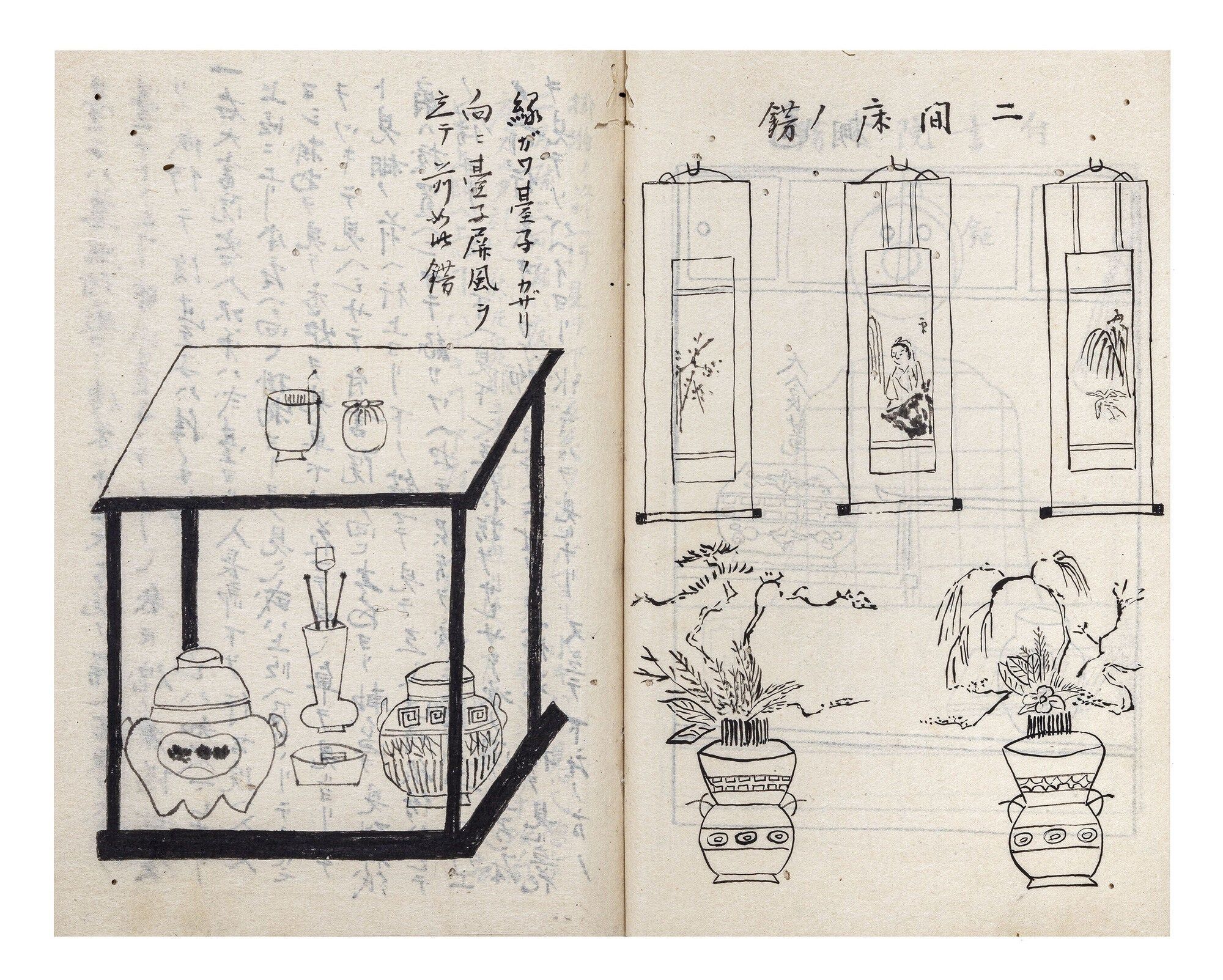
Many brush & black ink illus. 56 folding leaves. Small 8vo (200 x 140 mm.), orig. wrappers & stitching. [Japan]: from final page in trans.: “1748,” but this is probably a later copy.
In the tea ceremony, there was a shift during the Muromachi period (1338–1573) from elaborate large rooms to more modest shoin 書院, or study rooms, decorated with a tokonoma 床間 (an alcove to display vertical scrolls and flower arrangements) and chigaidana 違い棚 (shelves built into the wall to display objects such as scrolls, small vases, and tea utensils). The concept of zashiki shōgon (formal display) governed this style of architecture, reflecting the host’s refined sensibilities.
The source material for our manuscript derives from the writings in 1562 by Ikenobō Senkō 池坊専好 (1536-1621), who perfected the art of complex flower arrangement. A later, unidentified, author has added text in 1748.
Ikenobō’s taste in flower arrangement was an extension of the zashiki shōgon. The illustrations depict various arrangements of the objects for the tokonoma, the chigaidana, and other areas of the study room along with their many meanings. Some of these objects include rare books and scrolls, incense tools, calligraphy sets, tea utensils, flower arrangements, precious earthenware, miniature gardens, lamps, vertical scroll displays, the arrangement of serving trays, patterns of incense burner ash, gongs, pots of plants, Chinese porcelain dolls, etc. Twelve different shelf layouts are shown.
A pedigree of the various tastemakers of the zashiki shōgon style is given, and the Ikenobō family is listed.
Some worming throughout, becoming more pronounced towards end, touching text (which remains completely legible) and images.
In the tea ceremony, there was a shift during the Muromachi period (1338–1573) from elaborate large rooms to more modest shoin 書院, or study rooms, decorated with a tokonoma 床間 (an alcove to display vertical scrolls and flower arrangements) and chigaidana 違い棚 (shelves built into the wall to display objects such as scrolls, small vases, and tea utensils). The concept of zashiki shōgon (formal display) governed this style of architecture, reflecting the host’s refined sensibilities.
The source material for our manuscript derives from the writings in 1562 by Ikenobō Senkō 池坊専好 (1536-1621), who perfected the art of complex flower arrangement. A later, unidentified, author has added text in 1748.
Ikenobō’s taste in flower arrangement was an extension of the zashiki shōgon. The illustrations depict various arrangements of the objects for the tokonoma, the chigaidana, and other areas of the study room along with their many meanings. Some of these objects include rare books and scrolls, incense tools, calligraphy sets, tea utensils, flower arrangements, precious earthenware, miniature gardens, lamps, vertical scroll displays, the arrangement of serving trays, patterns of incense burner ash, gongs, pots of plants, Chinese porcelain dolls, etc. Twelve different shelf layouts are shown.
A pedigree of the various tastemakers of the zashiki shōgon style is given, and the Ikenobō family is listed.
Some worming throughout, becoming more pronounced towards end, touching text (which remains completely legible) and images.
Details
Title
Manuscript on paper, entitled on upper wrapper “Toko shoin shōgon kikigaki” 床書院荘厳記聞 [“Information on How to Decorate the Alcove & Shelves in a Shoin According to Zashiki Shōgon Taste”]
Author
ZASHIKI SHŌGON 座敷荘厳
Condition
Unknown