

WOMEN'S PROPERTY RIGHTS IN COLORADO
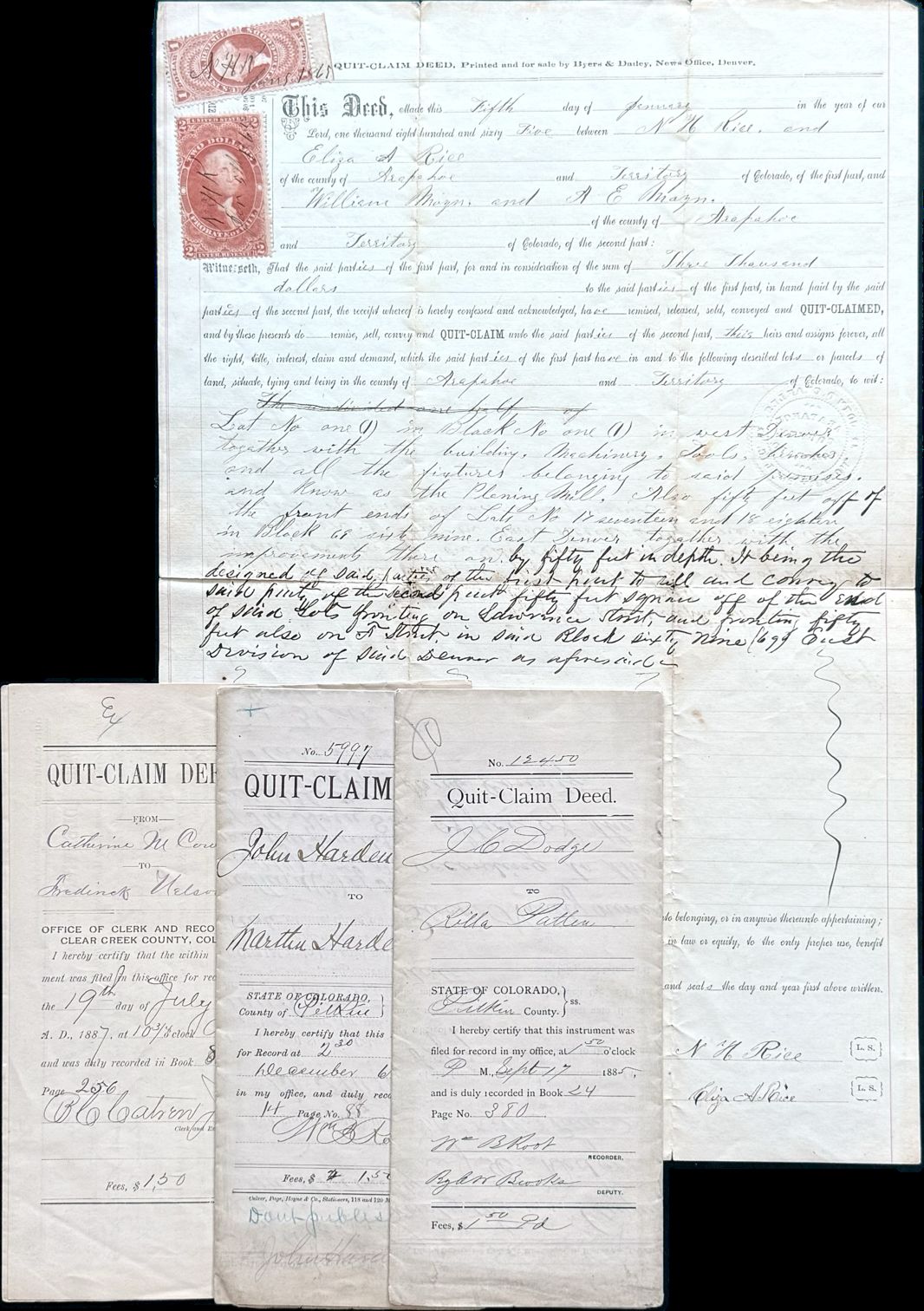
Four quit-claim deeds dating from the 1880s involving women in property transfers at a time when women’s property rights were severely restricted nationwide.
A deed dated September 17, 1885, recorded the purchase of a lot in Aspen by Mrs. Rilla Patten, who paid $150 to J.C. Dodge for lot “L” in Block 99 in the town of Aspen. The city’s population exploded from 500 to 3,500 between 1883 and 1885, reflecting the rapid development driven by the silver boom.
On January 5, 1865, Nanum Howe Rice and Eliza A. Rice (husband and wife) sold a "planing mill" and all its machinery in Denver, Arapahoe County, Territory of Colorado, for $3,000 to another party. He died in 1878.
The additional deeds appear to show the sale and transfer of properties within families.
On July 18, 1887, another deed records the sale of mining property in Clear Creek County by Catherine M. Cowles for $1,000 to Frederick Nelson. According to Ancestry records, Nelson married Catherine K. Cowles in 1885. Her mother, Catherine M Cowles, died in 1884.
On December 6, 1883, John Hardenburgh sold to his wife, Martha B. Hardenburgh, an interest in several mining claims in Pitkin County, Colorado, and a lot in the town of Aspen for $1,000. The couple was married in 1873, and she preceded him in death.
Changes in property rights laws for women paved the way for these transactions. While still a territory, Colorado adopted the Married Women's Property Act in 1861, which gave married white women the right to own property otherwise given to them. Before this time, under coverture, an English common law system, married women could not own property, control their wages, be part of contracts, and otherwise act autonomously to their husband's authority. Further, in 1872, the Colorado Territory allowed any woman while married to “execute any bond, bill, promissory note, or other instrument in writing, for the direct payment of money; and if the consideration thereof went to the benefit of her estate.”
By 1900, most states allowed married white women to own property, but access to credit and mortgages without a male co-signer was a barrier for all women, not addressed until the 1970s.
A deed dated September 17, 1885, recorded the purchase of a lot in Aspen by Mrs. Rilla Patten, who paid $150 to J.C. Dodge for lot “L” in Block 99 in the town of Aspen. The city’s population exploded from 500 to 3,500 between 1883 and 1885, reflecting the rapid development driven by the silver boom.
On January 5, 1865, Nanum Howe Rice and Eliza A. Rice (husband and wife) sold a "planing mill" and all its machinery in Denver, Arapahoe County, Territory of Colorado, for $3,000 to another party. He died in 1878.
The additional deeds appear to show the sale and transfer of properties within families.
On July 18, 1887, another deed records the sale of mining property in Clear Creek County by Catherine M. Cowles for $1,000 to Frederick Nelson. According to Ancestry records, Nelson married Catherine K. Cowles in 1885. Her mother, Catherine M Cowles, died in 1884.
On December 6, 1883, John Hardenburgh sold to his wife, Martha B. Hardenburgh, an interest in several mining claims in Pitkin County, Colorado, and a lot in the town of Aspen for $1,000. The couple was married in 1873, and she preceded him in death.
Changes in property rights laws for women paved the way for these transactions. While still a territory, Colorado adopted the Married Women's Property Act in 1861, which gave married white women the right to own property otherwise given to them. Before this time, under coverture, an English common law system, married women could not own property, control their wages, be part of contracts, and otherwise act autonomously to their husband's authority. Further, in 1872, the Colorado Territory allowed any woman while married to “execute any bond, bill, promissory note, or other instrument in writing, for the direct payment of money; and if the consideration thereof went to the benefit of her estate.”
By 1900, most states allowed married white women to own property, but access to credit and mortgages without a male co-signer was a barrier for all women, not addressed until the 1970s.
Details
Title
WOMEN'S PROPERTY RIGHTS IN COLORADO
Author
[Western Americana] [Women's Studies]
Condition
Unknown