

Lesbian Pulp Fiction and Female Authorship in Cold War America Ann Bannon and Anna Elisabet Weirauch, 1957-1959
- 1957
1957. Bannon, Ann and Weirauch, Anna Elisabet archive documents lesbian identity and authorship in mid-20th century mass-market publishing, produced between 1957 and 1959 during a period when most lesbian pulp fiction was written by men under pseudonyms. These works, authored by women who identified as lesbian or bisexual, present narratives grounded in lived experience and emotional interiority, diverging from dominant pulp conventions of exploitation and moral punishment. All three titles are recognized within Barbara Grier's classification system as containing substantial lesbian characterization and narrative focus, marking them as central texts in early LGBTQ print culture. The archive supports research in lesbian literary history, women's authorship, and Cold War-era sexual discourse.
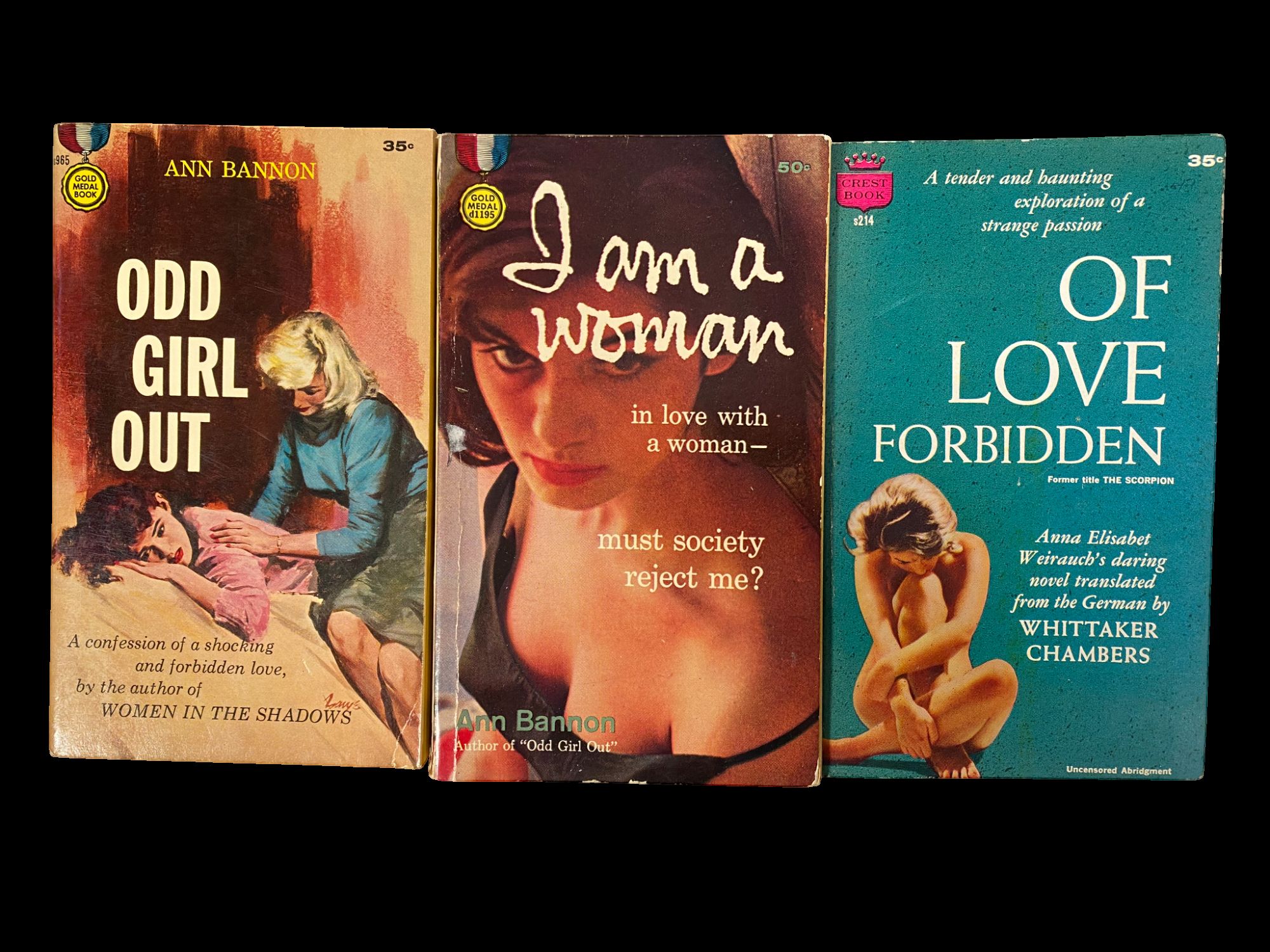
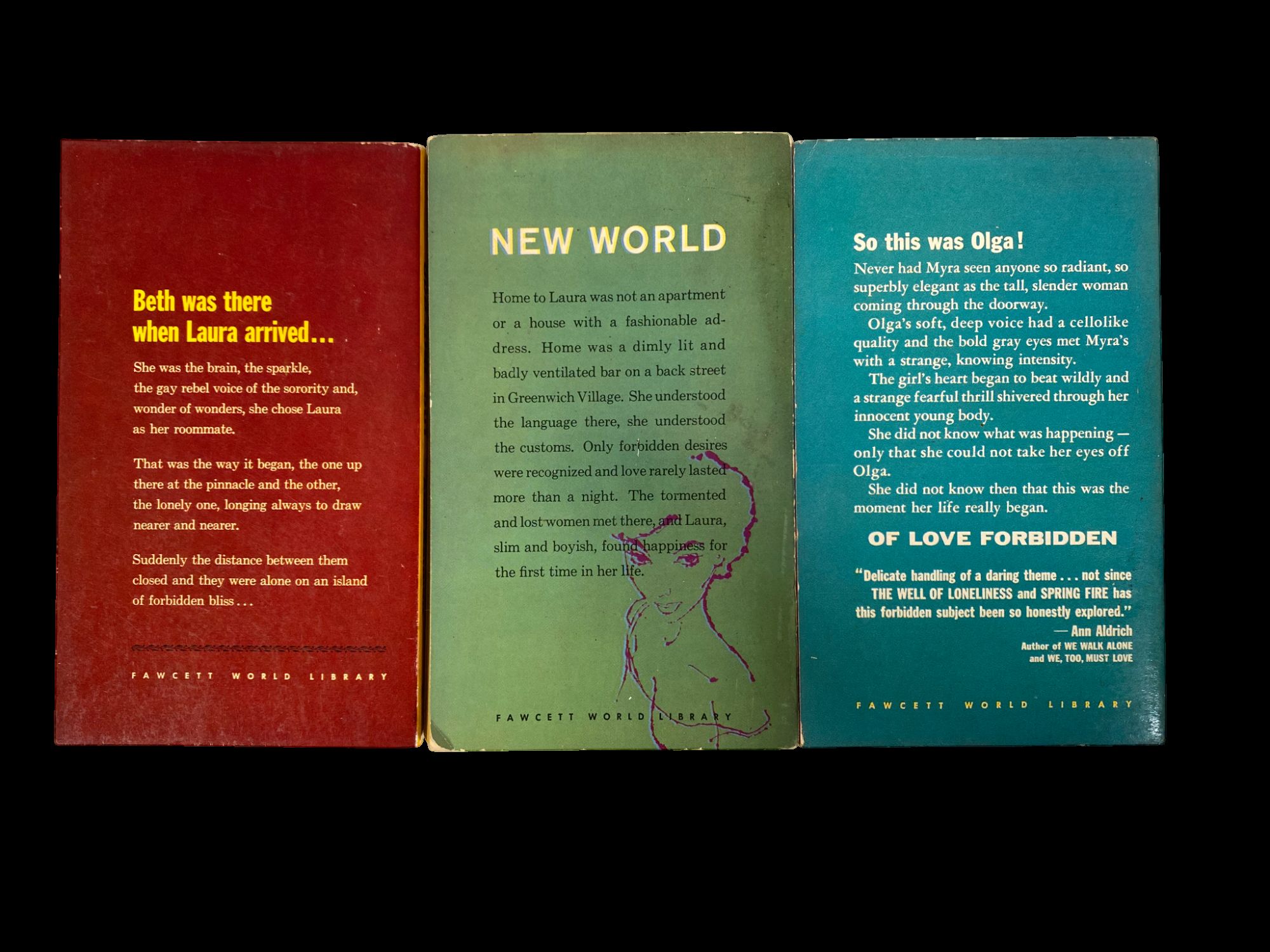
Bannon, Ann (Ann Weldy). Odd Girl Out. Greenwich, Connecticut: Fawcett Publications, 1957. First edition, first printing. Bannon, Ann (Ann Weldy). I Am a Woman. Greenwich, Connecticut: Fawcett Publications, 1959. First edition, first printing. Weirauch, Anna Elisabet. Of Love Forbidden. New York: Fawcett Publications, 1958. First printing, translated from Der Skorpion by Whittaker Chambers. Three volumes, standard mass-market paperback format. Illustrated covers follow pulp conventions of emotionally charged imagery and declarative taglines, foregrounding themes of forbidden desire and social constraint. Odd Girl Out, the first volume in what later became known as the Beebo Brinker series, achieved significant commercial success and established a sustained narrative of lesbian community and identity. I Am a Woman is notable for its explicit titling and continuation of these themes with greater directness. Of Love Forbidden traces the development of a young woman's same-sex desire within a restrictive social environment, offering a European literary antecedent adapted for American audiences.
These works were produced within a publishing environment shaped by obscenity enforcement and the legacy of the Comstock Laws, which constrained depictions of homosexuality while allowing limited circulation through coded or sensational framing. Female-authored lesbian pulp frequently diverged from dominant narrative patterns by offering more sustained emotional depth and, in some cases, less punitive conclusions for queer characters. Their publication coincided with early homophile organizing, including the Daughters of Bilitis, situating these texts within broader efforts to articulate lesbian identity in mid-century America. Clean covers and pages with tight textblocks; light handling wear consistent with age; overall very good condition. A cohesive grouping illustrating the emergence of lesbian-authored narratives within mid-century pulp publishing.
Bannon, Ann (Ann Weldy). Odd Girl Out. Greenwich, Connecticut: Fawcett Publications, 1957. First edition, first printing. Bannon, Ann (Ann Weldy). I Am a Woman. Greenwich, Connecticut: Fawcett Publications, 1959. First edition, first printing. Weirauch, Anna Elisabet. Of Love Forbidden. New York: Fawcett Publications, 1958. First printing, translated from Der Skorpion by Whittaker Chambers. Three volumes, standard mass-market paperback format. Illustrated covers follow pulp conventions of emotionally charged imagery and declarative taglines, foregrounding themes of forbidden desire and social constraint. Odd Girl Out, the first volume in what later became known as the Beebo Brinker series, achieved significant commercial success and established a sustained narrative of lesbian community and identity. I Am a Woman is notable for its explicit titling and continuation of these themes with greater directness. Of Love Forbidden traces the development of a young woman's same-sex desire within a restrictive social environment, offering a European literary antecedent adapted for American audiences.
These works were produced within a publishing environment shaped by obscenity enforcement and the legacy of the Comstock Laws, which constrained depictions of homosexuality while allowing limited circulation through coded or sensational framing. Female-authored lesbian pulp frequently diverged from dominant narrative patterns by offering more sustained emotional depth and, in some cases, less punitive conclusions for queer characters. Their publication coincided with early homophile organizing, including the Daughters of Bilitis, situating these texts within broader efforts to articulate lesbian identity in mid-century America. Clean covers and pages with tight textblocks; light handling wear consistent with age; overall very good condition. A cohesive grouping illustrating the emergence of lesbian-authored narratives within mid-century pulp publishing.
Details
Title
Lesbian Pulp Fiction and Female Authorship in Cold War America Ann Bannon and Anna Elisabet Weirauch, 1957-1959
Author
Ann Bannon; Anna Elisabeth Weirauch
Condition
Unknown
Date
1957