

Album of designs of decorative objects, lamps, clocks, architectural elements, cartes-de-visite, and ornaments. [Nouveaux Desseins de Differens Ornemens de Meubles Inventés et composés par Jean Baptiste Hagenauer]
- [Vienna , 1783
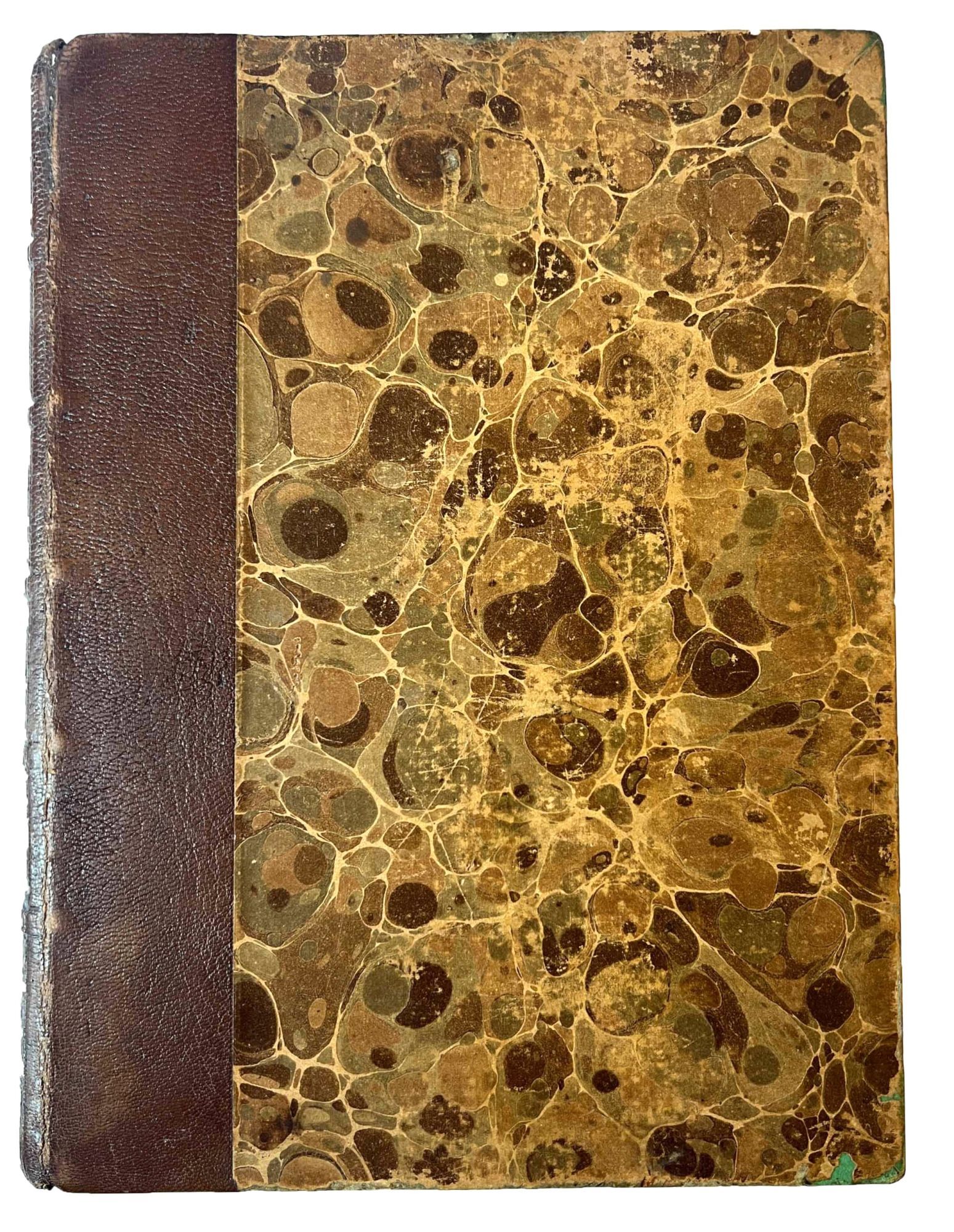
[Vienna, 1783. 4to (241 x 176 mm). 432 etched and/or engraved plates of decorative objects (platemarks 171-177 x 131 mm.), comprising parts (Cahiers) VI to XLI, by various engravers after Hagenauer. Printed on thick laid paper, watermark crown & shield with fleurs-de-lis watermark. (Overall discoloration due to paper quality, some spotting and finger-soiling, one or two short marginal tears, a few old ink splashes from users.) Bound ca. 1900 in brown morocco-backed boards, spine blind-tooled and with gilt-lettered title, by Franz Ostermann, binder’s ticket, address 80 boulevard Malesherbes (corners rubbed). Provenance: Victor and Robert Baguès, owners of the Maison Baguès, specialized in luxury lighting, bookplate, shelf-mark no. 72 on bookplate and on paper spine label.***
EXTREMELY RARE SUITE OF MOST OF THE EXTANT DESIGNS FOR ORNAMENTAL DECORATIVE OBJECTS by the Austrian sculptor Johann Baptist Hagenauer (1732-1810). The collection was produced for the benefit of his students at the Viennese Academy of Engraving and related applied arts.
The only complete copy of the suite recorded, containing 474 plates, is held by the Victoria and Albert Museum. Our copy appears to be a close second; it contains 36 of the 42 published parts, each with 12 plates. Absent are parts1 to 5 and 42, as well as the general title. The third most complete holding appears to be that of the library of the Museum für angewandte Kunst in Vienna, with 189 plates (see census below).
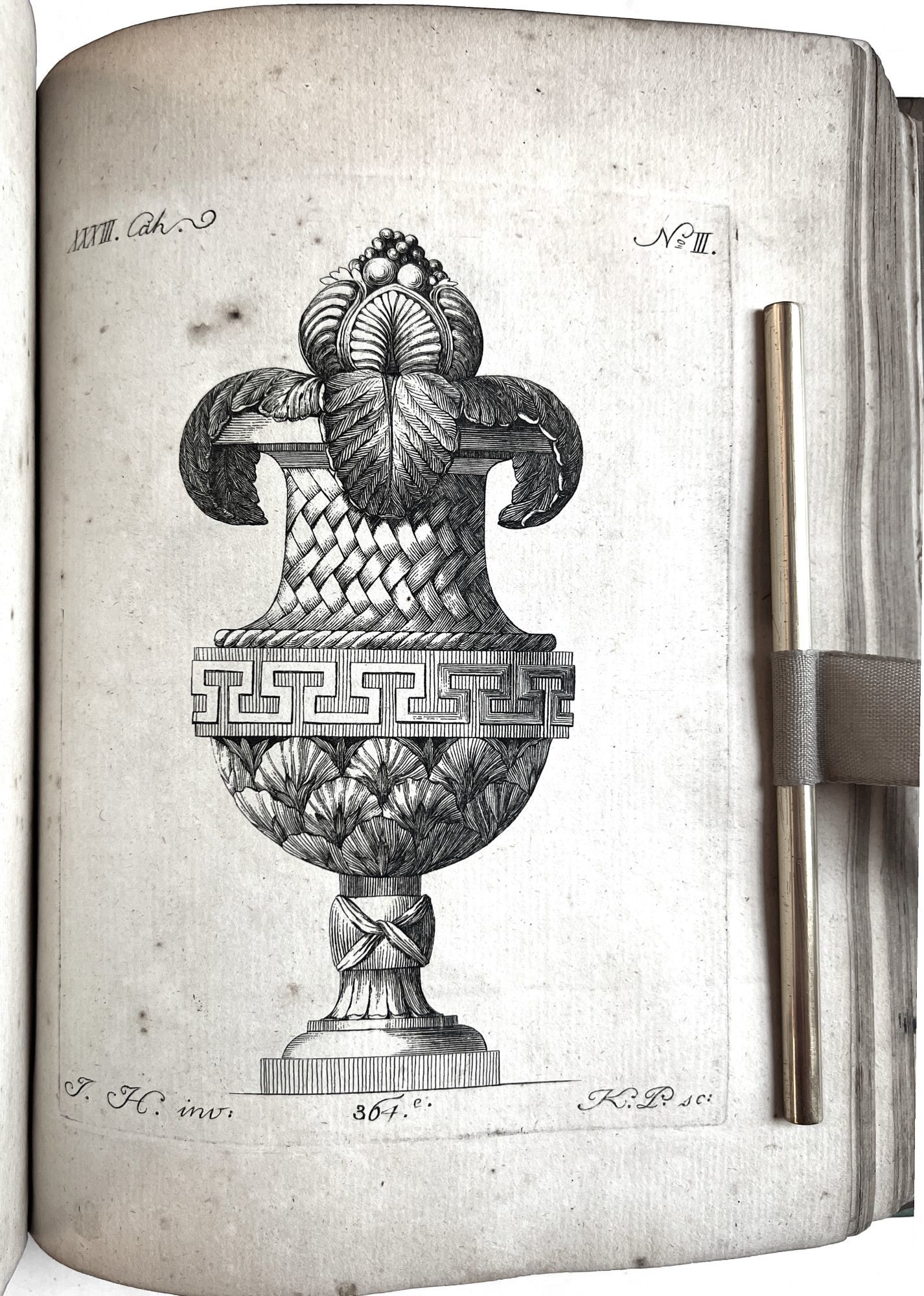
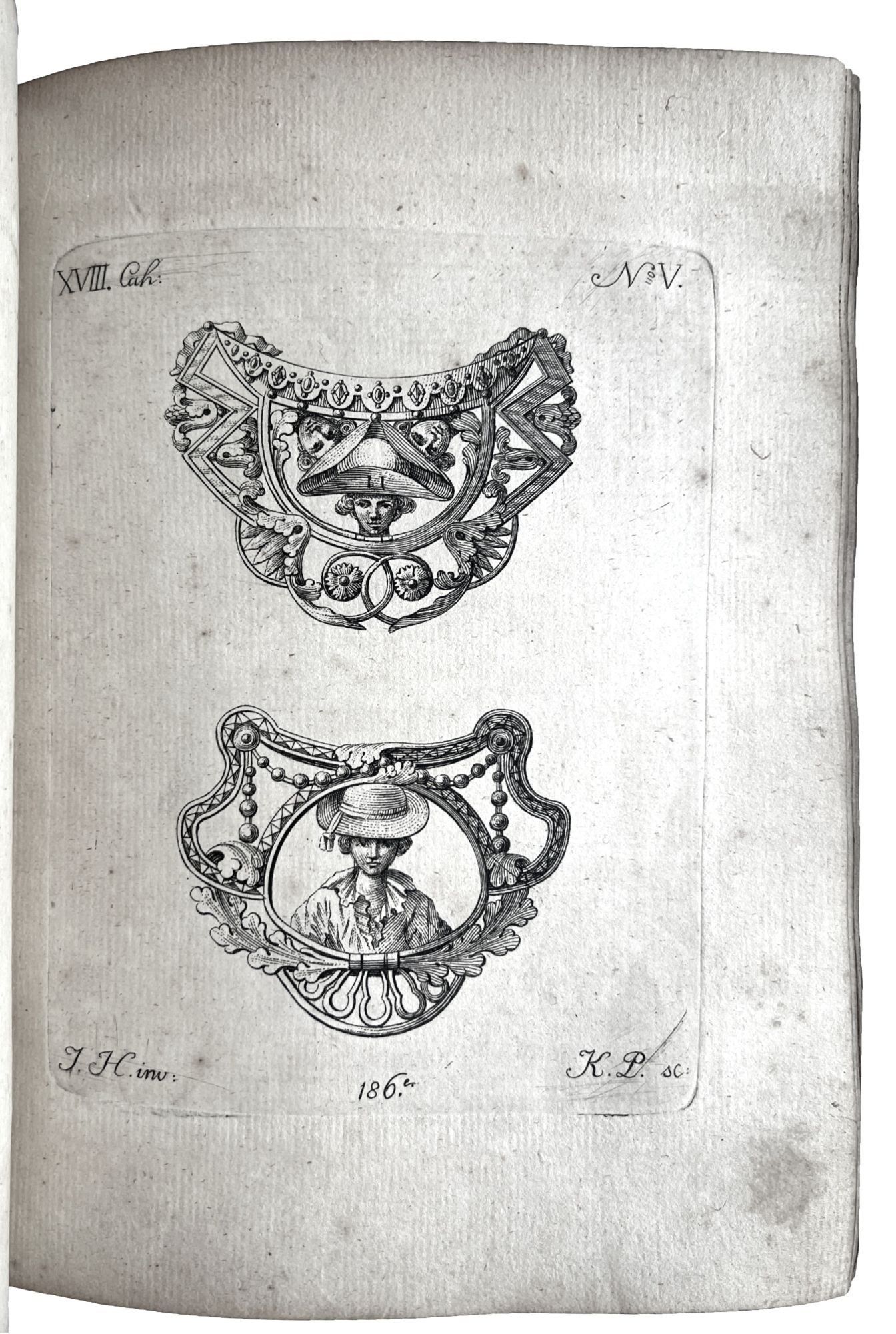
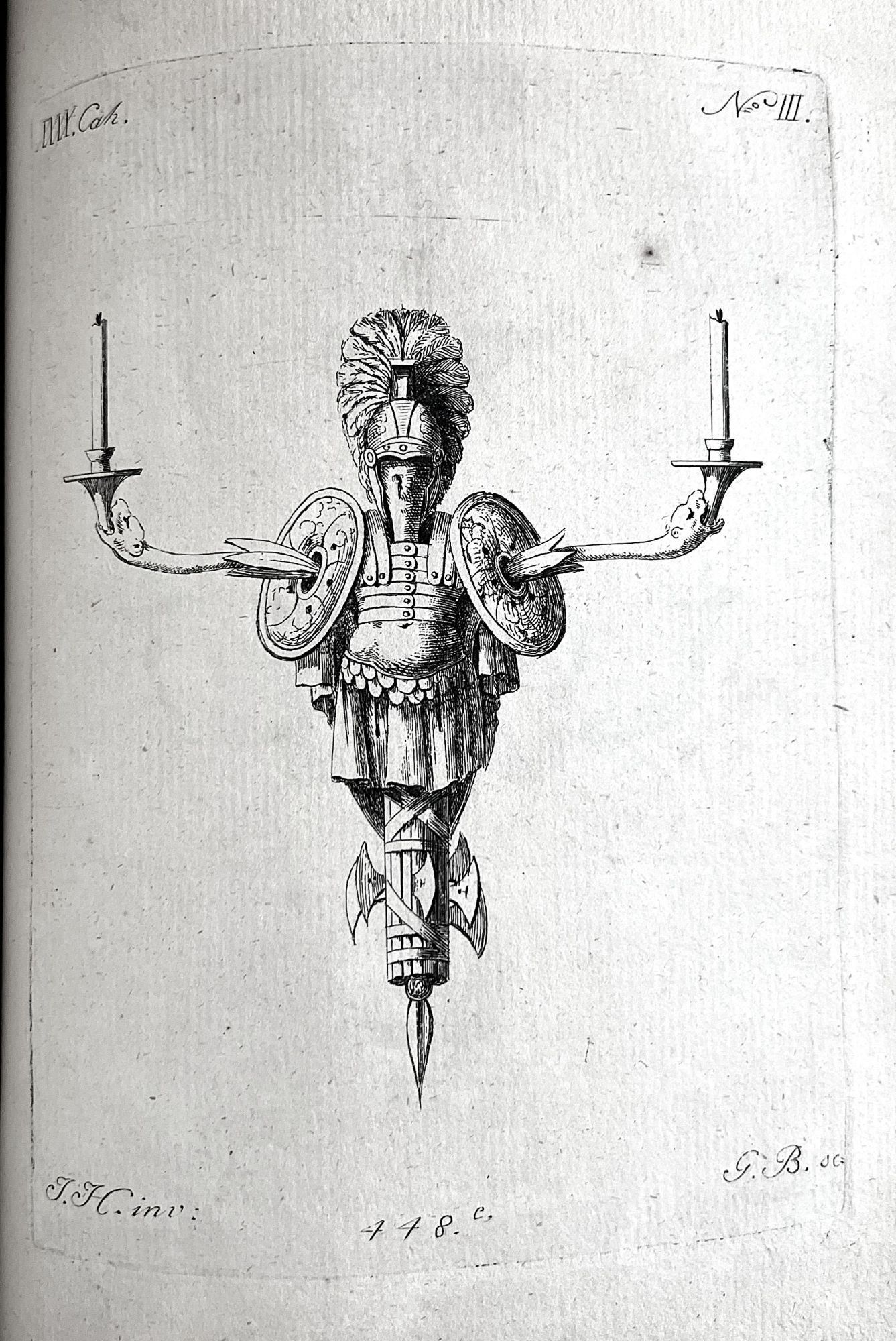
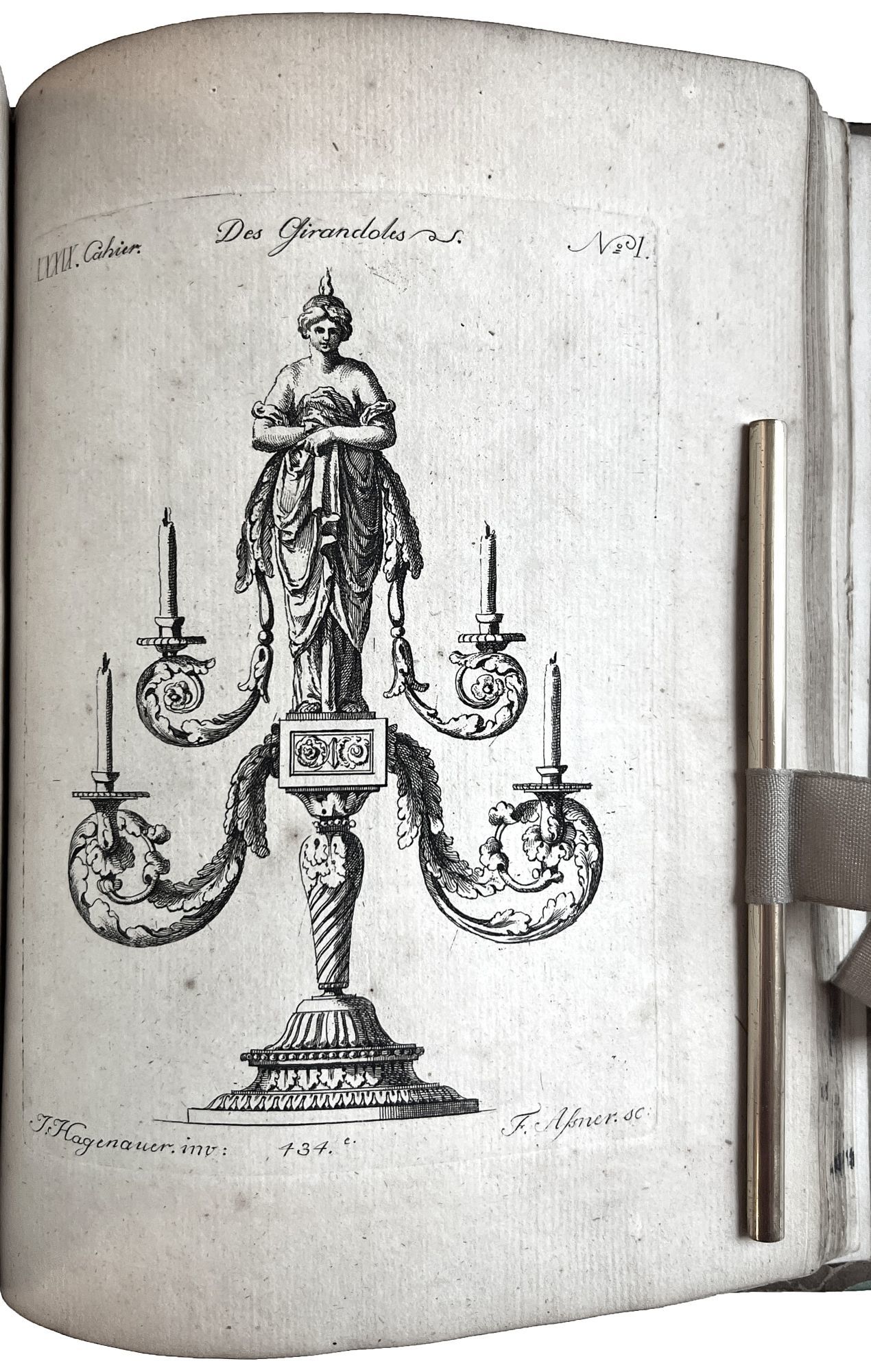
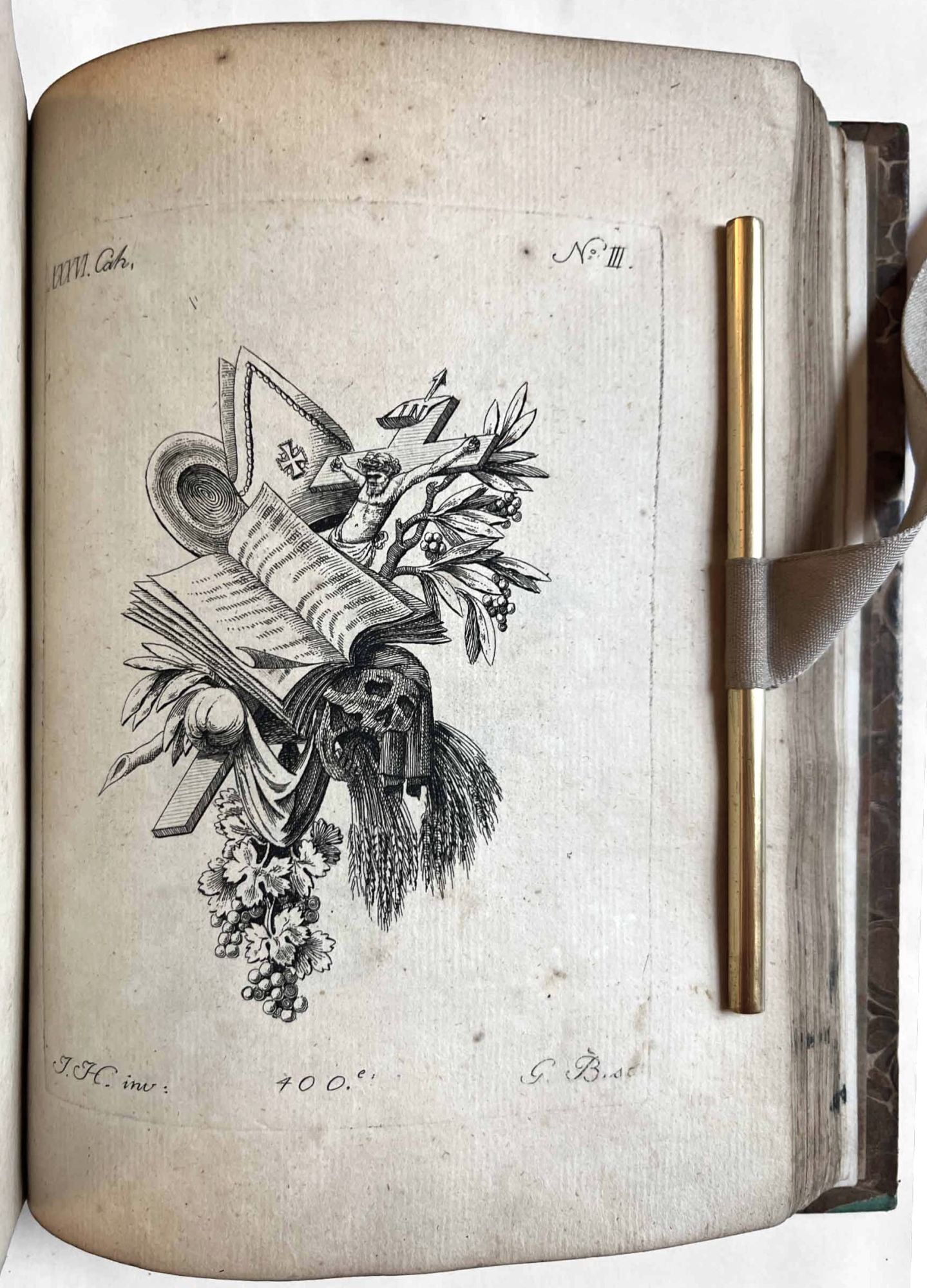
Hagenauer’s designs, for candelabras and chandeliers, cane pommels, buttons, buckles, cartes-de-visite, frames, wall friezes and molding, vases and ovens, and pure ornaments such as trophies, range in style from geometrical and neoclassical to wildly ornate and figurative, many incorporating fantastical anthropomorphic or zoomorphic figures. Between these two extremes, his designs above all furnished his students with models of the French style, although the sheer quantity and variety of the designs occasionally foreshadow future artistic schools — thus a few foliate or floral ornaments have an Art deco or even Art nouveau feel (e.g., two cane pommels, plates 129 and 133, the second with a fairy-like creature). The graphic designs for cartes-de-visite, which the artist specifies can be used for multiple purposes, include some particularly enchanting specimens. The whole provides a fascinating glimpse into a transitional period in the decorative arts, when the late Rococo (disparagingly labeled Zopfstil by Jessen and other critics) lingered amongst flashes of the soon to be dominant return to classical simplicity. (Rainald Franz traces the influences on Hagenauer’s ornament designs, and their influence on artists, in detail.)
Hagenauer is best known for his sculptures in stone and bronze, but he also produced small-scale works. He was the fourth of 11 children from Strass in Upper Bavaria (then under the jurisdiction of Salzburg). His two brothers Georg and Wolfgang were well-known architects. Christoph, Graf von Schrattenbach, Prince-Archbishop of Salzburg, and an uncle financed his studies at the Fine Arts Academy in Vienna, where his precocious talent earned him continued support from the Archbishop, who sent him to Italy. He met his first wife there, Maria Rosa Barducci, a talented painter. (After her death in 1786, he married another artist, 40 years his junior, Elisabeth Weber, a medallist and sculptor.) On returning to Salzburg Hagenauer was appointed “erzbischöflichen Hofstatuarius,” official sculptor to the Archbishopric. His best-known work is the statue of the Virgin on Cathedral Square in Salzburg, for which his brother Wolfgang carried out the architectural details; he later produced statuary for the park of Nymphenburg castle in Munich and for Schönbrunn in Vienna, and in 1777 became professor of sculpture at the Viennese Academy.
Most relevantly, from 1780 until his death he directed the royal school of engraving and metalwork (the k. k. Bossier und Gravierschule, the Imperial-Royal Academy of Engraving). The school had been founded by the engraver Jacob Matthias Schmutzer in 1767, to train “apprentices and workers of the `commercial professions,’ — goldsmiths and silversmiths, workers in bronze, beltmakers, armorers and sword smiths, but also interested amateurs,” in order to boost local production of these goods. In conjunction with tariffs and prohibitions against imported goods, the founding of this school helped further the development of autonomous Austrian decorative arts and crafts (Franz, pp. 874-5, trans.). Hagenauer completed sixteen of the cahiers at his own expense, before requesting funding from Prince Kaunitz, director of the Fine Arts Academy. The rarity of these ornament designs may at least in part be due to their use by student artisans.
Hagenauer’s only other published work appears to be a guide to perspective, also published for his students (Unterricht von der Proporzion des Menschen, vom Perspective, wie auch von der Lichtes- und Schattenlehre, Vienna 1791).
Subjects of the engravings are as follows:
Cahiers VI-VII: Table candelabras, held by sculpted mythological figures or animals (including a Cerberus), each individually named in the captions, which are in French throughout. 24 plates.
VIII: More table candelabra, with anthropomorphic, grotesque, classical or simply foliate decors. 6 pl.
IX-XI: Candlesticks, mostly neoclassical, some with figures, titled “Termes” (cahiers IX-X) and “Tridons” [sic, for Tritons?] (cahier XI). 36 pl.
XII-XIII: Ornate cane pommels, most showing the side and top views. 24 pl.
XIV-XV: Buttons, 9 to 14 per plate. 24 pl.
XVI: Buckles, “for men[’s belts or shoes], horses’ harnesses, and other ornaments.” 12 pl.
XVII-XVIII: “Buckles for women and other ornaments appropriate for luxury objects.” 24 pl.
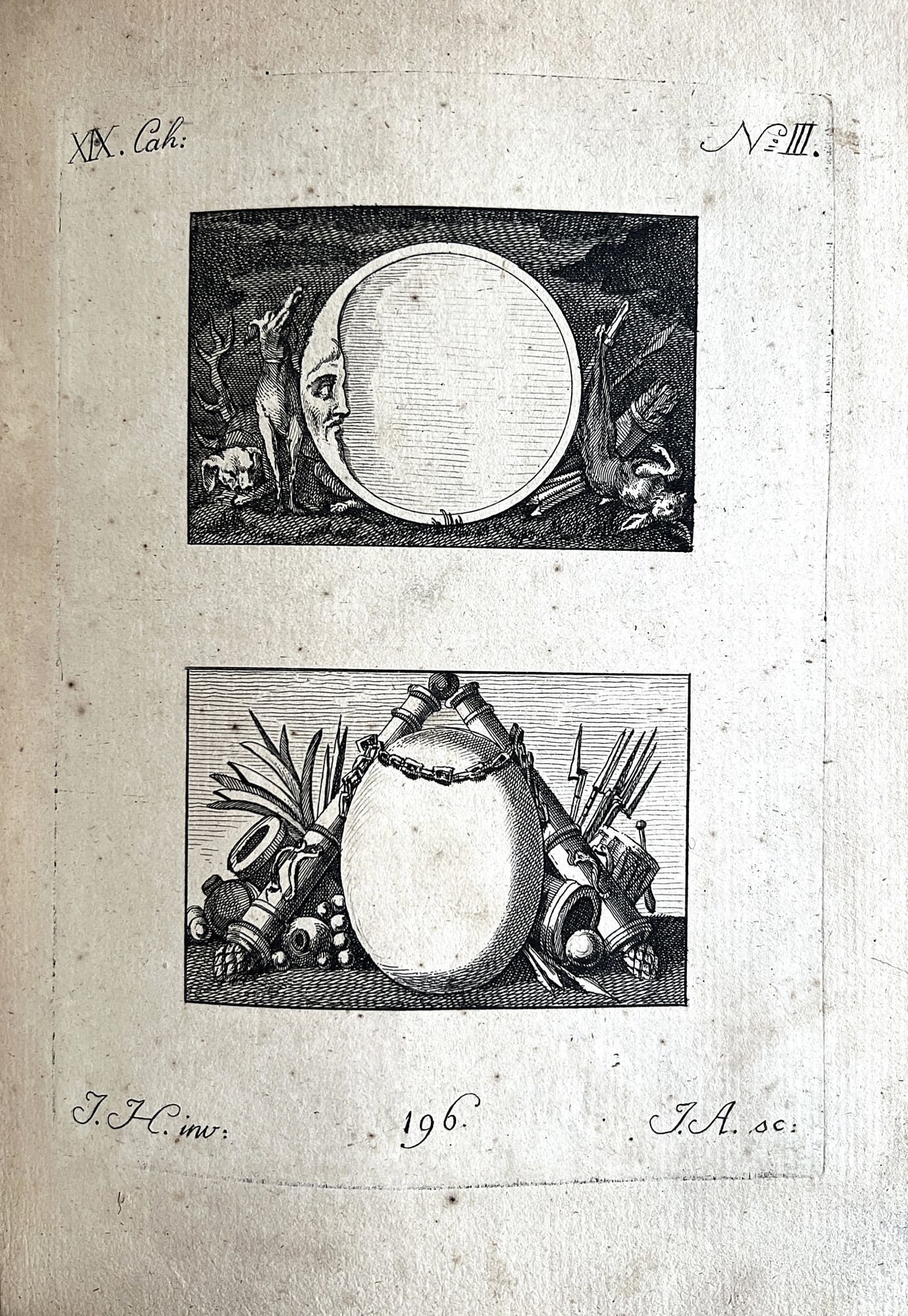
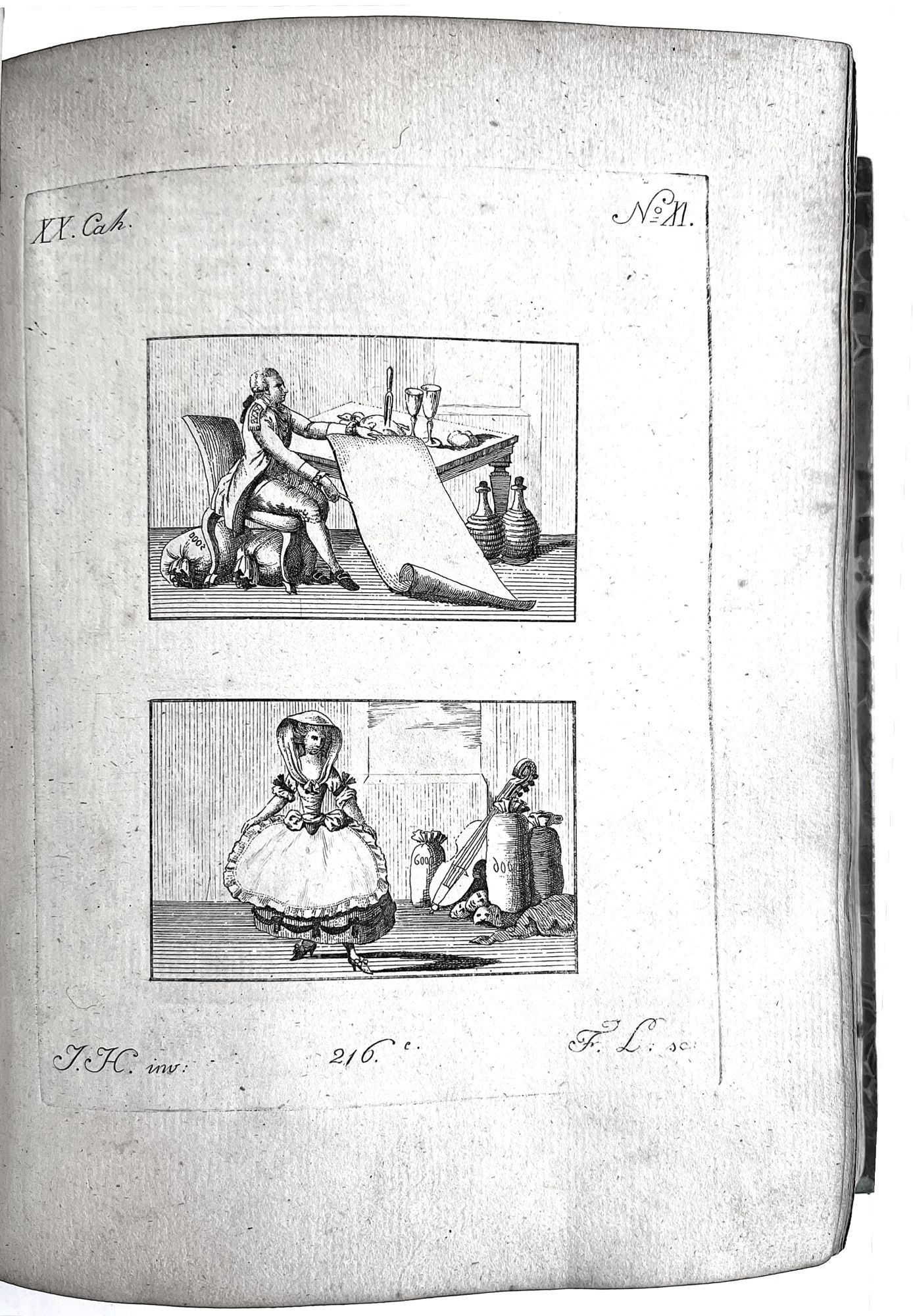
XIX-XXI: Designs for “billets de visite, also applicable as ornaments to other objects.” 72 designs on 36 pl.
XXII-XXV: Frames: “different borders applicable to all kinds of decorative objects.” 48 pl.
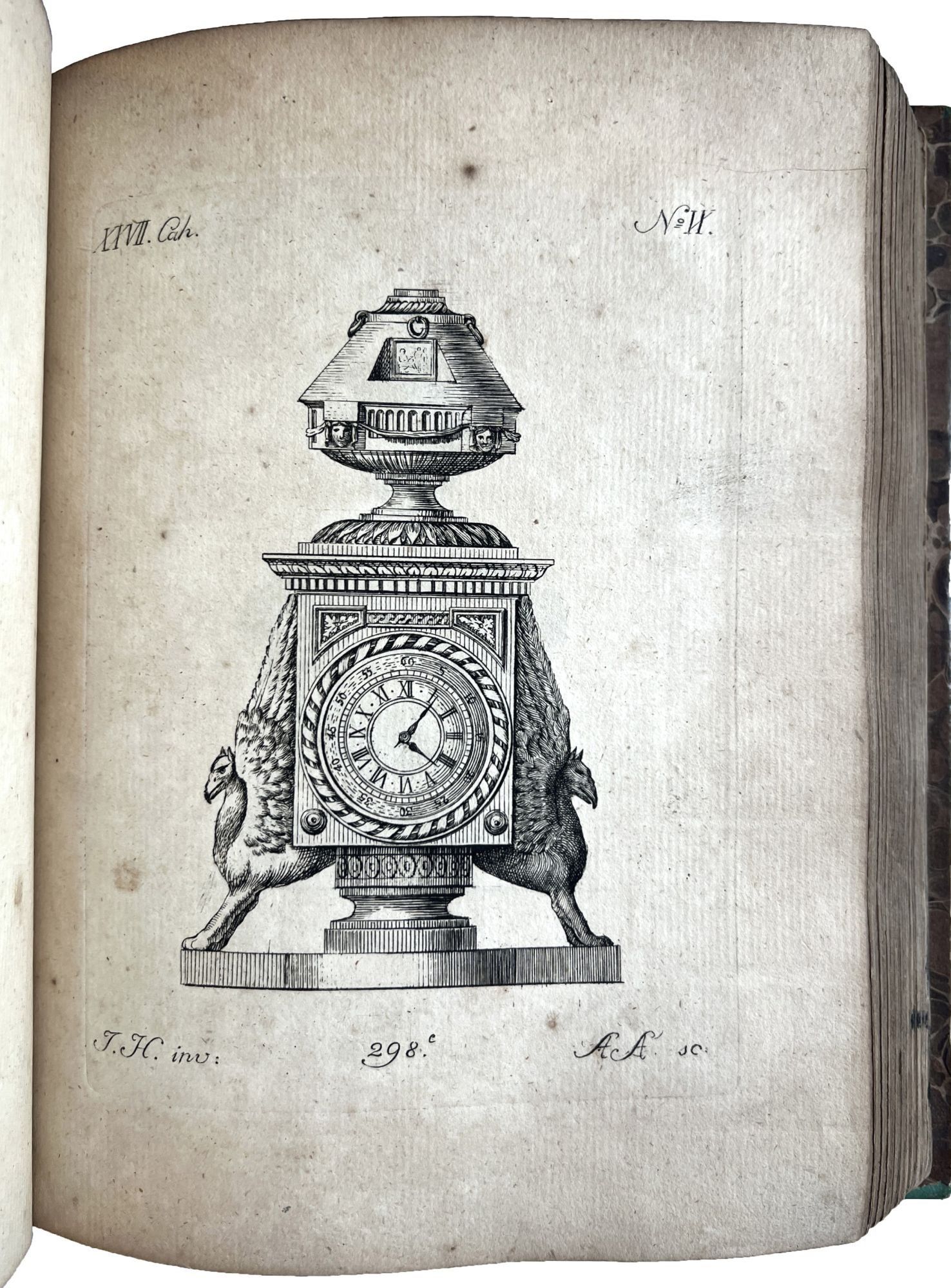
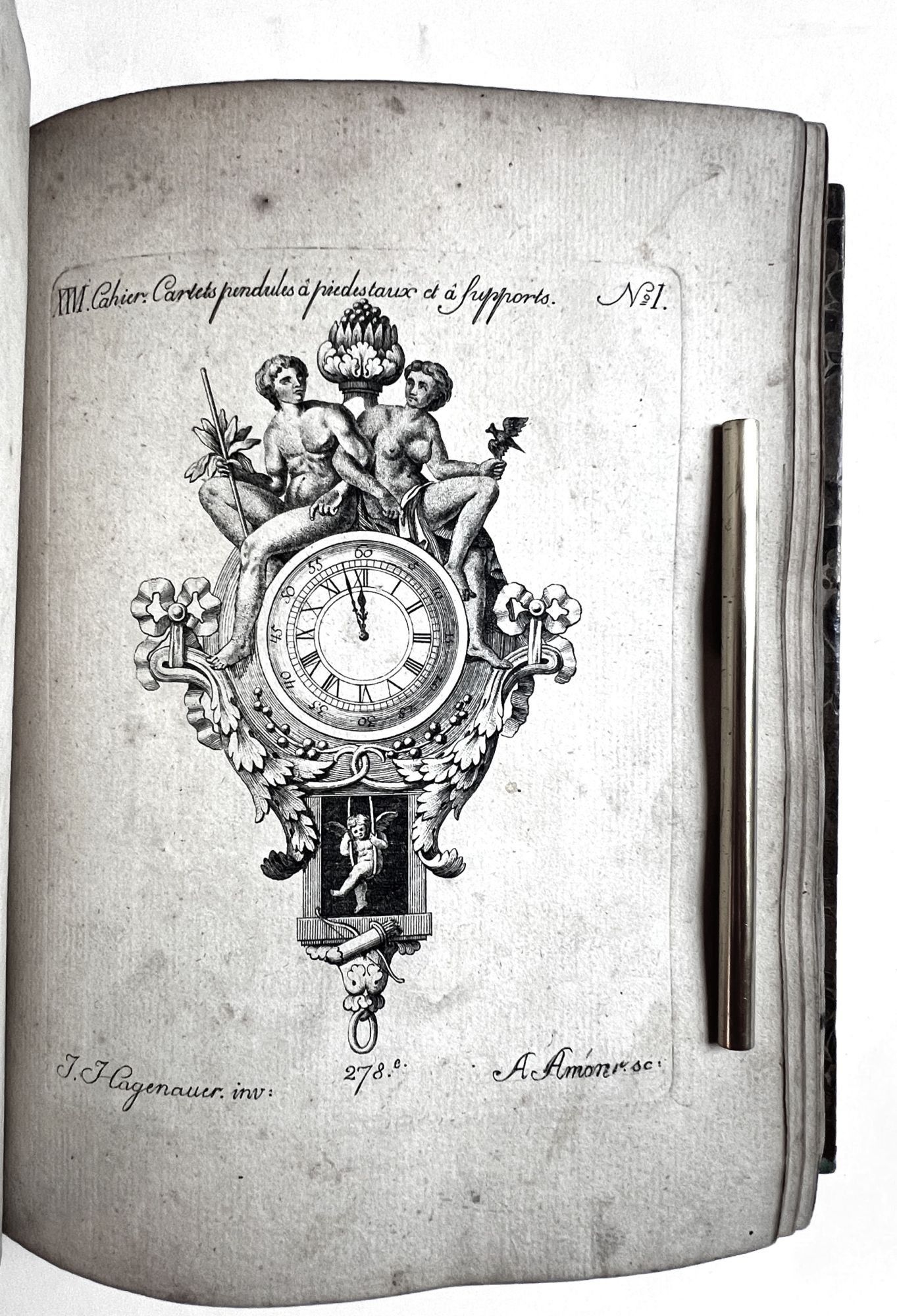
XXVI-XXVII: Clocks: (“Cartets pendules à piédestaux et à supports”). 24 pl.
XXVIII-XXIX: Wall supports for busts, figures, vases, etc. 24 pl.
XXX-XXXI: Moldings and friezes. 24 pl.
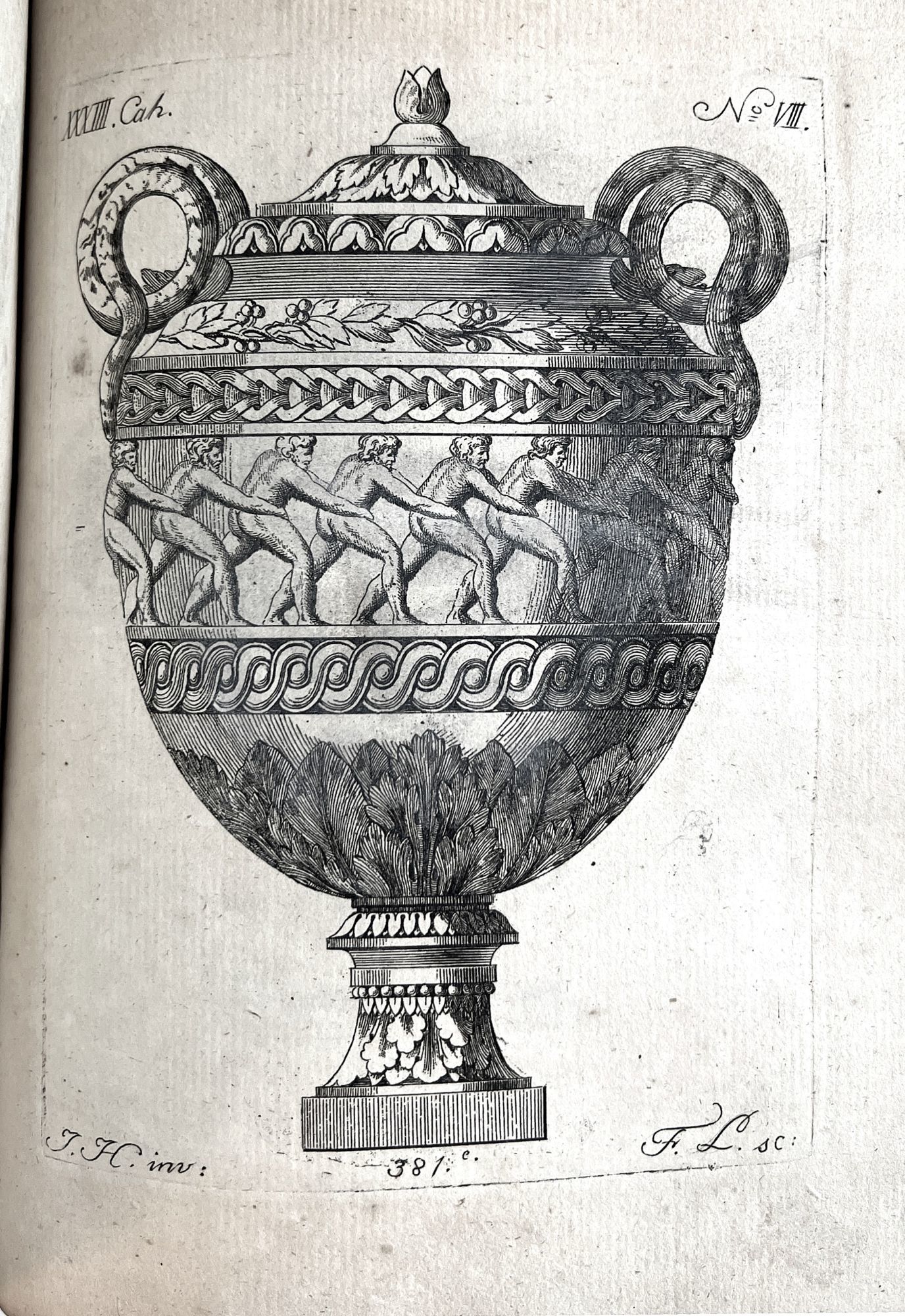
XXXII-XXXIV: Large ornate vases (“New inventions of different vases”). 36 pl.
XXXV: “Ovens [for heating] in pedestal form on which one can place vases, etc..” 12 pl.
XXXVI- XXXVIII: Trophies, “ecclesiastical, secular, and related to war, peace, the arts and sciences, etc.” 36 pl.
XXXIX-XXXXI: Large branched candelabra and chandeliers (”Girandoles” and “Lustres”). 36 pl.
(The absent cahiers 1-5 are largely devoted to ovens, and no. 42 depicts glasses and cups.) The plates are numbered at top by part and within each part, and consecutively at the foot. This collection starts with 38 (the first five parts had fewer plates each). Usually only the first plate of each part is titled, to identify the object, but the plates in cahiers VI and VII are individually captioned.
Various engravers signed or initialed the plates: Johann Lechner (the initial J. often confused with an F., cf. Thieme Becker), Kilian Ponheimer, Johann Assner, Franz Assner, Antoine Amon, M. Wohlfarter, and G. Brodkorb. Not all the engravers knew French; the caption for Cahier XIV, pl. 1, by J. Assner, for example, is spelled “Poutons.”
This copy was owned by well-known decorators. Victor and Robert Baguès’s Parisian firm of luxury lighting was founded by their father Noel Baguès in Paris in the 1850s. The brothers were “heirs to an admirable and patiently amassed collection [of lighting fixtures].... Every type was represented...” (La Renaissance de l'art français et des industries de luxe, vol. 9 [1926], p. 490). In 1911 they branched out into fer forgé, or wrought iron works, and they established a conservatory to maintain the traditions of master ironworkers. It may have been the Baguès brothers who had the plates bound, before 1902: Franz Ostermann (d. 1938), a binder originally from Alsace, founded his Paris workshop in 1872 at 80 boulevard Malesherbes, moving to 28 rue Ampère in 1902 (data.bnf.fr).
Census of recorded holdings:
UK: Victoria & Albert: apparently complete copy, 474 plates & title.
Austria: Vienna, Museum für angewandte Kunst (MAK): 189 plates.
Franz cites a copy at the library of St. Peter’s Abbey in Salzburg, though it is not in their online catalogue.
The Kupferstichkabinett in Vienna owns 340 drawings of the designs; many appear to be copies by his students (Franz, p. 877).
Germany: Staatlichen Kunstbibliothek Berlin: 105 plates, from cahiers 1-2, 14, 22-25, 28-29, and 33-35.
Ruhr-Universität Bochum, Universitätsbibliothek: 80 plates.
US: Winterthur: 18 plates from cahier 1,3 and 5 (all showing stoves), and the title
Getty Research Institute: the 12 plates of cahier 36
Poland: Polish National Libray: 3 plates.
Literature: Berlin-Katalog 190; Rainald Franz, “Die Ornamentvorlagen des Johann Baptist Hagenauer,” Barockberichte, nos. 44-45 (2006), pp. 871-880. Cf. Thieme Becker 15: 466-468; Jessen, Ornamentstich, p. 357; ADB 10: 343; Biographisches Lexikon des Kaiserthums Oesterreich (1891), 7:193.
EXTREMELY RARE SUITE OF MOST OF THE EXTANT DESIGNS FOR ORNAMENTAL DECORATIVE OBJECTS by the Austrian sculptor Johann Baptist Hagenauer (1732-1810). The collection was produced for the benefit of his students at the Viennese Academy of Engraving and related applied arts.
The only complete copy of the suite recorded, containing 474 plates, is held by the Victoria and Albert Museum. Our copy appears to be a close second; it contains 36 of the 42 published parts, each with 12 plates. Absent are parts1 to 5 and 42, as well as the general title. The third most complete holding appears to be that of the library of the Museum für angewandte Kunst in Vienna, with 189 plates (see census below).
Hagenauer’s designs, for candelabras and chandeliers, cane pommels, buttons, buckles, cartes-de-visite, frames, wall friezes and molding, vases and ovens, and pure ornaments such as trophies, range in style from geometrical and neoclassical to wildly ornate and figurative, many incorporating fantastical anthropomorphic or zoomorphic figures. Between these two extremes, his designs above all furnished his students with models of the French style, although the sheer quantity and variety of the designs occasionally foreshadow future artistic schools — thus a few foliate or floral ornaments have an Art deco or even Art nouveau feel (e.g., two cane pommels, plates 129 and 133, the second with a fairy-like creature). The graphic designs for cartes-de-visite, which the artist specifies can be used for multiple purposes, include some particularly enchanting specimens. The whole provides a fascinating glimpse into a transitional period in the decorative arts, when the late Rococo (disparagingly labeled Zopfstil by Jessen and other critics) lingered amongst flashes of the soon to be dominant return to classical simplicity. (Rainald Franz traces the influences on Hagenauer’s ornament designs, and their influence on artists, in detail.)
Hagenauer is best known for his sculptures in stone and bronze, but he also produced small-scale works. He was the fourth of 11 children from Strass in Upper Bavaria (then under the jurisdiction of Salzburg). His two brothers Georg and Wolfgang were well-known architects. Christoph, Graf von Schrattenbach, Prince-Archbishop of Salzburg, and an uncle financed his studies at the Fine Arts Academy in Vienna, where his precocious talent earned him continued support from the Archbishop, who sent him to Italy. He met his first wife there, Maria Rosa Barducci, a talented painter. (After her death in 1786, he married another artist, 40 years his junior, Elisabeth Weber, a medallist and sculptor.) On returning to Salzburg Hagenauer was appointed “erzbischöflichen Hofstatuarius,” official sculptor to the Archbishopric. His best-known work is the statue of the Virgin on Cathedral Square in Salzburg, for which his brother Wolfgang carried out the architectural details; he later produced statuary for the park of Nymphenburg castle in Munich and for Schönbrunn in Vienna, and in 1777 became professor of sculpture at the Viennese Academy.
Most relevantly, from 1780 until his death he directed the royal school of engraving and metalwork (the k. k. Bossier und Gravierschule, the Imperial-Royal Academy of Engraving). The school had been founded by the engraver Jacob Matthias Schmutzer in 1767, to train “apprentices and workers of the `commercial professions,’ — goldsmiths and silversmiths, workers in bronze, beltmakers, armorers and sword smiths, but also interested amateurs,” in order to boost local production of these goods. In conjunction with tariffs and prohibitions against imported goods, the founding of this school helped further the development of autonomous Austrian decorative arts and crafts (Franz, pp. 874-5, trans.). Hagenauer completed sixteen of the cahiers at his own expense, before requesting funding from Prince Kaunitz, director of the Fine Arts Academy. The rarity of these ornament designs may at least in part be due to their use by student artisans.
Hagenauer’s only other published work appears to be a guide to perspective, also published for his students (Unterricht von der Proporzion des Menschen, vom Perspective, wie auch von der Lichtes- und Schattenlehre, Vienna 1791).
Subjects of the engravings are as follows:
Cahiers VI-VII: Table candelabras, held by sculpted mythological figures or animals (including a Cerberus), each individually named in the captions, which are in French throughout. 24 plates.
VIII: More table candelabra, with anthropomorphic, grotesque, classical or simply foliate decors. 6 pl.
IX-XI: Candlesticks, mostly neoclassical, some with figures, titled “Termes” (cahiers IX-X) and “Tridons” [sic, for Tritons?] (cahier XI). 36 pl.
XII-XIII: Ornate cane pommels, most showing the side and top views. 24 pl.
XIV-XV: Buttons, 9 to 14 per plate. 24 pl.
XVI: Buckles, “for men[’s belts or shoes], horses’ harnesses, and other ornaments.” 12 pl.
XVII-XVIII: “Buckles for women and other ornaments appropriate for luxury objects.” 24 pl.
XIX-XXI: Designs for “billets de visite, also applicable as ornaments to other objects.” 72 designs on 36 pl.
XXII-XXV: Frames: “different borders applicable to all kinds of decorative objects.” 48 pl.
XXVI-XXVII: Clocks: (“Cartets pendules à piédestaux et à supports”). 24 pl.
XXVIII-XXIX: Wall supports for busts, figures, vases, etc. 24 pl.
XXX-XXXI: Moldings and friezes. 24 pl.
XXXII-XXXIV: Large ornate vases (“New inventions of different vases”). 36 pl.
XXXV: “Ovens [for heating] in pedestal form on which one can place vases, etc..” 12 pl.
XXXVI- XXXVIII: Trophies, “ecclesiastical, secular, and related to war, peace, the arts and sciences, etc.” 36 pl.
XXXIX-XXXXI: Large branched candelabra and chandeliers (”Girandoles” and “Lustres”). 36 pl.
(The absent cahiers 1-5 are largely devoted to ovens, and no. 42 depicts glasses and cups.) The plates are numbered at top by part and within each part, and consecutively at the foot. This collection starts with 38 (the first five parts had fewer plates each). Usually only the first plate of each part is titled, to identify the object, but the plates in cahiers VI and VII are individually captioned.
Various engravers signed or initialed the plates: Johann Lechner (the initial J. often confused with an F., cf. Thieme Becker), Kilian Ponheimer, Johann Assner, Franz Assner, Antoine Amon, M. Wohlfarter, and G. Brodkorb. Not all the engravers knew French; the caption for Cahier XIV, pl. 1, by J. Assner, for example, is spelled “Poutons.”
This copy was owned by well-known decorators. Victor and Robert Baguès’s Parisian firm of luxury lighting was founded by their father Noel Baguès in Paris in the 1850s. The brothers were “heirs to an admirable and patiently amassed collection [of lighting fixtures].... Every type was represented...” (La Renaissance de l'art français et des industries de luxe, vol. 9 [1926], p. 490). In 1911 they branched out into fer forgé, or wrought iron works, and they established a conservatory to maintain the traditions of master ironworkers. It may have been the Baguès brothers who had the plates bound, before 1902: Franz Ostermann (d. 1938), a binder originally from Alsace, founded his Paris workshop in 1872 at 80 boulevard Malesherbes, moving to 28 rue Ampère in 1902 (data.bnf.fr).
Census of recorded holdings:
UK: Victoria & Albert: apparently complete copy, 474 plates & title.
Austria: Vienna, Museum für angewandte Kunst (MAK): 189 plates.
Franz cites a copy at the library of St. Peter’s Abbey in Salzburg, though it is not in their online catalogue.
The Kupferstichkabinett in Vienna owns 340 drawings of the designs; many appear to be copies by his students (Franz, p. 877).
Germany: Staatlichen Kunstbibliothek Berlin: 105 plates, from cahiers 1-2, 14, 22-25, 28-29, and 33-35.
Ruhr-Universität Bochum, Universitätsbibliothek: 80 plates.
US: Winterthur: 18 plates from cahier 1,3 and 5 (all showing stoves), and the title
Getty Research Institute: the 12 plates of cahier 36
Poland: Polish National Libray: 3 plates.
Literature: Berlin-Katalog 190; Rainald Franz, “Die Ornamentvorlagen des Johann Baptist Hagenauer,” Barockberichte, nos. 44-45 (2006), pp. 871-880. Cf. Thieme Becker 15: 466-468; Jessen, Ornamentstich, p. 357; ADB 10: 343; Biographisches Lexikon des Kaiserthums Oesterreich (1891), 7:193.
Details
Title
Album of designs of decorative objects, lamps, clocks, architectural elements, cartes-de-visite, and ornaments. [Nouveaux Desseins de Differens Ornemens de Meubles Inventés et composés par Jean Baptiste Hagenauer]
Author
HAGENAUER, Johann Baptist, artist
Condition
Unknown
Publisher
[Vienna
Date
1783