

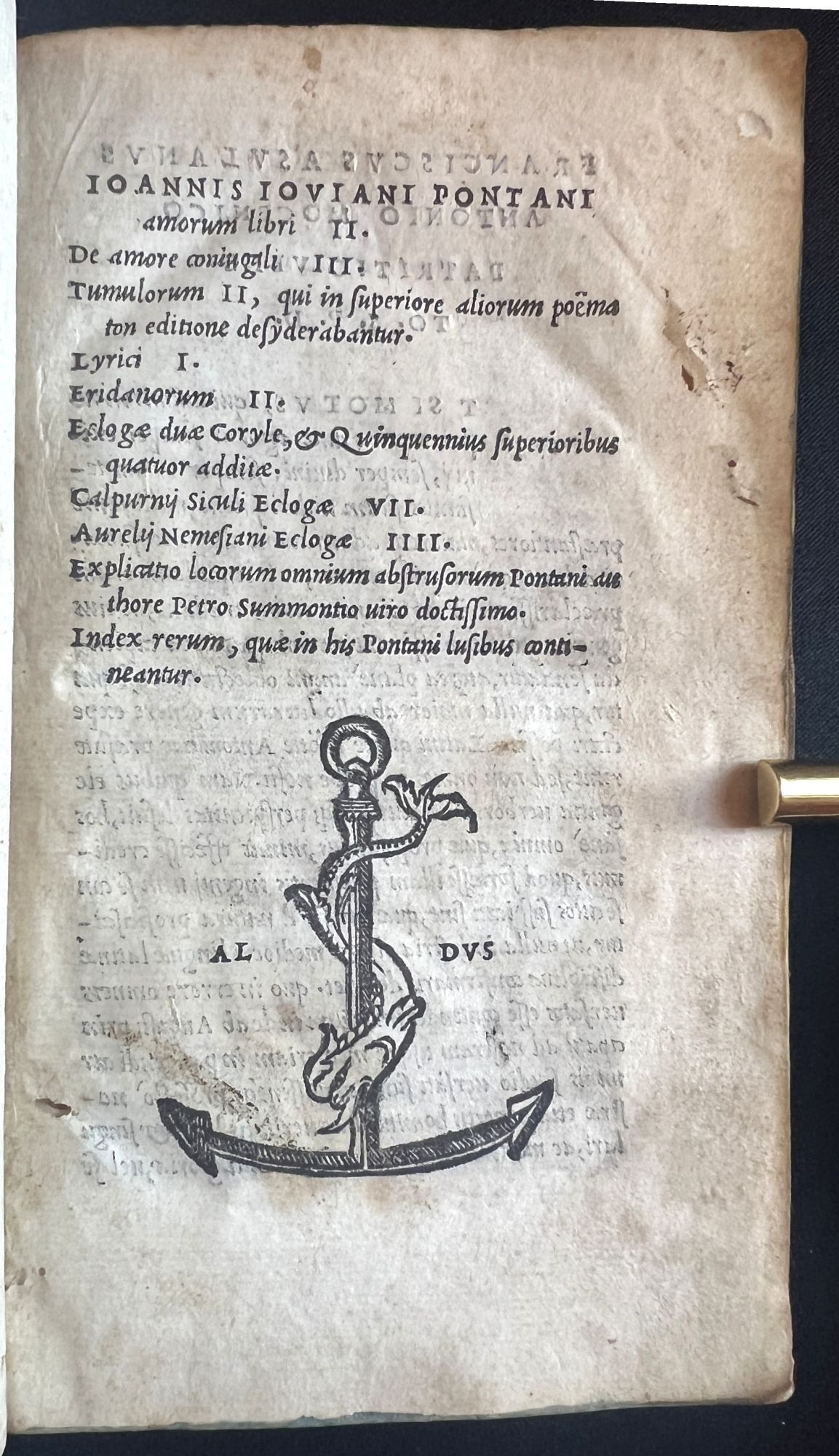
[Works, part 2]. Amorum libri II. De amore coniugali libri III. Tumulorum II ..
![[Works, part 2]. Amorum libri II. De amore coniuga](https://d3525k1ryd2155.cloudfront.net/h/529/072/1721072529.0.x.jpg)
- Venice: Heirs of Aldo Manuzio & Andrea Torresano, 1518
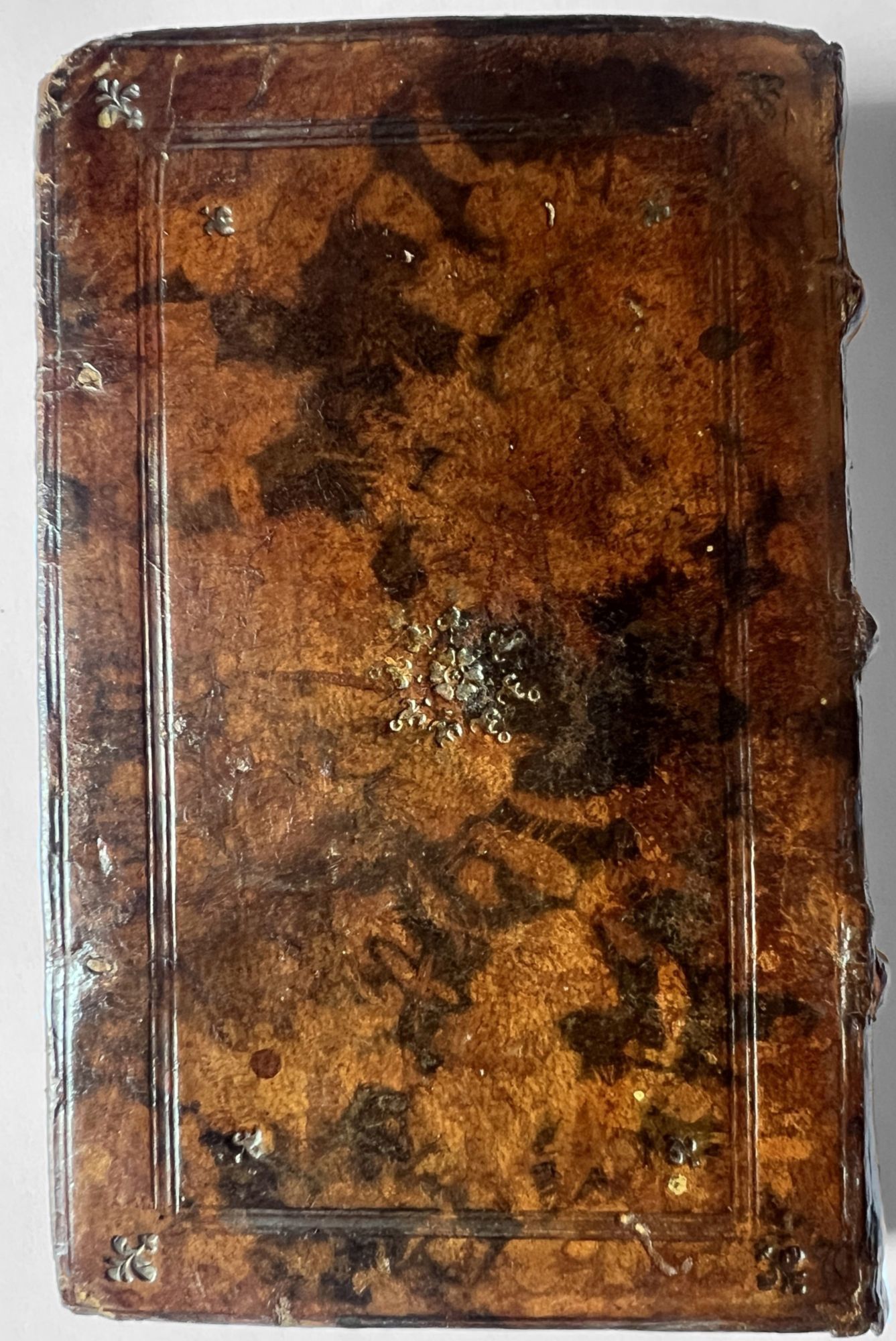
Venice: Heirs of Aldo Manuzio & Andrea Torresano, 1518. 8vo (159 x 97 mm). 170, [2] leaves. Aldine anchor device on title and final verso, italic types, initial spaces with guide letters. (Staining and marginal worming to first and last 3 or 4 leaves, light mostly marginal dampstaining throughout.) Contemporary, probably Venetian reddish-brown goatskin over pasteboards, irregularly mottled with a black vegetable dye, covers blind-paneled with two frames of triple thick-and-thin fillets, the inner panel with a silver-gilt foliate tool at outer corners and a smaller leaf tool at inner corners, at center a rosette composed of a six-petaled flower tool surrounded by 8 impressions of the smaller leaf tool, evidence of two fore-edge ties, edges stained blue and red-speckled (rebacked, preserving most of the original backstrip, restoration to corners, wear to edges, worming to inner covers, endleaves soiled). Provenance: T. Kimball Brooker.***
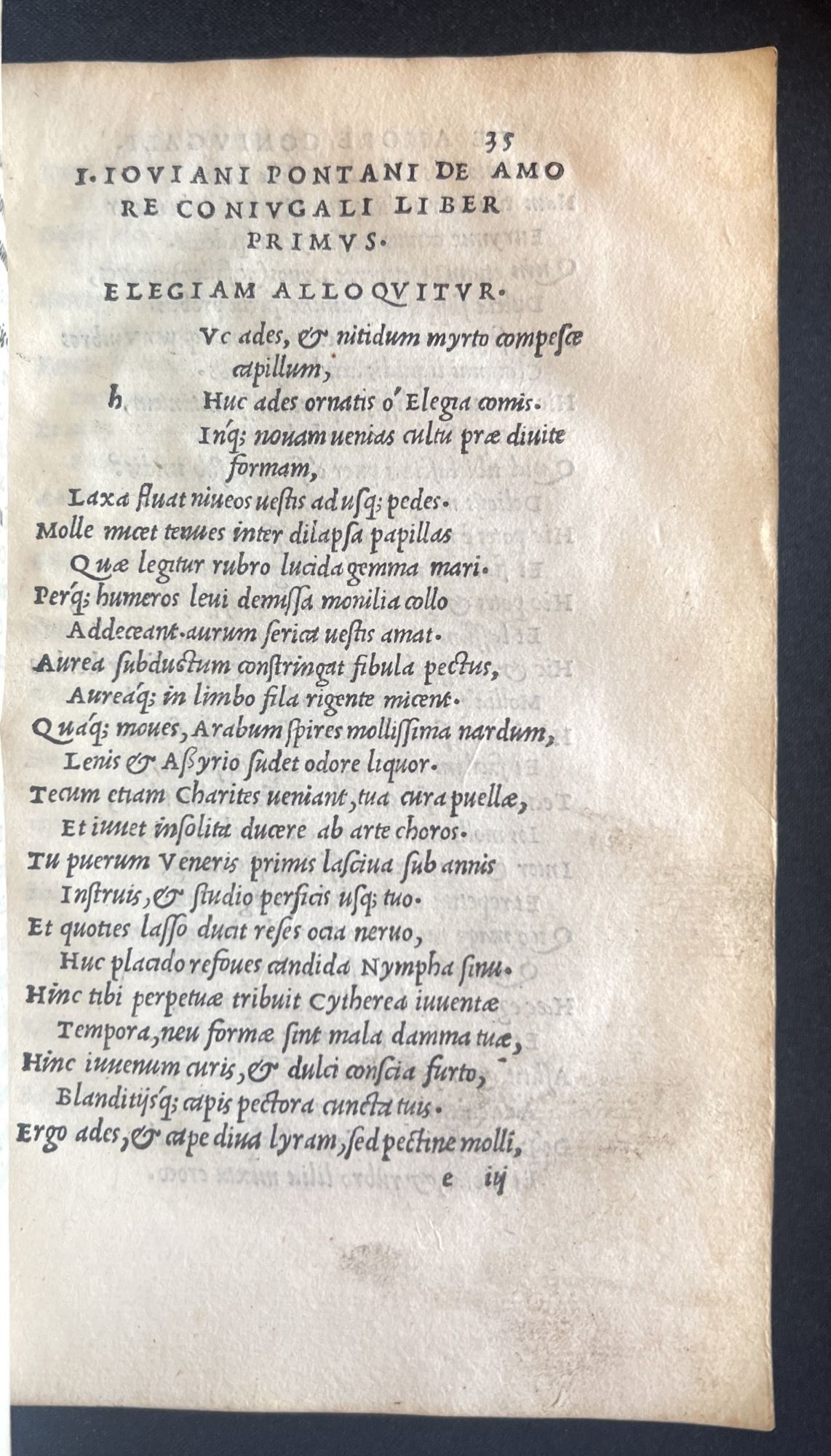
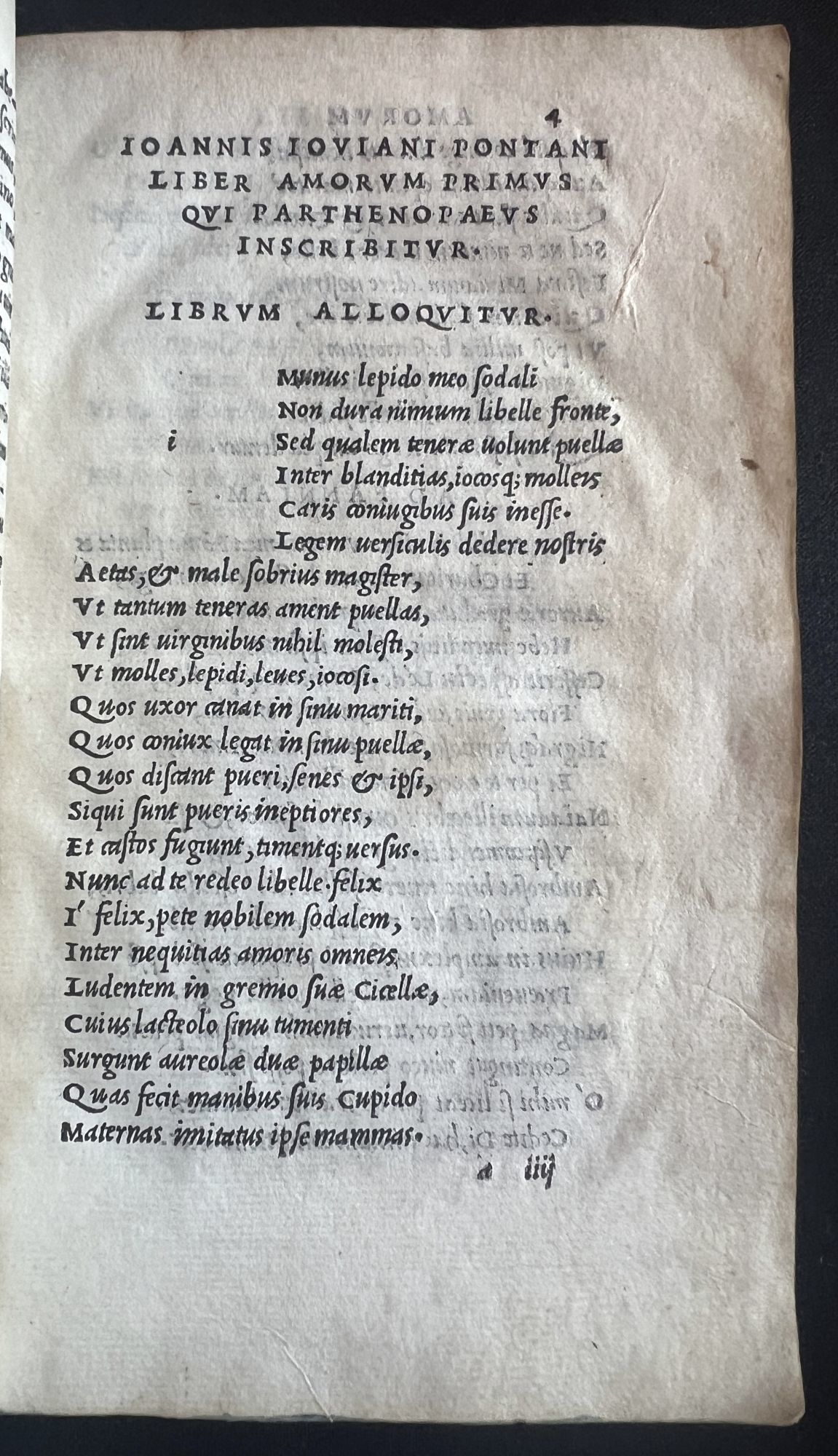
A very early example of a marbled goatskin binding, on the only Aldine edition of Pontano’s love poems. Born in Umbria, educated at the court of Ferdinand I in Naples, the humanist and statesman Pontano was one of the greatest Renaissance poets writing in Latin. His love poetry has been described variously as “ardently sensual” (van Tieghem), “ steamy,” or as containing “as many obscenities as the Ancients” (Oberlé). This volume, containing the works of his later years, was intended to join the earlier Aldine collection of his verse, first printed in 1505 and reprinted in 1513.
Marbled or variegated tanned leather bindings, probably produced by dyeing the skin with the juice of wild beets, first appeared in Italy in the early sixteenth century. Recent reappearances in the book trade of several examples of such marbled bindings, including this one, provide evidence both of the early date of this innovation and of its possible connection to the press of Aldus Manutius:
This volume was one of five early marbled goatskin bindings on Aldine editions in the recently disbursed collection of T. Kimball Brooker, and is probably the third in chronological order. The two earliest of those bindings are demonstrably from the first quarter or even decade of the 16th century: one, on a copy of the 1503 Aldine Euripedes (acquired by the Morgan Library), was dated to “not after 1513,” by Bernard Breslauer in his Catalogue 110 (no. 12), on grounds of provenance and the use of cut-up sheets from an incunable for the pasteboards. The second is an undecorated marbled alla greca binding covering the 1502 Aldine editiones principes of Pollux Vocabularium and Stephanus Byzantinus De urbibus: its pastedowns bear watermarks datable to ca. 1500 and 1501, suggesting that it is at least as early as the Euripedes (cf. Sotheby’s description, Bibliotheca Brookeriana VI, 25 June 2025, lot 1340).
In his discussion of the Euripedes, Breslauer remarked that while the Italian priority of marbled bindings had been correctly noted by the great Renaissance binding scholar Anthony Hobson, none of the Italian mottled bindings cited by Hobson could be dated before 1539, scarcely earlier than the first known such French specimens. The Euripedes and the Pollux, therefore, provide important proof of the very early use in Italy of bindings treated in this manner. This third binding, with its modest blind- and gold-tooling, probably dates to soon after the publication date of 1518. (The two other marbled goatskin bindings from the Brooker collection, both on Aldines, are later: one is on a copy of the 1513 Pontano; it is gold-tooled with a strapwork design, and is datable to the 1530s, and another contains a copy printed on vellum of the 1533 Capella, Anthropologia.) All these copies of Aldine editions, preserved in their original bindings of marbled goatskin, buttress Mr. Breslauer’s hypothesis that "this type of binding was a Venetian invention connected with Aldus and his associates.”
Edit-16 CNCE 37595; USTC 850310; Ahmanson-Murphy 165; Renouard 85.10; Adams P-1864; BM/STC p. 533; cf. van Tieghem, La littérature latine de la Renaissance (1944), p. 64; Oberlé, Poètes Néo-Latins, 187.
A very early example of a marbled goatskin binding, on the only Aldine edition of Pontano’s love poems. Born in Umbria, educated at the court of Ferdinand I in Naples, the humanist and statesman Pontano was one of the greatest Renaissance poets writing in Latin. His love poetry has been described variously as “ardently sensual” (van Tieghem), “ steamy,” or as containing “as many obscenities as the Ancients” (Oberlé). This volume, containing the works of his later years, was intended to join the earlier Aldine collection of his verse, first printed in 1505 and reprinted in 1513.
Marbled or variegated tanned leather bindings, probably produced by dyeing the skin with the juice of wild beets, first appeared in Italy in the early sixteenth century. Recent reappearances in the book trade of several examples of such marbled bindings, including this one, provide evidence both of the early date of this innovation and of its possible connection to the press of Aldus Manutius:
This volume was one of five early marbled goatskin bindings on Aldine editions in the recently disbursed collection of T. Kimball Brooker, and is probably the third in chronological order. The two earliest of those bindings are demonstrably from the first quarter or even decade of the 16th century: one, on a copy of the 1503 Aldine Euripedes (acquired by the Morgan Library), was dated to “not after 1513,” by Bernard Breslauer in his Catalogue 110 (no. 12), on grounds of provenance and the use of cut-up sheets from an incunable for the pasteboards. The second is an undecorated marbled alla greca binding covering the 1502 Aldine editiones principes of Pollux Vocabularium and Stephanus Byzantinus De urbibus: its pastedowns bear watermarks datable to ca. 1500 and 1501, suggesting that it is at least as early as the Euripedes (cf. Sotheby’s description, Bibliotheca Brookeriana VI, 25 June 2025, lot 1340).
In his discussion of the Euripedes, Breslauer remarked that while the Italian priority of marbled bindings had been correctly noted by the great Renaissance binding scholar Anthony Hobson, none of the Italian mottled bindings cited by Hobson could be dated before 1539, scarcely earlier than the first known such French specimens. The Euripedes and the Pollux, therefore, provide important proof of the very early use in Italy of bindings treated in this manner. This third binding, with its modest blind- and gold-tooling, probably dates to soon after the publication date of 1518. (The two other marbled goatskin bindings from the Brooker collection, both on Aldines, are later: one is on a copy of the 1513 Pontano; it is gold-tooled with a strapwork design, and is datable to the 1530s, and another contains a copy printed on vellum of the 1533 Capella, Anthropologia.) All these copies of Aldine editions, preserved in their original bindings of marbled goatskin, buttress Mr. Breslauer’s hypothesis that "this type of binding was a Venetian invention connected with Aldus and his associates.”
Edit-16 CNCE 37595; USTC 850310; Ahmanson-Murphy 165; Renouard 85.10; Adams P-1864; BM/STC p. 533; cf. van Tieghem, La littérature latine de la Renaissance (1944), p. 64; Oberlé, Poètes Néo-Latins, 187.
Details
Title
[Works, part 2]. Amorum libri II. De amore coniugali libri III. Tumulorum II ..
Author
PONTANO, Giovanni Gioviano (1426?-1503)
Condition
Unknown
Publisher
Heirs of Aldo Manuzio & Andrea Torresano: Venice
Date
1518