

Engraved miniature calendar for 1775
- Paris: chez Boulanger, 1774
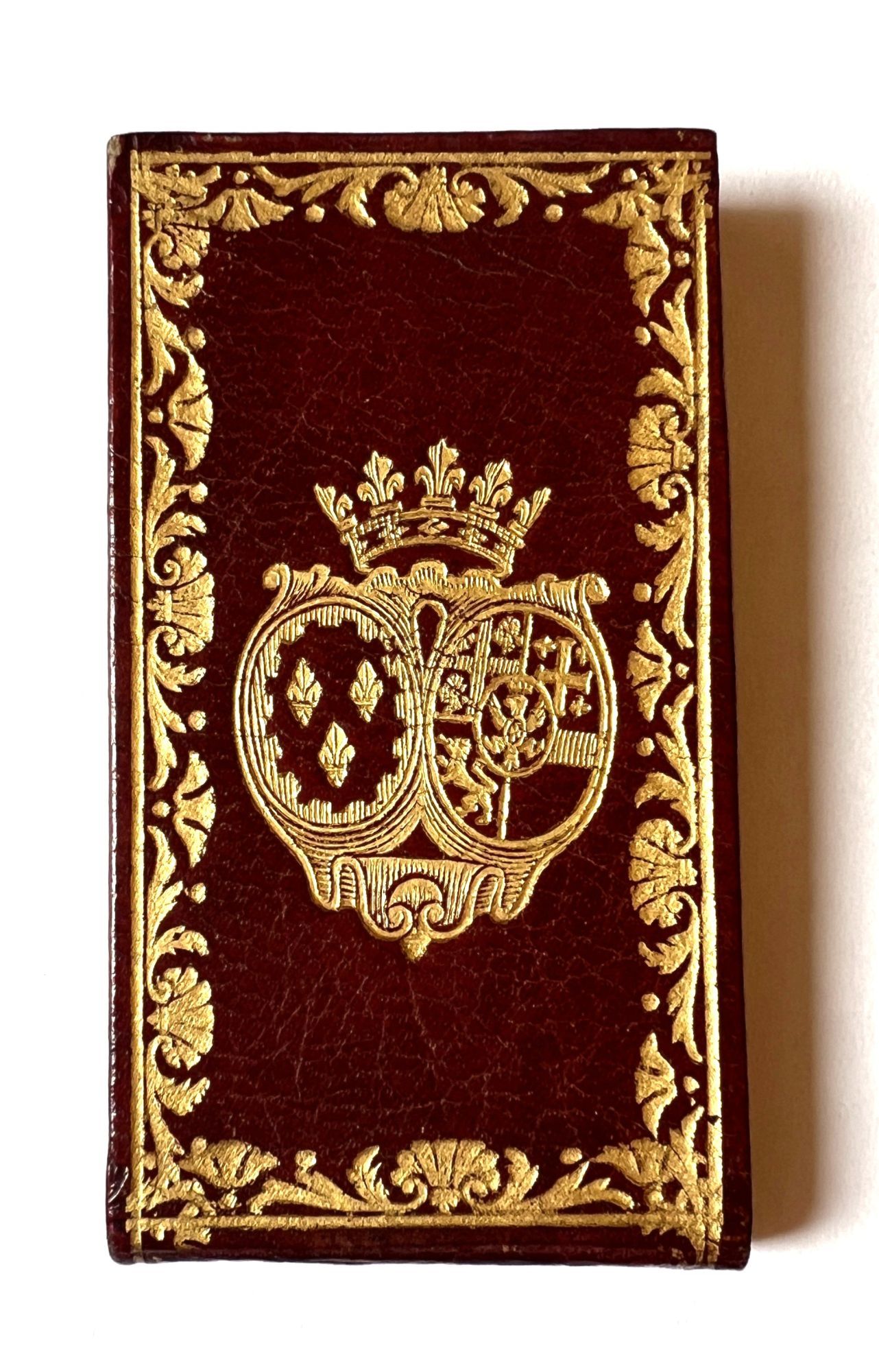
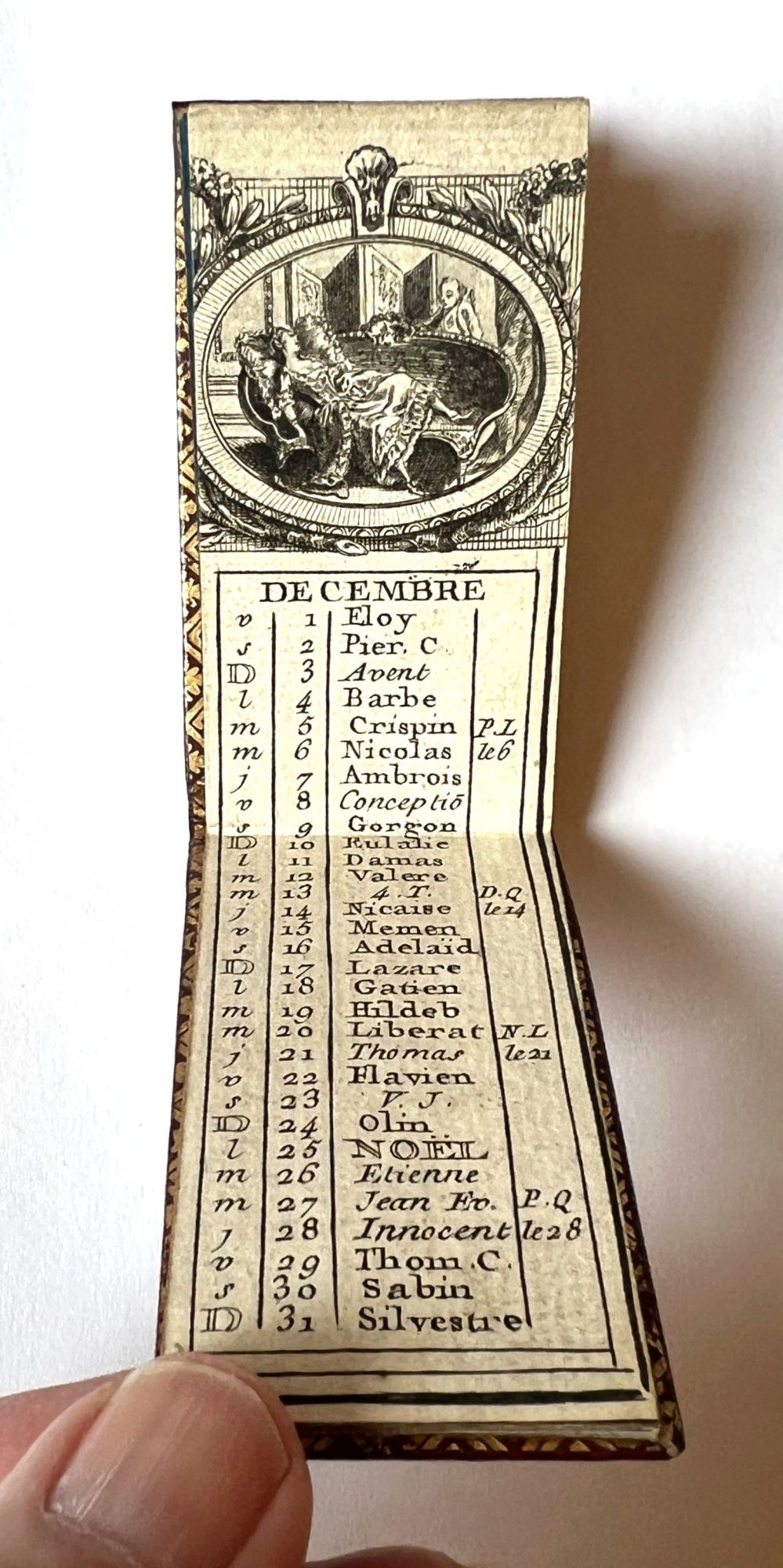
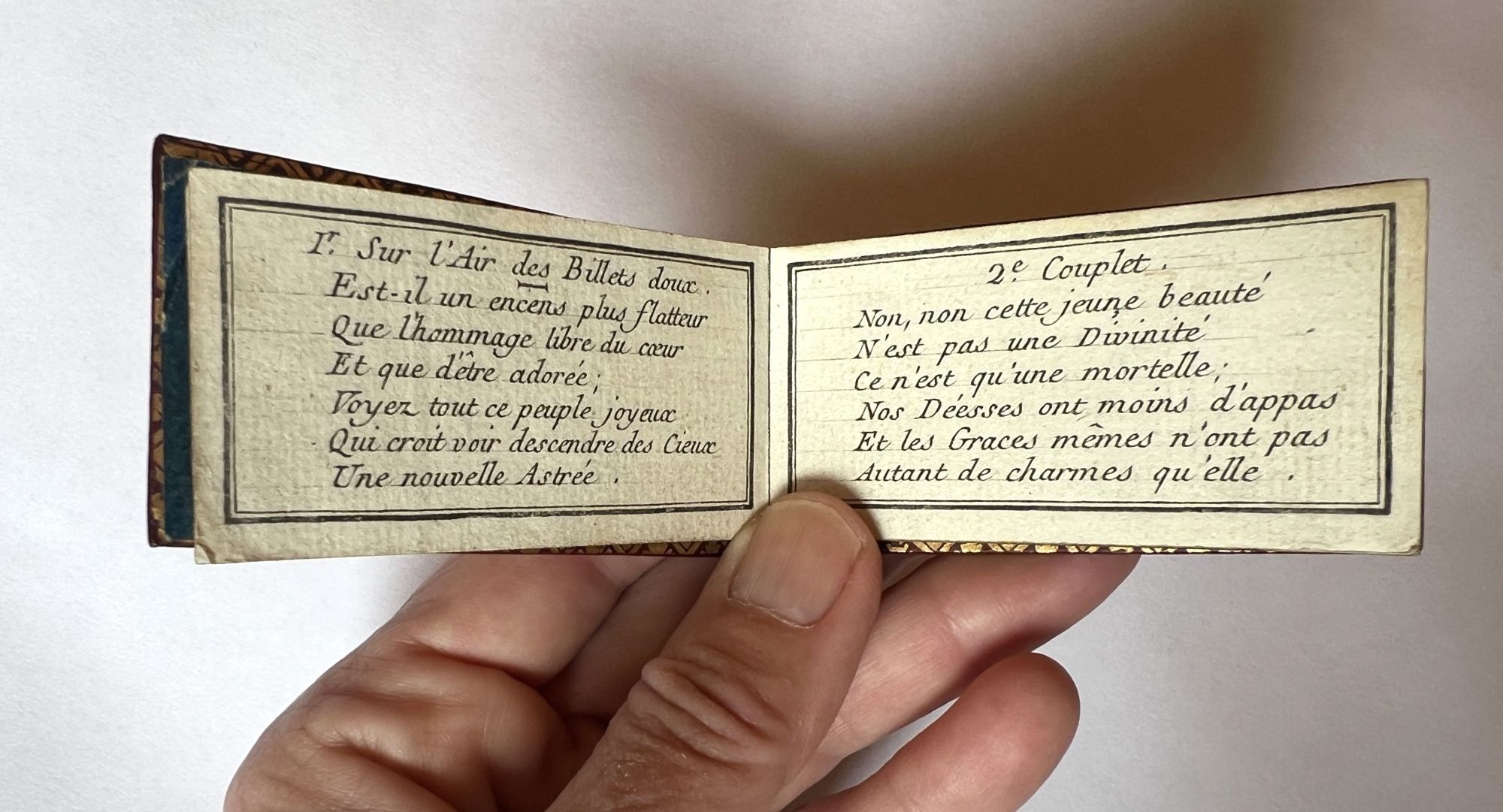
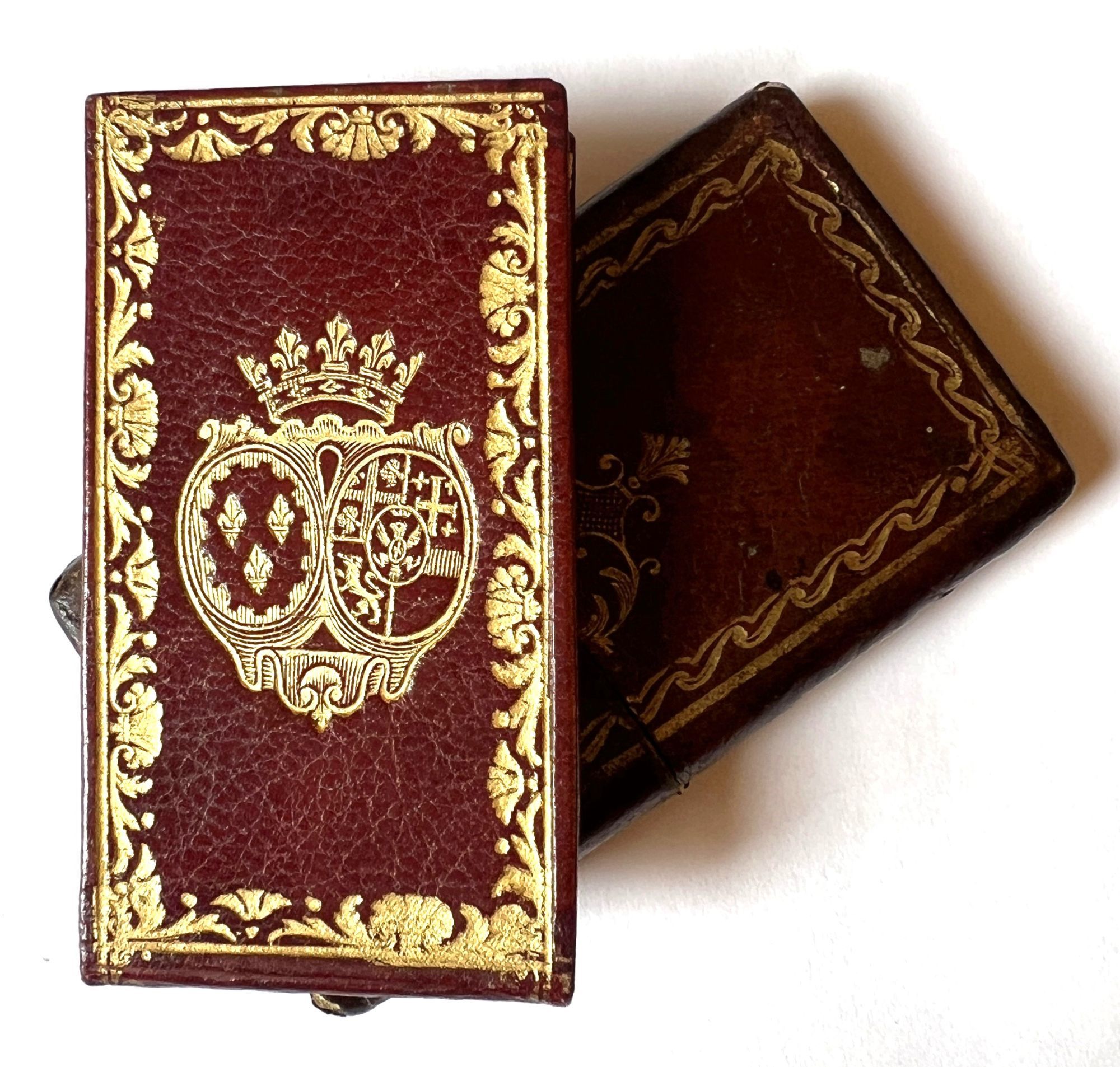
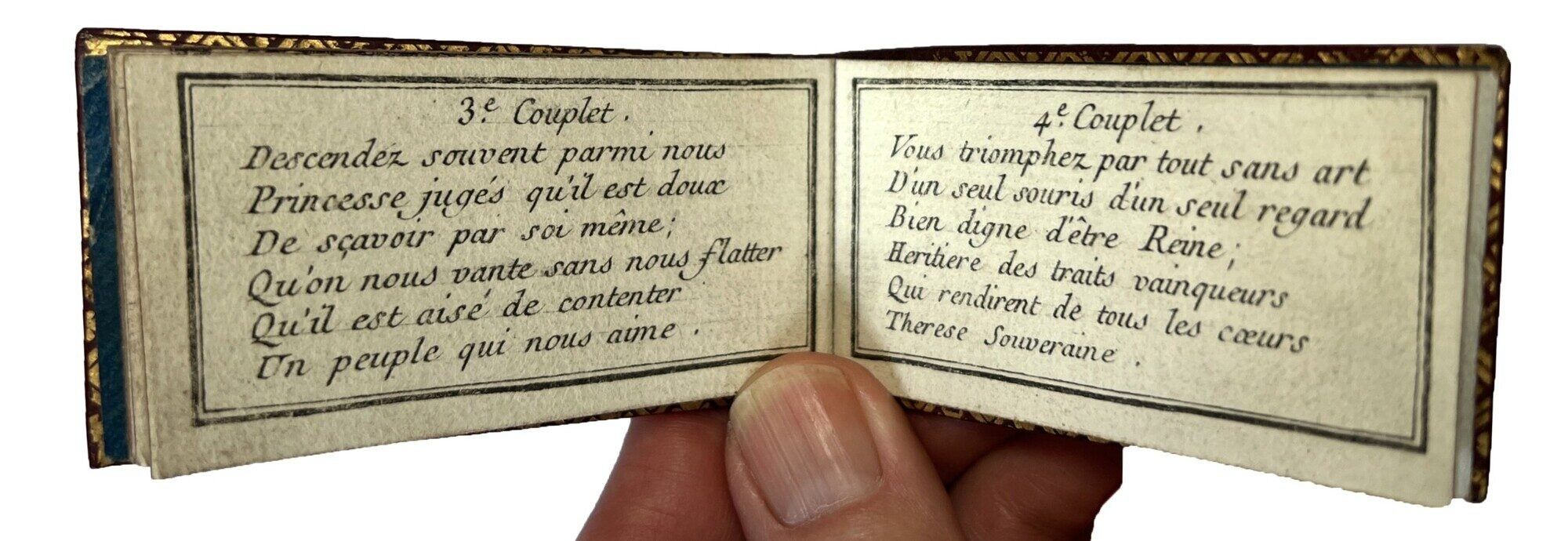
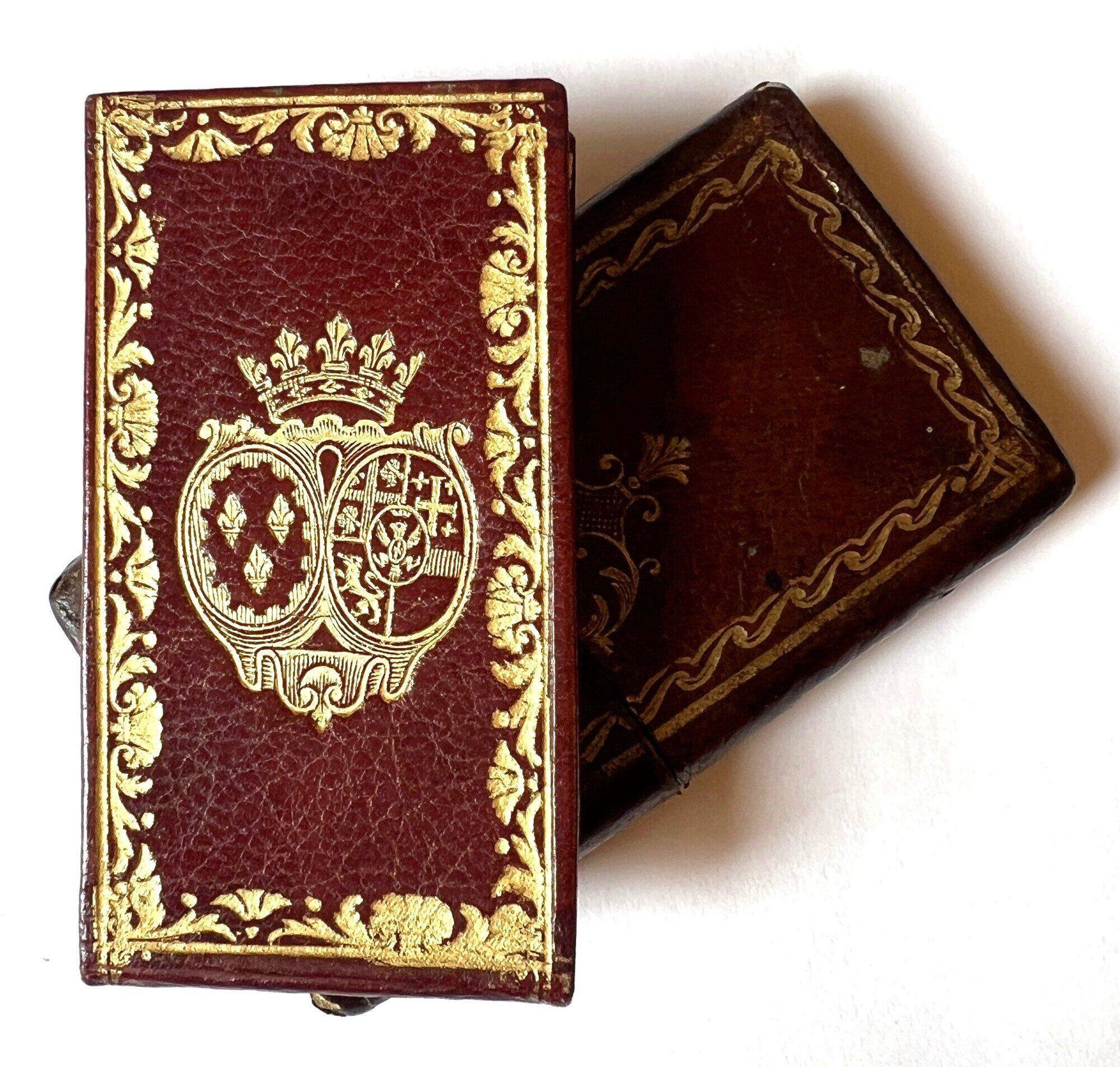
Paris: chez Boulanger, 1774. Oblong miniature (70 x 36 mm., binding 72 x 38 mm.). [15] leaves, entirely engraved, all but the first and last leaves printed on both sides (on sheets that were cut up and glued to each other). No title, first and last two pages with hexastichs honoring a princess named Thérèse (“Therese Souveraine”), calendar (on [2]v-[14]r) laid out longitudinally, creating twelve page openings, each with an etched genre scene, the month of January dated 1775. A few of the scenes slightly off-center, shaving the cartouches. Last leaf on thick card. The figures in the scene for September, showing two women bathing, slightly erased and colored with pale green and pink wash in an attempt to hide their nudity. Contemporary case binding of gold-tooled red morocco over pasteboard, sides with rocaille roll border and central gold-blocked arms of Marie Thérèse de Savoie as Countess of Artois (OHR 2551), spine gold-tooled, gilt edges, blue endleaves; contemporary gold-tooled red morocco silk-lined two-part pull-off case (non-matching, slightly rubbed). . ***
A fine association copy of a very rare miniature “strip” calendar, (possibly) printed for and (definitely) bound for Marie-Antoinette’s sister-in-law.
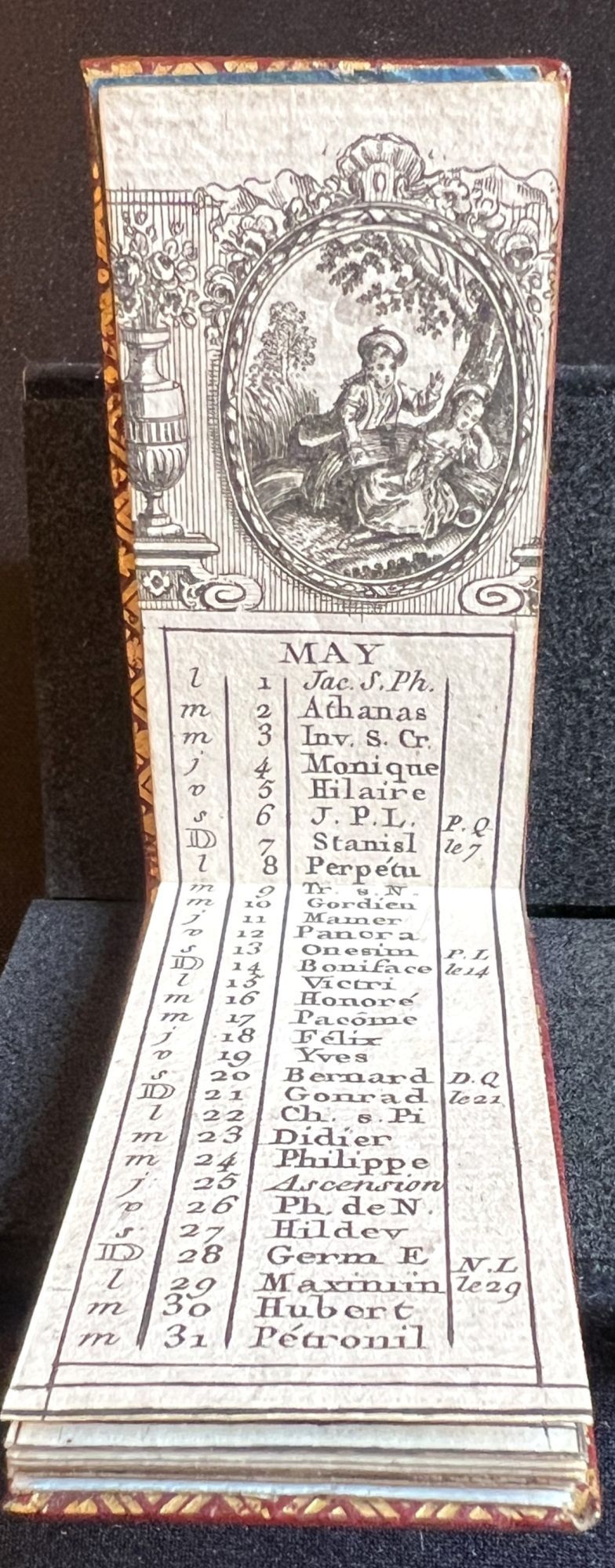
The calendar was printed on a single sheet that was cut into strips. These were then apparently pasted together and the whole was attached to the case binding by the endleaves, which are simply glued to each board. The imprint extends across the bottom of the first three page openings (A Paris, chez Boulanger rue du Pt. / Pont chez Mr Dufresne Marchand / Mercier). Each opening shows a month, in columns with from left to right the day of the week, the day of the month, the Saint for each day, and the phases of the moon, indicated by the abbreviations NL (nouvelle lune), PQ (premier quartier), PL (pleine lune), and DQ (dernier quartier). At the top of each monthly calendar is an etched image within decorative cartouches, showing a woman at her toilette, apple-picking, a rural family around a fire, girls and boys making garlands and on swings, etc.
Independent miniature calendars apparently began to circulate in the 1770s. Originally reduced versions of wall calendars, they were usually cut up, as in this example, and often handsomely bound, although they could also be used, uncut, as small wall calendars. The little volumes, which appear to have been of a standard size, “could be comfortably slipped into inside pockets or placed on the dressing tables of society ladies” (Grand-Carteret, pp. xxxiv-xxxv). Since they lack titles, their presence in libraries or collections is hard to ascertain, but they are scarce, and as ephemeral items surviving examples are often unique.
I have had another copy of a strip calendar, for 1772 (also probably produced by the almanac publisher Boulanger), which belonged to Marie-Thérèse’s sister Marie-Joséphine, and which has verses and pictures honoring the recent royal marriages. While the present edition is more generically illustrated, the verses that surround the calendar honor the charms of a princess who is “bien digne d’être Reine” (worthy of being Queen) and who is named at the end as Thérèse. (At this time Marie-Antoinette had not yet had any children, making Louis XVI’s brothers the next heirs to the throne.) The calendar was thus appropriate for Marie-Thérèse, and may have been printed for her. One nude scene was partially erased and bears traces of green and ink wash coloring, perhaps by Marie-Thérèse herself, who was reputed to be a religious “bigote.”
Marie-Thérèse of Savoy (1756-1805), granddaughter of Charles Emmanuel III, Duke of Savoy and King of Sardinia, was born and raised in the royal palace in Turin. At the age of 17, she was married to Charles-Philippe of France, Comte d’Artois, brother of Louis XVI, and future King Charles X, the last Bourbon king. She thus became sister-in-law to Marie-Antoinette, as well as to her own sister, Marie-Joséphine, who had married another royal brother, Louis-Stanislas, Count of Provence. In Versailles, these young members of the royal family at first formed a circle of friends, acting in plays and passing the time with other oblivious diversions of pre-Revolutionary royals, but their relations are said to have deteriorated after Louis XVI became King in 1774. Marie-Thérèse, who did not leave much of a mark on history, is described as plain, timid, lacking in curiosity and having no influence on her husband, who was as charming and libertine in his youth as he was to be reactionary in his maturity (DBI). She had a sad life. After the storming of the Bastille, she and her husband fled to Turin; in 1791 he deserted her to join Counter-Revolutionary forces in Germany, soon followed by their two sons. She never saw them again, and her last years were plagued by “episodes of paranoia.”
I locate no other copies of this edition (with the above caveat concerning lack of bibliographical control), but a later issue, for 1778, evidently printed from the same plate, was owned by Savigny de Moncorps (Almanachs illustrés, no. 24). He described the scenes, in his own words, as: “Le jour de l’an, la Toilette d’une jolie femme, scène champêtre devant une marmite suspendue au dessus d’un grand feu, une cueillete de fruits, une suprise agréable, autre petite scène galante, la Balançoire, Sacrifice à l’Amour, Le Bain, Berger et Bergère gardant un troupeau (mais pensant à autre chose), Le Coin du feu, un Jeune seigneur surprenant une jolie femme étendue sur un sofa.” The date of 1775 appears only in the month of January, so it would have been easy to change in the plate.
Olivier, Hermal, Roton, Manuel de l’amateur de reliures armoriées 2551. Cf. Savigny de Moncorps, Almanachs illustrés du XVIIIe siècle (1909), no. 24, pp. 63-64.
A fine association copy of a very rare miniature “strip” calendar, (possibly) printed for and (definitely) bound for Marie-Antoinette’s sister-in-law.
The calendar was printed on a single sheet that was cut into strips. These were then apparently pasted together and the whole was attached to the case binding by the endleaves, which are simply glued to each board. The imprint extends across the bottom of the first three page openings (A Paris, chez Boulanger rue du Pt. / Pont chez Mr Dufresne Marchand / Mercier). Each opening shows a month, in columns with from left to right the day of the week, the day of the month, the Saint for each day, and the phases of the moon, indicated by the abbreviations NL (nouvelle lune), PQ (premier quartier), PL (pleine lune), and DQ (dernier quartier). At the top of each monthly calendar is an etched image within decorative cartouches, showing a woman at her toilette, apple-picking, a rural family around a fire, girls and boys making garlands and on swings, etc.
Independent miniature calendars apparently began to circulate in the 1770s. Originally reduced versions of wall calendars, they were usually cut up, as in this example, and often handsomely bound, although they could also be used, uncut, as small wall calendars. The little volumes, which appear to have been of a standard size, “could be comfortably slipped into inside pockets or placed on the dressing tables of society ladies” (Grand-Carteret, pp. xxxiv-xxxv). Since they lack titles, their presence in libraries or collections is hard to ascertain, but they are scarce, and as ephemeral items surviving examples are often unique.
I have had another copy of a strip calendar, for 1772 (also probably produced by the almanac publisher Boulanger), which belonged to Marie-Thérèse’s sister Marie-Joséphine, and which has verses and pictures honoring the recent royal marriages. While the present edition is more generically illustrated, the verses that surround the calendar honor the charms of a princess who is “bien digne d’être Reine” (worthy of being Queen) and who is named at the end as Thérèse. (At this time Marie-Antoinette had not yet had any children, making Louis XVI’s brothers the next heirs to the throne.) The calendar was thus appropriate for Marie-Thérèse, and may have been printed for her. One nude scene was partially erased and bears traces of green and ink wash coloring, perhaps by Marie-Thérèse herself, who was reputed to be a religious “bigote.”
Marie-Thérèse of Savoy (1756-1805), granddaughter of Charles Emmanuel III, Duke of Savoy and King of Sardinia, was born and raised in the royal palace in Turin. At the age of 17, she was married to Charles-Philippe of France, Comte d’Artois, brother of Louis XVI, and future King Charles X, the last Bourbon king. She thus became sister-in-law to Marie-Antoinette, as well as to her own sister, Marie-Joséphine, who had married another royal brother, Louis-Stanislas, Count of Provence. In Versailles, these young members of the royal family at first formed a circle of friends, acting in plays and passing the time with other oblivious diversions of pre-Revolutionary royals, but their relations are said to have deteriorated after Louis XVI became King in 1774. Marie-Thérèse, who did not leave much of a mark on history, is described as plain, timid, lacking in curiosity and having no influence on her husband, who was as charming and libertine in his youth as he was to be reactionary in his maturity (DBI). She had a sad life. After the storming of the Bastille, she and her husband fled to Turin; in 1791 he deserted her to join Counter-Revolutionary forces in Germany, soon followed by their two sons. She never saw them again, and her last years were plagued by “episodes of paranoia.”
I locate no other copies of this edition (with the above caveat concerning lack of bibliographical control), but a later issue, for 1778, evidently printed from the same plate, was owned by Savigny de Moncorps (Almanachs illustrés, no. 24). He described the scenes, in his own words, as: “Le jour de l’an, la Toilette d’une jolie femme, scène champêtre devant une marmite suspendue au dessus d’un grand feu, une cueillete de fruits, une suprise agréable, autre petite scène galante, la Balançoire, Sacrifice à l’Amour, Le Bain, Berger et Bergère gardant un troupeau (mais pensant à autre chose), Le Coin du feu, un Jeune seigneur surprenant une jolie femme étendue sur un sofa.” The date of 1775 appears only in the month of January, so it would have been easy to change in the plate.
Olivier, Hermal, Roton, Manuel de l’amateur de reliures armoriées 2551. Cf. Savigny de Moncorps, Almanachs illustrés du XVIIIe siècle (1909), no. 24, pp. 63-64.
Details
Title
Engraved miniature calendar for 1775
Author
CALENDAR, ROYAL
Condition
Unknown
Publisher
chez Boulanger: Paris
Date
1774