

Fighting Card Players and Death
- SIGNED Hardcover
- Antwerp: Frans van den Wijngaerde, c., 1638
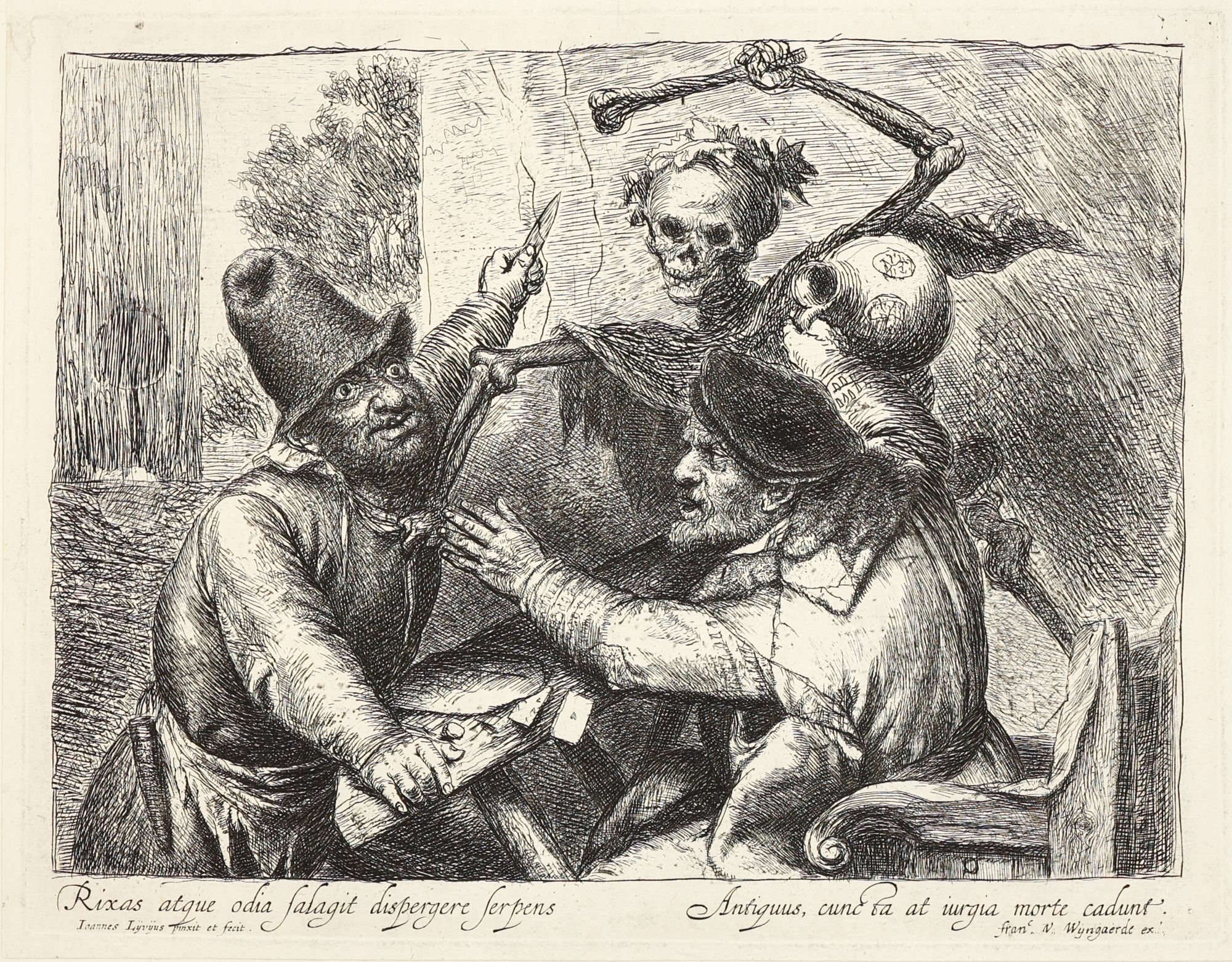
Antwerp: Frans van den Wijngaerde, c., 1638. THIRD STATE. With Wijngaerde’s name replacing that of Marten van den Enden. Hardcover. Fine. Signed lower left margin: Ioannes Lÿvÿus pinxit et fecit; publisher’s address lower right margin: fran.c V Wijngaerde ex. With Latin verses in the lower margin. Watermark: Crowned Strasbourg Coat of Arms with Lilies.
Bartsch 1779, 11; Dutuit 11 II (II); Rovinski 11 III (III); Hollstein XI, 19 III (III); Wheelock 2008, Cat. No. 78. An excellent, richly-inked impression with good contrasts and ample margins, in fine condition. The first state had no inscription. The second state had “Martinus van den Enden ex. Amsterdam” as publisher.
A captivating print by the renowned Dutch Golden Age painter Jan Lievens. Born in Leiden, from the age of ten Lievens studied under Pieter Lastman in Amsterdam. He later (1626-1631) shared a studio with Rembrandt in that city. Lievens’ talent was evident early. By the age of thirteen he had drawn the attention of Maurice of Nassau, Prince of Orange; by the age of twenty-four, he had been invited to the British court, where he was influenced by the work of Anthony van Dyck.
When he returned from London, Lievens settled in Antwerp. There he became a member of the local painters’ guild, and found himself in the company of artists many of whom many specialized in lower-class genre scenes and depictions of rough peasant types. The idiom of Adriaen Brouwer (1605/06 – 1638) was of particular influence on Lievens’ work of that period, as is evident from the painting Fighting Card Players and Death (c. 1638), now in the Leiden Collection, on which this etching is based.
Although the inevitability of death was not an uncommon subject for artists in Lievens’ day, it had enjoyed greater popularity in the sixteenth century, when images of Death personified proliferated in scenes that mixed menace with a touch of humor.
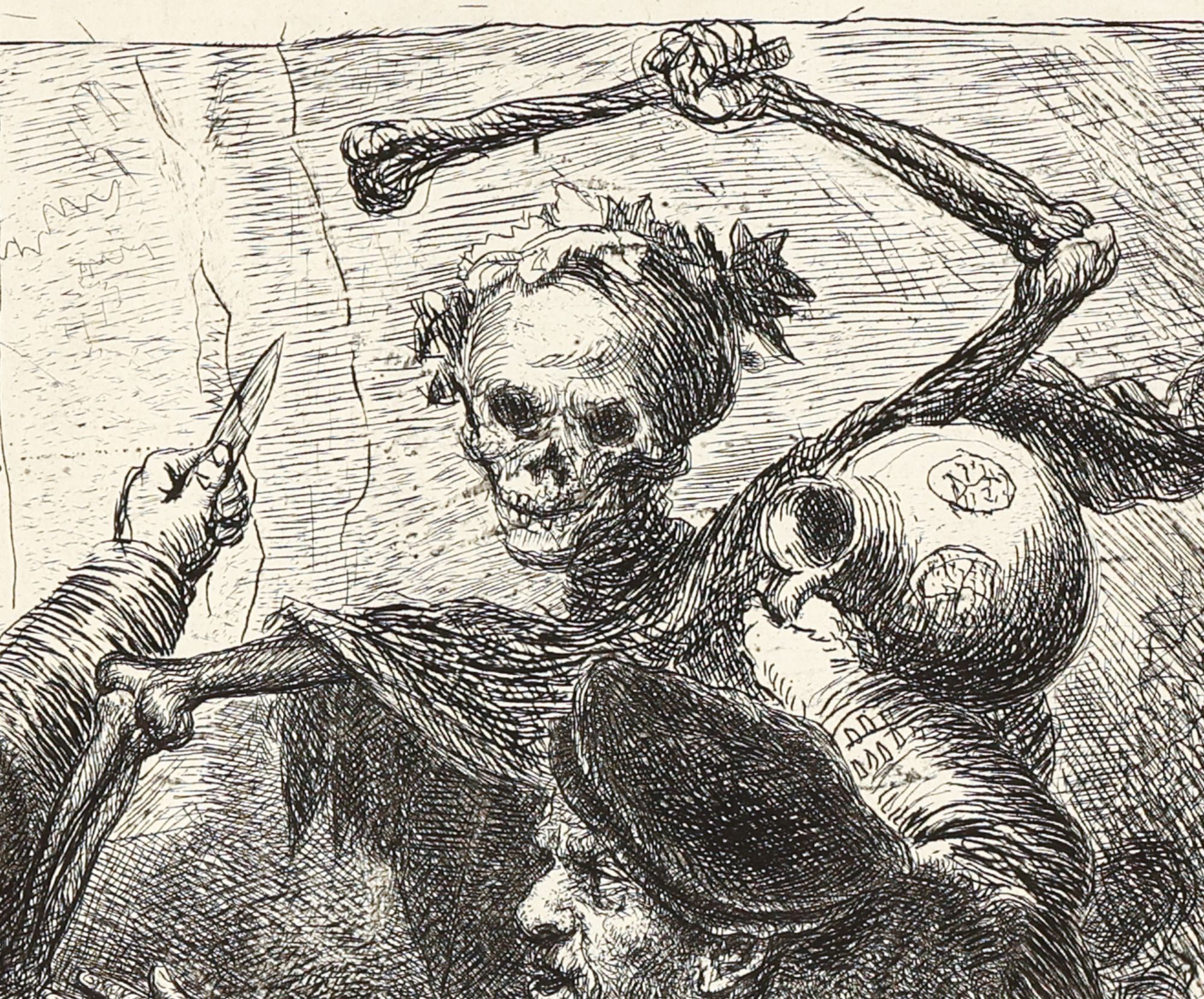
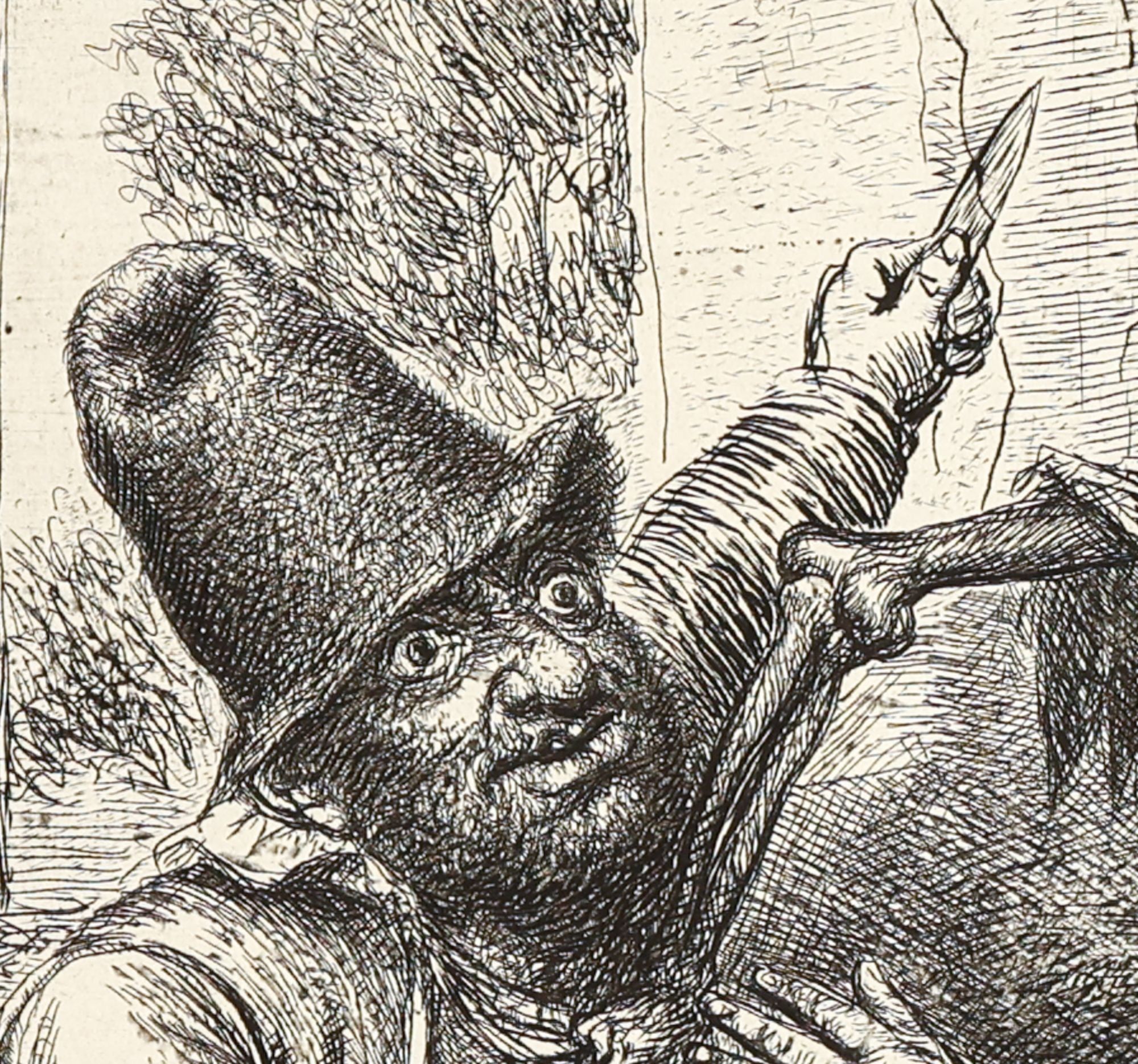
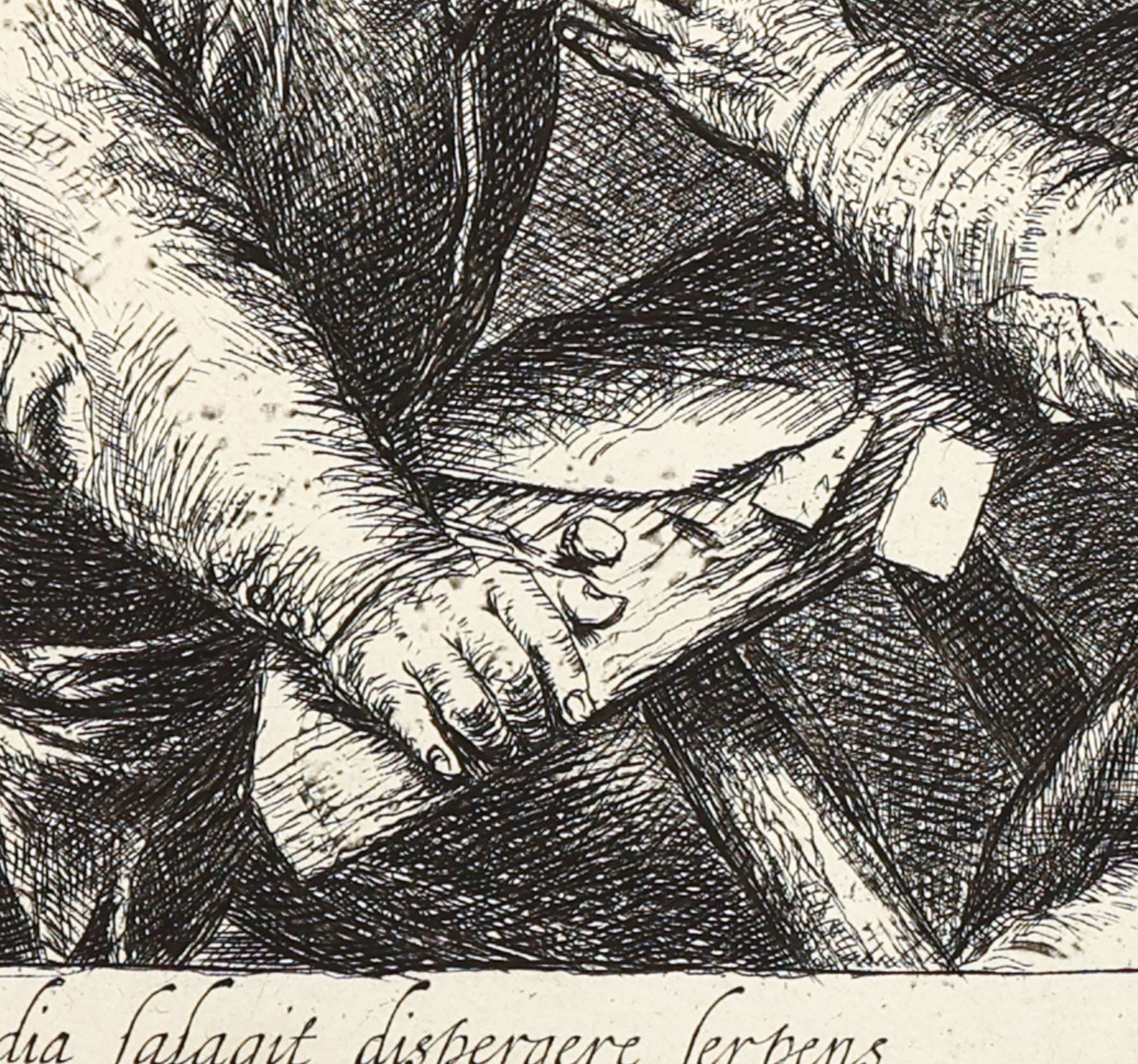
In Lievens’ Fighting Card Players and Death, two men come to blows over a game. One threatens his opponent with a knife, overturning the gaming board in the process, while the other seizes a jug and retaliates. Death, wearing an ivy crown and waving a bone as a club, joins the fray, grabs the man with a knife by the shirt, and prepares to strike him.
“While themes related to life’s brevity and the elusiveness of worldly possessions occur in seventeenth-century Dutch and Flemish painting, they primarily appear in portraits or vanitas still lifes containing such motifs as an extinguished candle, hourglass, or skull. The jarring appearance of an animated and predatory Death was far less common, and indicates the strong moralizing quality that Lievens sought to instill in these works, a theme expressly evident in the inscription added below a reproductive etching Lievens made of Fighting Card Players and Death (fig 4). The inscription reads: ‘The ancient serpent hastens to spread quarrels and hatred, but death cancels all brawls.’
“Lievens’s paintings Greedy Couple Surprised by Death and Fighting Card Players and Death, as well as the print he made after the latter work, all date to 1638. Lievens undoubtedly created these works in that year in response to the devastating plague then ravaging the Netherlands, a plague that claimed the life of, among others, Adriaen Brouwer. The realization that death could come at unexpected moments was one that must have weighed heavily on the populace, and Lievens, as well as other Dutch and Flemish artists, responded in imaginative and compelling ways to this mortal reality.”(Wheelock, "Fighting Card Players and Death." In The Leiden Collection Catalogue. Edited by Arthur K. Wheelock Jr. New York, 2017).
Bartsch 1779, 11; Dutuit 11 II (II); Rovinski 11 III (III); Hollstein XI, 19 III (III); Wheelock 2008, Cat. No. 78. An excellent, richly-inked impression with good contrasts and ample margins, in fine condition. The first state had no inscription. The second state had “Martinus van den Enden ex. Amsterdam” as publisher.
A captivating print by the renowned Dutch Golden Age painter Jan Lievens. Born in Leiden, from the age of ten Lievens studied under Pieter Lastman in Amsterdam. He later (1626-1631) shared a studio with Rembrandt in that city. Lievens’ talent was evident early. By the age of thirteen he had drawn the attention of Maurice of Nassau, Prince of Orange; by the age of twenty-four, he had been invited to the British court, where he was influenced by the work of Anthony van Dyck.
When he returned from London, Lievens settled in Antwerp. There he became a member of the local painters’ guild, and found himself in the company of artists many of whom many specialized in lower-class genre scenes and depictions of rough peasant types. The idiom of Adriaen Brouwer (1605/06 – 1638) was of particular influence on Lievens’ work of that period, as is evident from the painting Fighting Card Players and Death (c. 1638), now in the Leiden Collection, on which this etching is based.
Although the inevitability of death was not an uncommon subject for artists in Lievens’ day, it had enjoyed greater popularity in the sixteenth century, when images of Death personified proliferated in scenes that mixed menace with a touch of humor.
In Lievens’ Fighting Card Players and Death, two men come to blows over a game. One threatens his opponent with a knife, overturning the gaming board in the process, while the other seizes a jug and retaliates. Death, wearing an ivy crown and waving a bone as a club, joins the fray, grabs the man with a knife by the shirt, and prepares to strike him.
“While themes related to life’s brevity and the elusiveness of worldly possessions occur in seventeenth-century Dutch and Flemish painting, they primarily appear in portraits or vanitas still lifes containing such motifs as an extinguished candle, hourglass, or skull. The jarring appearance of an animated and predatory Death was far less common, and indicates the strong moralizing quality that Lievens sought to instill in these works, a theme expressly evident in the inscription added below a reproductive etching Lievens made of Fighting Card Players and Death (fig 4). The inscription reads: ‘The ancient serpent hastens to spread quarrels and hatred, but death cancels all brawls.’
“Lievens’s paintings Greedy Couple Surprised by Death and Fighting Card Players and Death, as well as the print he made after the latter work, all date to 1638. Lievens undoubtedly created these works in that year in response to the devastating plague then ravaging the Netherlands, a plague that claimed the life of, among others, Adriaen Brouwer. The realization that death could come at unexpected moments was one that must have weighed heavily on the populace, and Lievens, as well as other Dutch and Flemish artists, responded in imaginative and compelling ways to this mortal reality.”(Wheelock, "Fighting Card Players and Death." In The Leiden Collection Catalogue. Edited by Arthur K. Wheelock Jr. New York, 2017).
Details
Title
Fighting Card Players and Death
Author
Lievens, Jan (Leiden 1607 – 1674 Amsterdam)
Binding
Hardcover
Condition
Fine
Publisher
Frans van den Wijngaerde, c.: Antwerp
Date
1638
Edition
THIRD STATE. With Wijngaerde’s name replacing that of Marten v