

[Three Documents Concerning the Sale of Native American Lands in Oklahoma by the Federal Government]
- Oklahoma , 1911
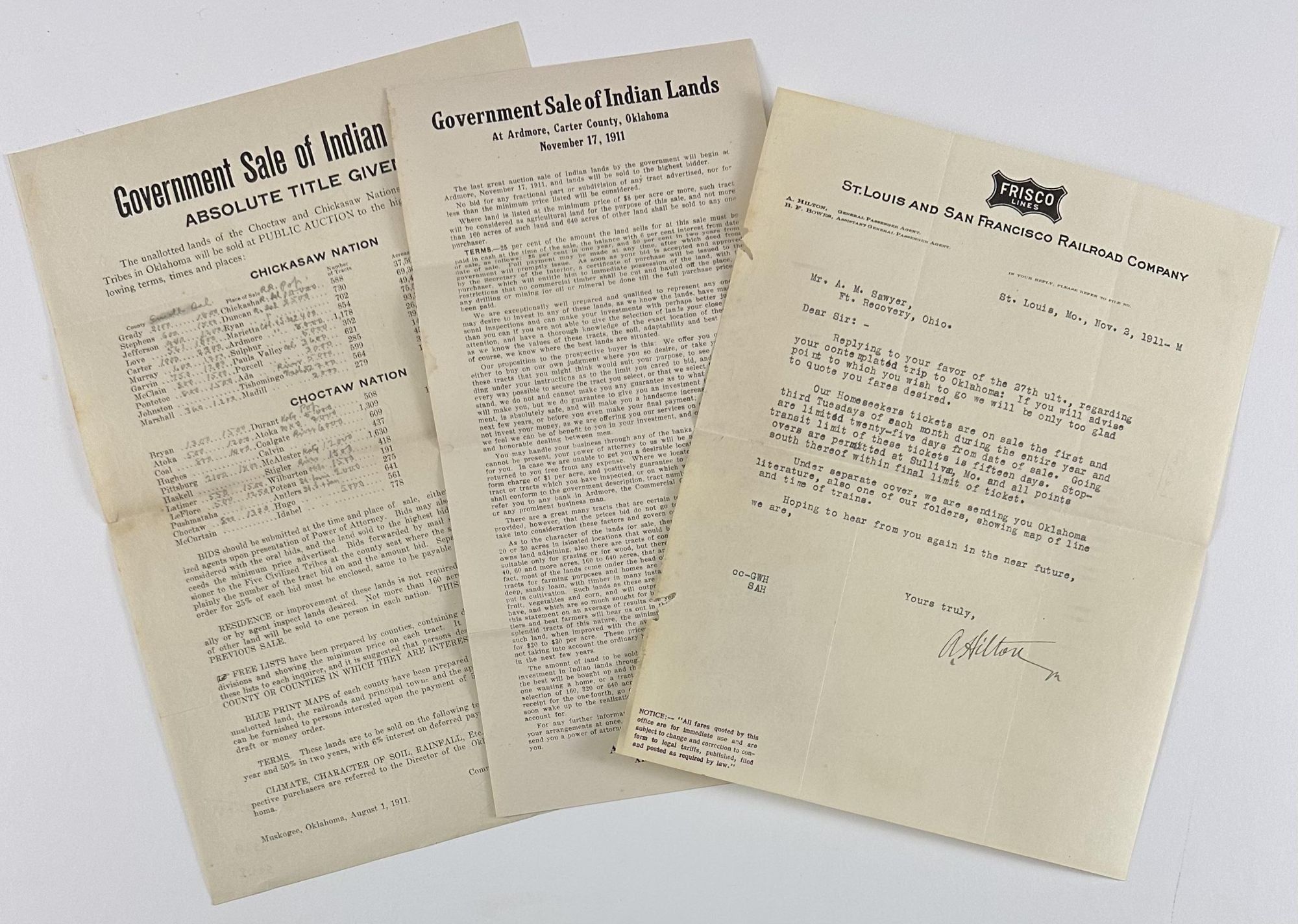
Oklahoma, 1911. Three documents (two printed broadsides and one typed letter): 12 x 6; 11 x 8.5; and 12 x 8.5 inches. Folded, with slight scuffing to some edges; one with notes in pencil. Otherwise excellent. Three documents concerning the United States government's auction of appropriated Indigenous land in Oklahoma following the 1898 Curtis Act. The Curtis Act was an amendment to the 1887 Dawes Act that extended its authority to the Five Civilized Tribes in Indian Territory (now Oklahoma). These acts were essentially land grabs that also allowed the state to break up tribal governmental and social structures. Among other provisions, they allotted households or individuals in the tribe plots of land, and the surplus land was sold at auction by the government.
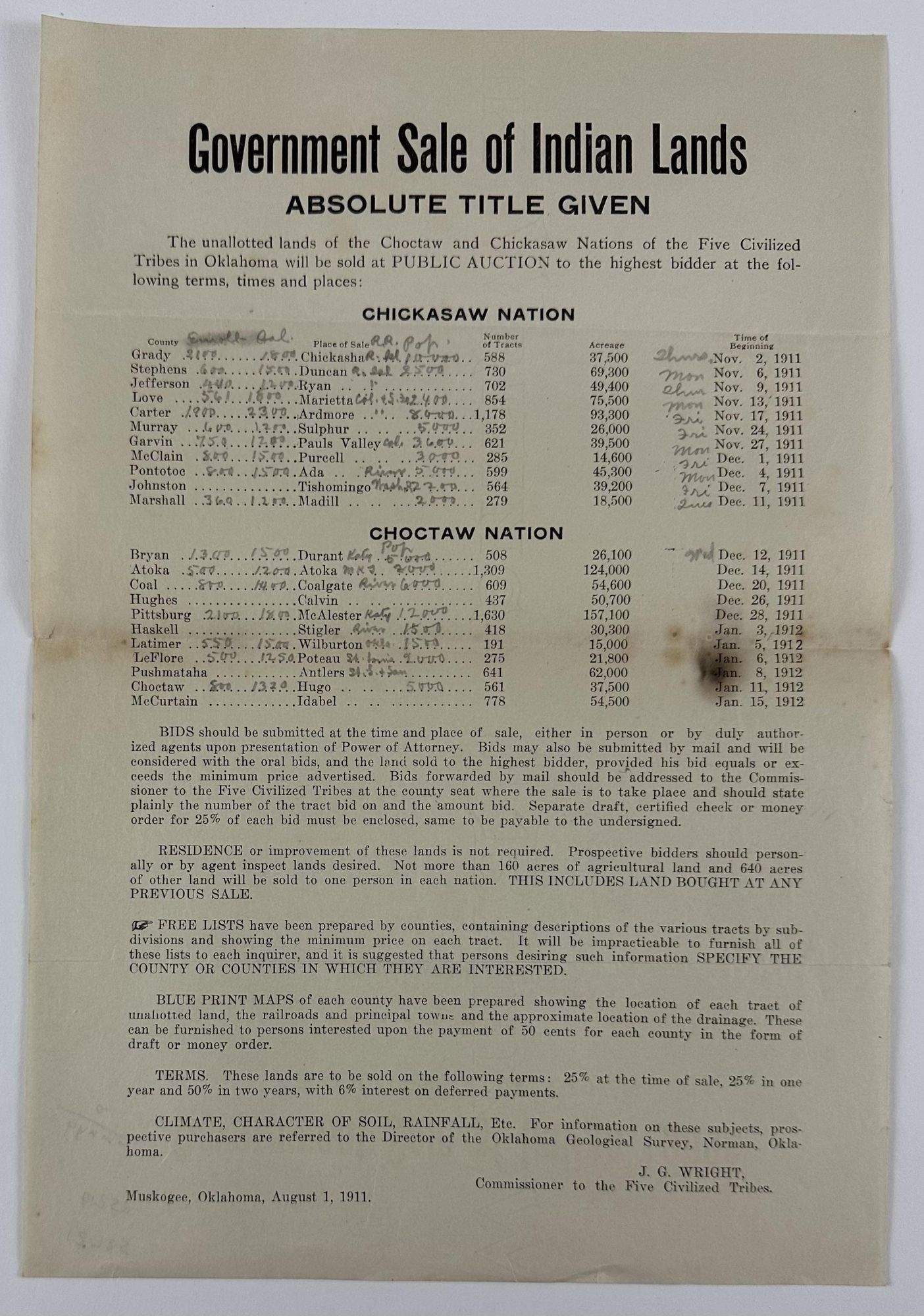
The present group includes two broadsides and a letter concerning the auction of Choctaw and Chickasaw land in 1911. The earlier broadside is dated August 1, 1911, and was issued from Muskogee by J.G. Wright, the Commissioner to the Five Civilized Tribes. Here, Wright provides the date and location of auctions in each county for "unallotted lands of the Choctaw and Chickasaw Nations" to be sold at "public auction," and information about the terms of the auction. A previous owner of the broadside, perhaps a participant in the auction, has added numerous notes in pencil regarding population in various counties and other information.
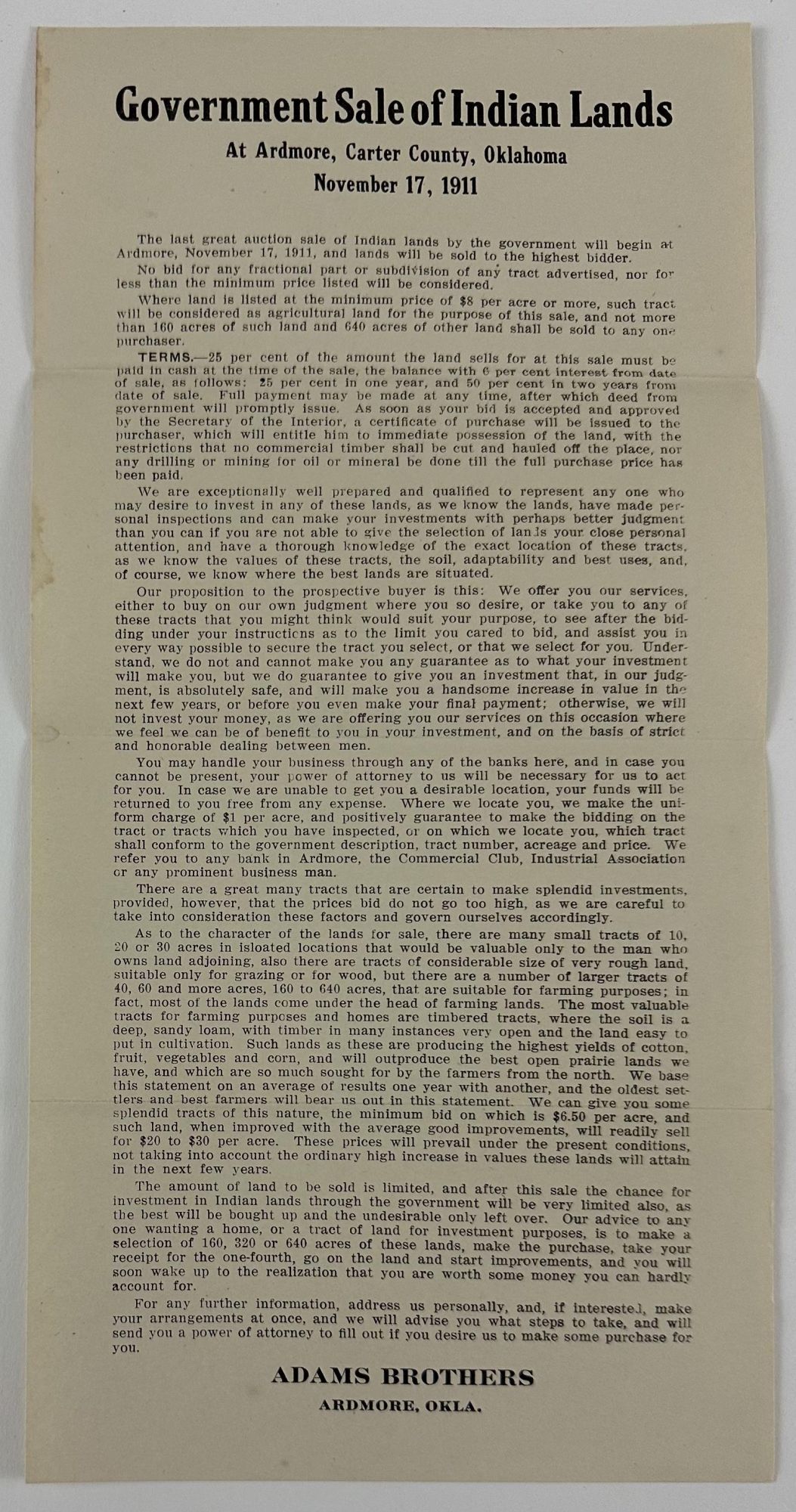
The slightly later broadside was issued by the Adams Brothers in Ardmore. They provide terms for the auction sale, noting land is being sold at a minimum of $8 per acre and that such lands are "considered as agricultural land for the purpose of this sale." Drilling for oil or minerals will not be allowed on any tract until "the full purchase price has been paid." In addition, the Adams Brothers remind potential buyers that both small and large tracts of land are available, to satisfy a range of needs (grazing, timber, farming, and more). The broadside also advertises services to prospective buyers, both in showing locations and in bidding on behalf of clients. It promises that if clients purchase land and improve on it they "will soon wake up to the realization that you are worth some money you can hardly account for."
The letter comes from A. Hilton, passenger agent with the St. Louis and San Francisco Railroad Company. It advises A. M. Sawyer of Fort Recovery, Ohio, about the railroad's "Homeseekers tickets," which seem to have been tickets out to areas where these sorts of land auctions were happening.
An interesting trio of documents encapsulating 20th-century efforts towards cultural assimilation of Indigenous Americans in Oklahoma, and spreading the wealth of the mineral richness of lands in Indian Territory, by dispersing their lands to the highest bidder.
The present group includes two broadsides and a letter concerning the auction of Choctaw and Chickasaw land in 1911. The earlier broadside is dated August 1, 1911, and was issued from Muskogee by J.G. Wright, the Commissioner to the Five Civilized Tribes. Here, Wright provides the date and location of auctions in each county for "unallotted lands of the Choctaw and Chickasaw Nations" to be sold at "public auction," and information about the terms of the auction. A previous owner of the broadside, perhaps a participant in the auction, has added numerous notes in pencil regarding population in various counties and other information.
The slightly later broadside was issued by the Adams Brothers in Ardmore. They provide terms for the auction sale, noting land is being sold at a minimum of $8 per acre and that such lands are "considered as agricultural land for the purpose of this sale." Drilling for oil or minerals will not be allowed on any tract until "the full purchase price has been paid." In addition, the Adams Brothers remind potential buyers that both small and large tracts of land are available, to satisfy a range of needs (grazing, timber, farming, and more). The broadside also advertises services to prospective buyers, both in showing locations and in bidding on behalf of clients. It promises that if clients purchase land and improve on it they "will soon wake up to the realization that you are worth some money you can hardly account for."
The letter comes from A. Hilton, passenger agent with the St. Louis and San Francisco Railroad Company. It advises A. M. Sawyer of Fort Recovery, Ohio, about the railroad's "Homeseekers tickets," which seem to have been tickets out to areas where these sorts of land auctions were happening.
An interesting trio of documents encapsulating 20th-century efforts towards cultural assimilation of Indigenous Americans in Oklahoma, and spreading the wealth of the mineral richness of lands in Indian Territory, by dispersing their lands to the highest bidder.
Details
Title
[Three Documents Concerning the Sale of Native American Lands in Oklahoma by the Federal Government]
Author
[Oklahoma]: [Native Americans]: [Curtis Act of 1898]: Adams Brothers, et al.
Condition
Unknown
Publisher
Oklahoma
Date
1911