

[Manuscript Letter Partially Concerned with Luring Members of the Famous Randolph Freedpeople to Voluntarily Return to Slavery in Virginia]
- Washington DC: January 9, 1847
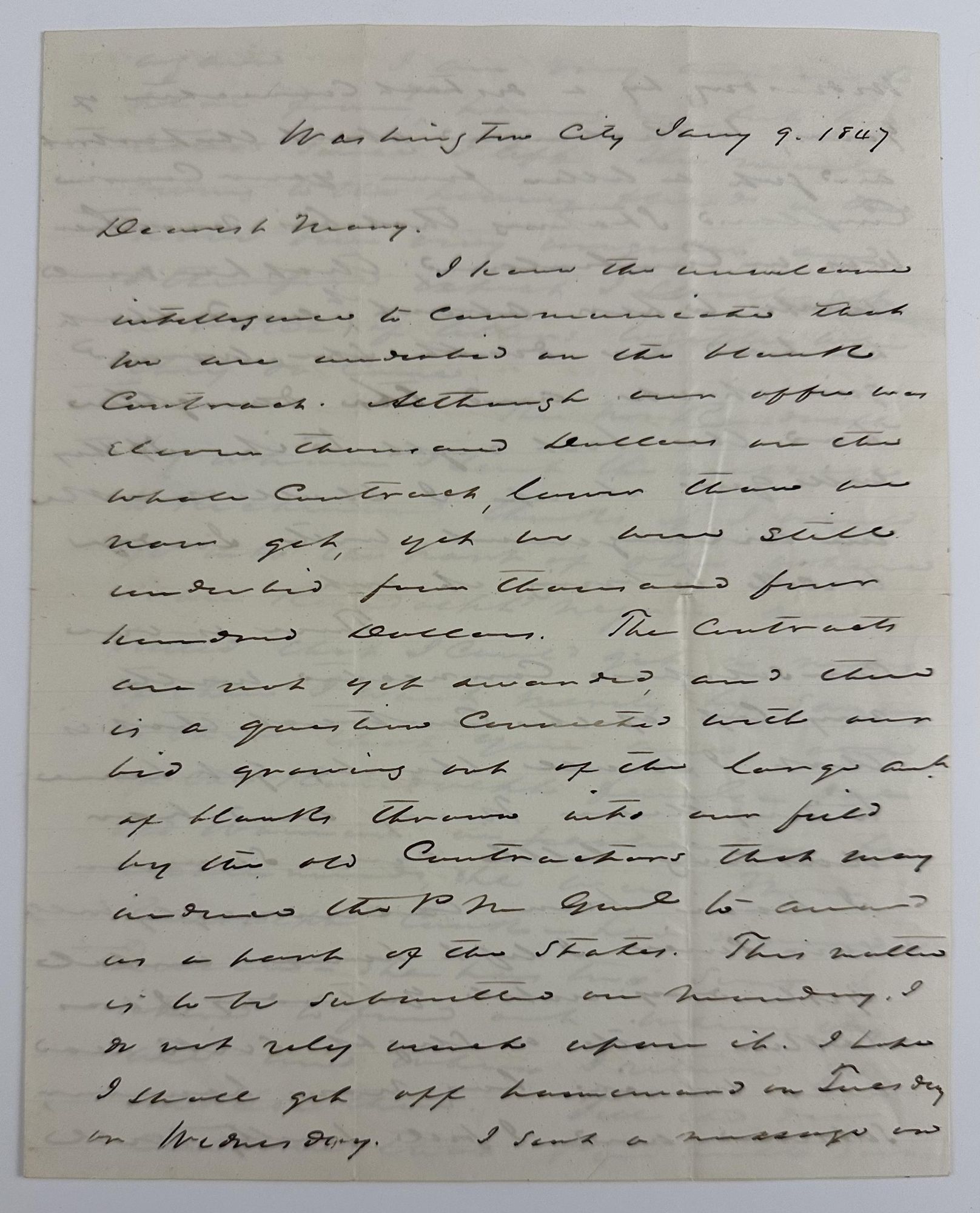
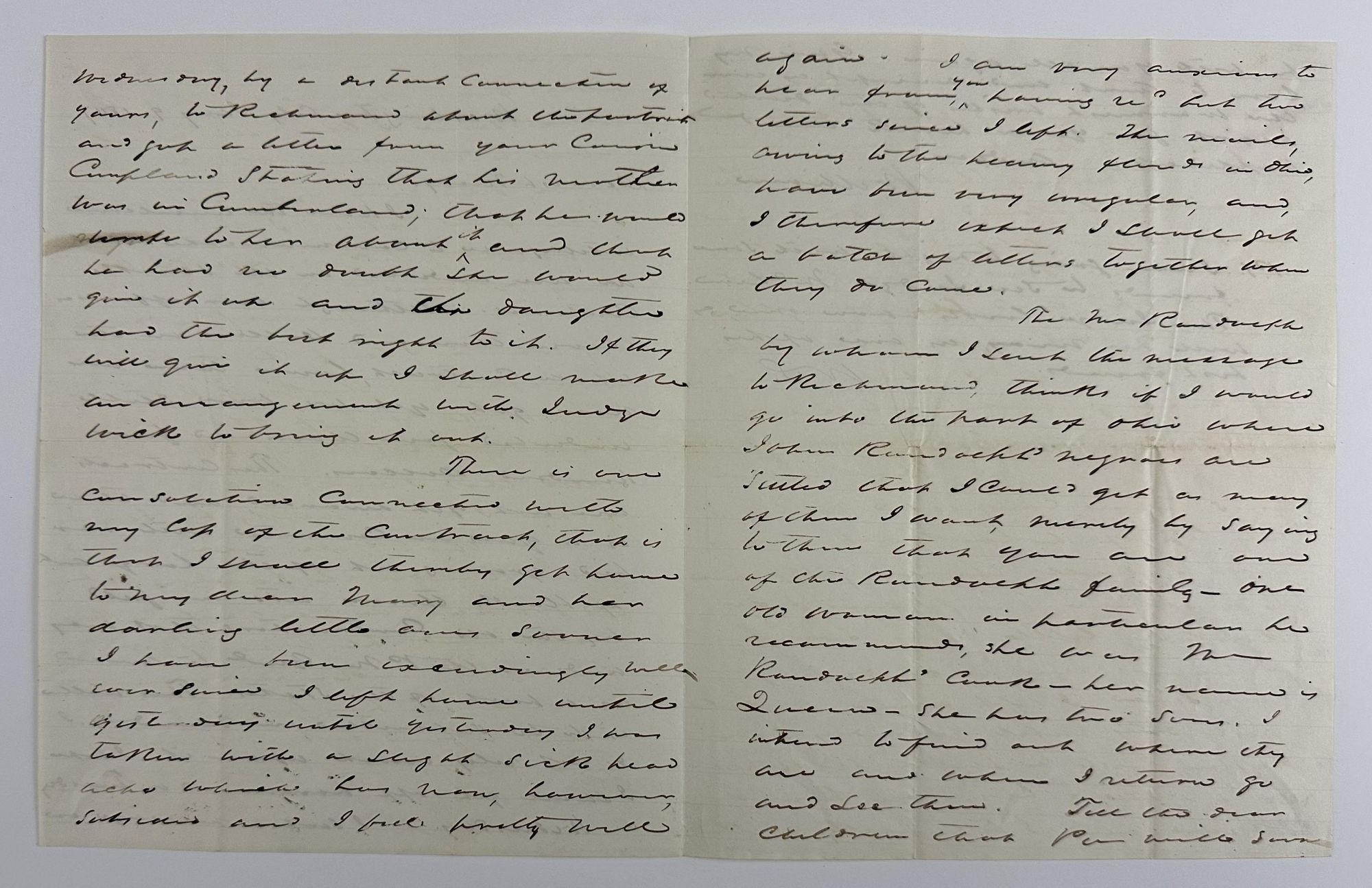
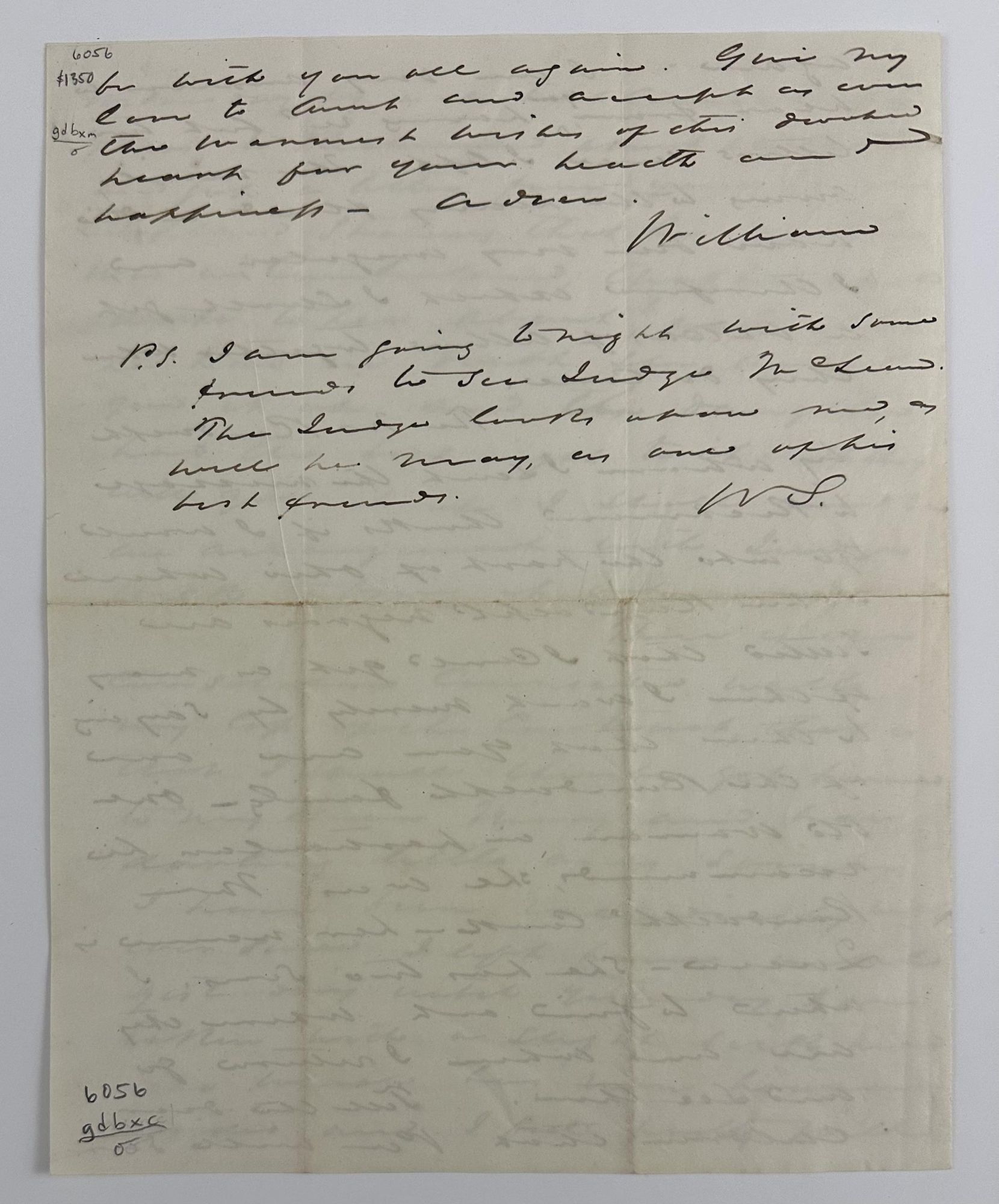
Washington DC: January 9, 1847. Very good plus.. [4]pp., on a single folded sheet. Original mailing folds, light overall wear. A well-preserved letter. A unique correspondence in which a businessman named William writes home to his wife Mary in Ohio regarding a number of matters. The letter opens with information on recent contractual troubles likely related to the couple's mail delivery routes with the U.S. Post Office. William also mentions his upcoming return home, and references the recent "heavy floods in Ohio." Most importantly, William details a scheme intended to lure members of the famous Randolph Freedpeople to voluntarily return to slavery in Virginia after they were freed in Ohio.
The case in question occurred when 383 slaves were manumitted by John Randolph, a member of Mary's extended family. This resulted in a year-long battle over Randolph's will, after which the court finally determined that the manumission was legally binding. William cryptically refers to other members of the Randolph family, relating to their possible renunciation of their claims on some property, perhaps their share of the slaves involved in the Randolph dispute: "I sent a message...by a distance cousin of yours to Richmond...and got a letter from [another cousin] stating that his mother was in Cumberland...and that he had no doubt she would give it up and her daughter had the birthright to it. If they will give it up I shall make an arrangement with Lawyer Wick."
Then, he writes more clearly about his scheme to lure some of the Randolph Freedpeople back to slavery in Virginia, just six months after they departed: "The Mr. Randolph by whom I sent the message to Richmond thinks if I would go into the part of Ohio where John Randolph's negroes are settled that I could get as many of them as I want merely by saying to them that you are one of the Randolph family -- one old woman in particular he recommends, she was Mr. Randolph's cook -- her name is Queen -- she has two sons. I intend to find out where they are and when I return go and see them."
Although neither Queen nor any other of the Randolph Freedpeople accepted William's offer (if he ever actually made one), some of the manumitted slaves may have indeed returned to bondage in Virginia after apparently encountering far more hostility, uncertainty, and danger in Ohio than they had on Randolph's plantation. As part of his will, Randolph directed 3,200 acres be purchased for the settlement of his former slaves in Mercer County, Ohio. The Freedpeople left Roanoke in June 1846 by wagon train to Kanawha, where they boarded a steamboat for Cincinnati. There, they journeyed in small vessels up the Miami-Erie Canal to Mercer County. At New Bremen, an armed mob of German immigrants prevented their landing, issuing a formal resolution that read, in part: "Resolved. That we will not live among Negroes, as we have settled here first, we have fully determined that we will resist the settlement of blacks and mulattoes in this country to the fullest extent of our means, the bayonet not excepted." The former slaves dispersed into smaller groups, and despite their trepidations they settled into more accepting communities in Miami and Shelby counties.
John Randolph was scion of the most powerful and wealthy family in 18th-century Virginia. The Randolphs first settled in Virginia in 1699, and the family eventually produced important offspring that included Thomas Jefferson, John Marshall, "Light Horse" Harry Lee, and Robert E. Lee. John Randolph served as a Senator for Virginia, multiple terms as a Congressman, and also as ambassador to Russia. Although a white supremacist, Randolph opposed slavery in principle, but found it ultimately necessary to the operation of his 6,000-acre tobacco plantation in Roanoke. The story of his last will and testament (all three of them) is an interesting case in and of itself, but the ultimate result was that Randolph's slaves were freed largely because of testimony Randolph delivered on his deathbed. Despite the circumstances, 383 slaves were freed by Randolph and were able to escape servitude in Virginia and begin new lives in Ohio, where they faced different challenges to their personhood.
The present letter remains an exceptionally-rare written record of the case of the Randolph Freedpeople; even as a brief passage, the letter is notable for any mention of the historical event. The only record we could locate of any part of the event is an incomplete bound collection of records from the Randolph will court case which is held by the University of Virginia.
The case in question occurred when 383 slaves were manumitted by John Randolph, a member of Mary's extended family. This resulted in a year-long battle over Randolph's will, after which the court finally determined that the manumission was legally binding. William cryptically refers to other members of the Randolph family, relating to their possible renunciation of their claims on some property, perhaps their share of the slaves involved in the Randolph dispute: "I sent a message...by a distance cousin of yours to Richmond...and got a letter from [another cousin] stating that his mother was in Cumberland...and that he had no doubt she would give it up and her daughter had the birthright to it. If they will give it up I shall make an arrangement with Lawyer Wick."
Then, he writes more clearly about his scheme to lure some of the Randolph Freedpeople back to slavery in Virginia, just six months after they departed: "The Mr. Randolph by whom I sent the message to Richmond thinks if I would go into the part of Ohio where John Randolph's negroes are settled that I could get as many of them as I want merely by saying to them that you are one of the Randolph family -- one old woman in particular he recommends, she was Mr. Randolph's cook -- her name is Queen -- she has two sons. I intend to find out where they are and when I return go and see them."
Although neither Queen nor any other of the Randolph Freedpeople accepted William's offer (if he ever actually made one), some of the manumitted slaves may have indeed returned to bondage in Virginia after apparently encountering far more hostility, uncertainty, and danger in Ohio than they had on Randolph's plantation. As part of his will, Randolph directed 3,200 acres be purchased for the settlement of his former slaves in Mercer County, Ohio. The Freedpeople left Roanoke in June 1846 by wagon train to Kanawha, where they boarded a steamboat for Cincinnati. There, they journeyed in small vessels up the Miami-Erie Canal to Mercer County. At New Bremen, an armed mob of German immigrants prevented their landing, issuing a formal resolution that read, in part: "Resolved. That we will not live among Negroes, as we have settled here first, we have fully determined that we will resist the settlement of blacks and mulattoes in this country to the fullest extent of our means, the bayonet not excepted." The former slaves dispersed into smaller groups, and despite their trepidations they settled into more accepting communities in Miami and Shelby counties.
John Randolph was scion of the most powerful and wealthy family in 18th-century Virginia. The Randolphs first settled in Virginia in 1699, and the family eventually produced important offspring that included Thomas Jefferson, John Marshall, "Light Horse" Harry Lee, and Robert E. Lee. John Randolph served as a Senator for Virginia, multiple terms as a Congressman, and also as ambassador to Russia. Although a white supremacist, Randolph opposed slavery in principle, but found it ultimately necessary to the operation of his 6,000-acre tobacco plantation in Roanoke. The story of his last will and testament (all three of them) is an interesting case in and of itself, but the ultimate result was that Randolph's slaves were freed largely because of testimony Randolph delivered on his deathbed. Despite the circumstances, 383 slaves were freed by Randolph and were able to escape servitude in Virginia and begin new lives in Ohio, where they faced different challenges to their personhood.
The present letter remains an exceptionally-rare written record of the case of the Randolph Freedpeople; even as a brief passage, the letter is notable for any mention of the historical event. The only record we could locate of any part of the event is an incomplete bound collection of records from the Randolph will court case which is held by the University of Virginia.
Details
Title
[Manuscript Letter Partially Concerned with Luring Members of the Famous Randolph Freedpeople to Voluntarily Return to Slavery in Virginia]
Author
[African Americana]: [Ohio]
Condition
Very Good
Publisher
January 9: Washington DC
Date
1847