

S. Filippo Neri. Oratorio à quattro Voci con Strumenti ... 1705. [Incomplete set of parts]. [Copyist manuscript]
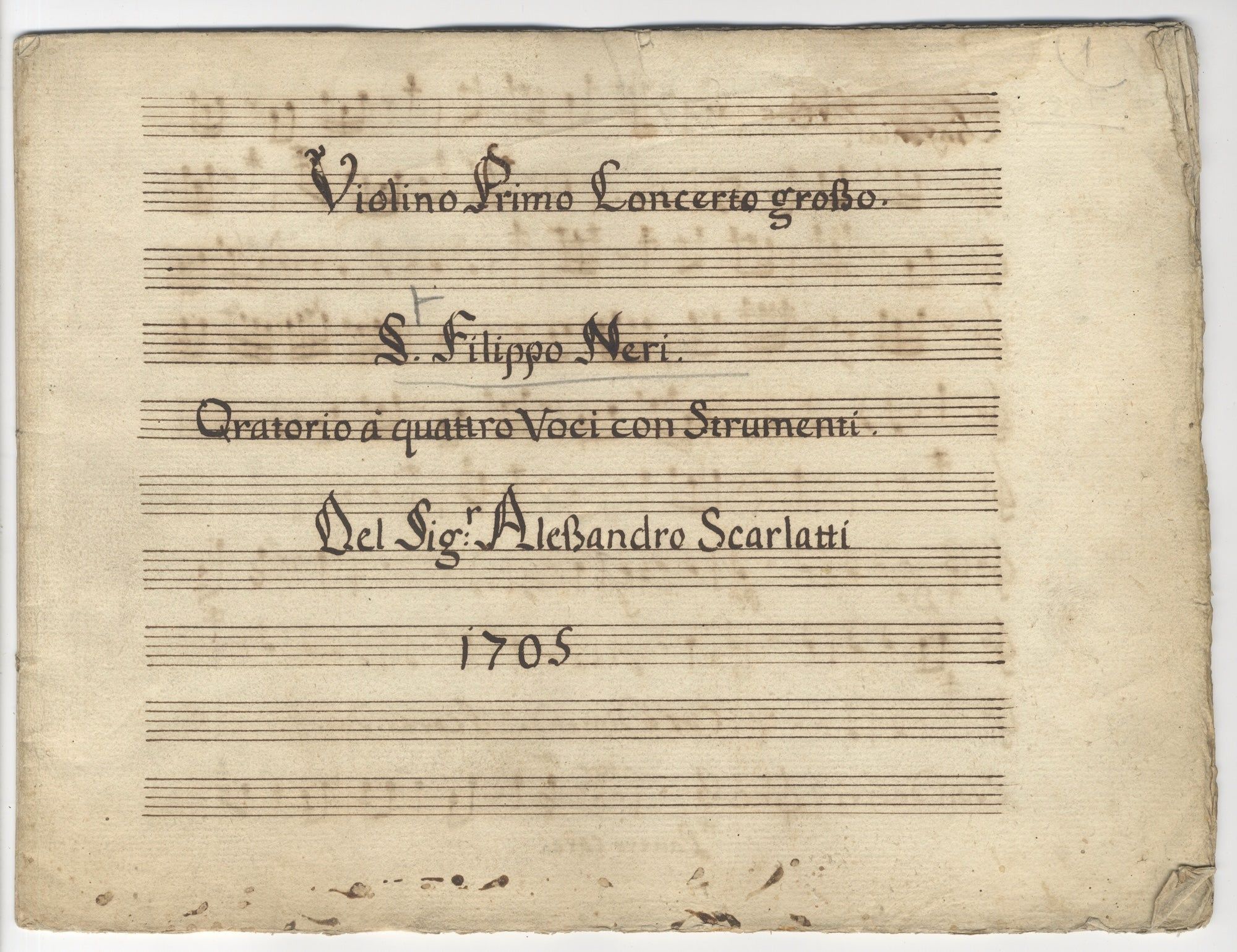
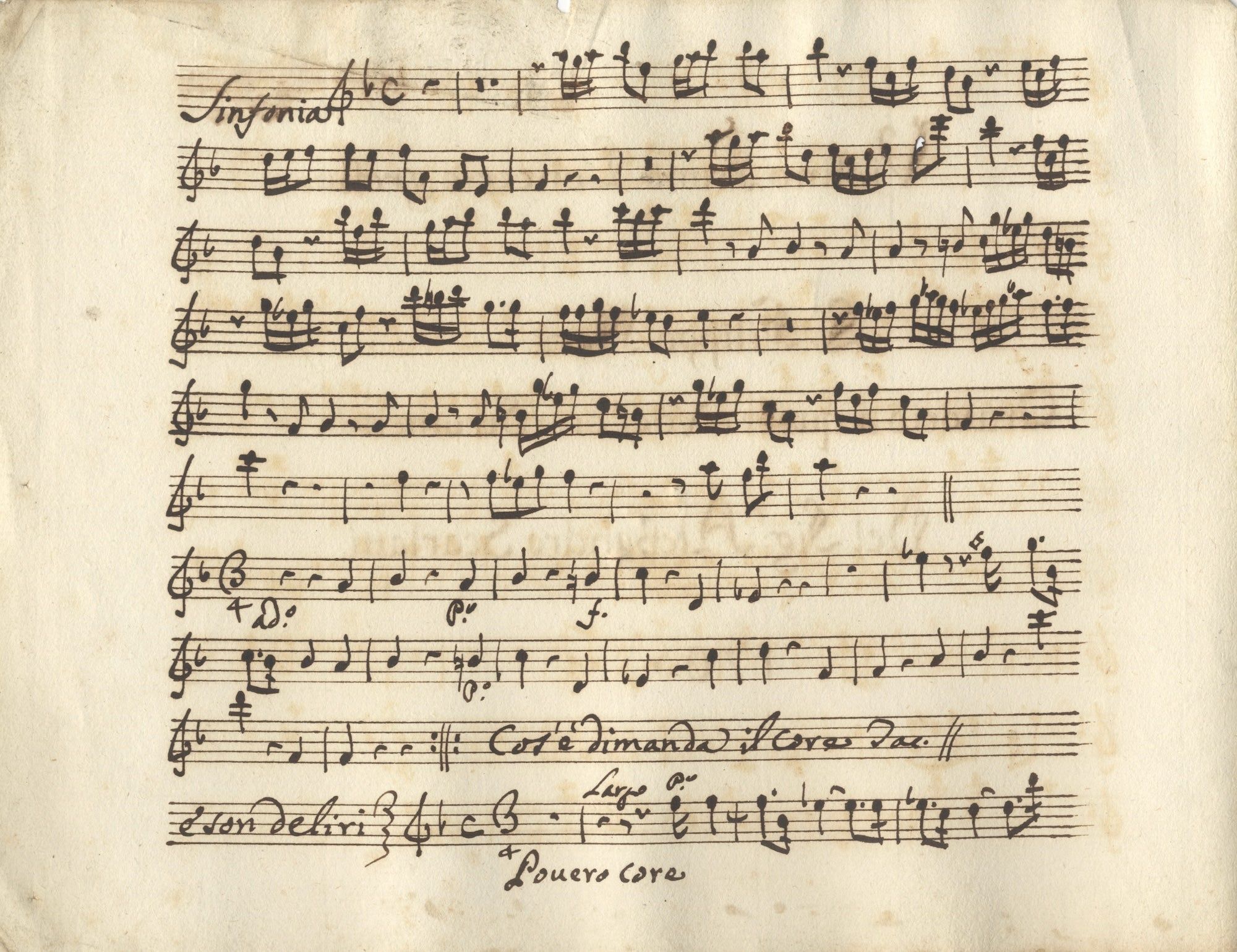
- Rome , 1705
Rome, 1705. Quarto (214 x 284 mm). Notated in black ink on 10-stave rastrum-ruled paper. Watermark fleur-de-lis within a double circle (unlocated).
- Violino primo concerto grosso: [i] (title), 12, [ii] (blank) pp.
- Violino secondo concerto grosso: [i] (title), 12, [ii] (blank) pp. Two systems canceled on penultimate page.
- Violetta: [i] (title), 14 pp.
- Parte della Carità [soprano voice]: [i] (title), 23 pp. "Fine della P[ri]ma. Parte" after final system.
Originally scored for S,A, A, T, trumpet, strings, lute, and basso continuo.
Slightly worn, soiled, and stained; occasional showthrough, dampstaining, and small holes; loss of 1-1/2 measures to uppermost system of final page of viola part; inkstains to four lowermost blank staves of final page of part for Carità, not affecting notation. An unrecorded source. Rostirolla p. 502, no. 18. No contemporary published edition of the score. RISM Manuscripts Online cites two manuscript sources only, one at the Bibliothèque Royale Albert 1er in Brussels formerly in the collection of Fétis (see Catalogue de la Bibliothèque de F.J. Fétis, Paris 1877, no. 2170, RISM ID no.: 700005808) and the other at the Diözesanbibliothek in Münster, Germany, RISM ID no.: 451023171.
First performed in Rome at the Palazzo della Cancelleria on 26 March 1705. The libretto, with anonymous text, was published in Rome in that same year.
The viola ("violetta") part and the vocal part for Carità include a stave for the bass, with the copyist entering the bass line at strategic moments in order to serve as cues.
"A more mystical and less ascetic example is the anonymous 'San Filippo Neri' ... In this work Faith, Hope, and Charity converse with and reflect on the life of St. Philip - who, having rejected riches and the world, yearns for a mystical union with God." Smither: A History of the Oratorio Volume I, p. 302.
" 'San Filippo Neri' ... is one of his [Scarlatti's] best oratorios. There is a real feeling of sincerity about it, though not all of it is in accordance with modern taste. The simile of a ship on a prosperous voyage leads St. Philip into vocal ripplings which are pretty, but rather out of place, and in the air "Son come destriero" the pawing and champing of both voice and violins throw Handel's frogs quite into the shade. But where genuine human feeling comes in Scarlatti rises to the occasion. There is something seraphic in the brilliance of Charity's high soprano airs; Faith speaks with a large Handelian dignity, and the pathetic recitative stromentato is worthily followed by the quiet and beautiful air in which St. Philip acknowledges the divine call." Dent: Alessandro Scarlatti: His Life and Works, pp. 133, 135.
"On 9 January 1703 [Scarlatti] was appointed assistant to Giovanni Bicilli, the elderly maestro di cappella of the Congregazione dell'Oratorio di S Filippo Neri at the Chiesa Nuova. ... Given the importance of oratorio in Roman musical life, and the important position of the Chiesa Nuova di S Maria in Vallicella in the genre, Scarlatti's work there assumes particular importance." Roberto Pagano in Grove Music Online
Rendered in an accomplished professional hand. The date of "1705" and the practical nature of these parts (with extensive cues) indicate that they may have been used for the original performance of the oratorio, under the directorship of Scarlatti himself.
A rare and previously unrecorded source.
- Violino primo concerto grosso: [i] (title), 12, [ii] (blank) pp.
- Violino secondo concerto grosso: [i] (title), 12, [ii] (blank) pp. Two systems canceled on penultimate page.
- Violetta: [i] (title), 14 pp.
- Parte della Carità [soprano voice]: [i] (title), 23 pp. "Fine della P[ri]ma. Parte" after final system.
Originally scored for S,A, A, T, trumpet, strings, lute, and basso continuo.
Slightly worn, soiled, and stained; occasional showthrough, dampstaining, and small holes; loss of 1-1/2 measures to uppermost system of final page of viola part; inkstains to four lowermost blank staves of final page of part for Carità, not affecting notation. An unrecorded source. Rostirolla p. 502, no. 18. No contemporary published edition of the score. RISM Manuscripts Online cites two manuscript sources only, one at the Bibliothèque Royale Albert 1er in Brussels formerly in the collection of Fétis (see Catalogue de la Bibliothèque de F.J. Fétis, Paris 1877, no. 2170, RISM ID no.: 700005808) and the other at the Diözesanbibliothek in Münster, Germany, RISM ID no.: 451023171.
First performed in Rome at the Palazzo della Cancelleria on 26 March 1705. The libretto, with anonymous text, was published in Rome in that same year.
The viola ("violetta") part and the vocal part for Carità include a stave for the bass, with the copyist entering the bass line at strategic moments in order to serve as cues.
"A more mystical and less ascetic example is the anonymous 'San Filippo Neri' ... In this work Faith, Hope, and Charity converse with and reflect on the life of St. Philip - who, having rejected riches and the world, yearns for a mystical union with God." Smither: A History of the Oratorio Volume I, p. 302.
" 'San Filippo Neri' ... is one of his [Scarlatti's] best oratorios. There is a real feeling of sincerity about it, though not all of it is in accordance with modern taste. The simile of a ship on a prosperous voyage leads St. Philip into vocal ripplings which are pretty, but rather out of place, and in the air "Son come destriero" the pawing and champing of both voice and violins throw Handel's frogs quite into the shade. But where genuine human feeling comes in Scarlatti rises to the occasion. There is something seraphic in the brilliance of Charity's high soprano airs; Faith speaks with a large Handelian dignity, and the pathetic recitative stromentato is worthily followed by the quiet and beautiful air in which St. Philip acknowledges the divine call." Dent: Alessandro Scarlatti: His Life and Works, pp. 133, 135.
"On 9 January 1703 [Scarlatti] was appointed assistant to Giovanni Bicilli, the elderly maestro di cappella of the Congregazione dell'Oratorio di S Filippo Neri at the Chiesa Nuova. ... Given the importance of oratorio in Roman musical life, and the important position of the Chiesa Nuova di S Maria in Vallicella in the genre, Scarlatti's work there assumes particular importance." Roberto Pagano in Grove Music Online
Rendered in an accomplished professional hand. The date of "1705" and the practical nature of these parts (with extensive cues) indicate that they may have been used for the original performance of the oratorio, under the directorship of Scarlatti himself.
A rare and previously unrecorded source.
Details
Title
S. Filippo Neri. Oratorio à quattro Voci con Strumenti ... 1705. [Incomplete set of parts]. [Copyist manuscript]
Author
SCARLATTI, Alessandro 1660-1725
Condition
Unknown
Publisher
Rome
Date
1705