

Remember Fort Pillow! Lincoln Seeks Cabinet's Advice on Best Response to a Confederate Atrocity against Black Troops
- Washington, DC , 1864
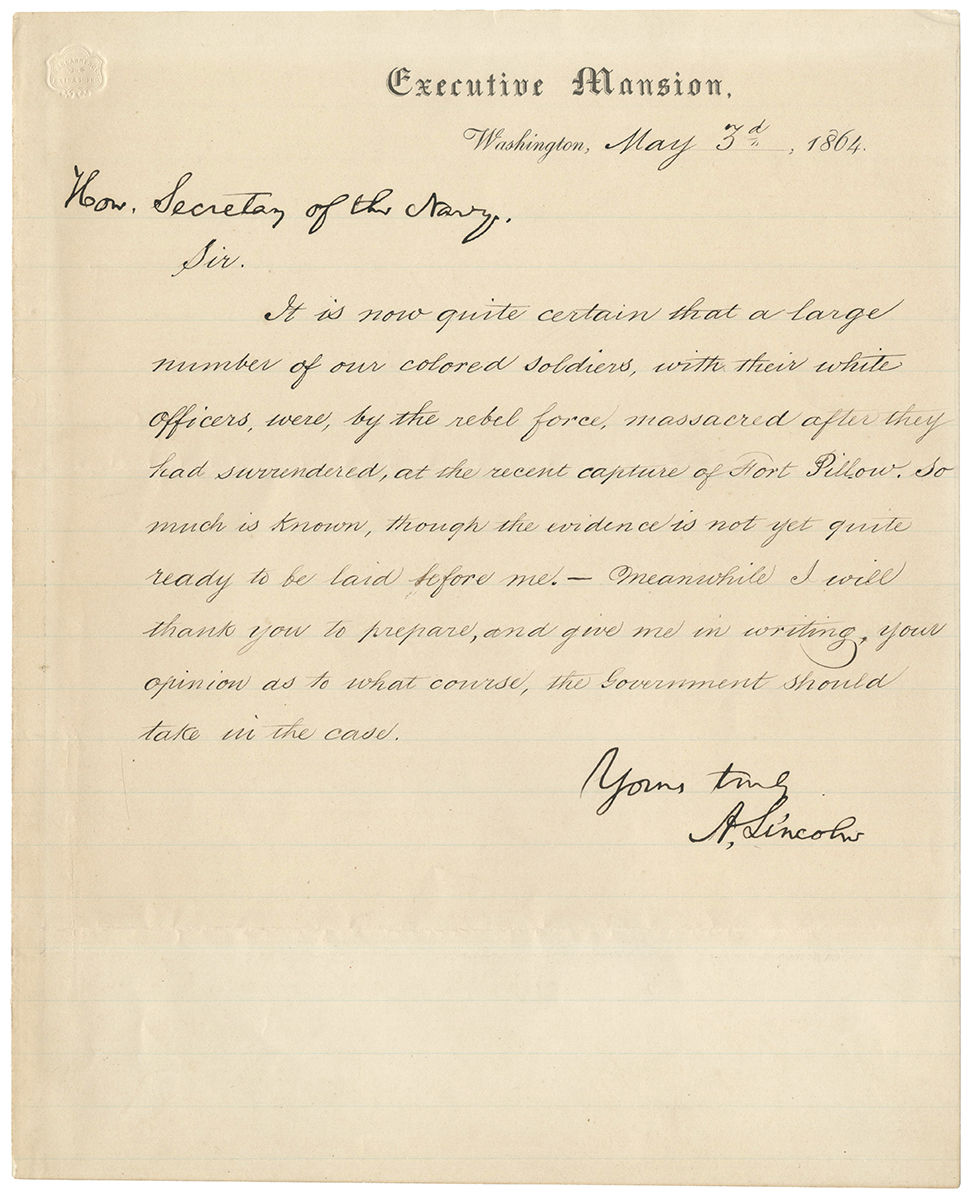
President Abraham Lincoln seeks counsel from his cabinet on the appropriate response to the massacre at Fort Pillow, Tennessee, three weeks earlier. More than 400 African-American Union troops and their white officers were slain, many of them after surrendering.
ABRAHAM LINCOLN. Letter Signed, to Gideon Welles, May 3, 1864, Washington, D.C. 1 p., 8 x 10 in. With: [FORT PILLOW MASSACRE] LYMAN TRUMBULL. Signed Presentation Copy. Reports of the Committee on the Conduct of the War: Fort Pillow Massacre. Returned Prisoners. 8vo. Illustrated with 8 portraits (on 4 pages) of woodcut engravings after photographic portraits of Belle Island POWs. Contemporary green cloth gilt with morocco spine label gilt-lettered. First Edition. [Washington, D.C., 1864]. Inscribed on front fly leaf: "Lyman Trumbull to D.J. Ely". The cover title of sammelband that contains two Senate Reports related to Confederate atrocities: 1. U.S. Congress. May 5, 1864. - Ordered to be printed...Joint Resolution directing the Committee on the Conduct of the War to examine into the recent attack on Fort Pillow... Senate Report, 38th Congress, 1st Session. Senate, Rep. Com. No. 63. Nevins I: 204. 2. U.S. Congress. May 9, 1864 - Ordered, That the report...be printed in connexion with the report of the committee in relation to the Fort Pillow massacre...Joint Resolution directing the Committee on the Conduct and Expenditures of the War... Senate Report, 38th Congress, 1st Session. Senate, Rep. Com. No. 68.
On April 12, 1864, 1,500 Confederate troops under Nathan Bedford Forrest attacked a Union outpost at Fort Pillow, Tennessee. After four hours of intense fighting, Forrest demanded the garrison surrender. Although outnumbered almost three to one, the Union troops inside the fort at first refused. Confederate forces eventually captured the position. According to survivors, Confederate troops, motivated by racial hatred, proceeded to kill Union prisoners as they pleaded for their lives. It is unclear how many were killed after the surrender, but first-hand accounts suggest that the numbers were high. Of 262 black soldiers at Fort Pillow, only 58 survived to be taken prisoner; of 395 white soldiers, 168 survived as prisoners.
On May 3, President Lincoln sent a letter like this one to each of the members of his cabinet. Three days later, Lincoln held a cabinet meeting at which each cabinet member read his opinion on the appropriate response. All agreed that the U.S. government should demand "an explanation" from the Confederacy. Seward, Chase, Stanton, and Welles advised holding Confederate prisoners, equal in numbers to the Union troops massacred, as hostages; if the Confederate government avowed the massacre, those prisoners would be executed. Usher, Bates, and Blair strongly disagreed, with Blair pointing out that such a response "would not be justified by the rules of civilized warfare." Bates concurred, noting that "retaliation is not mere justice. It is avowedly revenge; and it is wholly unjustifiable, in law and conscience."
Little formal action beyond a Congressional investigation took place. Perhaps the greatest impact that Fort Pillow had was on the morale of black troops. Knowing what their fate would be if captured on the field by Confederate soldiers, black Union soldiers charged into battle with the war cry "Remember Fort Pillow!"
Complete Transcript
Executive Mansion,
Washington, May 3d, 1864
Hon. Secretary of the Navy.
Sir:
It is now quite certain that a large number of our colored soldiers, with their white officers, were, by the rebel force, massacred after they had surrendered at the recent capture of Fort-Pillow. So much is known, though the evidence is not quite ready to be laid before me. Meanwhile I will thank you to prepare, and give me in writing, your opinion as to what course the Government should take in this case.
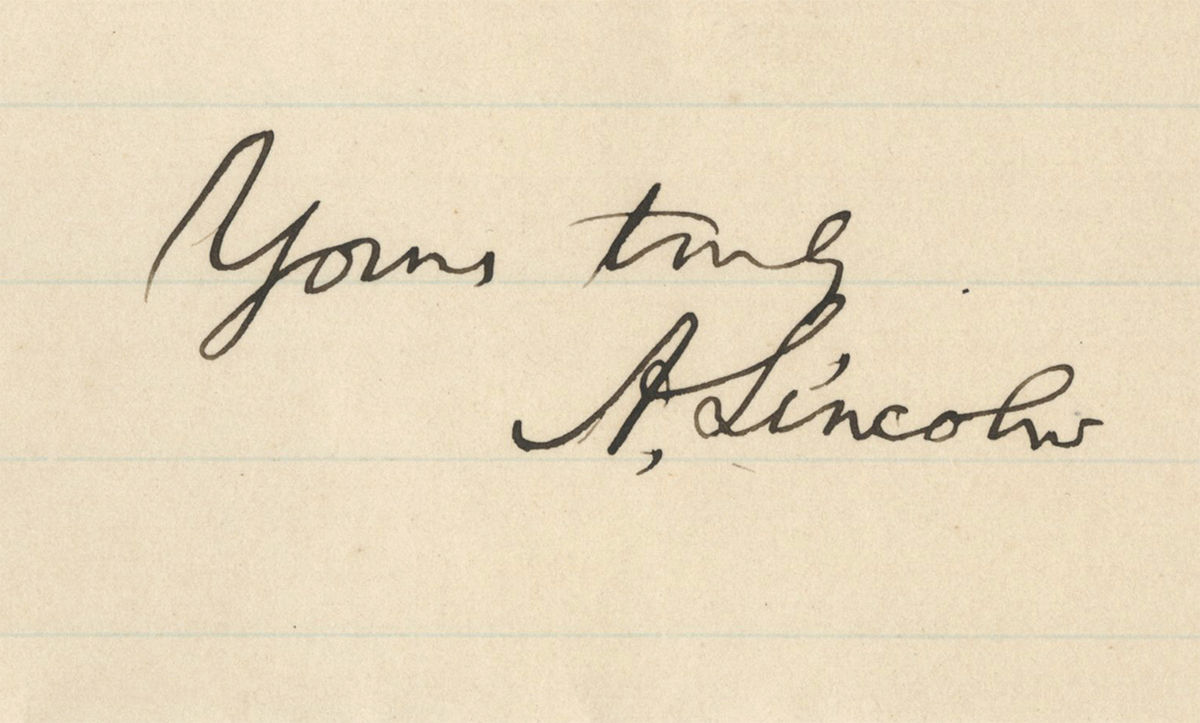
Yours truly
A. Lincoln
With abolitionist Senator Lyman Trumbull's signed presentation copy of Congressional reports.
Condition: very good.
Details
Title
Remember Fort Pillow! Lincoln Seeks Cabinet's Advice on Best Response to a Confederate Atrocity against Black Troops
Author
ABRAHAM LINCOLN
Condition
Unknown
Publisher
Washington, DC
Date
1864
Pages
1