

1754 Volume of Gentleman's Magazine, Several Issues with Important George Washington French and Indian War Content
- London, England: David Henry, 1754
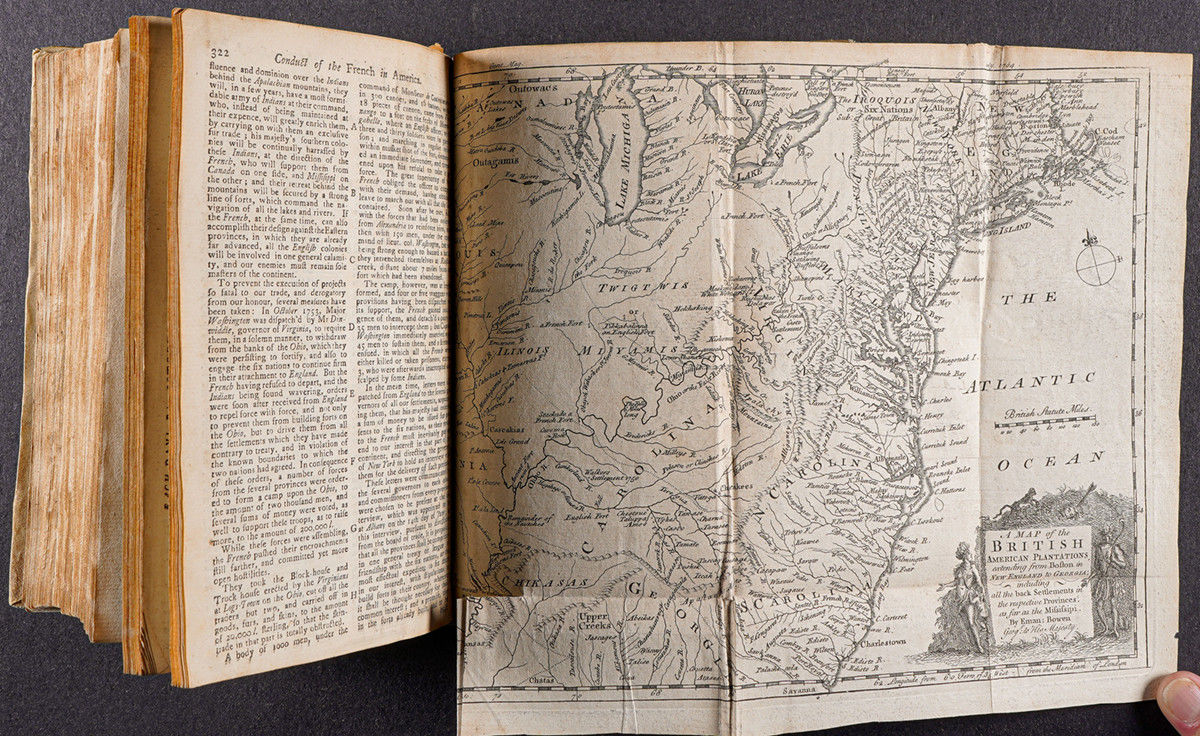
The July issue reports that Washington was ordered to use force to extricate the French, who "pushed their encroachments still farther, and committed yet more open hostilities..." The French "gained intelligence of them and detach'd a party of 35 men to intercept" but Washington "immediately marched with 45 men to sustain them & a skirmish ensued in which all the French were either killed or taken prisoners, except 3 who were afterwards intercepted and scalped by some Indians." (321-323). With "A Map of the British American Plantations . . . Including all the Back Settlements in the Respective Provinces, as Far as the Mississippi," which includes Illinois, the Louisiana Territory, the land west of Lake Michigan, parts of Arkansas, and more, folding out to 11¾ x 9½ in. The October issue reports on Benjamin Franklin's Albany Plan of Union for the British colonies of North America.
[GEORGE WASHINGTON]. Gentleman's Magazine, bound 1754 volume, January to December 1754. London: David Henry. With two folding maps, 21 [of 24] plates, text illustrations. 628 pp., 5¼ x 8¼ in.
Contents and Excerpts
January
- "Description of a Remarkable Venomous Insect found in South America" (p5-6);
- An article about a form of sun dial with an illustration of it (p17);
- "Of the Junction of Asia and America," which begins:"The termination & position of the N.E. parts of Asia, and the N.W. parts of America, & whether they are joined or not, has been matter of speculation for 200 years past, and is indeed one of the most important geographical questions that has ever been debated." French and Russian sources agree that the two continents are separated only by a "narrow streight." (p22);
- "Some Account of the Plague at Marseilles in the Year 1720" (p32-36);
In May 1720, a ship introduced the last major outbreak of bubonic plague in Europe at Marseille, France, which killed an estimated 100,000 people in Provence and Languedoc, including about half of the population of Marseille.
- "Enquiry into the Causes of Dreams" (p36-37);
- "Historical Chronicle" includes news from Boston on new taxes on coaches and other conveyances and a note from Rowan County, North Carolina, that "a skirmish has lately happen'd between some French Indians, and the Catawbas in alliance with the English, in which the latter gain'd a complete victory." (p46).
February
- "An Account of the Life of the late Mr Edward Cave," founder and former editor of The Gentleman's Magazine (p55-58);
- "A new Method of increasing the Solidity, Strength, and Duration of Timber" (p62-64);
- "A List of Seeds of Forest Trees and flowering Shrubs gather'd in Pennsylvania, the Jerseys and New York, by John and William Bartram" (p65);
- Correspondence regarding the conflict between the Assembly of New York and the governor of that colony (p65-66);
- "Cure for the Bite of the Tarantula" (p69-70);
- Diagram and description of Eolian Harp (p74);
- A description of the ruins of Palmyra (p78-81);
- "Historical Chronicle" includes news of a conflict between the assembly and governor in Virginia over taxation without the assembly's consent, which they voted to be "illegal, arbitrary, and oppressive." (p94).
March
- "Farther account of the Ruins of Palmyra" (p103-106, 108, with fold-out plate of ruins);
- "Method of increasing the Strength and Solidity of Timber" (cont.) (p111-112);
- "Some Account of a Chart lately published by M. de l' Isle, with the different Conjectures and Opinions it has produced; from a Tract called, A Letter from a Russian Sea Officer to a Person of Distinction at Petersbourgh, &c.": "All Attempts to discover an outlet from Hudson's Bay into the South sea having been ineffectual, and the space between Japan and California, an extent of more than 1200 leagues, being totally unknown, the late Czar Peter the great, appointed one Beerings [Vitus Bering]to attempt the discovery." Details the exploration of Alaska and the Yukon by three different explorers. (p123-128)
- "An Anemometer, or new Invent'd Weather-cock, which shews the Utmost Velocity of any Wind, and at the same Time all the Variations of its Directions," with a nearly full-page illustration (p130-132);
- "The Description of an Azimuth Compass of a new Contrivance," with illustration (p132-133);
- "Historical Chronicle" includes news from New York that "Our assembly has past a severe act against importing counterfeit British half-pence." (p142).
April
- "A Summary of the Proceedings in the last Sessions of Parliament" reports the repeal of the 1753 "Jew Bill" that allowed Jews to become naturalized English citizens. A popular antisemitic uproar caused the bill to be "passed through both houses with such rapidity, that all the necessary forms were over before the day on which the call of the house, upon Sir James's motion, was to take place, and the business for which it was intending being thus dispatched, the call was disregarded." (p155);
- "Account of de L'Isle's Chart and Remarks" (cont.) (p166-167); further details and questions about the exploration of "Russian America" (Canada and Alaska);
- "Historical Chronicle" includes a February 9 report from Virginia "That 1500 regular forces sent from France, have built three forts upon the Ohio, on some lands of which several gentlemen in London and Virginia have a grant from the king. The French expected to be repulsed, but, finding no opposition, intend to keep possession. They used our messenger very well, and gave him a guard of 200 men to escort him thro' the Indians. It is expected that a number of forces will be raised, as we have a sufficient quantity of gunpowder from London, with thirty pieces of cannon. If the French are not soon drove off, and forts built by the English on Missisippi, they will have such strong holds, that it will never be in our power to expel them." (p190).
- "Virginia, March 16. Our general assembly met on Feb. 14, and was prorogu'd on the 23d of the same month, after having unanimously pass'd an act for raising 10,000l. for supporting the British rights in the interior parts of America." (p190)
May
- "A List of the Counties, Boroughs, &c. with the Members returned for the ensuing Parliament" (p199-203);
- "The Japonese way of making Vessels of Paper, or Saw Dust." (p207-209);
- "A Description of a Sea Gage, to measure unfathomable Depths," with a half-page illustration (p215-219);
- Evidence for and against Elizabeth Canning (1734-1773), an English maidservant who claimed to have been kidnapped by Mary Squires and Susannah Wells, in January 1753 and held for almost a month. Her alleged captors were tried and found guilty. Then, Canning was tried for perjury in April and May 1754. She was found guilty and sentenced to prison for a month and transportation to British America, where she died twenty years later in Connecticut. Squires was pardoned. (p224-227);
- "Historical Chronicle" includes notes from America on the French & Indian War:
"Three hundred men under Col. Joshua Fry are ordered to Ohio, to build forts."
"On the 5th the governor issued an order for the officers and men of our new regiment to repair to Alexandria on the head of Potowmack, on or before the 20th instant."
"Our Assembly have pass'd An Act for encouraging & protecting settlers on the waters of Missisippi." (p240)
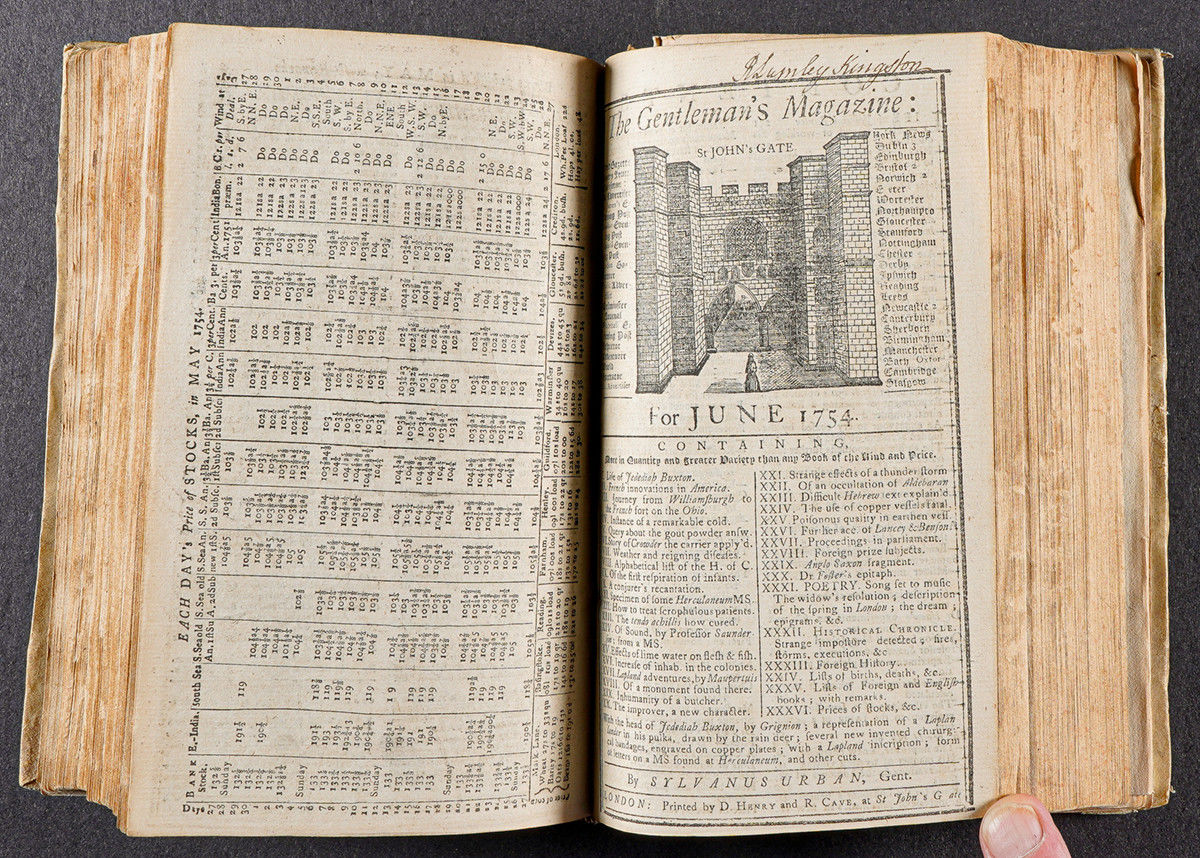
June
- "Account of a Journey from Williamsburg to the French Fort, near Lake Erri, in Virginia,"
"The French having been lately erecting forts, and making settlements upon the river Ohio, in the western parts of Virginia, which are known to be the property of Great Britain, Major Washington was sent by Governor Dinwiddie, with a letter to the French commandant on that river, by which he was required to depart.
"Mr Washingtonset out on the 31st of October 1753, and reached Will's Creek on the 14th of November; from whence we proceeded the next day with Mr Gist, a person whom he had engaged as a guide, a French interpreter, two Indian traders, and some other attendants and servants, with horses and proper accommodations for the journey.
"At a small distance from the fork of the Ohio, after 25 days travel, he called upon Shingiss, king of the Delaware Indians, who went with him to Logg's town, where he intended to assemble the chiefs of the Six Nations, in order to engage them in his interest, and induce them to renounce all connexion with the French."(p252-253)
"On the 26th of Nov. Mr Washington met the chiefs in council, when they agreed that the wampum delivered by the French to them should be returned, as a symbol of abolishing all agreements between them...." (p253)
"On the 13th a council was held [among French forces on the Ohio River] to consider what answer Mr Washington should carry back, which however he did not receive till the evening of the next day. In the mean time he perceived that every possible art was practiced upon the Indians, to prevent their returning with him: He therefore pressed them to execute their design without delay...." (p254)
"The purport of the answer which he brought to governor Dinwiddie, was, that the Commandant would send his letter to the marquiss Duguisne, that whatever he commanded should be done, and that in the mean time he was determined to kept his station." (p255);
- Lecture on Sound by Professor Nicholas Saunderson (1683-1739). Rendered blind by smallpox at age 1, Saunderson transcended his disability to become a mathematician and the Lucasian professor at Cambridge University. (p267-268);
- "Of the Increase of Inhabitants in W. Jersey." The population of West Jersey grew from 47,369 in 1737-1738 to 61,403 in 1745, "which makes an increase in 7 years of 14034 being almost one third, tho' that is a province into which there are but few direct importations of strangers." (p271);
- "BOHEMIA. A fire broke out in the Jews quarter at Prague, on the 11th, which was not master'd until the 19th: It consumed the greatest part of that quarter, almost 3 other streets, and many convents. The number of houses destroyed was near 700." Jews were expelled from Prague in 1745-1748, and the fire in 1754 occurred shortly after they were allowed to return. The fire destroyed a large part of the Jewish quarter, including six synagogues. (p287).
July(title page misdated 1745)
- Lecture on Sound by Professor Saunderson (cont.) (p307-309);
- "Some Account of An Address to the Liverymen of London; by Sir Crisp Gascoyne, late Ld Mayor, relative to his conduct in the Case of Canning and Squires." Additional information on the case of Elizabeth Canning. (p317-321);
- "Some Account of the Encroachments made by the French on the British settlements in America."
"In the treaty of Utrecht, which was confirm'd by that of Aix la Chappelle, the Indians called the Six Nations, were acknowledged by France to be subject to Great Britain, and it was stipulated that neither these, ore any other Indians, who were friends to the English, should be molested by the French, but that the subjects of both crowns should enjoy free liberty of going and coming to the colonies of either, for the promotion of trade as a common benefit." (p321)
"the French have been indefatigable in their attempts to draw off the six nations, and their allies, from the English interest to their own.... In order to accomplish this project, they have entered the country of these Indians, upon the back of his majesty's southern colonies, and within the limits of his territories...and erected a line of forts upon all the lakes and rivers, from Canada to Missisippi.... They have also pushed on their encroachments with equal vigour, quite round his majesty's eastern colonies, where they have engaged all the Indians to act with them against the English." (p321)
"In October 1753, Major Washington was dispatch'd by Mr Dinwiddie, governor of Virginia, to require them, in a solemn manner, to withdraw from the banks of the Ohio, which they were persisting to fortify, and also to engage the six nations to continue firm in their attachment to England. But the French having refused to depart, and the Indians being found wavering, orders were soon after received from England to repel force with force, and not only to prevent them from building forts on the Ohio, but to drive them from all the settlements which they have made contrary to treaty.... While these forces were assembling, the French pushed their encroachments still farther, and committed yet more open hostilities." (p322)
"The camp, however, was at length formed, and four or five waggons with provisions having been dispatched for its support, the French gained intelligence of them, and detach'd a party of 35 men to intercept them; but Captain [sic] Washington immediately marched with 45 men to sustain them & a skirmish ensued in which all the French were either killed or taken prisoners, except 3 who were afterwards intercepted and scalped by some Indians."(p322).
- Eman: Bowen, "A Map of the British American Plantations, extending from Boston in New England to Georgia; including all the back Settlements in the respective Provinces, as far as the Mississippi,"folds out to 11¾ x 9½ in. (after p322)
August
- "Essay on the Public Roads" (p347-349);
- Account of a boxing match in Norfolk (p364-365);
- "Some Account of Scotland, and the Manners of the Inhabitants, from the Letters lately published." (p366-371);
- Life of Professor Saunderson (with full-page engraving) (p372-374);
- "Historical Chronicle": "A ship of 900 tons is arrived at Louisburgh, from France, with cannon and ammunition of all forts, and a mine has been completed between the west and south gates of that fortress, and strong fortifications are erected on the light-house point." The Siege of Louisbourg in Nova Scotia in June and July 1758 by the British was a pivotal victory that ended French colonial dominance in Atlantic Canada and permitted the British to seize Quebec and the rest of New France in 1759.
September
- "Account of our Affairs in America."
"The congress at Albany, between the Indians of the six nations, and commissioners from our provinces in America, which had by several accidents been delayed beyond the appointed time, has since been held.... the Indians renewed the treaties already subsisting, and declared a resolution to take up the hatchet against the French and their allies, desiring the assistance of the English to drive them out of the country." (p399)
"Col. Washington with 400 men, having encamped in a wood, at the great meadows, on the Ohio, and defeated a party of French, that had been dispatched to intercept some provisions, (see p. 322, col. 2. D.) receiv'd intelligence soon afterwards, that the French hearing what had happened, and that he was soon after to be reinforced with 500 men from New York, were marching 900 men from Monongahela to attack him.
"The Colonel immediately prepared to defend himself against such a superiority, as well as he could, and began to throw up another intrenchment; but before it was finished, the Centinel gave notice that the enemy was approaching, by firing his piece. As the signal piece of the Centinel was loaded, and fired at the enemy, it killed three men, and the fire was immediately returned in battalions, but at 600 yards distance, and without effect; the men were then called to arms, and drew up before the trenches, but waited for the nearer approach of the enemy to return their fire. Upon this they moved very irregularly to another point of the woods, at the distance of about 60 yards, and there made a second discharge. The Col. perceiving by this conduct, that they were determined not to attack in the open field, ordered his men still to reserve their fire, and retire back again into the trenches, which it was expected an attempt would be made to force.
"In this expectation, however, he was disappointed, and therefore ordered his men to fire, after which the firing on both sides continued, from eleven in the morning till eight at night, apparently upon very unequal terms, our men being in trenches full of water, during a settled rain, and the French defended by the trees.... they called a parley...to receive their proposals, which were, that each side should retire without molestation, they to their fort at Monongahela, and we to Will's creek. This proposal was accepted, and the next morning our people began their march with beat of drum, and colours flying, but found it necessary to leave behind 'em the baggage and stores.... Our loss is said to amount to about 100 men killed and wounded, and that of the French to 300. The disadvantage which we have sustained by being thus obliged to abandon the Ohio, is imputed to the delay of the reinforcement from New York, which ought to have joined Col. Washington many months before this action." (p399-400)
"Such is the account said to be published in the Virginia Gazette; but it does not at all agree with the following articles of capitulation.
"Capitulation granted July 3, by M. De Villier, com. of his most christian majesty's forces, to the English troops in the Fort of Necessity, built on the lands of the king's dominions.
"Article I. We grant the England commander to retire with all his garrison, and to return peaceably into his own country; and promise to hinder his receiving insult from us French; and to restrain, as much as shall be in our power, the Savages that are with us.
"II. It shall be permitted them to go out, and carry with them all that belongs to them, except the artillery, which we keep.
"III. That we will allow them the honours of war, that they march out drum beating, with a swivel gun, being willing to shew them that we treat them as friends....
"VII. And as the English have in their power an officer, two cadets, and most of the prisoners made in the assassination of the Sieur de Jamonville, [an officer, who was bearer of a citation, as appears by his writings] that they promise to send them back with safeguard to the fort du Guerne, situated on the Fine river. And for surety of this article, as well as this treaty, Mr Jacob Vambraam and Robert Stobo, both captains, shall be left as hostages till the arrival of the Canadians and French above mentioned.. .." (p400)
"By the title of this capitulation, and the general tenor of the articles, it appears that Washington was not in trenches, but in a fort, which is called Fort Necessity;... and the French consider the defeat of their party upon pretence that it was about to intercept some provisions going to our camp (see p. 322. Col. 2. D) as an act of unjustifiable violence against the bearer of a citation, the Sieur Jamonville, whose death they term an assassination. But however this may be, we are told that Washington was attacked by the Indians when he marched away the next morning, who killed some and plundered others, in which it is said they were encouraged by the French commander, contrary to the capitulation, who, though he pretended to be much concerned, and ran in among the Indians with his sword drawn, yet instead of attempting to restrain and quiet them, he commended their courage." (p400)
The Battle of Fort Necessity on July 3, 1754, began the French and Indian War, which spiraled into the global Seven Years' War.When the French offered to negotiate, Washington sent two of his men, including translator Jacob Van Braam, to learn the terms. When Van Braam brought the terms to Washington, who could not read French, he agreed to the basic terms and signed the document written in French. Washington later insisted that he never would have signed the articles of capitulation had he understood that they declared that Jumonville had been assassinated.
- "An Account of Scotland" (cont.) (p416-422).
October
- "New Hypothesis to Account for the Phenomena of Vesuvius." (p443-444);
- "The Absurdity of Expensive Funerals Exposed"(p467-469);
- Benjamin Franklin's Plan for a Union of British American Colonies.
"Historical Chronicle": "New York, July 29. On the 16th instant our lieutenant-governor arrived here from Albany, having settled some matters to the entire satisfaction of all the nations of the Indians that attended the congress at that place. And the next day the commissioners from Philadelphia, Maryland, and Virginia, with several others, arrived here from the same place. From whence we learn, that at the said congress, the commissioners from the several governments were unanimously of opinion, that an union of the colonies was absolutely necessary; and a plan of union was accordingly drawn up by the said commissioners, in order to be laid before their respective constituents." (p483)
Representatives of seven of the British colonies in North America met at Albany, New York, in June and July 1754 to discuss better relations with Native American nations and common defensive measures against the French threat from Canada. Contrary to this report, Virginia was not represented.
Benjamin Franklin, a delegate from Pennsylvania to the Albany Congress, proposed a plan on July 10 based on his observations of the Iroquois and their system of common government. The proposed union would have a president general and a grand council with legislative powers to be elected by the colonial assemblies. Both the colonial assemblies and the representatives of the British Board of Trade in London rejected the plan.
November
- "Certain objects particularly worth the attention of a British Parliament at the present juncture." (p502-505);
"A fourth object worthy of parliamentary interposition, is the case of the Hudson's Bay company. Were the parliament to buy out the charter, and to send a few highland companies to take possession of that important country, and there, if necessary, make war upon the French, it would be infinitely better than to send forces to the banks of the Ohio. For, supposing we should prove victorious, what could we gain by settling colonies in that part of the world? Colonies so greatly distant from the sea, that we could never have any intercourse with them in the way of commerce? Colonies, which would be a continual expence, and could be of no advantage, whose very situation would put them under a necessity, and the fruitfulness of whose country could afford them the means of rivalling Great Britain in every article of its manufactures...." (p503-504);
"The English possess already more lands in America, than will be sufficiently peopled in five hundred years." (p504);
"The only shadow of a reason, that has ever yet been offered for carrying our settlements beyond the Apalatean mountains, is, that we may secure our fur and deer-skin trade with the Indians." (p504);
- "Historical Chronicle"
"New York, Sept. 14. The governor has given his assent to an act for raising 5000 l. towards assisting the Virginians against the French." (p530);
"Williamsburgh, Sept. 18. Our assembly has voted 2000 l. for the Ohio expedition, to be raised by a poll tax of 5 s. per head." (p530).
December
- "New System of Botany by Linnaeus." Carl Linnaeus was a Swedish biologist and physician who formalized the modern system of naming organisms, making him the "father of modern taxonomy." (p555-558);
- "America, the Property of the English." (p569-571)
"As our present contest with the French on the continent of America has justly excited the attention of the publick, I desire, by your means, to lay before them a brief account of some former transactions relating to our settlements there, the right on which they were founded, the encroachments of the French, and the proposals that were made for preventing what has happened." (p569)
"To obviate these evils it was proposed
"1. That all the British colonies in N. America be united under one legal and regular establishment, having over them one supreme governor, who shall reside on the spot, and to whom the governors of each colony shall be subordinate. And
"2. That two deputies be annually elected by the council and assembly of each province, who shall meet and form a kind of general council, and with the approbation of the governor settle all quotas of money, men, and provisions, to be raised by each province for the common defence....
"The Frech had then seized and fortified the territory on our back settlements remote from Canada, a thousand miles.. .. for how, says this writer, can we hope to succeed against them some years hence, when they shall have augmented the number of their inhabitants, debauched the natives to their party, and farther strengthened themselves by securing with forts and garrisons the passes of the rivers, lakes and mountains." (p571).
- "Historical Chronicle"
"Charles-Town, Nov. 10. A number of French and Indians assembled lately at the Charaws, near 200 miles on the back of this place, and killed near 200 persons.
"Horatio Sharpe, Esq; governor of Maryland, and Arthur Dobbs, Esq; governor of N Carolina, are at Williamsburgh, with governor Dinwiddie, and the former has a commission to command the troops till the arrival of major-general Braddock. The French on the Ohio are very weak, as Capt Lyons relates, who has been to exchange a French officer and 2 cadets for our 2 hostages, which was refused." (p578)
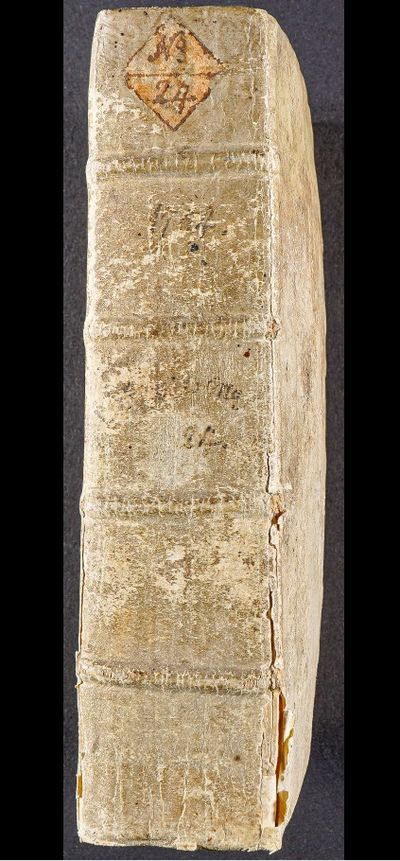
Condition: Contemporary stiff vellum; minor wear and soiling; a few leaves slightly cropped, lacking both plates in January issue and final armorial plate; name of subscriber R. Lumley Kingston signed on monthly title pages, subscriber's and later owner's bookplates on front endpapers.
The Gentleman's Magazine (1731-1922) was a monthly magazine published in London, England. It was the first periodical to use the term magazine. Edward Cave (1691-1754) began the magazine and edited it under the pen name "Sylvanus Urban" until his death. The iconic illustration of St. John's Gate on the front of each issue depicted Cave's home, the magazine's "office." Samuel Johnson had his first regular employment as a writer with The Gentleman's Magazine. Under the leadership of David Henry (1709-1792) and after 1778 also John Nichols (1745-1826), The Gentleman's Magazine experienced great growth and was read throughout the English-speaking world. It included a stunning array of material, including the fluctuating prices of commodities, daily closing quotations for stocks and bonds, mortality figures for the city of London, theatre reviews, original poetry, parliamentary debates, theological disputes, lists of both civil and military promotions, Church preferments, and thousands of obituaries. David Henry was a friend of Benjamin Franklin and a first cousin of Patrick Henry, and The Gentlemen's Magazine included extensive coverage of news from America. It printed the entirety of the United States Constitution in 1787, and Washington's Farewell Address in 1796. George Washington was a subscriber to The Gentleman's Magazine.
Details
Title
1754 Volume of Gentleman's Magazine, Several Issues with Important George Washington French and Indian War Content
Author
[GEORGE WASHINGTON]
Condition
Unknown
Publisher
David Henry: London, England
Date
1754
Pages
628