

Pratique de chymie, divisée en quatre parties… Avec un avis sur les eaux minerals.
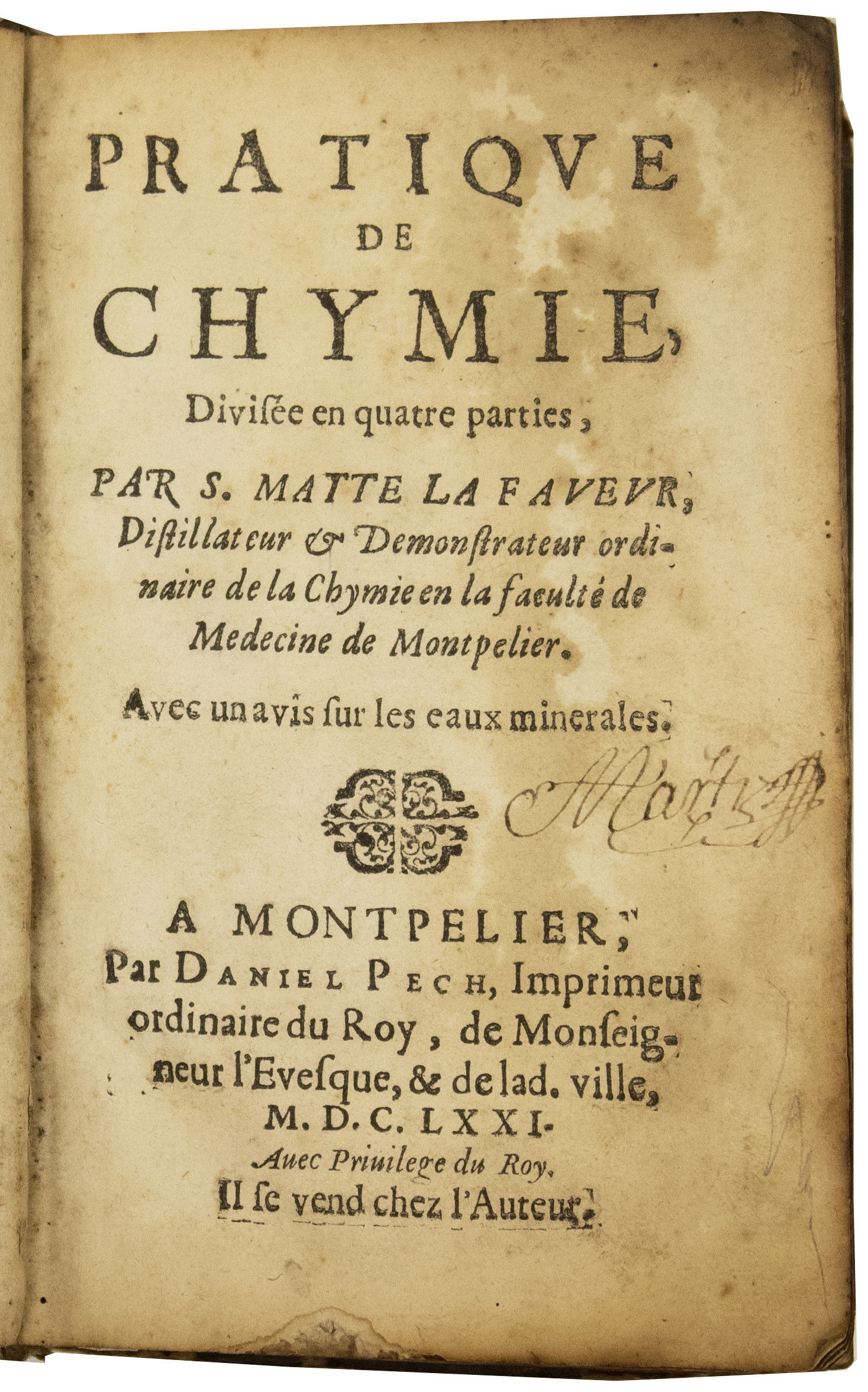
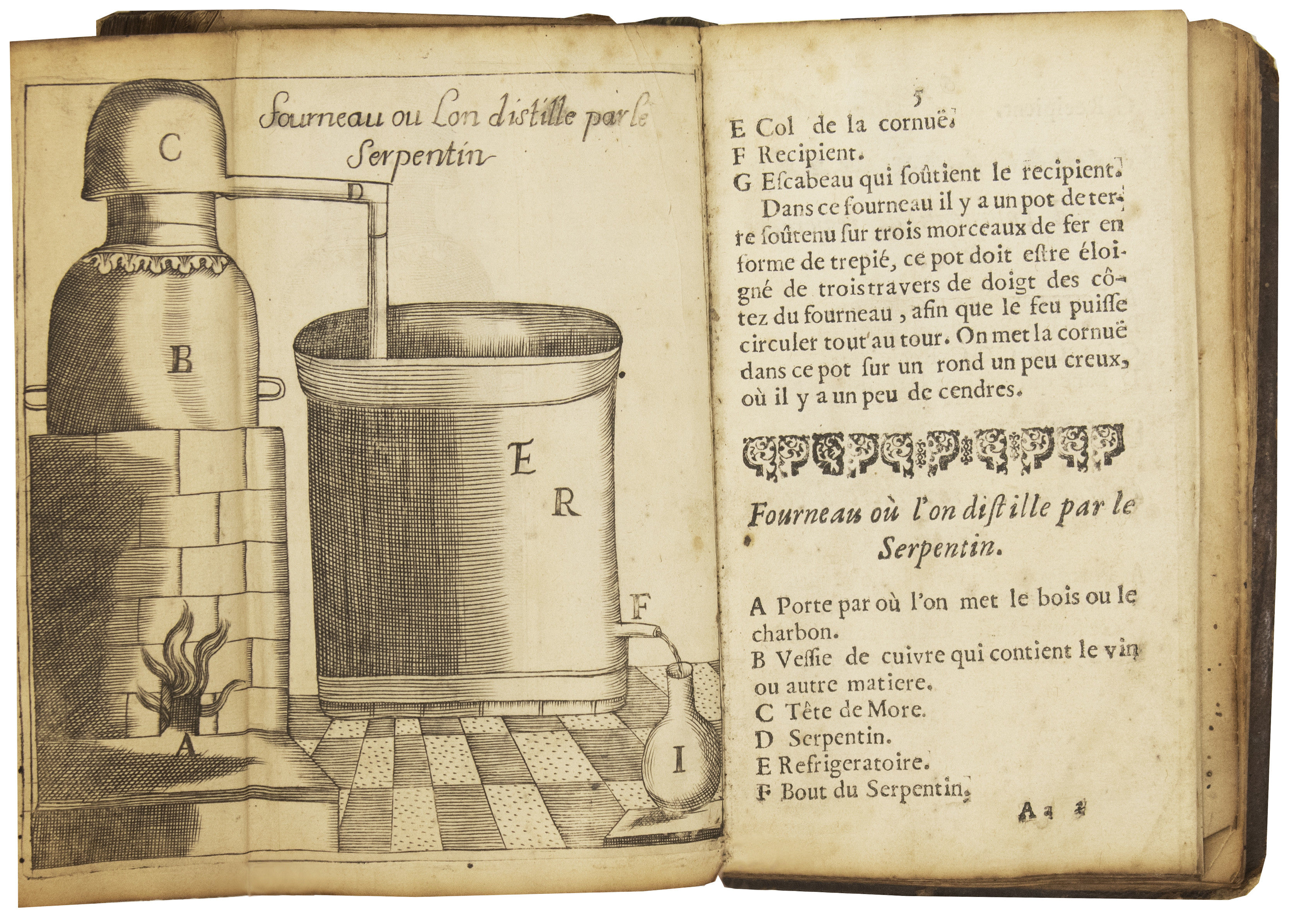
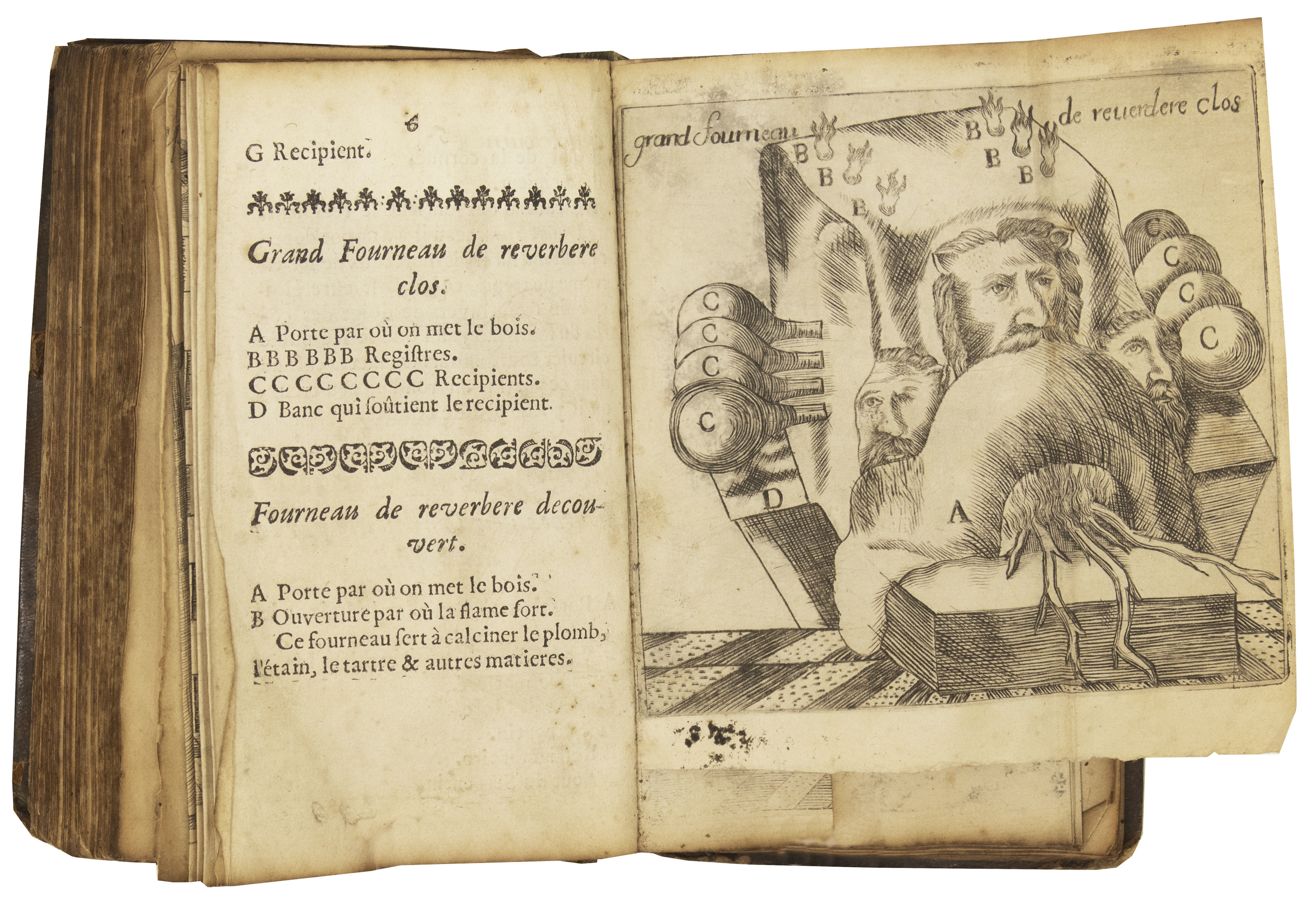
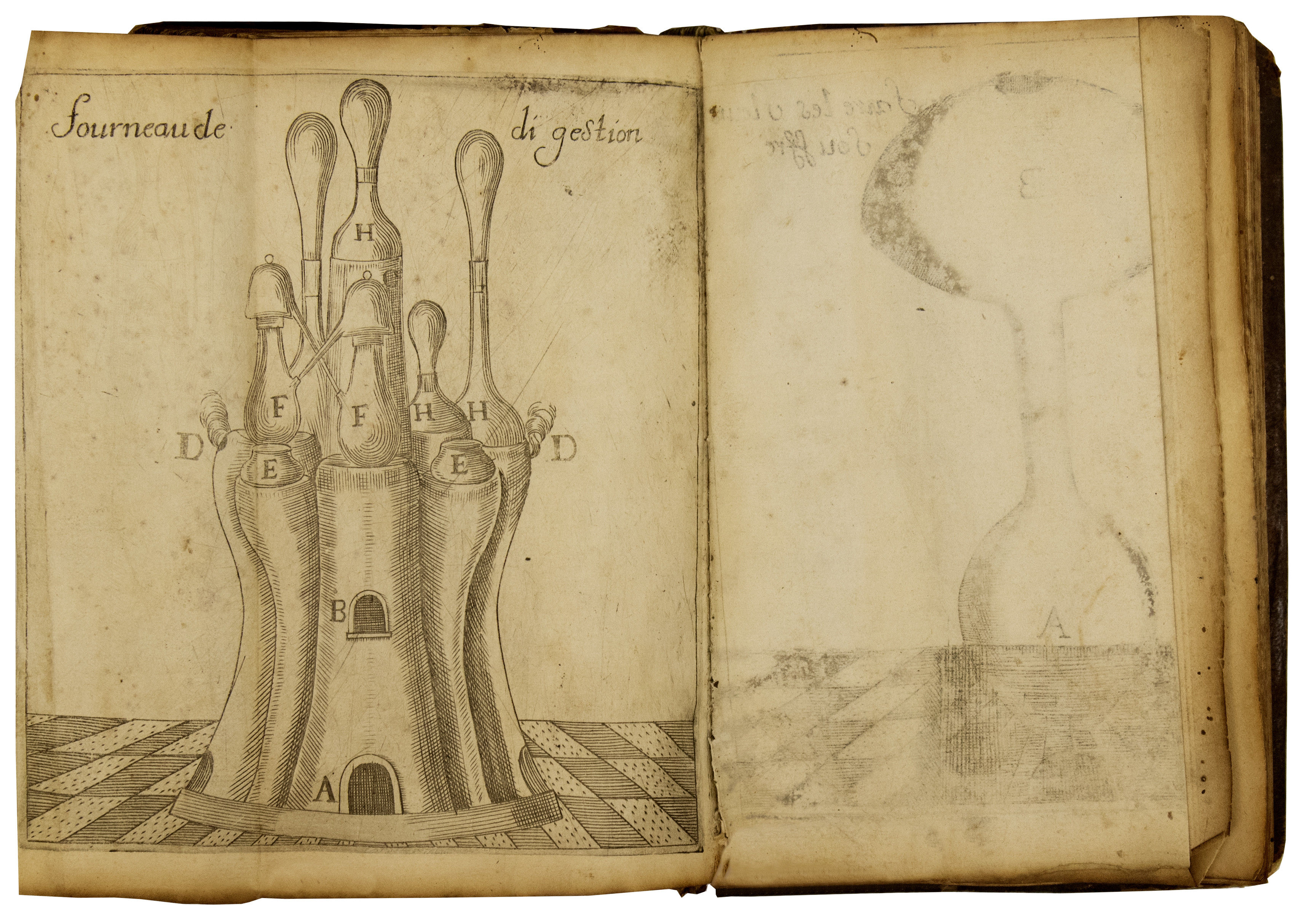
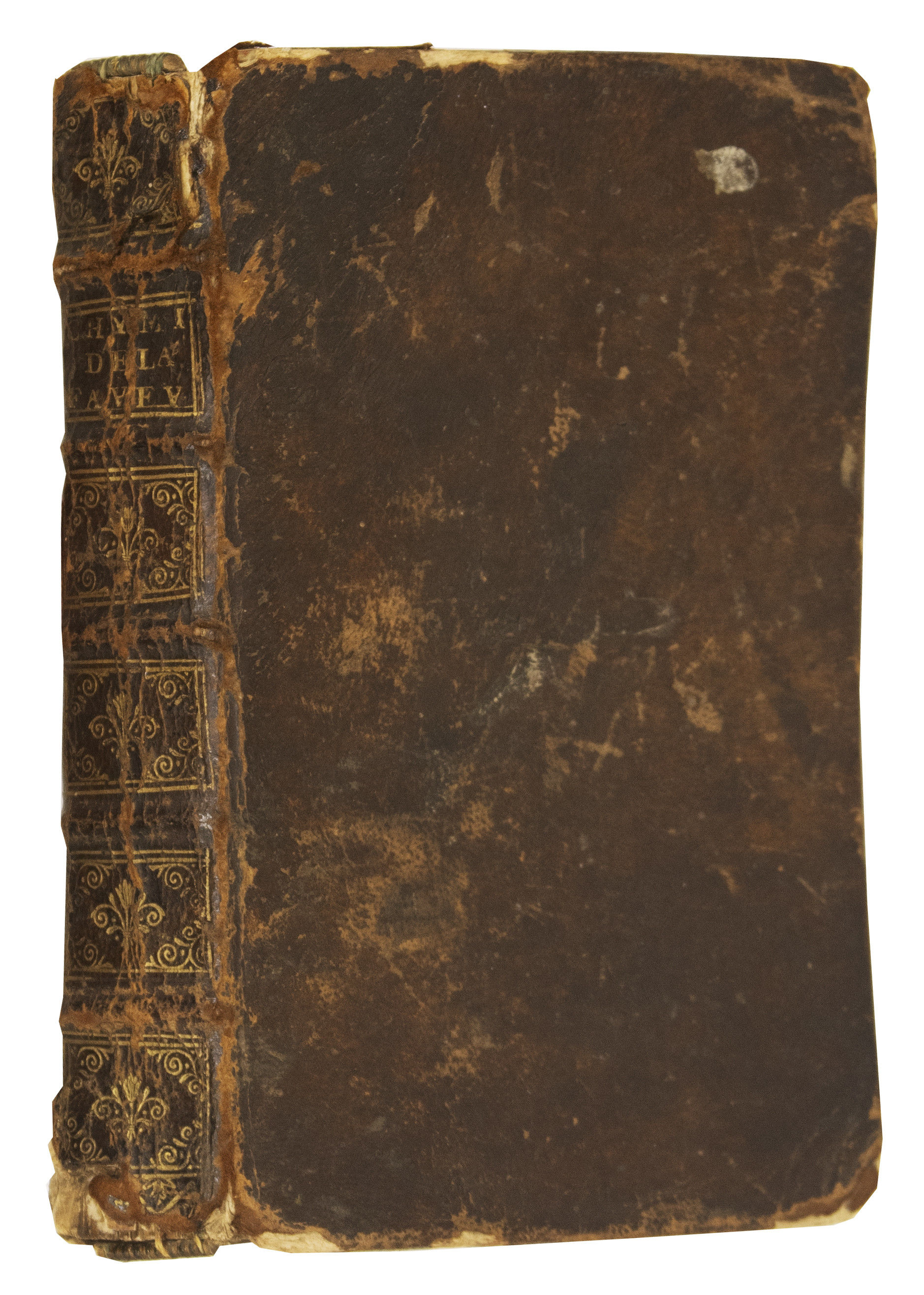
- Montpellier: Daniel Pech for the author, 1671
WITH AN EARLY OWNERSHIP MANUSCRIPT ANNOTATION BY A WOMAN
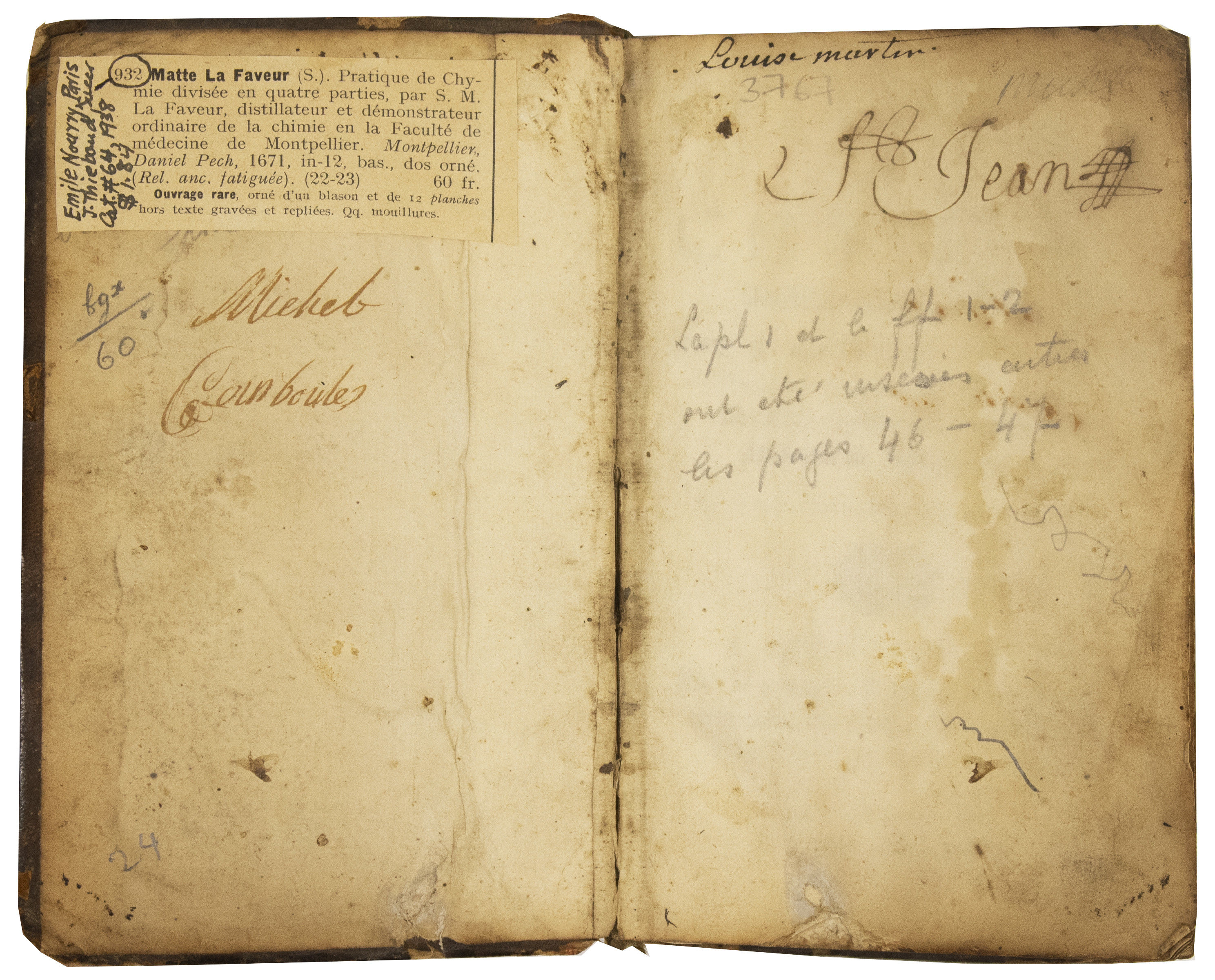
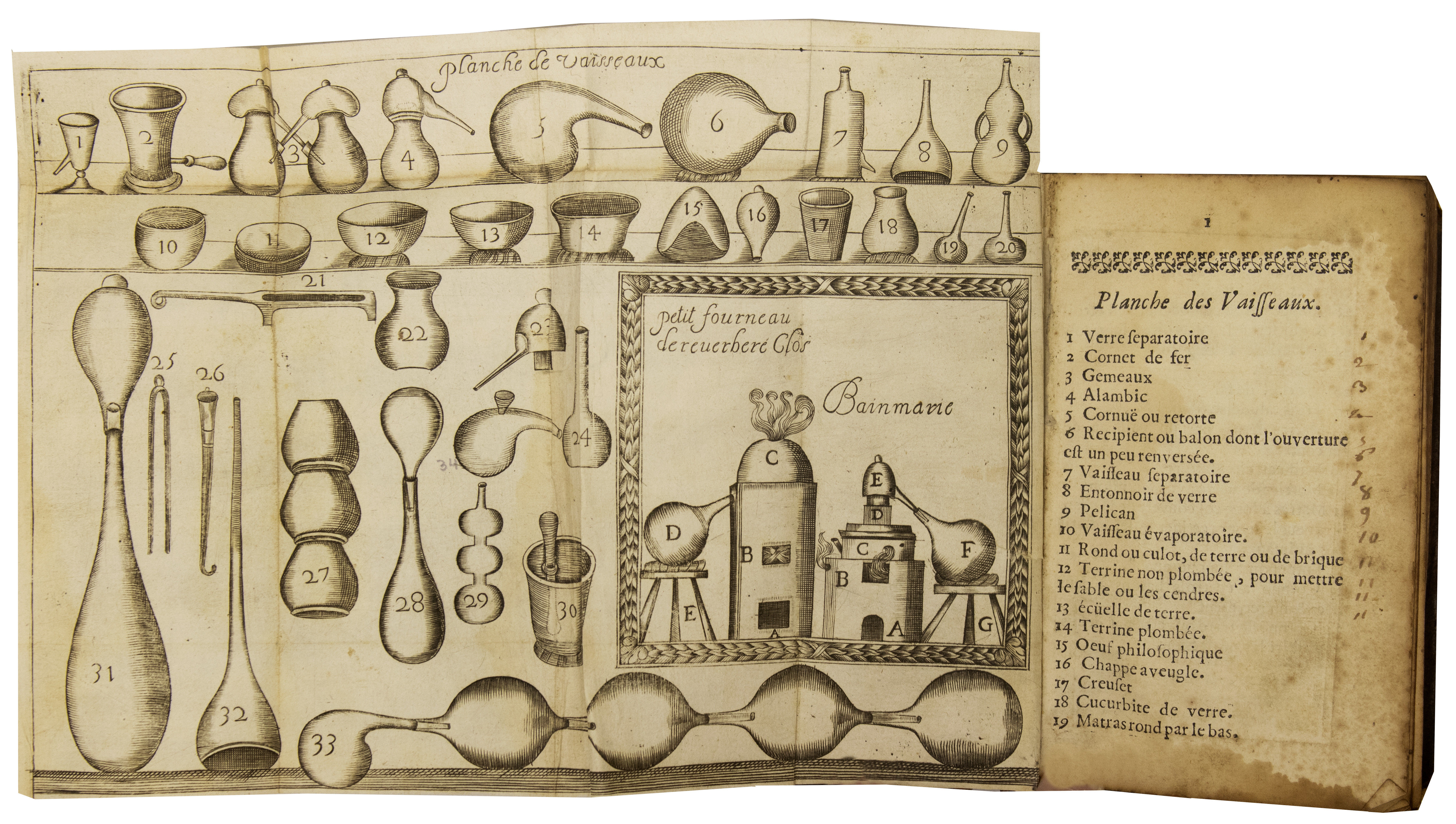
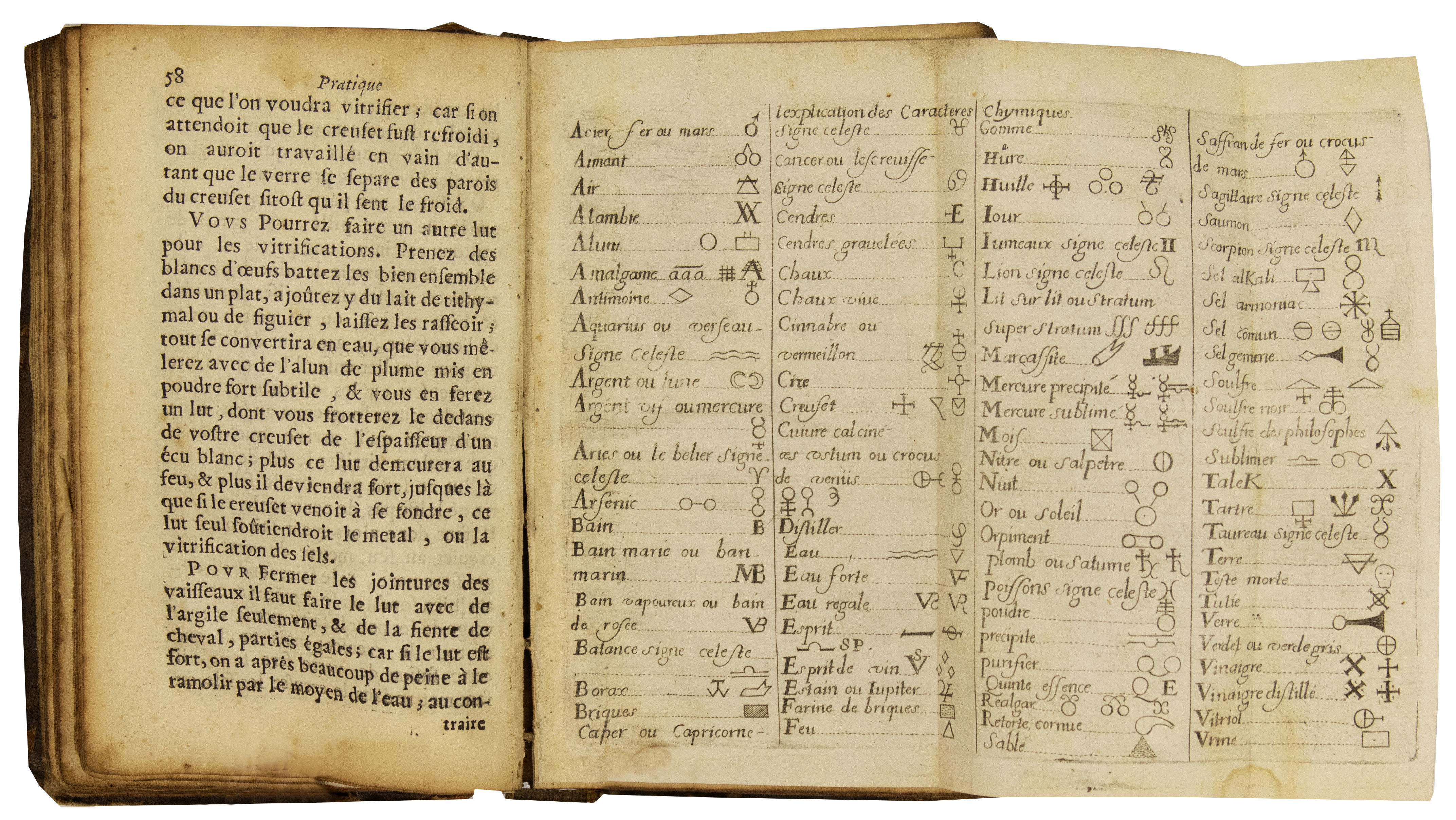
8vo (16 x 10 cm). [7] ff. (including engraved coat of arms frontispiece), 360 pp., 10 pp. (with pp. 1-2 moved adjacent to the corresponding folding plate between pp. 46-47), [17] ff. (including final blank), and 12 engraved plates (comprising plate of chemical vessels at p. 46, plate of chemical symbols at p. 58, and 10 folding plates of different kinds of furnaces at end).Toning and light spotting throughout; occasional damp stains, mostly marginal, especially on the front endpapers, title, preliminary leaves, pp. 1-26, and pp. 89-189; small area of paper damage on lower margin of a front endpaper, title, and preliminary leaves. Bound in contemporary sheep, spine gilt; worn, front board warped. Old ownership signature on title (Martin?), and other ownership signatures on front endpapers, including Michel Courboules (or Coinboules?), Louise Martin, and another (surname Jean, first initials illegible); catalogue description on front pastedown of bookseller Emile Nourry, J. Thieboud successeur in Paris dated 1938. Genuine and unsophisticated working copy.
First edition of a privately published early chemistry work of which "less than a dozen copies are known to exist, most imperfect" (The Roy G. Neville Historical Chemical Library, vol. 2, p. 153 Assembled by the author himself in a haphazard manner, there are considerable variations in the collation of existing copies.
Matte la Faveur is accredited for the discovery of "styptic water", a solution to stop the bleeding of small wounds and treat minor cuts or abrasions. For Matte La Feveur, chemistry was "the art of separating the parts of a natural body, purifying them, and reuniting them for their use in medicine. His elementary substances were phlegm, spirit, sulphur, salt, and 'terre morte', the most commonly accepted groups from this period. After a description of chemical operations and equipment he devoted the remainder of his book to chemical preparations, which he divided into the customary categories of mineral, vegetable and animal" (Debus, p. 144).
"The author discovered styptic water and that the post of chemical demonstrator at Montpelier was created for him. He also became professor of chemistry in Paris" (NBG apud Duveen).
"Sold only by the author at his home in Montpellier, the Pratique contains clear directions on practical operations and the preparation of chemicals. Matte La Faveur, distiller and demonstrator of chemistry at Montpellier, simultaneously gave a course at Paris until 1684, when he was succeeded by the famous chemist Nicolas Lemery. Undoubtedly, Lemery used this work when writing his celebrated Cours de Chymie (1675), and it is well known that he seldom acknowledged his sources. The Pratique forms a direct link between the Traité de la Chymie (1663) of Christophle Glaser and the Cours of Lemery" (Neville).
According to Antonio Clericuzio, "Matte La Faveur adopts the traditional Aristotelian distinction between perfect and imperfect mixts, which he interprets in vague corpuscular terms. Imperfect mixts, he says, are those which can easily be decomposed by heat; perfect ones are those which resist the action of heat, because their parts have a closer union. The chemical principles, he asserts, are not the same in the three kingdoms of nature. Volatility, he states, is a relative quality. Though mercury is the most volatile among the principles, salts too are volatile, though in different degrees. The same principle can be more or less volatile, according to the natural kingdom from which it originates. The principles of minerals are the most fixed, those extracted from vegetables are the most volatile" (Clericuzio, p. 170).
Sébastien Matte La Faveur (1626-1714) was a 17th-century French chemist and pharmacist from Montpellier. Son of Jacques Matte, master glassmaker from Haute-Ardeche, he developed his activities as an autodidact, and aroused the jealousy of the apothecaries of Montpellier, who sued him for competition, which he ended up winning. Matte's most famous product was undoubtedly his "Water of the Queen of Hungary", an alcoholate of Rosemary and scrubland plants, which according to him he manufactured with "unparalleled accuracy", and whose merits he disseminated "in all parts of the world of the Kingdom". The preparation, used in the treatment of gout, earned Matte the title of pharmacien particulier du Roi Louis XIV and a chair at the Sorbonne (cf. Pierre, citing Boussel). It is said that Madame de Sévigné loved it and always had a bottle in her pocket.
Protected by Antoine d'Aquin, king's physician, Matte became Louis XIV's private pharmacist and was the intendant of the chair of chemistry at the Jardin du Roi from 1680 to 1684 (now the Jardin des Plantes), Matte was ennobled by Louis XIV and became Sébastien Matte La Faveur.
His son Jacques Matte La Faveur, known as "the Younger", became a perfume merchant, and his descendant Jacques Pascal Matte La Faveur founded the Matte chocolate factory in Montpellier in 1820.
OCLC lists copies with different collations at Cornell, University of Delaware, Dickinson College, Harvard, University of Pennsylvania, Science History Institute (Othmer Library), University of Wisconsin-Madison, and Washington State University.
Collation notes for most of the institutional copies we consulted are available upon request.
* Caillet, 7225; Dorbon-Aine, 6273; Duveen p. 395 (collation matching this, noting that it "lacks, apparently, one leaf of explanatory text and 2 plates"); Ferchl, 345; Goldsmith, M669; Neu, 2681; Partington, 111, 27; Poggendorff, 11, 78; Sotheran, Bibliotheca Chemico Mathematica, 2nd suppl., 11519 (9 plates only); Thorndike, VIII, 141; Thornton 8c, Tully, 122. See also: Antonio Clericuzio, Elements, Principles and Corpuscles: A Study of Atomism and Chemistry in the Seventeenth Century (2000); Allen G. Debus, The French Paracelsians: The Chemical Challenge to Medical and Scientific Tradition in Early Modern France (2002); Roy G. Neville, The Roy G. Neville Historical Chemical Library: An Annotated Catalogue of Printed Books on Alchemy (2006); Julien Pierre, "Matte la Faveur et l'eau de la reine de Hongrie: Patrice Boussel, Trois cent quarantième anniversaire de la naissance de Sébastien Matte, dit La Faveur (1626-1714)", in Revue d'Histoire de la Pharmacie (192), 1967, p. 410.
Details
Title
Pratique de chymie, divisée en quatre parties… Avec un avis sur les eaux minerals.
Author
MATTE LA FAVEUR, Sébastien
Condition
Unknown
Publisher
Daniel Pech for the author: Montpellier
Date
1671